FACE Is Social Currency
 Saving Face: How to Preserve Dignity and Build Trust by Maya Hu-Chan
My rating: 5 of 5 stars


This is one book that you will want to put on your “to read” shelf and then move immediately to your “currently reading” shelf. While reading this book there were many things that became immediately applicable and usable. This, to me, is the greatest of compliments. There were also times when, as I read, I would literally say, “So, that’s why I screwed that up so bad.” “Face,” as Maya Hu-Chan said is like social currency. The more you have, the easier and faster you can get things done.
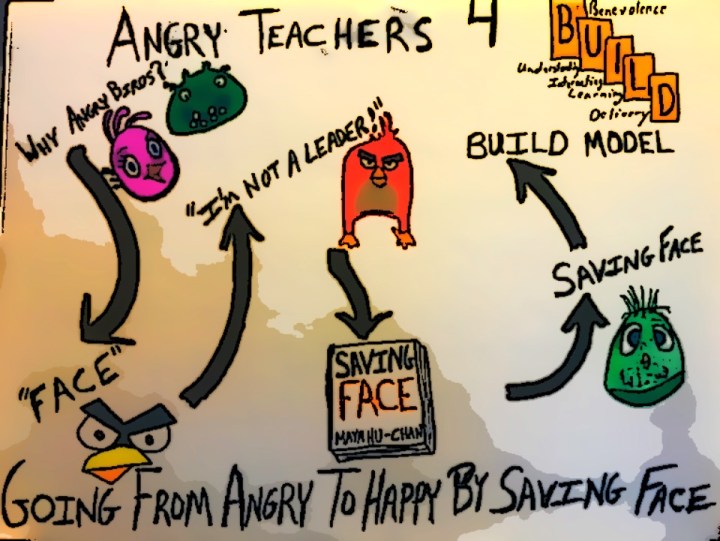 Immediately after reading my advanced copy of the book I had the opportunity have Maya be a part of a professional development webinar I put on for teachers. Maya and I used Angry Birds as the throughline for presenting the professional growth. We actually watched part of the first Angry Birds movie and picked the part of the movie where Red is asked to be a leader and he says, “I’m not a leader.”
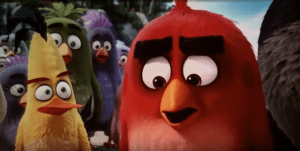
“I’m not a leader!” ~ Red
This provided a great springboard for Maya to connect the teachings of her book. One of the things she discusses in the book is using the Platinum Rule instead of the Golden Rule (not that the Golden Rule is bad, mind you). The Platinum Rule is, “Treat others the way they want to be treated.”
Think about how just doing this would improve relationships – “face.” Needless to say, Maya’s teaching is a huge hit with educators.
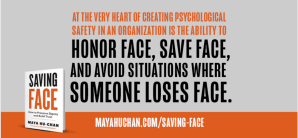 One of the most impactful parts of the book dealt with psychological safety. Hu-Chan posited that, “At the very heart of creating psychological safety in an organization is the ability to honor face, save face, and avoid situations where someone loses face.” Psychological safety is one of the number one variable for team performance. Psychological safety allows for moderate risk-taking, speaking your mind, creativity, and sticking your neck out without fear of having it cut off — just the types of behavior that lead to ideas, creation, and breakthroughs.
Finally, Maya also taught us the BUILD model in the book. BUILD stands for Benevolence, Understanding, Interacting, Learning, Delivery. By putting the BUILD model into action in our lives we will be able to live a life of significance while saving face. As you can see, you are going want to start reading this book right now.
View all my reviews
Getting Comfortable With Being Uncomfortable
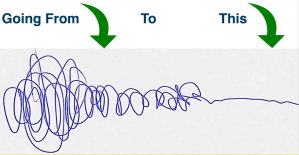 I first drew the illustration featured in this post for a webinar that I presented as a part of for the SMART Factory League back in April. Then I used it again this week for two webinars I did for teachers entitled “Embracing the Changes: Let’s Not Go Back to Status Quo.” The drawing represented how we are being nudged, pushed, or even shoved to make changes, given our current uncertain and unprecedented times. I hoped the drawing represented going from the massive, unorganized scribble that was the uncertainty and confusion we first experienced when dealing with the COVID-19 Pandemic to a very focused, straight line. On this, now day 80 of the pandemic, I would argue we are not at the focused, straight line yet, but are moving closer.


So, how do we get started? To borrow from our friend Goldilocks – we must get our focus just right. Focusing to narrowly on just one of our challenges will not work, but it also will not work to try to change everything at once, either. We need to change in a controlled fashion. But, what does that mean during this time of both the normal disruption of things and the ongoing pandemic? We are all trying to cope with unprecedented levels of uncertainty.
In fact, studies show that we are loss-averse and gain-seeking. We want the sure thing. We will accept less to lower the risk of failure. Sometimes we even give up success to not experience failure. We contemplate this a lot in athletics. Do we play to win, or play not to lose? Most teams who play not to lose, do just that – lose.
One thing I know for sure, we have done a lot of developing our “dealing with uncertainty capability.” One of the most important ways I believe that I have been able deal with the uncertainty has been to fully embrace the fact that every day was going to be a learning experience. I have literally asked myself, “What can I learn today?” These past 80 days have put the mantras of “lifelong learner” and “growth mindset” to the ultimate tests. You see, when something’s too easy or we’re not facing uncertainty, we’re not learning. Numerous scientific studies show that when we confront setbacks and we can adjust our view of these setbacks to see them as lessons, our brains literally begin to change.
None of us were trained on how to respond in a global pandemic and our immediate response to the challenges might have been “I can’t do this” or “We’ll figure it out.” As Nora Bateson (2016) so aptly put it in Small Arcs of Larger Circles: Framing Through Other Patterns, “No one is qualified to talk about uncertainty. You cannot get a degree in it yet, to the best of my knowledge.” Furthermore, she went on to say, “How, after all, can I pretend to offer you any kind of lesson on what I do not know?”
But, learn in adversity is what we did in education. While in the beginning it looked like the left had side of my scribble, we have been making our way across the page to the straight line. Wednesday and today we began to chronicle our learning by embracing the changes and discussing how to not go back to status quo. Here are two graphic recordings done by Amy Reynolds, Principal of Governors Charter Academy, during our session: “Embracing the Changes: Let’s Not Go Back To Status Quo.” Check them out:


The information in the graphics came from over 200 teachers working in breakout groups answering the following “What if?” questions:
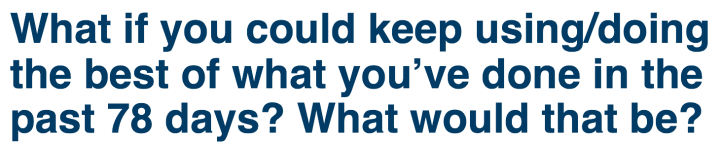
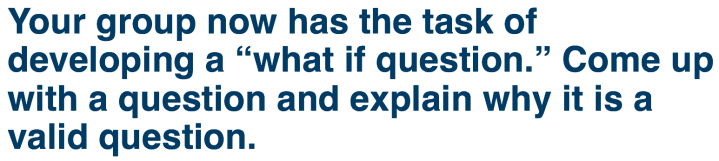

I learned to use “what if?” questions from the late Dr. Clayton Christen. These type of questions allow us to challenge assumptions, allow for innovation, and allow us to prepare. How about you? What have you been learning during these uncertain times?
“Easy To Say, Harder To Live By”

“What have I become during the pandemic?”
I had another Frank Reagan (Tom Selleck) Blue Bloods quote that made me do some reflecting. He said, “Easy to say, harder to live by.” We all have heard people say, or said things ourselves that are very easy to say, but much tougher to actually do. I wrote about another quote from Frank Reagan in “Life Isn’t Fair, But You Can Be.” It’s easy to set set ambitious goals or say you will do the right thing, but it is a much harder thing to do the work to achieve them.
We talked about this last night during 3D Leadership. The participants made Flat Stanley’s and Flat Sarah’s representing what they have become during the COVID-19 Pandemic. Almost everyone talked about new and exciting things they are doing or have started to do again. Many talked about how at first was easy to get down, but then once they started learning and doing it became exciting to be doing great new things.
Remember, it’s easy to say. Much harder to do. But, it’s the hard stuff that separates the ordinary from the extraordinary.
“Life Isn’t Fair, But You Can Be”
 We need to develop dexterity when dealing with others and leading. One uniform way of doing things will not work in all contexts. We all have micro-behaviors we can use to be agile according to situation at hand. We have seen this first hand from many leaders during the COVID-19 Pandemic. During this time we have become, in some ways, more atomized and insular.
The is a great line by Frank Reagan, played by Tom Selleck, to his granddaughter, Nicky Reagan-Boyle (played by Sami Gayle), in the television series Blue Bloods where he says, “Life isn’t fair, but you can be.” It’s true, life is not fair. Life happens in the context of others. Our actions affect others and their actions affect us. However, the actions of others are not some cosmic judgement on your being. They’re just a byproduct of being alive.
As I stated earlier, there just isn’t a uniform style of leading or dealing with others that works for everyone, every situation, or every relationship all the time. When dealing with people, we must remember that most are just trying to do their best, under different circumstances than your own.
Therefore, we, ourselves, can be fair. But, the idea of life being fair isn’t obtainable. Nor would we want it to be. Life would be insane if it actually was fair to everyone. There would be no choosing of anything. There would be no failure to understand success. It’s actually mind-boggling to think about. Many times we get too hung up on our view of how the world should work that we can’t understand how it actually does work. Embrace that life is not fair, but that you absolutely can be.
Good Enough: Five Positives For Every Negative
 I finished reading a great book, The Power of Bad: How the Negativity Effect Rules Us and How We Can Rule It by John Tierney and Roy Baumeister this morning. This was an interesting book to read during the COVID-19 Global Pandemic. It’s interesting to me that I interact daily with people who are very positive right now and those who are extremely negative. There does not seem to be much of an in between. Anecdotally, there seems to be more negativity than positivity. Tierney and Baumeister told us this is because negative experiences are more powerful than positive ones.
 The authors reminded me that the Gottman Ratio is a pretty good rule of thumb. The Gottman Ratio tells us that we are happiest when we have five positive interactions for every negative one. The authors posited this is a pretty good rule, but that we should aim for at least four positives for every negative. Kind of makes you think about who you want to be hanging out with, or Zooming with, whichever the case may be. Or, if others want to hang out with you.
“If one thing goes wrong, don’t interpret it as a harbinger of inevitable doom, whether you’re dealing with a personal setback or contemplating the state of the world.” ~ John Tierney & Roy Baumeister in The Power of Bad
If we want to keep things positive we must avoid the negative things. A Yale study really caught my attention described in the book where abusive parenting was found to have a statistically significant effect resulting in unhappy children. The opposite of very supportive and loving parenting did not lead to a larger number of happy children. Therefore, reducing negatives was more important than adding more positives. I found this to be encouraging because I believe it is easier to reduce negatives that increase positives. For one, I can do this by just having a positive attitude myself.
Furthermore, I was reminded of what Voltaire said, “Perfect is the enemy of good.” I would add that “Perfection is the enemy of done.” Progress, tweaks, checks, re-do’s, and reviews do not equal perfection. Good or effective work is about moving toward the destination than about getting things done with spilling or knocking something over in the process. Momentum matters! As Confucius said, “Better a diamond with a flaw than a pebble without.” For example, if I am needing to market an event for next week, would it be better to have already gone out with an advertisement made by me that will for sure not be perfect (a marketer, I am not) or on Sunday of the week of the event, still be waiting on the perfect advertisement? For me it is the former rather than the latter.
“Striving to better, oft we mar what’s well.” ~ William Shakespeare
In The Power of Bad we were taught that rather than always striving for perfect, we need to think in terms of being “good enough.” Make no mistake, this does not mean lowering standards. It means paying less attention to transcending expectations and paying more attention to getting the basics right. Being steady and reliable is much more effective that dramatic ups and downs. So, don’t forget, your mood and demeanor and the mood and demeanor of those around you will have a huge impact on your own and the feelings and effectiveness of those with you. Positivity will cause social support and negativity will cause social undermining. Get out there and be positive and “good enough.”
66 Days To A New Habit


First of all it is important to note that as I write this post we are in Day 66 of the COVID-19 global pandemic. I blogged about the day, March 11th, that I am considering our first day of these uncharted times in The Day We Started Down The Path With No Footprints. The other night in one of our 3D Leadership gatherings I had the participants make their own Flat Stanley or Flat Sarah that represented who they had become since March 11th when the WHO (I thought that was a rock band) declared COVID-19 a global pandemic. O.k., the WHO is the World Health Organization.
Participants could either make the their Flat Stanley or Sarah using materials in their homes or using an online resource we gave them. The group did a great job with these and they were very creative. I found it interesting that many of the participants discussed how they had picked up, developed new, or restarted old habits. One participant said, “It takes a month to build a new habit.” She was referring to now doing a better job of exercising. Of course, I had to check and see if there was any research that backed this claim of taking a month to develop a new habit up.
Here’s what I found: Phillippa Lally, a health psychology researcher at University College London, did a study published in the European Journal of Social Psychology, Lally and her research team decided to figure out just how long it actually takes to form a habit. So, what was concluded from the study? On average, it takes more than 2 months before a new behavior becomes automatic — 66 days to be exact. And how long it takes a new habit to form can vary widely depending on the behavior, the person, and the circumstances. In Lally’s study, it took anywhere from 18 days to 254 days for people to form a new habit. But, as was stated, 66 days was the average. Thus, why I chose today to write this post. We are exactly 66 days into this pandemic.
So, why is the length of time it takes to form a habit important? During these challenging times, everyone in the world has been forced to change their routines, be creative, try new ideas, learn new ways of doing things, slow down focus on some of the most important things (in education-the most important content), and connect with people and in the case of education, students, in effective ways we never thought possible. The abrupt shift to remote instruction changed many aspects of our lives. In my case I continue to say I have grown in great and unimaginable ways during this time. In education, I continue to say that we have grown in the aspect of school no longer being a place.
Let me be clear; I realize there are those, and maybe even me still, that the crisis will be catastrophic. This post is not intended to minimize the seriousness of the consequences many people face, or may be facing. I believe that many of us have grown in our ability to be o.k. with feeling bad or being comfortable with uncertainty. Personally, I continue to see this crisis as a challenge to overcome and a conduit for personal growth. The 3D Leadership participant who talked about it having been a good time to use the month to develop new and better habits, I believe, had in mind that we can see the loss of our, pre-pandemic and regular life as a chance to focus on other aspects of your life that have been neglected because we’ve been too busy to address them. We have also identified areas we want to work on or improve in our lives and focus on developing those areas. We need to all use this break from “normal life” to seek balance in our life and pursue aspects of our lives that we did not have time for before the crisis.
We need to use our responses to the crisis as an opportunity to learn and grown and become more positive, adaptable, and resilient which will, no doubt, serve us well when the current crisis passes. We can all create new structures and routines in our lives around school, work, daily activities, and social life. Finally, and most importantly, we can take action. Keep in mind, we’ve already had the 66 average days it takes to make a new habit become automatic. Are you happy with your new habits?
The Day We Started Down The Path With No Footprints
 As I write this post it is day 129 of the 366 days of 2020. With 237 days left in this leap year, I felt the need to go back and reflect on the 70th and 71st days of 2020. These two days marked the start of my life being very different. In fact I was reminded that my life is not really my own, apart from everyone else. My life is a part of an entire community and ecosystem. Our world, up to and including March 10th, was really built on the premise that our world and education works off of and teaches that we are individuals and act as individuals. But, overnight from March 10th to 11th we were taught that we are all part of a ecosystem and even our own health depends on others.
 The 70th day of 2020 was March 10th. That day wasn’t much different that any other day, other than I had been invited to attend the Indiana Pacers vs. Boston Celtics game at Bankers Life Fieldhouse in Indianapolis, Indiana that evening with my Krannert School of Management friends from Purdue University. Other than the Pacers losing in a great and close game 114-111, it was a perfect evening of visiting with and networking. I do remember we had begun “elbow bumping” instead of shaking hands and there were extra bottles of hand sanitizer on the tables. Little did I know at the time I had seen the last NBA game of the season.
 I do, however, vividly remember one comment I made toward the end of the evening: “I wonder what happens if one player on one of these teams has Coronavirus?” Well, the next day, Wednesday, March 11, the 71st day of 2020, I got my answer. Rudy Gobert of Utah Jazz was the first NBA player to be diagnosed with what, that day, we began calling “COVID-19.” That same day the NBA canceled the rest of the season and the NCAA said the college basketball tournament would be played without fans (a few days later the tournament was canceled completely). On Wall Street that day, the Dow Jones Industrial Average fell 1,465 points. Also, on that day I learned that my son would be coming home from Murray State University to take his classes online till at least April 6th (later, the rest of the Murray State University semester went to online). That day we started down a path with no footprints.
Additionally, on March 11th, we officially started calling it a Global Pandemic, as declared by the World Health Organization on that day. It was that day that I came to the realization that this was for real, and this was much bigger than all of us. I also realized that if I was going to survive the weeks ahead, I would need to think in terms of self reflection instead of self evaluation. Also, it was abundantly clear on March 11th that pre-COVID-19 life and what happened next was still a path with no footprints. My existence as an individual was forever altered to make me realize how dependent we are on each other. For example that very March 11th day, the hoarding began. It became a time when we couldn’t find a bottle of hand sanitizer because someone else had hoarded a truckload of it – literally. I realized we, as a people, think and act very individualistically. Even though we were being told that there was plenty of everything, people still hoarded. I saw with my own eyes the empty shelves. We weren’t thinking about ourselves as a part of a larger community that needed to think about the next person coming down the aisle looking for toilet paper – which for some reason became the most hoarded item early on.
“My health is not my own. My health is the whole community’s, it belongs to the elderly, the youth, and even to the biome of organisms that live in my body and in the soil. This, is the opposite of everything that the last centuries of manufacturing, education and politics have forged into societal infrastructure and even the making of identity. ~ Nora Bateson
When people begin to talk about going back to normal, I cringe. I’m not sure I want to go back. I get it. You all now think I am crazy, and you’re arguing that not getting back to normal will cause the economy to crash. But, just going back to normal without having learned and grown from the experience is a huge tragedy. If it really takes a month to build a habit then we are in great shape because we have had nearly two months of developing new habits of realizing that what we do affects others and so on. We have also had a chance to slow down and ponder things like “how do we take what we have learned and make our education system better?” We’ve realized that school is no longer a place, and so how do we as Nora Bateson asked us, “What is the measurable value of changing the education system so the next generations may be more proficient at complexity and systemic understanding than their parents?” improve our education system. We do need an education system focused on developing our children to be able to deal with the complexities of our world that most of their parents don’t even realize exist.
I can truly say I have grown in ways I never thought possible in the last two months. And, a big part of that learning is the realization that we are all a part of something bigger than ourselves. As I finish writing this on May 8th, we are beginning to reopen, but hopefully we take advantage of of the clean slate of the path with no footprints to make the world a better place.
Gaps In Our Consistency
 At one of our most recent gatherings of 3D Leadership, a topic came up that the participants were calling “gaps in our consistency.” When I asked about these gaps they said they were the things that really kept them from being great teachers and the schools which they taught from being as great as they could be. One of the most important tools in effective schools is consistency. Research and practice have proved that school leaders and teachers must be consistent every day in carrying out their duties if they want to improve student performance and conduct. Here is what the teacher leaders said the gaps were:
- Being Reactionary
- Everything done short term/constant change
- Lack of training to make sure initiatives/processes could be implemented
- Relationships must be in place for there to be the trust for everything to be going well
- Besides the why, there needs to be the what and the how
- Teachers need to teach and not be auditors
Really, what any teacher wants is to be able to get to work and feel like what he/she is doing are the right things to be doing. What teachers don’t need are things constantly changing or different expectations or directions. These result in confusion. It is really about being on the same page and staying on the same page. Consistency really can be the protagonist or the villain of great accomplishment. There is a difference between being agile and continually changing focus, priorities, and behavior patterns.
One of the biggest problems that inconsistency brings on an organizational and personal level is a loss of trust. Judgement becomes not trusted, follow through on initiatives is not trusted, and trust that what is being implemented today will even be important as soon as tomorrow. The administration and staff must operate like a single coherent unit. If we are able to build this consistency in any organization we can build what researchers have called a “culture of consistency.” We need to recognize our gaps in consistency; delivering consistently can have a profound impact on our effectiveness.
Educating Students To Improve The World
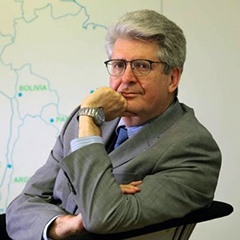
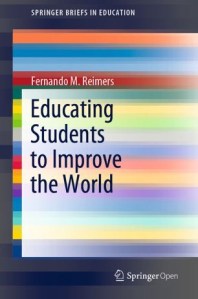 The book Educating Students to Improve the World, written by Harvard Professor Fernando M. Reimers, presents an inspiring and bold vision of how schools should be organized to cultivate a range of skills and dispositions that effectively educate students to make the world better. The book is unique in the breadth of the scholarship it integrates and in how it builds a sensible model to understand the process of educational change that honors the multidimensionality of the process. It is, at the same time, a very scholarly book, an erudite treaty of the field of global education, and a very practical book, a book that makes sense to those in the business of leading schools and school systems.
Professor Reimers
The idea that the book contains is simple, yet holds remarkable potential to transform education around the world. The big idea the book contains is that public education, as an institution of the Enlightenment, was meant to be global since its creation, but the obvious global nature of many of the challenges facing humanity requires that education becomes intentionally global. Professor Reimers argues in the book that formal education should be aligned with audacious and hopeful visions for a more inclusive world, such as those contained in the Universal Declaration of Human Rights or in the United Nations Sustainable Development Goals. Such alignment involves defining what kind of competencies would actually help students care about and have the skills to make a difference in advancing a more inclusive and sustainable world. With such clarity on the expected learning outcomes for students, the curriculum would then map backwards an instructional sequence to gradually support students in a rigorous process of development of such competencies.
But the merit of this book goes beyond articulating why education should help students develop a sense of purpose, aligned with ambitious purposes of building a better world, it then explains how structuring effective education programs requires that the process of change is advanced multidimensionally, reflecting a cultural, psychological, professional, institutional and political.
The ambitions of the book are considerable, to bridge an evident schism between the scholarship and practice of global education. The book is an intellectual tour de force tracing the history of global education to the very creation of public education systems, and integrating research reflecting a variety of disciplinary perspectives in support of a conceptual framework in service of more coherent and effective educational practice.
Enhancing the credibility of the ideas in the book is not just the fact that the book is well researched and crafted, but that it builds on a long practice of the author actually doing the very things this books recommends should be done to develop a relevant curriculum. Professor Reimers invented an approach to take bold goals, such as the United Nations Development Goals, and translate them into student learning outcomes, and then curriculum and pedagogy. It’s a simple and intuitive idea, but it had not been done before.
It is the combination of the powerful idea that education should be aligned with ambitious goals for inclusion and sustainability with a theoretical model of how to structure efforts to translate that idea into changed educational practices that makes this book unique. It is not surprising that since it was published, as an Open Access resource by Springer, a week ago, the book has already been downloaded 24,000 times.
The book can be downloaded here https://www.springer.com/gp/book/9789811538865
Easter Isn’t Canceled

Baseball was not canceled during the Pandemic of 1918-1920
Today, I chronicle thoughts, here in my blog, on a new page in the book that is the story of my life. I have been doing some personal growth studying, with the help of the Woodrow Wilson Presidential Library and Museum, on the pandemic of 1918-1920. My motivation this morning is that I am always moved by the personal stories written by people experiencing an event first hand. The most interesting and compelling speak of what was happening, the mood of the country and those around them, and what he or she was feeling at the time. I’m going to attempt a little of that this morning. I also believe if we are not using this as an opportunity for our children and students to write an account of something that will be undoubtedly written about in textbooks, or whatever our kids’ grandchildren will be using, we have missed a chance to process and save the realness of our experiences real-time.
Queen Elizabeth II shared a video message yesterday that was quite moving. Click here to watch it. The genius of her message was how different parts of the message have and will inspire different people in different ways. For me it was when she said, “But Easter isn’t canceled; indeed, we need Easter as much as ever.” No doubt things will be different today for most of us. But, Easter isn’t canceled, and different doesn’t have to mean bad.
 One of my fondest memories growing up was of our Easter morning Easter egg hunt. We’d get up and go find the eggs hidden all over our very large yard that included barn lots. Interestingly, the one thing that I remember most vividly is the blue egg, and it was always a blue egg, put on top of an electric box on the back side of the house. I need to point out that these were real boiled eggs, usually a few duck eggs mixed in because we raised ducks, and my mom and sister colored them – I wasn’t much into coloring Easter eggs (that involved being inside and standing still – some things don’t change with age). My dad was so proud of that hiding spot on the electric box (not sure why). That became a special spot, however, because the first Easter we lived in that house my dad, after I spotted and claimed the egg, had to lift me up to get the egg. The next year I could reach it and every year after that that egg was mine, and my dad would always laugh and say, “You need me to help you get that one?” I’d say, “No!” We’d make eye contact and now having a son of my own I think I know what was going through his mind.
 Easter isn’t canceled because of the COVID-19 Pandemic and my son will have an Easter basket (yes even at age 19) this morning. We will go to church via Zoom and then have the traditional Easter brunch of “One Eyed Connelly’s (that is the family name for a piece of toasted bread with a hole cut in the center and an egg cooked in that hole), sausage links, and cinnamon rolls. I’m sure there will be Easter egg hunts with the nieces and nephews to be joined virtually on some electronic platform or another. And, how cool is it we have those platforms? We are connecting more, socially, than ever before. Physical distancing (as I am calling it because I hate the term social distancing) is not keeping us from socializing.
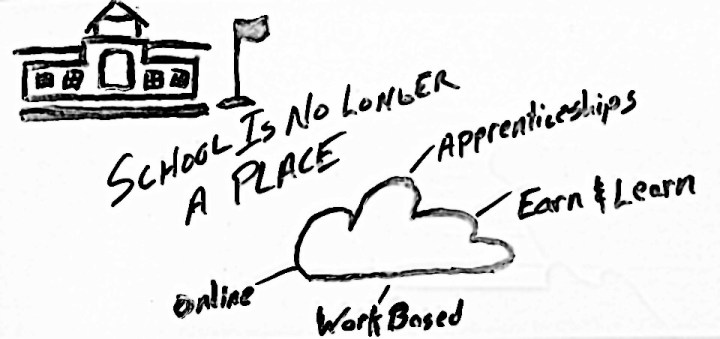 I went to my first virtual Happy Hour last week – very fun. Also, I popped into a teacher’s lunch bunch. She has all her students get their lunch and they all log into Zoom and eat together. Students get social time with their fellow students and teacher. Everyone turned their mic on and it sounded just like a traditional school lunchroom. I hope we use our pandemic experiences to get education in our country to a place where we could say, “School isn’t canceled.” I realize that is a tall order, but we need to contemplate what that would mean. We need to think about the fact school is no longer a place. We need to think about the why behind professional working parents being so frustrated with being adjunct teachers now. Continuing to educate, which I believe we need to be doing, cannot be about providing busy work and crappy worksheets. It needs to be about great content, accessible by all, and delivered in a way the student can easily access. Now becomes the time to decide what education will look like during the next pandemic, other crises, or just moving us into the next decade.
Today, however, Easter isn’t canceled. During the pandemic we are distanced, clouded by the threat of disease, but stubbornly persistent. Realizing this is usually a pastel colored and celebratory day, this might just be a season of clarity about what it means to be a person of faith.


1 comment