Leading With Social Currency

Sometimes I wonder if I really do read for pleasure or not. Even though I have developed a love for fiction, I still am looking for connections to my personal and professional life. So, I guess I really am reading for pleasure, just with a purpose. During my reading yesterday morning of Robert A. Heinlein’s great book The Cat Who Walks Through Walls the comment made by character Chou-Mu to Richard was, “You may think you won back in there. You did not. You lost. You made the Moderator lose face—you made both of them lose face” (p.216). This reminded of the work and great book Saving Face by Maya Hu-Chan. Saving face is not about winning or losing.

Choy-Mu went on to say, “So you’re a walking time bomb, an accident looking for the spot.” He frowned. “Not too healthy for me, either, being present when they lost face … after making the initial mistake of ‘bearing bad news to the king.’ Understand me?” “I’m afraid I do.” Xia asked, “Choy-Mu, truly did Number-One lose face?” “Truly he did, luv. It was Aunt Lilybet Washington who did it to him. But of course he can’t touch her. So it lands on Captain—On Richard. So I see it” (p. 216). “Face,” as Maya Hu-Chan said, is like social currency. The more you have, the easier and faster you can get things done. I had the opportunity to get to know Maya and do a workshop for teachers with her. You can read about that in FACE Is Social Currency.

Maya told us that, “Saving face requires deliberate thought, care and courage to address someone with clarity that is fueled by empathy.” Leaders who take genuine ownership of their work set high standards. What I have learned about saving face is to protect people, not image. It is about providing a psychologically safe place, not a safe place for our egos. Pride can take over both organizationally and from a human standpoint. Leadership fails when image takes priority over integrity.
Maya also told us, “Losing face describes conditions where people feel devalued, humiliated or unappreciated.” Saving face provides a psychologically safe environment and provides a positive work, organizational, or community environment.
The Way We Talk
Another line in Robert A. Heinlein’s book The Cat Who Walks Through Walls jumped out at me and caused me to pause and think. The line, “Because, many years ago, a wise and cynical man proved that the way a person talks is the most important thing about him when it comes to dealing successfully with the world” reminded me that language matters and how we communicate matters.

The tone, choice of words, and confidence we use can reveal much about our character, intentions, and capabilities. Heinlein’s character suggested that effective or influential communication is a crucial tool for navigating social interactions and achieving success in the world. The mention of a “wise and cynical man” underscored that this insight, while perhaps somewhat skeptical or pragmatic, is rooted in understanding human nature and the importance of communication in establishing trust, influence, and dealing effectively with others.
Please Amplify That
I continued my reading of Robert A. Heinlein’s The Cat Who Walks Through Walls today. As a person who believes in listening to understand and the power of diverse input, I loved a comment by protagonist Dr. Richard Ames (his author pen name) to his wife. He said, “Please amplify that” after she had presented an idea. I have to say that will be a comment I start using. If we want someone to truly “amplify that,” we are asking them to emphasize, increase, or highlight a particular point, idea, or message. I will use this to help others make something more prominent or impactful, often to ensure it gets noticed or resonates more strongly with others.

When leaders invite team members to amplify ideas, it fosters a sense of ownership and active participation, making team members feel valued and heard. Empowering others to emphasize their ideas also helps boost their confidence and voice within the organization.
Amplification helps ensure key messages are prioritized and clearly communicated throughout the team or organization, reducing misunderstandings. By consistently encouraging amplification promotes a culture where sharing, reinforcing, and building upon ideas is the norm, leading to better teamwork and innovation.
One thing I had learned is that when multiple voices accentuate a message, its significance and likelihood of producing action or change increases. It helps clarify what’s most important and aligns everyone around key priorities or insights.
Leaders who ask others to “please amplify that” demonstrate trust in their team’s perspectives and foster an environment of open, dynamic communication conducive to growth and success.
The Power of Trust and Autonomy in Leadership
I love Robert A. Heinlein’s writings! I am presently reading The Cat Who Walks Through Walls. This 1985 novel by Heinlein is great so far. As you know, I love fiction novels because the characters make me think about real-life things. The Cat Who Walks Through Walls is already doing that and I am only to chapter five. The protagonist Dr. Richard Ames (his pen name), who narrates the story, said a couple of things that intrigued me:
- “I helped by not offering advice.”
- “My help consisted of mostly staying out of her way.”

Isn’t it so true that sometimes the best thing we can do is not offer any advice? Many times what the other person needs is just to beard heard or have someone list. Or, sometimes the most effective way to support others is by allowing them to find their own solutions rather than stepping in with direct instructions. This approach fosters independence, critical thinking, and confidence among team members. It shows trust in their abilities and encourages them to develop their problem-solving skills, leading to growth and a stronger, more empowered team.
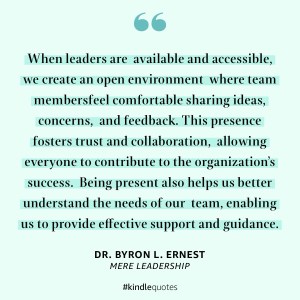
The other comment, “My help consisted of mostly staying out of her way” was another one we can all relate to. How many times have you said to yourself, “I just need them to stay out of the way?” I know I have. This is where, as leaders, we need to be available, but not in the way. In my book, Mere Leadership, I made the point that, “When leaders are available and accessible, we create an open environment where team membersfeel comfortable sharing ideas, concerns, and feedback. This presence fosters trust and collaboration, allowing everyone to contribute to the organization’s success. Being present also helps us better understand the needs of our team, enabling us to provide effective support and guidance” (p. 31). By being available and present we’re able to know how to help or stay out of the way.
Great leaders understand that the best support is many times provided by giving a person space and autonomy rather than intervening or micromanaging. Leaders need to trust an individual’s abilities to handle tasks independently and believe that sometimes, the best way to help is by stepping back and allowing those we serve to find their own solutions. This approach can encourage confidence, self-reliance, and growth, highlighting the importance of giving team members room to learn and succeed on their own.
Have An Opinion
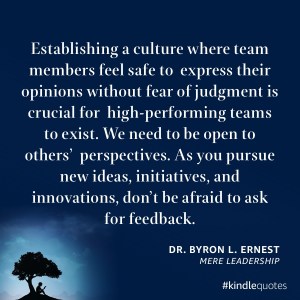
I was inspired to write this post while watching another episode of, House. While I would say we shouldn’t follow all the actions of the protagonist Dr. Gregory House (Hugh Laurie), I was intrigued and agree with the character’s comment of, “If you want to stay on this team, have an opinion.” When he made the comment he was talking to a new team member who just sat through a diagnostic discussion and said nothing. In the context of the scene, I believe the new doctor was both intimidated and not sure of herself. Dr. House’s comment was to make her understand she needs to throw her thoughts out there, even if wrong. The problem in the show’s team, though, is that it is not a psychologically safe place to throw ideas out. If we want everyone to share opinions, we must create the environment where all feel safe to do so. Check out my thoughts on this from my book, Mere Leadership, in the featured image.
Even so, House was emphasizing the importance of active participation and individual voice within the team. He was also suggesting that being a valuable team member involves sharing your thoughts, ideas, and perspectives rather than remaining silent or passive. By encouraging team members to have opinions, we need to promote open communication, innovation, and a sense of ownership among the team, which are essential for teamwork and collective success.
Don’t Let Someday Become Never

On yesterday’s new episode (Season 4 Episode 2, “Switchback”) of the great show, Tracker, Colter Shaw (Justin Hartley) is told by trail expert Becca (Erica Hernandez), “Just don’t let someday become never.” Becca told Colter this after he shared a hiking goal and then said, “Someday.” This was a great reminder that we should take action and pursue our goals or dreams instead of constantly delaying them with the mindset of “someday.”
It’s also a reminder not to keep postponing important things, because if we keep waiting for the perfect moment, or tomorrow, that may never come. Thus, our plans or aspirations might never actually happen. So, let’s stop procrastinating and start making progress now, rather than letting “someday” turn into an indefinite delay or forever when nothing gets done.
Evolving As A Leader

In a professional development I was doing this week a participant made the comment, “We can’t be afraid to evolve.” So true! With all the experiences I have been blessed to have I know I have certainly evolved. I discuss this in my book, Mere Leadership, saying, “Even in my seventh decade, I must continue to learn and evolve. No matter what decade you are in, you must do the same” (p. 157). I also quote C. S. Lewis in my book, saying, “All that is not eternal is eternally out of date” (p. 157). Lewis was reminding us that things that are not timeless or everlasting in nature eventually become obsolete or irrelevant. If we don’t want to become irrelevant, we must evolve. Plus it is just part of becoming wiser.
Our personal growth and progress often require change, adaptation, and stepping outside of our comfort zones. Fearing change can hinder development, and instead, we should embrace our own evolution as a natural and necessary part of life. Being open to evolving allows us to learn, improve, and become better versions of ourselves, even if the process feels challenging at times.
Leading By Knowing Just Where You’ve Been

I wrote about the great band Five Finger Death Punch’s song, “Battle Born,” already in Navigating Life’s Journey: Embracing The Unknown. The other day when spending time in the tractor cab I heard the song and thought about how how the phrase in the song, “I don’t know where I’m going, but I know just where I’ve been (battle born)” relates to a phrase I often use about being the “deer in the headlights.” In my book, Mere Leadership, I said, “Usually, this term is associated with being a bad thing, but I have come to realize that it really is a great thing. To truly gain expertise, become great at leading in a specific area or circumstance, and/or develop empathic concern, which we considered in the previous section, we have had to be the ‘deer in the headlights’” (p. 30).
Getting back to the lyrics, “I don’t know where I’m going, but I know just where I’ve been” reflects a sense of uncertainty about the future combined with a familiarity or perhaps nostalgia for the past. It suggests a feeling of being unsure of the next steps, but having confidence because of our past experiences. Just like having been the deer in the headlights.
We’re reminded to regularly take a moment of pause to allow ourselves to process our experiences and assess situations. Sometimes, taking a fleeting moment to reflect or gather ourselves can lead to better decisions or a clearer understanding inspired by our past experiences.
Being Scared Means We Are Paying Attention
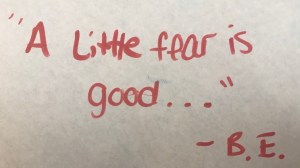
There have been a lot of things written about fear and even more research done on the topic. We all get scared and we all deal with fear in different ways. On Tuesday night while watching the new season debut of NCIS, Special Agent Anthony DiNozzo (Michael Weatherly) made a great comment to Special Agent Timothy McGee (Sean Murray): “Being scared (afraid) doesn’t mean your weak, it means you are paying attention.” Feeling scared or anxious can sometimes heighten our alertness and focus, as our brain perceives a threat and activates the body’s stress response. This heightened state can make us more attentive to certain details in our environment.
This “paying attention” when we are scared in an important psychological response. Our attention becomes laser-focused on the perceived threat. As a result, it’s really hard to concentrate on other stuff. That’s a good thing if there’s an actual threat. Funny how the show NCIS can remind us that fear helps us stay in the present moment and to focus.
Leading By Being Adaptable
This week when spending time with a first year teacher that I am coaching and mentoring, he commented that one of the big things he has learned in the first quarter of the school year is that being able to adapt is key. I was impressed and told him that is a very important part of teaching in many ways. The day I was there he had to adapt a lesson because an outside stakeholder who was helping with a project was not able to be at the school. My mentee shifted seamlessly to another lesson. I’ve seen seasoned teachers struggle with making these kind of adaptations.
I love that this teacher has realized the importance of being adaptable. It is such an important leadership attribute. In my latest book, Mere Leadership, I wrote, “In today’s rapidly changing world, leaders need to be able to adapt to new situations and challenges” (p. 60). This is hugely important in teaching. Teachers are leaders and need to be adaptable in various ways to effectively support their students and navigate the dynamic classroom environment.
The teacher that is the focus of this post used adaptability to modify lesson plans and content to meet the needs of students, whether due to curriculum changes, student feedback, or unforeseen circumstances such as remote learning requirements. During our discussion of being adaptable we also discussed the need to adjust teaching methods to suit different learning styles, abilities, and interests of students. This includes using diverse instructional strategies like project-based learning, technology integration, or differentiated instruction.
All leaders need to be malleable. I used that term in Mere Leadership saying, “Malleable leaders are open to new ideas and perspectives. This openness fosters innovation and encourages our team members and those we serve to share their thoughts, leading to better problem-solving and decision-making” (p.p. 158-158). This also means growing professionally. We must continuously update our skills and knowledge through professional development to stay current with research and other innovations.


leave a comment