Leading With Social Currency
Sometimes I wonder if I really do read for pleasure or not. Even though I have developed a love for fiction, I still am looking for connections to my personal and professional life. So, I guess I really am reading for pleasure, just with a purpose. During my reading yesterday morning of Robert A. Heinlein’s great book The Cat Who Walks Through Walls the comment made by character Chou-Mu to Richard was, “You may think you won back in there. You did not. You lost. You made the Moderator lose face—you made both of them lose face” (p.216). This reminded of the work and great book Saving Face by Maya Hu-Chan. Saving face is not about winning or losing.

Choy-Mu went on to say, “So you’re a walking time bomb, an accident looking for the spot.” He frowned. “Not too healthy for me, either, being present when they lost face … after making the initial mistake of ‘bearing bad news to the king.’ Understand me?” “I’m afraid I do.” Xia asked, “Choy-Mu, truly did Number-One lose face?” “Truly he did, luv. It was Aunt Lilybet Washington who did it to him. But of course he can’t touch her. So it lands on Captain—On Richard. So I see it” (p. 216). “Face,” as Maya Hu-Chan said, is like social currency. The more you have, the easier and faster you can get things done. I had the opportunity to get to know Maya and do a workshop for teachers with her. You can read about that in FACE Is Social Currency.
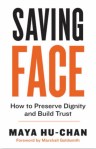
Maya told us that, “Saving face requires deliberate thought, care and courage to address someone with clarity that is fueled by empathy.” Leaders who take genuine ownership of their work set high standards. What I have learned about saving face is to protect people, not image. It is about providing a psychologically safe place, not a safe place for our egos. Pride can take over both organizationally and from a human standpoint. Leadership fails when image takes priority over integrity.
Maya also told us, “Losing face describes conditions where people feel devalued, humiliated or unappreciated.” Saving face provides a psychologically safe environment and provides a positive work, organizational, or community environment.
Saying Nothing

I really enjoyed the most recent article by my friend, Maya Hu Chan, “7 Steps to Take Managing to the Next Level,” published in Inc. It caused me to reflect on how important relationships are and how dignity, trust, and respect play into those relationships – and our everyday interactions. Then, this week through some encounters I either witnessed or was a part of, I thought about how sometimes saving face is not saying anything. For example, is anything gained by reminding someone that we were supposed to leave at 11:00 and it is now 11:18 serve any purpose? If you think it does, I won’t argue, but I don’t really think so. My point here is that our emotional equilibrium requires inner strength and a sense of self. We need our protective inner guardrails. For me, a good question to ask is: will what I’m about to say serve any valuable purpose?
Sometimes our comments only serve to humiliate. I am guessing you are like me and have been guilty of embarrassing someone, either willfully or inadvertently. I have learned from Maya and her great book, Saving Face, that we many times accidentally cause another person to lose face due to misunderstanding, lack of information, or because we’re startled or shocked. That’s why, again, as I analyzed some interactions I was witnessing or a part of this past week I was reminded that a tool in our saving face toolbox is to just not say anything. To be clear, I am not saying that’s always the best tool; it is not. But sometimes it is. Situational awareness is key here.
The idea of saving face is so important. Take a few minutes and think of scenarios. For example, you might be in a group where someone asks if you saw the new Spider-Man movie. Do you immediately say that you hated it and it was the worst made movie in history? Or, do you just acknowledge you have seen it and save face for the person raising the question if she loved it? See the difference? You can still express why you didn’t like the movie after the discussion gets going. You haven’t lied, you just didn’t say the first thing that came in your mind. I get it! This is tough! Frank and “straight-shooters,” are often viewed as uncultured, overbearing, and even rude. I have to watch this. Some of you probably do too. It is particularly important to put this in check when dealing with other cultures.
In thinking about the idea of sometimes not saying anything, I believe my three rules for tweets applies here. I believe tweets should be light, bright, and polite. I leave it there for you to ponder.


leave a comment