Taking The Time
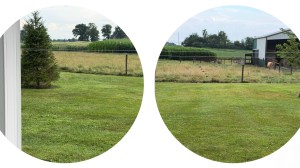
Last night I had a pleasant surprise. I had just got done doing the evening feeding and had sat down on the back porch to watch it rain. Just then my son pulled in the driveway and came over and sat down beside me. He reminded me how he and I used to sit and watch storms come in when he was little. This was a good evening to do this because clouds were moving in all directions and we could see the rain coming down in the distance. It was also really cool to hear the rain coming down on the corn before it got to where we were. There was also the unique smell of corn pollen in the air. All of that really isn’t the point of this post, although I guess it really is. The point is, my son and I sat there for a couple of hours watching the clouds, the rain, the cows coming out to graze and then running back in the barn during the intermittent downpours. It was glorious dad and lad time!
“Taking time to listen to a bird’s song on the breeze. Taking time to gather up the blossom dancing free. Taking time to imagine the deep sounds of the sea. Taking time to cherish you…and cherish me.” ~ Taking Time by Jo Loring-Fisher
The time last evening was time well spent. My son and I talked about lots of different things. It’s really interesting how things we did with our parents when we were young still stick with us. It gave me a warm feeling when my son said he also enjoyed being with me watching storms come in. It can be very easy to get caught up in all that is going on and perceive being to busy to do things like sit and talk to my son for a couple of hours, but there just might not be anything more important. We need to take the time!
Time Is A Tool

Last night I heard the statement, “Time is a tool.” As a student, friend, and fan of L. David Marquet (also the author of Leadership is Language) who teaches us to “control the clock”, time being a tool suggested that time can be utilized as a resource to help accomplish goals, manage tasks, and structure our lives. Most people just want to complain and say there is not enough time, which is really stupid because we can’t make more of it. But just like a tool is used to build or create something, time can be harnessed effectively to enhance productivity, prioritize activities, and achieve personal or professional objectives.
Time used as a tool implies that we have the power to make choices about how we spend our time, emphasizing the importance of time management and planning to navigate our daily lives more efficiently. Ultimately, it highlights the idea that time, when used wisely, can lead to greater success and fulfillment.
Marquet’s concept of “controlling the clock” emphasizes the importance of taking charge of how we use our time, particularly in a leadership context. When he talks about controlling the clock, he’s highlighting the need for individuals and teams to be proactive in their approach to time management rather than reactive. This idea is closely related to viewing time as a tool.
When time is seen as a tool, it shifts our perspective from being passive recipients of time to active managers of it. Think about the best athletic coaches. What do they do really well? Control the clock. Here are a few connections between Marquet’s ideas and time as a tool:
- Intentionality: Just as a tool requires skill and intent to use effectively, managing time well requires deliberate choices about how to allocate it. Marquet encourages leaders to create cultures where team members feel empowered to make decisions that optimize their time and contributions.
- Ownership: By controlling the clock, individuals take ownership of their responsibilities and schedules. This sense of ownership allows for better prioritization and focus on what truly matters, turning time into a resource that can be shaped to meet specific goals.
- Empowerment: Marquet’s approach advocates for giving people the authority to manage their own time, which fosters engagement and accountability. When team members control their own schedules, they can align their activities more closely with their strengths and priorities.
- Adaptability: Understanding time as a tool means being flexible and responsive. Marquet stresses adapting strategies based on the situation, just as one would choose different tools for different tasks. Being aware of how time can be manipulated allows for better navigation through challenges. One of the things Marquet advocates for is taking a “timeout” or “pause” to think and reflect.
So, as Marquet says, let’s not “obey the clock,” but “control the clock.” This aligns well with the notion of time as a tool by emphasizing intentional use, ownership, empowerment, and adaptability. These principles can help individuals as leaders and teams maximize their effectiveness and achieve their objectives more successfully.
Make Time

In the great book, Be Useful: Seven Tools For Life, Arnold Schwarzenegger said, “The key is not to try and find time, but to make time.” He meant that rather than waiting for time become available (which we know never happens), it is necessary to prioritize and allocate time for important tasks or activities.

Schwarzenegger emphasizes the importance of being proactive and taking control of one’s schedule in order to accomplish goals and objectives. Instead of passively searching for free time, it encourages individuals to actively create and dedicate time for things that matter to them.
Harvesting Time
 I heard someone mention the thought of harvesting time this week. Really, I had never given much thought to the idea of time being something to be harvested. But, really it is something that we need to think about and be very deliberate about how we harvest. Most of the philosophical thought on time is spent thinking about the sowing of the seeds for harvest, but the timing and how we harvest is just as important. In agriculture we must have machines set properly and know the exact time when the crop is right – whether that be ripeness, moisture content, or ground conditions. We should also take this same care in the thought of the harvesting of our time.
“Now is the accepted time, not tomorrow, not some more convenient season. It is today that our best work can be done and not some future or future year. It is today that we fit ourselves for the greater usefulness of tomorrow. Today is the seed time, now are the hours of work, and tomorrow comes the harvest and the playtime.” W.E.B Du Bois
I love the quote above. As a civil rights activist and first African American doctoral graduate from Harvard University, W.E.B. Du Bois certainly understood the idea of harvesting as much out of the time we have available today – not for some other time that might be convenient. Even though I do not at all believe the socialist ideals that Du Bois did, particularly related to communism, I do share some of his other ideals. As Martin Luther King, Jr. said, “Du Bois was not afraid to speak his mind regarding what he believed was best for others.” W.E.B. Du Bois represents a great example of how leaders are not always liked by all.
An important lesson to be learned from Du Bois is the fact that he used every moment for accomplishing good. We must consciously decide what we want to spend our time on. Time is our most valuable possession. Our time on Earth is limited. Therefore, we must be productive, harvest our time wisely, and improve the lives of others.


leave a comment