Education 5.0: Empowering Minds for the Age of AI, Empathy, and Innovation
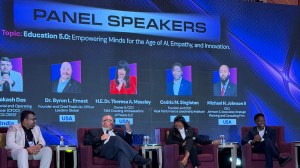
Yesterday I had the honor of serving on an international panel contemplating “Education 5.0: Empowering Minds for the Age of AI, Empathy, and Innovation.” It was an incredible discussion that was part of the 2026 FLUXX Asia Leadership Conference in Manila Philippines. I wanted to share some of the thoughts I contributed to the discussion yesterday.

When asked about the biggest challenge in education I brought three points:
- We need to make sure students are developing the skills necessary to become worthwhile citizens in a global economy
- Our education entities need to become more systems thinking and have systems change leaders to carry out those changes
- As a global community we need to be learning promising practices from each other

Next, I was asked what critical human skills are at risk of being undervalued or underdeveloped because of the use of AI:
- Critical thinking/Problem solving
- Creativity/Curiosity
- Ethical reasoning
- Adaptability/Resilience
How do we strengthen the human connection for students?
- Students should work on real problems and issues
- Students should work with adults I mentioned my partnership with AgReliant Genetics when I was teaching where students were doing real research for the company and collaborating with the scientists
- We need to provide mentoring by adults for students
- Work-based learning opportunities
- Students present results/proposals
- Help students understand what it means to have ownership in their learning/education and then allow them to have that ownership
- Create space for students to have human to human contact and interaction
What are actions needed for proper use of AI?
- Provide support and professional development in the use of AI
- We need to incorporate AI, not make it an either/or thing
- Get diligent in helping students recognize fact from opinion/false information [Research from Programme for International Student Assessment (PISA) showed that only 9% of 15-year-olds can actually tell when facts are really facts and not just opinions]
Finally, I was asked to complete the following sentences (the italicized are what I contributed):
- AI will replace routine tasks, but never replace the human elements of love, creativity, curiosity, and empathy.
- The most underrated skill is emotional intelligence.
- The future of education is students taking ownership of their own learning and education.
Distinctions That Matter

I have always been intrigued by the phrase, “a distinction without a difference.” I think it interests me because we tend many times to make big deals out of minor distinctions when there truly is no difference in what we are saying. The phrase “a distinction without a difference” reminds us that some differences may be superficial, irrelevant, or just semantics. Leaders should focus on genuine distinctions that drive progress, understanding that clarity and significance are crucial for effective decision-making and communication within our teams. Making distinctions that do not result in meaningful changes or improvements can lead to confusion and inefficiency.
While contemplating this post I thought about a quote from John McCarthy: “Hard distinctions make bad philosophy.” When studying McCarthy in my Oxford AI course I was fascinated by his suggestion that binary or strict classifications may overlook the complexities and nuances of reality. McCarthy’s philosophies encouraged a more flexible and thoughtful approach to distinguishing concepts, allowing for the shades of gray that often exist in complex ideas and real-life situations. In essence, he was calling for intellectual humility and an acknowledgment that life and thought cannot always be neatly categorized.
Crowdsourcing AI Expertise
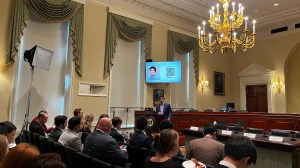
Earlier in the spring of 2024 I had the opportunity to become a member an artificial intelligence (AI) legislative policy sprint with the Federation of American Scientists (FAS). It literally was a sprint as we created all the briefs in about eight weeks. This crowdsourcing of expertise by FAS, as it was described by Daniel Correa, CEO of FAS, was an incredible undertaking on their part. This was truly a bipartisan labor of collaboration bringing together those with experience using AI to create the top ideas for legislation and policy related to AI.
At the time that the FAS put out the call for proposals for the policy sprint I was taking a course in AI in the Saïd Business School at the University of Oxford. I was learning so much and was realizing how far we were behind in the United States in education in terms of utilizing AI for considering the all important questions of how and what students learn. In a project for my Oxford course I wrote:
“First, teaching about artificial intelligence (AI) and teaching with AI are two very different things. In education we are going to have to do both; facilitating learning about the ethical use of AI and using AI in real world/work-based learning, so students understand how to use AI in careers. Therefore, one of the main obstacles that education faces is the need for education to evolve in the face of so many new technological developments making use of AI. Our policies will need to reflect the capabilities AI affords us. Educators must be trained in AI in programs very much like this one I am in now. Skill acquisition will need to be paramount to student seat time. Practicing, memorization, and repetition in many subjects is becoming irrelevant due to AI. AI allows us to shift memorization to understanding. Many are predicting this change in education to take two to six years. In education I believe societal acceptance is the biggest factor determining obstacles and adoption. Many might consider AI a technical challenge, which I recognize there are questions of technological progress, but I believe regulation (and who owns that regulation), economic conditions, plus the societal factor make this, instead, an adaptive challenge.”
Yesterday it was fascinating to listen to my colleagues’ ideas and views on AI in other sectors, including healthcare. One theme that came out throughout the day was that no matter the sector we need proactive prescriptions, not random knee-jerk reactions. This includes being responsive to new sources of risk. In other words, we need to catch threats before they happen. We also need to identify threats before they become public.
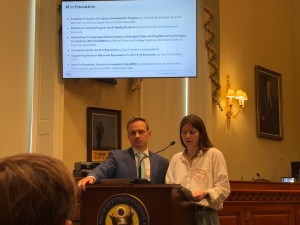
In my sector of education the themes of there not being enough data and the lack of training or guidance for teachers to be successful using and facilitating student use of AI emerged. One thing we need to do is leverage and mine the data we have. One thing is clear; we must be vigilant in helping educators understand AI and how to teach about AI as well as using AI to facilitate learning. I loved Zarek Drozda‘s comment when he said, “Education is a vaccine misinformation.” We must not miss the opportunity to educate our children for dealing with and using AI.
Click on A National Center for AI in Education to read my proposal. You can also click on New Legislative Proposals to Deploy Artificial Intelligence Strategically to see all the FAS Policy Sprint proposals.
Those proposals are broken into four categories:
- AI Innovation, Research and Development, and Entrepreneurship
- AI Trust, Safety, and Privacy
- AI in Education
- AI in Healthcare
I applaud the Federation of American Scientists for doing this innovative crowdsourcing of expertise to bring together great minds for creating policy ideas related to artificial intelligence. It was such an honor to be on the journey with everyone.
The Frictionless Experience

I was reading an article, “What Smart Companies Know About Integrating AI: Talent and Data are Just As Important as Technology,”this week in Harvard Business Review last night related to artificial intelligence (AI). It was interesting to contemplate the idea of a “frictionless experience.” Having a frictionless experience means having a smooth and seamless interaction or process without any obstacles or difficulties. This is the customer experience (CX) at its best. We as consumers expect the same level of service, understanding of our needs, and prompt resolution of our issues across all channels. If we are to take a customer-centric approach we need to be able to personalize at every touch point. I really believe this is also true when working with our students and families in our schools. This relates to all the various aspects, such as customer/student services, user interface design, or even personal experiences. It means that everything flows effortlessly and efficiently, making it easy and enjoyable for every person involved.
AI can also analyze user data to personalize interactions and tailor recommendations, making the experience more relevant and personalized. Additionally, AI can automate repetitive tasks and streamline processes, saving time and reducing the chance of errors. One of the big points of the article was that AI does not replace people, but better informs the people who will be doing the inventing, creating, and innovating. It is about the talent using the data.
I also think about how AI-powered chatbots could be used to tutor and help students. Chatbots can provide personalized learning experiences by assessing the student’s needs and adapting the content accordingly. Not to mention the big support to students, this could be of huge help to teachers by providing both a time-savings and important data. The Chatbots could answer questions, provide explanations, and offer additional resources to support the student’s learning journey. Notice I am suggesting giving additional support – not replacing teachers or existing support. Those same Chatbots can also track the student’s progress, provide feedback, and suggest areas for improvement. With their availability 24/7, chatbots can provide continuous support and enhance the learning experience for students. Wouldn’t it then be amazing to get that report of what questions were being asked and what I, as the teacher, needed to go back and provide more learning on. This could be incredible for a frictionless student experience.


leave a comment