The Angry Birds Effect
 I used to talk about the “Nintendo Effect.” The reason why kids of all ages love and get hooked on video games is because of the great educational best practices these games employ. These best practices are: student-centric instead of monolithic, immediate feedback, actionable feedback, the opportunity to immediately go back and re-try, and the ability to collaborate and watch others play and learn from them. You would have to agree, all of these are important to learning whether you are a p-16 learner, business executive, or pro-football player. Right?
I have now changed my phrase, however, from “Nintendo Effect” to “Angry Birds Effect.” This change is not just to keep me more in tune with the times, but the fact that Angry Birds does a better job of combining all the best practices than Nintendo ever could. For those reading that have never played Angry Birds let me give you a little tutorial. Basically, you are presented with Angry Birds and a sling shot and your job is to destroy green pigs who are sheltered by very creative structures in a variety of settings. This game, designed by the Finnish game developer Rovio Mobile, was first designed for the Apple IOS system in 2009.
Each level starts with the number, types, and order of birds predetermined. If all the pigs are defeated by the time the last bird is used, and you improve your score three times the next level is unlocked. Basically, standards mastery! Upon completing each level, players receive one, two, or three stars, depending on the score received. I want to make sure you understand here, I can play as many times as needed to get all three stars – a little different than the way most students are graded today. Players may reattempt unlocked levels as many times as they wish in order to complete them successfully or to earn additional points or starts. 
Angry Birds has many of the components that should be incorporated into great student centric curriculum and lesson planning or development of corporate training programs. The way most schools do feedback right now is by grades and “when the grades are handed out, the privilege of feeling successful is reserved only for the best students. By design, the rest experience failure” (Christensen, Horn, & Johnson, 2011). Let’s take a look at the best practices we can learn from Angry Birds:
1. Early in the game, the single Red Bird is the only one available-basic knowledge.
2. Players advance at their own pace.
3. Mastery is required to advance – You must have cleared a level three times with score improvement each time before moving on.
4. As the player advances, new levels are introduced.
5. The player can move ahead and clear levels beyond the one they are presently in, but not too far.
6. Different contexts are portrayed (deserts, gem mine, city at night, et cetera) to make it interesting and relevant to the player.
7. The player is given new tools (different types of birds) to use as he/she advances and unlocks higher levels.
8. Immediate feedback is given. The player knows the score immediately.
9. Ability to go back and retry and review any level any time.
10. The next level is always “just above” (Christensen et al., 2011) the players ability. Not too far above, but “just above.”
Let’s dig into this concept of “just above” a little deeper. Christensen et al. (2011) asserted, “There is mounting evidence that students’ learning is maximized when content is delivered “just above” their current capabilities – not too much of a stretch, and not too easy. Customization to the “just above” level for each student is much easier to achieve in software than in the current monolithic delivery of most schools.” This adds a whole new dimension to differentiated instruction and modifying learning according to the way students learn. Remember, this is true for adult learners as well.
So let’s recap what we can learn from Angry Birds. We must provide a learning environment that is student centric, not monolithic (Christensen et al., 2011); we must provide immediate and actionable feedback; we must provide the students with the ability to go back and keep trying and editing till mastery is achieved; and we must introduce material “just above” where each individual student’s capabilities are.
Next time you are planning a lesson, developing a training program, planning a practice, or whatever your profession has you teaching others; think about the best practices of Angry Birds.
Reference
Learning From SMART Coaches
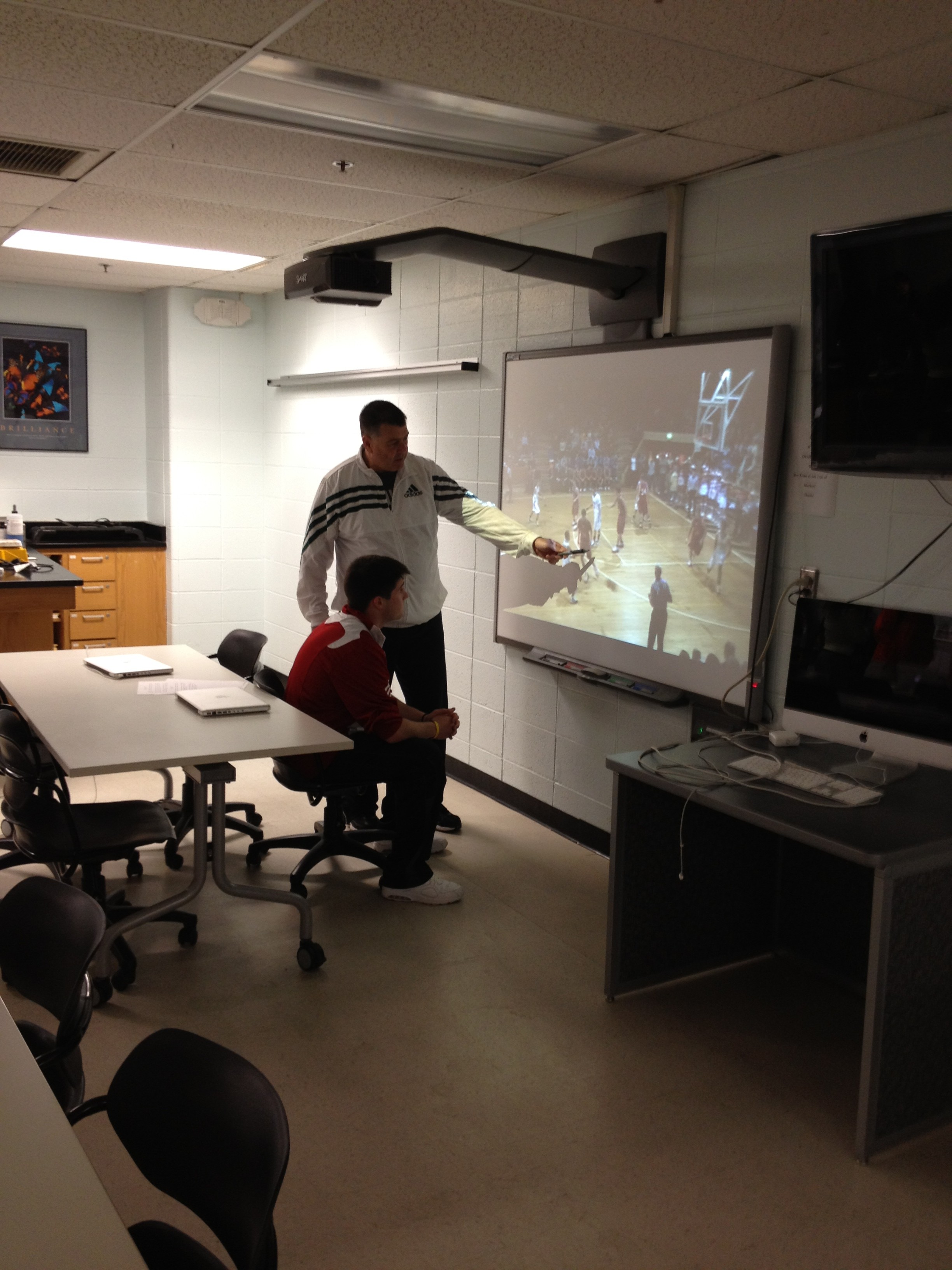
Coach Hendrix in SWELL
This past week I wrote a post for EDCompass Blog entitled, SMART Coaching. In this post I described how I learned from our basketball coach, Albert Hendrix, how to better differentiate instruction. I encourage you to click here to read the post because I want to go a little deeper in this post. As I reflected on the way Coach Hendrix teaches I realized he is doing what Christensen, Horn, and Johnson (2011) described as “student-centric” in Disrupting Class: How Disruptive Innovation Will Change the Way the World Learns, Expanded Edition. I had this book recommended to me by Scott Shelhart (@KD9SR) during the #TalkToTony Education Twitter Town Hall a couple of weeks ago with Dr. Tony Bennett, State Superintendent of Public Instruction.
Christensen et al. (2011) discussed how our educational system is monolithic and needs to be more student-centric. By monolithic the authors mean we teach to only one learning style. Student centric means teaching to the way a student learns. Coach Hendrix teaches is a student-centric manner. By using the SWELL Classroom he is able to split the team up according to, not only different line-ups, but also the players’ knowledge of the game. Additionally, for those that are more spatial learners (need to see or visual) than kinesthetic, the triangulated SMART Boards give Coach Hendrix the ability to show players what they need to be doing.
What I learned from Coach Hendrix is that all players have specialized needs. They are all at a different starting point, have varied learning styles, and all learn at different paces. In other words, just like every student I teach. You might say every student is “differently-abled.”
During the 1800’s education was customized and student-centric by the teacher for level and pace out of necessity – all students were in one room. It is now important for us to once again become student centric. “Teachers can serve as professional learning coaches and content architects to help individual students progress – and they can be a guide on the side, not a sage on the stage” (Christensen et al., 2010).
Reference
Christensen, C.M., Horn, M.B., Johnson, C.W. (2011). Disrupting class:How disruptive innovation will change the way the world learns, expanded edition. New York, NY: McGraw-Hill Companies.
Flavor of the Month or Research & Development?
 I heard discussion and saw an advertisement talking about education having our “Flavors of the Month.” In other words what’s the next initiative, program, product, or technology that will increase standardized test scores, student performance, student engagement, teacher effectiveness, learning, or whatever other metric we might be using (all of which are important). It’s interesting the advertisement using the “Flavor of the Month” analogy was for a professional development program. Interesting, huh?
Here’s my take. First of all, transformational change does not come from programs and initiatives. Those are things! It comes from having a process where action research is constantly occurring. It also is about having a collaborative culture where learning is always occurring. Garvin (2000) called this environment the learning organization. “A learning organization is an organization skilled at creating, acquiring, and transferring knowledge, and at modifying its behavior to reflect new knowledge and insights” (Garvin, 2000, p. ii). Now, think about that definition. If you think about it you’ll understand when I say it is good to use a few “Flavors of the Month” every so often to try new learning techniques for effectiveness. I would not have known I like Pistachio Ice Cream had I not been tempted to try it on a Flavor of the… trial. What’s wrong with trying new things? We need to view it as Research and Development.
The problem within our schools is we then need to collaborate in a learning organization environment to truly know what worked and did not. We need to have knowledge sharing in conjunction with knowledge generation. Now I know I will get all the negative reactions that are associated with any time of professional development or professional learning communities – no money, no time, yada yada yada. A true learning organization is a culture not a thing.
Let me give you an example. Yesterday I wanted to try using a People Search. This is an activity where students receive a chart with eight questions and they have to collaborate with eight different students to answer each question. They both initial when they believe they have the correct answer. I tweaked this activity to do it electronically and invited another teacher in who uses this activity often with success to observe and critique afterward. We spent time reflecting afterward and it was incredible and worthwhile personal growth time spent. Did you notice this did not cost money, require board approval, or any of the other things we complain about or use as excuses.
This interaction was a true modeling of a learning organization. There was no fear of failure, and even if it had failed, my teacher guest is of the same culture as me. We are not afraid of risk. The process of a learning organization starts from a cognitive phase where new ideas are exposed and are digested by the people followed by a behavioral phase (trying something new) where these ideas are put to use and finally a process improvement phase (reflection). So don’t forget we must develop a culture of Research and Development, knowledge creation and sharing, and the learning organization.
Reference
Garvin, D. (2000). Learning in action: A guide to putting the learning organization to work. Boston, MA: Harvard Business Press.
Agriculture – Our Next Moon Shot
 A few weeks ago there was an article that discussed the agriculture industry as not being a viable career choice for students. It seems to me that agriculture continues to be one of the least understood industries, with some of the most tremendous opportunities for our students. When starting the Agriculture Science program at Lebanon Community School Corporation eight years ago, I spoke of the fact that agriculture is more than Cows, Plows, and Sows. I now use the phrase that agriculture is our next “man on the moon” that Kennedy had. Think about it; as our population increases we will need food, clothing, shelter, sustainable fuel sources, cures for diseases, and the list goes on and on. Where will these come from? AGRICULTURE SCIENCE!
When people begin discussing Science, Technology, Engineering, and Math (STEM) education and careers, I like to remind them that it really should be STEAM – Science, Technology, Engineering, AGRICULTURE, and Math. But don’t take my word for it, click here to take a look at the results of the 2011 Employment Summary Food, Agriculture, Life, and Natural Resources May Graduates – College of Agriculture, Purdue University.
As our next “moon shot” it is critical that we continue to support agriculture science as an important Career and Technical Education (CTE) component in our secondary schools. It is also critical that teachers, such as myself, take the integration of science very seriously into our curriculum. It is also critical that we continue to recruit the best students into agriculture to be the Neil Armstrong’s of the agricultural industry and take the giant leaps of solving world hunger, disease, fuel needs, and all other areas related to food, life, and natural resources.
SWELL Education
SMART Worldwide Effective Learning Lab
This week’s post is going to direct you to four posts I have done for SMART Technology’s EDCompass Blog. I serve as a guest blogger and have done a series of four posts describing my journey as a SMART Exemplary Educator. This journey has also involved the development of the SWELL (SMART Worldwide Effective Learning Lab) classroom. The four titles are listed here and linked to the EdCompass Blog. Check out these posts!
Could you Convince Your School to Put a SMARTBoard in Every Room?
A SWELL Place To Be: The Story of the SWELL Classroom
A Typical Day in the SWELL Classroom
Professional Development for Digital Learning is a TALL order
Also check out this video my class made about project based learning and the use of technology. To view the video click here.
Never Be Average!

Cord and I
This week I am going to let one of my student’s words be the focus of my post. A couple of weeks ago you will remember I blogged about our basketball team (to read the post again click here). Well this week I would like to use a paper Cord Barricklow, a member of that team, wrote as a class assignment for an “I Believe…” statement. It is so exciting to have a student who combines leadership traits, faith, integrity, and values into such a balanced package. We talk a lot about leadership and life lessons in my classes and let me tell you, Cord gets it. But here I’ll let you judge for yourself. You’ll see why I say I learn from my students every day! I have taken the liberty of putting some of Cord’s most profound statements (in my opinion) in bold and italics for emphasis. Please join me in celebrating this young man’s beliefs. We can all learn from Cord. Enjoy!
Never Be Average – by Cord Barricklow
I believe in the fight to excel above others. To fully commit yourself into whatever your dream is and be the best you can be. You can achieve anything you want to with hard work and dedication. Know that you are the best at what you do. Never be average.
In order to be the best, you have to believe in yourself and know that you are capable to be that star. You must have the Muhammed Ali confidence, Ali once said, “I am the greatest, I said that even before I knew I was.” It can be seen as cockiness but it is much deeper than that. It is an attitude, a swag to what you do and what you love. When you put all of your blood sweat and tears into a single goal, you have the right to know you are the best.
You may not really like the training, it will get tough. Ali puts it into the best words. “Don’t quit. Suffer now and live the rest of your life as a champion.” That’s what has to fuel your fire. Sure, it is a struggle to maintain the level of determination to keep grinding it out, but without struggle what’s it all worth. Nothing is given to you in this world, and when you push yourself, you will get what’s necessary to be a champion.
You may need some luck in your journey, but I believe that luck is hard work, cleverly disguised. With great skill and good luck, you can achieve anything. People are born for a greater purpose than to just survive. God put us on this world to thrive at the challenges we face, not just to turn away and survive them. And when you achieve that prize, that goal you have pushed for, you give him all the glory in your victory.
I work everyday at the things I push to succeed in. Whether it is rodeo, basketball, or school. If I don’t consistently work on my game, someone else might be getting better than me. I cannot be average, I must find the push within me to get to the top, and stay there.
And when you achieve the greatness that you worked so hard to obtain, you will know that you made it, that you are not average, that you’re a champion! This I believe!
Do You Edify?
 Today, as is the case most days, one of my students has provided the teaching and I am obliged to do the learning. Garrett Breedlove (@Goob_22 on Twitter) tweeted me that the word of the day was “Edification.” You may recall that Garrett was the facilitator of learning for one of my blog posts last fall. To read that post (Attitude Is Like A Cold) again click here. Now I have to admit, I didn’t even know what “Edification” meant. So off to my Dictionary App I went, and guess what the definition was? “1. The act of edifying.” I hate it when that happens! So, I looked up “Edify.” That’s when the learning began. Here’s what it said: “To instruct or benefit.” Now, that’s good stuff!
Wouldn’t it be great if we were all edifying? That would mean we would be instructing or coaching and benefiting others all the time. What a great world it would be if we were all striving to “Edify.” I was then reminded of a conversation I had just yesterday with my good friend Kevin Eikenberry. I shared my frustrations with him about a leader of a meeting I was in the week before who had just not taken her own professional development serious enough and was, quite frankly, giving wrong information. I shared that I had gone back to his book Remarkable Leadership:Unleashing Your Leadership Potential One Skill at A Time and read the part where he talks about that as leaders we must always realize that the others in the room may not be at the same knowledge level or leadership ability as us. Kevin, in his normal wisdom, shared that we have to find a way to coach and provide that information to others in a way that benefits all. 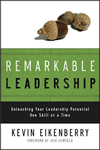
As a person who leads from the middle most of the time this makes so much sense. During our conversation it clicked that really I have to take the same approach in all my leadership roles that I take with my students. That being, to always facilitate learning from where the students are right now, and not where I want them to be. Really, I was approaching this leader wrong – Instead of instantly correcting, which is what I did (honestly, because I knew I was right & wanted to be seen as being right) I needed to “EDIFY.”
Next time I will take the lessons of Garrett and Kevin, and stop and think about how I can provide coaching, instruction, and benefit to others. In other words, provide “Edification.”
Next time you are in a situation like mine think about how you can “EDIFY.” It will make the world a better place. Thanks for the inspiration Garrett! Just goes to prove that Twitter is one of the greatest professional development tools ever.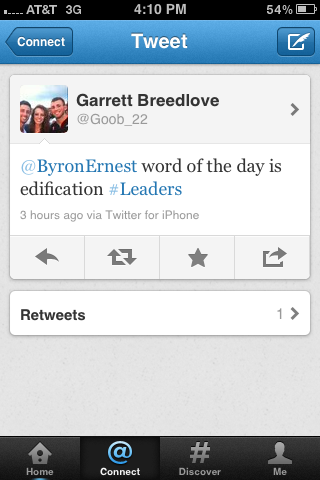
Own Your Own Expectations
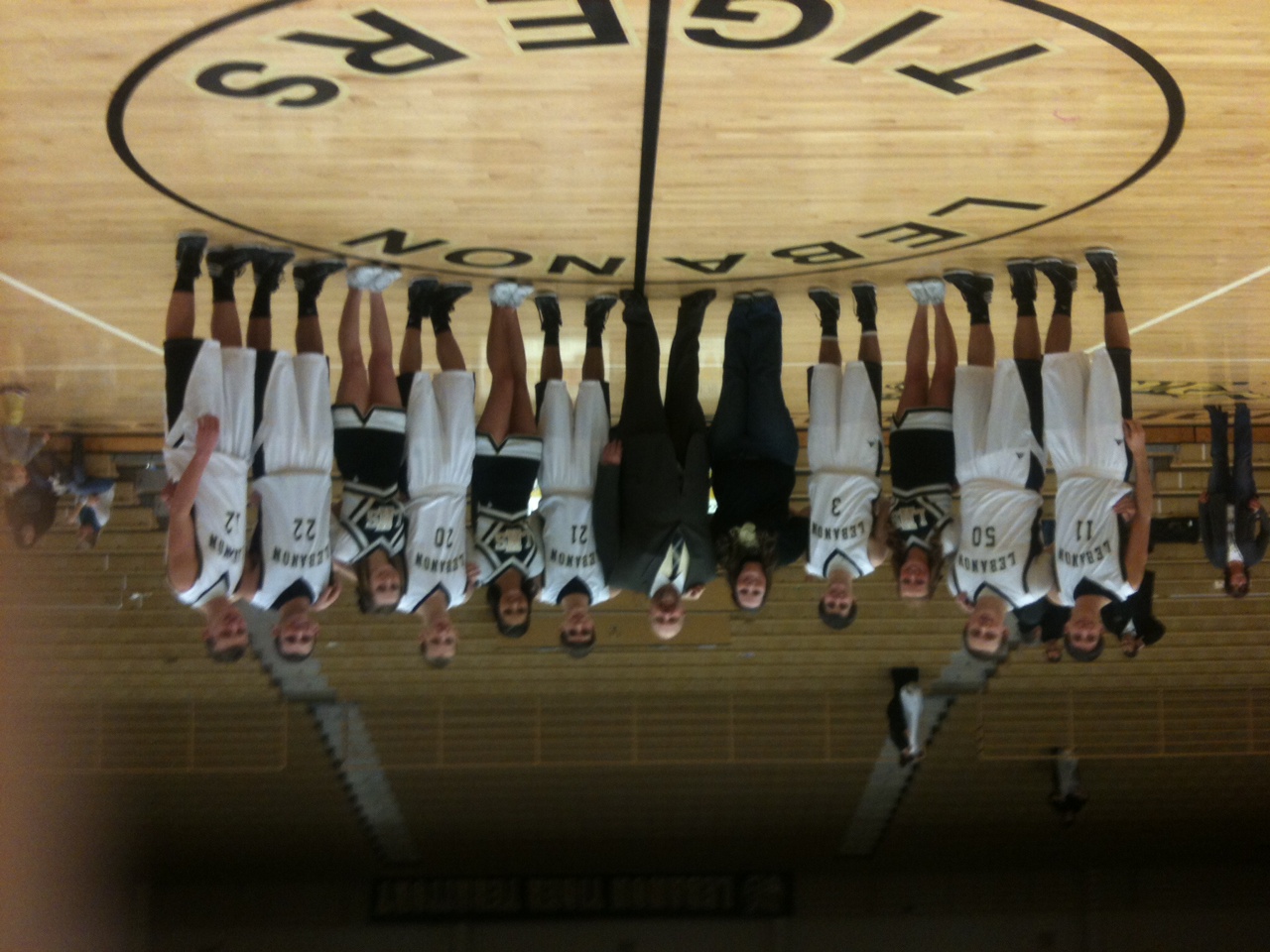
Me & The Seniors
Last night I had the tremendous honor of being named our Lebanon High School Mens Basketball Honorary Coach. This was huge for me because it was the players’ idea and Coach Albert Hendrix agreed. The players are are biggest reason for my being excited about this opportunity. I have all but two in class, and since I am a systems thinker those two are my students too, since they go to Lebanon. Our Tigers are now 16-2, and I have been to all the games but but two (I was out of state for both). I have blogged about my personal mission of using Rigor, Relevance, and Relationships to facilitate high student achievement. Today’s post really goes to the Relationship component. Because of basketball a bond between myself and these students has been forged that is unbelievable. But really all of this is not the theme of this post.
Last fall during a leadership workshop we were conducting for our students one player/student, Ray Solomon, made a comment that has forever changed me and shaped many of my discussions with this team. When asked by the workshop facilitator “What are major distractions to to your being successful?” Ray wrote down “Expectations.” I asked Ray about this because normally we think of high expectations being a key to attaining success. Here’s where the student set the teacher straight; Ray said, “But Mr. Ernest you don’t understand, in basketball everyone has their own idea of what the expectations of the basketball team should be. They want us to all be straight A students, go to the college they went to, win a state championship (even though many making that statement never coached a state championship team, were on one, or even a good basketball player), never get into trouble, and the list goes on and on. Every one of them also wants to tell us exactly what me need to do better, and many times the next piece of advice contradicts the one before. It’s just too much to handle.” This statement from Ray really struck me and caused me to think. I really believe most of this is not coming out of love for the student athletes but out of these people’s own selfish desires to attach themselves in some way to the team. Much of it becomes not providing expectations, but DISTRACTIONS.
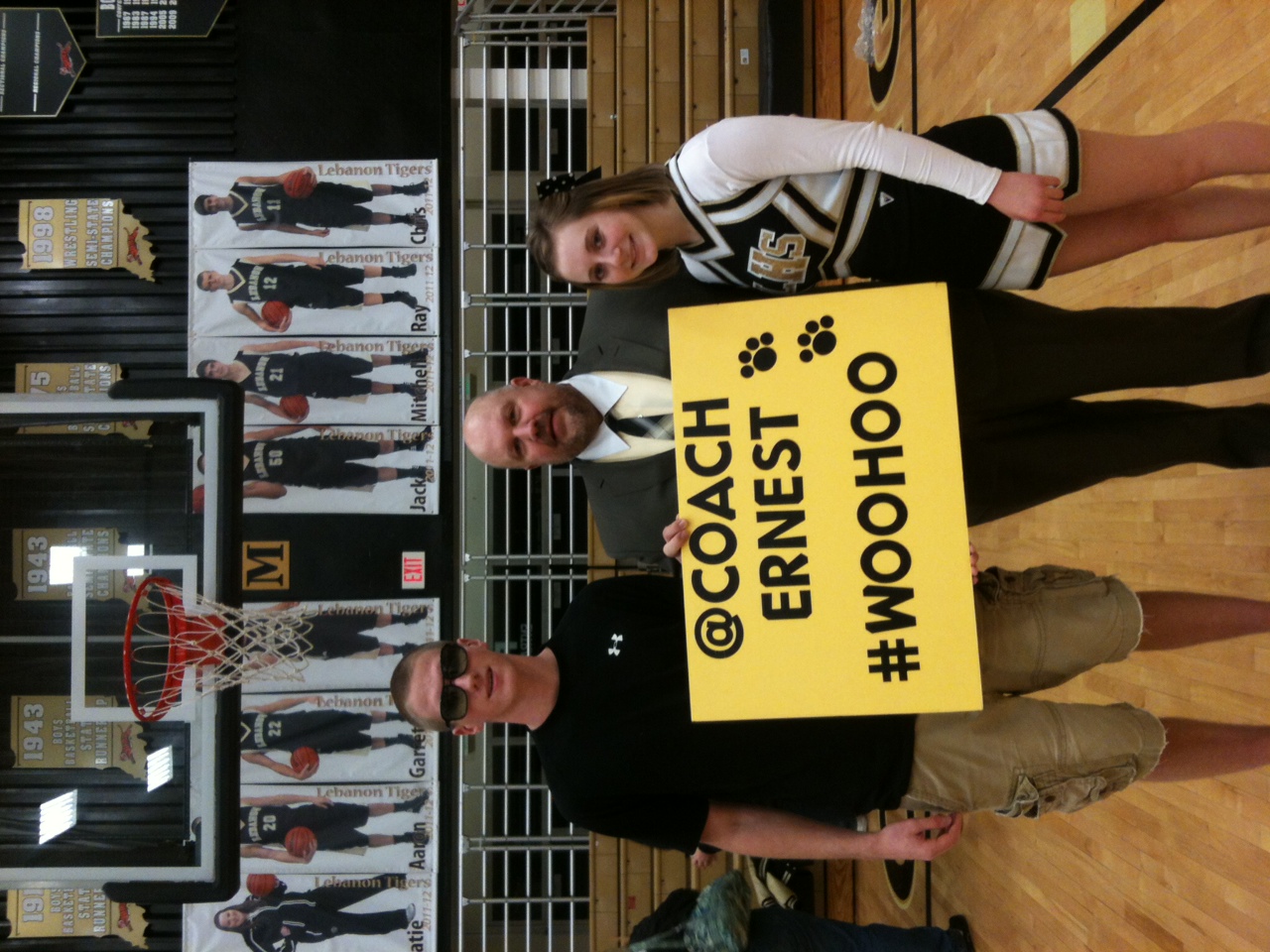
Sign Made by Rob Dukes
Coach Hendrix and I have developed a great relationship as well (in fact he uses my room and SMARTboards for film practice) and we have discussed these distractions. Amazingly, he gets the same thing – many who think they can coach the team better. My thought – even if they can (pretty sure they can’t) they are not the coach, period. Let me assure you after being on the bench with Coach Hendrix last evening there are few better at adjusting to what is happening in the game than him. He is a tremendous game coach. I have always said one of the best things we could do would be to take down all the banners in the gym and not live in the past but live for the here and now. Right now is this teams time. It doesn’t matter what has happened in the past or who came before. What matters is the expectations this team has for themselves right now. It has to become personal.

Ray & I After My Coaching Debut!
My suggestion to Ray and all the other players is quite simply “Own your own expectations!” Don’t worry about everyone else’s expectations. I want them to quite simply make it personal. In fact, I personally tweeted that message to each player yesterday before the game and reinforced it in the locker room during the game. As Coach Hendrix said in his pregame, “you now have the opportunity to do something that very few get to do, it has to become personal, you have to want it more than anyone else, the stretch to a state championship begins right here, right now!” We won last night, by the way!
Last night it was such an incredible honor to be honorary coach for the game. I did everything that a coach would do – locker room pregame, on the floor for warm ups, sat on the bench with the players, halftime locker room adjustments, and post-game talks. What an experience! Words cannot describe the love I have for this team. Everyone of them is a great student, and more importantly, person. I will never forget the experience of the feeling of being asked to be the Honorary Coach. It means so much because it was this team – it was their own EXPECTATION of me. Guess what – I owned that expectation, too!
So for the readers of this post please remember that high expectations are important, but also remember as I tweeted: “No more DISTRACTIONS. Tonight it becomes personal. Don’t worry about everyone else’s expectations. Own your own Expectations!”
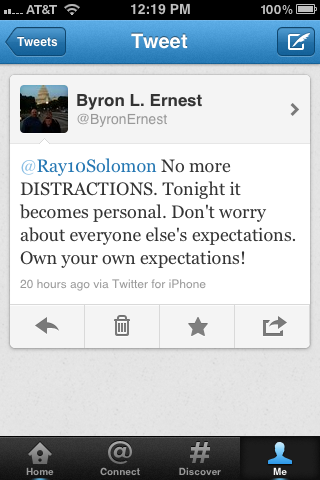
My Tweet to Ray - All the other players got one too!


8 comments