Frustration
 This past week I defended my research proposal (successfully I might add) as part of my Doctoral journey. At the end I was asked if I had any comments I would like to make about the journey. Well of course I did. For one of my comments I used the term “frustrated.” After saying that I quickly tried to correct, and said “I’m sorry, frustrated is not the correct term, I didn’t mean to sound so negative.” My doctoral committee chair quickly jumped in and said “Byron, it is o.k. to feel frustration – it’s part of the process.”
Let me tell you, as a card carrying “Positive/Possibility Thinker” it frustrated me to think I had been frustrated. So in reflecting I thought, “How can we turn frustration into a positive emotion?” Off to Dictionary.com I went. Here’s what the website had to say: Frustration – The condition that results when an action is thwarted by an external or internal force. The blocking or thwarting of an impulse, purpose, or action (who the heck uses the word thwarted anyway?). Also, it is ironic that one of John Maxwell’s Minute with Maxwell videos was on the work frustration this week as well. Click here to watch his video and hear his thoughts on “frustration”
So here’s what I learned: When I get frustrated I need to use the impulse to evaluate my purpose and create actions that will eliminate the frustration. Really, frustration is a gauge pointing us to the next action necessary to carry out our purpose. Frustration happens to you and it happens to me so let’s harness it’s effects for positive action.
Students Achieving Engagement
 Back on December 9, 2011 my post was about action research we are doing at my school on student engagement. I wrote about the four themes that our students developed about what great teachers needed to do to keep them engaged in the learning process. To read the post click here. Here are the themes from the student responses as to how students are best engaged: 1. Students learn best from Passionate and Energetic teachers; 2. Students learn best from teachers that are Prepared and Creative; Students learn best when the material is Relevant to them; and 4. Students learn best when they best when they believe the teacher genuinely Cares about them.
This past week we took two student LAB times (time each day I spend with the same group of students) to discuss the students’ role in being engaged learners. The discussion revolved around the answers the students gave to the question: What can students do to improve engagement?
Here are the themes and every related comment made by the students:
Proper Sleep
Come to class well rested, Decent amount of sleep, Get more sleep, Get enough sleep, Get more sleep at home not in class, Get more sleep, Sleep more – go to bed earlier, Get enough sleep, Get a good night’s sleep, Go to bed earlier, Get enough sleep, Get enough sleep, Get more sleep, Proper rest, Get plenty of sleep, More Sleep, More Sleep, Get proper amounts of sleep, More sleep (not in class), Get more sleep, Get more sleep – try to have a specific time by which to go to bed, Get more sleep by putting away electronic devices, managing time better, going to bed earlier, and cutting off sugar and caffeine at an earlier time, Get Enough Sleep (at “home”), Get more sleep, Get enough sleep, Get more sleep at home, Get sleep, Reasonable bedtime
Eat Breakfast
Eat a nutritious breakfast, Eat breakfast, Breakfast in the morning, Eat Breakfast, Eat a good breakfast, Eat breakfast – set up night before, eat the right foods, and bring a healthy snack, Eat healthy, especially breakfast, Eat breakfast, Eat breakfast, Eat a good breakfast, Eat breakfast, Eat breakfast, Breakfast, Eat breakfast, Follow proper diet (nutrition/meals), Eat breakfast, Eat Breakfast, Eat correct meals, Eat breakfast, Eat breakfast
Positive Attitude and Motivation
Positive outlook, and motivation and guidance, Be a more positive student, Have a positive attitude, Self motivation, Be self-motivated to reach your future goals, More self-motivation, Positive outlook, Motivate yourself, Have a more positive attitude, Students need to work towards having a positive attitude every day they come to school, Positive attitude, Be positive – care about yourself – care about your classmates – care about your education – maintain a positive outlook, Get motivated, Positive Attitude, Have a positive attitude towards classmates, teachers, and schoolwork, More Positive Attitude (This one was brought up the most), Have a positive outlook each day, Self Motivation, Motivate others by encouraging them, Care about your grades, Care about grades, Keep Motivated, Change your attitude about school: don’t be a “Debbie owner” and cooperate, Students should be setting clear-cut, obtainable goals
Respect
Students need to care and respect others students and teachers, Meet teachers halfway/show respect, Be less disruptive, Don’t join in on bullying or picking on others, Don’t derail lectures during class – cooperate more, Have respect/Less drama, Students need to have an equal amount of respect for themselves and their peers, Respect, Respect Students and Teachers/Don’t judge others, Students can be more cooperative (not disruptive, kind, courteous, respectful), Be more respectful to both fellow classmates as well as teachers, Teamwork – help classmates if they need help, Be willing to help others, Get to know your classmates (it helps your comfort level in classes.)
Responsibility and Work Ethic
Do not procrastinate, Be responsible, Don’t procrastinate, Don’t procrastinate, Use time wisely and apply yourself when in class, Be responsible for my actions – do assignments- get excited to learn – take notes – put homework in agenda book, Don’t procrastinate-Use student handbook – use class time wisely when teachers give homework time – set a schedule while doing homework (ex: after I do 10 problems THEN I can check Facebook) – make a too do list to check off, Take advantage of time/don’t procrastinate, Be responsible for actually doing the work, Students need to be proactive in class and avoid procrastination, Take responsibility, Stop procrastinating – set priorities, Don’t procrastinate, Don’t Procrastinate, Take more responsibility, Don’t procrastinate, Be responsible – be on time to class – be prepared – don’t procrastinate, Don’t procrastinate, Don’t procrastinate, Don’t Procrastinate, Don’t procrastinate, Don’t Procrastinate, Don’t Procrastinate, Be responsible for yourself: take notes – do assignments – pay attention in class
Commitment
Take notes, Do your homework completely, Be engaged in class activities; don’t work on homework for other classes, Be prepared for class (complete homework/reading, be well rested), Take good notes, Take Notes, Stay Focused and take “active” notes, Come to school prepared- supplies, Actually do homework at home not during other classes, Apply yourself/do your homework, Take good notes, Take good notes in class, Study to be prepared for homework, tests, and class discussions, Do the homework, Do the homework, Do The Work, Bring the necessary supplies (book, pencil, paper,etc), Take good notes, Do your homework, Do your homework, Learn how to take notes, Self-preparation, Turn in all homework even if it is not completed – do all homework the night it is assigned and while it is fresh, Keep on top of my homework, Students can do homework/ come prepared for class, Make an effort – even if you don’t like it, suck it up and do it, Do Homework and use agendas to record assignments, Turning in homework – Studying for tests
Active Involvement
Ask questions in class and get help outside of class if necessary, Ask questions, Ask questions and participate in class and school activities, Asking questions – focus on listening and taking, notes, Ask questions, See more teachers and ask questions when needed-students should not be afraid to ask teachers questions – If they are shy or do not feel comfortable wait until after class or email their question to the teacher, Participate more in classroom activities, Ask questions, Ask for help, Apply Yourself More Often, Ask questions, Ask questions in class, Participate – ask questions – get help after school – take notes – don’t sleep in class, Be active participants in class (do homework/study, ask questions, focus, be prepared with supplies, use your class time wisely), Participate/ask questions in class, Pay attention – ask for help, Focus in Class, Students will be active participants in class by cooperating with teachers, avoiding procrastination and doing their work, asking questions, and taking notes, Students can participate in class/ ask questions, Pay attention in classes, Be more engaged in learning…ie. Pay attention – Ask Questions – Be here, Ask more questions in class, Apply yourself to each subject to the best of your ability, Ask questions and support classmates when they ask questions, Participate by volunteering on a regular basis, Ask questions whether it be in class or outside of class if that is more comfortable. Don’t be scared to say something silly, Ask good questions when not understanding, Ask Questions
To complete this exercise the students wrote down three areas on an index card that they personally were going to commit to for improved engagement. We as teachers are committing to: 1. Students learn best from Passionate and Energetic teachers; 2. Students learn best from teachers that are Prepared and Creative; Students learn best when the material is Relevant to them; and 4. Students learn best when they best when they believe the teacher genuinely Cares about them. The students are also taking ownership by having identified their own areas of commitment.
Teaching: My “Can Do” Profession
 Yesterday, I was asked to provide my thoughts on whether teacher salaries should be based on student achievement. The idea of teacher pay being linked to student achievement is certainly at the forefront of education reform. I am proud that Indiana has taken a lead in this arena with the legislative reforms of 2011. First of all I want to frame my thoughts through the lens of Brill (2011) who recognized that teaching is hard work, very hard work. Brill (2011) called it “grueling work” (p.2). He went on to say, “It required more talent, more preparation, more daily reevaluation and retooling, more hours in the class day, and just plain more perseverance than many teacher, and most teachers’ union contracts were willing or able to provide” (p. 2) Many took this statement as a dig toward teaching and unions. I took it as a huge compliment to my profession – teaching. Notice I said profession. To me Brill’s (2011) statement recognizes me as a highly effective professional who needs to be evaluated and compensated as such. Therefore I do believe in a compensation model that uses student achievement as part of the compensation metric.
Thank goodness most professions have not taken a “these kids” or “can’t do much approach.” Can you imagine if professionals in the medical field took the attitude: “not much we can do for this cancer” or “can’t do much for diabetes.” Many of our friends and relatives would not be with us today. I for one want my profession, teaching, to be thought of as the “can do” and “all kids can learn” profession. As a professional teacher I am glad that Indiana has new legislation that recognizes me such and evaluates me as a professional teacher leader. Call it what you want, merit pay, bonus pay, or whatever, but the bottom line it really comes down to what Pink (2009 ) described as “base-line rewards.” In Indiana a portion of the compensation will now be based on student achievement and performance. The system is still based on a base-line rewards system where I am truly paid as a professional. This was a crucial step in getting our profession where it needs to be. Many have pointed to whether this system becomes a “carrot-stick” type of compensation that some research says doesn’t work. I look to it as be the adequate and equitable reward that Pink (2009) subscribed to when he said, “If someone’s baseline rewards aren’t adequate or equitable, her focus will be on the unfairness of her situation and the anxiety of her circumstance. You’ll get neither the predictability of extrinsic motivation nor the weirdness of intrinsic motivation. You’ll get very little motivation at all” (p. 55). I am excited we are going to a model where I am paid to be a highly effective teacher leader.
This past week further evidence as to just how important the teacher really is was released. Lowry (2012) reported that Harvard researchers Chetty and Friedman and Columbia researcher Rockoff reported that an effective teacher has a high economic value. Lowry (2012) reported “Replacing a poor teacher with an average one would raise a single classroom’s lifetime earnings by about $266,000, the economists estimate. Multiply that by a career’s worth of classrooms.” To read the full article click here. To me this speaks volumes to my value as a professional.
Finally, my last thought on a compensation model that bases a portion of the salary on student achievement and performance – We cannot afford not to do it that way because it is what is in the best interest of our students. This should be how we frame every education decision – What is best for our students!
References
Brill, S. (2011). Class warfare: Inside the fight to fix America’s schools New York, NY: Simon & Schuster.
Lowry, A. (2012). Big study links good teachers to lasting gain. New York Times. Retrieved on January 6, 2012: from http://www.nytimes.com/2012/01
/06/education/big-study-links-good-teachers-to-lasting-gain.html
Pink, D. H. (2009). Drive: The surprising truth about what motivates us. New York, NY: Riverhead Books.
I Am An American
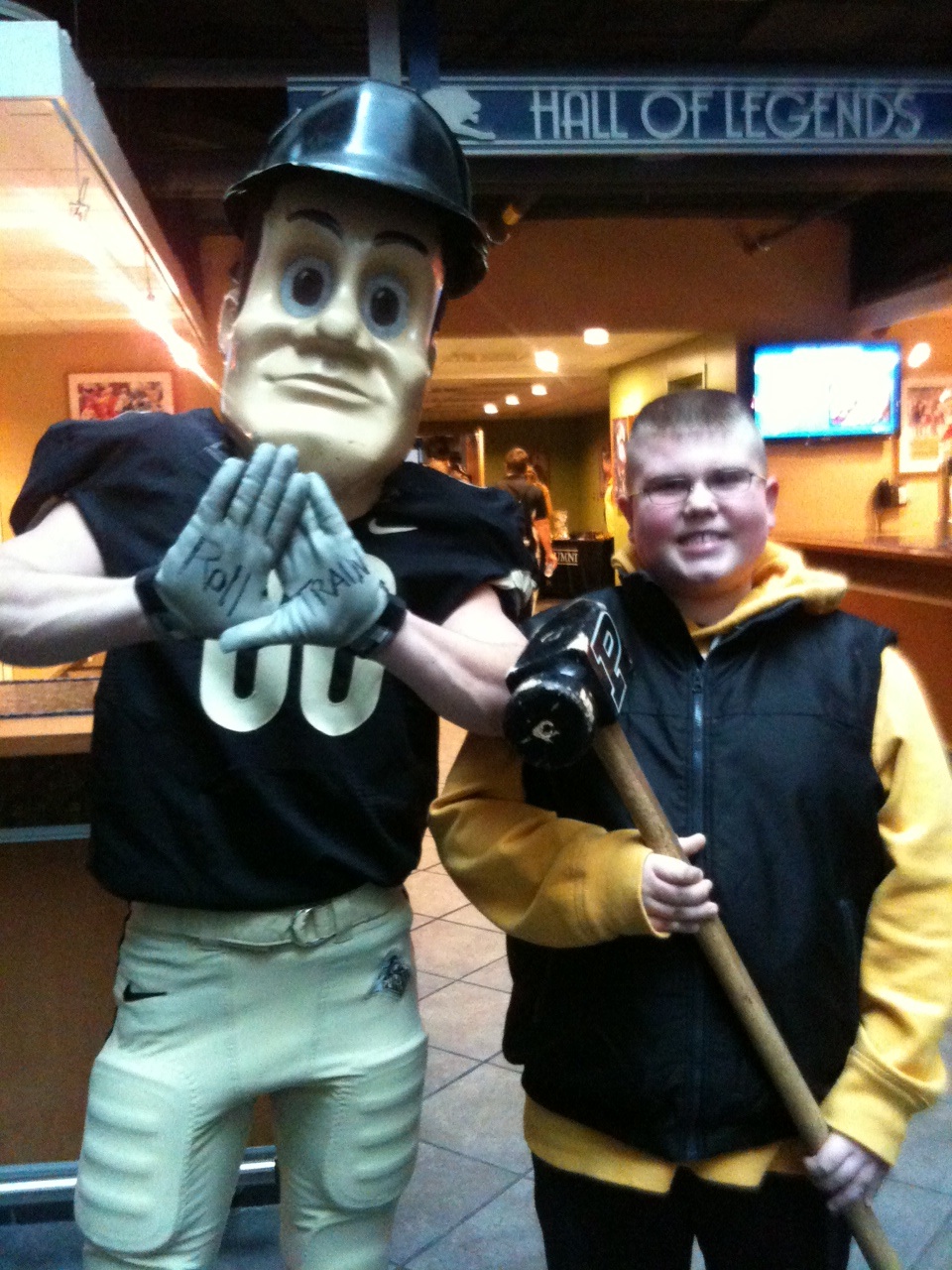
My son, Heath, with Purdue Pete
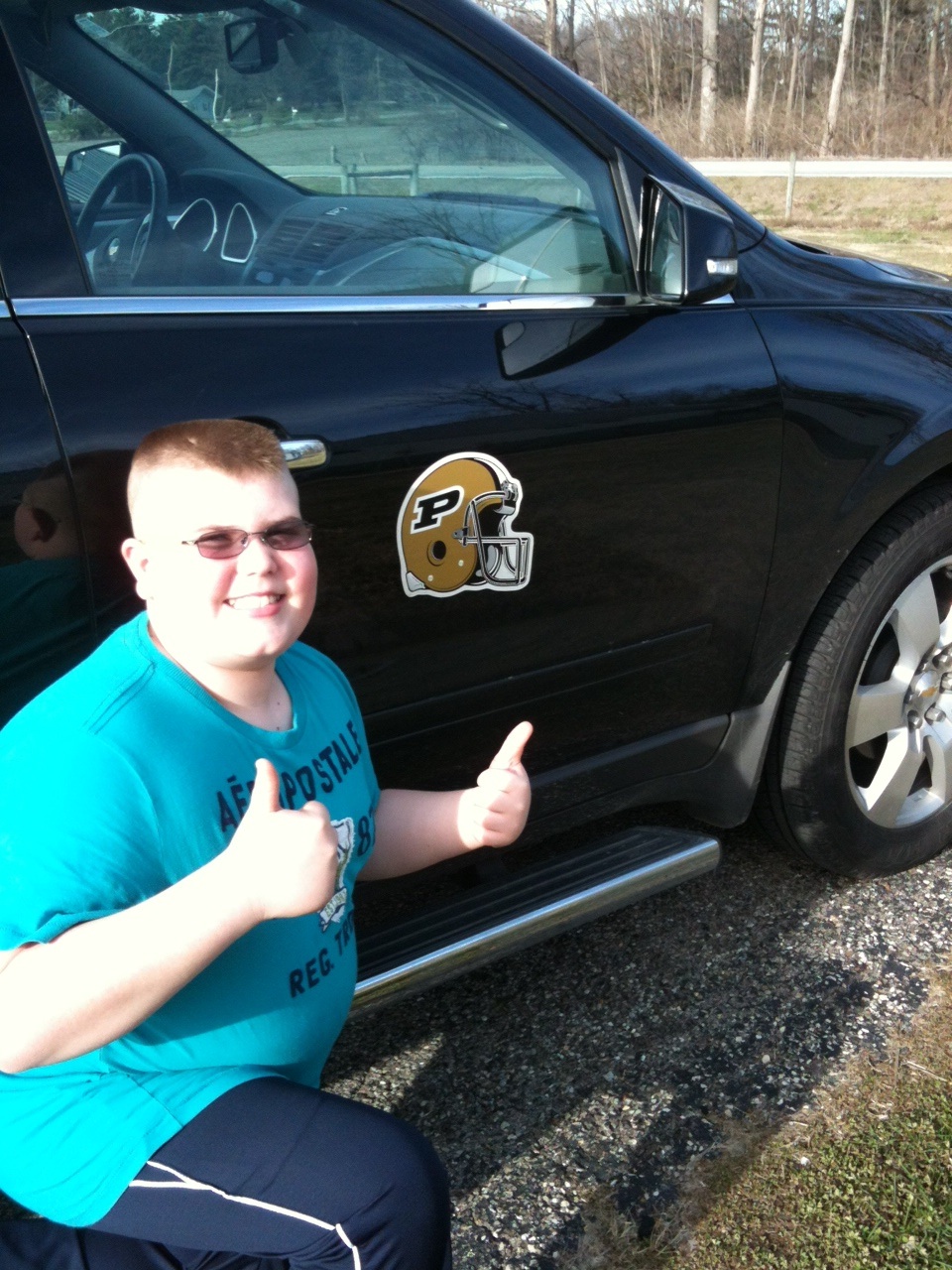
Showing Our Spirit for the Trip to Detroit
This past week at the Little Caesar’s Pizza Bowl in Detroit, Michigan I was reminded as I am at every home Purdue Football game how proud I am to be an American as well as a Purdue alumnus (my wife, Hope, is also an alumna). We made the trip to Detroit a family trip and were not disappointed as our beloved Boilermakers won by a score of 37-32. It was an exciting game with one of the most interesting fourth quarters of a football game I have ever witnessed (I’ll leave that for another story if you did not see the game). We also had a great time pregame with Purdue Pete and all the other bowl festivities.

I Am An American
My post today, however, deals with what I consider to be one of the most moving pregame shows in the world. The Purdue University “All American Marching Band” does a show leading up to the national anthem that includes a portion called “I Am An American.” For a complete story of this show that was first done in 1966 click here. To the left is a picture of the band’s final formation in Ford Field as “I Am An American” was read. I still get goose-bumps and tears in my eyes every time it is done. Amazingly, I had a Western Michigan University fan tell me they were most looking forward to seeing the Purdue “All American Marching Band” perform. That’s pretty cool!

Traditional "Block P" by the Purdue "All American Marching Band"
I close this post and my last post of 2011 as a Proud American and Boilermaker.  Here are the words for you, see if they give you goose-bumps too:
Values, Dreams, & Priorities

In my reading, studying, and reflecting this year I have been reminded time and time again how our values drive us as leaders. Those same values drive me as an educator as well. I am glad that I chose to read the book The Leadership Challenge by Kouzes and Posner. In their book they gave us the five principles of leadership:
- Model the Way
- Inspire a Shared Vision
- Challenge the Process
- Enable Others to Act
- Encourage the Heart
I am not going to write about all of them, but suffice it to say; you need to read the book!
As an educator and leader I must envision exciting and enabling possibilities. As Kouzes and Posner said, “In some ways, leaders live their lives backward. They see pictures in their mind’s eye of what the results will look like even before they’ve started their project, much as an architect draws a picture or an engineer builds a model. Their clear image of the future pulls them forward.” As a teacher leader it is so true that I must live my life backward.

It is important that we see the end goal of what a great school and educational system looks like. Indiana’s State Superintendent of Public Instruction, Tony Bennett, has been a great modeler of this. As a teacher I must live life backwards, by seeing where the students need to be at the end of a course. So how does one live life backwards effectively? VALUES, PRIORITIES, & DREAMS!
In my opinion one of the biggest mistakes teachers and coaches make is teaching and coaching a person where they want them to be instead of where they are. One of my values in education is realizing that we must allow our students to be bad at something before they can get good at it. Let me tell you a story:
An important philosophy I have is allowing students to be bad at something before they can become good at it. The best example I can think of is Scott Martin,[1] a student who was a terrible public speaker. I use many student presentation activities in my classes, so this young man had plenty of opportunity for improvement. While having Scott as a student, a teacher made a comment to me that he did not have students make presentations because they were so poor at it. I remember saying, “Shame on you! How can students get any better if they are not allowed to try, with us helping them?” We must be willing to stand beside our students and allow them to be bad at a skill while we are teaching them to become proficient. Scott Martin went on to become a gifted speaker. In fact, he emceed the opening ceremony for our new welding shop. He did an outstanding job for the ceremony which had school board members, advisory committee members, business and community leaders, and parents in attendance.
As Kouzes and Posner said, values serve as guides to action. It is important to have our values driving us. As a teacher leader those values are equally important.
Many times when collaborating with other teachers it is easy to let that learning time turn into a gripe session about issues that are about the adults (general frustration) and not the students. It’s easy for me to bring the group back to what’s important by reminding them that what is important is the goal of a first rate learning environment for the students of Lebanon High School. In order to speak up w must know what to speak about. Our values give us that voice. Kouzes and Posner said, “Personal values clarity drives commitment.” So for us to have our priorities in order and dreaming positive dreams we must first know what we value most.
[1] Scott Martin graduated May, 2009. Author has permission to use this story.
Great Educators: 30 Days of Restoration
 I am so excited to share with you this week about a book that you all need to buy. The book is Great Educators: 30 Days of Restoration Workbook 2012 Edition. This workbook has been dedicated to all the great educators in the nation. The book is a 30 day exercise for educators to renew an restore their excitement and dedication to their profession. Whether you are a new or experienced teacher, this workbook will help you bring joy and enthusiasm back into your classroom.
This book gives teachers a chance to explore what other educators are doing in their classrooms and schools to be powerfully influential as teacher leaders and highly effective teachers. Each day’s story comes from an award-winning teacher that was nominated to be a part of the book.
Why am I so excited? Because I am featured on Day 24. My plan for Implementing Cross Department Collaboration is outlined in this chapter. Day 24 begins with a quote from me: “Teacher expectations affect student achievement, so it is important that we have high expectations for our students. My personal mission is to use rigor, relevance, and relationships to be a steward of high student achievement.” My chapter deals with realizing the importance of collaboration.
It is important to take time to have a conversation with one another and share successful teaching strategies. Then, teachers will have the opportunity to make adjustments that allow for the creation of innovative ways to teach students how to learn to learn. To do this I introduce a what I call Cross Department Collaboration (CDC). A plan that my Agriculture Science Department uses to meet with anther department each month to share best practices or learn new strategies.
I will let you read the book to learn more about my journey with collaboration and leading our school to become a learning organization. I hope you will consider buying the book. Every chapter has a worksheet section at the end for reflection on the day. This book would be a great source of professional development. Happy reading.
Achieving Student Engagement
 I would like to share some thoughts about and a process that my school is going through to improve student engagement. We all know that to maximize a student’s learning potential, the student must be engaged in the teaching and learning process. It seems that so much of what is happening in schools is either based on old models that are obsolete or so constrained that it doesn’t build thoughtful, responsible young people. Education cannot be about memorizing answers and pleasing the teacher, but must be about critical thinking, collaborative work, and knowing what questions to ask. Learning must be about connecting real world experience to core subject matter.
We, as a teaching staff, are making a concerted effort to provide outstanding instruction to our students. Recently, we asked our students three questions and had small group discussions with all students. Those three questions are: 1. Why do students disengage? 2. How do we improve student engagement? and 3. What can students do to improve engagement?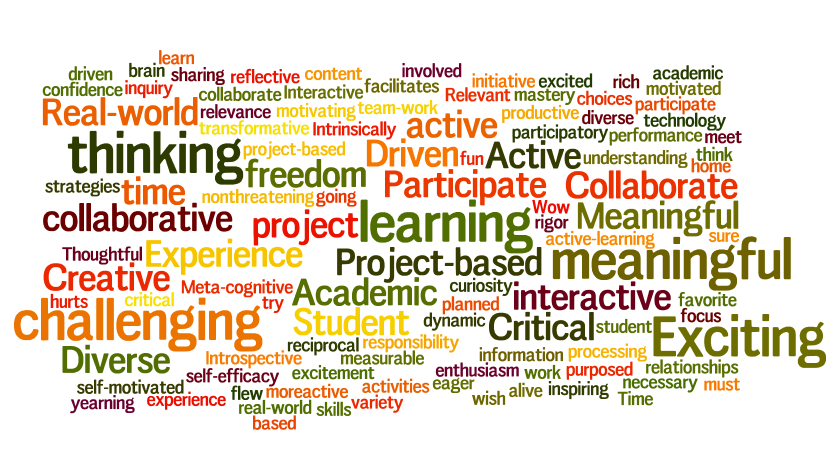
As a teaching staff, we discussed the student responses and found four common themes as to how students are best engaged: 1. Students learn best from Passionate and Energetic teachers; 2. Students learn best from teachers that are Prepared and Creative; Students learn best when the material is Relevant to them; and 4. Students learn best when they best when they believe the teacher genuinely Cares about them.
Next, when we get back from Winter Break we are going to have all the students to discuss what they can do to improve their own engagement. Those discussion items will then be coded into themes for action points of the students.
Our goal through this process is to unlock every student’s and teacher’s potential to maximize their performance.
Iron Triangle of Higher Education
 I had the opportunity to be a part of a group of agriculture industry leaders providing input to Purdue University’s Presidential Search Committee. I took this role very seriously as I saw myself representing both agriculture and education. The Trustee’s and Search Committee’s goal is to match the skill-sets of the top candidates to what Purdue University needs now and ten years in the future.
This is a tall order given the Iron Triangle of Higher Education: Quality, Cost, and Access. Purdue being in a position to appoint a new President is really a great opportunity at a great time. A time when students must thrive in a global market. This will require what Secretary of Education, Arne Duncan, just yesterday said will require “Reimagining how higher education does business.”
“My chief message today is a sobering one,” Secretary Duncan told officials from colleges and universities who were gathered this week at the annual Federal Student Aid conference in Las Vegas. “I want to ask you, and the entire higher education community, to look ahead and start thinking more creatively—and with much greater urgency—about how to contain the spiraling costs of college and reduce the burden of student debt on our nation’s students.” Click here to read his speech. Also, click here to learn more about the administration’s pay-as-you-earn proposal.
Given Secretary Duncan’s call for creative thinking and controlling the cost of higher education and amount of debt students incur I would like to provide a bullet list of the characteristics identified for the new President of Purdue University:
- high energy
- long-term
- familiar with the Land Grant University
- passion for Indiana
- appreciation of agriculture and extension programs
- research and acquisition savvy
- international presence
- able to bridge academia, research and applied science
- global stature – we have to do Indiana and the globe right
- its ok to have have someone with a shorter pedigree to have someone who can be longer term
- Midwestern values
- vision for advancing Purdue University
- balance strategic direction set by the board of trustees, but also foster an entrepreneurial approach
- does not change for the sake of change, but understands why
- able to make smart, quick decisions
- surrounds themselves with smart people
- visionary
- public person
- a person who will know how to staff themselves with the right people
- understands the role of delivery, branding, and recognition
- the person is more important than the resume
- understands public/private partnership
- engagement
- promotes Indiana value-added agriculture
- accessible
- transformational leader
- superb organizational leader
I am sure you can imagine the energy of this almost 3 hour discussion. Purdue Trustee John Hardin said at the end of the discussion, “On a bad day this person needs to be God.” Not an easy task to find a person who can do all of the above. Keep in mind the search committee has had 40+ discussions like the one I was involved in.
Personally, I want a transformational, unconventional leader who will think, as Secretary Arne Duncan has called for, creatively and reimagine higher education. Specifically I want Purdue University to be a leader in bridging the gap between p-12 education and higher education. I continue to stress that with all of the great education reforms in p-12 education in Indiana occurring that higher education, including Purdue University, must also make reforms accordingly.
Think about it, wouldn’t it be great if a students circumstance did not determine what type of education he or she received from pre-k all the way through college? Let’s all be unconventional leaders and solve the Iron Triangle of Higher Education – Quality, Cost, and Access.
Mountains of Thanks

Thanksgiving Reflection!
I have several big projects I am working on right now, and yesterday for some reason at the end of my emails to my collaborators I started typing “We have a lot to be thankful for.”
Then I got to thinking that I was typing it, but had I stopped to reflect on all I had to be thankful for? Well, here goes my attempt at doing so. My top ten list to be thankful for:
#1. Isn’t it cool that we serve a God that shows grace, continues to put us in the right place at the right time, puts the right people in our lives at the right time, and all the other great things even though, in my case, we fail miserably at serving him?
(The gap here is to emphasize how much more important #1 is than anything else I have to be thankful for!)
#2. An incredible wife and son. They make me better everyday.
#3. Great leaders who I consider coaches, mentors, and great friends. Such as Dr. Tony Bennett, State Superintendent of Public Instruction; Kevin Eikenberry, The Eikenberry Group; Dr. Dale Whittaker, Purdue University; Dr. Jay Akridge, Dean of the College of Agriculture at Purdue University, Dr. Pamela Harrison, my Doctoral Committee Chair at Walden University; and Dr. Hobe Jones, retired Purdue University Professor who got me into teaching.
#4. The greatest Agriculture Science Teaching Staff in the country: Stacey Hartley, Ambra Tennery, and Kristen Scott.
#5. Outstanding students that are all ROCK STARS!
#6. Outstanding teachers to teach with.
#7. Outstanding school to teach in.
#8. Incredible corporate partners that help me be an effective teacher like SMART Technologies, Apple, Steelcase, Pasco, and many more.
#9. Community that cares about our school and education.
#10. The ability to DREAM BIG & HAVE ZERO FEAR OF FAILURE!
There are things I am sure I will think of after I hit “Publish,” but as I always say, “Don’t let perfection get in the way of a great thing.” I am so glad I took time for this reflection & encourage you to do the same.
Passion is Tough Work!
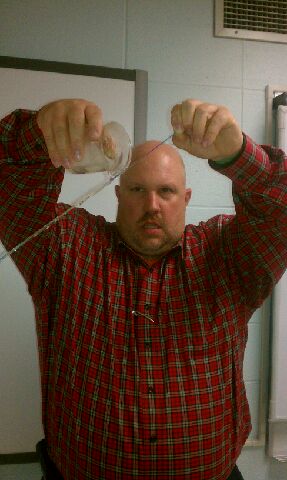
Me passionately teaching Adhesion & Cohesion
The word “Passion” comes from the Latin word “pati,” which means to endure, submit, or suffer. This past week I was really able to make the connection between what we usually think of passion being and the Latin word pati. We did a professional development that involved our entire student body providing a list of reasons why students were unengaged. One of the top reasons was some of our teachers having a lack of passion. Interesting that our students realize it, but some those very same teachers don’t see it in themselves. Gives validity to doing 360 degree evaluations.
It really saddened me to hear that said about teachers in our building because I consider myself very passionate. Then when I started thinking about it in light of how I view passion – powerful or compelling emotion and having a strong desire to accomplish something – I thought, wow, passion is really hard work. If we have passion it is really intense. It drives us and sometimes its painful. Sometimes it even eludes us.
Our professional development exercise reminds me, however, that it is important to our students to come to our learning environment prepared and with passion every day. This past week I finished reading the incredible book, Class Warfare: Inside the Fight to Fix America’s Schools by Steven Brill. In this book, Brill really drove home the fact that, “Truly effective teaching, could overcome student indifference, parental disengagement, and poverty – and, in fact, was the key to enabling children to rise above those circumstances” (2011, p.1). When I see that in print it really drives home the importance of what I do every day.
Brill (2011) went on to say, “successful teaching is grueling work. It required more talent, more preparation, more daily reevaluation and retooling, more hours in the class day, and just plain more perseverance than many teachers, and most teachers’ union contracts, were willing or able to provide” (p. 2). After seeing the thoughts of our students I would say Brill is spot-on right.
All of this reminded me that my continued passion is important, and all teachers need to self-evaluate and see if they have the passion it takes to do the work of educating our students. Guess what? If not, it’s probably time to find something else to do. It’s not an easy profession, but an important profession that deserves to be done by only the best and most passionate professionals.
Brill, S. (2011). Class warfare: Inside the fight to fix America’s schools. New York, NY: Simon & Schuster.


3 comments