Proverbs 29:18
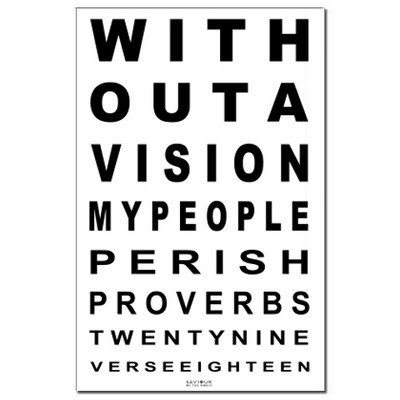 For the second week in a row I am going to reference a Bible verse. I received an email from one of our teachers this week thanking me for the leadership I have been providing. I really appreciated the email, but also appreciated the reminder of what it says in Proverbs 29:18: “where there is no vision, the people perish but blessed is he who keeps the law.” It was great to see this reference in his email.
I love references to Proverbs because I read a chapter a day, as there are 31 chapters. Perfect for a daily reading. I learned this from reading Steven Scott’s The Richest Man Who Ever Lived: King Solomon’s Secrets To Success, Wealth, and Happiness.
This reference was so appreciated because I believe having a vision is so important. More important than the vision is the action. You can plan and visualize all you want, but until you “do” nothing happens. We have a vision for a great school for our students and are working very hard to provide that.
Am I Done? No!

The Horizon Has No Boundary
Yesterday (September 29, 2012) I had the honor of addressing the graduates of the Northwest Indiana Campus of the University of Phoenix on the beautiful campus of Valparaiso University in Valparaiso, Indiana as their keynote speaker. Earlier in the summer I addressed the University of Phoenix graduates of the Indianapolis campus with a speech I titled “It’s Not All About You!” When asked to serve as the keynote speaker again for another campus I asked what they wanted me to focus on. They told me to give the same speech I had in Indianapolis. I featured that speech in my blog on July 4th. To read the speech click here.
The University of Phoenix has an incredible graduation ceremony which features graduates reflecting on their experience with the university. I was moved by the student speakers yesterday. One, Sherri Green, told about how she had gotten tired of training individuals with degrees to take her jobs. She then told how she started her degree and then was in an accident and had to fight through a long rehabilitation to finish her associates degree. Throughout her speech she kept referring back to a question – “Am I Done?” Then she would say, “No!” She finished her speech with “Am I Done?” “No,” she continued, “I have now started my Bachelor’s Degree!” I was so moved because my speech of “It’s Not All About You!” could easily be retitled “Am I Done? No!” because I spent a great deal of time talking about a very important point – YOU MUST BE READY FOR WHAT YOU DON’T KNOW YOU NEED TO BE READY FOR!
This also goes right along with my new definition of a Lifelong Learner: Education continues an unfinished past into the future. Think about it; this applies to all of us. We all have an unfinished past. As James P. Carse put it in the tremendous book Finite and Infinite Games: A Vision of Life As Play and Possibility (Carse, 1986) one never reaches a horizon. It is not a line; it has no place; it encloses no field; its location is always relative to the view. One can therefore never be close to one’s horizon, though one may certainly have a short range of vision, a narrow horizon.
Those of us who live life as an infinite game see life as theatrical and never ending. We see our death happening while we are living. The finite see it happening at the end of life. “We are never somewhere in relation to the horizon since the horizon moves with our vision” (Carse, 1986). In other words, every move I make is toward the horizon not toward a boundary. As Carse (1986) put it: “Who lives horizontally is never somewhere, but always in passage.” I am hoping you are like me and what to live horizontally, because; I AM NOT DONE!
Reference
Carse, J. P. (1986). Finite and infinite games: A vision of life as play and possibility. New York, NY: The Free Press.
Mind Vs. Brain
 I just finished reading Walter Isaacson’s Einstein. Besides being a great read, I learned so much from reading this book. From an educator’s perspective I found it amazing that Einstein always believed that he had no special talent – he was just as he said, “passionately curious.” This points to the important fact that we have a tremendous obligation to help our students develop and find their curiosity. Einstein posited that the brain was wired and set up as it was, but we all have the ability to develop the mind.
It is important for us to develop and create minds that question. Individuals with intuition and imagination are crucial to our future. The locksmith of the atom and universe also realized that power without wisdom is deadly. The events of the time that Einstein lived was proof of this. Along with developing the free mind and curiosity we must have tolerance and humility. Einstein was a very humble man and we can all learn a lot from his example!
Mending Fences
 As most of you know I live on a farm. My son raises Jersey dairy cows so one of the jobs that periodically has to happen is fence maintenance. I got to thinking how true this is in leadership of organizations as well. There are basically four jobs my son and I were doing:
#1. Checking for areas that needed maintenance or repair.
#2. Tightening up loose wires (we have high tensile fence).
#3. Replacing fence staples that had popped out (the fence staples hold the high tensile wire to the posts).
#4. Cleaning out and spraying weeds around the fence.
If these four maintenance items are taken care of regularly a fence will remain strong and do it’s job. Let’s look at each of these actions individually and compare them to leadership in an organization.
Checking of Areas of Needed Maintenance/Repair
Marzano (2005) calls this situational awareness and has it as #2o on his list of 21 Responsibilities of a Leader. Situational awareness is knowledge of what is going on in the school (or organization), feelings and emotions, day to day activities. This will allow the leader to anticipate any issues, or be better prepared should a situation arise (Marzano, 2005). It is very important that we, as leaders, know what is going on in our organizations. We must be out checking the fences, so to speak, knowing what is going on. As I always say, “People by day, paperwork at night.”
Tightening Up Loose Wires
Our high Tensile fence makes use of eight wires (heavy gauge) that are tightened to give them strength. Loose wires encourage the animal to try to go through. Because I believe in the flattened hierarchy of the learning organization (Garvin, 2000) I really believe in a tight-loose approach to leadership. Successful organizations ensure every person, regardless of position, has a clear understanding of what the vision and mission is and the ability and the opportunity to achieve the goals and drive results. Movement toward a tight-loose culture, which is high on clarity and empowerment, enables all employees to lead from where they are and be effective ambassadors for their organization.
Replacing Fence Staples That Have Popped Out
This may mean at times we may need to bring new people in to replace employees that just aren’t getting it done or provide professional development to get individuals back on track. This goes back to my first point of being situationally aware of what is going on.
Removing the Weeds
This point is so important to leading an organization. Weed removal is analagous to leading in a complex organization. Just as the fence needs a clear pathway to realize it’s full potential, so do our team members. An ideal environment contains the correct mixture of diversity, climate, capability, and potential. The key is to cultivate them and diligently remove the competition (weeds) and through really understanding (situational awareness) their different needs, build lasting relationships.
Hopefully, these four points of fence mending and maintenance can help you do a better job of maintaining your organization!
References
Garvin, D. A. (2000). Learning in action: A guide to putting the learning organization to work. Boston, MA: Harvard Business School Press.
Marzano, R. J. (2005). School leadership that works: From research to results. Alexandria, VA: Association for Supervision and Curriculum Development.
Twas The Night Before!
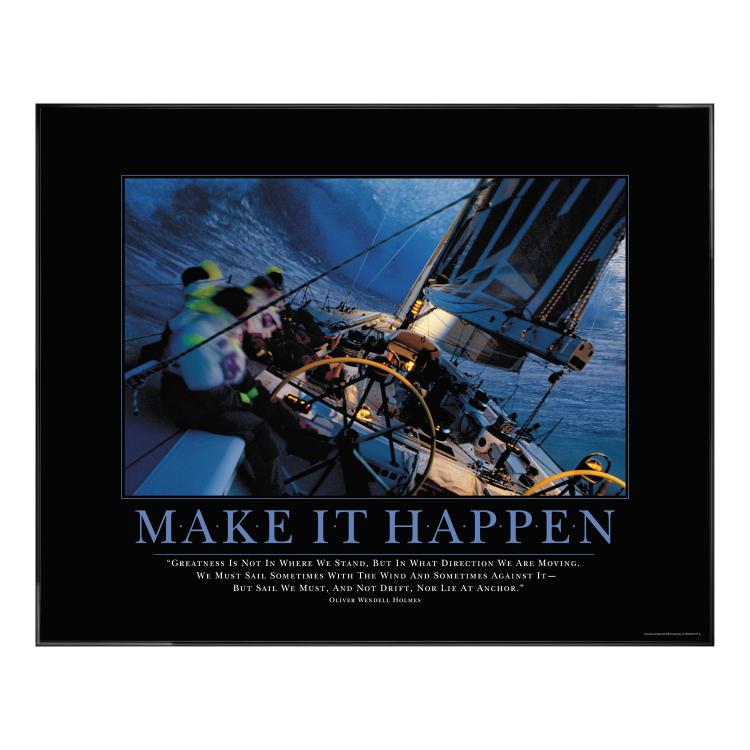
“Make It Happen”
Well here we are the Saturday before school starts at Emmerich Manual High School. As the new principal of one of the state’s turnaround academies I am so excited to finally have students here on Monday morning. I am so excited about our ADVANTAGE: Putting Students First!
For this week’s post I would like to share with you the letter I put in our first newsletter that will be given to the students on Monday. Here it is:
Hello Emmerich Manual High School students, parents, and community stakeholders,
It is with great excitement and anticipation that I write this first entry in our school newsletter! On Monday, August 6, we officially begin our partnership for the critically important task of providing highly effective learning for the students of Emmerich Manual High School. I am grateful that I have the opportunity to serve as your Principal. I want you to know I am excited to be taking this journey with you.
As a teacher my mission statement was always “to be a steward of high student achievement and performance through rigor, relevance, and relationships.” These will continue to be cornerstones that I believe are very important to highly effective teaching for our students. I would also add the fourth “R” of “Results Driven.” If we truly put our students first we will be victorious in this endeavor together and our students will win the results of high student achievement and performance and being college and career ready.
In my office I have a picture titled “Make It Happen.” The inscription reads: “Greatness is not where we stand, but in what direction we are moving. We must sail sometimes with the wind and sometimes against it – But sail we must, and not drift, nor lie at anchor,” by Oliver Wendell Holmes. This picture has a brass plate with the inscription: Emmerich Manual High School Advantage: Putting Students First, additionally, the picture is matted in such a way to have signatures put on it. I am having all staff sign this picture as a reminder that everything we do will be driven by putting our students first.
This is going to be a very exciting year. We have an incredible staff and enthusiastic and well-prepared teachers that will be facilitating engaging learning for our students. Also, I cannot wait for our athletic seasons to start, especially with the return of football.
Please know I am proud to be serving as your principal; this will be an exciting journey as we sail toward putting the students of Emmerich Manual High School first!
Positively,
Byron L. Ernest, Principal
It’s Not All About You!
 Last Saturday, June 30, 2012, I had the distinct honor of addressing the graduates of the University of Phoenix with the keynote graduation address. It was such an honor to address the the 2,500 in attendance and I would like to share my speech with you here:
Members of the University of Phoenix Class of 2012:
This experience, as your keynote graduation speaker, very much like my career in education was not a goal that I set out to accomplish. Instead, because of the collaboration of many others, has been just like my career in education – an incredible journey that I will value forever – a journey that has led me in front of you today.
There was no epiphany when I said, “I am going to be a teacher!”
There was no pressure from home to be a third generation educator. There was no epiphany where I said, “I am going to be Indiana’s Teacher of the Year or Principal of Emmerich Manual High School, one of Indiana’s first turnaround academies.”
What I had were fans, a supportive front line, and a great coaching staff. Let me explain why I use the football analogy here. I had the opportunity a few years ago to meet and visit with Terry Bradshaw, the storied quarterback for the Pittsburg Steelers. He told me a story that has turned into one of the greatest educational and leadership lessons I know. Here’s what he said, “Byron, I was standing on the four yard line ready to score a touchdown in my fourth Super Bowl win, knowing this would be my last game before my retirement. I took a timeout and did not go to the sideline but spun around and looked at all of the fans, I looked over at our bench and coaches, and then I looked at my offensive line who had given me so much protection and opened up holes for so many huge plays to happen, and finally I looked over at my running backs and receivers who always made me look good.” Byron, he continued, “I realized right then and there that my amazing professional football career was not about me. It was about something much bigger – all those others that I just spun around and looked to.”
Today for you, just like Terry Bradshaw’s experience, is much bigger than just you. In fact as much as today is about celebrating your personal achievement of graduation – it’s not all about you. It’s about having a strong support network that I know supported you in this process. You know who that support network is – it is the faculty, friends, and family – make sure you thank them. In fact I would like for you to stand right now and join me in giving that support network a hand.
Ladies and gentlemen, I want you to understand what I have said and continue to say about my educational experience and career – It is much bigger than me. Hopefully my journey of ending up in front of you today can serve as a platform for others to follow.
Why is this bigger than me? Let me share with you my story of how I even ended up in education. I became a teacher because a professor at Purdue University cared, and pulled me into his office for a conversation one day that would change my life forever. Dr. Hobe Jones, my Purdue University Animal Science professor and counselor, said, “Byron, have you ever considered a career in teaching?” After giving what was probably a Hannah Montana type response of “You say what?” He knew I had not considered this as an option. After I promptly told him I had come to Purdue in Animal Science, and was going to graduate on time (keep in mind this was the spring semester of my sophomore year) he said, “Byron you are a great student and I will make sure you graduate on time.” Reluctantly, I agreed to graduate from Purdue with two B.S. Degrees. One which I never thought I would use – Agricultural Education and the other in Animal Science. It is interesting that with the focus now on content area mastery, I look back and really value my Animal Science Degree because it gave me the extra content area mastery to succeed during the teaching part of my career. It is Dr. Jones’ caring guidance that I tried to emulate every day as a teacher and now as a principal of an inner city school.
Can you imagine if I would have had to plan out my life’s journey in exact detail at the time Dr. Jones was recommending I become a teacher? Why, I would have had that all screwed up. It’s about BEING PREPARED FOR WHAT YOU DON’T KNOW YOU NEED TO BE PREPARED FOR. Let me say that one more time – It’s about BEING PREPARED FOR WHAT YOU DON’T KNOW YOU NEED TO BE PREPARED FOR.
You have made the first step in achieving this by graduating in your chosen field of study today. But make no mistake, your diploma is not an award, it is a ticket – a ticket to an incredible journey of giving back and continued learning! As the late John Wooden put so eloquently, “Its what you learn after you know it all that counts!”
Let’s break that giving back down by first looking at the University of Phoenix Mission and Purpose: University of Phoenix provides access to higher education opportunities that enable students to develop knowledge and skills necessary to achieve their professional goals, improve the productivity of their organizations and provide leadership and service to their communities. Notice it did not say that the University of Phoenix would award you a diploma, and you could then go have a party!
I’m not saying that is not allowed, but I am saying we need to take a look at how you now live out the mission and purpose by which the University of Phoenix facilitated your education.
Let’s break this down into three parts. #1. Access to higher education opportunities that enable students to develop knowledge and skills necessary to achieve their professional goals. As you graduate, University of Phoenix has done their job for the first part of the mission and purpose, but only to the extent of your professional goals today. Realistically, those may change, or even be changed for you tomorrow. Again, remember what I said earlier, YOU MUST BE PREPARED FOR WHAT YOU DON’T KNOW YOU NEED TO BE PREPARED FOR! The beauty of this is you have been empowered with the foundational knowledge to become or continue to be a lifelong learner. My challenge to you is to never be satisfied! Continue to take on educational challenges. We all need to be pushed.
Let me share one of my favorite parables. It is about the King who stood upon the banks of a mighty river with his daughter, the princess. His courageous warriors stood on the opposing bank.
The king knew that he would not live forever and so he wanted a prince who could lead his kingdom. He issued a decree: “I am looking for a brave warrior, a leader among men!” A roar rose over the raging rapids of the mighty crocodile-infested river. “I have a challenge!” Whoever shall swim across this river shall have all my riches and my daughter’s hand in marriage or anything else his heart desires.” The princess was a beautiful and brilliant young woman; the king possessed untold riches in gold and diamonds; but there was that river – that raging, crocodile-infested river…
The warriors looked at one another, exchanged wary glances, and suddenly – splash! A hole appeared in their ranks. They noticed one of their own, a young warrior, in the river, fighting desperately to make the crossing. As the crocs slithered into the water, headed toward the young man, a collective shout sounded over both banks: the young man swam! His arms pumped, his back flexed, his legs churned the water like propellers. The roar grew louder as the young man disappeared into the undertow and emerged again – pursued by the razor-toothed, prehistoric-looking reptiles. With one last burst he catapulted out of the river and onto the bank, grasping the hand of the king himself, who’d reached down to pull the young man out of the river.
The young warrior stood for just a moment until, overcome with emotion and fatigue, his hands dropped to his knees. The king at that moment raised the young man’s hand high into the air. In a booming voice, he announced, “Young man, you made it. You succeeded against all odds. You may have all my riches and my daughter’s hand in marriage.”
The young man looked at the king and the warriors back on the distant bank before speaking. “Your highness,” he said, “you are a wealthy and benevolent man” – his chest heaved as he paused to catch his breath – “and your daughter is beautiful, indeed…” He hunched over and, now facing the cheering warriors he had left on the far bank, shouted: “All I want is the fool that pushed me into the water!”
You’ve been pushed. Now swim like your life depends on it!
Now let’s look at mission and purpose #2. Improve the productivity of their organizations. I believe that one of the most important functions of any institution, no matter what level – k-16 and beyond, is to teach students to learn to learn. I know this is how University of Phoenix empowers their learners. No matter where your career is now or will take you, you must practice learning to learn and the sharing of that knowledge in the truest sense of a learning organization.
In his book, Power: Why Some People Have It – And Others Don’t Jeffrey Pfeffer calls it “Feedforward,” which emphasizes what people need to do to get ready for the subsequent positions and career challenges they will confront…focusing on what you need to change to accomplish future personal goals can be much more uplifting than going back and reviewing past setbacks or considering areas of weakness.
Finally, #3. Provide leadership and service to their communities. This one is of the upmost importance. You all have an obligation to become agents of social change. In other words, set out to make a life – not just a living. When you make a living, you pay your bills. When you make a life, you pay your debt. We all have a debt to be an agent of social change.
Now I want to recap a couple of things. Don’t forget you must prepare for what you don’t know to be prepared for. Also you must learn to learn. And you must set out to make a life, not just a living. Make sure you are walking the talk and always remember you have the ability to at any time do what I call Byron’s three “R’s” of life: Retool, Reposition, and Re-Launch. By Retooling, Repositioning, and Re-launching, you become the lifelong learner that is always prepared for the next opportunity.
Why is this bigger than you and me? We must always remember that we are successful as leaders not due to solitary efforts, but due to organizational and collaborative success. I would like to close with a poem that I believe sums up everything I have been trying to say today:
Wreckers or Builders
I watched them tearing a building down,
A gang of men in a busy town.
With a ho-heave-ho and lusty yell,
They swung a beam and a sidewall fell.
I asked the foreman, “Are these men skilled,
As the men you’d hire if you had to build?”
He gave me a laugh and said, “No indeed!
Just common labor is all I need.
I can easily wreck in a day or two
What builders have taken a year to do.”
And I tho’t to myself as I went my way,
Which of these two roles have I tried to play?
Am I a builder who works with care,
Measuring life by the rule and square?
Am I shaping my deeds by a well-made plan,
Patiently doing the best I can?
Or am I a wrecker who walks the town,
Content with the labor of tearing down?
Thank you for allowing me to have this BIGGER THAN ME experience and be part of your graduation!
Good Is Not Enough!

This past week I had the opportunity to speak to the faculty of University of Phoenix prior to delivering the keynote address for their graduation ceremony. I would like to share with you my notes from this speech here:
I would like to start today with an excerpt that I have done some creative editing on from Onward: How Starbucks fought for its life without losing its soul. I believe you will find that this comparison of teaching to a successful business model fits right in with what I consider my and my school’s ADVANTAGE: “Putting Students First.”
Here is the excerpt adapted from Onward:
Pouring espresso (Teaching) is an art, one that requires the barista (teacher) to care about the quality of the beverage (education). If the barista (teacher) only goes through the motions, if he or she does not care and produces an inferior espresso (student) that is too weak or too bitter (not ready to compete), then Starbucks (teaching) has lost the essence of what we set out to do 40 years ago (in 1635): inspire the human spirit. I realize this is a lofty mission for a cup of coffee (education), but this is what merchants (teachers) do. We take the ordinary – a shoe (boy), a knife (girl) – and give it (them) new life, believing that what we create has the potential to touch others’ lives because it (their lives) touched ours.
I believe this is such a great representation of what we all do in this room – EDUCATE. As Henry Adams put it, “A teacher affects eternity; he can never tell where his influence stops.”
As a teacher my personal mission statement was, “I strive to use rigor, relevance and relationships to be a steward of high student achievement.” I have given a lot of thought about what my personal mission statement should not be as a principal, and then realized it really does not change. All I am doing is adding one new “R” – Results Driven.
Someone recently asked my to use a word to define myself. I chose “Trailblazer”
Goes before others go!
Don’t send someone where you are not willing to go yourself.
A “Trailblazer” is not a travel agent. Travel agents send people places they have never been. Trailblazer set the path for others to follow or even go down simultaneously with the leader.
We must follow Kouzes and Posner’s Ten Truths of Leadership:
- You make a difference
- Credibility
- Values
- Focusing on the future
- You can’t do it alone
- Trust rules
- Challenge is the crucible for greatness
- Lead by example
- The best leaders are the best learners
- Leadership is an affair of the heart
Remember, if better is even possible, good is not enough!
What If Teaching Was Our Most Important & Valued Profession?
 Great teachers build nations. Great teachers provide the inspiration for highly engaged and effective learning. They awaken and raise our children’s expectations. Great teachers also inspire creation through tapping into students’ imaginations that lead to discovery. They shape our next generation of great decision-makers.
Let’s be clear, teaching is hard work done correctly. Most high level professions are. So again, let’s be clear teaching is a high level profession. As I reflect on my career, my choosing to be a teacher was a very deliberate choice based on the mentoring of a college professor (teacher).
My teaching career did not begin with the same story that many teachers share. I did not have an epiphany when I said to myself, “I want to be a teacher.” My journey as an educator began during my sophomore year at Purdue University when Professor Hobe Jones pulled me into his office and asked if I had ever considered teaching. When I said, “no,” he explained that he saw a talent in me for educating and wanted me to double major in Animal Science and Agricultural Education. It is amazing how someone like Dr. Jones can make a huge impact on someone’s life. His inspiration and personal interest helped me to deal with the challenges of a double major, making my 27 year educational career possible. Without Dr. Jones’ personal interest in my abilities, I probably would have missed this opportunity. It is his example of true caring that I strive to emulate every day of my teaching career.
Teaching is a high level profession and we need to become very deliberate in recruiting students into this profession. Only the best will do for our children. As Superintendent of Public Instruction, Dr. Tony Bennett says: “What if Indiana’s most important work was also our most valued work?” In closing I would like to share a video I was part of making with the Indiana Department of Education in honor of Teacher Appreciation Week entitled: What if? To view the video click here.
Do You Know What Your Guns Can Do? Or Can’t?
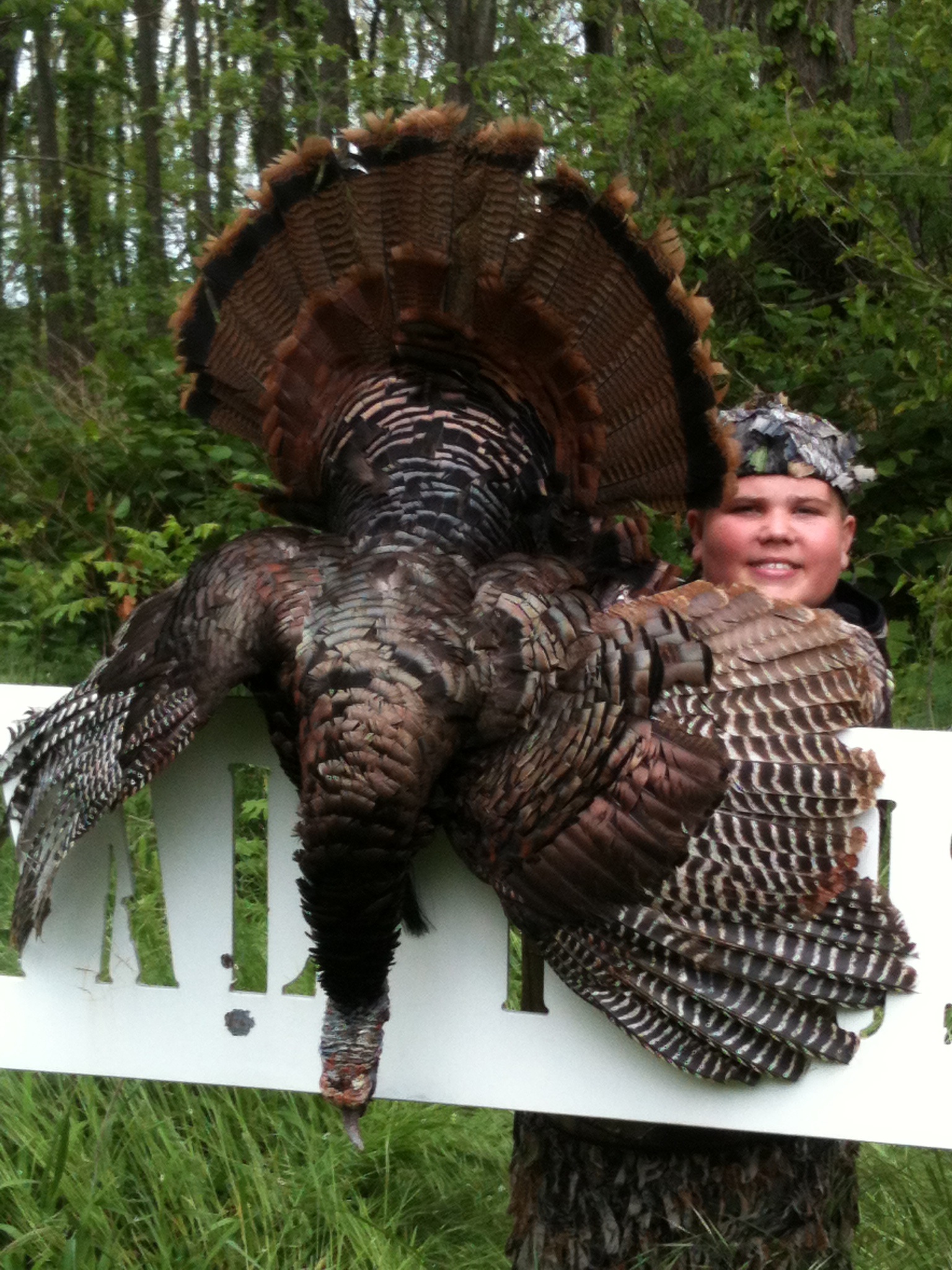
Heath Ernest, 4/21/12
This past weekend my son, Heath, harvested his third turkey in a row on Youth Spring Turkey Hunt weekend. Two years ago when he shot his first turkey I posted Talkin’ Turkey About Coaching (click here to read entire post). I was reminded again this year how important knowing what you can do and what you can’t are. Let’s use Heath’s gun for this analogy.
Heath hunts turkeys with a Remington 870 Youth 20 gauge shotgun. The preferred gun for hunting turkeys would be a 12 gauge in order to have more distance, but the youth guns do not come in a 12 gauge. Therefore, we know that Heath has distance limitations – what he can’t do. We also have taken the time to practice with many different combinations of ammunition and chokes (the part of the gun that controls the patter) – what he can do.
Heath knows that when a turkey is 23 yards or closer he can be successful. At 23 1/2 yards his gun does not have a pattern left to harvest a turkey. He knows all of the capabilities of his gun because of practicing and actionable feedback. He harvested his turkey on the 57th shell of the season. In other words he had taken 56 shots at targets prior to harvesting his turkey.  Because of the feedback from the targets and shots taken at different distances, Heath knows exactly how to adjust to any situation.
It is also important to note that from the time we first saw his big Tom it took 2 hours and 34 minutes to get him into acceptable range. There were a few times when he got close only to move back, well out of range. It took the guesswork out of decision making for Heath and I gave him distances from our rangefinder. He knew exactly what he and his gun could do and waited patiently for the turkey to be at the correct distance.
Let’s relate this to business and education. It is so important that we know what our guns (people) can accomplish and what they can’t, areas for improvement, and reflection on how to accomplish the mission and vision. This feedback and reflection provides insight about the skills and behaviors desired in the organization to accomplish the mission, vision, and goals and live the values. The feedback is firmly planted in behaviors needed to exceed the organization’s expectations.
Just as Heath practiced with 56 shots prior to the one used to harvest his turkey, feedback is to assist each individual to understand his or her strengths and weaknesses, and to contribute insights into aspects of his or her work needing professional development. This is also why I am such a huge proponent of IC 20-28-11.5, a new law passed in the spring of 2011 relating to the evaluation of all certified teaching staff and administrators. Without effective evaluation systems, we can’t identify and retain excellent teachers, provide useful feedback and support to help teachers improve, or intervene when teachers consistently perform poorly.
This timely, actionable feedback is crucial for any organization to know what your guns can do or can’t!
Pelican Leadership Lessons

Brown Pelican who became our fishing friend as my son and I were cleaning fish!
I just returned from our annual spring break trip to Destin, Florida. We literally live on the beach for eight days. One of my favorite things about beach life are the Brown Pelicans. Every year I am amazed by these majestic birds and the lessons we can learn from them.
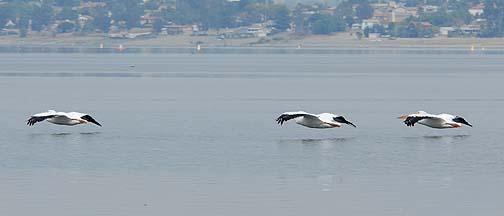 The most amazing thing they do is fly in cooperative “u” and “v” shaped groups. They do this to drive the fish to shallow water. Many times they will beat their wings on the surface of the water to drive the fish. So, like many species they collaborate to catch their food. We can learn from the Brown Pelican that without collaboration, the group/team does not succeed.
It is also amazing to watch these birds fly in a straight line. It is really cool to watch them fly right over the surface of the water. The lead bird will go up and down with the ebb and flow of the waves just above the surface. All the other birds follow in a perfect rhythmic wave. We as leaders need to also make this smooth adjustment to the ebb and flow of our daily happenings. 
Additionally, Pelicans fly in a “V” pattern. Flying this way reduces drag and saves energy (actually up to 20%). Don’t you think collaborating saves 20% of our energy as well? Even more interesting is the fact that the lead bird in the “V” has to work the hardest by breaking through the air where there is the most resistance. Sound familiar? But wait, the Pelicans have figured out this leadership challenge as well. The lead bird does not stay at the point of the “V” for very long. It drops back to let another bird lead so it can rest and have leadership renewal.
This is a very smooth transition that happens in flight. In other words, biological stress necessitates this constant transition. More importantly, every Pelican in the “V” can lead. Can you say that about everyone in your organization? Does everyone have the opportunity or feel the need to lead?
Think about it. For us, biological stress also dictates we need to rest and be renewed. Also, collaborative organizations are healthier when the hierarchies are flattened and leadership is distributed.
I am particularly excited that in Indiana, part of our new teacher evaluation system involves the teachers’ ability to provide school leadership. When effective distributions of leadership occurs all teachers are better able to lead from where they are. Leadership must occur from all levels.
Next time you need a visual reminder of leadership – Look to the Pelican
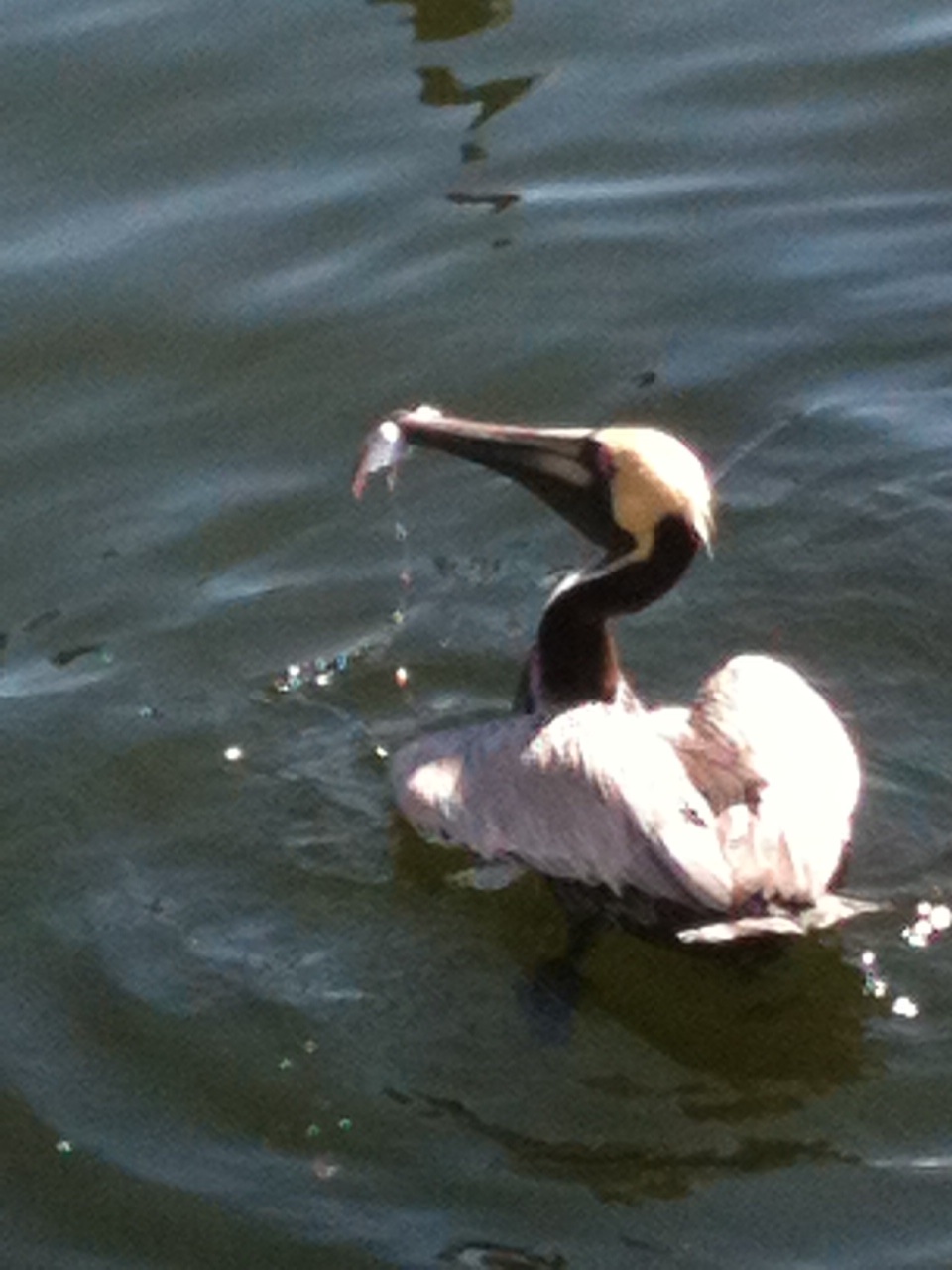
Loving the scraps we were throwing him!


1 comment