Turmoil In Education: No One Right Way To Learn

Korean War Veteran Jerry McCandless Teaching Students From Michigan
Yesterday I had one of the most incredible experiences of my life. On Armed Services Day (May 16) I had the opportunity to serve our Veterans as a Guardian for our Honor Flight sponsored by The Honorable Order of Kentucky Colonels. Once I get sorted through all of my emotions from that experience I will write a post, but for today I am going to use the Veterans as the heroes of a post on education reform. The quote above was actually said by one of the students in the picture. The Veteran, my new friend and hero, Jerry (in the picture), did an incredible job of bringing history alive for these students from Michigan. I have to say he brought it alive for me, too! As a believer and researcher of real world context in education this really drove home the fact that students need to be able to make the connection of what they are learning to their real world context. In fact, it has really got my wheels turning as to how we might, more intentionally, on our Honor Flights connect students with our Veterans. What an untapped wealth of wisdom and knowledge for the students we serve.
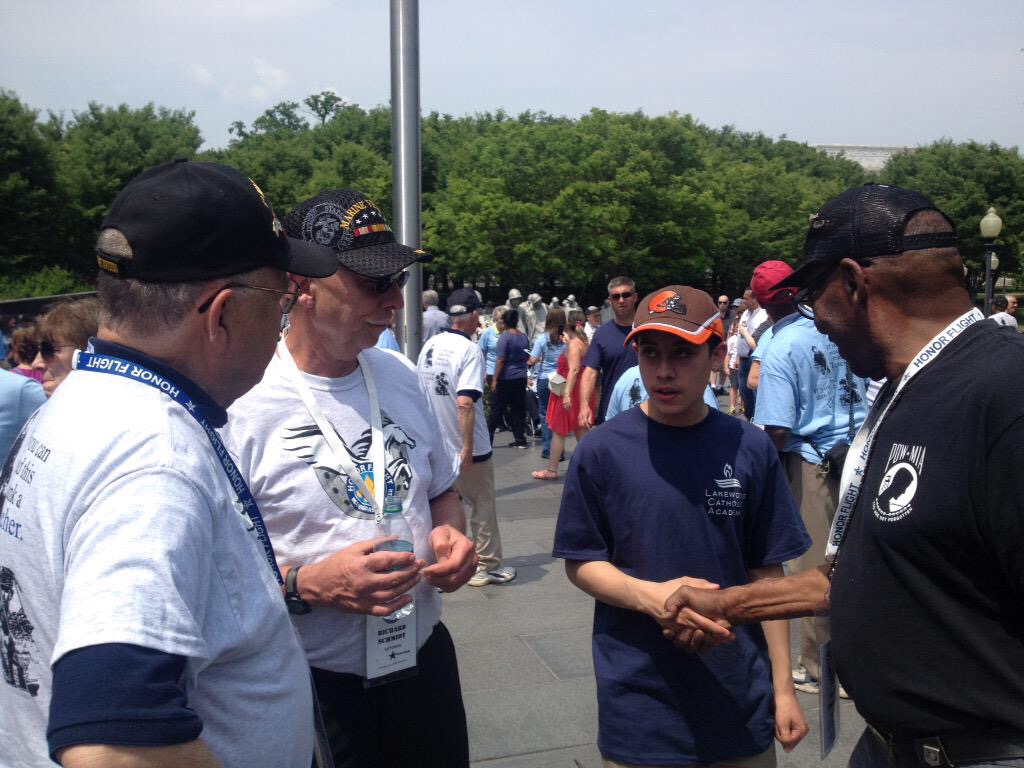
Veterans Jerry McCandless & Richard Schmidt Bringing History Alive For A Student
It was so ironic that this week’s lesson in Marciariello’s (2014) A Year With Peter Drucker was on education. Also, it is ironic that as I type this this post I am sitting in the airport waiting to board a plane for New Orleans for the American Federation for Children’s National Education Policy Summit where I am speaking on a panel on school choice and education reform. Drucker called for a systematic innovation in our schools (Maciariello, 2014). Drucker believed the heart of remediation was a “focus on strength.” He also believed we must stop “treating by patching.”
“Perhaps the time has come for an entrepreneur to start schools based on what we know about learning, rather than the old wives tales about it that have been handed down through the the ages.” ~ Peter Drucker
In September 2012 the Intelligence Unit of “The Economist“ had the United States ranked 17th out 39 countries plus Hong Kong, who was ranked third in Education Attainment, in Cognitive Skills (reading , math, and science) and Education Attainment (literacy and graduation). Bottom line: we have some work to do. “Literacy” traditionally means subject knowledge. In a knowledge society, however, people have to learn how to learn (Maciariello, 2014). The knowledge society also requires lifelong learning. For this we need a discipline of learning. We must also remember that reading is the basic skill needed for lifelong learning.
 Make sure we are aware that learning, to be most effective, should be individualized – otherwise it can be torture!
We must start with the question, “How does each of our students learn most effectively?” Then, and only then, can an individualized plan for lifelong learning be developed. The goal of teaching should be to find the student’s strengths and then focus them on achievement. Students have different patterns of learning – teachers must unlock these patterns. We need to lead our students to great achievement. We need to create a real world connection, excitement, and motivation just as our Veterans did for students yesterday in Washington D.C. This relevancy of context will go a long way in creating intrinsic motivation for the rigorous, disciplined, persistent work, and practice that learning requires. Education is a mentoring process.
Most schools and colleges are organized on the assumption that there is only one right way to learn. If we are going to be successful in truly reforming education we must differentiate the choices students have for schools. I believe in school choice, but we must actually have choices for our families, and then help them make those choices. If all schools are using exactly the same cookie cutter approach, is it really school choice? Another question to ponder in closing, “How do we create more opportunities for our students to glean from the incredible wisdom of our Veterans like Jerry McCandless and Richard Schmidt?
Reference
Maciariello, J. A. (2014). A year with Peter Drucker: 52 weeks of coaching for leadership effectiveness. New York, NY: HarperCollins Publishers.
Creating A New Future: Practice Before Theory
 “The important thing is to identify the ‘future that has already happened.'” ~ Peter Drucker
As an “Energetic Change Agent,” I was really into the week 19 lesson in Maciariello’s (2014) A Year with Peter Drucker: 52 Weeks of Coaching for Leadership and Effectiveness. If you have not begun the journey of reading this book, let me recommend it again. This week’s lesson dealt with identifying emerging trends and how that is different from trying to forecast the future. Identifying trends concentrates on directions and patterns. We must, as leaders, discern patterns from emerging trends, and separate fads from real changes (Maciariello, 2014). I have blogged about change before in other posts, but really dug into this topic in a post entitled: Change Creation is Proactive. You can read that post by clicking here.
Leaders who are effective at facilitating change capitalize on emerging trends and use them to create a new future for their organizations, thus providing a competitive advantage in times of rapid change, This is proactive, not reactive! Again, as was stated in the Drucker quote, this is an exercise in “seeing the future that has already happened.” To create the future any other way is reacting rather than acting, which is what one does if one grows quickly. We need to make sure to study the trends and look for the ‘certainties’ of the future. One place to look for this is in the demographics. One important part of change that I believe was left out of this lesson, and may be discussed in future weeks, is how some organizations ability to create the new future will be impaired by legislation and other government misunderstanding or slowness to adjust. An example is my own: education. As I look back to this year’s legislative session here in Indiana there was a lot of work around education. It is interesting to me that our House of Representatives is very pro “school choice” and innovative practices such as online education, but our Senate is not. Some of our legislation passed is helpful toward the ‘new future,’ but part of it still does not necessarily hinder practices for facilitating futuristic change, but certainly does not serve as a catalyst either.
Therefore, it will be important for us, as leaders of these affected organizations, to help all involved in decision/policy-making to understand the methodology that Drucker outlines to identify “the future that has already happened.” As I describe what Drucker calls the “seven windows of opportunity,” (Maciariello, 2014) think about online education as an example. Online education is already here and I believe everyone would agree it is not going away – nor should it go away. Amazingly, however, there are those that continue to try to block any legislation or policies that help to improve or make online education more effective. So we (and leaders of other such change) will need to help all of those involved understand the seven sources that Drucker outlines as: (1) unexpected success or failure, (2) incongruities, (3) process need, (4) a change in industry or market structure, (5) demographics, (6) changes in perception, (7) new knowledge (Maciariello, 2014). I believe you can extrapolate the implications of the seven windows to your organization. I believe in my own case we have done a pretty good job beginning to work on windows 5, 6, and 7, but we need to continue to put the whole package together to continue to move our cause for the students we serve forward.
“Theory organizes the new realities, it rarely creates them.” ~ Peter Drucker
As a rule, theory does not precede practice (Maciariello, 2014). Decision and policy-makers in government and organizations need to remember this. They need to understand, and few do, that events that have already occurred do not fit their present-day assumptions, and thereby create new realities. We must make sure our policies and structures support “the future that has already happened.”
What steps are you taking to turn future trends and needs into your advantage?
Look for “the future that has already happened” and turn it into an opportunity for innovation. If you do this, you can become an effective change leader. If you are a policy or decision-maker, please make sure you are thinking about how you can support “the future that has already happened.”
Reference
Maciariello, J. A. (2014). A year with Peter Drucker: 52 weeks of coaching for leadership effectiveness. New York, NY: HarperCollins Publishers.
Talkin’ Turkey About Sunk Cost Bias
 I am always amazed at how much I learn on my son and I’s annual turkey hunt. First let me answer the big question on everyone’s mind. Did you get one? I am happy to report that my son did! I did not. For the second year in a row Heath got a turkey and I didn’t. This was his fifth turkey in the seven years we have been hunting together. Not bad for a fourteen year old. In my defense, I did not even take a shot. I saw a bunch of turkeys and witnessed some great wildlife shows, but never a gobbler close enough to harvest.
When turkey hunting there is a great deal of time in solitude for thinking. My favorite time is the first thing in the morning. We get to the woods at 5:00 a.m. and then watch and listen as the woods comes alive. First there are the birds, then the occasional deer, and then the gobble of a roosted turkey. Our two days of turkey hunting each year remind us of all the wonderful creations that God has made. Though my seat attached to my turkey vest is not as comfortable as a yoga mat, I am not any less mindful when in this state of thought and meditation. There are so many things that run through your mind when sitting in total silence and not being able to move. It is exhilerating and I am already looking forward to next year.
On our first morning of the hunt, Saturday, we went to the river bottom along the levee. My son, Heath, set up along the field’s edge that separated the levee from a woods (the turkeys typically come off the levee and graze the field while heading to the woods for the day). I set up about a mile south of him. We both had a great show of turkeys that first morning. I even had a hen come right past me close enough that I could of reached out and touched her. Those that know me are probably amazed that I am able to sit that still in my full camo glory! Anyway, neither of us got a long beard (tom turkey) close enough for harvesting.
Later that afternoon, my wife took Heath to a baseball game (he pitched a save, by the way), and I went back near where we had hunted in the morning. There was a tremendous showing of birds. There was a group of 11 that appeared – four long beards, three jakes (young male), and four hens. They worked the field in front of us for two hours, but we could never call them in close enough for a shot. Then there was a single Tom who strutted around the field like he owned it, but again, not close enough. It was a tremendous show that Walt Disney would have been proud to have filmed for his nature films. But, still, they stayed along the levee side.
The next morning, you guessed it, I went back to the levee. Heath, on the other hand, went to another location. You guessed it, at 8:30 he harvested a bird. I was texted a picture (seen at the top of this post) and was thrilled – the goal is always for Heath to get a bird – I am secondary. Once again, however, I had the greatest show ever. Turkeys were coming off the levee right and left – lots of them. You guessed it, though, they were not interested in coming to me. The Toms were with hens and not interested in what I had to offer. Anyway, it was another great morning of solitude and thought. At least I kept telling myself that!
Toward the end of the morning, as the turkeys were moving out of site I got to thinking about “sunk cost bias.” Was I falling into the trap that leaders fall into. As I thought about this I realized that turkey hunting might be one of the greatest case studies to teach this because I kept getting drawn back to this same area. I knew there were lots of turkeys here. In fact three of Heath’s turkeys he harvested in past years had been taken very near where I was sitting. Also, I had already spent a lot of time there this year. This year, however, the turkeys were just not moving across the fields in the same way – this is what really makes turkey hunting so exciting and facinating. The turkeys never act the same from year to year. Does this sound like any of the organizations you lead? Yet, for some reason I was drawn to this place. Part of it was the fact that it is one of the most beautiful places in the world. Hemlocks were blooming, Blue Jays were playing in the trees above me, a squirrel was hopping from tree to tree, and a Bald Eagle was soaring above. It is just a glorious place to be.
Still, there were all these turkeys. When we regrouped for the afternoon and Heath’s turkey had been processed it was decided to go to another location for the afternoon. “Sunk Cost Bias” had been resisted; at least for now. At 4:30 p.m., after not seeing or hearing any turkeys, it was decided, you guessed it, to go back to the levee. I know what you are thinking: this guy is an idiot because he knows the turkeys won’t come close enough. You are right, I was giving into sunk cost bias. I knew we would see birds, but I would never get a shot. Yet, I was drawn by the fact I had invested so much time there and knew there were turkeys. I had become the poster child of what sunk cost bias is: The sunk cost bias is manifested when we have a greater tendency to continue an endeavour once an investment in money, effort or time has been made.
I was first introduced to this thinking at Harvard University by Dr. Monica Higgins when studying a case study of the 1996 Mount Everest tragedies. Reasoning that further investment is warranted on the fact that the resources already invested will be lost otherwise, not taking into consideration the overall losses involved in the further investment. During the Mount Everest tragedy the sunk cost bias was carried out on two fronts: 1. At the time of starting for the summit, some thought the conditions were not right, but they had come all this way and were not going to wait; and, 2. Many that died did not summit by the 2:00 p.m. cutoff time (the time set to turn around if a summit had not been made yet) but went ahead and summited as much as two hours late. Again, the thought of “I’ve invested all this time, money, effort, et cetera and by golly I am going to summit Mount Everest” was at play there.
Obviously, my life was not on the line, but by going back to the levee for one last ditch effort at the end of our last day of hunting was giving into sunk cost bias. You guessed it, too, we saw a lot of turkeys but none came close enough. What I was failing to realize is that moving back to the levee would most likely result in the loss of much more time and not getting a turkey. I was thinking short-term, not long-term, and simply trying to avoid not getting a turkey, which was fallacious thinking. It was really thinking from a defensive posture and not an offensive one. This experience has really caused me to think about the strategic and academic plans we are carrying out in the schools I lead. Do we have areas of sunk cost bias? It begs taking an introspective look.
When we make a hopeless inventment of time, treasures, or talents we sometimes reason: We can’t stop now, otherwise what we have invested so far will be lost. This is true, of course, but irrelevant to whether we should continue on with the plan. If the plan will not work that everything invested will be lost regardless. Therefore, it really is irrational to continue, but yet we (at least me) continue on anyway. The rational thing for me to do on our turkey hunt would have been to try a new spot. Why didn’t I make the rationale choice: Our decisions are tainted by the emotional investments we accumulate, and the more we invest in something the harder it becomes to abandon it. As an emotional human, my aversion to loss often leads me right into the sunk cost bias. We need to instead look at the loss from a growth mindset and consider it learning and knowledge gained.
Luckily, we all have the ability to reflect, study, and regret past actions. So, in my case, I need to remember what I did on this turkey hunt and apply it to my professional life as a leader. Do you have areas in your personal or professional life where sunk cost bias is hurting your ability to move forward? If you’re not sure, might I suggest an early morning meditation time in a woods as it comes to life at the start of the day?
Meaningful Measurement
 This week’s lesson from Peter Drucker started with a story from when Ronald Reagan gave a campaign appearance at Claremont College. He was telling about how different it was at the time in 1980, than when he went to college. When discussing all the entertainment and laborsaving devices and space exploration, he said: “My generation didn’t have these; we invented them. (Maciariello, 2014, p. 139).” Even today there will be fundamentally new concepts, new ways of seeing the world, new ways of relating as individuals, as organizations, and as countries that will need to be developed. This is why Peter Drucker believed that, even in 1992, we were in a “very dangerous, a very upsetting, and a very exciting period (Maciariello, 2014, p. 141).”
These upsetting, dangerous, and exciting times that Drucker refers to, and I still believe we are in, also leads to a great deal of uncertainty. Drucker talked about realizing that the things being measured for success are not meaningful anymore (Maciariello, 2014). This is where all industry and education are alike; we must have meaningful measurement of metrics that matter. This is exacerbated by the fact that we live in a “mixed mindset” society as opposed to a “growth mindset” society. We have such a fear of failure because have become so fixated on winners and losers as opposed to getting smarter. We need to use all our knowledge and insight from all sources, including the humanities, life sciences, physical sciences, economics, history, and social sciences to bring about effectiveness and results. According to Drucker (Maciariello, 2014), the knowledge society has contributed to income inequality and uncertainty (this whole idea of winners and losers).
 Education certainly is a prerequisite to competing and succeeding in our global economy today. This, in turn, creates exciting times for education. This is why I believe we must shift to a much more student-centered accountability that is framed on a growth mindset. In other words, we should weight student growth more heavily than proficiency. We should be measuring credits earned (as many students transfer from school to school already credit deficient), courses failed, attendance, and classroom engagement. We should also develop alternative accountability definitions that include mobility, date of enrollment, prior achievment, persistence and course failure. We should also include a growth measurement for high school students, which may require a pre-test in courses that have end-of-course assessements; although this is an additional assessment, a pre-test will provide actionable data that will lead to individualized instruction. I think you get the idea from this that I believe we must find out where the students are and then develop an action plan to get them there. This is very much a growth mindset approach to facilitating highly effective instruction and learning for the students we serve.
In closing, I would challenge you to take an introspective look at your organization, business, school, or governmental entity you lead and ask yourself, and your colleagues “Are we measuring the right things, do we have a growth versus fixed mindset, and how should we be measuring success?” Let me know your thoughts.
Reference
Maciariello, J. A. (2014). A year with Peter Drucker: 52 weeks of coaching for leadership effectiveness. New York, NY: HarperCollins Publishers.
New World Global Leadership
 “We know this much. The world is not going to be dominated by any one great power. For Americans that’s going to be a very difficult thing to accept. Most of us still see a world – the world of 1960 – in which America was the only great power, and the only functioning economy.” (Peter Drucker in Maciariello, 2014, p. 134) These were the words of Peter Drucker in 2004 and I think he was spot on. In fact, I believe we still don’t fully understand the new world we live in. Drucker also said, “So we Americans will have to learn that it is going to be a very different world in which different values must coexist (Maciariello, 2014, p. 134).” I really believe that sometimes we proceed as if the United States is the world, when in reality we are part of the world.
We are going to have to learn to be effective change agents of a global future. We will need to create our own future, rather than trying to predict the outcome of all these global forces (Maciariello, 2014). Whether the global demands become threats or opportunities will depend on our competence. The forces of a global society cannot be left to market forces or any one sovereign nation. Today’s lesson from Peter Drucker furthers my belief that leaders in education must make a commitment to moving global education forward. Engagement is the key to having teachers lead this movement in global education.
 Global education is not just about economics, it has to be about citizenship and global awareness. Therefore, kids need skills to navigate globally. Furthermore, kids need skills to navigate a shrinking world. The world is getting smaller and kids need the skills to navigate globally. Hanging world flags and doing multi-cultural days with different ethnic foods does NOT make students globally competent. We must begin to use the ABCs of global immersion: Academic Achievement, Bilingualism/Biliteracy, and Cultural Competance. We must create intentional/strategic curricula for global education and competancies, not just a few activities.
The skills and insights students can gain from interacting with people of different nations and cultures is critical as America engages more intensely with an increasingly global marketplace and interdependent world. As an educational leader, I must lead the charge to help the students I serve to have a high quality global education program. A great global education program is multi-faceted, fully job imbedded professional development for the teachers, and has transdisciplinary themes. Finally, I believe all students have the right to deep global competency! How will you help to develop a sense of urgency around global education?
Reference
Maciariello, J. A. (2014). A year with Peter Drucker: 52 weeks of coaching for leadership effectiveness. New York, NY: HarperCollins Publishers.
Love Thy Neighbor!

Choose Your Friends By Their Character & Your Socks By Their Color
I want to begin this post by posing an essential question for you to reflect on: How can you make yourself useful and effective in helping to solve a social problem of our society?
In this week’s study of Peter Drucker in Maciariello’s (2014) A Year with Peter Drucker: 52 Weeks of Coaching for Leadership Effectiveness, I learned that Drucker believed that social issues and problems were of greater danger to the United States than economic issues. During the 1992 presidential campaign, former President Bill Clinton’s strategist, James Carville, coined the slogan: “Its the economy, stupid!” Obviously, the public seemed to believe this because Clinton won the election. Drucker disagreed, however, and thought our growing social problems were more significant than our economic problems (Maciariello, 2014). Drucker pointed to the fact that none of the U.S. government’s programs of the last 40 years really produced any significant results. We can however point to programs put in place by religious organizations, churches, and other independent non-profit agencies that have had impressive results and done a great deal of good for Americans, as well as individuals in other countries. In my opinion one of the best legacies that President George W. Bush will be remembered for were his faith-based initiatives to have private organizations taking on the overwhelming societal needs.
Social needs, according to Drucker, grow in two areas. First, in charity: helping the poor, disabled, helpless, and victims. Secondly, and probably a faster growing need is in respect to the services that aim at changing the community and at changing people (Maciariello, 2014). Every developed country needs an autonomous, self governing social sector of community organizations to provide the requisite community services, but above all to restore the bonds of community and a sense of active citizenship. Historically, community just happened by fate. We must now make a commitment to the development of the community. In 1939, Winston Churchill even commented prior to becoming Prime Minister of England in 1940 about Drucker’s forward thinking on the needs of society. Churchill said, “…he [Drucker] not only has a mind of his own, but has the gift of starting other minds along the stimulating line of thought.” Drucker knew that taking care of the social needs of our country was going to be important.
Right now there is a great deal of animus in America dealing with race, religion, gender, sexual orientation, socioeconomic differences, education, and even partisan politics. Some of these differences are constrained by social norms, but certainly not to the extent necessary. In education, as school curriculum continues to be aligned with standards and goals, pressure will grow for these goals to be aligned with the students’ strengths and societal needs. We must teach our students how to make changes in society peacefully and democratically. Thinking, reasoning, problem-solving, entrepreneurship, and creativity and the arts must align with the revolutionary changes in all cultures around the world. We live in a country and world of multiple cultures, made even smaller by instant communication and rapid transportation. If we manage our diversity well, it will enrich us. If we don’t, it will divide us. Meeting that challenge is up to each and all of us.
We must listen to the students we serve and give them a voice. Getting them engaged. Students will expect their voices to be her in decisions. As stated earlier, thinking, reasoning, problem solving, creativity, and communication skills coupled with ethical  behavior, will be essential if we hope to have a future. We must take extra care to provide our young people with experiences that enable them to develop core values of ethical behavior and civic duty. I have witnessed and been involved with non-governmental organizations that do this quite well. One is the National Honor Society. My son is a member right now and certainly besides the promotion of high academic performance and achievement, he is also getting a taste of the importance of community service and why it is important to be involved in finding solutions for the needs of the community. I am also proud to have been a part of bringing the National Honor Society to Hoosier Academies. As a school leader, I understand the importance of these civic-minded experiences to our students. Drucker
  called this developing “creaturehood” for the ordinary individual. Another incredible organization that gives students real world, in context, leadership experience in a societal setting is the Kiwanis Key Club. From their many enrichment and civic projects, Key Club members dedicate their energy to serving their communities in order to ensure the world will be a better place for future generations.
As adults and leaders we also have a responsibility to society and modeling our social service to our young people. We all have time, talents, treasures, and connections we can bring to the table in order to do our civic duty for society. I realize time is a precious commodity, but we must make  time to do those things in our communities, state and nation that are necessary to make the radical changes necessary to not be left behind. I have made a conscience effort to model this or “walk the talk,” so to speak. I have been involved at the local, state, and national levels for civic service whether in service organizations or politically. In 2010 I had the honor of being commissioned as a Kentucky Colonel because of my contributions in the realm of education in Kentucky. The commission of Kentucky colonel is the highest title of honor bestowed by the Commonwealth of Kentucky. Commissions for Kentucky Colonels are given by the Governor and the Secretary of State to individuals in recognition of noteworthy accomplishments and outstanding service to a community, state or the nation. Because I really believe in the mission of the Honorable Order of Kentucky Colonels I have made a real commitment to provide time, talent, treasures, and connections. In fact, on May 16, 2015 I am going to be on an Honor Flight, sponsored by the Honorable Order of Kentucky Colonels, serving as a Guardian while taking Veterans from Indiana and Kentucky to honor them. We will be flying out of Louisville, Kentucky to Washington, D.C. for them to be honored as Veterans and tour the Monuments of our foreign wars.
  Check out this inspirational video promotion of our Honor Flight. Click here to watch the video. I am very excited to have been selected to serve as a Guardian for this very important service to our Veterans. This is just one of the social services that the Honorable Order of Kentucky Colonels provides through our Good Works Program. If you are so moved and want to donate feel free to click here.
Our second president, John Adams, stated: “We have no government armed with power capable of contending with human passions unbridled by morality and religion. Avarice, ambition, revenge, or gallantry, would break the strongest cords of our Constitution as a whale goes through a net. Our Constitution was made only for a moral and religious people. It is wholly inadequate to the government of any other.” I am a believer in the rights given to us of freedom of religion and the freedom of speech (in other words the right to hit “publish” when I complete this blog post). I also completely believe in our moral responsibility to give in service to the civic and social needs of our communities, state, and nation. The title of this post is “Love Thy Neighbor!” The inspiration comes from the the Bible in the book of Mark. It first comes up in the 31st verse, but then the most important lesson is given in the 41st through 44th verses: “Sitting across from the offering box, he [Jesus] was observing how the crowd tossed money in for the collection. Many of the rich were making large contributions. One poor widow came up and put in two small coins – a measly two cents. Jesus called his disciples over and said, ‘The truth is that this poor widow gave more to the collection than all the others put together. All the other gave what they’ll never miss; she gave extravagantly what she couldn’t afford – she gave her all’ (The Message Bible).” Are you giving your all to make the world we live a better place now and for future generations?
I hope you have reflected on the essential question I started with: How can you make yourself useful and effective in helping to solve a social problem of our society? Now, I leave you with this question for a post-reflection: How can you leverage your social and religious involvements to increase your involvement in civic life?
Reference
Maciariello, J. A. (2014). A year with Peter Drucker: 52 weeks of coaching for leadership effectiveness. New York, NY: HarperCollins Publishers.
Educating Outside The Walls
 I spent Monday and Tuesday of this week at the Indiana State House with a group of our teachers. Our mission was to demonstrate to our state legislators how virtual education really works. We set up in the House Committee rooms and had our teachers facilitate learning for our students from there. Many legislators came down and spent time with our teachers and we really appreciated the opportunity to share. At stake, right now, is a bill (HB 1001) that came out of the house calling for 100% funding for all schools. When the bill went to the Senate the amount was reduced back to the present level of funding of 90% for us, as a virtual charter school. I absolutely believe that our school, Hoosier Academies, should be funded at 100%. I believe all schools serving Indiana’s students should be funded equally at the 100% level.
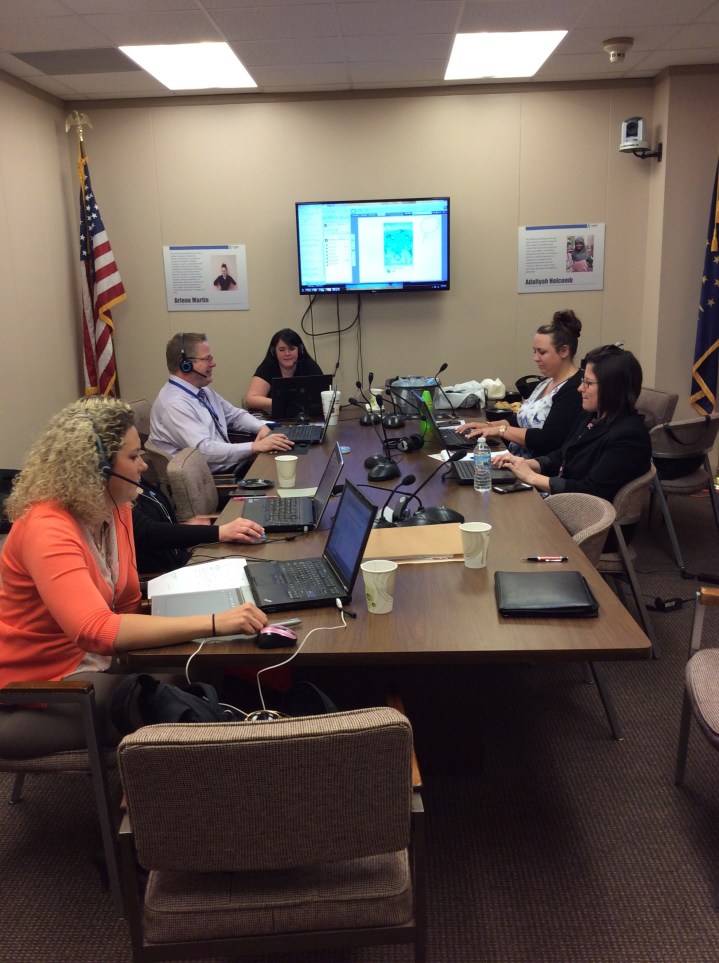
Hoosier Academies Teachers Teaching In Room 156A Of The State House
 Representative Dave Ober, from Albion, said it best this week in a tweet: “The education philosophy in Indiana is that money follows the child. We need to make that commitment clear.” I have blogged about leading with certainty and clarity before (click here to read), and I consider this leading with both certainty and clarity. I had the opportunity to visit with Representative Ober this week and he certainly understands what is at stake. He is displaying his commitment to ALL Indiana students. In my personal growth time this morning I was reading David McCullough’s Truman. McCullough stated that former President Harry S. Truman hated the words “progressive,” “liberal,” and “reform.” Truman wanted everything to be “Forward Moving.” To have our schools and education to be “forward moving” there needs to be 100% funding for all schools, regardless of type.
One of the issues about funding right now relates to virtual schools. Let’s dive into the virtual thing. Really, virtual education is very “forward moving,” as Truman would have said. I hope we can all agree that all students can learn and that all students learn differently. If that is the case, then why would we think that all students learn best in a building with walls and a roof? We need to think “outside the walls.” Having just spent time with my Smithsonian Institution friends in Washington D.C. this past week, I can tell you they embrace the fact that not all students will be visiting, or even have the means to be able to visit within the walls of their museums. In fact, the Smithsonian Institution wants you to take advantage of visiting virtually. Truly, the Smithsonian Institution is equal access to everyone. EVERYONE!
I’ll give you an example: The Wright Flyer, on display in the Smithsonian National Air and Space Museum, was scanned using a 3D laser, which produces a highly detailed and accurate image of the object. The 3D Wright Flyer exhibit is part of the Smithsonian Institution X 3D Collection, which provides a very detailed look at objects. The 3D Explorer allows visitors to rotate the objects on the screen and includes guided tours. The X 3D Collection provides access to many of the Smithsonian Institution’s 137 million objects of which only one percent is on display at any one time in the 19 museums, nine research centers, and the Smithsonian National Zoo. This is very “forward moving” and is in line with the Smithsonian Institution’s core mission – “The increase and diffusion of knowledge.” The Smithsonian Institution is certainly thinking “outside the walls” to provide extensive public outreach and educational programs.
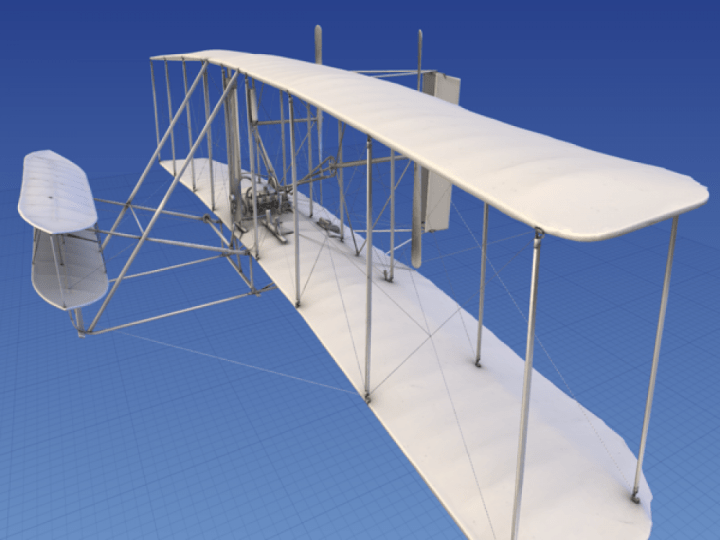
Image Of The Wright Flyer From The X 3D Collection
Just like the Smithsonian Institution, we in the virtual education world, are serving as pioneers and trailblazers in online and blended education. We continue to learn how best to navigate innovative ways to deliver content and facilitate engaging lessons for students. Our “forward moving” and “outside the walls” approach includes a data-driven academic plan, increased professional development for our teachers, individualized learning plans for all students, strengthened family and stakeholder engagement, and a targeted credit recovery program.
A key to the success of any organization is understanding what makes it distinct. At Hoosier Academies we are distinct because we are carrying out, as called for in the state constitution, education equally open to all and by all suitable means. We know in our case what makes us unique is the fact that students served by Hoosier Academies are able to be fully online (statewide in all 92 counties) or have the option to go to our hybrid schools (face to face two days a week and online the other three) in Indianapolis. What also makes us distinct is that we have a 67% mobility rate. We must embrace the fact that in many cases we are a short term solution to many of our students. This mobility may be because of health issues, bullying, differentiated learning needs, or students who have special circumstances such as being an Olympic gymnast. For many students we are the only available choice in a state that embraces school choice. I believe we are beginning to make progress because we have begun to answer the question of what what makes us different and really owning it. This realization has only come about because of really asking and listening to the students and parents of the students we serve about what they believe we should be trying to accomplish for them. We have a long way to go, but are making progress.
This discovery has come about from stories, for example, of the family whose daughter has been with us through 6th, 7th, and 8th grade, because of being bullied at her local school, but, is going to try going back to her local high school next year. Another family, who I visited with recently in Gary, has their children enrolled in Hoosier Academies because they are scared to have the students walk to school. We also have students with medical conditions that do not allow them to be enrolled in a traditional setting and who are flourishing in our modality. Another story comes from our starting a National Honor Society this year and how the parents of a student with Down’s Syndrome who was inducted stated that there was no way their daughter could have ever been as successful, academically or socially, in a traditional setting. These stories are anecdotal and qualitative proof that Hoosier Academies is an interim solution for many families. We are a place for students to go for whatever length of time the parent believes is necessary. Furthermore, more than one-half of parents of high school students and one-third of elementary students will choose this option to catch their child up academically.
The internet has changed the way people accomplish so many things, including the education of their children. Thanks to technological advances, students aren’t limited to learning in a traditional classroom environment. Many parents are choosing virtual schooling as a viable educational choice that provides a range of benefits. Virtual schooling provides the same opportunities for children and teens, allowing them to use technology to learn and grow in the familiarity and comfort of their home environments. Online school programs may also provide students with more of the personal attention they need. Teachers are often better able to focus on each student’s unique needs and provide a more customized approach to learning. In a perfect world, no child would ever face bullying or other social struggles in school. In reality, however, many children deal regularly with bullies and troubling social interactions that make learning nearly impossible. Many students we serve also face classroom-learning challenges because of their own behavioral or emotional needs. Online learning modalities allow students to learn in a safe and secure environment that is free from the social and behavioral concerns typical of traditional classrooms.
Again, if we truly believe all students learn differently we need to embrace the fact that students will need individualized learning environments as well. Let us be “forward moving” in our continued improvement of all learning environments for tomorrow!
Wright Brothers Fascination
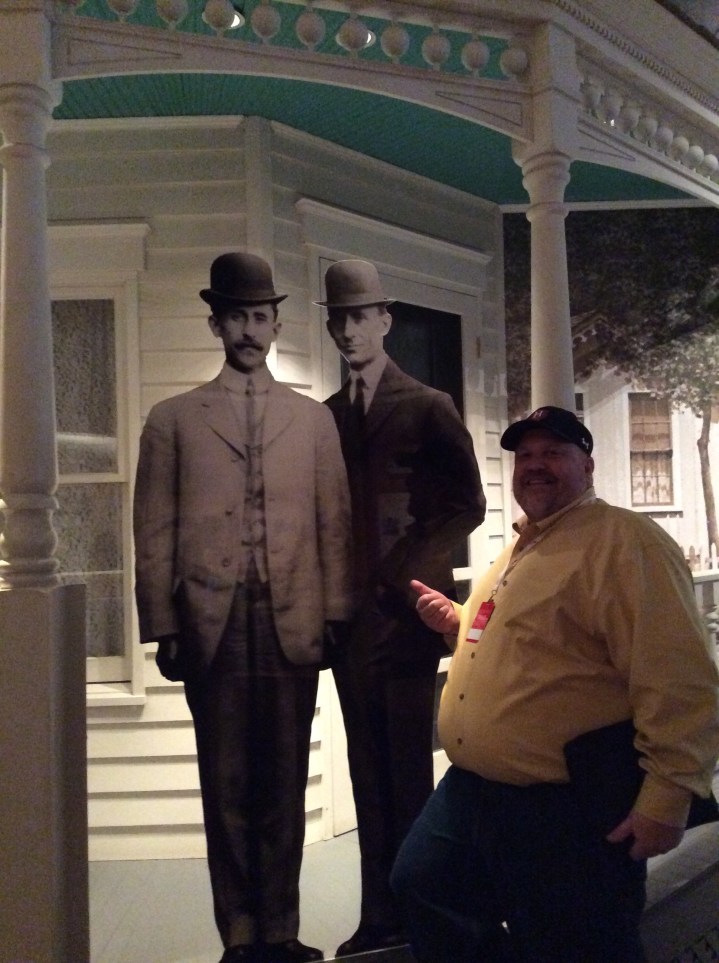
You all know I am fascinated and obsessed with the Wright Brothers. They are members of my personal Mount Rushmore. This past week when I had the opportunity to travel to Washington D.C. with Hoosier Academies students and families I took a group to my favorite Smithsonian Institution exhibit – The Wright Brothers and 1903 Wright Flyer, in the Smithsonian National Air and Space Museum. I am such a student of the Wright Brothers because of the audacious leadership they displayed. Imagine the audacity to think they could build a machine that would fly. Remember, people made fun of them. Also, the audacity to know what being able to fly would do to affect all generations to come. In other words, WHY being able to fly would be advantageous to the human race. Basically, everything in the Smithsonian National Air and Space Museum is there as a result of the Wright Brother’s innovative leadership!
Additionally, the Wright Brothers were controversial, which according to Sally Hogshead, makes them fascinatining. Some of this controversy was a simple rivalry between the Smithsonian Institution and the Wright Brothers, and their claims of who was the first to fly. The Smithsonian at the time was primarily a research facility rather than a museum and Dr. Langley, the leading competitor in the race for first flight, was America’s most respected scientist, and the keader of the Smithsonian Institution. In 1928, Orville Wright loaned the Flyer to the London Science Museum, where it stayed for 20 years. It was not until 1948 that the Smithsonian received the airplane. I for one am glad it is where it belongs and the Wright Brothers are serving as an example of American enginuity for all who come to the Smithsonian National Air and Space Museum.
Malcolm Gladwell said it takes 10,000 hours of practice to become great at something. Imagine if the Wright brothers had “tried” flying for a couple of months and then gave up saying “we are just no good at flying.” It sounds humorous, but many people do this when starting a new project. From something as simple as getting into shape to the more complicated endeavor of pioneering and inventing new products, achieving high levels of success in anything is less dependent on talent and more dependent on tenacity. Sometimes we forget that anything we are now good at, we were once not proficient. In other words, we must be bad at something before we can get good at it. The Wright brothers set out with a dream and worked vigorously to make the impossible a reality. It wasn’t easy and took hard work with thousands of failures to get the success they were looking for. After only four years, the vision they had cast was actualized by their own actions. 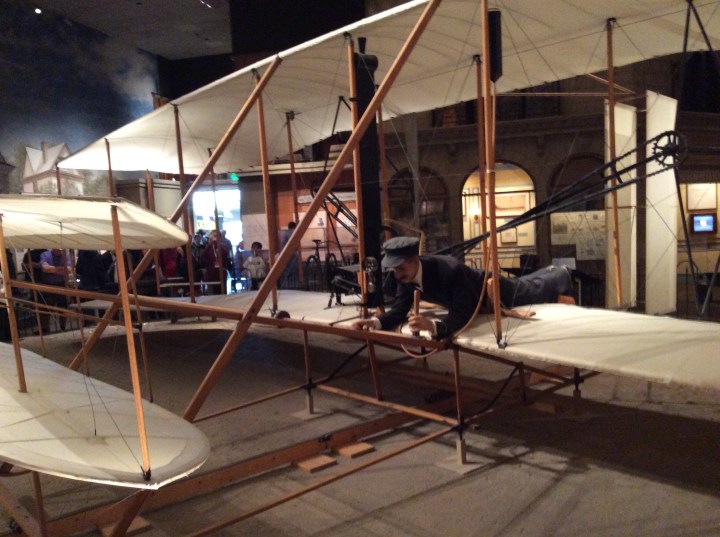 The more amazing part though is the business story that followed. It took them several more years to hammer out the safety issues with flight and then had a multimillion dollar earning year in 1910. What is truly unbelievable is that after only another 5 years, Wilber Wright was able to sell the company for not only $36,000,000, but also received another $600,000 for serving as the chief consulting engineer during the first year of the new company’s operation. We severely overestimate what we can accomplish in one year and strictly underestimate what we can do in 10. I am also always amazed to remember that neither of the Wright brothers had diplomas or collegiate courses, instead they were encouraged heavily by their parents with a “classics” education focus and read hundreds if not thousands of books from their family library. Pontific knowledge, tenure, and certificates does not equate to being educated.
Remember, every big success requires first a dream, then a struggle, before the victory. Think about this: “If I take away your struggle, I will also take away your victory.”
Responding With Mindfulness
Being mindful in our responses ensures integrity in our interactions and solutions to opportunities (what I call challenges and problems). Absence of mindfulness raises the likelihood of emotional reactions and unproductive arguments instead of thoughtful and effective responses. We need to gain control through attentiveness and awareness, centering ourselves to lead our solutions and conversations fruitfully, honestly, and fully. It is easy to be pulled into reacting, and it takes more effort to respond. However, with mindfulness practices, I believe exchanges can be more productive and greater integrity can be maintained.
As we maintain our mindfulness through inner calmness and strength, we listen to what is being said more intently, and we watch the way in which it is being said. Also, we truly can begin to look at the challenge as an opportunity. We become more aware as we formulate our response. Our raised attentiveness enables us to respond more thoughtfully and, if needed, begin to direct the exchange in a direction of collaboration or more productive areas of discussion. Our mindful and responsive solution can truly become a new adventure and great journey.
Let me tell you the story of my morning. I am in Washington D.C. with a group of our Hoosier Academy families. They really wanted to go to the Smithsonian National Zoo. Well, as a former Smithsonian Teacher Ambassador and Smithsonian Diffusion Award Winner, I was ready to do anything Smithsonian! We arranged for our charter bus to take us there in the morning. Then we were going to have the bus take us at noon to the Smithsonian Castle and Enid A. Haupt Garden to meet up with some of my Smithsonian friends for a research experience. On the way to the zoo, our staff person coordinating the trip got an email telling her that we could not use the bus at noon. Ok, I’m not going to lie, my first thought was to react, but then I practiced mindfulness. Keep in mind the zoo is 3.8 miles from the Smithsonian Castle. Not an easy walk for a group of 55. Also keep in mind that almost all in the group had never been to Washington D.C. – certainly, never been on the Metro!
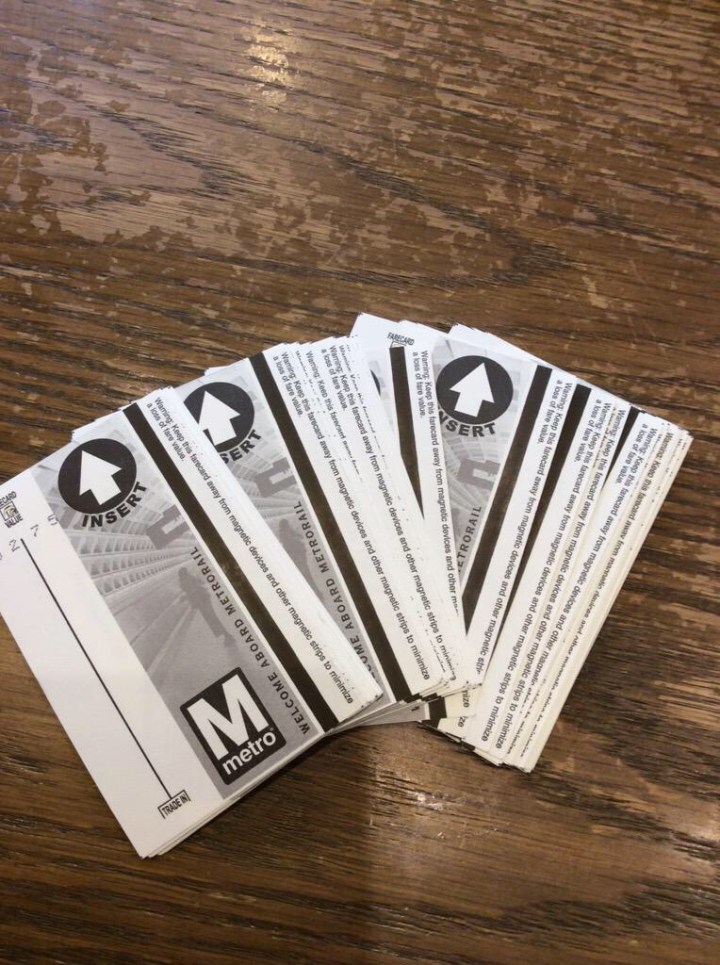
As I took a moment to become mindful, however, I decided that with a Metro station two blocks from the zoo at Woodley Park, and then a short ride with one change from the Red Line to the Orange or Blue Line at Metro Center, it would be a cheap, $2.75 per person, experience and journey for our students and families. So, what did I do? While the group was exploring at the zoo, I went and purchased 55 Metro passes. What a great experience and adventure it was! Bottom line: we all got to Enid A. Haupt Garden on time for our program (see picture below)! I had students telling me it was the greatest thing they had done. All of our participants were glad to have had the experience. What a great lesson for our students to learn how to use mass transit. 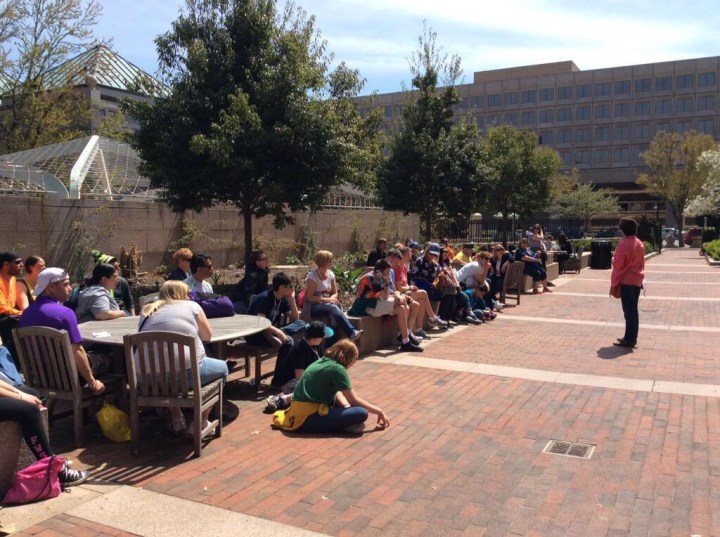 While there may only be a slight difference between the words react and respond. In practice, there seems to be a gulf of difference. When people react, it seems to be defensive and snap, poor decisions are made. By practicing mindfulness, however, responding is more thoughtful. Mindful responses contain reasoning. If mindfulness is being more centered within and aware of others, then this is a practice we need to embrace to prevent reacting and focus on responding. Being mindful in our responses ensures integrity in our interactions. It might even enable us, as leaders, to provide opportunities of great adventures for those we serve!
Spirit of Performance
 Drucker believed that the spirit of performance in an organization is led by leaders who are committed to getting the right things done (effectiveness) and doing the right things (efficiency) (Maciariello, 2014). These leaders must posses integrity of character, a vision for the organization, and focus. They must also be able to lead change. Drucker called those who could lead change agents “disturbing elements” (Maciariello, 2014). A disturbing element in an organization is a leader who seeks to change its culture and practices to prevent bureaucratic behavior from settling in. These leaders bring energy and spirit to the organization.
Drucker also believed that the purpose of an organization is to “make common men do uncommon things” (Maciariello, 2014). We all hire from the same pool of common people. Face it, we are all just common people. Why do some achieve greatness in the companies, organizations, and schools they work for? Because there has been at least one leader in that institution who prodded people to develop, improve, innovate, and sustain the spirit of performance. Organizations must see being entrepreneurial and innovative as a duty. As such, organizations must develop their people to be entrepreneurial and innovative. This ca be accomplished with “conscience” activities. Those activities that remind the organization what it should be doing and what it isn’t doing.
Those leaders who provide the sustaining spirit for an organization are forever watchful for bureaucratic tendencies allowing people to drift into repetitive routines and lose focus on primary results. I was really reminded in this week’s lesson, how much all of this really deals with people. It deals with hiring the right people and then providing the right opportunities and a culture of performance. Furthermore, it is important to remember that decisions that affect people, their placement and pay, promotion, demotion, and severance, must represent the values and core beliefs of the organization. As businesses, organizations, and schools, innovate and evolve there will be people who are just not the right fit. This poor fit may be because of skill level, personality or any number of things. Drucker teaches us this is natural. We must work to make conscience decisions about how to get them the professional development they need, help them understand the gap in fit, or come to an understanding together that it is just not in the best interest of either party to continue. I liked the suggestion by Maciariello (2014) that we should always ask the question, “What can they do?” Many times there are adjustments that can be made.
Are you providing the spirit of performance in your organization?
Reference
Maciariello, J. A. (2014). A year with Peter Drucker: 52 weeks of coaching for leadership effectiveness. New York, NY: HarperCollins Publishers.
 Byron's Babbles
leave a comment