What Do You Bring To The Table?
 A couple of Saturday’s ago for our Focused Leader Academy (FLA) we used the mental model of food again. Participants decided to prepare breakfast and tell their story. This was pretty special and really meant a lot. I was struck by the fact that these teachers who had been ISTEP (Indiana’s students achievement test) all week and were probably exhausted would want to do this, But, as always, they amazed me one more time.
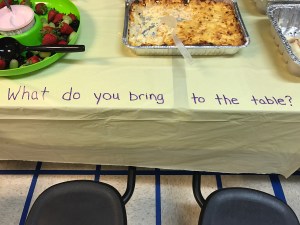
What a spread! It was the most amazing breakfast buffet I had ever seen with: two kinds of bacon, cinnamon rolls, blueberry muffins, yogurt, biscuit and gravy casserole, bagels, cheesy potatoes, and lots lots more. I have put a picture of the buffet here for you to see, We have a practice of writing on the table butcher paper and on the breakfast buffet table someone had written the statement, “What do you bring to the table?” This of course then became the theme for the discussion. 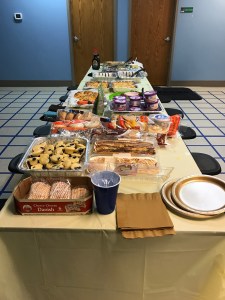
So what does it mean to bring something to the table? I believe it means to provide something that will be a benefit. Just like the fact that I believe everyone is a leader, I also believe everyone brings something to the table. Essentially, your list of what you bring to the table should reflect your best qualities, and that is what you should be offering to an organization, school, or business. Is what you are offering equal to what you are expecting? Do you consider what you have to offer those you lead, or merely what your team is offering YOU?
Leadership is about taking care of those you lead. Leadership is serving others. It is involving others in setting and achieving their own goals or the group goals. Leadership includes learning from mistakes and growing from them. Leadership is about having a positive impact on anyone we cross paths with. Leadership is contagious. If we can do these things, we are offering quite the leadership buffet to our organizations.
It was so great that Saturday to have Mike Fleisch, Sita Magnuson, and Kelvy Bird all present to graphic record the discussion presented by the FLA members about their food. It is the first time they had ever worked at an event all together. These are amazingly talented individuals, thought leaders, community leaders, and facilitation conveners. I have embedded a photo of the graphic here: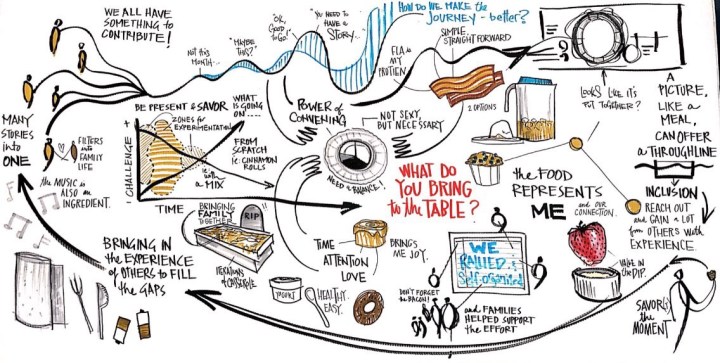 Just like the awesome selection and choices that a breakfast brings us, the more different people become leaders, the more problems we will solve. The more skills, interest, and expertise that will be brought to the table. We need leaders to think about and organize around many issues beyond those of our organizations and schools like: youth development, economic growth, substance abuse, crime, the environment, health care — the list goes on and on. Each issue will require a troop of skilled leaders to handle them. We need leaders who are women, young people (we were all young once), people of color, low -income people, immigrants, people with disabilities and many others that have been told that they should follow others, not lead. We need leadership from all walks of life in order for ours to be a truly democratic society. Remember, we are all leaders!
You have to make a decision to lead and view yourself as a leader. No one else can contribute what you can. You have a point of view that no one else has. You have a set of skills that is unique. Your corner of the world will be different if you decide to act on its behalf.
How has your organization benefited from having you in leadership roles? What do you bring to the table? Are you showing value in your current role?
Learning From An Education Reformer

Here is my review of the great book:
Letters to a Young Education Reformer by Frederick M Hess
My rating: 5 of 5 stars
This book has so much great information and thought leadership, that one recommendation/review cannot do it justice, but I’ll try. From the beginning of the book, Dr. Hess teaches us that passion can distort our perception of reality. We are taught in the book to draw wisdom from our own experiences and failures and the experiences and bad judgement of others.
Furthermore, this book eloquently argues we need to learn from both those whom we agree and those we don’t. We do not want our passion to close the door to a fruitful discussion. This book also drives home the fact that reform is not about having good ideas, but about how to make ideas actually work. For this, Dr. Hess teaches us that the how of education reform is more important than the what. We are reminded that we all want the same end (what is best for children), but we many times disagree on the means.
We are reminded in the book that American schooling was never designed to do what we are asking it to do today. While this book is specifically about education reform, anyone involved in the reform of anything in business or society today would be well served to read this book. As reformers, the author holds us accountable by positing that those making decisions need to be held responsible for making them work.
Centenarian JROTC Leadership!
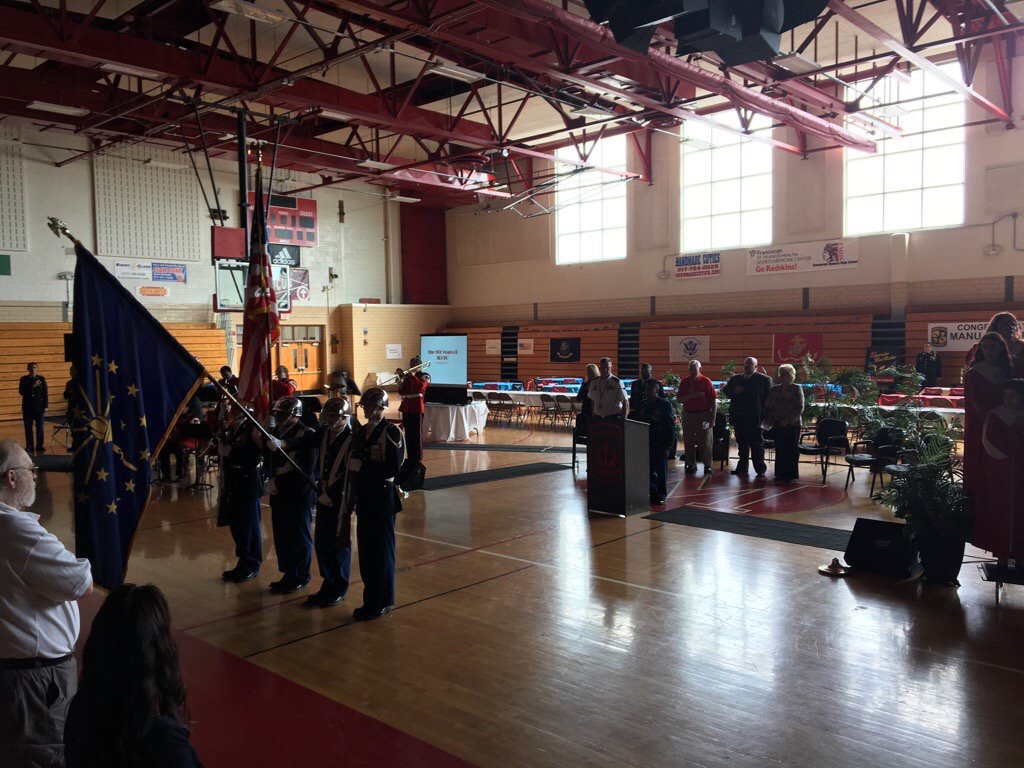 Last night I had the honor of speaking at the annual Manual Military Appreciation Day celebration. This great annual event was started by the Army JROTC program when I was principal of Emmerich Manual High School. This event also served as the 💯Year Anniversary Celebration of the Army JROTC program at Manual. It was incredible to be invited to this event and reconnect with alumni, teachers, staff, and former students.
I was reminded just how much I love this school. It was also a reminder of what can be accomplished when a team comes together, truly puts students first, and works hard while having fun toward a common vision. This school had been rated one of the worst, had been an “F” school, as rated by the state for seven years. We were able to turn the school around and take it off the “F” list. Make no mistake, the Army JROTC program was crucial to the success of this school. The JROTC instructors Colonel Duxbury and Sargent Carter are highly effective teachers and are responsible for making sure the program has continued to thrive, improve, and grow.
Emmerich Manual High School is an awesome school with great teachers and incredible students. This school is an important part of Indianapolis’ south side community.
In my speech, I discussed why the 💯Year Anniversary of JROTC was such a big deal. I also told the story of my friend David Marquet, author of the book, Turn the Ship Around! I believe JROTC is a program where students learn and practice character, citizenship, and leadership at the highest level.
Lead By Telling The Truth
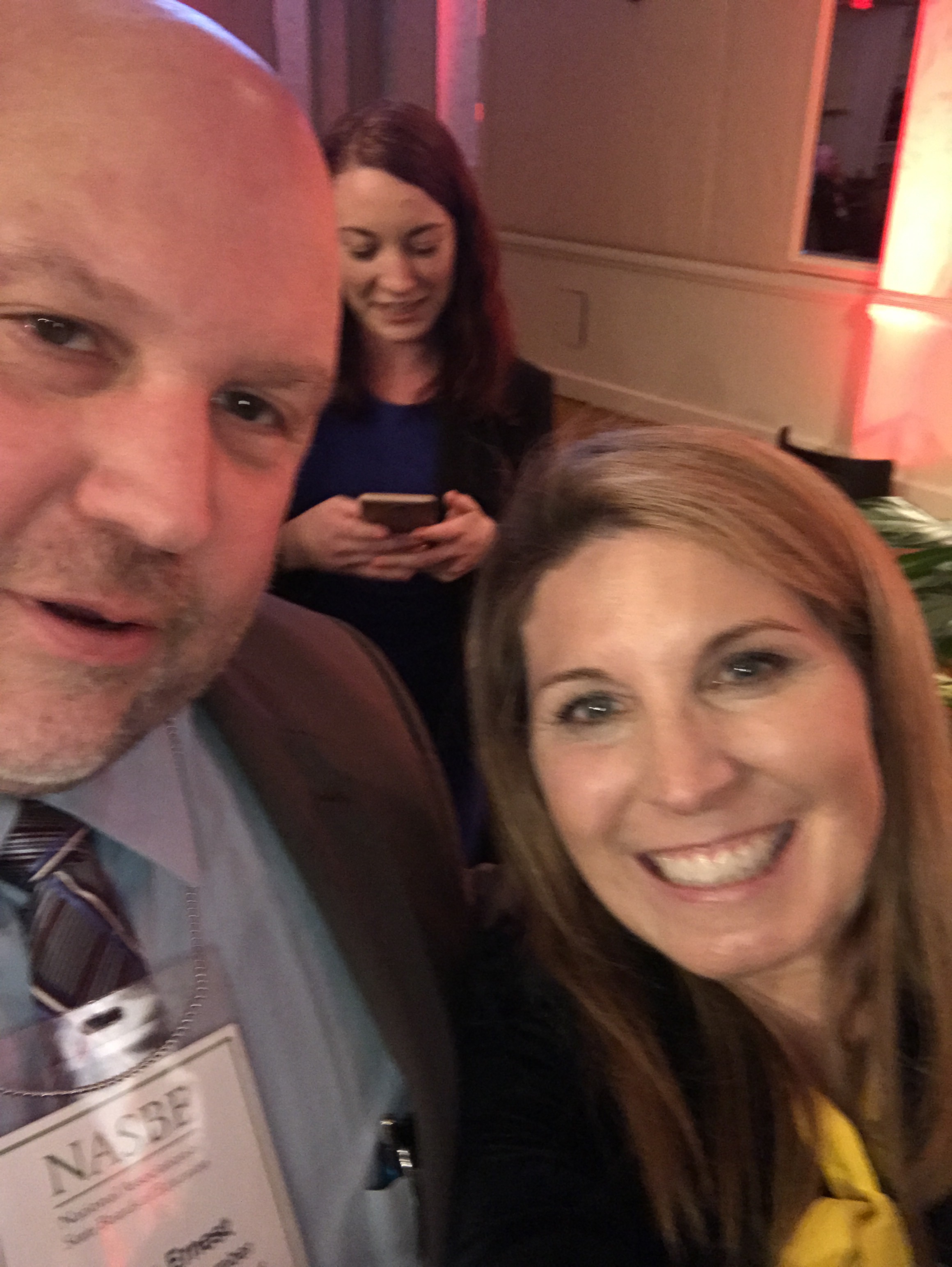 Nicolle Wallace & I
I had the honor and opportunity last night to personally meet and hear Nicolle Wallace speak. Nicolle is a bestselling author, political analyst for MSNBC, and former co-host of ABC’s “The View.” And, I would add, great speaker! She keynoted our opening joint dinner for the National Association of State Boards of Education (NASBE) and Council of Chief State School Officers (CCSSO). On my side, as a NASBE member, this opened our annual Legislative Conference.
Let me tell you, I was mesmerized by her comments. In her many meaningful phrases she made one that hit me like a ton of bricks. She said, “If you want others to tell you the truth, you need to tell them the truth.” Think about that. What wold the world be like if we all put this in practice.
Powerful leadership is needed in America today and the world to deal effectively with a broad range of challenges. History, however, is full of examples of leaders that lacked character to sustain trust and credibility with the public. Good character and integrity, basically telling the truth, are the solid foundation of great leadership. Failure of leadership today is not the absence of competence or skills, but simply sustaining credibility and integrity with people. Character is a rare commodity now adays. Our culture has produced few enduring leaders, few people with leadership integrity.
Great leaders must demonstrate the right virtues to lead effectively. Nicolle said, “we must all take responsibility for our power.” We must demonstrate honesty, humility, authenticity, credibility, courage and accountability. Thanks Nicolle for reminding me that the most important leadership virtue is integrity.
Leaders Must Be Schooled
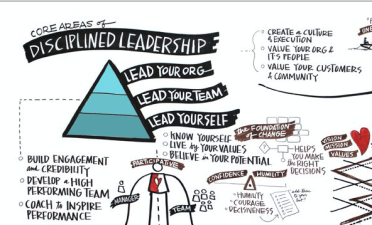 Given the high rate of leadership turnover in many fields nationwide, finding ways to provide leaders with the experience they need quickly is paramount. This is very true in my own area of educational leadership. What makes leadership so challenging is that it is rife with painful trade-offs that make decisions difficult under the best of circumstances. What’s more, leaders are faced with a group of stakeholders—vendors, customers, students, teachers, parents, communities, local, state, and federal government—whose competing demands can make it impossible to satisfy the needs of one group without dramatically upsetting another. By developing adaptive leadership skills we can get help our leaders improve decision making at times of crisis, benefiting, in my particular context, both the school culture and ultimately, student outcomes.
Because of the many stakeholders involved in leadership, leadership is dangerous because we are rarely authorized to lead. We all operate within a limited scope of authority. Opportunities for exercising leadership do not depend on position. Since I believe everyone is a leader, leadership can come from any place within or even outside the organization. With adaptive leadership we need to help those we serve understand that leadership often involves challenging people to live up to their words, to close the gap between their espoused values and their actual behavior. Leadership often entails finding ways to enable people to face up to frustrating realities.
It is important to recognize the difference between technical challenges and adaptive challenges. Technical challenges may be complex but an expert can usually solve – like fixing a car that won’t run or a website glitch. Conversely, adaptive challenges do not lie in technical answers, but in the leader. The technician can fix the car, but he can’t make the owner do the regular service to keep it running. This would be an adaptive leadership challenge. Most social issues are adaptive. They are not resolved with a logical argument. This is what makes my field of education so challenging. This also why there is such a great need to school our leaders.
Successful leaders in any field tend to emphasize personal relationships. These relationships are a tenant of adaptive leadership. Again, with adaptive leadership we are asking people to close the distance between their espoused values and their actual behavior. This kind of leadership can come from anywhere in the organization and can fashion new and better responses to local realities. Are you schooling your leaders?
Leadership Story Reflections
 This is the final post of a four post series reflection on this past weekend’s retreat of our Focused Leader Academy (FLA). The first in the series was Feeding Leadership. Click here to read the second in the series, Leadership Breakfast Story. Yesterday, I posted the third in the series, Telling Your Leadership Story. If you read those posts you will realize what and incredible journey this past weekend was. To give a quick recap; we started Friday night by learning fro an Executive Chef how to tell a story with a meal. Then Saturday morning Mike Fleisch and I modeled this by cooking breakfast for the group and telling the story of our journey together. The highlight of the weekend, though, was when our FLA members were turned loose to plan, organize, and execute a breakfast to tell of their journey as teacher leaders and about the school. This was a total success and this post is about the reflection session of the FLA members afterward.
For this reflection we used a technique call the “Fish Bowl.” To do this, a circle of chairs is made in the number of participants minus the number of groups used to complete the activity. In this case here were three groups, so three chairs were placed in the middle (see picture in this post of setup). One person from each group then sits in the middle and are the only ones that can talk. If you have something to say after the original three have had a chance to speak, then you can get up and tap the person from your group and take their seat in the middle. This can go on for as long as someone has something to say. It is also a best practice to have prompts to help get the discussion going. Here are the prompts we used: The graphic recording of this session, included below, from Mike Fleisch does a great job of reflecting the richness of the discussion, but I wanted to point out a few of the highlights. One of the comments that really struck me and that I had not thought about was that the planning, organizing, and executing of the story through a meal was a great 360° evaluation. 360° feedback has been around for some time now. In case you haven’t gone through the process, here’s how it works. Your boss, your direct reports, and your peers give you feedback on what are your strengths and weaknesses (or “developmental needs” or “opportunities”). Therefore, you get feedback from everyone around you who knows you well — hence, you’re hearing it from 360° around you. When it’s done well, 360° programs allow all your team members to improve in key areas that might be limiting their upward career path or actually causing major conflict within a team.
This discussion was around the fact that they were all able to see their own personalities come out and the personalities of those on their team. Additionally, the ways in which each individual changed in conditions of shared urgency. One participant said, “I feel like I left out the organization step and rushed too much.” Another participant admitted to thinking, “If you all would just shut up, I will lead you!” There was a great deal of self reflection going on during this part of the discussion. I realized just how effective this activity was as a 360° tool – much better than a survey done by someone else in my opinion.
Another point that came out was when someone said, “Sometimes it is hard to think about giving up another Saturday, but I for sure do not want to miss these retreats.” Obviously, that was music to my ears, but it is an important concept that is worth mentioning. We should always have at the forefront of anything we plan the idea that we want to design it in such a way that no one will want to miss it. In other words a participant should feel as if there is too much great stuff going on and content being learned to miss. Here is the graphic recording of the rest of the discussion: As you can see this was a tremendous experience for all of our teacher leaders. I come away from each of these weekends inspired and rejuvenated. There is so much energy in these young leaders and we must continue to take the time to give them the development experiences they deserve. What experiences are you providing for your up and coming leaders?
Telling Your Leadership Story

Dr. McCormick (10th from left) With Our Focused Leader Academy Participants
 After breakfast and the sharing session on the learning from our meal at Ulen Country Club it was time to explain why in addition to the normal fresh flowers, crayons, markers, fresh fruit, and butcher paper there was a $100 bill taped to the tables. I explained it was now their, FLA participants, turn to plan a meal in order to tell a story. My instructions were to prepare a meal that had an appetizer, main course, and dessert that told the story of their journey as a teacher leader and of our school. I gave these instructions at 9:30 am and told them the meal would be at 12 noon. I also told them to plan as if they would have some type of government official present to tell the story to. A few questions ensued, but for the most part they got started.
It was amazing to watch the process unfold. Different leadership styles emerged. Some went straight to doing, others to planning. Others began developing the story. Then about 30 minutes in they all began to check on each other. The appetizer and main course groups realized they were developing along the same story lines of “selling the steak and not the sizzle” and “under fire.” Quickly, they all all came to the conclusion to use a Mexican food theme and serve fajitas.
 In normal form for me, I then added two last pieces to the design sprint. I told them they could get another $100 through a non competitive automatic grant (I called it the LWFS Grant – Leading With Food Stories Grant) if they wanted it. One group applied and received the grant, but in the end did not use it. This caused a great discussion about budgeting, having too much money, and being able to move the money where it was needed. My philosophy is to have as few buckets in a budget as possible. This way money can be used where it is needed the most to make strategy reality. Also, we talked about that with less buckets we eliminate the trap of people/departments spending money just because they have it. This was a great philosophical discussion and real world budget lesson for our teacher leaders and future school leaders.
The other new wrinkle I added was that there really would be a government official in attendance. I had arranged for our Indiana State Superintendent of Public Instruction, Dr. Jennifer McCormick, to be in attendance to have lunch with our teacher leaders and hear there journey told through food and a meal. My only regret was not having a camera ready or a video going when I told them, because it was truly an “Oh Shit!” moment. The look on their faces said, “Oh Shit, this is really happening. We have an hour and a half!” I laughed because their theme of “under fire” was coming true and very appropriate. We all know that leaders grow leaders. This why I have taken it as my personal charge to develop, grow, and improve our Focused Leader Academy. Remember my rules for learning: For accelerated leadership growth we must create an environment where our developing leaders experience fear, excitement, anxiety, and experimentation. This design sprint of preparing a meal to tell a story really did this. For rapid growth we must create real time, real work experiences of:
- Fear
- Excitement
- Worry
- Anticipation
- Terror
- Thrill
- Anxiety
- Experimentation
- Risk
- Possibility
Additionally, I watched in amazement as one group proceeded to clean and make sure the convening space was just right. They went and got table clothes, bulletin board materials, and everything else needed to make our commons area perfect for the event. I was so impressed because I really hadn’t thought anything about that.
When asked why I was so calm, I told them I had total faith in them and the only piece I had to worry about was whether Dr. McCormick would show up on time, call in sick, or forget. I was not expecting any of those, but you never know. As I expected, Dr. McCormick showed up about 10 minutes prior to the start time for lunch. My part was done!
 As for lunch…It was perfect! I am so proud of our FLA members. They planned the perfect lunch menu in buffet style. They had set up and decorated three tables for eating and visiting. The appetizer group went with Dr. McCormick first through the buffet line for appetizers and then had her sit with them and they explained the story they were telling with the appetizers. They then ate the appetizers and visited. Then it was the main course team’s turn to go through the buffet line with her for fajitas, tell their food story, and visit while eating at their table. Then, last but certainly not least, since they were serving Gigi’s Cupcakes and ice cream, the dessert team used the same format as the other teams. Again, and I know I am biased and sort of like the proud papa here, it was PERFECT!

For more details, a picture really is worth a thousand words. I am going to let the graphic recordings that Mike Fleisch did during the three courses of the meal fill in the details of the discussion. Here they are:


 After the meal and great discussion we gave Dr. McCormick the opportunity to say a few words or reflect. She spoke of how great it was to learn about our school and our development program for teacher leaders. She spoke of how education goes both ways – in other words, is all about learning from each other. Dr. McCormick also invited our FLA members to get involved on her advisory committees. Finally, she left the group with three very important and inspiring points:
- Be nice!
- Work hard!
- Be amazing!
Here is Mike Fleisch’s graphic recording of her comments:
 As you can see, this was quite the event. In my next blog post entitled Leadership Story Reflections, I will capture the group’s thoughts and emotions after the meal.
Leadership Breakfast Story
 This is the second post in a series of four that tells the journey of our Focused Leader Academy (FLA) learning to tell a story with food. Click here to read the first post entitled Feeding Leadership.
We started the day yesterday with my good friend and Graphic Recorder, Mike Fleisch, and I telling a story of our six year journey working with teachers together by cooking breakfast. We had so much fun planning for this and wanted to model storytelling, like we had learned from … the night before. This was so much fun and really caused a lot of reflection on the part of Mike and I.
Most importantly, we noted the fact that we practiced our normal “Jazz Improvisation” when putting this breakfast together. I would say, let’s have this and Mike would say yes and I can bring this to top it off and make it really cool. Honestly, that’s how it works with us. We have become such great friends and convening partners that we can visualize what each other is doing and improvise the next part of the music, so to speak. That was an important part of this story for us to tell. What sets Mike and I apart from others who bring groups together for professional development is what sets jazz apart from other music – this cool thing called improvisation.
Jazz is certainly an art of the moment, but it is also an art in and of a particular history, and history flows out of every note played. Mike and I practice adaptive leadership, what I’ll call Jazz, of the moment and become artful in differentiating for the moment. Our form of leadership jazz is also rooted in life, it takes all that life has to offer and makes a rich amalgam with the history and context of the teacher leaders we serve in our Focused Leader Academy.
Here was our breakfast:
- Starbucks Coffee – coffee from a socially responsible company was important to Mike and I because we both want to be a part of social change and making the world a better place.
- Titus® Donuts – These are the official donut of FLA. We felt it was important to go ahead and make the staple and constant product available. An important thing for leaders to do, even when introducing new and exciting things.
- Mixed fruit cups – When Mike and I first met and started facilitating together, we both came with different talents, beliefs, and skills. Just like when you put different fruits together with different tastes, textures, and colors it makes something really amazing. And, Mike did his usually of adding the artistic touches of shaved lime and real whipped cream on top. Improve at its best!
- Then came an awesome cheese dish with toast that Mike made with Wisconsin Cheddar cheese since he is from Milwaukee, Wisconsin.
- Eggs – We wanted to serve eggs because we wanted this to represent how great leaders differentiate and meet those they serve where they are. We represented this by preparing the eggs to order – over easy, over hard, sunny side up, scrambled, or the most complex order of the morning: one whole egg and three egg whites scrambled together.
- Goetta – First let me explain what Goetta is. Pronounced “get-uh”, the sausage-type patty is pretty synonymous with Cincinnati (where Mike lives), though its roots are steeped in the “Queen City’s” German heritage. Goetta employs steel-cut or pinhead oats to extend the amount of pork and beef scraps that are then blended with spices, formed into a log, sliced, and fried. We chose Goetta because each month I go spend a day with Mike and plan out our weekend retreats. He always has some new cultural thing for me to learn and we go to his favorite places. One time he took me to a great restaurant where I had Goetta for the first time. This is one of the discoveries that has remained closest to my heart. It proves how relationships and trying new things can change our lives and cause us to grow.
- Non-alcoholic Mimosa – Bottom-line it’s elegant and can be made with so many combinations. Think about it, you can really add in any of your favorite fruits – peaches, blueberries, kiwi – the possibilities are endless. Mike and I like trying new things, putting new models into play, and iterating. It was the perfect drink to top off our breakfast storytelling.

So, let me finish by talking about the very important leadership skill of storytelling again. Everybody talks about ‘storytelling’. It’s a leadership buzzword – I hate buzzwords. That’s why we are used ‘food stories’ as our through line this weekend. Storytelling is something we’re all meant to be doing (or think we do already) as leaders. But, do we actually know how to tell a story? How are stories structured? And what makes a story impactful? It is very important to learn storytelling skills that move those you lead to action, whoever they may be.
Here are three things Mike and I expected our teacher leaders to take away from our Leadership Breakfast Story:
1. Learn how to use stories to communicate complicated messages and data without jargon and without the dreaded ‘death by PowerPoint’. If you want me to become un-engaged, just pull up the PowerPoint. Note: technology is not allowed, except for Tweeting, at any of our FLA retreats.
2. Learn how to use stories to influence others, and persuade them in a human and authentic way.
3. Learn how stories make your messages more memorable and more likely to be passed on.
Just like I said in Leading With “Food Stories”, “Subconsciously, when you eat something, your brain is always comparing it to what you’ve had previously, the place you were eating it, and the people you were eating with. Think about it – our brain tries to find connections and similarity. Just like being able to tell stories is a very important leadership trait, the more powerful story behind the food, the more it evokes the memory, which in turn enhances the flavor. There is no doubt that flavor is inextricably linked with memory and emotion. They’re all processed by the same part of the brain,’ planning the food for a meal is an excellent way to learn and model storytelling.
What foods would you use to tell the story of your leadership journey?
Feeding Leadership

Starting In The North With Chef Nick!
Really this comes down to personal influence. What is the power of personal influence? Paul Hershey and Kenneth Blanchard, in their book Management of Organizational Behavior, describe it this way: “To the extent that followers respect, feel good about, and are committed to their leader, they will see their goals satisfied through the goals of their leader.” When there is internal motivation, close supervision is not required, and the leader is effective. This is the kind of leadership that makes teachers effective in their work. It also reduces tension and stress.
Unfortunately, we leaders can tend to be more concerned about tasks than people. We have board meetings to prepare for, committees to attend, agendas to develop, phone calls to make, paperwork to do, and a gazillion other things that are, just that – things to check off mob a checklist. I would argue we communicate a lack of trust when we refuse to delegate tasks and then give people the freedom to pursue the task in their own style. By encumbering ourselves with paper shuffling, we lose contact with people. By staying in direct personal contact with the development of those we lead, we are able to develop the technical and leadership skills of those we serve.
The cure to this is spending more time with your leaders, in my case: teacher leaders. Make no mistake, this takes time and some rearrangement of your ordinary schedule. But more than that, it requires an adjustment in thinking. Here are two ways to care for and feed your leaders:
- Committing to Leadership Development
- Make it a priority to give professional growth time to developing leaders
Two avenues I have found to do this effectively are task forces and our Focused Leader Academy (FLA). The goal for both is to have teacher leaders developing while actually serving in leadership roles and working on real leadership issues. I just received a message from a teacher leader, Cassidy Thomas, that I was deeply touched by and one sentence in the note really drove home the importance of this idea of training leaders while under fire and working on real school issues: “I truly feel that I have grown so much just as a person from the opportunities that you have provided me in just a little over a year. First experience toward the end of last school year where I got the phone call, will you be a BA… I felt…anxious, nervous, flattered, several emotions.” I have always said that for real professional learning to be happening there must be both excitement and some fear.
 So, let’s talk a little about what we did this weekend at our FLA retreat (design sprint). By using the through line of telling leadership stories through food, our FLA participants first learned from Chef Nicholas Townsand and Bar Manager Patrick at Ulen Country Club Friday night on how to prepare a meal to tell a story. Nick and Patrick took us from a journey starting in the north and ending in the south. Stories were told between each course and a long discussion of the meal preparation with Nick and Patrick took place after the meal. Our participants learned so much from the experience. We did a debrief Saturday morning using the prompts from the evening before of:
- Know your team!
- Where are we going to put the money, where are we not going to put the money?
- If it was just price, I’d run an Applebee’s®
- Plan, Organize, Execute
- Other Thoughts
Here are pictures of the prompts with our FLA participants’ responses:


 Then a great discussion ensued about lessons learned from Nick and Patrick. Here are the Mike Fleisch graphic recordings from this design sprint:


 Then we started the day Saturday with my good friend and Graphic Recorder, Mike Fleisch, telling a story of our six year journey working with teachers together by cooking breakfast. I am going to do separate consecutive blog posts from the other parts of Saturday. Here are the titles and graphic (so you don’t think Mike’s skills are leaving him, you need to know I did the agenda graphic) of our agenda from Saturday:
 I was so moved by a video I watched as part of my Harvard class I am in right now, that I wanted to share a blog post response to it. Here is the link to “The Gardener”:


leave a comment