Water The Bamboo
 I had the incredible privilege of meeting Greg Bell, author of Water The Bamboo this morning at the NWEA Fusion East conference. He was the keynote speaker and having read his book I was very pumped to hear him speak. I use the principles in his book and was excited to have him autograph it for me. He and I have also had great fun tweeting back and forth.
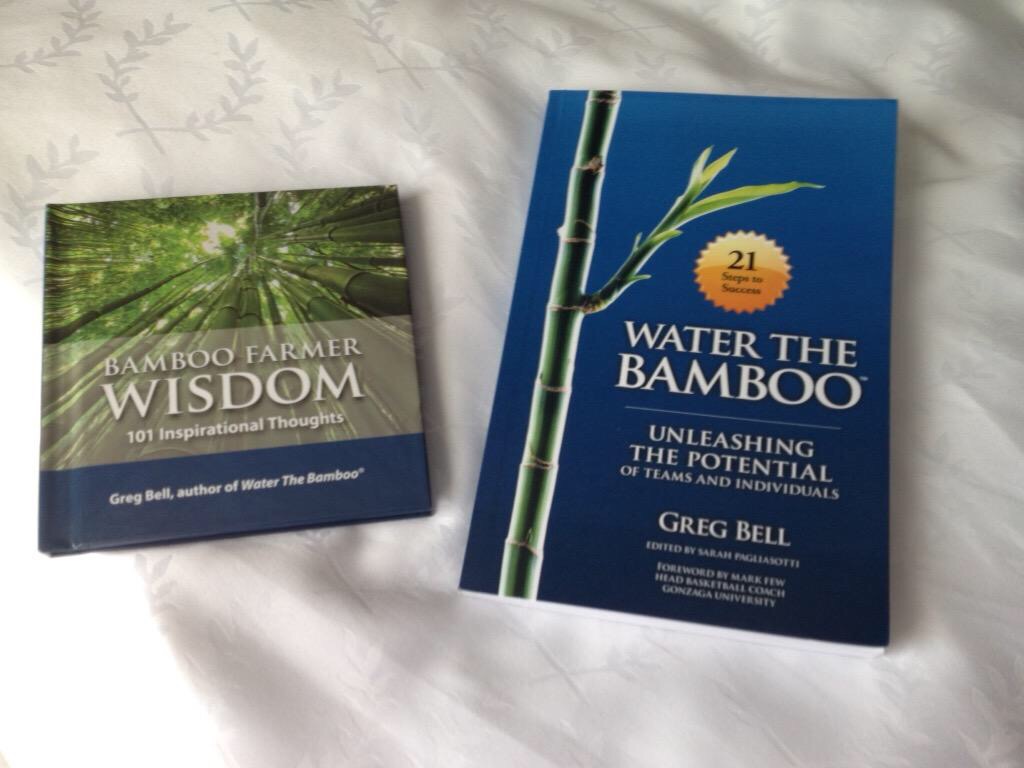
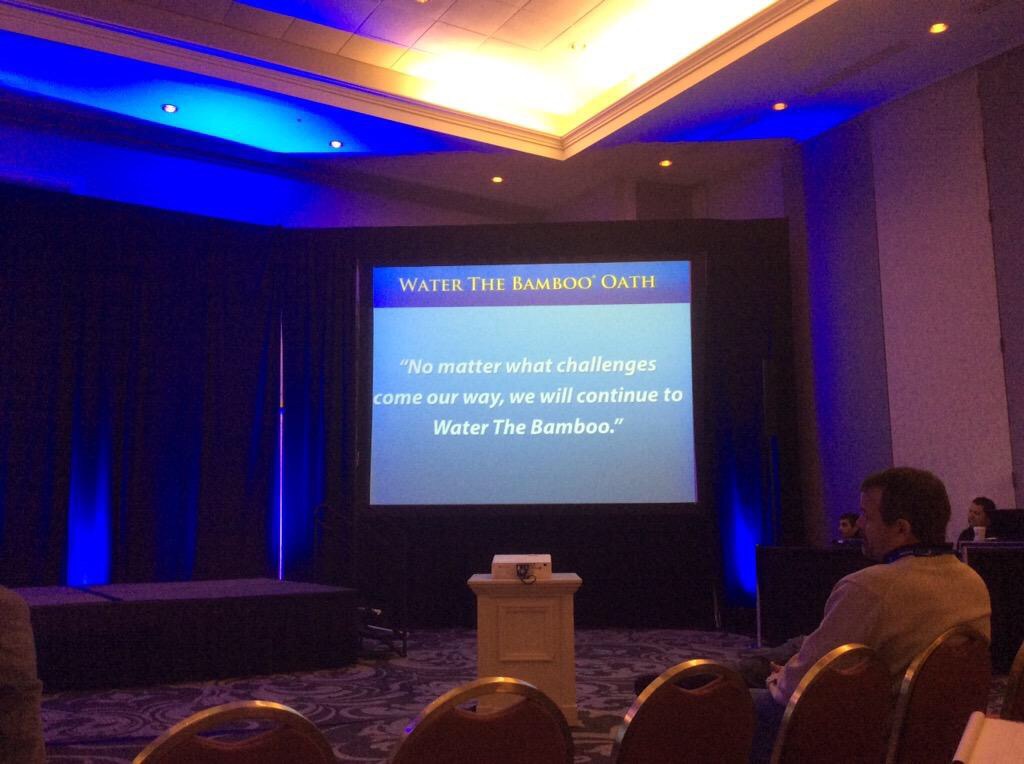
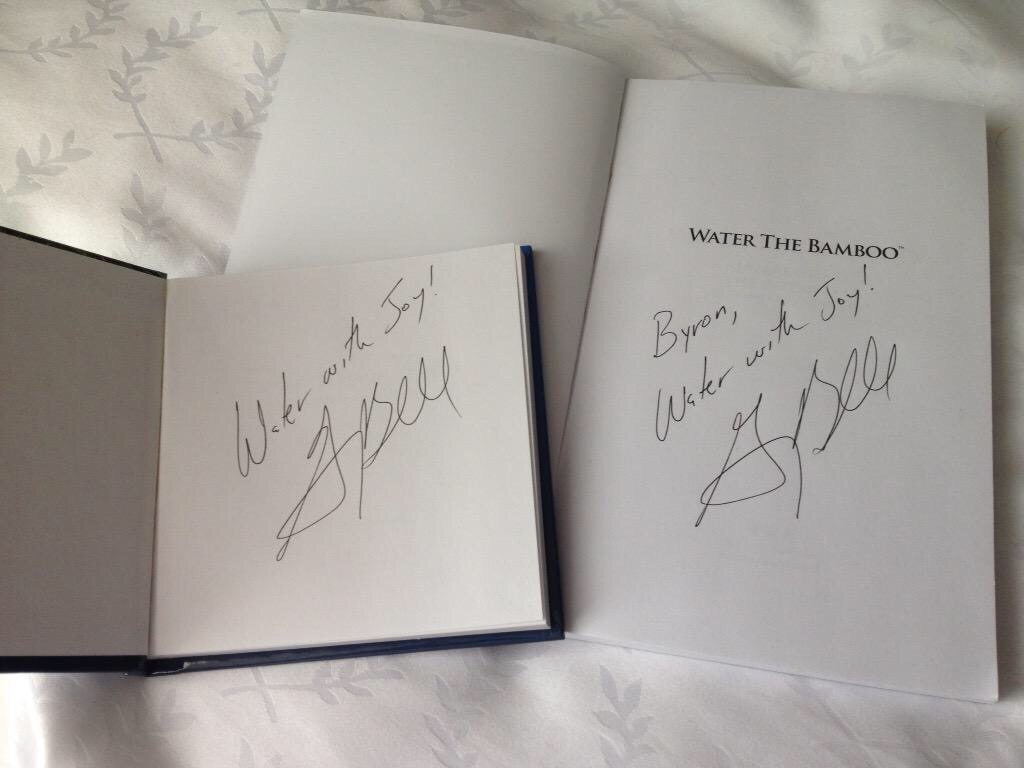 Let me tell you his keynote was just as inspiring as his book! He is awesome. During his keynote he had us all take the Water the Bamboo Oath. Needless to say, I and everyone else in attendance was inspired. I would like to share some of the thoughts with you from his speech.
 Here are the highlights:
– Sunrise or sunset…it’s all in your perspective
-Change your perspective; leave the either/or and reintroduce the “and”
-Instead of pushing, how can we stand side by side to address an issue?
-A person pushed against their will has the same opinion still
-Water the right intent
-How we talk to ourselves impacts our reality
-When you change the language you change everything
-Mindset of a Bamboo farmer: Patience, persistence, self-discipline, courage, and belief
-What are you holding on to? Bamboo sheds! Get rid of the things you no longer need. Focus on the right 20%
-Let go of your bad stories
-Don’t keep staring at the closed door. Turn around and look for the open one.
-Individuals and organizations who understand the relationship age will flourish
-Bamboo grows 90 feet in 60 days. Prior to that is shows no growth above ground for 220 days. Symbolic of many of our learners in our schools
-Start your day with this question: What’s going well?
-Don’t be a negaholic! Optimism always wins!
-We need to encourage our students to dream!
-Language matters in your organization’s culture
-Sweat the small stuff and the big stuff will take care of itself
-Catch reverse paranoia. Optimism always wins
-The word “student” in Latin means “eager to learn.” Are you cultivating this?
-Three things that will get you out of poverty: 1. education 2. education 3. education
-Are you a negaholic? Do you only see the negative? QUIT THAT! Instead, ask yourself what is going well.
 As you can tell, there was a lot of great information packed into our time with Greg Bell. Can you imagine how awesome all of our lives would be if we followed every bullet point above. Remember, we have an obligation to those we lead, particularly in our schools to be doing this. Also remember, every day with your students could be THE day!
“Deer In The Headlights”
 I have been to several great conferences lately and I realized something about some of the so called “experts” that present at the conferences. Now I have to be careful here because I was a speaker at all of these conference. But, I realized that in some cases the person doing the presenting has not had the experience of being the “deer in the headlights.” Usually this term is associated with being a bad thing, but I have come to realize that it really is a great thing. To really become an expert or great at leading in a certain area or circumstance you really have had to be the “deer in the headlights.”
Having successfully served as a principal for a takeover/turnaround school that broke the failing school cycle and came off the “F” list; I can say I truly was that “deer in the headlights.” I still remember that first day of the students coming in, the looks on their faces and saying, “what have I got myself into?” Then a week later after our first round of NWEA testing and seeing that only 19% of our students were on grade level, I was not only the “deer in the headlights,” but the deer smashed in the front grill of your car. Then we began to navigate and I fell in love with our students, as did the whole staff, and we turned the school around. That experience is truly at the top of my list for my career.
My experience under fire really honed me as an educational leader. I learned so many things that I could have never learned had I been in an “A” school. There were so many issues to navigate: students not on grade level, behavioral issues, staffing issues, students’ personal and family issues, operations issues, facility issues, extracurricular issues, teacher coaching, and many, many more. Don’t think for a minute that I believe myself to be an expert leader in all of those areas, but let me tell you I did have to lead the charge on all of these areas and I did learn and grow from it.
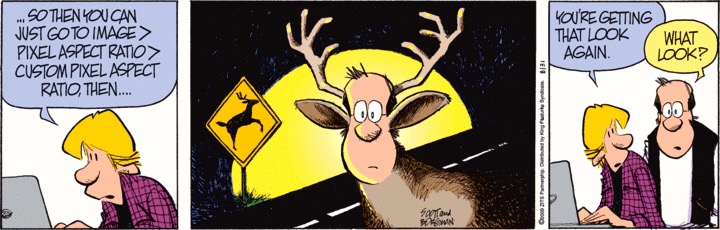 So, my point in this post to my blog is to not be afraid to be the “deer in the headlights.” Don’t be afraid to take on projects or career changes where you will be that “deer in the headlights.” I seem to have moments like that every day, but I am better and growing from it each and every day. I can think of many leaders who have become very status quo about their own professional growth and development. Really, those individuals are like old farm equipment sitting in the fence row rusting. Don’t let yourself become rusty.
I have been reading Water the Bamboo: Unleashing the Potential of Teams and Individuals by Greg Bell. I am so excited to be speaking at the same conference (NWEA Fusion East) this weekend in Charlotte, North Carolina. I can’t wait to have him autograph my book. In his book he suggests developing a personal mission statement. I did. It is: In my professional life, my vision is to always be the “deer in the headlights.” As Bell says, “To accomplish a great vision you will need laser-like focus.” Just imagine the learning I will be doing!
National Standards Day
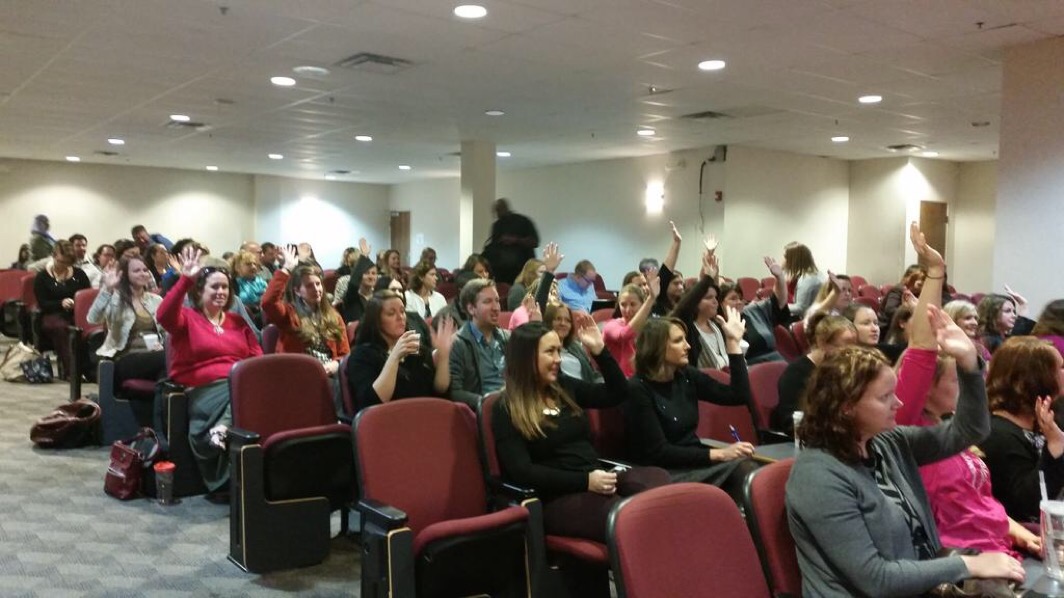
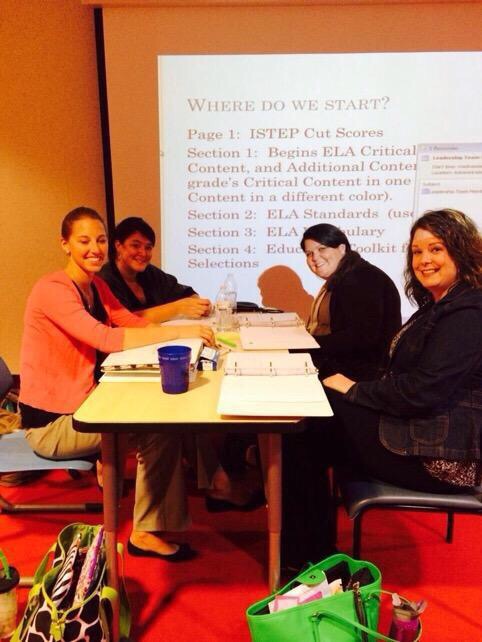
 Yesterday was a great day at Hoosier Academies. We brought our entire staff together around the idea of making sure that all of our curriculum was aligned to the Indiana Academic Standards, we were teaching to the standards, and how we would use rigor, relevance, and relationships to be good stewards of our students’ achievement. Our teachers were very engaged and there was incredible collaboration all day.
As always, I am using my blog as a way to reflect on the day. For this post I am going to bullet point the top tweets that were done during the day using the hashtag #HoosierNSD. The tweets were great and so was the learning. Also, I have attached the powerpoint that I used to guide my introductory kickoff session to the day. Here is the link for the powerpoint: Ernest_NSD_k12_2014
Here are the top tweets from the day for you to think about and reflect on:
-21st Century Learners? That’s old school. #HoosierNSD is creating 21st&1/2 Century Learners!
-Push for best effort. With effort comes results.
-Acknowledge a student that reaches an expectation, praise a student that exceeds it.
-Assume every kid is your brightest and best!
-Focus on the now and move forward – not on what went wrong #teachlikeachampion
-Describe the next move, not what went wrong #teachlikeachampion
-Positive framing by modeling and narrating your workable goal! It isn’t impossible. #TeachLikeAChampion
-Relevance makes rigor possible; relationships make anything possible.
-Reviewing not repeating. That’s RIGOR.
-Rigor: ask higher level questions and push students to respond at a higher level.
-If they had to buy tickets to your class would they come?
-5 Steps to get to quadrant D. Reaching for the summit one step at a time.
-Less than 5% of high school lessons provide opportunity for student collaboration! This needs to change! We can do this Hoosier Academies.
-Was your lesson worthy of the student’s undivided attention???
-We have to bring the engagement up. Not just Hoosier, but all high school teachers.
-Teamwork makes the dreamwork
-Getting to know those you work with makes a difference
-Reflection is important. Why we are having #HoosierNSD.
-Thankful to have a minute to take a step back, learn the standards, and focus my instruction. #thirdgrade
-Make school work more like real work.
-Demonstrate the rigorous and relevant learning.
-My pillar of rigor would be action.
-Teachers have to make schoolwork more like real work.
-If you say it can’t be done, then you are doing it wrong the first time.
-Rigor and relevance and don’t forget motivation in our virtual environment.
-Great day! Real-world project based learning in HS English. How do literary themes connect with my students’ worlds?
-Real world application can only exist in the virtual world if strong relationships have been built for optimal engagement.
-Rigor and relevance and backwards planning are our best friends.
-Students need collaboration, critical thinking, oral and written communication
-Taking students to the 21st 1/2 Century and beyond
-We’ve been in the 21st Century for 15 year! We’re here. Think 21st 1/2 Century skills.
-As it relates to teaching, these three remain…rigor, relevance, and relationships. But the greatest of these is relationships.
-We’re spending a day breaking down standards.
-Teaching to one standard is not enough. You need to make them all connect together in a meaningful way with purpose.
-It is virtually impossible to make content relevant to students you don’t know – Carol Ann Tomlinson
-Key pieces of education: rigor, relevance and RELATIONSHIPS.
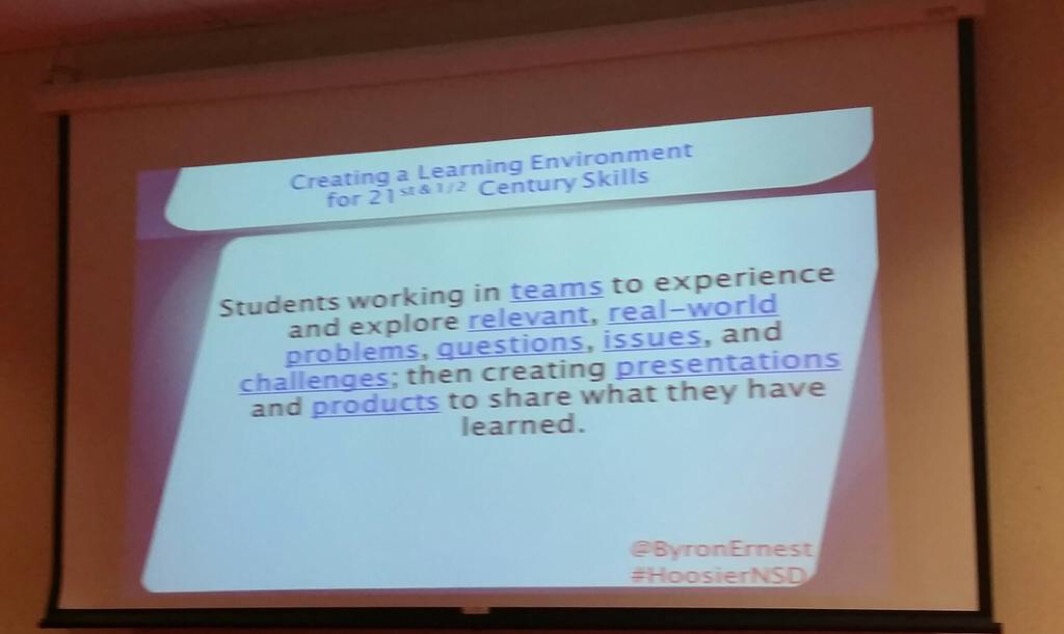
As you can see, some great learning went on. You can’t help but think about making education rigorous and relevant when you reflect on theses tweets. Additionally, the tweets reinforce the importance of building relationships with our students.
Is Your Group Too Small?
 Yesterday I finished the great new book, You Can, You Will: 8 Undeniable Qualities of a Winner by Joel Osteen. If you have not read it; it needs to go on your “to read” bookshelf. One of the comments Osteen makes in the book is: “If your the smartest person in your group, your group is too small.” I loved this comment and tweeted @ByronErnest it. I found that many others loved the comment too because it was retweeted several times. The comment also hit home because I just wrote the post, “Are You The Smartest Person in The Room?” a couple of weeks ago.
When I heard Osteen make this comment (I listened to this book on Audible during my commute) I immediately thought about the advice of always surrounding yourself with the best people. How can your team be great if you are smarter than everyone around you? I’m reminded of my dad’s advice to me at a young age: “Always marry better than yourself!” That’s hard advice to understand, but now coming up on 29 years of marriage; I completely understand it. I certainly married better than myself. Hope is smarter, a better parent, better leader of a household, and the list goes on and on. As I always tell everyone, she is the primary parent! I fail in comparison. In fact I am reminded of a comment my son, Heath, made to his teacher when he was in the fourth grade when asked if he had done all of his reading the night before: “I’m not sure; my mom is out of town for work and dad and I have no adult supervision.” That really is a true story, and of course he had heard me make that comment jokingly before. But, really, there is some truth to it. So, if your still looking for that someone, make sure you marry better than yourself!
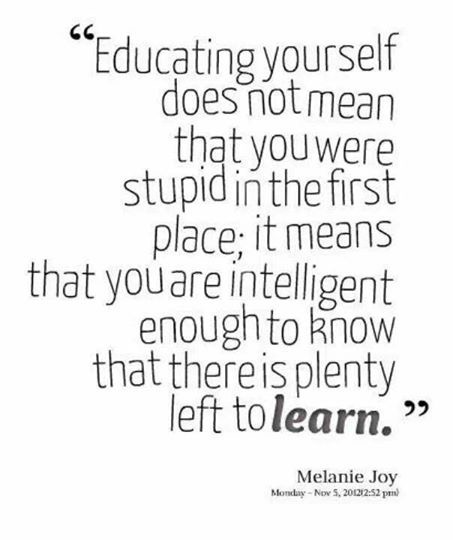
The real point that Osteen was making was, however, that we all need to be taking responsibility for our own personal growth to be the smartest, most skilled person in the room, but we need to also seek those who are talented in the areas we are not. The quote from Melanie Joy sums it up nicely: “Educating yourself does not mean that you were stupid in the first place; it means that you are intelligent enough to know that there is plenty left to learn.” We all need to make sure we are constantly taking advantage of any chance to learn that comes our way. For example, I am excited to be presenting at three conferences yet this fall and early winter. I am most excited because of the chance to learn from all the other conference attendees and the other presenters’ sessions. I am positive I will not be the smartest person in the group of attendees and presenters!
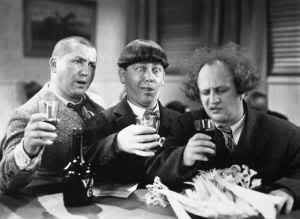
So, think about your own situation and find some ways to get yourself some personal professional growth. It may be reading a book (I am always amazed at how much I learn from every book I read), going to a conference, taking a course (I’m proof it’s never to late to start a doctoral program), or finding a coach, mentor, or sponsor. I loved another comment that Osteen made in his book: “While it may be a lot of fun to hang out with Mo, Larry, and Curly; you probably won’t be getting any smarter or experiencing any personal growth.” In other words, who you hang out with matters!
Finally, don’t forget to give of your “smarts” to others. I am always amazed to watch others in leadership positions who seem to want to hire “dumber” than themselves, suppress the learning of others, and just not provide growth opportunities to others. I guess they think this makes them look smarter – NOT! It has always been my personal mission to make sure that when those I have worked with reflect back that they say, “My life is better and I grew personally and professionally because of being around Byron.” Actually, a pretty good epitaph, don’t you think?
Go forth and make your group big enough that you are not the smartest!
Learning To Lead Together
 As is standard operating procedure for me after some type of professional development, I have written a post reflecting on my learning. The Kappa Delta Pi Learning, Leadership, and Practice: Educating Global Citizens International Research Conference in Calgary, Alberta, Canada really caused me to reflect on my own leadership journey. Many of the presentations touched on environments, situations, and leadership that were in place, enabling me to get to where I am today. This post is a compilation of the thoughts I have had over the last couple of days and those of the presenters.
There are really five characteristics that great educational leaders that I have been associated with possess: Passion for learning, Supervisory intentionality, Reflective Conversations, Learning Culture, and High Expectations. Other Characteristics of exemplary leaders include moral purpose and interactive visibility (awareness). Great leaders then coach and mentor learning leaders who are “schooled by the system” so they are ready to move into all leadership positions. These all start at teacher leaders.
Highly effective schools with highly effective teachers promote environments where everyone can be “Learning Leaders.” Everyone in an organization fits into one of these three categories: Aspiring, Beginning, and Experienced Leaders. Because of this coherent and coordinated quality learning opportunities to support school leaders must be a part of career long professional learning. As a leader, we are a leader of learning. As such you have a responsibility to take part in career long learning.
Leadership Matters! School leadership is second only to classroom teaching as an influence on student learning. High performing school leaders regularly lead, sponsor and participate in formal and informal teacher learning. Every person in the school shares the leadership for student success. Great school leaders build a strong connection between learning and the collective leadership. High performing schools have fatter decision making structures. This fatter, more effective structure comes from shared leadership. Shared leadership works through its motivational impact and the school staff works to create structures for collaborative decision making. The school then really becomes a shared learning school.
When a school becomes a shared learning school it can more effectively address three of the most important factors of a school: Learning, Well Being, and Engagement. There are four parts of effectively building a shared learning school and classroom: Setting Direction, Developing People, Redesigning the Organization, and Managing the Instructional Program.
Built correctly, a shared learning school has an instructional ethos where there is an an acute awareness of the instructional actions and an acute awareness of teaching and learning in the school. Then everyone in the school become designers of worthwhile tasks for students.
One Man’s Trash…Leadership is Art!
 I am writing this post while in Calgary, Alberta, Canada for a conference. I am always amazed at how the littlest of events will inspire posts for my blog. Allow me to tell a story of another one of those times. With a little free time I was doing what I do best – explore and be curious. As I was exploring the streets of Calgary I came across an interesting sculpture of a horse outside Saltlik A Rare Steakhouse (I am eating there tonight). I have posted a few pictures of it in this post. It is actually a major work of art in my opinion. Basically, the artist took metal pieces of farm equipment and tools and welded them into this great representation of a horse. Really, it is amazing enough that I probably looked at it and analyzed for about an hour. Now, as a farm boy, let me tell you it is awesome!
When I first viewed it, in awe, I first thought of the old phrase, “One man’s trash is another man’s treasure,” because all of these tools and parts would really be of no value to anyone today, from an agricultural industry point of view. Yet, these worthless pieces of metal were looked at by the keen eye of an artist who saw value and placed the pieces together in perfect harmony to form this magnificent representation of a draft horse.
The longer I gazed at the beast and identified the parts of metal (my dad would have been proud) two other thoughts came to mind. Some leaders, and I consider myself one of these, are artists. We take what we have, what we can find, and what we can develop – whether time, treasures, talent in the form of people, or other resources, and mold those into something amazing. Some call this visionary, but I prefer artist. A visionary is not necessarily an artist. A visionary person can see direction and predict what needs to be done, but can’t always see how to put it all together. Take a close look at the horse and imagine all those pieces lying on the ground. A visionary might say, “let’s make something,” but the artist starts taking the pieces and welding them together while seeing the horse the whole time in her mind. The artist says, let’s make a horse,” and then proceeds to do it. I strive everyday to hone my skills as an artistic leader providing wowful educational leadership.
Another thought I had while looking at the iron equine was all the different pieces that were welded together are like all of the different individuals that make up our teams or organizations. Every piece of metal that makes up this horse had a specific role to play. If you look closely there is a tractor seat, part of a sickle, plow shear, cultivator points, leaf springs, and the list goes on and on. Again, every piece had a role. Sound familiar? This imagery hit me so hard and reminded me how important it is to make sure that every person in your business, organization, or school understands his or her specific role in carrying out the vision, mission, and action plan of the organization. This then empowers your team members to work effectively on high achievement of the key performance indicators (KPI) for your organization.
Next time you are working with your team, take a little time to imagine them all as pieces that come together to build the artwork of a successful organization! If you do that you are not just horsing around!!!
Educating Global Citizens

As I write this post I am flying over the beautiful Canadian countryside on my way to Calgary, Alberta, Canada for the Kappa Delta Pi Educating Global Citizens International Research Conference. This will be my first time to Calgary and I just know it is going to be a breathtakingly beautiful place with lots to do. I am super excited to be able to attend this conference. I was turned on to Kappa Delta Pi when I was invited to membership as 2010 Indiana Teacher of the Year. I have even had the opportunity to make professional development videos with KDP on educational leadership, effective student engagement, and highly effective facilitation of learning using technology. Kappa Delta Pi has become an important part of my personal professional development. I am even more excited that I am a conference presenter on my research entitled, “The Impact of Agricultural Science on Student Achievement and Performance in a Biology Class.”
I cannot wait to share the impact that teaching in a relevant, real world context can have on student learning. I have shared the powerpoint and supporting documents as a blog post as well entitled, “#KDPLeads.” Click #KDPLeads to read that post. My goal is to effectively facilitate a discussion and planning session that helps teachers, administrators, and other stakeholders to use relevant contexts to facilitate highly effective learning. Really, shouldn’t that be the goal of the whole conference and all our schools?
Furthermore, I picked the sessions I am going to attend (Conference Program) with one simple goal in mind: I want to learn how to be a better leader of highly effective principals and teachers in our school corporation. To do this, I want to hone my personal call to action of: delivering wowful educational leadership! It is always exciting to go to an international conference. The chance to connect, interact, and learn from leaders all around the globe is exciting. As a believer, promoter, and practitioner of global connectivity and citizenship it is a chance for me to model asset based thinking. In other words, no matter where someone comes from or their cultural orientation, he or she brings assets to the table. And, I for one, want to learn from everyone in attendance at the conference.
With the goal of connecting with everyone, I have created the hashtag #KDPLeads to organize all of my tweets and hopefully others at the conference will tweet their learning and thoughts to this hashtag as well. I am always amazed at what a great professional development tool Twitter is. Even those not in attendance at this conference can follow along and even make comments. How cool is that? So, make sure you follow me at @ByronErnest and learn with me at #KDPLeads.
The great part about belonging to an organization like Kappa Delta Pi is the smorgasbord of professional development it has to offer. These opportunities are so important for teacher leaders and school leaders because your school’s circumstances will dictate the choices made for professional development. It is also important to note the advantage KDP brings to the market because of all the platforms they make available for members to choose from. These range from live, face to face conferences like I am on my way to, to recorded videos that members can watch on their time. This truly differentiates the learning for members. I am a huge believer that professional development must be differentiated for professionals the same way it is differentiated for student learners – both in modality and content.
It always amazes me when I here educational leaders talking about not having time for professional development. I change that to the question of, “There isn’t time to not take part in personal professional development.” The educational landscape changes so quickly that we must stay current and put ourselves in the best position to create learning organizations where we can learn from others. We must be learning from each other’s mistakes, failures, and successes. The bottom line is we must be sharing the knowledge we have created. There is such a sense of urgency that we must have whether turning schools around or moving high achieving schools to the next level. The students and families we serve are so valuable that we must do everything possible to develop our skills so we can perform at the highest level. Isn’t that what we expect from the professionals that serve us – doctors, lawyers, pilots, et cetera?
If you are not doing so, I challenge you to make time to take part in some personal professional development yet this fall!
Living & Leading Like Curious George
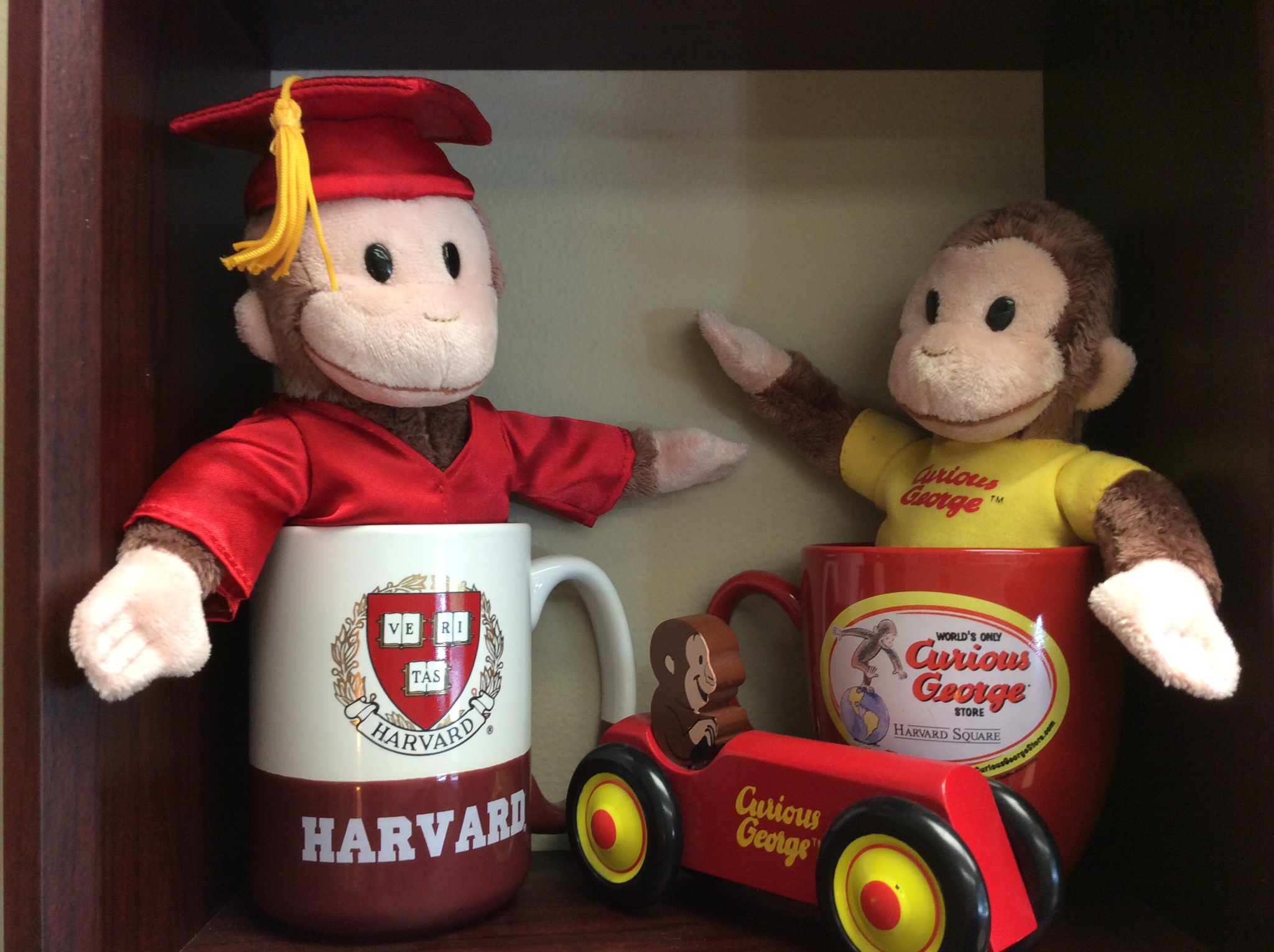
Who isn’t a fan of Curious George? No matter your age, the inquisitive little fellow who always seems to get into one scrape after another has, in all likelihood, captured your heart. I think I am such a fan because I still live every day just like like him. In fact, as you can see from the picture on this post, I have an area in my office dedicated to him. When I am at Harvard University I always have to stop into the World’s Only Curious George store to do some shopping and get my “Curious George Fix.”
Perhaps his popularity lies in the predictability of his unpredictability. You know that as soon as the man with the yellow hat leaves the house, warning George to be careful, George is going to get into trouble. And when George starts getting into trouble, he only digs himself deeper. The more you poke around, question systems, and look for new ways of doing things, the more you will frustrate some people. As a leader, though, this is what you need to be doing. All to often, however, it’s easier to leave the status quo untouched. This can really get organizations in trouble. To assume you can “arrive” and be done growing and changing is maybe the biggest mistake anyone can make. And the more you push for those out-of-the-box changes, the more you’ll frustrate those who are satisfied with keeping things the way they are.
Children naturally gravitate towards creativity and fun. But life has a tendency of breaking many of us of that. I am so blessed I have been able to resist this tendency because curiosity is a beautiful thing. It leads to new discoveries and new adventures, as long as you’re willing to pursue it. As Margret Rey (who created Curious George with her husband, H.A.) observed, “George can do what kids can’t do. He can paint a room from the inside. He can hang from a kite in the sky. He can let the animals out of their pens on the farm. He can do all these naughty things that kids would like to do.” As leaders we need to remember curiosity is a beautiful thing and needs to be embraced and encouraged. One cannot give enough credit to the Reys. H. A.’s delightful illustrations and Margret’s clear and precise turn of phrase may appear effortless, but that’s only because they labored over each book to achieve that perfect look and tone. Don’t get so tangled up in details, systems, and processes that you forget to have a little fun along the way. There’s an adventure around every corner if you’re willing to look.
If you embrace creativity in life and encourage creativity as a leader, know that things will get messy and chaotic. Rarely will you find order in the middle of creativity. As an artistic leader, I know that I’m going to have to put up with a bit of chaos in the creative process. But at the end of the day, it’s worth it. The insights, new directions, and “art” you’ll create for your school, organization, or business through the process make it worth the effort.
H. A. and Margret Rey each looked to the child within. “I know what I liked as a child,” H. A. once said, “and I don’t do any book that I, as a child, wouldn’t have liked.” By portraying George as a servant leader, they really created a great role model for all of us. If you’ve read the books or watched the cartoon’s you know George’s goal is always to help people. In helping people, however, he often gets into big messes. Doesn’t this sound familiar as a leader? Many of the characters in the books get frustrated with George. Even the one that loves him the most, the man with the yellow hat, get frustrated with him. Again, sound familiar? Which is what you’ll sometimes, unfortunately, find as a servant leader. Facilitating change, growth, and dealing with life is often messy and frustrating.
As a leader, however, the most joy I receive is in the mentoring, coaching, and creatively developing the professional growth of our team members. There are many young and talented leaders in our organization right now that have very promising careers ahead of them and I am so honored to serve them in taking that journey. Their success, advancement, and ultimately, outstanding service to others makes me as happy with them as the man in the yellow hat is with Curious George.
So, my challenge to you is to live and lead a little more like Curious George!
Teacher of the Year Learning!

This week I had the honor of serving on the Top 10 Interview Committee for the 2015 Indiana Teacher of the Year. I say honor for two reasons: 1. Because I served with nine other fellow Indiana Teachers of the Year; and, 2. I learned from the 10 candidates we interviewed. This post really has nothing to do with the Teacher of the Year process, but is about what I learned from the candidates and the reflecting I did during the interviews about my own journey in education.

I had the chance to really think about my personal mission as an educator to use rigor, relevance, and relationships to be a steward of high student performance and achievement. From a rigor standpoint we have to remember that acquiring information is not enough, the student has to be able to do something with it.
Relevance is also very important in the equation of highly effective teaching. We know that students are myopic in their vision; they need to be more global. We need to ensure an experience that is rigorous and facilitates learning of global citizenship. This also allows us to facilitate the school and students in developing “community enhancement projects.” These are the projects like cultural events that not only benefit the school, but are a huge benefit to the community.
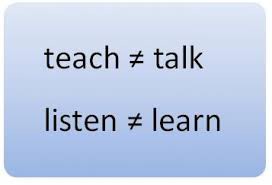
As educators we need to be “vending machines of knowledge!” Having said that, relationship building with the students is very important. We must get to know the students as individuals, so we can challenge them the way that is best for them! This enables us to learn along-side the students. This relationship building is so important. If we go a little where the students are going , they will go a little where we are going!
Because we are not all linear in the type of students who come to us, our view of teacher effectiveness and highly effective facilitation of learning has had to evolve as well. We have advanced to a time of using data to drive our instruction. We are also using constructive, not destructive evaluation systems. It is really about coaching, observing, and providing feedback for our teachers to become all they can be. Regular and frequent walkthroughs now allow us the “touchtime” necessary to really hone in and coach teachers on one to two areas at a time for improvement.
While I realize there is so much room for improvement in our educational system, I am so excited about all the great things that are happening. I was also reminded in the presence of great teachers why I am on this education leadership journey!
Reading Big Red

I know I write a lot of posts about reading, but this post will be the most meaningful to me personally because I am describing how my love for reading began. Really, I am ashamed that I did not write this post before today because had this story not happened I probably would not be where I am today. I believe that because had I not become a reader, I would not have enjoyed the successes I have in my life. Today I was at a conference and one of the speakers mentioned the book that his teacher made him read over and over that helped him learn to read. This inspired me to reflect on my reading history.
Actually, I never had trouble reading. I just hated to read! I did not find anything that teachers were MAKING me read interesting. It was all boring stuff that I did not understand. Now, if you have followed me at all you know I am all about relevancy and how students have to understand the “why” for effective learning to take place. Students perform better when the learning is relevant to them. I’m passionate about this because I’ve got the research to back it up. We also need to change the context from the students thinking of what they HAVE to read, to what they GET to read. That’s a big mindset change.
My personal story of the journey to my love of reading also reinforces this philosophy. As I stated, I hated reading all the way through my sixth grade year. Then one day the librarian at Markleville Middle School in Markleville, Indiana changed my life. It was not rocket science for Mrs. Wilking! Think about it, most of the solutions in education aren’t. It’s about having educators who care and have formed the relationships necessary to understand the needs of their students and then acting on them.
Mrs. Wilking came to me one day and said, “You know Byron, I think the reason you don’t like reading is that you have never read anything that you enjoy.” Well, duh, I knew that! I just didn’t like reading all the things elementary students are supposed to read. Anyway, Mrs. Wilking made a suggestion that changed my life. She explained that she knew I lived on a farm, had a dog, loved animals, loved to hunt and fish, and wanted to be outdoors every moment of every day. As I think about it, nothing has really changed in my life!
Mrs. Wilking went on to explain that she had a book she wanted me to read. “Please read it,” she said. The book was Big Red by Jim Kjelgaard. The book is about a boy and his dog. From the moment Danny sees the beautiful Irish setter, he knows Red is the dog for him. Fast and smart, strong and noble, Red is the only dog Danny wants by his side. Soon, neither boy nor dog can stand to be apart. Together Danny and Red face many dangers in the harsh Wintapi wilderness that they call home. But the greatest test of their courage and friendship will come from an enemy more cunning than any they’ve known before–a bear who is the undisputed king of the wilderness, a savage killer called Old Majesty. I got goosebumps just writing this description! How could a boy like me not love this book!
Well, needless to say, I was hooked! Mrs. Wilking had made reading relevant to me. That same year I read almost all of Jim Kjelgaard’s books, including Irish Red, Outlaw Red, Stormy, and Snow Dog. I loved these books and have been a rabid reader ever since. In fact I just finished book 42 of my goal of 60 for the year. Let me tell you, the book still has to be relevant and interesting to me for me to read it. And, as you know I believe reading is a very important part of my personal professional development.
A wide variety of meaningful texts must be available to teachers and students and form the core of the curriculum. The texts must be used in ways that make them relevant to the students’ lives. Texts may be used in their entirety or partially. Additionally, there is a significant academic achievement gap between African-American, Latino and Caucasian students. One way to reduce this gap is to help struggling readers who attend public schools improve their reading skills. But, to do this, struggling African-American & Latino readers need to be exposed to books that relate to their lives, capture their interest, and shape positive life outcomes, as well as address academic progress.
All students need to be read to, need to read consistently throughout their school years, and read meaningful books and texts that relate to their lives and culture, capture their interest, and shape positive life outcomes, as well as address academic achievement. Only then will the academic achievement gap start to get smaller. If it had not been for Mrs. Wilking understanding this back in the early 1970’s I might have become one of those non-readers. Thanks Mrs. Wilking for recognizing the need for relevance in reading.
I have to close by telling you that I had the chance to thank and talk to Mrs. Wilking about her influence in my life many times before she passed away. I am thankful that I had the opportunity to do that. I think about her often and the example she modeled for me as an educator!
PS: The copy of Big Red that I read was checked out of the library. I now am inspired to find an original copy of the book. If you know where I can get one, let me know. The original book published in 1945.


2 comments