Praying for Chicks!
 If you are reading this, you may have thought I was going to be writing about women. Well, you are wrong, but at least I know my hook worked to get you to read this. So, please continue!
Actually, I am writing about a disappointment I had in church this morning. During the prayer request time a young girl stated that her family had just got a bunch of baby chicks to raise and that one was not doing very well. Some in the church giggled and our preacher really did not even acknowledge the little girl. In other words, just brushing it off. The preacher even made it seem awkward and as if he did not know what to say. Needless to say, I was very disappointed and appalled at the missing of a great opportunity to teach a young person about prayer. Let me tell you, as a farm boy, I have done my share of praying for animals of all ages and kinds (sometimes that they would not hurt me).
So what do I think the preacher should have done? Well, take the opportunity to thank the youngster for the prayer request and talk to the congregation about how every prayer is important, particularly to the person making it. Also, make it very clear, there is never a time that God responds to our prayers with this thought: “I just don’t get it.” God has been the “Deer In The Headlights!” Remember a very important part of the New Testament story – God came to earth as a human, lived among us, and was then killed by us. God, a human? Stunning truth. But he remembers. “We don’t have a priest who is out of touch with our reality. He’s been through weakness and testing, experienced it all—all but the sin.” (Hebrews 4:15 MSG) How cool is that!
He has “Street Creds!” God knows how you feel and what you need.
And, this is big time, “he knows what you need before you ask him.” (Mt. 6:8) You don’t have to be perfect in your prayer request. God doesn’t need our counsel or advice. “Before they call I will answer, while they are yet speaking I will hear.” (Isa. 65:24) And, you don’t need others’ approval as to whether a prayer request is important or not. If it is important to you, it is important to God.
This young girl needs to realize that prayer changes things because God changes things. Prayer makes a difference because God is determined to make a difference. Prayer matters because each of us matters to God. I pray constantly during the day. I even pray for things like parking spaces and for meetings to go well. I do not believe there are any stupid prayers. I know there are those that do, but I just don’t believe in a God that would laugh at or make fun of my prayer requests or think them beneath him. I’ve just had too many times of pulling into a full parking lot after saying a little prayer and having a front row, primo parking place open up. I’ve also had too many big favors happen from God that I did not even know to pray for. It’s interesting to me that I really pray for the small stuff and God takes care of the really big stuff that I can’t even imagine.
So, is praying for the health of a baby chick important enough for prayer? YES! There isn’t anything of too little importance for you to ask God! Don’t forget what God said, “I know the thoughts I think towards you…thoughts of peace and not of evil to give you a future and a hope…call upon me and pray to me and I will listen to you.” (Jer. 29:11) Remember, he gets it. He has “been there, done that” for all of us!
Unwavering Steadfastness & Loyalty

Leaders must be strong, don’t they? Also, leaders must demonstrate they are decisive, resolute, and have all the answers. Right?
Wrong? Leaders should strive for clarity, not necessarily certainty. It is extremely hard to operate today with 100% certainty all the time. Therefore, we should strive for clarity. I have blogged about this before. Click here to read my previous post, “Lead With Clarity, Not Certainty.”
Back to the earlier comments I led off with. Leaders should be allowed to change their minds and should not be afraid to consult others for help answering questions. If the team is developed correctly, leaders should be getting input from everyone. Many times the term “unwavering” is used to describe the decisiveness of a leader. I would rather use this term to describe the leaders unwavering loyalty and steadfastness to those she leads and the organization she serves.
Steadfastness is a disposition of choice to embrace and pursue a worthy goal or objective, despite obstacles. This steadfastness should not be confused with obstinance or not making changes when it is clear a change in direction is needed or necessary. Steadfastness is also a mark of moral maturity and courage. When challenged or facing obstacles and leadership storms we must use our counsels of wisdom.

Great leaders will step outside of their comfort zones. By exercising their flexibility, the leaders becomes stronger. He recognizes the rewards of the risk. Finally, steadfastness allows great leaders to act calmly in the face of disruption or catastrophe. The unwavering leader is resolved to see things through.
It behooves us, then, as leaders, to work at having the physical, mental, and emotional stamina to be an unwavering leader for those we serve.
Important, Not Urgent!
 Peter Drucker was the master of focusing his time on the important, not the urgent. He led a focused life doing what he felt he was called to do. Drucker knew how to work on the truly important issues and abandon all the rest (Maciariello, 2014). We have our own purpose in life that should include balance between work and pleasure. But there will always be a decision to make between the important and the urgent.
In advising leaders, Drucker believed in focusing on their processes of leadership, organization and management, including the development of people, building community, and planning for succession (Maciariello, 2014). A pretty good list of focal points if you ask me. Keeping this in mind it is important to remember: You are responsible for allocating your life.

In this week’s lesson I learned of Harry Hopkins, one of President Franklin Roosevelt’s top advisers during World War II. Because he was dying of stomach cancer toward the end of his service, he was forced learn how to do the important and not the urgent. He was able to cut out everything but truly important and vital matters. Churchill called him “Lord Heart of the Matter” and believed he accomplished more than anyone else in wartime Washington. I have added the book The Hopkins Touch: Harry Hopkins and the Forging of the Alliance to Defeat Hitler by David L. Roll to my bookshelf to read this year.
Drucker believed effective leaders do not start out with the question, “What do I want to accomplish?” They start out with the question, “What needs to be done?” He believed, “If there is any one secret of effectiveness, it is concentration.” We must learn in the midst of multiple demands, to give priority, and the necessary amount of time and focus, to the important rather than to the urgent (Maciariello, 2014).
Maciariello (2014) suggested forming a habit of pausing to distinguish the difference between the important and the urgent demands on your time. In order to determine the decisions and work that is important, you must answer the question, “What do I want to be remembered for?” The answer that you come up with will give your life focus and purpose.
I’ll leave you with a question to reflect on: How Have You Allocated Your Life?
Reference
Maciariello, J. A. (2014). A year with Peter Drucker: 52 weeks of coaching for leadership effectiveness. New York, NY: HarperCollins Publishers.
Dedication Attracts People
 I must say that I looked forward to my dedicated study time this morning for reading the second week’s lesson in A Year With Peter Drucker: 52 Weeks of Coaching for Leadership Effectiveness. As you know from my first week’s post I dedicated myself to spending personal professional development time each week in doing a personal book study and then writing a post to this blog each week. Click here to read the first week’s post.
This week’s coaching lesson was very appropriate. The title of Week 2 is: “Questions to Ask Before Committing a Portion of Your Life to the Service of an Organization.” This was obviously important because I have had to do this in my life several times. But more importantly, it caused we to reflect on the importance of making sure the school corporation I lead can answer those questions correctly and is able to ensure everyone has a chance to achieve and make a meaningful contribution. These are two of the most important tasks an organization has to perform, according to Drucker (Maciariello, 2014). Interestingly, John C. Maxwell’s Minute With Maxwell word today was “Dedication.” Click here to watch the one minute video. Even though the teaching of Drucker this week was not on dedication, this spoke to me because I believe that our organizations must be dedicated to our team members’ achievement and ability to make meaningful contributions. The school system I lead right now needs to do a much better job of this and we are working very hard at this. I believe we need a leadership progression and training program. We should working side by side with those we lead to answer the questions: What should I contribute?; Where and how can I have results that make difference?; and, What should my contribution be? In Drucker’s view, these were questions that the person looking for a position should answer, but I believe we must help them answer these at all phases; from interviewing to job placement, to competency/leadership building.

The questions Drucker suggested a potential employee should ask of the organization are worth noting. I would also argue that these are questions that the organization, school, or business should be asking of itself as to whether they are providing (Maciariello, 2014). Here are the questions:
– Are you learning enough?
– Are you challenged enough?
– Does the organization make use of your strengths or what you can do?
– Does the organization make use of your strengths or what you can do?
– Does the organization constantly challenge and make you more ambitious in terms of contribution?
– Are you actually suffering from creative discontent?
Interestingly, Drucker talked about positive contentment and negative contentment. He argued that contentment was for six year olds. Thirty year olds should not be content because achieving great results should be hard to achieve and will be uncomfortable. At the same time, however, we must provide the environment where the results are meaningful. I love a quote in the book from Drucker because it is a school example where he says a team member should be saying: “We have that enormous job here in the new school… and we are recruiting faculty and so I spend all my weekends with prospective faculty people (Maciariello, 2014, p. 10).” This person is certainly challenged positively because they have responsibility to mobilize, challenge, and grow human resources. Let me tell you, from personal experience, taking over and turning around a school is anything but comfortable and is very hard work. But, it is extremely rewarding and, I believe, very fun work. It was very rewarding when a couple of people, one of them an Indiana State Board of Education member, said to me, “You should be very proud of providing the leadership for Emmerich Manual High School to be removed from the “F” list.” Let me tell you, I am, but I also always want to recognize the accomplishment took dedication from many more team members than me. There were many more who did much more heavy lifting than me and they were dedicated to the opportunity for achievement and making a meaningful contribution.
Another piece to this is very important. “Knowledge workers must take responsibility for managing themselves (Maciariello, 2014, p. 11).” Our team members, as well as ourselves, must take responsibility for developing ourselves. We need to seek feedback and feedback analysis. Concentration should be on areas of high skill and competence. It takes far more energy and farm more work to improve from mediocrity to first rate performance than it takes to improve from first rate performance to excellence.
Take a little time and reflect on where you are as an individual and where the organization you are a member of is in terms of dedication to every person having the opportunity to achieve and make a meaningful contribution. I know we have some work to do in this area. We have extremely talented individuals, but we need to make sure we are developing our bench strength, to use an athletic analogy, to have our future leaders ready to lead from within. REMEMBER: Opportunities do not come according to your schedule. Your job is to be prepared to recognize and seize opportunities as they come.
Reference
Maciariello, J. A. (2014). A year with Peter Drucker: 52 weeks of coaching for leadership effectiveness. New York, NY: HarperCollins Publishers.
Be Consistent, Not Clever!
 I am very excited about a new book I started reading this morning. It will actually take me all year to read it. The book is A Year With Peter Drucker: 52 Weeks of Coaching for Leadership Effectiveness by Joseph A. Maciariello. From the title I am sure you understand why I said it was going to take me a year to read the book. It is set up to take the year with 52 lessons, one for each week. I am dedicating time each Sunday in 2015 to study the lesson for the week. Each week I am also going to do a reflection post in this blog – I will post the picture of the book so you will know it is the reflection on my year-long book read.
Actually, I found this book because of the inspiration of one of my 2015 reread books. You will remember I have committed to rereading 12 books (one each month) that I have already read. My first reread book for 2015 was Turn The Ship Around!: A True Story of Turning Followers Into Leaders by L. David Marquet. I have written and tweeted a great deal about this book and believe lessons learned have had some of the greatest impact on my latest successes as a leader as any professional growth exercise I have done. I will be doing a post about my fourth reread of this book later in the month. However, in the book Marquet references learning from the teachings of Peter Drucker. I have read some of Drucker’s work and because of my affiliation with the American Society for Quality and the American Society for Quality Education Division I have been exposed to a great deal of his work. So, I decided I was going to find a Drucker book to read and gain more insight. Off to Barnes and Noble I went to get a Starbucks and look through the books. Right away I found the book that I believe Maciariello wrote just for me (even though I have never met him I am sure he wrote it just for me!). Amazingly, in doing the first week’s reading I found some correlation between Marquet and Drucker. It turns out leaders are readers! Who’d of thought?
 The connection I found between Marquet and Drucker right away was the idea of empowerment. Marquet talks about empowerment just being a word and you can’t just tell those you lead they are empowered. We must, as leaders, develop everyone in our organizations to be effective based on competence and trust. Without this competence and trust all we really have are what Drucker referred to as “functionaries” (Maciariello, 2014, p. 4). In other words just going through the motions and doing what they are told to do. Empowerment is really a delegation of authority. Marquet described, however, that delegation alone is not the answer. We must also be committed to increasing the technical knowledge of those on the team. As Marquet said, “When authority is delegated, technical knowledge takes on greater importance at all levels” (Marquet, 2013). He went on to say, “Control without competency is chaos” (Marquet, 2013). I love this quote because it drives home the point that leaders must consistently provide an environment of professional growth that builds the competency of all in our organizations. This means that leaders cannot be self serving.
Another point in this week’s reading was the idea that to be a leader you must have followers. This is much easier said than done. For this to happen you must get things done and you must have the trust of those you lead. Again, sounds easy but in reality is very tough to achieve. “Trust is built on communication and mutual understanding.” “To achieve mutual understanding you must understand what information your colleagues need from you to perform their function, and they must understand what you need from them” (Maciariello, 2014, p.6). This is where the consistency comes in. In other words what I say and what I do must be congruent. This is an area we must all continually work on.
There are four questions in the “Practicum-Prompts” section of the weekly lesson that really jumped out at me. I will close by sharing them with you and telling you that I am going to print these out and post them at my desk and use them as a barometer for my leadership in the coming weeks and months. These questions are on page 8 (Maciariello, 2014):
Is the authority of the leadership group in your organization grounded in responsibility, integrity, and service?
Does it bring out whatever strength is present in each person?
Does it foster a sense of community and citizenship?
What can you do enhance the legitimacy of the leadership group in your area?
I know right now I need to really work on bringing out the strengths and building the technical knowledge of all I serve. I find that this is very easy to do with some and extremely tough with others. Have you noticed there are many individuals (I include myself in this category) that are “sponges?” They want to learn everything. These individuals are easy to work with. The individuals I need to spend more time with are the ones that believe they have arrived and know everything already. After my study this morning, I believe the answer to working with these individuals is to truly developing the sense of community and citizenship. This will in turn bring legitimacy to their leadership.
Remember, it’s about being consistent. You do not need to be clever!
References
Maciariello, J. A. (2014). A year with Peter Drucker: 52 weeks of coaching for leadership effectiveness. New York, NY: HarperCollins Publishers.
Marquet, L. D. (2013). Turn the ship around!: A true story of turning followers into leaders. New York, NY: Penguin Group.
Group Intelligence
 My first book read of 2015 has been a great one. I am reading Eleven Rings: The Soul of Success by Phil Jackson. During his storied career as head coach of the Chicago Bulls and Los Angeles Lakers, Phil Jackson won more championships than any coach in the history of professional sports. I have taken a great deal of notes during the reading of this book. One thing that has really jumped out at me though is the idea of what Jackson calls, “group intelligence.” Many also call this collective intelligence. When we form teams we commit to work together for a common goal.
“The strength of the team is each individual member. The strength of each member is the team.” –Phil Jackson
Jackson stated: “Basketball is a sport that involves the subtle interweaving of players at full speed to the point where they are thinking and moving as one… a powerful group intelligence emerges that is greater than the coach’s ideas or those of any individual on the team.” Really, coach and leader are interchangeable terms in this quote. One thing I’ve learned is that the only way to lead any school or organization with great success and scale is to build a great team. No matter how smart, talented, driven, or passionate you are, your success as a leader depends on your ability to build and inspire a team. A successful leader is one who can inspire his or her team members to work better together toward a common vision and goals.
“Talent wins games, but teamwork and intelligence wins championships.” –Michael Jordan
What we know as an individual is actually a dynamic collection of a lifetime interactions and knowledge sharing with all those we have collaborated with. Collective intelligence strongly contributes to the shift of knowledge and power from the individual to the collective. In education we have been modeling this with professional learning communities and the way educators are learning to participate in knowledge cultures outside formal learning settings. To be successful we must continue to embrace and find ways to make a a culture of group intelligence common place.
Rudolph & Elf Fascinating Leadership
 Every year, we see movies move their way into a regular rotation as part of the Christmas Season culture. Movies like…”It’s A Wonderful Life“, “Home Alone“, “Miracle On 34th Street“, “National Lampoon’s Christmas Vacation“, “A Christmas Story“…and a whole bunch of others. These movies are touching, funny, and in some cases even action-packed…they’ve become holiday classics that we look forward to each year. This year, however, after having read Sally Hogshead’s incredible book, How The World Sees You: Discover Your Highest Value Through The Science of Fascination, and taking the Fascination Advantage Assessment, two of the Christmas classics really stuck out as having leadership lessons for us all.
Sally’s great work helps reveal who we are when we are at our best. She helps us to confidently and authentically communicate, based on our natural personality advantages. Most importantly, and the premise for this post, she teaches us that to be successful we don’t have to change who we are. We have to become more of who we are. When thinking about this two great Christmas movies come to mind as lessons of this. The first is Rudolph The Red Nosed Reindeer.
From Rudolph we learn we must leverage our strengths. We tend to spend most of our time and energy at work, and in life, trying to shore up our weaknesses. If we focus on building upon our strengths and minimizing the instances our weaknesses come into play, we tap into more joy, engagement, and success in our work. Rudolph had a strength no other reindeer possessed, a bright red nose, and found success because he discovered and leveraged that strength. In other words, he learned how to fascinate by becoming more of who he was. Ultimately, he’s offered the opportunity to save Christmas by leading the reindeer team through the terrible blizzard with his shiny nose, and he says yes! Think about it. He says yes to Santa, the man who said Rudolph would never make the sleigh team. When Santa utters those famous words, “Rudolph, with your nose so bright, won’t you guide my sleigh tonight?” he replies with humble conviction, “It would be an honor, sir.”
 The other great Christmas movie to learn leadership lessons from is Elf. In 2003, Jon Favreau directed an instant classic, not to mention my son’s favorite Christmas movie, that was immediately embraced as a yearly Christmas must-see. The story, if you haven’t seen the movie, is of a human (Will Ferrell), named Buddy, who was raised by elves in the North Pole…and eventually left to seek out his real father living in New York. He finds his father and there is a happy ending, but the important leadership lesson is at the beginning of the movie just before Buddy realizes he is not an elf.
Buddy makes a profound statement at the beginning of the movie that many of us have made in our own ways. “Why don’t you just say it…I’m the worst toy maker in the world. Seems like everyone has the same talents, except for me.” – Buddy the Elf. If this is not a field day for someone like Sally Hogshead and her “How To Fascinate Team,” I don’t know what is! Like Buddy, sometimes we feel like the odd person out on our teams or in our organizations. Especially when our ideas and talents don’t necessarily match up with the organizational mainstream. You can begin to feel a bit like an outlier. Buddy the Elf had incredible talents, but because he was trying to be someone he was not, he was not successful.
As leaders we have to be able to not only notice this happening to ourselves, but also make sure we strategically put the people who we serve strengths to work. To find ways for each person in the organization to contribute positively to their team, as individuals. When we do this, we not only avoid creating an echo chamber of thoughts and ideas, or group think, we allow the strengths, talents and diversity of our people and teams to be utilized to their highest benefit. For this to happen, it requires that a leader not only notice, but differentiate and intentionally engage the variety of strengths and talents around them.
So what have we learned from Rudolph and Buddy the Elf? Rudolph transformed himself from a reindeer who lacked self-confidence to the leader of Santa’s sleigh team because he refused to let his assumed constraints hold him back, leveraged the unique strengths he possessed, prepared diligently, and took a risk when the opportunity presented itself. Buddy learned that we cannot be someone who we are not. We need to be more of who we are. Outstanding lessons for all of us this holiday season.
Wouldn’t it be great to have Sally Hogshead and her team way in on what they think the How To Fascinate Anthems of Rudolph and Buddy the Elf would be?
Merry Christmas and Happy New Year to all!
Distress Patterns
 “Unfortunately, you don’t just have people on your staff; you also have distress patterns. The art of managing people includes the challenge of managing their distress patterns; people are very different from their distress patterns.” This statement by Dorothy Stoneman, President, YouthBuild USA is so true. Leading a school staff or any other group involves managing irrational distress patterns in other people, stress in yourself, and attacks on you. Being mindful of these distress patterns will enable you, as a leader, to navigate your organization.
I am a major believer in the power of context. With distress patterns, context certainly matters. Everyone experiences negative and positive feelings. The tendency to respond to a certain type of situation with a specific emotion, the intensity of our emotional responses, the ways in which we express our feelings, the balance between positive and negative feelings, and the duration of a particular emotion are all characteristic of each person as an individual. People differ, then, in regard to the inner experience (feeling) and in the outward experience (behavior) of emotions. I am learning how important understanding these distress patterns is. We all have behavior patterns and attitudes rooted in painful past experiences.
Sometimes these distress patterns undermine our ability to lead or function as a team. You can tell a distress pattern when you see one because it is behavior that is repetitive, that occurs whether or not it is appropriate for the situation, whether or not it achieves positive goals, whether or not it hurts other people or oneself. It is not flexible; it almost always occurs under certain circumstances. What we have to realize as leaders is that behind every distress pattern is a past experience that causes a repetitive or unproductive behavior develop. What I learned from Dorothy Stoneman is, “it is always useful to separate people from patterns, never blaming people for patterns they happen to have, always relating to the people rather than the patterns.” Remember, these patterns come from their past personal and professional experiences.
As turnaround school leader I have experienced these distress patterns related to the culture of the organizations. Lack of trust, self serving leadership patterns, divisiveness. personal attacks or other negative behavioral patterns can be major detriments to developing a positive environment. Sometimes leaders are criticized not based on the decisions made, but on the distress patterns experienced in the past. Fair and unfair criticism, including attacks, will come to anyone who takes the visible leadership in any situation. It’s part of the territory. We need to stand up for anyone willing to take, in good faith, for good purposes, the stress of being in charge.
Values In Action: Viva VIA!
 Yesterday at Harvard University I had the opportunity to learn from and work with Jerry Murphy, former Dean of the Harvard Graduate School of Education. He is doing exciting work around the idea of ‘Dancing In The Rain.’ His idea is he wants us to flourish as a leader. The ‘Dancing In The Rain’ metaphor comes from wanting us, as leaders, to have an upbeat and realistic way of living in stressful times. I have actually played in the rain and I can tell you it is an upbeat experience. Jerry is currently writing a book on this and I cannot wait till it is published. Trust me, it will be a must read!
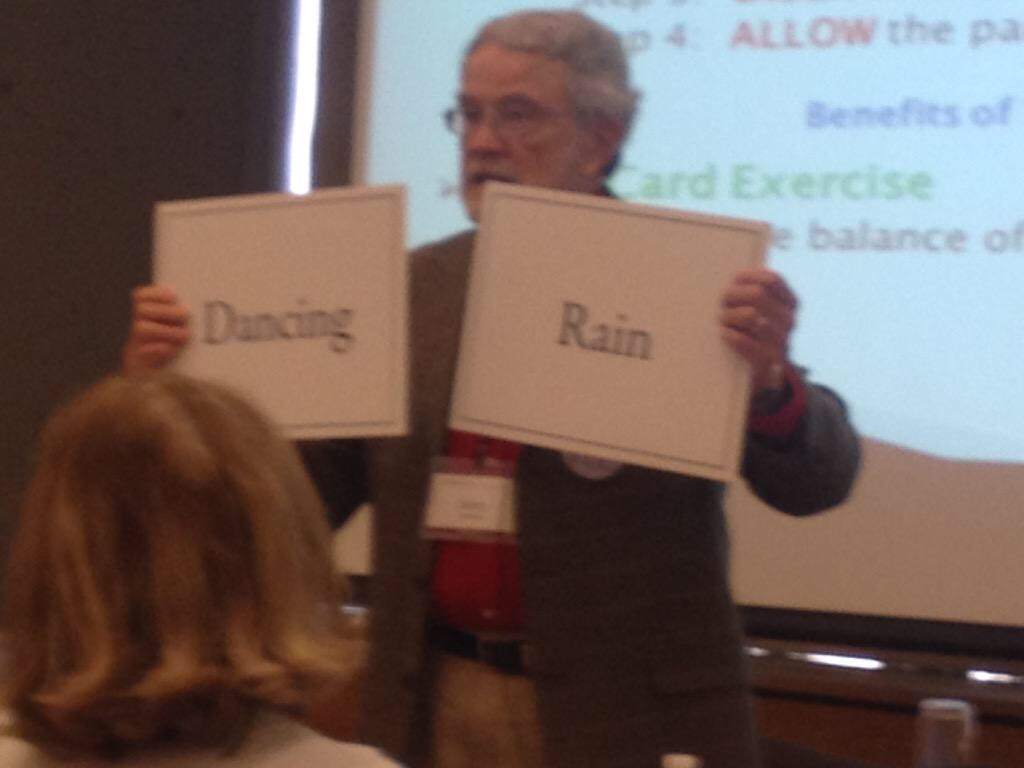 Jerry Murphy has developed a framework called ‘MY DANCE.’ Without going into much detail in this post, I would like to just share the framework.
MY DANCE FRAMEWORK:
Step 1: M – Do what MATTERS
Step 2: Y – Say YES to here and now
Step 3: D – DISENTANGLE from upsets
Step 4: A – ALLOW the pain life brings
Step 5: N – NOURISH myself
Step 6: C – Practice Self-COMPASSION
Step 7: E – EXPRESS feelings wisely
This post is really about Step 1: M – Do what MATTERS. It is the idea that what really matters are your core values. We cannot let our circumstances or discomforts that are thrown our way hijack us from what is important to us. During our time with Jerry Murphy he had us do an exercise called, ‘The Retirement Party.’ For this exercise you first imagine yourself retiring and you are attending your retirement party. Secondly, you spend a few minutes writing down four or five things that you like for people to say about your values as a trustworthy leader.
As you can imagine this exercise caused a great deal of reflection for me. I would like to share my points that I would want people to be able to say about me. Here are the four I cam up with:
1. Byron is just the kind of guy you are glad he is your friend and he has added value to your life because he has helped you grow.
2. Byron pulled me and enabled me to get to the places in my life I wanted to be. He has helped me be all I can be.
3. Byron certainly ‘Walked the Talk.’
4. Byron was able to bend in the breeze and navigate difficulties.
5. Byron was a lifelong learner.
This is not an easy exercise because sometimes you have to discover your values instead of just pulling them out of the air.
Then came the most powerful part of the exercise. He had us pick one of the statements that we wrote and think about if we were really doing and acting on that value. Then, we were to develop and action plan to truly carry out that value for everyone I serve as a leader and translate the value into action. Jerry call this Viva VIA! VIA – Values In Action. In fact he created buttons that he gave each of us. I have included a picture of the button here in this post.
My action step was for value number two: Make sure I do all I can for every staff member I serve according to their goals and professional growth plan. Sometimes it is easy to work with just a few, particularly those who are most aggressive with their own personal professional growth plans. I need to make sure and collaboratively identify those areas where the faculty I serve need to be pulled up to reach the goals they desire. This exercise really reminded me to lead my life shaped by what matters most to me. In other words what make me come alive and inspires me to lift those up which I serve.
We must remember that our values give meaning, purpose, and resolve to everything we do. As leaders, we must have a commitment to take action, even when it hurts. No matter how big the storm, the sky is big enough to handle it. Much like our storms as a leader, we must be big enough to handle them.
Bending In The Breeze: Being A Mindful Leader
 Today, while learning to be a more mindful leaders while at Harvard we did a meditation exercise looking out the window. This exercise was done in the Gutman Library at the Harvard Graduate School of Education during a session of Inner Strengths of Successful Leaders. I looked out and saw the tree that I have included a picture of in this post. It was a little windy out and the tree was gently bending in the breeze. It made me think about how as mindful leaders we must bend as the winds of difficulties blow in our everyday lives. I have seen wind break a tree that does not bend while leaving others that bend untouched.. After every windstorm there are broken branches scattered everywhere. I think, just like a tree we have a choice to either bend or break, or duck behind a windscreen.
While I agree with the observations regarding flexibility, resilence, and being adaptable. There is a fact that everyone must recognize. The tree that is highly flexible must also be rooted deeply or in a forest where the root systems intertwine and provide additional strength. A high rise building that moves up to 9 meters at the top requires a very strong foundation. A person who can bend with the circumstances must have core values and mindsets that are deeply rooted. Sometimes we need to take our mind for a walk, which was the whole purpose of the meditation at the window. We need to be aware of those things that are serving us well.
When we have difficult meetings, phone calls with difficult people, or are thrown difficult circumstances (which we will be) we need to take a mindful moment. In this mindful moment we are bending like the tree in the breeze. We need to be aware, take a moment to breathe, and show some compassion for ourselves. Also, in difficult situations we must recall what matters most to us as leaders. Another great leadership skill to remember is that when you feel the impulse to explain, LISTEN! Remember, act out of your values.
Furthermore, don’t try to get rid of difficulties, but build a bigger playing field so your values can be brought to the forefront. The leadership reality is that we will get overwhelmed. When thrown, we need to ratchet down the reaction just like the tree bends in the breeze. When thrown, our bend will be listening, looking inside to explore patterns and identify where we might be wrong, and take responsibility.
Finally, mindful leaders are poised. When we practice mindfulness we are able to bend with difficulties because of our presence and clarity to know what is happening. A great quote is, “What you resist persists.” Think about it; if the tree resists the wind and does not bend, it will break.


leave a comment