Nervous As Kittens
 As I was reading during my personal professional growth time this morning, I read a comment by Richard Branson in his great book The Virgin Way: Everything I Know About Leadership where he said he was nervous as kittens. After reading this I thought about our six newborn kittens we have in the barn right now. What a fitting phrase “Nervous As Kittens” is, because they are just that – nervous. It must be noted that I love cats. I believe what is attractive to me is the fact that they are not pack animals, like dogs. Cats are perfectly content to play by themselves or with other cats.
One thing I learned growing up on a farm that valued having an abundance of cats is the mother cats role. Mothers are key to having happy, secure kittens. Well socialized cats are more likely to have well socialized kittens. We always work very hard at spending time with our cats so they are socialized to people. Kittens often mirror their mothers’ calm or fearful attitude toward people or other animals; this is a normal part of their socialization. In other words, we play a vital role in the development of kittens. By petting, talking to and playing with our new kittens, we can help them develop good people skills. Then I read some startling research: kittens who are gently handled 15-40 minutes per day during their first seven weeks are more likely to develop larger brains. That really got me thinking about the connection to leadership, which was what I was reading about in the first place.
So, I compared what I learned and reflected on with kittens to that of leading people in an organization. What I thought about was modeling and exemplars.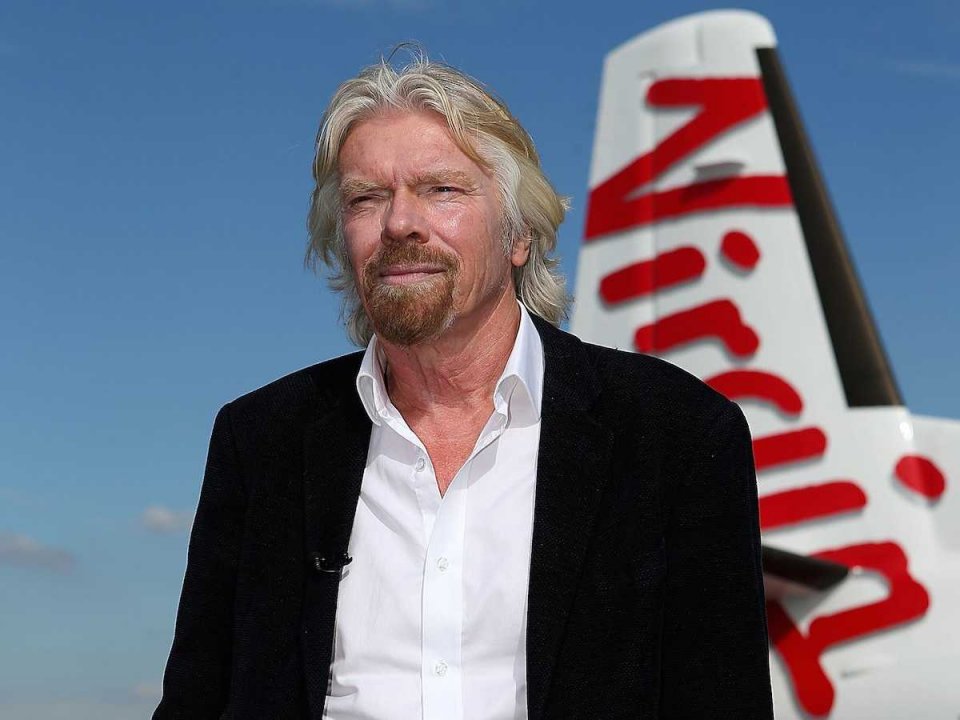
Modeling and Exemplars
Kittens learn many important lessons from their mothers. They learn from their mothers by observing. Research shows that kittens taken from their mothers at weaning are much slower to develop. As leaders, we need to learn from this and model for those in our organization the proper behaviors. Make no mistake, I am not saying I do this well. If being honest we would probably all say we need to be much better at this. I certainly do!
I am a big believer in using exemplars in education and learning. Sometimes people want to argue with me and say that the student will just do the assignment exactly like the exemplar. Well, duh, that is exactly what I want them to do. It amazes me how people will resist this with students, but in real world, real work we are given templates and exemplars all the time. In fact we would not think of beginning many projects without them. That is why I believe they are even more important for our students.
How many times have you said, “Let’s not reinvent the wheel.” What you were really saying is we need a model or exemplar. Certainly nothing wrong with that! Next time we reflect on those we lead and the students some of us educate, let’s not forget the lessons of the nervous kittens and make sure we are providing the modeling and exemplars we have learned to be so very important from the mother cat.
Authenticity 101
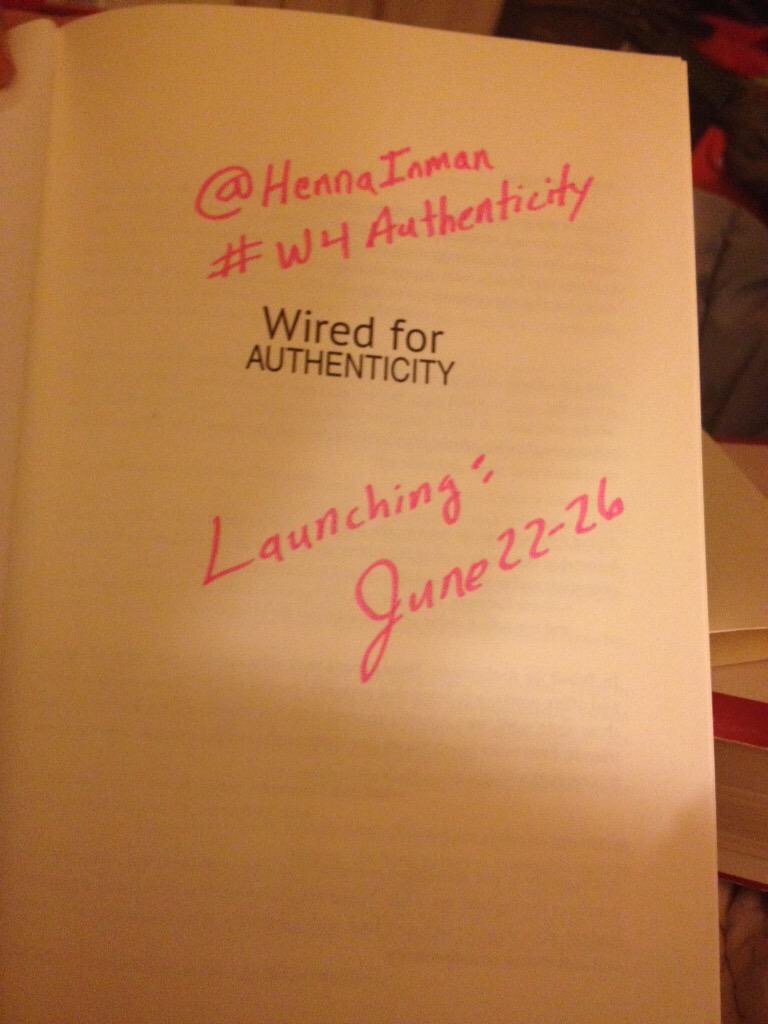
“Authentic leadership is the full expression of “me” for the benefit of “we.” ~ Henna Inman
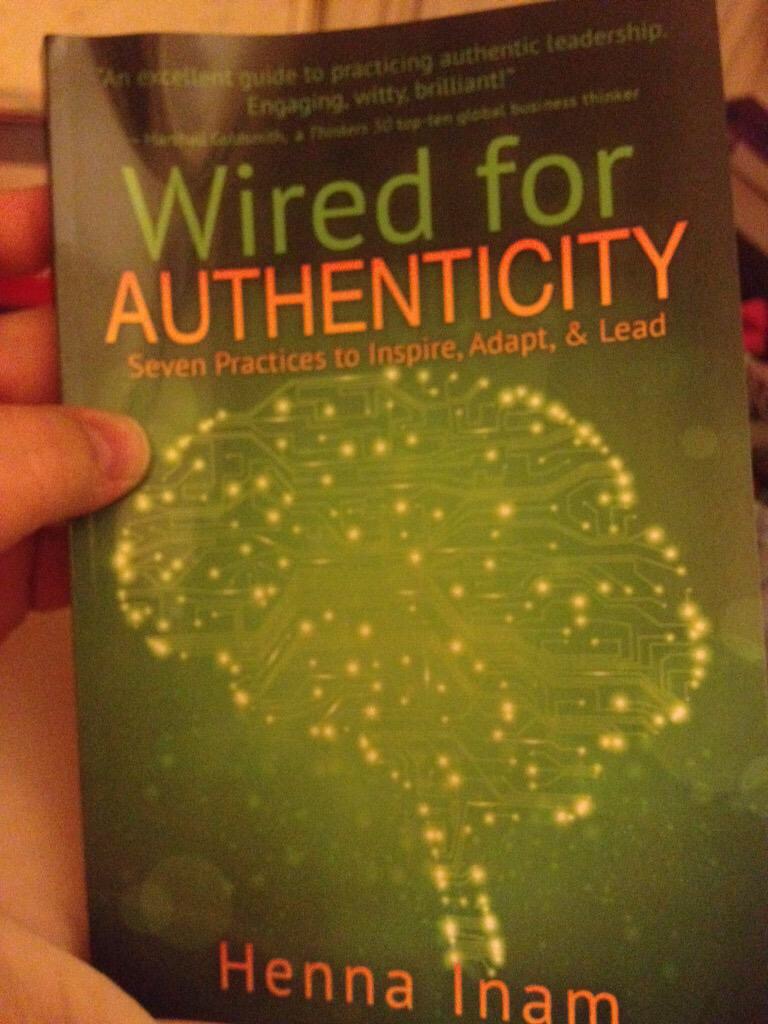
I had the great honor of receiving an advance copy of Henna Inman’s great book, Wired for Authenticity: Seven Practices to Inspire, Adapt, & Lead. What an awesome read. I gave the book five stars on both GoodReads and Amazon. Here is what I wrote as a review: “This is the only book out there that actually gives leaders best practices for being authentic. If I had to retitle the book, it would be: ‘Authenticity 101.’ This is a must read for all who want to be authentic in dreaming big and leading change and innovation.”
Inman’s Step 1 is to “Find Your ‘why.'” We learn best when we set a goal. Inman suggested writing a goal in the margin of the book that I, as the reader, wanted to be authentic in. I wrote, policy consensus and implementation. In order for us to truly be authentic, we need to lose who we think others believe we ought to be, or what is “good” and become who we really are. Being authentic means we will have our own ideas, core values, and beliefs. Guess what? That’s an incredible thing! Can you imagine how bad our constitution would have been if all the founding fathers would have had group think and all agreed on everything? I, for one, am glad they had disagreements and heated arguments, but in the end reached consensus and implemented a constitution that has stood the test of time. They were truly Leading Audaciously!
“We can choose to create within a high-change, high-uncertainty environment only by being in our authentic selves – not the saboteurs. ~ Henna Inman

“The trouble is when our identity starts to limit us and how we perceive our self-worth.” ~ Henna Inman
We must dare to dream big and lead with audacity. I have blogged about this before using my heroes the Wright Brothers as the example. Click here to read that post. Inman explains that when we dream big, we invite all of our saboteurs in for a feeding frenzy. When we get out of our comfort zones and do the audacious and pursue our big dreams we wake up our saboteurs to show up and try to make us fail. That’s ok. We have to continue our climb for what we believe in and not be intimidated. We must also strive to not be the saboteur and work to build consensus by turning the full expression of all the “me’s” into the good of the “we!”
“Our becoming who we are comes from our intentions and actions, not from concepts or theory.”
~ Henna Inman
Nothing Works Forever: Perpetuating the Mission & Values of the Organization!

“Nothing works forever. Our purposes never change – but our methods and tactics must constantly change. It is amazing how quickly a successful organization can deteriorate into mediocrity.” ~ Rick Warren, Pastor and Founder of Saddleback Church in Lake Forest, California.
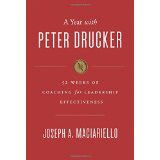
This week’s lesson in Maciariello’s (2014) A Year With Peter Drucker was based on an interview with one of my hero’s – Rick Warren. Dr. Warren founded Saddleback Church in Lake Forest, Calif., in 1980 with one family. Today, it is an evangelical congregation averaging 30,000 weekly attendees. Peter Drucker and Dr. Warren were friends and this week’s lesson was based on a 2003 interview. They discussed that organization must innovate and change. Organizations also tend to become bureaucratic and need to have conscience activities for maintaining and transmitting its core values (Maciariello, 2014). These principles should be implemented in a way that will perpetuate the mission and values of an organization and provide continuity, while also facilitating change.
The key here is facilitating needed innovative change, but at the same time having continuity. Tough order, huh? Drucker posited that we all need people committed to our vision our our teams, but we also sometimes need radical change (Maciariello, 2014). Drucker also argued that change and continuity are not opposites, but a continuum (Maciariello, 2014). If an organization does not change, it will die of being status-quot. In order to achieve continuity, therefore, an organization must be designed to change. Change and continuity are thus poles rather than opposites. Interestingly, I just spoke on this last week at the American Federation for Children National Education Policy Summit. In our panel I stated that in education and “school choice” that we were in danger of the new beginning to look like the old. In other words as a believer in “school choice,” we must make sure that the choices are not just some of the same old thing in a new wrapper. We must create schools that have the core value of all students can learn, but are differentiators in the way we do that. We need schools that educate better than anyone else and that have an “edge” or “niche” in doing so. In other words, a constant stream of incremental improvements will lead to substantial change and great schools over time. Schools, and all organizations, should therefore seek and reward continuous improvement activities. Continuous improvement must be one of our “BIG” initiatives to be working on in education, and all organizations for that matter. 
According to Maciariello (2014) change can occur in two forms: 1.) creating new wealth through innovation; 2.) creating wealth by moving resources from low to high productivity. Competition speeds this process up. This is why I am such a believer in school choice. We cannot predict the future, so it is our job, as leaders, to have the core values in place to allow for changes in products, processes, and services that will continue to meet the needs of our customers in the future.
As an “Energetic Change Agent,” I know that change is risky and creating the future is a lofty goal, but it is much more risky to leave the future to chance. Are your organization’s core values strong enough and believed by all to make it possible plan for change? Are your own core values and change agent abilities such that you will be able to maintain organizational cohesiveness during necessary changes? Isn’t it excited to be creating the new future?
Reference
Maciariello, J. A. (2014). A year with Peter Drucker: 52 weeks of coaching for leadership effectiveness. New York, NY: HarperCollins Publishers.
Earned Empowerment is Dangerous
 On Tuesday of this week, at the breakfast session of the American Federation for Children National Education Policy Summit, my new friend Jean-Claude Brizard made a comment during our discussion that really hit me like a ton of bricks. We were talking about building leadership capacity in our teachers and building our leadership benches/pipelines. Jean-Claude said, “Earned empowerment is very dangerous.” I have to say I more than a little taken aback by this statement. As a believer in distributive and shared leadership, I was a believer in the the idea of “earned empowerment.” In fact I have even blogged about it. Click here to read “Walk the Talk” and click here to read “Be Consistent, Not Clever!” Jean-Claude went on to explain what he meant. He believes that if you subscribe to “earned empowerment” that you will only be empowering the top 10% of your team. In other words, those top-performers who “earn” it.
Jean-Claude contends that we need to empower everyone in some way or another. In his words, “we need to empower them whether they want to be or not.” His belief is this empowerment will then develop them as leaders. I must say, after reflecting, this really makes a lot of sense. As a leader who has created a “make it so” environment, why would I not want everyone to be empowered. I guess I really have been practicing empowering everyone, because I want everyone to come to me with well thought through plans and tell me what they intend to do. My goal is to always say, “Make It So!”
This idea of empowering everyone really is interesting. Think about it; if we are able to empower all of our people with projects, responsibilities, and aren’t we really expanding the capacity of our organization. So really, mass empowerment equals capacity building. This in turn means leadership development of our teams. Wow!
There is one catch to this, however, in Turn The Ship Around!: A True Story of Turning Followers Into Leaders by L. David Marquet, he talks about empowerment really being a delegation of authority. Marquet described, however, that delegation alone is not the answer. We must also be committed to increasing the technical knowledge of those on the team. As Marquet said, “When authority is delegated, technical knowledge takes on greater importance at all levels” (Marquet, 2013). He went on to say, “Control without competency is chaos” (Marquet, 2013). I love this quote because it drives home the point that leaders must consistently provide an environment of professional growth that builds the competency of all in our organizations. Therefore, if we are going to empower all of the members of our organization we need to make sure we have trained them and provided them the necessary professional growth opportunities to prepare them for their responsibilities. Pretty exciting stuff!
Another important thing to keep in mind is that there will be differences in abilities of those on our teams. Also, there will be those who do not want to be empowered. There always seem to be a few who just want to be told what to do. This means that we, as leaders, will need to differentiate and individualize how we empower our team members.
This whole idea of the danger of earned empowerment has really got me thinking about those on the team I lead that I have not empowered or need to empower more. Do you have members of your team you need to empower?
Reference
Marquet, L. D. (2013). Turn the ship around!: A true story of turning followers into leaders. New York, NY: Penguin Group.
Talkin’ Turkey About Sunk Cost Bias
 I am always amazed at how much I learn on my son and I’s annual turkey hunt. First let me answer the big question on everyone’s mind. Did you get one? I am happy to report that my son did! I did not. For the second year in a row Heath got a turkey and I didn’t. This was his fifth turkey in the seven years we have been hunting together. Not bad for a fourteen year old. In my defense, I did not even take a shot. I saw a bunch of turkeys and witnessed some great wildlife shows, but never a gobbler close enough to harvest.
When turkey hunting there is a great deal of time in solitude for thinking. My favorite time is the first thing in the morning. We get to the woods at 5:00 a.m. and then watch and listen as the woods comes alive. First there are the birds, then the occasional deer, and then the gobble of a roosted turkey. Our two days of turkey hunting each year remind us of all the wonderful creations that God has made. Though my seat attached to my turkey vest is not as comfortable as a yoga mat, I am not any less mindful when in this state of thought and meditation. There are so many things that run through your mind when sitting in total silence and not being able to move. It is exhilerating and I am already looking forward to next year.
On our first morning of the hunt, Saturday, we went to the river bottom along the levee. My son, Heath, set up along the field’s edge that separated the levee from a woods (the turkeys typically come off the levee and graze the field while heading to the woods for the day). I set up about a mile south of him. We both had a great show of turkeys that first morning. I even had a hen come right past me close enough that I could of reached out and touched her. Those that know me are probably amazed that I am able to sit that still in my full camo glory! Anyway, neither of us got a long beard (tom turkey) close enough for harvesting.
Later that afternoon, my wife took Heath to a baseball game (he pitched a save, by the way), and I went back near where we had hunted in the morning. There was a tremendous showing of birds. There was a group of 11 that appeared – four long beards, three jakes (young male), and four hens. They worked the field in front of us for two hours, but we could never call them in close enough for a shot. Then there was a single Tom who strutted around the field like he owned it, but again, not close enough. It was a tremendous show that Walt Disney would have been proud to have filmed for his nature films. But, still, they stayed along the levee side.
The next morning, you guessed it, I went back to the levee. Heath, on the other hand, went to another location. You guessed it, at 8:30 he harvested a bird. I was texted a picture (seen at the top of this post) and was thrilled – the goal is always for Heath to get a bird – I am secondary. Once again, however, I had the greatest show ever. Turkeys were coming off the levee right and left – lots of them. You guessed it, though, they were not interested in coming to me. The Toms were with hens and not interested in what I had to offer. Anyway, it was another great morning of solitude and thought. At least I kept telling myself that!
Toward the end of the morning, as the turkeys were moving out of site I got to thinking about “sunk cost bias.” Was I falling into the trap that leaders fall into. As I thought about this I realized that turkey hunting might be one of the greatest case studies to teach this because I kept getting drawn back to this same area. I knew there were lots of turkeys here. In fact three of Heath’s turkeys he harvested in past years had been taken very near where I was sitting. Also, I had already spent a lot of time there this year. This year, however, the turkeys were just not moving across the fields in the same way – this is what really makes turkey hunting so exciting and facinating. The turkeys never act the same from year to year. Does this sound like any of the organizations you lead? Yet, for some reason I was drawn to this place. Part of it was the fact that it is one of the most beautiful places in the world. Hemlocks were blooming, Blue Jays were playing in the trees above me, a squirrel was hopping from tree to tree, and a Bald Eagle was soaring above. It is just a glorious place to be.
Still, there were all these turkeys. When we regrouped for the afternoon and Heath’s turkey had been processed it was decided to go to another location for the afternoon. “Sunk Cost Bias” had been resisted; at least for now. At 4:30 p.m., after not seeing or hearing any turkeys, it was decided, you guessed it, to go back to the levee. I know what you are thinking: this guy is an idiot because he knows the turkeys won’t come close enough. You are right, I was giving into sunk cost bias. I knew we would see birds, but I would never get a shot. Yet, I was drawn by the fact I had invested so much time there and knew there were turkeys. I had become the poster child of what sunk cost bias is: The sunk cost bias is manifested when we have a greater tendency to continue an endeavour once an investment in money, effort or time has been made.
I was first introduced to this thinking at Harvard University by Dr. Monica Higgins when studying a case study of the 1996 Mount Everest tragedies. Reasoning that further investment is warranted on the fact that the resources already invested will be lost otherwise, not taking into consideration the overall losses involved in the further investment. During the Mount Everest tragedy the sunk cost bias was carried out on two fronts: 1. At the time of starting for the summit, some thought the conditions were not right, but they had come all this way and were not going to wait; and, 2. Many that died did not summit by the 2:00 p.m. cutoff time (the time set to turn around if a summit had not been made yet) but went ahead and summited as much as two hours late. Again, the thought of “I’ve invested all this time, money, effort, et cetera and by golly I am going to summit Mount Everest” was at play there.
Obviously, my life was not on the line, but by going back to the levee for one last ditch effort at the end of our last day of hunting was giving into sunk cost bias. You guessed it, too, we saw a lot of turkeys but none came close enough. What I was failing to realize is that moving back to the levee would most likely result in the loss of much more time and not getting a turkey. I was thinking short-term, not long-term, and simply trying to avoid not getting a turkey, which was fallacious thinking. It was really thinking from a defensive posture and not an offensive one. This experience has really caused me to think about the strategic and academic plans we are carrying out in the schools I lead. Do we have areas of sunk cost bias? It begs taking an introspective look.
When we make a hopeless inventment of time, treasures, or talents we sometimes reason: We can’t stop now, otherwise what we have invested so far will be lost. This is true, of course, but irrelevant to whether we should continue on with the plan. If the plan will not work that everything invested will be lost regardless. Therefore, it really is irrational to continue, but yet we (at least me) continue on anyway. The rational thing for me to do on our turkey hunt would have been to try a new spot. Why didn’t I make the rationale choice: Our decisions are tainted by the emotional investments we accumulate, and the more we invest in something the harder it becomes to abandon it. As an emotional human, my aversion to loss often leads me right into the sunk cost bias. We need to instead look at the loss from a growth mindset and consider it learning and knowledge gained.
Luckily, we all have the ability to reflect, study, and regret past actions. So, in my case, I need to remember what I did on this turkey hunt and apply it to my professional life as a leader. Do you have areas in your personal or professional life where sunk cost bias is hurting your ability to move forward? If you’re not sure, might I suggest an early morning meditation time in a woods as it comes to life at the start of the day?
Meaningful Measurement
 This week’s lesson from Peter Drucker started with a story from when Ronald Reagan gave a campaign appearance at Claremont College. He was telling about how different it was at the time in 1980, than when he went to college. When discussing all the entertainment and laborsaving devices and space exploration, he said: “My generation didn’t have these; we invented them. (Maciariello, 2014, p. 139).” Even today there will be fundamentally new concepts, new ways of seeing the world, new ways of relating as individuals, as organizations, and as countries that will need to be developed. This is why Peter Drucker believed that, even in 1992, we were in a “very dangerous, a very upsetting, and a very exciting period (Maciariello, 2014, p. 141).”
These upsetting, dangerous, and exciting times that Drucker refers to, and I still believe we are in, also leads to a great deal of uncertainty. Drucker talked about realizing that the things being measured for success are not meaningful anymore (Maciariello, 2014). This is where all industry and education are alike; we must have meaningful measurement of metrics that matter. This is exacerbated by the fact that we live in a “mixed mindset” society as opposed to a “growth mindset” society. We have such a fear of failure because have become so fixated on winners and losers as opposed to getting smarter. We need to use all our knowledge and insight from all sources, including the humanities, life sciences, physical sciences, economics, history, and social sciences to bring about effectiveness and results. According to Drucker (Maciariello, 2014), the knowledge society has contributed to income inequality and uncertainty (this whole idea of winners and losers).
 Education certainly is a prerequisite to competing and succeeding in our global economy today. This, in turn, creates exciting times for education. This is why I believe we must shift to a much more student-centered accountability that is framed on a growth mindset. In other words, we should weight student growth more heavily than proficiency. We should be measuring credits earned (as many students transfer from school to school already credit deficient), courses failed, attendance, and classroom engagement. We should also develop alternative accountability definitions that include mobility, date of enrollment, prior achievment, persistence and course failure. We should also include a growth measurement for high school students, which may require a pre-test in courses that have end-of-course assessements; although this is an additional assessment, a pre-test will provide actionable data that will lead to individualized instruction. I think you get the idea from this that I believe we must find out where the students are and then develop an action plan to get them there. This is very much a growth mindset approach to facilitating highly effective instruction and learning for the students we serve.
In closing, I would challenge you to take an introspective look at your organization, business, school, or governmental entity you lead and ask yourself, and your colleagues “Are we measuring the right things, do we have a growth versus fixed mindset, and how should we be measuring success?” Let me know your thoughts.
Reference
Maciariello, J. A. (2014). A year with Peter Drucker: 52 weeks of coaching for leadership effectiveness. New York, NY: HarperCollins Publishers.
The Leadership Bottleneck!

“The bottleneck is at the head of the bottle,” so the old saying goes. In other words, no business or organization is likely to be better than, or perform better than, its top management and leadership. As a management innovator, Peter Drucker built off of the existing knowledge of others to create and integrate missing knowledge into the organization. He called this practice “integration” (Maciariello, 2014). Top management and leadership is responsible for creating and for maintaining the spirit of the organization, which includes values, standards of conduct, and standards of quality.
So, the first task in designing and assessing an organization is the presence of an effective top management and leadership team with a strong spirit of performance. Close behind in importance is a program for developing talent to fill open management positions. Most call this the building of a bench. This athletic team analogy is appropriate. Study any successful athletic team and you will find a strong bench of players ready to perform at a moments notice. This year’s NCAA Tournament has given us many examples. Not the least of which would be Kentucky who just had their 38th season win defeating Notre Dame last night. I had the opportunity to watch this Kentucky team play in person during the tournament and it doesn’t matter who is on the floor for them – they are all great. We can certainly learn from them as we build our teams.

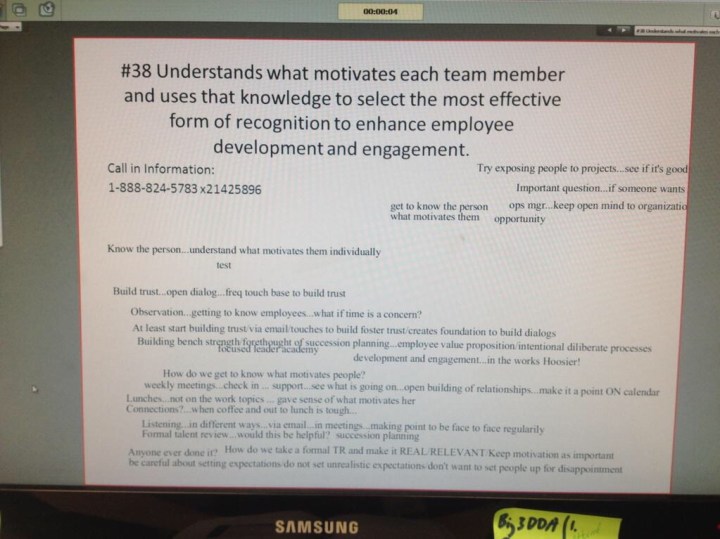
This building of a bench is very important to employee engagement. One of the things I am working very hard on for the school I now serve is a leadership academy for building our talent bench. We are going to take a group of our talented teacher leaders each year and put them through a program that will be individualized for their specific needs and interests. We are in the planning stages of this and I am sure I will blog about this in the future. In the meantime I will share a picture of a screenshot of some notes from a meeting about this, just this week.
In any major institution, such as a school corporation, the finding, developing, and proving out of leaders of tomorrow is an essential job to which the best leaders must give fully of their time and attention. Maciariello (2014) asked some great questions in this week’s reading:
- Is your organization preparing future leaders by giving significant responsibility and authority to lower level executives?
- What has been the organization’s track record of finding successors for key positions inside versus outside?
These are certainly questions I will want to use as guides as we develop our bench. How about you?
Reference
Maciariello, J. A. (2014). A year with Peter Drucker: 52 weeks of coaching for leadership effectiveness. New York, NY: HarperCollins Publishers.
Resist Multitasking: Cut The Pattern To Fit The Cloth
I am almost a week behind on my reflection of week nine in A Year With Peter Drucker: 52 Weeks of Coaching for Leadership Effectiveness (Maciarello, 2014). I usually read the week’s lesson and write the post on Sunday mornings. Last week, however, I had to fly out to be at Harvard University early Sunday morning so I packed my book and was going to do the work Sunday night. Well, long story short, the airline lost my bag and I just had it returned last night – a full day after returning home. That entire experience and adventure may be the topic of another post.
The basic premise of last week’s lesson was to organize our personal work and the work we delegate to others effectively. We should attempt to plan our time, making sure that our most important tasks are done first, and, as much as is possible, resist pressures to engage in multitasking (Maciariello, 2014). Both empirical evidence and common practice confirm that multitasking really isn’t possible. In other words, we should fit our most important tasks into our available time. Or, “Cut the pattern to fit the cloth.”

Andy Grove, one of the three founders of Intel, put it this way: “What am I doing that I shouldn’t be doing (Maciariello, 2014, p. 66)?” Grove also offered four other great questions to help guide us in resisting multitasking:
- Should I still be doing it?
- Am I doing it well?
- Am I adding enough value to what I am doing?
- Is it more worthwhile or less worthwhile than anything else?
Grove shared that after answering these questions he then negotiates with himself.

So how do we make this all happen? We must learn to delegate certain activities, abandon other activities, or relax the frequency of the performance of repetitive duties. To do this we must have the strongest followers. Successful leaders are not afraid of strong subordinates. We must assemble the most talented team available develop their competency and capacity, and then, get out of their way. When we develop others we simultaneously develop ourselves because we have to figure out how to raise the capacity of the people we are trying to develop. This will serve as a stretching activity for us, too.
Therefore, resist multitasking, develop your team with “A” players, and determine what are the most important tasks for you. As Peter Drucker said, “Effective leaders delegate, but they do not delegate the one thing that will set the standard. They do it (Maciariello, 2014, p. 70)!”
Reference
Maciariello, J. A. (2014). A year with Peter Drucker: 52 weeks of coaching for leadership effectiveness. New York, NY: HarperCollins Publishers.
Targeting & Focusing Your Efforts
Think about creating tomorrow by focusing on the “right results” and “changes in trends” rather than on just the current trends affecting your organization. An important question to ask is, “What are the right results for your organization?” Maciariello (2014) posited in Week 8’s lesson that knowing your mission or purpose is essential in choosing from among all available opportunities those that have the highest probability of producing the right results.
I compare this “focusing” to that of sunlight through a magnifying glass to start paper or grass on fire. Peter Drucker said, “Concentrate on the smallest number of activities that will focus on the greatest productivity.” (Maciariello, 2014, p. 62) I have found this to be so true in turning schools around. This is one of the most important lessons I have learned from my postdoctoral professional development at Harvard University. We talk about having too many resources. I know that sounds really weird coming from an educational leader. Too many resources? Yes, if you have not asked yourself, “What am I (or our school or organization) willing to give up?” We should abandon, or not start at all, programs where even great success is unlikely to make a significant difference.

Maciariello (2014) argued that economic results require that staff efforts be concentrated upon the few activities that are capable of producing significant business results. This would be true for schools as well. Knowing who we serve and what makes us distinct allows us to concentrate our resources on a few major opportunities. This also means being prepared to eliminate past programs and best practices that are no longer productive or getting the results needed to move our organizations to the next level. “If leaders are unable to slough off yesterday, to abandon yesterday, they simply will not be able to create tomorrow.” (Maciariello, 2014, p. 63) Without targeting and focusing on the right things we will not be able to exploit our resources strategically for success.

Just like a flashlight focused on an object in the darkness, we must target ourselves on the areas where a little success will have the greatest impact. Don’t forget the key question here: What are the “right results” for our school or organization?
Reference
Maciariello, J. A. (2014). A year with Peter Drucker: 52 weeks of coaching for leadership effectiveness. New York, NY: HarperCollins Publishers.
Manipulation of Reality

“The problem is that 25 years after Photoshop launched, we’d much prefer manipulations of reality to reality itself.” This statement by Caitlin Dewey of The Washington Post in a very well written article entitled “How 25 years of Photoshop changed the way we see reality” really got me to thinking about whether this was true in all parts of our lives, not just photos and appearance. This great article was about a set of unretouched Beyoncé photos that appeared on a fan site called Beyoncé World on Wednesday morning. Within an hour the pictures were taken down, but fans were angry not that Beyoncé had been Photoshopped to breathtaking beauty, but that someone had shown her without manipulation.

So, have we really come to a time that we do prefer manipulation to reality? If so, what implications are there for leaders? The more I reflected the more I realized there are similarities between leading and manipulation. Both imply action and involve influencing people to do things. Furthermore, both ultimately benefit the person who is either doing the leading or the manipulation. Manipulation is what happens when we influence someone to do something and only we benefit from their actions. Think about it; there is really only one person that benefits from the Photoshopped pictures of Beyoncé – her. Leadership, in contrast, works to ensure that both parties benefit. For a relationship to be sustainable you need to be getting at least as much as you are giving from relationships (both personal and professional). While sounding selfish, I would argue that a relationship where one party gives without receiving much in return only breeds resentment over time. Again, this is what happens with manipulation.
As Dewey also stated in her article, “It’s worth remembering… that perfection and reality are not the same thing.” As leaders we must always make sure we are not creating distorted realities for our organizations and those we serve.


leave a comment