It Isn’t Always Right To Be Right
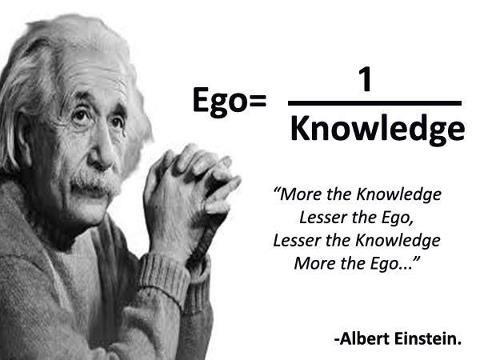
This week’s lesson in The Disciplined Leader (Manning, 2015) dealt with humility. Manning points out that disciplined leaders admit they do not have all the answers. They are able to let go of the ego and ask for and accept help. The lesson here is, according to Manning (2015), you are responsible for how you carry and lead yourself. It’s really pretty simple, talk less and listen more.
“Disciplined Leaders live and die based on the performance of their team. You will find that many of the best business leaders talk about their team and keep them in the spotlight, not talking about themselves. These leaders understand their role is to help their team be successful and give them credit every time credit is due. Through these actions, such leaders earn that crucial respect, build loyalty, and consistently get their desired results.” ~ John M. Manning
Manning (2015) gave us three great points to live by in the book:
- Look beyond you for answers.
- Adopt a teamwork mindset.
- Grow awareness of your verbal and body language.
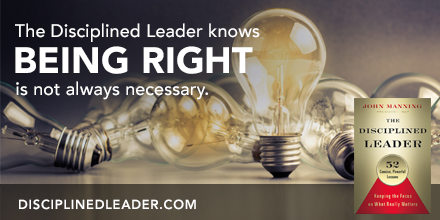
I am a believer we must share our mistakes as teachable moments. When, as leaders, we showcase our own personal growth, we legitimize the growth and learning of others; by admitting our own imperfections, they make it okay for others to be fallible, too. We also tend to connect with people who share their imperfections. Another way to practice humility is to truly engage with different points of view. Too often leaders are focused on swaying others and “winning” arguments. When people debate in this way, they become so focused on proving the validity of their own views that they miss. As Manning(2015) pointed out, “It isn’t always right to be right.” Ambiguity and uncertainty are par for the course in today’s knowledge society. When leaders humbly admit that they don’t have all the answers, they create space for others to step forward. Finally, we must role model being a “follower.” Inclusive leaders empower others to lead.
“Develop your leadership style like a branded product. You want others to trust that brand and always lean toward it.” ~ John M. Manning
Reference
Manning, J. (2015). The disciplined leader: 52 concise, powerful lessons. Oakland, CA: Barrett – Koehler Publishers, Inc.
Being Prepared For What You Don’t Know You Need To Be Prepared For
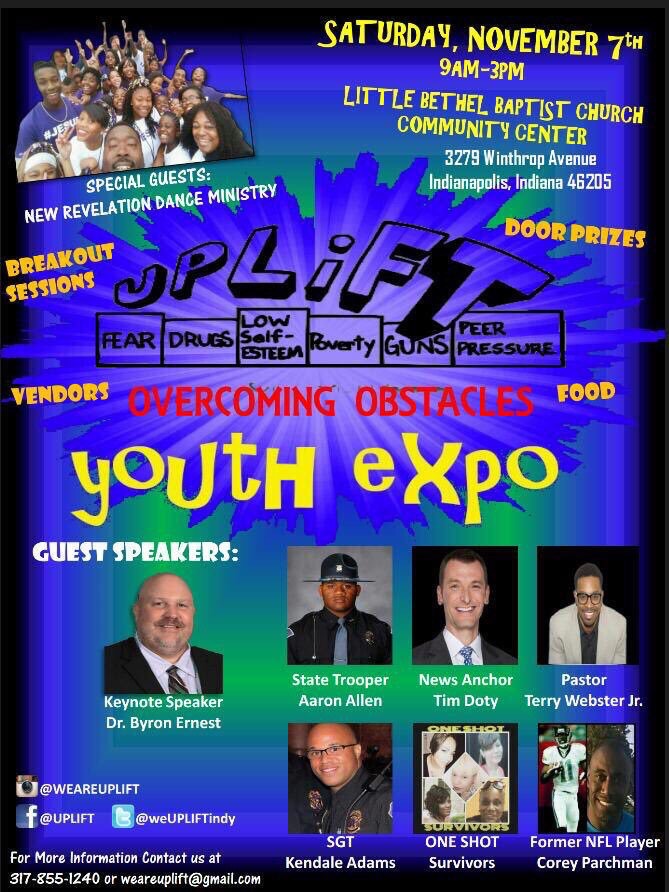
Later today I will be speaking at the Overcoming Obstacles Youth Expo. This expo is being put on by Uplift Indy. I love the title, “Overcoming Obstacles.” That’s really what it is all about. I will be closing out the day and will tie it all together by working with the youth on around the idea of “Being Prepared For What You Don’t Know You Need To Be Prepared For.” Isn’t that what obstacles are? Things we are not prepared for. But really, we have some tools already in our toolbox for being prepared and just need to think through how we get the rest. I can’t wait to spend time with these kids today!
I will post my comments and thoughts from the day when the expo ends today.
Truth: The Key To A Candid Workplace Culture
“The longer I live and participate in the business world, the more I realize telling the truth is almost always the correct choice, painful or not. There are ways to communicate with tact; a harsh reality can be delivered in a constructive way.” ~ John M. Manning
 As I read this week’s entry in The Disciplined Leader (Manning, 2015) I was reminded of the dramatic scene in the great movie A Few Good Men. In the movie’s final court scene where the military lawyer, Kaffee, played by Tom Cruise is trying to draw the arrogant colonel, Jessup, played by Jack Nicholson into admitting that he ordered a Code Red (a sort of vigilante justice within a unit) that was officially not allowed by the military; Kaffee yells at him: “I want the truth!”, and then Jessup yells back “You can’t handle the truth!”, and then proceeds to make the admission and tell the truth, finally. This telling of the truth ultimately builds trust on the team. According to Gary Peterson of Forbes Magazine (Peterson, 2013) there are four key attributes to strong followership. Followership is defined, according to the University of Oregon, as the willingness to cooperate in working towards the accomplishment of the group mission, to demonstrate a high degree of teamwork, and to build cohesion among the group. (University of Oregon, 2013). Here are the four key attributes: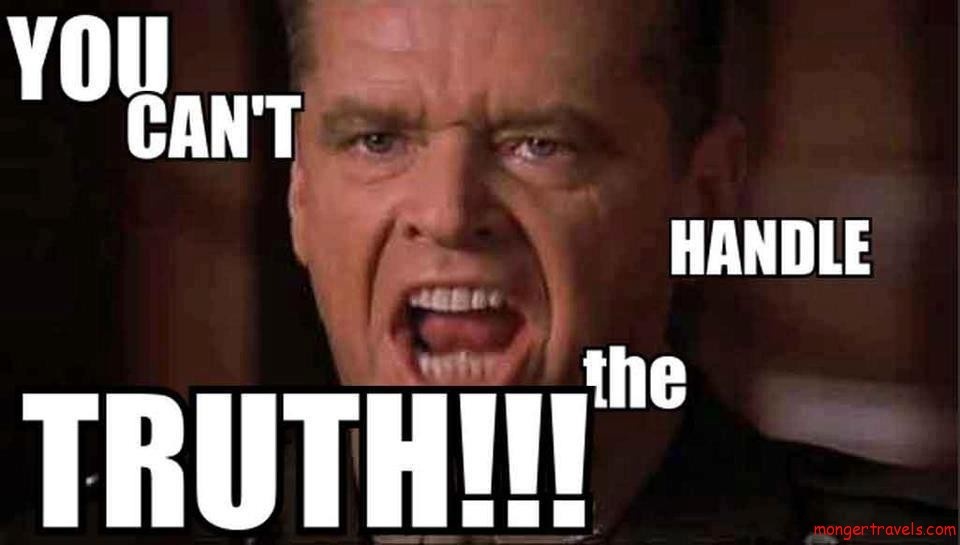
- Trust: Through everyday behavior, “followership” requires that the leader provides evidence that they can be trusted.
- Stability: Leaders with strong “followership” remain calm in the face of panic and give a sense of confidence to those around them.
- Compassion: Strong “followership” leaders have unrelenting passion for people and show empathy when those folks are enduring hard times.
- Hope: “Followership” requires that the leader has unwavering belief that their product/service will not only succeed, but will change lives.
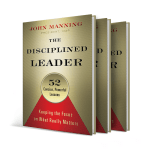
Manning (2015) points out that the truth also sets the stage for a candid workplace culture. This allows it to be a productive and safe place for team members to be engaged and part of a learning organization culture. The truth never hurts us, it is what we do with the truth. I really like the way Manning (2015) describes the truth as giving us the ability to act fast. He posits that truthfulness is a change agent (Manning, 2015). This truthfulness will act as a catalyst for making decisions that mirror our core values, wisdom, self-discipline, and integrity. We must remember to make the truth a part of our core values.
References
“Followership.” Followership. The University of Oregon, 01 Jan. 2013. Web. 15 June 2013.
Manning, J. (2015). The disciplined leader: 52 concise, powerful lessons. Oakland, CA: Barrett – Koehler Publishers, Inc.
Peterson, Gary. “Leadership 310: The Four Principles of ‘Followership'” Forbes. Forbes Magazine, 23 Apr. 2013. Web. 14 June 2013.
Understanding Oneself to Manage Oneself
“Truly knowing yourself is a powerful lever for initiating personal growth and development.” “When you know yourself well, you are better able to maximize your leadership potential. You will realize what’s been working for you and what’s not. You will gain clarity on how to leverage your strengths and overcome your weaknesses.” ~ John M. Manning

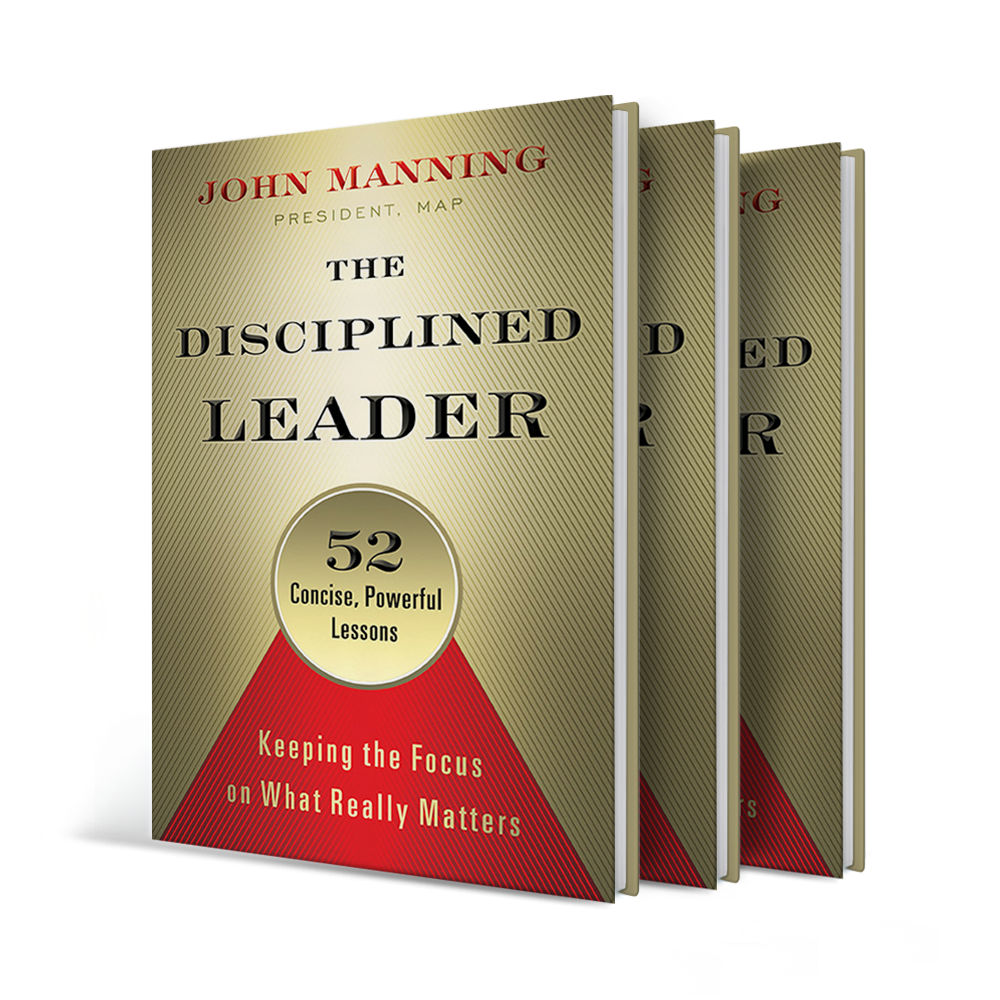
It is amazing to me how two entries in two entirely different books could be so alike in the entries today. In A Year With Peter Drucker (Maciariell, 2014) discussed “A Catalyst to Help People Manage Themselves and Move to the Second Half of Their Lives.” I titled my blog post about that entry “Managing Oneself.” Click here to read that post. In that study I learned that once we understand our strengths, our values, how we work, and areas in which we are likely to make a contribution, we are ready to manage ourselves in the second half of our lives. In today’s entry in The Disciplined Leader: Keeping Focus on What Really Matters (Manning, 2015), John Manning taught us that part of initiating a change or developing professionally begins with an analysis of ourselves. This analysis can then provide the necessary building blocks for continued improvement.
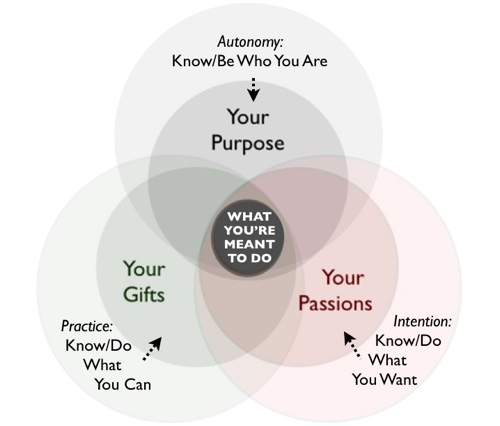
 I have learned that in order to understand ourselves and our willingness to lead others we should also take a detailed look at what really drives us. What drives us will influence what we value and enjoy, our attitudes and behaviors in the workplace and is likely to provide insight into our strengths and talents. In order to lead others, we need to be able to relate to and connect with other people, their motivations, needs and aspirations and their deepest values and core beliefs. Before others are willing to be lead by us, they will want to connect to something within us – something that is authentic, real and true. This is why when we talk about leadership, we often focus on ‘authentic leadership’ or being an ‘authentic leader’. In order to be an authentic leader, we need to be a person that others can relate to. We need to know ourselves, our beliefs and core values and how they manifest in our attitudes, behaviours and actions and in the impact that we have on others. For this I would go back to what Drucker (Maciariello, 2014) argued were the four things we needed to understand for managing oneself:
- What are we good at – that is, our strengths.
- Managing oneself requires that we understand our values.
- We should understand how we work best – alone or with others as a team.
- Are we good at taking on unstructured tasks, or do we do better when we understand the structure at the outset?
 I am going to try one of Manning’s (2015) Take Action! Tips and would encourage you to as well. Identify five changes in routines you could do tomorrow that are easy. I can think of five right of the bat that would make me a better leader. I’ll bet you can to!
References
Maciariello, J. A. (2014). A year with Peter Drucker: 52 weeks of coaching for leadership effectiveness. New York, NY: HarperCollins Publishers.
Manning, J. (2015). The disciplined leader: 52 concise, powerful lessons. Oakland, CA: Barrett – Koehler Publishers, Inc.
Managing Oneself
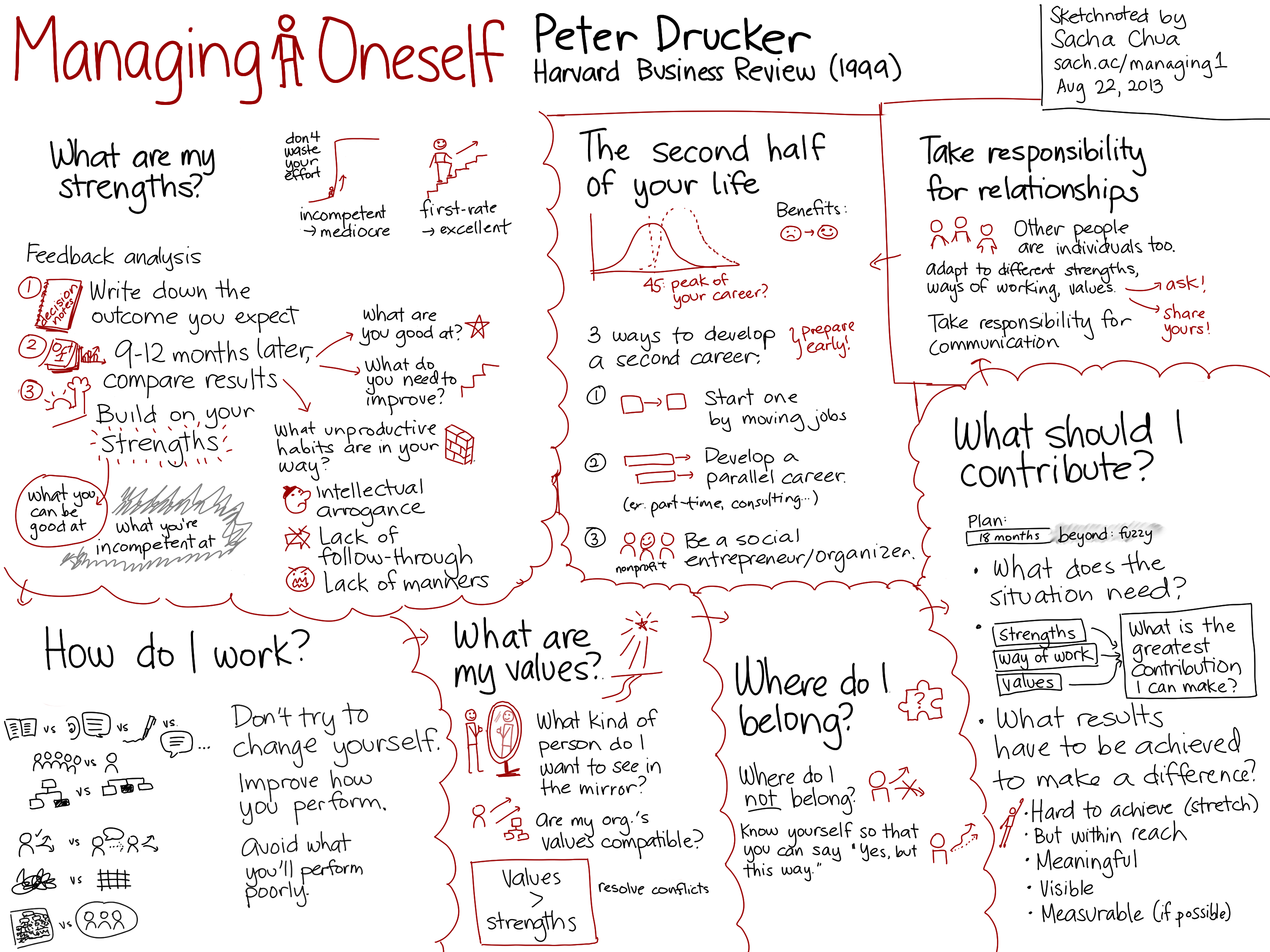 This week’s entry is the last dealing with moving from success to significance in the last half of our life. In this entry Maciariello (2014) explains Drucker’s body of knowledge on “managing oneself.” Managing oneself requires that we understand four things:
- What are we good at – that is, our strengths.
- Managing oneself requires that we understand our values.
- We should understand how we work best – alone or with others as a team.
- Are we good at taking on unstructured tasks, or do we do better when we understand the structure at the outset?
Once we understand our strengths, our values, how we work, and areas in which we are likely to make a contribution, we are ready to manage ourselves in the second half of our lives. In order to reach significance, Drucker believed you could not do more that two or three initiatives; with one probably being the best focus (Maciariello, 2014). 
“Siginificance need not be a 180-degree course change. Instead , do some retrofitting so that you can apply your gifts in ways that allow you to spend more time on things related to what is in your box {your strengths and values}. And to do it in such a way as to reclaim the thrill of that first deal.” ~ Bob Buford
Today, knowledge workers are likely to outlive organizations, and the knowledge worker has mobility. Mobility is widely accepted in the United States, but the idea of outliving organizations is still a tougher pill to swallow. Drucker believed that boredom leads to an underutilization of our talents (Maciariello, 2014). We run the risk of what he called being “mentally finished.” Therefore managing oneself requires us to prepare for the second half of our life.
Reference
Maciariello, J. A. (2014). A year with Peter Drucker: 52 weeks of coaching for leadership effectiveness. New York, NY: HarperCollins Publishers.
Significance Through Social Entrepreneurship
 It is hard to believe there are only 10 lessons left in A Year With Peter Drucker (Maciariello, 2014) after this week’s entry. This means a couple of things: I am about to finish a book that has inspired a great deal of thought and action in me; and, we are only 10 weeks away from closing out 2015. This week’s lesson reminded me of the entrepreneurial spirit that brought about the social civil society we now have in the United States. The Salvation Army, CARE, Alcoholics Anonymous, Red Cross, Girl Scouts, and Lions club were all organized as the result of a service oriented entrepreneur recognizing a social need. In 2011 there were approximately 1.6 million tax-exempt, 501(c)(3) organizations in our great country. This 1.6 million was made up of private charities, private foundations, and religious institutions (Maciariello, 2014). Clearly social innovations is one of the distinguishing characteristics of American society.
 Drucker (Maciariello, 2014) advised us that an opportunity set exists for successful leaders in the second half of life to create significance. If leaders, according to Drucker (Maciariello, 2014), have a develop a narrow focus they can find opportunities for utilizing their gifts in their communities, states, nation, and the world. To do this we need to analyze our own strengths, weaknesses, and core values. Drucker (2014) also spoke of how systematic innovation can be found when he said, “The unexpected – the unexpected success, the unexpected failure, the unexpected outside event; the incongruity – between reality as it actually is and reality as it is assumed to be or as it ‘ought to be’; innovation based on process need; changes in industry structure or market structure that catch everyone unawares. The second set of sources for innovative opportunity involve changes outside the enterprise or industry: demographics (population changes); changes in perception, mood, and meaning; new knowledge, both scientific and nonscientific (p. 333).” When reflecting on the lessons of Peter Drucker I was reminded of how Duke University was founded. Back in the 1920s, James P. Duke wanted to build a medical school and a hospital to provide medical resources, including doctors, to the Carolinas. Today, Duke University provides a place for extraordinary academic learning and research. This is accomplished through undergraduate and graduate schools, research centers and a variety of international programs. In Mr. Duke’s vision, leadership also involved harnessing the power of higher learning for the larger social good to meet the world’s great needs. Duke University is now widely recognized for its pioneering leadership in social entrepreneurship education, having provided essential and important legitimacy for the field by producing and facilitating academic research that has defined, informed, and advanced the field, and having delivered high quality courses to undergraduates and graduate and professional students eager to learn about the field. This is a pretty outstanding example of successful social entrepreneurship if you ask me.
We all need to take some time, especially as we reach halftime, to think about our “opportunity set” and what we need to learn to make a significant commitment, thus, ensuring a probability of success.
Reference
Maciariello, J. A. (2014). A year with Peter Drucker: 52 weeks of coaching for leadership effectiveness. New York, NY: HarperCollins Publishers.
Don’t Worry, Be Happy!
 This week’s entry in The Disciplined Leader (Manning, 2015) is a great one that we all have to diligently work on as leaders taking the responsibility of leading ourselves first in order to effectively lead others. The topic was that of managing our worries. This is one topic that we can all say we have experience with, right? If we are honest, this is something we all struggle with. Instead of mindlessly rushing through life, often stop during the day to ask yourself what really matters to become more aware of your inner world and the chatter in your mind (metacognition). Another very helpful way to calm anxiety and fear is to take the proverbial ‘fly on the wall’ perspective as an observer. When you experience these emotions, imagine stepping back as a third person observer and observing yourself and the situation at a distance. Distancing has proved to be one of the most effective ways to calm our fear. This mindfulness allows us to be very thoughtful in analyzing the situation to either develop a solution or realize no action or worry is necessary because it is out of our control.
“Worry is a toxic emotional condition that can feel like it’s choking us at times, even though most of what we worry about doesn’t ever happen.” ~ John Manning
 Manning (2015) offers three suggestions for leaving your worries behind:
- Understand that worrying is not a solution. I am reminded of one of my favorite TV shows growing up: MacGyver. I’ll let you click on the link I’ve provided to get the details if your not familiar with the show. My takeaway and lesson I learned from watching the show was that MacGyver never let fear take over; he looked for the solution instead of staring at the problem. Then he would take action with his trusty Swiss Army knife and go to work. What a great lesson – if you have never watched an episode get one and let the learning begin.
- Surface your worries. Categorize into what you can control and what you cannot control. I always go one step further and think about what do I need to control and when do I need to worry about controlling it. In other words is it something that is a priority right now.
- Reduce worries. This involves being proactive. Taking control where you can. I use the example here of having a very tight and sound school safety plan. I can’t control what may happen, but with an outstanding plan that every staff member understands, I can eliminate constant worry.
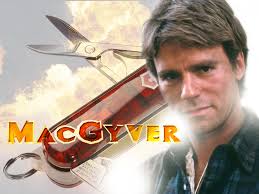 Finally, just be mindful of priorities and use your problem solving skills to diminish your worries so you can be like MacGyver and look for solutions instead of mindlessly staring at the fear.
Reference
Manning, J. (2015). The disciplined leader: 52 concise, powerful lessons. Oakland, CA: Barrett – Koehler Publishers, Inc.
Push Me – Pull Me Leadership
 This past week a discussion came up about how do we get young leaders to grow. Leadership growth happens when there is stretch. By stretch I mean being put in an uncomfortable place – In other words, pushed. But, is pushing always the best approach?
It is very easy as a leader to push our high flyers. The old adage “we give the most projects and responsibility to the busiest and most competent people because they get things done and get them done right,” is all too true. But really, we need to make sure that we are pushing all of our team members. We just need to make sure we are differentiating the way we are pushing, or as I will discuss here, occasionally pulling too. I am reminded of a story back from my early teaching days. I would like to share it with you here:
At the time of this story I was an agriculture science teacher and FFA advisor. Needless to say, I was very competitive in FFA contests and really pushed students hard to success. We had many state champions and many students that went on to successful careers based on the foundations that began in those contests, or Career Development Events as they are called now. But, that’s not what the focus is here.
The focus here is on a student name Suzie (I have changed the name). Suzie was very talented and over the course of her high school career won three state FFA championships. That is not an easy task. As you can guess, I pushed Suzie very hard. Let me reiterate here for emphasis that Pushing was what I was doing until she came to me in tears one day and said the words that would change my life as a leader forever. She said, “Big E (that’s what they called me back then) sometimes you need to pull me up along side of you once in a while instead of pushing all the time.”
Wow, I was devastated! How stupid I had been. I was so glad Suzie had given me this slap in the face, however, because it changed me and gave me a new perspective as a leader. From that time on I would always remember how important it is to pull those I serve up alongside myself and work shoulder to shoulder while at the same time pushing occasionally, too.
Suzie had taught me how to lead in such a way that followers would choose to act. Pulling a person in motivation means creating conditions that they choose themselves. It means showing them how something else will be beneficial to them. It means them deciding rather than just you deciding. Push and pull are a matched pair: pushing is the stick to the carrot of pulling. It is discovery as opposed to the ordering of push methods. It is creating desire rather than creating fear. It is creating attraction rather than repulsion.
While the objectives of PUSH and PULL are the same, the way that one goes about achieving these objectives is very different. The objective is the same, but the approach is very different. To help pull it is important to help those we lead to set goals with a reasonable chance of achievement, but not so easy as to lack challenge. We must also have people develop their own specific plans for how they will accomplish their goals; then jointly review these plans and provide our input. Regularly ask people how they’re progressing in reaching their goals and ask what you can do to help them achieve or exceed their goals. I believe it is important to express confidence in the individual’s ability to reach goals. We must follow up regularly on progress and reinforce all movement in the right direction. Demonstrate enthusiasm to our teams by talking about why the organization’s goals are important and encouraging others to set challenging individual goals.
So how do we move from the push style of leadership to a pull leadership style. Essentially it requires becoming involved with the challenges and initiatives your organization has before it. We become involved when we show both in what we say and what we do that we are interested and care. We need to clearly demonstrate that what we do is for the greater good of the organization, not merely something that will boost our own value. We need to clearly demonstrate with words and actions that we want our team to develop as individuals. It really is about remember that the most important thing we can focus on as leaders is our people.
Building The Bench!
 The lesson in A Year With Peter Drucker (Maciariello, 2014) on planning succession in organizations really struck home with me. In my own situation of leading a school in turnaround mode, it was obvious early that we did not have the bench strength for succession planning in most of our roles and responsibilities. Ideally, having the ability to test a number of people in highly responsible positions before making a decision is one of the safest approaches to succession. Amazingly, we just rolled out a program called “Focused Leader Academy” to do just that. I believe we should continually be mentoring the next generation, which is what we are doing with our Focused Leader Academy. I need to spend a percentage of my time mentoring the next generation. An organization that is not capable of perpetuating itself has failed. An organization therefore has to provide today the men and women who run it tomorrow (Maciariello, 2014). We must renew our human capital. We must also steadily upgrade our human resources.
“There is no success without a successor.” ~ Rick Warren
Really, the essential question when considering building the bench is: “What problems and opportunities are we likely to face as we expand globally?” For our Focused Leader Academy we started with the theory of action: IF we empower our teachers through leadership skill development… Then we will have teacher leaders ready to contribute to the success of Hoosier Academies and be an important part of our talent pipeline. This is an employee development and engagement program. The idea is that great minds and great motives still matter. Teachers with school and educational leadership aspirations will have the opportunity to become part of a cohort, which will take part in monthly training and be part of supervised Focused Leadership Projects for the schools.
The vision for this program is that leadership is born out of those who are affected by it. Our mission is that leadership needs to appear anywhere and anytime it is needed. By institutionalizing this program we are giving our emerging teacher leaders a legitimate place in the organization. I believe for high staff engagement we must be enabling our teachers to become leaders in the organization. I also believe in a strong employee leadership development program, such as our Focused Leader Academy, supported by an effective human resources organization.
So, in closing I would ask: What is your bench strength?
Reference
Maciariello, J. A. (2014). A year with Peter Drucker: 52 weeks of coaching for leadership effectiveness. New York, NY: HarperCollins Publishers.
The Greater the Strengths the Greater the Weaknesses
 We all know it is a priority to help each person in our organizations to focus on his or her strengths to enhance the performance of the entire organization. This week’s coaching for leadership and effectiveness lesson from Peter Drucker deals with managing the superstar. After reading this week’s entry I would back up a step and say that some organizations (and probably most if we are honest), my own school included, have to find ways to identify the superstars. Additionally, we need to find ways to develop team members into superstars – that will be a topic of another blog post on another day.
Helping each person to focus on his or her strengths will enhance the performance of the entire organization. The goal is to use the performance of starts not only to promote their objectives but by their positive example, to raise standards of performance of others and to help others become star performers (Maciariello, 2014). We as the leaders of our organizations have the obligation to provide opportunities for our team members to build on their strengths and make their weaknesses irrelevant. In other words a skill or behavior that is a strength in one person can offset a weakness in the form of that same skill or behavior in another person. We must think: What can we do to make the deficiencies become subordinate to strengths? This can be done by highlighting the performance example the individuals set and making our superstars in particular areas accessible to colleagues who need their help.
“One should waste as little effort as possible on improving areas of low competence. Concentration should be on areas of high competence and high skill. It takes far more energy and far more work to improve from incompetence to low mediocrity than it takes to improve from first-rate performance to excellence. And yet most people – and equally most teachers and most organizations – try to concentrate on making incompetent performers into mediocre ones. The time, energy, and resources should instead go into making a competent person into a star performer.” ~ Peter Drucker & Joseph A. Maciariello
One way Drucker advocated using star performers was to use them as featured performers. By using star performers as teachers of his or her peers allows the star performer recognition as well as building pride in the organization for all. Let’s face it, learning from an actual high performer would be the most effective way to learn. Additionally, it is an important function of us, as leaders, and our organizations to make our team members’ strengths effective in performance and to help neutralize human weaknesses. In all of this, however, do not forget that superstars are expensive. I am not talking money here. They are hard to deal with sometimes because, almost always, they are very unbalanced (Maciariello, 2014). Thus the title of this post: The Greater the Strengths the Greater the Weaknesses. Superstars are very narrow in their range. This makes it challenging for us as leaders, but be must find ways to effectively use the incredible talents of these individuals. 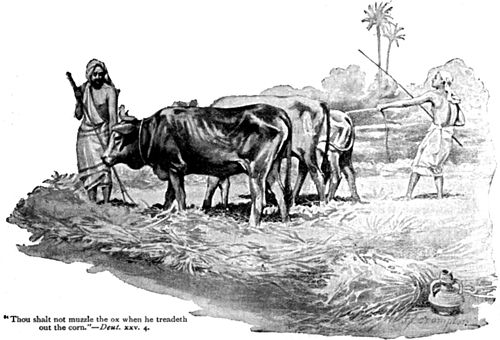
Maciariello (2014) used a very appropriate Bible verse from Deuteronomy 25:4 to illustrate: “You shall not muzzle an ox while it is treading out the grain. Let it thresh the corn [and reap rewards accordingly]!” One thought is for us, as leaders, to tread right along side of our superstars. Leaders need to remember that team members are paid to perform and not to please you as the leader.
Some thoughts to ponder:
- What does your organization do to build individual strengths and neutralize weaknesses?
- Do you have a process to recognize and use your superstars to serve a models and teachers for the other team members?
- Do you and your organization keep superstars where their strengths remain productive?
- Do you protect your superstars, and all team members for that matter, against their blatant weaknesses and errors?
Reference
Maciariello, J. A. (2014). A year with Peter Drucker: 52 weeks of coaching for leadership effectiveness. New York, NY: HarperCollins Publishers.


leave a comment