Are You A Sherpa?
 This past week at our Back to School Professional Development and Family Expo I did a session using a case study of the Mount Everest -1996 disaster. I have actually posted about this before. Click here to read Mount Everest Leadership (Part 1) or here to read Mount Everest Leadership (Part 2). Out of this case study session last week two themes really emerged: We need to become the Sherpa’s of high student achievement and “Hoosier Academies Climbs Everest.”
Technically, “Sherpa” refers to an ethnic group of people from Nepal, or those hired to guide mountaineering expeditions in the Himalayas. Thus, most of us cannot hope to become sherpas (though sherpa is sometimes used as a proprietary eponym for those who haul the belongings of others or invoked to imply knowledge of high altitude mountain climbing). Yet the allure is great–sherpa guides are people, mostly men, who don’t just climb mountains; they were born to climb mountains. They are physically disposed for this act more than anyone else. It makes me consider the question: what was I born to do? What am I physically, mentally, or emotionally equipped for that 99% of the earth’s population is not?
Amazingly, for me I believe that I was born to be an educator – most recently an educational leader. I also really believe our staff came out of our kickoff expo with renewed enthusiasm that they are the ones physically, mentally, and emotionally ready to do what 99% of the population is not – educate children! I am excited for us to be leaving Base Camp today as we start our school year together and begin our summit journey up Mount Everest! The analogy of us as educational leaders to that of a Sherpa is great because they are successful by helping those around them reach their full potential. We must be Sherpa’s of high student achievement for the families and students we serve. Also, great Sherpa’s do not just look up the mountain and say, “Let’s go!” Great leaders carefully plot out each step to ensure a safe and successful trip. I believe we have a great plan and we must now execute with fidelity. Additionally, Sherpa’s routinely deal with unexpected weather, animals, obscured paths, and many other obstacles. Rather than becoming derailed, they build contingency plans and adapt in real-time.
We all know as leaders that there will be challenges and obstacles and as servant leaders must provide support wherever and whenever it is needed. I am so exited for all of those that have accepted the role of an educational Sherpa to help facilitate a great school year filled with many summits of student success!
Identifying The Thoughtful Classroom
 I am writing this post while on the flight home from Las Vegas. I flew in this morning to be a part of a Data Driven Instruction professional development. During the professional development I was asked the question of what a highly effective classroom looked liked. I was also asked if I thought it looked different for face to face instruction or virtual facilitation of learning. While there are certainly modality differences, I said great instruction is great instruction. Period.
Then I went on to discuss the adjectives I would use in describing a highly effective classroom. I used these five: engaging, comfortable, collaborative, flexible, and safe. Really, all of these have to do with the physical environment of the classroom. There are then cultural forces that go along with each of these adjectives. To be engaging the teacher will use rigorous lessons that might include global connectivity and uses a relevant context that the student cares about. A collaborative environment has a lot of student to student interaction and might include partnerships with business and industry for enabling the students to solve/research real world problems. Flexibility is also the key – in a brick and mortar setting there should be no front or back to the classroom and in a virtual setting many different modalities of technology may be used. Finally, the environment must be safe. This safety not only includes physical safety and safety from bullying, but also a safe environment where students are encouraged to think creatively, be curious, and share those thoughts.
The routines and structures that guide the life of the classroom are also important to creating an engaging and thoughtful classroom. Instead of creating thinking -skills lessons, highly effective teachers must create rich thinking opportunities. It is important to create relevant content students care about. Relevancy matters! Relevant context must be the norm, not a discrete context disconnected from anything going on in the student’s life. Course themes and generative topics make learning opportunities relevant to the students.
Guiding questions help the students keep in mind the big ideas. With the standards it is easy to get bogged down with isolated bits of knowledge. We must remain aware of the forest even as we look at individual trees. Connecting course activity to big ideas enhances the purpose and meaning of the work for the students. In other words it gives them the “why” of what they are learning. How many times have we heard students, or even ourselves for that matter, say, “Why do I need to learn this?” or “Where will I ever use this?” This relevancy makes it easier to engage students in the thinking because they are actively exploring.
Having the students pose unanswerable questions will also foster engagement. Teachers should expect students to be independent thinkers, take risks, and show initiative. Again, why it is important to have a safe environment. Making assignments iterative is also very important. There should be several drafts involved in assignments. This will emphasize process refinement.
This all really means creating a student self managed environment. This includes student to student interactions that the teacher does not control. The teacher should be a role model of engagement in the context of the class. The bottom line is we must provide students with Thinking Opportunities!
Leading Audaciously!
 As I write this post it is the eve of July 4th, 2014. I have had some incredible Fourth of July Celebrations, such as being the Grand Marshal of Lebanon, Indiana’s Fourth of July Parade in 2010. To read about that experience click here. This year, however, my family and I are spending the Fourth of July in our Nation’s Capitol. I am so excited that we will be watching the fireworks from the Washington Mall in view of all the monuments of our great leaders. Many people are writing and talking about doing audacious things these days, but what does that really mean.
In thinking about what it means to lead audaciously, I reflected on our founding fathers. Now there was some audacious leadership! These audacious leaders defied convention and stepped beyond the ‘norms.’ They provided us out of the box solutions for a group of colonies made up of people looking for something a little different. When we have the courage to live out our convictions, Walk the Talk, we lead the way for others to do the same. In other words we are serving as trail blazers. Audacious Leadership works with people to make the changes within themselves to affect and create social change for the world around them. We are all far more audacious and powerful than we think we are. What would you do that would be considered audacious if you knew you could?
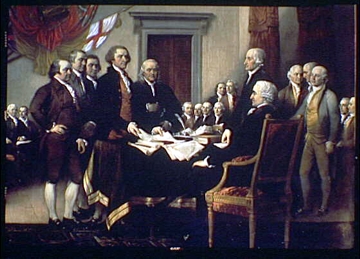
Signing of Declaration of Independence
Even though the first Fourth of July happened in Philadelphia, not Washington D.C., and did not have any fireworks or really any signing ceremony to speak of; I am still in awe of the audacity of the leaders involved on that historic day! Really, not much is known about the day except that on July 4, 1776, the Second Continental Congress was meeting in Philadelphia. It debated whether to adopt the Declaration of Independence. The delegates had come from the 13 original states. Many things, including the Stamp Act and other taxation without representation, to lead up to this point. Originally, the colonists thought boycotting British products would cause change. We all know, however, that even the Boston Tea Party was not audacious even to effect social change.

Printed Material Stamp
So, on June 7, 1776, the 2nd Continental Congress met and debated whether to break ties with Great Britain. The separation seemed likely, so the Congress assigned a committee to write an explanation of the decision. As we know, this committee then gave the job of writing to Thomas Jefferson.
Thomas Jefferson took two weeks to write the Declaration of Independence, so on July 4, 1776, Congress voted to adopt. John Hancock immediately signed in large print to signify his bold statement of committing treason. Pretty audacious, don’t you think? Then on August 4, 1776 the rest of Congress signed the Declaration of Independence.
I am truly in awe of the audacity of these leaders. They lead our nation to independence. That is about as anti-status-quo as you can get. Thomas Jefferson captured the ideals of the United states in writing. Those words inspired the original Patriots who audaciously fought against insurmountable odds. They have also inspired movements of Americans against slavery, for civil rights, for women’s rights, for education reform, and social justice in not only America, but around the globe.
On this July 4th I invite you to celebrate the audacity of our Founding Fathers and challenge you to lead audaciously to bring about social change for the people of our great nation and the peoples around the world! Happy Fourth of July!
1,000 Vs. 30,000 Foot View

30,000′ View
I already wrote one post this week that was motivated by Rich Horwath’s book Elevate: The Three Disciplines of Advanced Strategic Thinking. Click here to read Competere. I also wrote another post View From 30,000 Feet that has thoughts on strategic thinking and leading strategically as well. While finishing reading the book for the second time I was on my way home from Washington D.C. It was nighttime and if I sit next to the window I love to look out and see if I can identify the cities we are flying over.
This time I was struck by how little detail you really can see at 30,000 feet (actually, according to the pilot were cruising at 32,000 feet). I have shared a picture I took out the window at this altitude with you in this post. Then, when we were getting ready to land I took another picture at what I guessed was around 1,000 feet. I have shared that picture in this post, too.

1,000
It was amazing to me the difference in detail that could be made out. This was one of the points that Horwath was trying to make in his book. He contended that the old adage of taking a 30,000 foot view is too high. You are too high up to see anything with any precision.
He likes to use the analogy of a helicopter at 1,000 feet. here, he argued, you can see with precision and clearly recognize what you are looking at. You can see houses, trees, flow of traffic, and trucks backing into docks. So, what did I learn from my experience looking out the plane window?
The 1,000 view enables me to see the whole picture with detail. this will enable me to lead in a way that strategy is developed first, so that great tactics (key initiatives) can be put in place. Think of it this way: as I write this I am on an airplane headed back to Washington D.C. The plane I am on is the tactic. While the plane is what is getting me to my destination; it would probably not be a very successful, or safe, flight without an accurate flight plan. This flight plan and allocation of the airplane to Washington DC is the strategy.
The airline was even able to be strategic and route us around a storm. The reallocation of extra fuel to send us around the storm made our flight safer, smoother, and more enjoyable. The only negative was it took about 8 minutes longer. A pretty good trade off in my book. If this example didn’t make for a great story, I don’t know what would.
From all this I have learned that I must get myself to the optimal height to see the detail needed, but yet still get the big picture. This really becomes a question of strategic insight. An insight is the combination of two or more pieces of information or data in a unique way that leads to the creation of new value. Strategic thinking, then, is the ability to generate insights that lead to competitive advantage.
Putting strategy in action we begin to think about why initiatives need to be pursued instead of just what is being done. This kind of thinking is so important in all industries, but is crucial in education. There are thousands of tactics available that are touted as the next tool for enabling the highest student achievement. But, we have to remember that without strategy we are flying blind, literally! Without a clear strategy and theory of action, we are just completing “to do” lists!
Great strategy enables us to be agile and allocate and reallocate resources to be successful!
Competere!

Strive Together!
The term compete comes from the Latin competere meaning “to strive together.” When I first saw this definition I was taken aback. I always viewed competing as striving against someone else. But, as I have learned from my journey of learning this year on strategy, it is all about making sure every individual on our team or staff understands his/her role working toward the vision/mission.
The analogy I like to use is a football team. For a defense or offense to be successful every player has to execute his ROLE. But, before he can execute this role, he must know what his role is (eg. who to block, what route to run, et cetera). It drives me absolutely nuts to be watching a youth football game and the coaches say, “Just hit somebody!” No! That’s absolutely wrong! The young men must know who they are supposed to hit, and where! Think about it…Does everyone on your team know what their role is?
Competition involves striving together and reaching for higher levels of performance. Those higher levels of performance are directly related to your insights for providing your stakeholders with differentiated value. There are three competitive conditions we find our schools, businesses, and organizations in: leader, challenger, or spectator (Horwath, 2014).
The leader is systematically looking for audatious ways to change the way our world looks at current products, services, education, or organizations. Additionally, the challenger creates ways for people to use and become part of what the leader has created, transformed, or innovated. Finally, the spectator sits back and watches it all happen. The spectator is probably acting out of apathy or status quo (Horwath, 2014).
As leaders, lets make sure we are enabling our team members to understand their role in the strategic plan. In other words, lets coach our team to compete, strive, and reach it’s full potential!
Reference
Yellow Flag Leadership Strategies

Be A Leadership Lifeguard
This past weekend as I was re-reading Leverage Leadership I was struck by the analogy used of yellow flags used on beaches. The section of the book was, “Early Warnings, Yellow Flag Strategies.” As we know, a yellow flag means the potential for rip currents or danger exists. Well, as you know, I love the beach and I have always noticed that very rarely is there a green flag flying. The green flag signifies calm seas and no threats.
This is rarely ever true with oceans, or our classrooms and schools. There is always the threat for riptides or something to go astray. In the ocean if caught in a riptide it is very specific what you do. Riptides (properly called rip currents because they are not actually a tide), are long, narrow channels of water which move from shore to sea and can take you with them as they go. 80% of all water rescues are because of riptides and claim over 100 victims per year.
If you get caught in a riptide, here’s what you do: Don’t panic. You will feel like you are getting swept out to a deserted island, but most riptides go away in 50-100 feet. Don’t swim against the rip. No one is strong enough to swim against the riptide and this exhaustion is what causes most deaths. Swim parallel to the shore. You want to swim perpendicular to the rip current. In 20-100 feet you will be out of the current and you can swim at an angle away from it towards the shore.
Similarly, strategies should be employed when teachers are continuing to struggle, and the standard observation and feedback cycle needs additional structure. Author of Leverage Leadership, Paul Bambrick-Santoyo points to the following as “Yellow Flag” strategies: provide simpler instructions and techniques (bite-sized, as John Wooden would have called them), give face to face feedback more often (face to face makes the difference), plan an immediate post feedback observation, arrange for peer observing, and choose interruptions of the person you are coaching with care. Desire alone will not help you improve a struggling teacher (or team member in any industry/organization). You need effective systems and approaches that can be put in place immediately for teachers (or team members) who need them.
Really, when you think about it, these “Yellow Flag” strategies can be applied to any field; not just education. As leaders we must always be watching (awareness) for those where our feedback/coaching just isn’t helping or they just need extra help. Think about the last time you were trying to swim out of the figurative rip current! Let’s all try to be better leadership lifeguards!
Walk the Talk!

Walk The Talk
I believe in the value of having 360 degree leaders evaluations. I had the unique opportunity to have the opportunity for an informal 360 degree evaluation that really wasn’t even intended to be an evaluation, but I used it as such. It started as an interview that one of our leadership team members wanted to conduct with me for a paper she needed to write for one of her Master’s classes. I absolutely love the journal and magazine articles where someone interviews a leader.
After the interview, I was given a copy of the paper. While reading the paper I really began to reflect on what was being said and whether I really do practice what I said I do in my answers. For those that have been in my office, you know I have a much talked about picture of penguins in my office with the title: “Walk The Talk.” The subheading is: “Take the initiative and lead the way. You can make a difference.” Walking the talk is one of my core values. It really speaks to the fact that our character is our legacy. If we say believe or act in a certain way, then our actions should prove that.
With our team members permission I am sharing her paper here in this post. I hope it gives you a chance to think about how you would answer the questions and what would be written about you!
Interview with a Leader
The person that I chose to interview is Dr. Byron Ernest. He is the Principal at Emmerich Manual High School. I chose him because I feel that his leadership style embodies that of a successful leader. He is a leader because of the way he behaves, not because of his title. I have worked for people in the past who feel that you should follow their lead simply because of their title, with very little regard for how a true leader conducts his or her self.
I asked Dr. Ernest what his leadership philosophy is and he said that “leadership’s about influence and empowering others”. “Everyone should lead from where they are. It’s just like in this building, I consider everyone a leader. They need to lead from whatever position they’re in.” He feels that it is important for everyone to hold themselves accountable. Some of the behaviors that he equates to leadership are being inspiring others, empowering them, and mentoring those who need it. “One thing that I think is important that a lot of leaders leave out…is helping employees in whatever their next position is going to be.” He feels that some leaders worry about retaining employees and keeping them in positions, rather than building leaders that are able to grow and succeed. He wants his employees to be able to look back and say “being here got me to where I want to go”.
Some of the values that he uses to support these behaviors are honesty and commitment. He also values providing a fun and happy atmosphere to his employees and students. “We could point to Southwest probably being… the best model of that. Southwest Airlines believes that if their employees are happy, then their customers will be, and it kind of does work that way.” I thought that it was awesome that he mentioned this. We are reading the book written about this very same business motto for this class. Dr. Ernest also mentioned that he values creativity. “I want people to feel comfortable trying new things, and doing different things and (to know) that it is okay to fail.”
I asked him how he assesses his subordinate’s behavior. He said that he has an informal way of looking at that. He asks himself some of the following questions. “Is that person leading from where they are?” “How are they using that, what I call, earned empowerment?” “I want folks to take things on, and use their own initiative.” When it comes to the tools that he uses to measure these things, there is a performance evaluation that each teacher fills out each year. They have to write down some goals that they would like to achieve each school year. They list different projects and initiatives that they plan on taking on. At the end of the year, he sits down with each teach and goes over these goals and they assess whether or not they have been met.
The next thing that I asked Dr. Ernest was how he deals with conflict. He said “conflicts are going to happen”. “One of the best things you can do is, is listen. And I think you always need to try to validate the other person’s problem, or where the conflicts are coming from.” I love that he mentioned this because empathy is one of traits mentioned in our text. “Besides fostering trust, empathy also equips leaders with a keen sense of social savvy that helps them sift through complex social dynamics and make good decisions.” (P.53) Dr. Ernest mentioned a specific situation that had transpired early that day, and he was able to listen to a parent to find out what their concerns were. He then went to the specific individuals that were involved in the situation and asked what had happened. This diffused the situation because the parent felt that their concerns were heard and that Dr. Ernest genuinely wanted to solve the issue. Then the issue was able to be solved.
I asked him what his vision is for our high school. He said that he wants to see the school be an A rated school. He said that the way to get there is “to use all the things that we have already talked about in this interview…to build a team of empowered and talented people that can get us to an A school.” “That would be the vision.”
I asked Dr. Ernest how he demonstrates his values in his behaviors and he said that he does this “by walking the talk”. This has been mentioned in the text as well. The chapter on integrity talks about trust. It talks about how leaders should do what they say they are going to do. It mentions that you will have a more productive staff if they feel that they are able to trust you. “Basically it all comes down to trust. Integrity fosters trust, which leads to higher productivity.” “When employees trust their leaders, they don’t have to worry that their work won’t be rewarded, that promises won’t be met, that the organization will go bankrupt, or that executives will milk all the profits for personal benefit.” (P.25) I believe that Dr. Ernest’s employees trust him, and would agree that he does indeed walk the talk. He leads by example. He empowers his staff to lead as well. He does not micro-manage. He entrust you with responsibilities and provides you the tools to complete them. He tries to remove any obstacles they may get in your way. In my opinion, that is what a true leader does, and that is exactly why I chose to interview Dr. Ernest.
References
Craig E Johnson (2012). Meeting the Ethical Challenges of Leadership Casting Light or Shadow
Thousand Oaks, CA: SAGE Publications Inc.
Live interview with Dr. Byron Ernest
Wonderment!

This past week as I was taking my son to school he had the radio on. The song Hey Brother by Aviccii was playing. As is many times the case; I got the lyrics wrong. I thought he was saying “Do you still believe in what I wonder?” In reality he was saying, “Do you still believe in love? I wonder!” Really, I’m glad I had it wrong because it got me thinking. Does my team believe in what I wonder? More importantly, do I believe in what they wonder?
Wonderment is a type of behavior, that as a leader, engenders our teams. We can accomplish this by creating environments where team members can bring their best selves and curiosity, and good things will happen as a result. By cutting off conversation through words or non-verbal cues, a less effective leader sends a message that the team member’s idea isn’t an option or even worthy of pause. Done often enough and pretty soon your team won’t even tell you you’re walking in the wrong direction.
Just as science fairs represent an invaluable learning opportunity for students to use wonderment and curiosity to conceive and develop an experiment, conduct it, prepare the findings and present them to student peers and experts in the field, leaders can use wonderment to find that next solution that does not presently exist. Instead of conducting cookbook lab experiments and submitting a lab report for a grade, science fairs foster independent thinking, creativity, problem-solving and written and oral presentation skills. The same is true for the leader; instead of doing what has always been done or what he thinks is right, spend some time in wonderment with the team!
A well-balanced leader knows that getting the best from their team means letting them talk, fail, succeed, wonder, be curious, and feel comfortable. Thus, as the leader, we have to have the strength to listen to differences and make decisions even if they are opposite to what the group thought was right. Spend some time in wonderment this week!
iREAD Because I Lead!
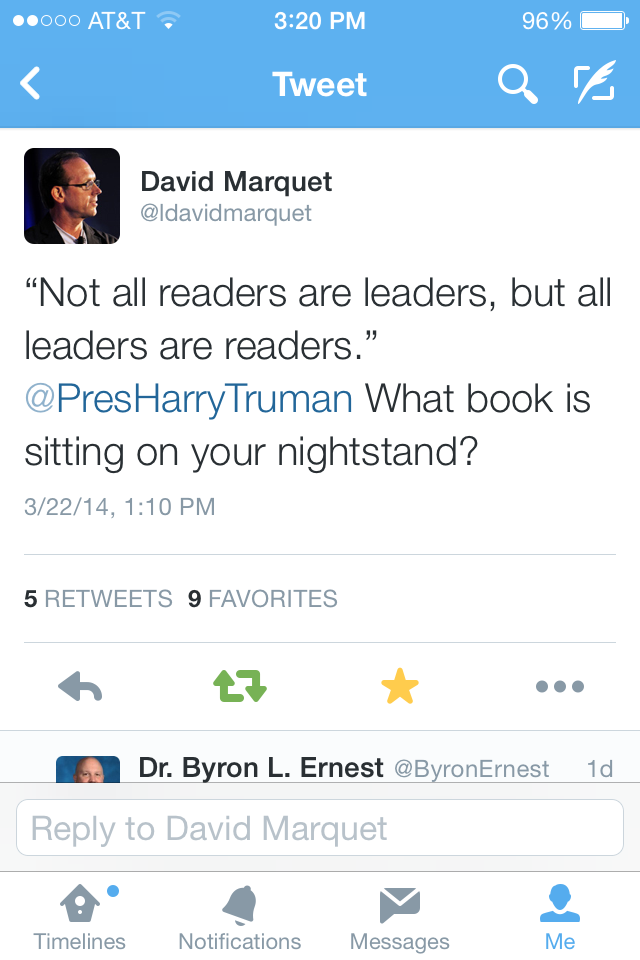
David Marquet’s Tweet
“Not all readers are leaders, but all leaders are readers.” ~ Harry S. Truman
I was reminded of this quote from our 33rd President this past week when @LDavidMarquet tweeted it. I, of course, immediately retweeted. On the same tweet, he (Marquet) also asked the question, “What book is sitting on your nightstand?” Those that follow me on twitter, @ByronErnest, know that I can’t resist answering questions. So, I answered that I just finished The Last Place on Earth: Scott and Amundsen’s Race to the South Pole by Roland Huntford and Paul Theroux. And, since I am such a fan of David Marquet, I had to throw in that he (Marquet) is like Amundsen is this contrast of two leaders. You will also notice from the picture on my response that I am now using GoodReads. It is an awesome way to keep track of books, get recommendations, and make recommendations. It even lets you scan in your books using the barcode. I learned of this app while discussing books with one of our awesome teachers, Allison Marchisani. I love the team we’ve got here because I learn from them every day.
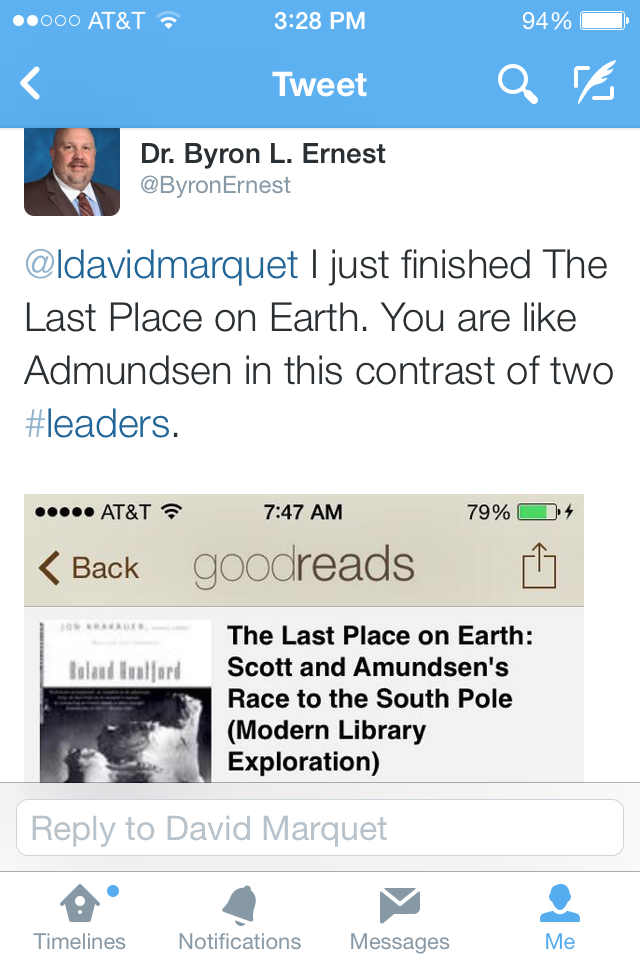
My Response Tweet
This post is not a review of any books. I can guarantee you that I will be posting to my blog about David Marquet, however, in the future. So, watch for that, but today my post deals with the importance of reading. It is interesting that earlier in the week before being asked the question of what book was on my nightstand I was reminded of just how many books I have read this past year. In fact the exact number is 35 since July 1 of 2013. The only reason I know this is because our Media Specialist keeps track of it for our iREAD – I Just Finished Reading program. She sent out a report last week and I was amazed, as was our staff, how many books I had read!
Our school has the goal of every student and staff member reading 30 books per year outside of the normal school reading. This is a huge undertaking, but research shows that high school students should be reading 30 books outside of school per year. Therefore, our staff believes that if the students are doing it, we should be doing it. I am excited to already be five over the goal. Keep in mind I read in three modalities: book in hand, Kindle app on my iPad Air, and Audible app for listening. As a leader the benefits of reading are wide-ranging. Evidence suggests reading can improve intelligence and lead to innovation and insight. Reading — whether Wikipedia, Michael Lewis, or Aristotle — is one of the quickest ways to acquire and assimilate new information. Harvard research claimed that reading across fields is good for creativity. As a leader who reads, I can sample insights in other fields, such as sociology, the physical sciences, economics, the military, or psychology, and apply those insights to my own organization. Think about it, I can take the incredible leadership lessons of David Marquet and apply them to my own leadership journey to help us innovate and prosper.
So let me explain how we do our iREAD – I Just Finished Reading program: On the honor system, each student and staff member are responsible for reporting to our media specialist the title of each book finished. The media specialist then records the book and makes a laminated picture of the cover. This cover is then put on the walls out in the building (see picture). Our halls are filling up with cover pictures. It is great to see students and staff perusing the titles and having conversations about the books.

Book Covers
In addition, I have gone one step further with my Principal’s Picks 13-14 Program. As I finish books I actually buy a copy to be put on display in the Principal’s Picks 13-14 Display (see picture) in the media center. A card is placed in each book and staff and students can sign up to win the drawing for their very own copy of the book. There are usually four to seven books that I have read on display at a time. This has been such a fun way to promote reading. In fact it has become quite competitive when it comes drawing time for the books. There have also been some great discussions about reading that have developed out of this program.
As I close this post I would say that I really do believe that leaders are readers. Also, I want to share my list of 35 books I have finished so far since July 1 of 2013. Click on Principal’s Picks 13-14 to see my list. Since everyone will ask which is my favorite of the 35, I’ll tell you: Turn The Ship Around: A True Story of Turning of Turning Followers Into Leaders by David Marquet. Did you make the connection to where I started this post? We are full circle back to David Marquet! Because of iRead I have now made a connection to a great leader and author. Don’t forget if you lead, you must read!!!
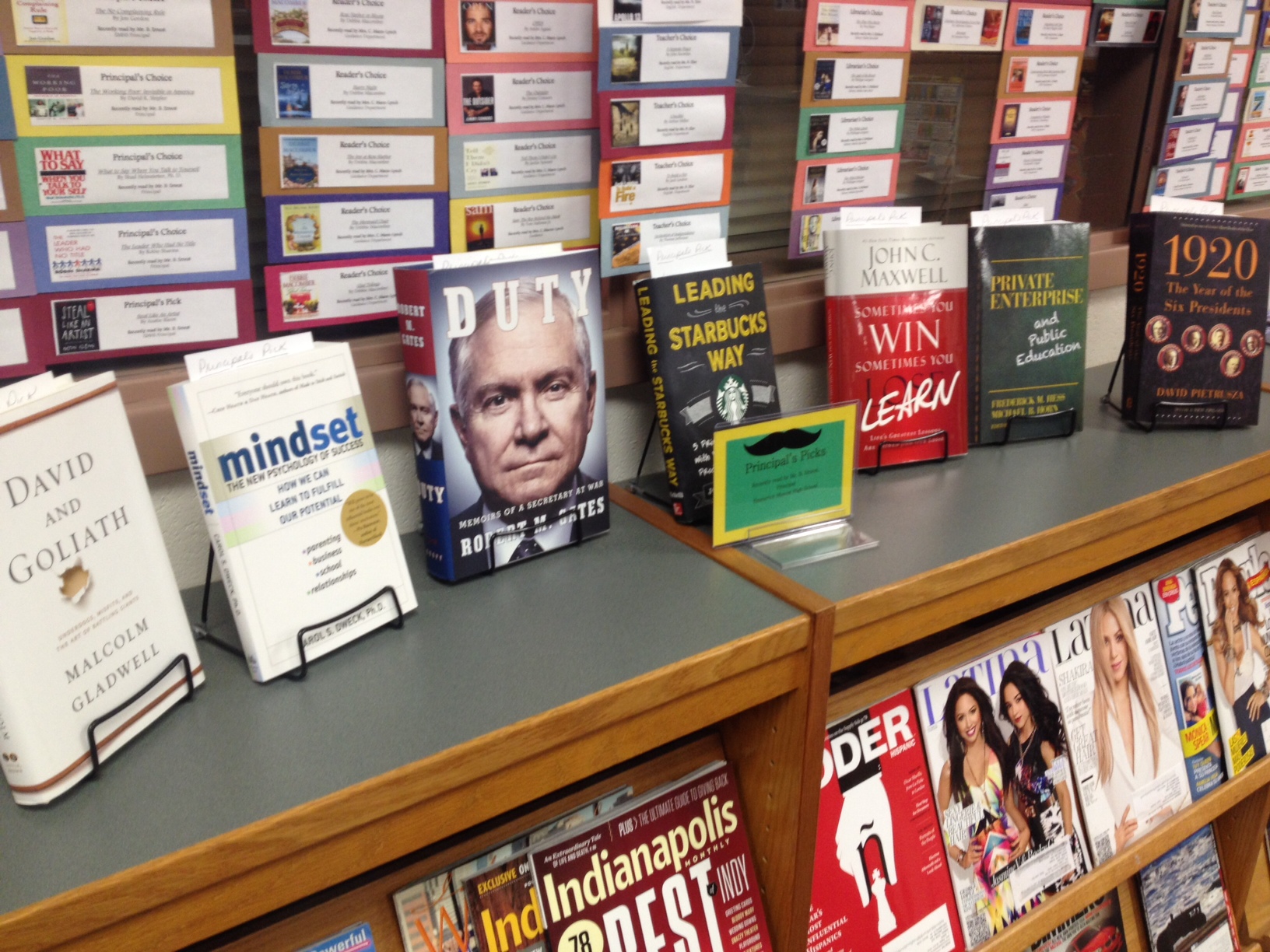
Principal’s Picks Display
Angry Birds University

Power-Up University
Back in 2012 I wrote a post about Angry Birds for the first time. To read my post The Angry Birds Effect click here. Amazingly, this game has not gone away, but gotten stronger, added different versions, and created tutorials and educational materials. For those few of you who have not had the Angry Birds educational experience, the main goal of the game is to sling-shot birds into a structure made of wood, ice, stone, or other materials in order to have the structure collapse and kill cartoon pigs. Each level offers a more challenging structure to topple and several different kinds of birds (of different sizes and capabilities) to utilize as weapons. Now there are even new versions such as Angry Birds Rio, Angry Birds Space, Star Wars Angry Birds, Angry Birds Short Fuse Aftershock, and many more.
I am still a major believer that Angry Birds is a powerful exemplar for facilitation of highly effective learning. As I play the game, I cannot not help but think: what if all teacher’s classrooms were more like this? Would students have a better learning experience? Would there be more focus on learning than teaching? I believe the reason the game is so addictive is because it plays to our meta cognitive skills. We all want instant feedback. We also want the chance to use that feedback to make adjustments and try again to ultimately attain mastery. There is no risk in trying new techniques and there is no limit to the amount of tries. This is why I am a believer in standards mastery grading using a narrative report card.
Angry Birds now has tutorials and additions such as Power-up University. This is a game segment you complete in order to learn to use special “power-up” powers given to the different characters. Power Ups can help you improve your scores in levels and help you get more stars. There are 4 Power-Ups, and you can use 2 per level. Here are the 4 Power-Ups:
- Super Seeds: Super Seeds turn any bird on the slingshot bigger and tougher.
- King Sling: King Sling upgrades your slingshot so that when flung, birds can go faster and farther than before.
- Sling Scope: Sling Scope allows you to see where your bird’s gonna go before you fling them.
- Birdquake: Birdquake rumbles the ground in a level and can make pig’s structures fall down.
As in the best video games, students need a safe place to try and fail until they succeed. There is the buzzword, “gamification” in education. Many are just taking this to mean using games for teaching, but I believe we should be on the quest to make learning more like a video game. In order to do this let’s take a look at the best practices we can learn from Angry Birds that I outlined in my original post The Angry Birds Effect:
1. Early in the game, the single Red Bird is the only one available-basic knowledge.
2. Players advance at their own pace.
3. Mastery is required to advance – You must have cleared a level three times with score improvement each time before moving on.

Instant Feedback
4. As the player advances, new levels are introduced.
5. The player can move ahead and clear levels beyond the one they are presently in, but not too far.
6. Different contexts are portrayed (deserts, gem mine, city at night, et cetera) to make it interesting and relevant to the player.
7. The player is given new tools (different types of birds) to use as he/she advances and unlocks higher levels.
8. Immediate feedback is given. The player knows the score immediately.
9. Ability to go back and retry and review any level any time.
10. The next level is always “just above” (Christensen et al., 2011) the players ability. Not too far above, but “just above.”
It is no wonder we are all addicted to this game! Now if only we could ensure that our classrooms are always safe spaces to practice new strategies, offer students a range of possibilities for how to succeed in their learning, give our students constant feedback, and support knowledge transfer within and among our courses. Angry Birds could be our exemplar for helping to close the achievement gap!
Reference


leave a comment