It’s Not All About You!
 Last Saturday, June 30, 2012, I had the distinct honor of addressing the graduates of the University of Phoenix with the keynote graduation address. It was such an honor to address the the 2,500 in attendance and I would like to share my speech with you here:
Members of the University of Phoenix Class of 2012:
This experience, as your keynote graduation speaker, very much like my career in education was not a goal that I set out to accomplish. Instead, because of the collaboration of many others, has been just like my career in education – an incredible journey that I will value forever – a journey that has led me in front of you today.
There was no epiphany when I said, “I am going to be a teacher!”
There was no pressure from home to be a third generation educator. There was no epiphany where I said, “I am going to be Indiana’s Teacher of the Year or Principal of Emmerich Manual High School, one of Indiana’s first turnaround academies.”
What I had were fans, a supportive front line, and a great coaching staff. Let me explain why I use the football analogy here. I had the opportunity a few years ago to meet and visit with Terry Bradshaw, the storied quarterback for the Pittsburg Steelers. He told me a story that has turned into one of the greatest educational and leadership lessons I know. Here’s what he said, “Byron, I was standing on the four yard line ready to score a touchdown in my fourth Super Bowl win, knowing this would be my last game before my retirement. I took a timeout and did not go to the sideline but spun around and looked at all of the fans, I looked over at our bench and coaches, and then I looked at my offensive line who had given me so much protection and opened up holes for so many huge plays to happen, and finally I looked over at my running backs and receivers who always made me look good.” Byron, he continued, “I realized right then and there that my amazing professional football career was not about me. It was about something much bigger – all those others that I just spun around and looked to.”
Today for you, just like Terry Bradshaw’s experience, is much bigger than just you. In fact as much as today is about celebrating your personal achievement of graduation – it’s not all about you. It’s about having a strong support network that I know supported you in this process. You know who that support network is – it is the faculty, friends, and family – make sure you thank them. In fact I would like for you to stand right now and join me in giving that support network a hand.
Ladies and gentlemen, I want you to understand what I have said and continue to say about my educational experience and career – It is much bigger than me. Hopefully my journey of ending up in front of you today can serve as a platform for others to follow.
Why is this bigger than me? Let me share with you my story of how I even ended up in education. I became a teacher because a professor at Purdue University cared, and pulled me into his office for a conversation one day that would change my life forever. Dr. Hobe Jones, my Purdue University Animal Science professor and counselor, said, “Byron, have you ever considered a career in teaching?” After giving what was probably a Hannah Montana type response of “You say what?” He knew I had not considered this as an option. After I promptly told him I had come to Purdue in Animal Science, and was going to graduate on time (keep in mind this was the spring semester of my sophomore year) he said, “Byron you are a great student and I will make sure you graduate on time.” Reluctantly, I agreed to graduate from Purdue with two B.S. Degrees. One which I never thought I would use – Agricultural Education and the other in Animal Science. It is interesting that with the focus now on content area mastery, I look back and really value my Animal Science Degree because it gave me the extra content area mastery to succeed during the teaching part of my career. It is Dr. Jones’ caring guidance that I tried to emulate every day as a teacher and now as a principal of an inner city school.
Can you imagine if I would have had to plan out my life’s journey in exact detail at the time Dr. Jones was recommending I become a teacher? Why, I would have had that all screwed up. It’s about BEING PREPARED FOR WHAT YOU DON’T KNOW YOU NEED TO BE PREPARED FOR. Let me say that one more time – It’s about BEING PREPARED FOR WHAT YOU DON’T KNOW YOU NEED TO BE PREPARED FOR.
You have made the first step in achieving this by graduating in your chosen field of study today. But make no mistake, your diploma is not an award, it is a ticket – a ticket to an incredible journey of giving back and continued learning! As the late John Wooden put so eloquently, “Its what you learn after you know it all that counts!”
Let’s break that giving back down by first looking at the University of Phoenix Mission and Purpose: University of Phoenix provides access to higher education opportunities that enable students to develop knowledge and skills necessary to achieve their professional goals, improve the productivity of their organizations and provide leadership and service to their communities. Notice it did not say that the University of Phoenix would award you a diploma, and you could then go have a party!
I’m not saying that is not allowed, but I am saying we need to take a look at how you now live out the mission and purpose by which the University of Phoenix facilitated your education.
Let’s break this down into three parts. #1. Access to higher education opportunities that enable students to develop knowledge and skills necessary to achieve their professional goals. As you graduate, University of Phoenix has done their job for the first part of the mission and purpose, but only to the extent of your professional goals today. Realistically, those may change, or even be changed for you tomorrow. Again, remember what I said earlier, YOU MUST BE PREPARED FOR WHAT YOU DON’T KNOW YOU NEED TO BE PREPARED FOR! The beauty of this is you have been empowered with the foundational knowledge to become or continue to be a lifelong learner. My challenge to you is to never be satisfied! Continue to take on educational challenges. We all need to be pushed.
Let me share one of my favorite parables. It is about the King who stood upon the banks of a mighty river with his daughter, the princess. His courageous warriors stood on the opposing bank.
The king knew that he would not live forever and so he wanted a prince who could lead his kingdom. He issued a decree: “I am looking for a brave warrior, a leader among men!” A roar rose over the raging rapids of the mighty crocodile-infested river. “I have a challenge!” Whoever shall swim across this river shall have all my riches and my daughter’s hand in marriage or anything else his heart desires.” The princess was a beautiful and brilliant young woman; the king possessed untold riches in gold and diamonds; but there was that river – that raging, crocodile-infested river…
The warriors looked at one another, exchanged wary glances, and suddenly – splash! A hole appeared in their ranks. They noticed one of their own, a young warrior, in the river, fighting desperately to make the crossing. As the crocs slithered into the water, headed toward the young man, a collective shout sounded over both banks: the young man swam! His arms pumped, his back flexed, his legs churned the water like propellers. The roar grew louder as the young man disappeared into the undertow and emerged again – pursued by the razor-toothed, prehistoric-looking reptiles. With one last burst he catapulted out of the river and onto the bank, grasping the hand of the king himself, who’d reached down to pull the young man out of the river.
The young warrior stood for just a moment until, overcome with emotion and fatigue, his hands dropped to his knees. The king at that moment raised the young man’s hand high into the air. In a booming voice, he announced, “Young man, you made it. You succeeded against all odds. You may have all my riches and my daughter’s hand in marriage.”
The young man looked at the king and the warriors back on the distant bank before speaking. “Your highness,” he said, “you are a wealthy and benevolent man” – his chest heaved as he paused to catch his breath – “and your daughter is beautiful, indeed…” He hunched over and, now facing the cheering warriors he had left on the far bank, shouted: “All I want is the fool that pushed me into the water!”
You’ve been pushed. Now swim like your life depends on it!
Now let’s look at mission and purpose #2. Improve the productivity of their organizations. I believe that one of the most important functions of any institution, no matter what level – k-16 and beyond, is to teach students to learn to learn. I know this is how University of Phoenix empowers their learners. No matter where your career is now or will take you, you must practice learning to learn and the sharing of that knowledge in the truest sense of a learning organization.
In his book, Power: Why Some People Have It – And Others Don’t Jeffrey Pfeffer calls it “Feedforward,” which emphasizes what people need to do to get ready for the subsequent positions and career challenges they will confront…focusing on what you need to change to accomplish future personal goals can be much more uplifting than going back and reviewing past setbacks or considering areas of weakness.
Finally, #3. Provide leadership and service to their communities. This one is of the upmost importance. You all have an obligation to become agents of social change. In other words, set out to make a life – not just a living. When you make a living, you pay your bills. When you make a life, you pay your debt. We all have a debt to be an agent of social change.
Now I want to recap a couple of things. Don’t forget you must prepare for what you don’t know to be prepared for. Also you must learn to learn. And you must set out to make a life, not just a living. Make sure you are walking the talk and always remember you have the ability to at any time do what I call Byron’s three “R’s” of life: Retool, Reposition, and Re-Launch. By Retooling, Repositioning, and Re-launching, you become the lifelong learner that is always prepared for the next opportunity.
Why is this bigger than you and me? We must always remember that we are successful as leaders not due to solitary efforts, but due to organizational and collaborative success. I would like to close with a poem that I believe sums up everything I have been trying to say today:
Wreckers or Builders
I watched them tearing a building down,
A gang of men in a busy town.
With a ho-heave-ho and lusty yell,
They swung a beam and a sidewall fell.
I asked the foreman, “Are these men skilled,
As the men you’d hire if you had to build?”
He gave me a laugh and said, “No indeed!
Just common labor is all I need.
I can easily wreck in a day or two
What builders have taken a year to do.”
And I tho’t to myself as I went my way,
Which of these two roles have I tried to play?
Am I a builder who works with care,
Measuring life by the rule and square?
Am I shaping my deeds by a well-made plan,
Patiently doing the best I can?
Or am I a wrecker who walks the town,
Content with the labor of tearing down?
Thank you for allowing me to have this BIGGER THAN ME experience and be part of your graduation!
Good Is Not Enough!

This past week I had the opportunity to speak to the faculty of University of Phoenix prior to delivering the keynote address for their graduation ceremony. I would like to share with you my notes from this speech here:
I would like to start today with an excerpt that I have done some creative editing on from Onward: How Starbucks fought for its life without losing its soul. I believe you will find that this comparison of teaching to a successful business model fits right in with what I consider my and my school’s ADVANTAGE: “Putting Students First.”
Here is the excerpt adapted from Onward:
Pouring espresso (Teaching) is an art, one that requires the barista (teacher) to care about the quality of the beverage (education). If the barista (teacher) only goes through the motions, if he or she does not care and produces an inferior espresso (student) that is too weak or too bitter (not ready to compete), then Starbucks (teaching) has lost the essence of what we set out to do 40 years ago (in 1635): inspire the human spirit. I realize this is a lofty mission for a cup of coffee (education), but this is what merchants (teachers) do. We take the ordinary – a shoe (boy), a knife (girl) – and give it (them) new life, believing that what we create has the potential to touch others’ lives because it (their lives) touched ours.
I believe this is such a great representation of what we all do in this room – EDUCATE. As Henry Adams put it, “A teacher affects eternity; he can never tell where his influence stops.”
As a teacher my personal mission statement was, “I strive to use rigor, relevance and relationships to be a steward of high student achievement.” I have given a lot of thought about what my personal mission statement should not be as a principal, and then realized it really does not change. All I am doing is adding one new “R” – Results Driven.
Someone recently asked my to use a word to define myself. I chose “Trailblazer”
Goes before others go!
Don’t send someone where you are not willing to go yourself.
A “Trailblazer” is not a travel agent. Travel agents send people places they have never been. Trailblazer set the path for others to follow or even go down simultaneously with the leader.
We must follow Kouzes and Posner’s Ten Truths of Leadership:
- You make a difference
- Credibility
- Values
- Focusing on the future
- You can’t do it alone
- Trust rules
- Challenge is the crucible for greatness
- Lead by example
- The best leaders are the best learners
- Leadership is an affair of the heart
Remember, if better is even possible, good is not enough!
Pelican Leadership Lessons

Brown Pelican who became our fishing friend as my son and I were cleaning fish!
I just returned from our annual spring break trip to Destin, Florida. We literally live on the beach for eight days. One of my favorite things about beach life are the Brown Pelicans. Every year I am amazed by these majestic birds and the lessons we can learn from them.
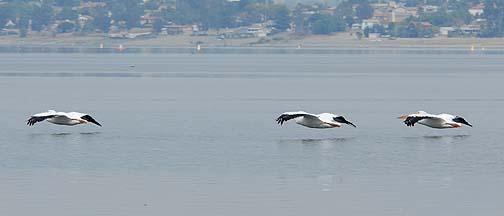 The most amazing thing they do is fly in cooperative “u” and “v” shaped groups. They do this to drive the fish to shallow water. Many times they will beat their wings on the surface of the water to drive the fish. So, like many species they collaborate to catch their food. We can learn from the Brown Pelican that without collaboration, the group/team does not succeed.
It is also amazing to watch these birds fly in a straight line. It is really cool to watch them fly right over the surface of the water. The lead bird will go up and down with the ebb and flow of the waves just above the surface. All the other birds follow in a perfect rhythmic wave. We as leaders need to also make this smooth adjustment to the ebb and flow of our daily happenings. 
Additionally, Pelicans fly in a “V” pattern. Flying this way reduces drag and saves energy (actually up to 20%). Don’t you think collaborating saves 20% of our energy as well? Even more interesting is the fact that the lead bird in the “V” has to work the hardest by breaking through the air where there is the most resistance. Sound familiar? But wait, the Pelicans have figured out this leadership challenge as well. The lead bird does not stay at the point of the “V” for very long. It drops back to let another bird lead so it can rest and have leadership renewal.
This is a very smooth transition that happens in flight. In other words, biological stress necessitates this constant transition. More importantly, every Pelican in the “V” can lead. Can you say that about everyone in your organization? Does everyone have the opportunity or feel the need to lead?
Think about it. For us, biological stress also dictates we need to rest and be renewed. Also, collaborative organizations are healthier when the hierarchies are flattened and leadership is distributed.
I am particularly excited that in Indiana, part of our new teacher evaluation system involves the teachers’ ability to provide school leadership. When effective distributions of leadership occurs all teachers are better able to lead from where they are. Leadership must occur from all levels.
Next time you need a visual reminder of leadership – Look to the Pelican
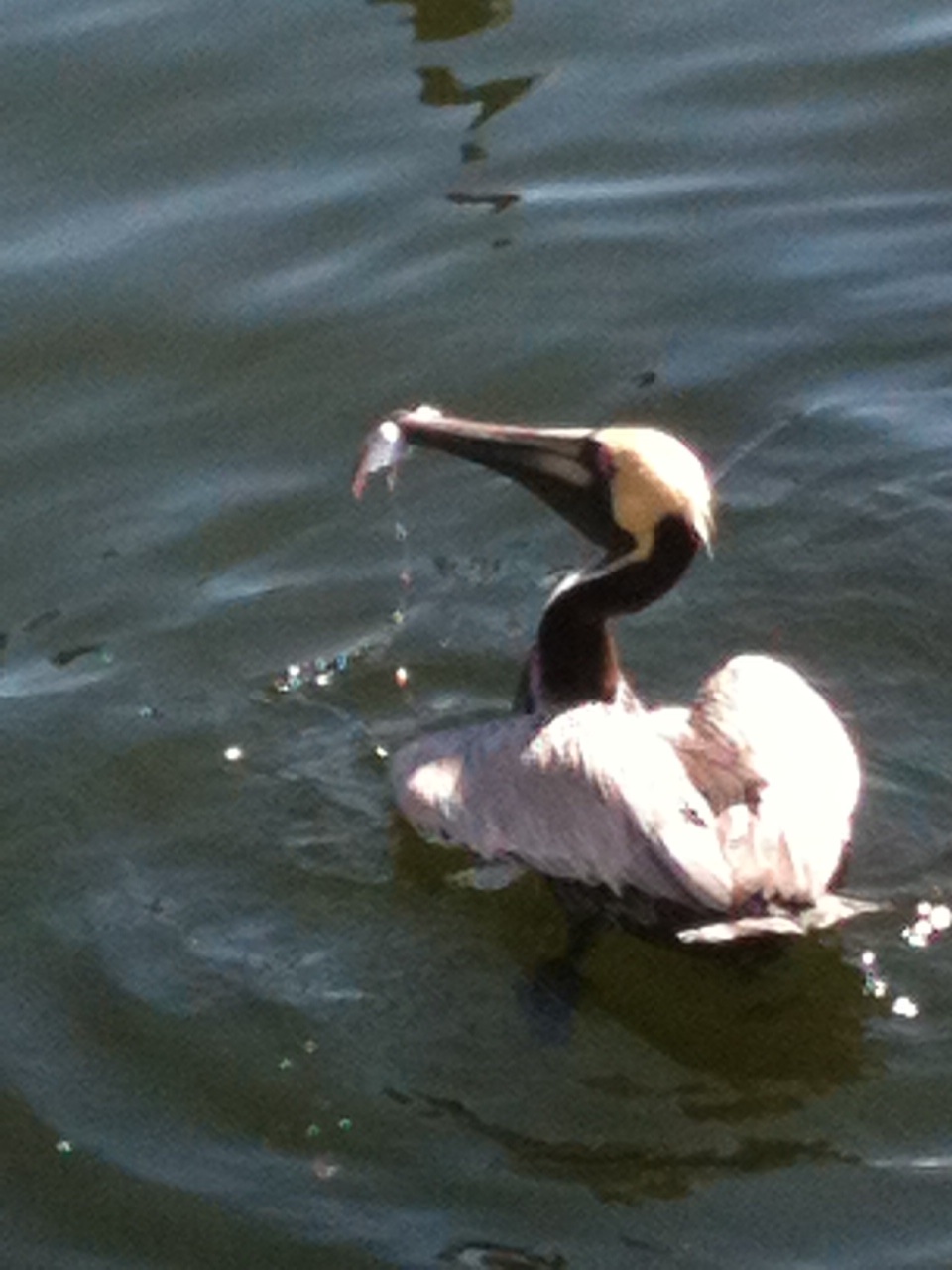
Loving the scraps we were throwing him!
The Angry Birds Effect
 I used to talk about the “Nintendo Effect.” The reason why kids of all ages love and get hooked on video games is because of the great educational best practices these games employ. These best practices are: student-centric instead of monolithic, immediate feedback, actionable feedback, the opportunity to immediately go back and re-try, and the ability to collaborate and watch others play and learn from them. You would have to agree, all of these are important to learning whether you are a p-16 learner, business executive, or pro-football player. Right?
I have now changed my phrase, however, from “Nintendo Effect” to “Angry Birds Effect.” This change is not just to keep me more in tune with the times, but the fact that Angry Birds does a better job of combining all the best practices than Nintendo ever could. For those reading that have never played Angry Birds let me give you a little tutorial. Basically, you are presented with Angry Birds and a sling shot and your job is to destroy green pigs who are sheltered by very creative structures in a variety of settings. This game, designed by the Finnish game developer Rovio Mobile, was first designed for the Apple IOS system in 2009.
Each level starts with the number, types, and order of birds predetermined. If all the pigs are defeated by the time the last bird is used, and you improve your score three times the next level is unlocked. Basically, standards mastery! Upon completing each level, players receive one, two, or three stars, depending on the score received. I want to make sure you understand here, I can play as many times as needed to get all three stars – a little different than the way most students are graded today. Players may reattempt unlocked levels as many times as they wish in order to complete them successfully or to earn additional points or starts. 
Angry Birds has many of the components that should be incorporated into great student centric curriculum and lesson planning or development of corporate training programs. The way most schools do feedback right now is by grades and “when the grades are handed out, the privilege of feeling successful is reserved only for the best students. By design, the rest experience failure” (Christensen, Horn, & Johnson, 2011). Let’s take a look at the best practices we can learn from Angry Birds:
1. Early in the game, the single Red Bird is the only one available-basic knowledge.
2. Players advance at their own pace.
3. Mastery is required to advance – You must have cleared a level three times with score improvement each time before moving on.
4. As the player advances, new levels are introduced.
5. The player can move ahead and clear levels beyond the one they are presently in, but not too far.
6. Different contexts are portrayed (deserts, gem mine, city at night, et cetera) to make it interesting and relevant to the player.
7. The player is given new tools (different types of birds) to use as he/she advances and unlocks higher levels.
8. Immediate feedback is given. The player knows the score immediately.
9. Ability to go back and retry and review any level any time.
10. The next level is always “just above” (Christensen et al., 2011) the players ability. Not too far above, but “just above.”
Let’s dig into this concept of “just above” a little deeper. Christensen et al. (2011) asserted, “There is mounting evidence that students’ learning is maximized when content is delivered “just above” their current capabilities – not too much of a stretch, and not too easy. Customization to the “just above” level for each student is much easier to achieve in software than in the current monolithic delivery of most schools.” This adds a whole new dimension to differentiated instruction and modifying learning according to the way students learn. Remember, this is true for adult learners as well.
So let’s recap what we can learn from Angry Birds. We must provide a learning environment that is student centric, not monolithic (Christensen et al., 2011); we must provide immediate and actionable feedback; we must provide the students with the ability to go back and keep trying and editing till mastery is achieved; and we must introduce material “just above” where each individual student’s capabilities are.
Next time you are planning a lesson, developing a training program, planning a practice, or whatever your profession has you teaching others; think about the best practices of Angry Birds.
Reference
Flavor of the Month or Research & Development?
 I heard discussion and saw an advertisement talking about education having our “Flavors of the Month.” In other words what’s the next initiative, program, product, or technology that will increase standardized test scores, student performance, student engagement, teacher effectiveness, learning, or whatever other metric we might be using (all of which are important). It’s interesting the advertisement using the “Flavor of the Month” analogy was for a professional development program. Interesting, huh?
Here’s my take. First of all, transformational change does not come from programs and initiatives. Those are things! It comes from having a process where action research is constantly occurring. It also is about having a collaborative culture where learning is always occurring. Garvin (2000) called this environment the learning organization. “A learning organization is an organization skilled at creating, acquiring, and transferring knowledge, and at modifying its behavior to reflect new knowledge and insights” (Garvin, 2000, p. ii). Now, think about that definition. If you think about it you’ll understand when I say it is good to use a few “Flavors of the Month” every so often to try new learning techniques for effectiveness. I would not have known I like Pistachio Ice Cream had I not been tempted to try it on a Flavor of the… trial. What’s wrong with trying new things? We need to view it as Research and Development.
The problem within our schools is we then need to collaborate in a learning organization environment to truly know what worked and did not. We need to have knowledge sharing in conjunction with knowledge generation. Now I know I will get all the negative reactions that are associated with any time of professional development or professional learning communities – no money, no time, yada yada yada. A true learning organization is a culture not a thing.
Let me give you an example. Yesterday I wanted to try using a People Search. This is an activity where students receive a chart with eight questions and they have to collaborate with eight different students to answer each question. They both initial when they believe they have the correct answer. I tweaked this activity to do it electronically and invited another teacher in who uses this activity often with success to observe and critique afterward. We spent time reflecting afterward and it was incredible and worthwhile personal growth time spent. Did you notice this did not cost money, require board approval, or any of the other things we complain about or use as excuses.
This interaction was a true modeling of a learning organization. There was no fear of failure, and even if it had failed, my teacher guest is of the same culture as me. We are not afraid of risk. The process of a learning organization starts from a cognitive phase where new ideas are exposed and are digested by the people followed by a behavioral phase (trying something new) where these ideas are put to use and finally a process improvement phase (reflection). So don’t forget we must develop a culture of Research and Development, knowledge creation and sharing, and the learning organization.
Reference
Garvin, D. (2000). Learning in action: A guide to putting the learning organization to work. Boston, MA: Harvard Business Press.
SWELL Education
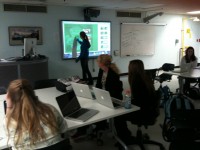
SMART Worldwide Effective Learning Lab
This week’s post is going to direct you to four posts I have done for SMART Technology’s EDCompass Blog. I serve as a guest blogger and have done a series of four posts describing my journey as a SMART Exemplary Educator. This journey has also involved the development of the SWELL (SMART Worldwide Effective Learning Lab) classroom. The four titles are listed here and linked to the EdCompass Blog. Check out these posts!
Could you Convince Your School to Put a SMARTBoard in Every Room?
A SWELL Place To Be: The Story of the SWELL Classroom
A Typical Day in the SWELL Classroom
Professional Development for Digital Learning is a TALL order
Also check out this video my class made about project based learning and the use of technology. To view the video click here.
Values, Dreams, & Priorities

In my reading, studying, and reflecting this year I have been reminded time and time again how our values drive us as leaders. Those same values drive me as an educator as well. I am glad that I chose to read the book The Leadership Challenge by Kouzes and Posner. In their book they gave us the five principles of leadership:
- Model the Way
- Inspire a Shared Vision
- Challenge the Process
- Enable Others to Act
- Encourage the Heart
I am not going to write about all of them, but suffice it to say; you need to read the book!
As an educator and leader I must envision exciting and enabling possibilities. As Kouzes and Posner said, “In some ways, leaders live their lives backward. They see pictures in their mind’s eye of what the results will look like even before they’ve started their project, much as an architect draws a picture or an engineer builds a model. Their clear image of the future pulls them forward.” As a teacher leader it is so true that I must live my life backward.

It is important that we see the end goal of what a great school and educational system looks like. Indiana’s State Superintendent of Public Instruction, Tony Bennett, has been a great modeler of this. As a teacher I must live life backwards, by seeing where the students need to be at the end of a course. So how does one live life backwards effectively? VALUES, PRIORITIES, & DREAMS!
In my opinion one of the biggest mistakes teachers and coaches make is teaching and coaching a person where they want them to be instead of where they are. One of my values in education is realizing that we must allow our students to be bad at something before they can get good at it. Let me tell you a story:
An important philosophy I have is allowing students to be bad at something before they can become good at it. The best example I can think of is Scott Martin,[1] a student who was a terrible public speaker. I use many student presentation activities in my classes, so this young man had plenty of opportunity for improvement. While having Scott as a student, a teacher made a comment to me that he did not have students make presentations because they were so poor at it. I remember saying, “Shame on you! How can students get any better if they are not allowed to try, with us helping them?” We must be willing to stand beside our students and allow them to be bad at a skill while we are teaching them to become proficient. Scott Martin went on to become a gifted speaker. In fact, he emceed the opening ceremony for our new welding shop. He did an outstanding job for the ceremony which had school board members, advisory committee members, business and community leaders, and parents in attendance.
As Kouzes and Posner said, values serve as guides to action. It is important to have our values driving us. As a teacher leader those values are equally important.
Many times when collaborating with other teachers it is easy to let that learning time turn into a gripe session about issues that are about the adults (general frustration) and not the students. It’s easy for me to bring the group back to what’s important by reminding them that what is important is the goal of a first rate learning environment for the students of Lebanon High School. In order to speak up w must know what to speak about. Our values give us that voice. Kouzes and Posner said, “Personal values clarity drives commitment.” So for us to have our priorities in order and dreaming positive dreams we must first know what we value most.
[1] Scott Martin graduated May, 2009. Author has permission to use this story.
Great Educators: 30 Days of Restoration
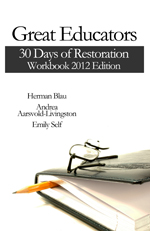 I am so excited to share with you this week about a book that you all need to buy. The book is Great Educators: 30 Days of Restoration Workbook 2012 Edition. This workbook has been dedicated to all the great educators in the nation. The book is a 30 day exercise for educators to renew an restore their excitement and dedication to their profession. Whether you are a new or experienced teacher, this workbook will help you bring joy and enthusiasm back into your classroom.
This book gives teachers a chance to explore what other educators are doing in their classrooms and schools to be powerfully influential as teacher leaders and highly effective teachers. Each day’s story comes from an award-winning teacher that was nominated to be a part of the book.
Why am I so excited? Because I am featured on Day 24. My plan for Implementing Cross Department Collaboration is outlined in this chapter. Day 24 begins with a quote from me: “Teacher expectations affect student achievement, so it is important that we have high expectations for our students. My personal mission is to use rigor, relevance, and relationships to be a steward of high student achievement.” My chapter deals with realizing the importance of collaboration.
It is important to take time to have a conversation with one another and share successful teaching strategies. Then, teachers will have the opportunity to make adjustments that allow for the creation of innovative ways to teach students how to learn to learn. To do this I introduce a what I call Cross Department Collaboration (CDC). A plan that my Agriculture Science Department uses to meet with anther department each month to share best practices or learn new strategies.
I will let you read the book to learn more about my journey with collaboration and leading our school to become a learning organization. I hope you will consider buying the book. Every chapter has a worksheet section at the end for reflection on the day. This book would be a great source of professional development. Happy reading.
Lesson of a Pin Oak
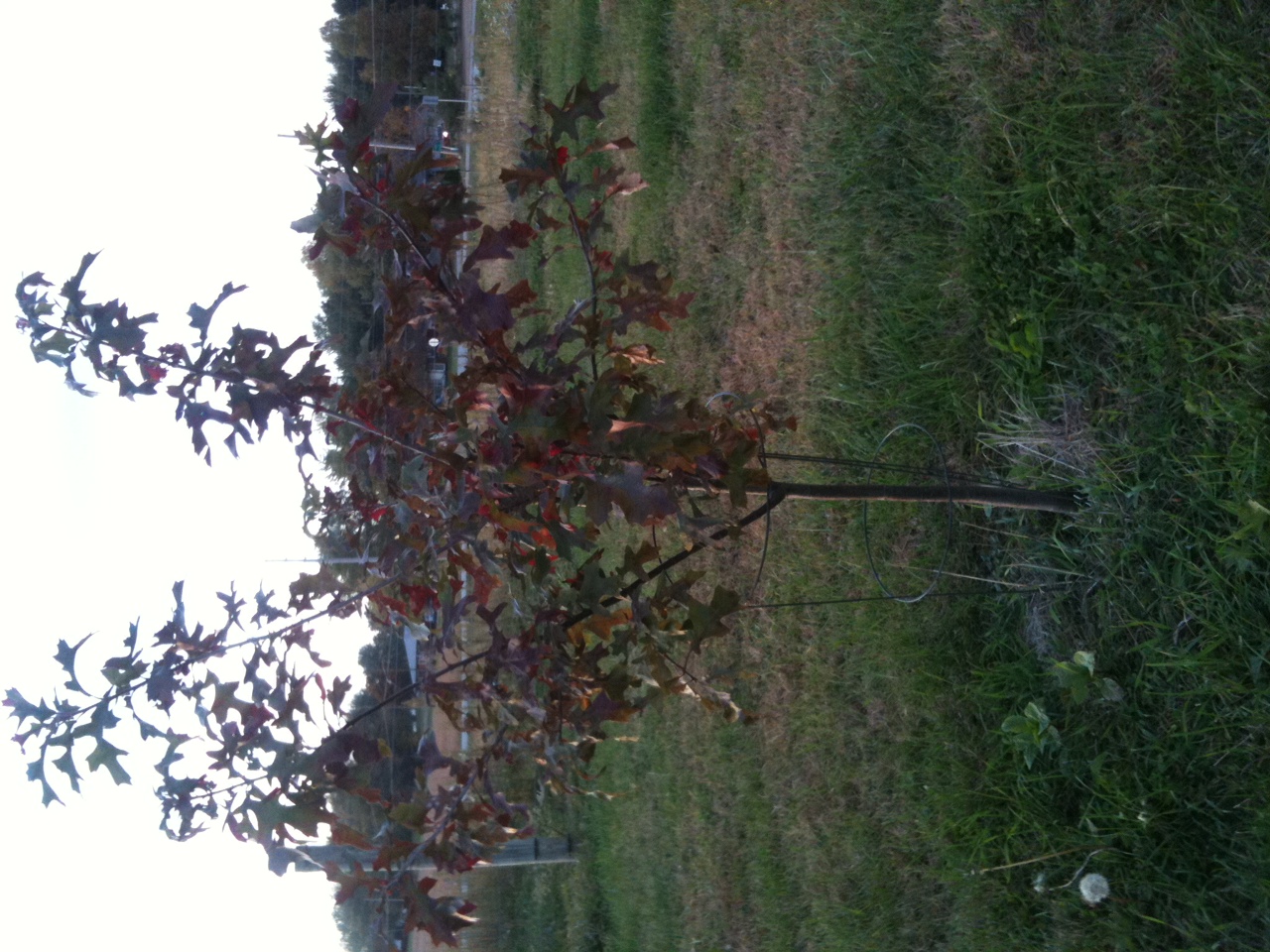 Last year my son, Heath, received a small Pin Oak tree to plant at home as part of a fourth grade project. We planted the little 18″ sprig and it is now a little over five feet tall (see attached picture). Heath is proud of his Pin Oak tree and and has watered it every day, has kept it staked and even put in tree fertilizer stakes for it. Needless to say, it might be the healthiest tree in Indiana.
I know there have been lots of writing using trees as the analogy, but I couldn’t help sharing my son’s reflection. This weekend he was standing next to his tree and he said, “Dad this tree and I are about the same size. I guess I have done a good job of taking care of it. You told me if I did everything right that it would put down good roots, grow fast, and be strong enough to last for my kids to see someday.” Then he made the profound connection. He said, “I guess that is really what you’ve been doing with me, huh?”
This became one of those “Touchpoints” for learning as Douglas Conant and Mette Norgaard called them in their book Touchpoints: Creating Powerful Leadership Connections in the Smallest of Moments. As Conant and Norgaard (2011) pointed out, these interruptions (or little conversations) can be both planned and unplanned, but give us the opportunity to lead. For these touchpoints to be effective Conant and Norgaard (2011) posited that leaders must “listen, frame, and advance.”
I did the listening, and Heath had framed the learning perfectly. All that was left was to advance. So we talked about how this nurturing did not just apply to father son, but to any time we are able to help someone, whether it be a classmate, teacher, or anyone who needs our expertise to be lifted up. We discussed how he has the chance to be a role-model and how others can learn from his example.
Finally, I learned from Heath that, “the action truly is in the interaction,” as pointed out by Conant and Norgaard (2011). So let’s all make sure we take time to listen so we can make something of our interactions.
Change Creation is Proactive

In doing some research this morning I came across the work of Lick and Kaufman (2000) and it was too good not to share. Lick and Kaufman (2000) asserted that,
Change creation is the process whereby an organization and its people:
- Invite, accept and welcome change as a vital component in defining and achieving future success.
- Define the future they want to design and deliver.
- Create the designed future and continuously make improvements while moving ever closer to the desired future. (Chapter 2)
When organizations enact change creation, they intentionally move from being victims of change to becoming masters of change. I don’t know about you, but I want myself and my school to be masters of change.
Reference
Lick, D., & Kaufman, R. (2000). Change creation: The rest of the planning story. In J. Boettcher, M. Doyle, & R. Jensen (Eds.), Technology-driven planning: Principals to practice. Ann Arbor, MI: Society for College and University Planning.


2 comments