Soaring Like A Malcontent Eagle
 This past Saturday night I got caught up watching the documentary “The History Of The Eagles” on CNN. As a student of rock and roll bands and artists I became engrossed. Particularly when you think about all the artists that were members of the Eagles, like Glenn Frey, Don Henley, and Joe Walsh; or those who influenced and mentored the band, like Bob Seger, Jackson Browne, and Linda Ronstadt. There were so many things that I could blog about after watching this. I took a couple of pages of notes.
 One of the things that caught my attention was when the Eagles manager said that Don Henley was a “malcontent.” Henley, however, just wanted the band to keep getting better. A malcontent is someone who is dissatisfied and rebellious. I believe many tines those of us who have a very defined purpose and are very passionate are viewed as, and rightly so, rebellious. I don’t think this is necessarily a bad thing.
Isn’t a malcontent really someone who is not satisfied with the status quo? Couldn’t a malcontent be that person who sees a need and opportunity for change? Finally, couldn’t a malcontent be a catalyst for change? When all three of these questions get answered with “yes,” that constitutes a person being a productive malcontent.
This is the person who challenges what is being done, but always has an alternative to offer. This is healthy. It’s the person who just complains and fights change with no alternatives that is toxic to the organization or community. So let’s embrace the productive malcontent and be vulnerable to positive/constructive criticism/change for the betterment of our organizations, schools, businesses, communities, or even rock bands.
Triageformational Leadership: New Hybrid Definition of Triage and Transformational Leadership
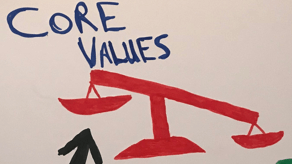 You all know how I like to make words up, so here is my latest: Triageformational Leadership. Actually, I made up the word and the definition over a year ago while in a meeting, but am just now blogging about. Does that give you any indication of how long my “want to blog ideas” list is? Anyway, here is the definition: The process of leading by core values to determine and prioritize needed changes so limited resources can be rationed efficiently and effectively to support the organization’s realization of vision and mission.
The important thing to note about triageformational leadership is that that the transformation is done by triaging by using core values. So many times this is given lip service, but not really done. By putting our core values at the forefront of our triageformational leadership we:
- determine our school or organization’s distinctives.
- dictate personal involvement.
- communicate what is important.
- embrace positive change.
- influence behavior.
- inspire people to action.
- enhance credible leadership.
- shape teaching/employee character.
- contribute to educational/organization success.
…it is clearly necessary to invent organizational structures appropriate to the multicultural age. But such efforts are doomed to failure if they do not grow out of something deeper; out of generally held values. ~ Vaclav Havel
So much goes into truly embodying what it means to be a triageformational leader beginning with the sense of community we develop within an organization. Those that I believe that would make great triageformational leaders place a high value on fostering an environment or community of collaboration. This community is balanced, diverse, and equitable. These leaders build community and culture by truly living out their own core values and the organization’s core values. Just like doing triage in an emergency situation, these leaders are prioritizing what gets done next by matching core values to the situation. This in turn brings about transformation and service oriented leadership.
Buy In From All Vantage Points
 This week I had the opportunity to present a leadership academy workshop session entitled “Buy In From All Vantage Points.” The gist of the session was how to get an entire school staff to “buy in” to a continuous education model and other important school initiative. When I was first given the title I balked a little, but then decided to leave it so I could refer to not liking the title. I don’t like the title because “buy in” to me implies that there needs to be a “sales job” done after decisions are made. In my view, decisions should be made by including a wide range of individuals so the initiative, challenge, or opportunity can be looked at from all Vantage Points©. I refer to and use this model often when discussing leading change, which is what I would have titled the session. Here is the Vantage Point© model developed by MG Taylor Corporation:
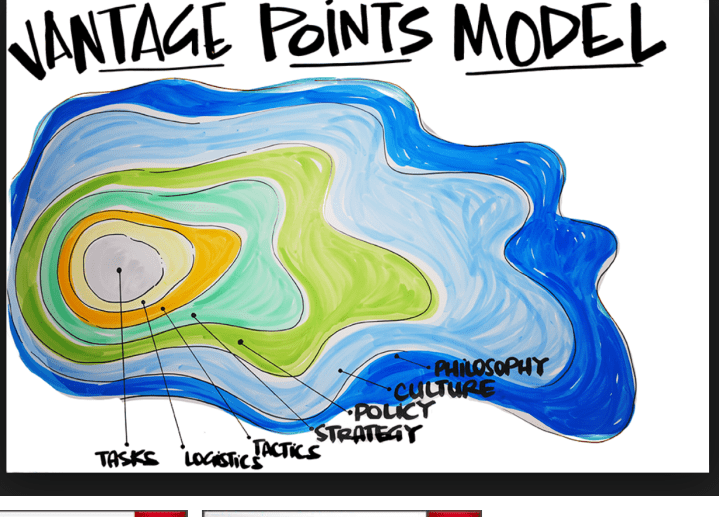
When I want people to understand how powerful using The Vantage Points© is to leading change, I like to compare it to board games. If you think about it board games have a philosophy, culture, policy, strategy, tactics, logistics, and tasks. So, I had the groups pick a board game to use as an example. The group picked Candy Land™. Then they had to discuss board game from the seven Vantage Points©.
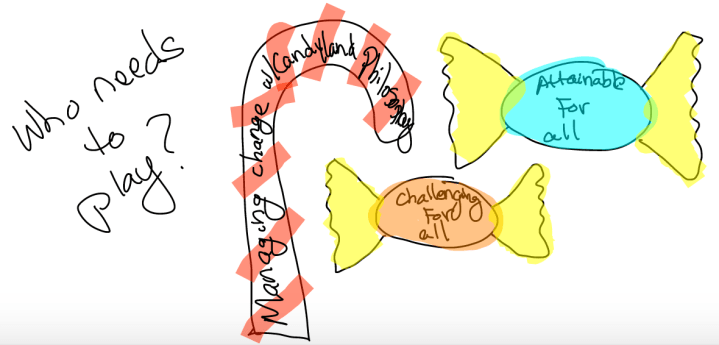
One of the groups of the two sessions I did on this did some research on the Candy Land™ board game and we learned some history. We were reminded that in the 1940s the dreaded disease of Polio struck thousands of Americans. In response to this, Eleanor Abbott, who was a victim of the disease herself, set out to develop games that would help recovering children pass the time. Milton Bradley, which is now Hasbro® began marketing the game in 1949 and is still being marketed today. Additionally, it is now available in electronic forms.
As the group made the comparison to leading change, they found that the philosophy was to be attainable and challenging to all – what we want in all education initiatives. Just like a board game, we need to give everyone a chance to play and have the opportunity to be a part of the decision making. It’s important to acknowledge that you will never convince everyone to get on board. An unfortunate truth is often that a better future for your school or organization doesn’t always mean a better situation for every individual in the end. It should, however, mean a better situation for the students we serve.
We need to always remember, when leading change, that change is always personal. Think about it; any time there is a change we all question how the change will affect us personally. As leaders, we need to be cognizant of this, and address this. By involving individuals from all vantage points we are able to help everyone, including ourselves, understand how the change will affect everyone. Leading change and new initiatives is a process, we need to use all our tools and techniques to manage the people side of change to achieve the required school or organization outcome. Effectively leading change incorporates the organizational tools that can be utilized to help individuals make successful personal transitions resulting in the adoption and realization of change.
United States Merchant Marine: The Link To American Victory
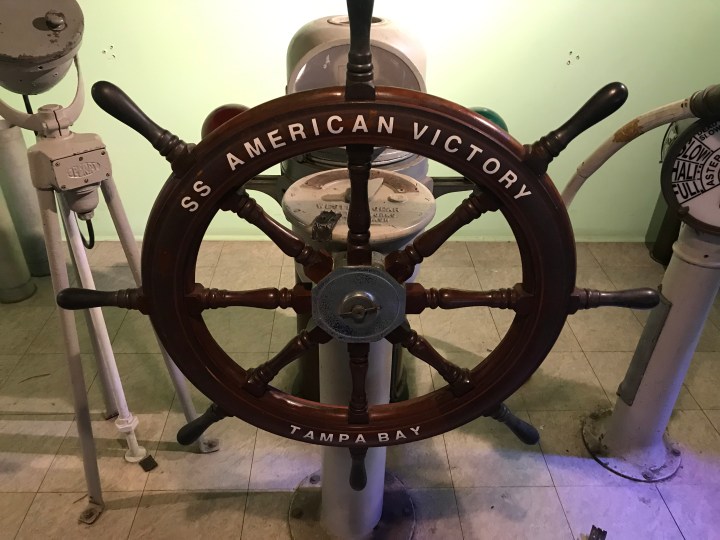 Each year I try to do a Memorial Day post honoring those who paid the ultimate price for the freedoms I love, and do not take for granted. This past week I had the opportunity to visit and tour the nine decks of the SS American Victory Ship in Tampa, Florida. I already blogged some about my visit in Where Is Your Leadership Engine Order Telegraph Set? While on the ship, which one deck serves as the museum, I stood in the wheel house, walked the deck, saw the radio and gyro rooms, sat in the mess hall, looked in crew cabins, experienced the captain’s quarters, walked the engine room deck, and so much more.
 Even as eye opening as all this first hand experience was, I really learned a lot from the attendant who took time to have a long conversation with me about the United States Merchant Marine. I have to admit I was very ignorant about this important part of our military support. The Merchant Marine is also crucial to our economy as well.
Merchant Mariners are not part of the military but do support our armed services, particularly the U.S. Navy, with cargo, fuel, personnel, and other cargo. The Merchant Marine fleet is small and includes privately owned and government owned. The SS American Victory was and still owned by the U.S. Navy. The SS American Victory saw service at the end of World War II, the Korean Conflict, and Vietnam.
The United States Maritime Administration, under the Department of Transportation, handles programs that administer and finance the United States Merchant Marine. This includes supporting the United States Maritime Service, which helps to train officers and crew on merchant ships.
Additionally, there is legislation being considered in the 116th Congress, HR 550 and S133, called the Merchant Mariners Of World War II Congressional Gold Medal Act Of 2019. This legislation would award a Congressional Gold Medal, collectively, to the United States Merchant Mariners of World War II, in recognition of their dedicated and vital service during World War II.
 After spending time on this ship, learning of the sacrifices, I, certainly on this Memorial Day morning, believe passing this legislation would be appropriate. President Dwight D. Eisenhower, who was Supreme Commander Of the Allied Forces during World War II, recognized what an important part the Merchant Marines played in winning the war when he said, “through the prompt delivery of supplies and equipment to our armed forces overseas, and of cargoes representing economic and military aid to friendly nations, the American Merchant Marine has effectively helped to strengthen the forces of freedom throughout the world.” Upon reflection, we would not have successful without this crucial link to equipment, fuel, ammunition, and the many other supplies needed.
According to statistics the Merchant Marine suffered the highest rate of casualties during World War II. Another thing my host shared was a story of American ingenuity. Before the Victory Class ship there was the much slower Liberty Class. The Liberty Class could only travel at approximately 8 knots. This was not fast enough to outrun the 12 knots of the German U Boats. We then redesigned and came up with the Victory Class that could run at 17 knots. This would allow for outrunning the U Boats. Even in war we were having to innovate and make improvements. It still amazes me to think that the SS American Victory was built in 55 days. We need to also take a moment and honor the civilians, many of who were women, for making sure everything was being taken care of back home, including getting our ships built quickly.
I am so grateful I had the opportunity to learn about the United States Merchant Marine and their part in securing our freedom. Today, on Memorial Day, we should all pause and give thanks for the ultimate sacrifice paid by so many for our freedom.
Where Is Your Leadership Engine Order Telegraph Set?
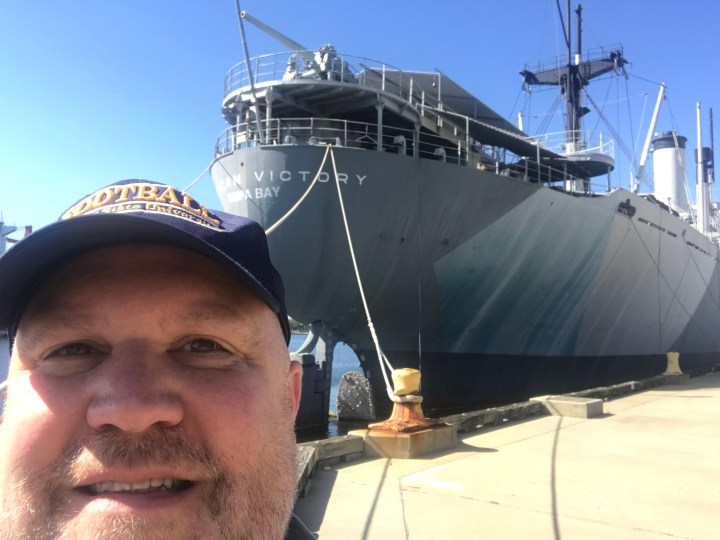
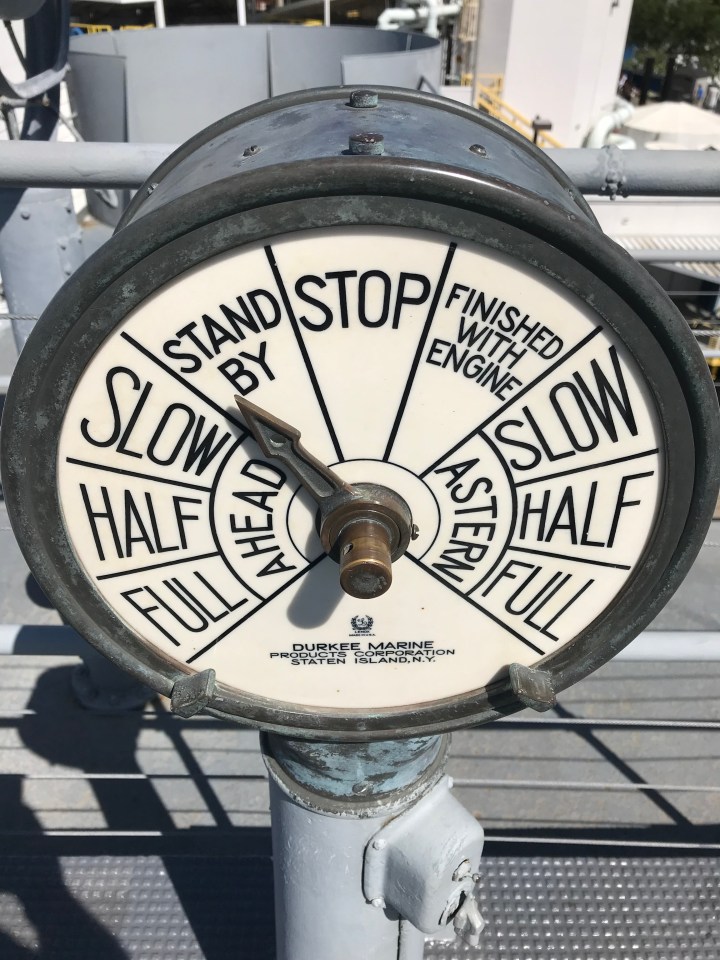 I had the opportunity this past week to visit and tour the SS American Victory Ship and Museum in Tampa, Florida. It is an outstanding icon of America during times of war. I particularly learned a lot from the museum and the person there who answered all my questions and took the time to have a lengthy conversation with me. Before that day I really did not know much about Merchant Marine ships, how they were operated, and the relationship to the US Navy. I’m still pretty ignorant, but I am learning.
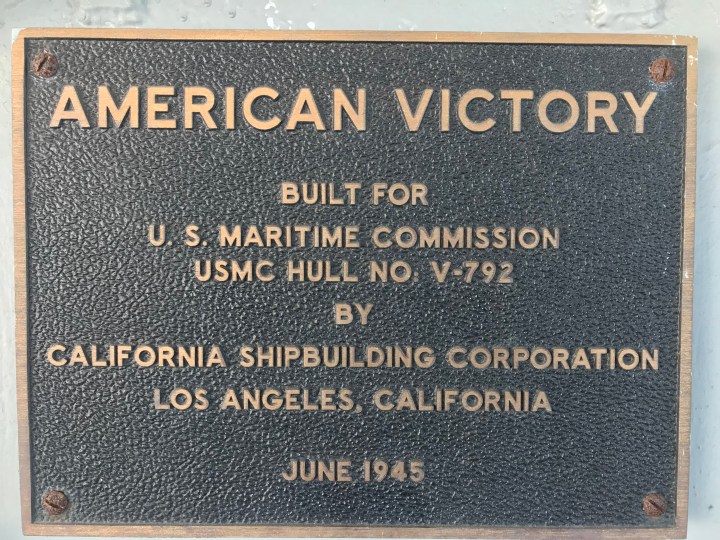 The SS American Victory was a Merchant Marine cargo ship that supplied our troops at the end of World War II, and then in the Korean Conflict and Vietnam. This ship hauled ammunition, cargo, and troops. The ship was run by the Merchant Marines, but of the crew of 62 part were US Navy personnel who manned the weapons in case of attack. This ship was launched 74 years to the day (May 24) I was there, in 1945. It only took our patriotic citizens 55 days to build the ship.
 The exhibits in the museum are awesome and I had the chance to explore the entire ship. I was especially inspired in the wheel house, or bridge, as I looked out the port hole windows and thought about the decisions leaders had to make on this very deck. Then when I went above to the outdoor wheelhouse deck I studied the Engine Order Telegraph (the featured picture of this post). I immediately realized I had found another great metaphor that I believe represents the ways many organizations, leaders, associations, and governments work. Earlier last week I blogged about metaphors in Leading By Metaphor.
 The Engine Order Telegraph, also known as an EOT, is a device that transmitted the orders from the pilot to the engine room. It has slow, half, and full for both ahead and astern (reverse). Also, it has stop, stand by, and finished with engine. As I stood there studying the EOT on a beautiful sunny day in beautiful Tampa Ybor Channel and thought about how these are incredible metaphors for leadership.
 On these older style ships the captain didn’t physically control the ship like on today’s ships. On this ship the EOT would telegraph what the captain needed and engineer in the engine room made the adjustments – slow down, open up the throttle, et cetera. I thought about how this ship would have been like an orchestra with the captain as the conductor and the deck and engine crew playing the instruments.
 As leaders we have the opportunity be a part of telegraphing full speed ahead, reversing the engines, slowing down, or stand by which I believe is analogous to status quo. I chuckled to myself that the EOT was set to stand by because I am such a status quo hater. If I was captain of a ship it would probably be hard to order stand by. I’m kind of a Rear Admiral David Glasgow Farragut kind of guy – “Damn the torpedoes, full speed ahead!” We all have to make decisions using the best intel available at the time from collaboration with our teams to enter the correct decisions into our metaphorical EOTs. We work in such a high speed environment! Therefore, we must figure out ways for professional growth of our leaders and teams on how to achieve organizational goals in the shortest time possible. We must then also find ways to provide maximum professional growth in the shortest time possible.
Therefore, we need to be ready to ring the bells for full speed ahead, just as Rear Admiral Farragut did in Mobile Bay in 1864. Had those ships not been willing to go ahead full, they probably would not be successful. I can tell you that the SS American Victory Ship and Museum team have their EOT set on full speed ahead for telling the story of the important work of Merchant Marine ships. How about you and your organization? Are you stuck in the status quo of stand by? Or will you make the call for full speed ahead?
It’s Not My Story To Tell

Hailey showing off her temporary Emoji tattoo
I am writing this post as I sit in the airport waiting to fly home after a few days in central Florida facilitating our last 3D Leadership sessions for the spring semester. I am going to miss doing these in June and July, not just because I love doing them and working with all the great leaders that I have the opportunity to serve, but also because of all the learning and reflecting I am able to do as well. We have had so many great discussion and I have a whole list of topics I want to reflect deeper on and study.
This post is about communication, but not the normal topics related to communication like the leader that talks in espoused cliche´infused declarations like “Students first,” or “Customers first,” “All hands on deck,” or “We need to move with urgency.” Over and over again, they present grand, overarching and fuzzy statements of who really knows what. Too often we assume that everyone shares the same definitions for terms that go on and on like vision, value, move with urgency (does that mean I’m supposed to run everywhere?), teamwork, focus, strategy, and on and on. While it is important for great leaders to get a handle on this communication issue, this is not the focus of tonight’s post.
Tonight, I remembered a statement by one of our North Carolina members, Hailey Odum, made in her first session while reflecting on what she wanted to be as a leader. Hailey said it bothered her when people talk about things they either shouldn’t be talking about, or really don’t know all the details about. She said she does not tell the story if: “It’s not my story to tell.” This really hit me because this is a pet peeve of mine as well.
You know the individuals Hailey and I are talking about here:
- need to know everything and probably don’t.
- want you to know they know something.
- usually don’t have all the details.
- flaunt that someone called them and let them know something before you, or even say, “I’ll bet they haven’t told you yet.”
- start with: “I’m not supposed to know this, but so and so told me.”
- you hear in a meeting an announcement and are told it is not public yet, but you heard a group talking about it the week before with all the details you just heard.
When I look at these items in bullet list form it almost reminds me of being in the third grade again. I am sure you could probably add another six bullet points to this list, but you get the point. Now this is not to say that I do not know things at times in advance of others or that others don’t confide in me at times, but I really do try to use Hailey’s sniff test of asking myself “Is it my story to tell?” If it is not then I shouldn’t. Notice I did not say I don’t because I am not perfect, but I have to say I am much better at applying the sniff test since Hailey pointed this out as a leadership trait that needed to be followed.
This then goes to thinking about how communication is handled. For example if you work in a team, it is probably not healthy for certain team members to find out things ahead of others. If we have to say things like “Oh, I thought you knew.” or “You didn’t hear this yet.” or the worst one “So and so probably didn’t tell you, but she let me know (you’ve just been told you are not worthy of knowing at the same time as everyone else).” Now in reality what we may have just experienced is simply terrible communication skills, but even so, this is a little bit like leadership by the game of telephone. And, because it is probably not the person who is telling you story to tell, things maybe are not represented correctly.
I really appreciate Hailey bringing this up as a topic of discussion because it has now been something that I consciously think about. So next time you know something, or think you know something, ask yourself, “Is that my story to tell?” Nine times out of ten I’ll bet you answer, “It’s not my story to tell.”
Stand Your Ground & Be The Example
 Setting an example through your own practice illustrates to others that change is a shared endeavor. True leaders are the pinnacle of what they expect from the people around them. And by setting an example, true leaders encourage their people to aim for that. By walking your talk, you become a person others want to follow. When leaders say one thing, but do another, they erode trust–a critical element of productive leadership.
Great leaders are persistent. Try, try again. Go over, under or around any hurdles to show that obstacles, what I like to call opportunities, don’t define your company or team. This will allow you to create solutions. Don’t dwell on problems; instead be the first to offer solutions and then ask your team for more.
Furthermore, being the first to change can be challenging. As a pioneer, you have to overcome resistance to the status quo. We humans get used to the way things are. Yet those who dare to rock the boat are in a position of tremendous power, and can send ripples of inspiration out to the world. Lead by example because others will become curious. Remember, our actions are much more persuasive than than our words.
Leadership Is Empowerment
 By being generous and loving, we become better leaders. Our kindness inspires others to follow in our footsteps. Humans require community in order to survive. As individuals we are week, but together we are strong. We need to strive for greatness, but we need to lift others as we rise. The goal is not to tower over our fellow humans, but rather to lift them up to where we are. If we all want to succeed ourselves, we cannot do it alone.
Leadership is empowerment. It’s lifting others up, helping them advance, and making them a part of something bigger than themselves. In short, it’s helping people to be a little closer to who they’re meant to be. Our leadership ability won’t be measured by our own advancement, but how well we advance the lives of others.
How does your leadership success measure up?
Leading With Extreme Axe Throwing Finesse
 There are so many formulas that have been written about as best pathways toward great leadership. I have tried to write a few of those myself. Yesterday, our professional development team went on a team building excursion to Extreme Axe Throwing in Hollywood, Florida. Needless to say, it was a great time, but there were moments when I was struggling just to get the axe to stick. I kept getting told, “Finesse, Byron, finesse!” I had to think about what the heck “finesse” even was. So, off to Merriam Webster dictionary:
- refinement or delicacy of workmanship, structure, or texture
- skillful handling of a situation: adroit maneuvering
- the withholding of one’s highest card or trump in hope that a lower card will take the trick because the only opposing higher card is in the hand of an opponent who has already played
 As I familiarized myself with what “finesse” really meant, I began to think about how this related to my current situation at the time of throwing an axe at a target. I believe last night’s situation relates to #2. I needed to be skillful and use the techniques our axe throwing coach instructed us with. Then, as I began throwing I needed to get clever and maneuver to make it all work for me. Sometimes I threw too hard, others I was releasing early, others I kept getting told I was flicking my wrists. We can certainly relate this to leadership, don’t you think?
Check out my axe throwing prowess in this video:
Leadership, then, is an art of finesse. It’s being able to adjust and communicate in different ways, specific to each person. I don’t mean being “everything to everyone.” I just mean having enough self-awareness to know what is going to yield the best response from each person–and then having the patience to execute with that behavior in mind. What makes this mentality so difficult is that, in every capacity, it asks that you, as a leader, put yourself in a serving others mode. We must finesse away ego. We can’t just rage out of impatience, or get upset because other people aren’t working the way we want them to work. We can’t show your frustration–even if everyone else is. We can’t sit back and complain when times get tough. We must be the positive force that leads change. This art of finesse is learned through diligent self-inquiry, and constantly practicing the art of finesse and being flexible in the way you communicate and lead others.
 Leadership finesse requires that we, as leaders, constantly identify barriers and causes of struggles. Then, with relentless determination, make the best of the current reality we are in. Using my axe throwing metaphor, one barrier we have is fear of failure. Fear of failure holds us back from our dreams more than anything. The thing I was reminded from axe throwing is that we are going to fail over and over and over. During one round of throwing (10 throws) last night I did not get the axe to stick in the wood once. That’s right; my score was 0 at the end of the round. To handle this with finesse, I was reminded that if you’re, you’ll be rejected too. The key is to fail forward, where the pain of the failure is reduced by the benefit of the lessons it brings.
Remember Who You Are And Be Okay With It
 One of my favorite compliments to give someone is: “Thanks for being YOU!” I believe it is a powerful compliment because it implies that what makes that person such a unique human being comes from deep within. What I am trying to do is give unconditional gratitude. I want the person to remember who they are and be okay with it. When I say, “Thanks for being YOU!” I am not just saying thank you for what the person has done – I am saying thank you for who he or she is. I am telling him or her that I value them as a person.
“Thanks for being YOU!” Even for all the mistakes the person made and the flaws he or she found that they want to change. For the times he or she did and the times he or she could not, for one day they will all add up. Any of us at our best is what serves us all best. We need each of us to be who we are in order to shape the future. We grow into being who we are one day at a time. We need everyone’s contribution. We need your contribution as much as mine. It’s something we build as much as we find, to do either takes a present mind.
Remember, you are not a robot or a Barbie™. Therefore, let’s be who we are and be okay with it. This does not mean that we should not work to improve or learn new things. It means we need to be okay with who we are as we continue to improve and evolve as the person we are. I believe every person is a work of art. Research indicates that our capacity for self-evolution and growth of our personality, mental capacities, relationships and actions are all based on conscious intent. Shaping our being is like making art; the same way an artist develops, evolves and creates a painting; or a composer creates music. We can all make our conscious being and all that emanates from it a work of art. As I always say, “There is no bad art.” So let’s go out there and remember who we are and be okay with it.


leave a comment