Open Your Mind To The Past & All Of This May Mean Something
 Late last night I found myself flipping through the television channels. Actually, using the term channels probably really ages me – are they even called channels anymore? Anyway, I came across an old episode of Star Trek: The Next Generation (TV Series). This was my favorite of the Star Treks because I love the character Captain Jean-Luc Picard (played by Patrick Stewart). My favorite line of his that is in almost every episode is “Make it so.” I practice “Make it so!” leadership and just realized I haven’t really blogged specifically about that. Maybe tomorrow.
As I surfed and found Star Trek, the episode was just beginning. The episode was Season 2, Episode 17 and was titled Samaritan Snare. There were two throughlines established early: Captain Picard needed heart replacement surgery (routine in the 24th Century) so was traveling with Wesley Crusher in a small craft to far away Starbase 515. The Enterprise was on a rescue mission to a Pakled vessel that turned into an attempt to steal computer knowledge.
On their journey to the medical facility and surgery Picard and Crusher had a deep and revealing conversation where Picard shared how his heart had been damaged in a fight with Nausicaans as a young ensign. While at the base Crusher will be taking Starfleet exams. Here is the conversation:
Captain Jean-Luc Picard: There’s no greater challenge than the study of philosophy.
Wesley Crusher: But William James won’t be on my Starfleet Exams.
Captain Jean-Luc Picard: The important things never will be. Anyone can be trained in the mechanics of piloting a starship.
Wesley Crusher: And Starfleet Academy…
Captain Jean-Luc Picard: Takes more. Open your mind to the past – art, history, philosophy. And this all may mean something.
Star Trek has taught generations of us how great humanity could be if we study and learn from our past, learn to deal with our biases, and work together (I bolded that for emphasis) to create a better future. People have always faced difficult times and situations, and Star Trek always reminds us that when smart people come together they can come up with smart answers. It would be interesting to know just how many have been inspired to leadership, science, engineering, medicine, or many other careers because of Star Trek. As Edmund Burke taught us, “People will not looking forward to posterity, who never look backward to their ancestors.” Thus, pretty good advice from Captain Picard to open our minds to the past so that all this does mean something. Pretty good advice indeed in the 21st Century year of 2020!
I hadn’t thought about philosopher William James for a long time. William James, the father of psychology and a leading thinker of the 19th Century, actually laid the groundwork for the study and research that continues on leadership. James asserted that individuals do make a difference in history, and that the study of influential people an important pursuit. Interestingly, as I studied more and more on this I came back across the work of Thomas Carlyle and the “great man” theories I talked about in Leaders Crashing and Flying Higher. It also had me looking at studies on “hero-worship.”
According to James (1880, 1884, 1890/1956) any change that happens can be attributed to an individual or multiple individuals. The potential of a group, organization, business/industry, community, or country will be brought out not by just one individual leader, but by a collective of leaders. Thus why I believe everyone is a leader. I really believe James believed this too. No one leader has the power to determine change. No one has that kind of power. Instead a leader must work within the context she is given. Leadership then brings together individuals with circumstances.
And, I really got to thinking that this theory was modeled by the entire Enterprise crew. It took leadership from all to solve the issue with the Pakled vessel and Picard’s surgery that ended up having complications. The head surgeon said that the complication was out of his realm of knowledge and that Picard was dying. He then said that he knew someone who could solve the issue – she was summoned and did. Nothing happens in a vacuum. This is why the context matters and everyone’s expertise matters and must be brought to the “table.” This is why everyone must be a leader.
Seeking Opportunities To Observe & Update Our 🌎Worldview🌍
 We create our own beliefs, they don’t happen to us. We choose what and how we believe. As we grow up, we see the world and ourselves in a particular way. This “way” is based on environmental influences, our parents/families, and our peers. Whether we like it or not, we are responsible for developing our own belief system.
“To argue with someone else’s experience is futile. To add their experience to your own is possibly useful.”
One of my favorite quotes by an unknown author is, “To argue with someone else’s experience is futile. To add their experience to your own is possibly useful.” To me this is what empathy is about – understanding how another person’s experiences have shaped them. If we take time to truly study the experiences of others, those experiences can help give us information free of confirmation bias.
One Machiavelli principle I prescribe to is that we should always “declare” what we believe. This does not, however, mean that those beliefs can’t evolve and change. Thus, why declaring is important. In fact, sometimes we must grapple with contradictory evidence. As our society becomes more and more global, we have more and more of our own experiences and the experiences of others to process. This contemplation of dealing with opposing views and possibly believing parts of both has always intrigued me. F. Scott Fitzgerald taught us, “The rest of a first-rate intelligence is the ability to hold two opposed ideas in mind at the same time and still retain the ability to function.” I see this as an ability of great empathy, openness, humility, and leadership.
“It’s not what you don’t know that gets you into trouble, it’s what you know for sure that ain’t so.” ~ Mark Twain
This trait of openness was reinforced in an awesome book I’m reading right now, Creative Confidence: Unleashing The Creative Potential Within Us All by Tom Kelley and David Kelley. In the book we are taught that building on the ideas of others requires humility. We must first acknowledge to ourselves the we don’t have all the answers. The upside to this is that it takes the pressure off of us to know we don’t have to generate all the ideas on our own.
 Mark Twain taught us that, “It’s not what you don’t know that gets you into trouble, it’s what you know for sure that ain’t so.” We need to be diligent to not be fooled by what we “know for sure” about ourselves, our customers, our students, those we serve, our communities, or the world. We must seek out opportunities to observe and update our worldview.
Leading Like A Superhero


Ever since we were kids we’ve dreamed of becoming superheroes. During our first fall gathering of 3D Leadership, I used a superhero throughline and had participants research superheroes and pick one that best represented themselves; or they could create an all new one. As always, they were super creative (a superhero power) and as they shared out I asked them a few questions:
- What is your superpower?
- How did you get your powers?
- What’s something that your arch nemesis has?
- Where would you live when your not saving the world?
- If you were on a team of superheroes, what would your role be?
- What would you fight the enemy with?
- In addition to your powers, what weapon would you want?
A couple of these superheroes really jumped out at me: Wonder Lori and Glinda. Wonder Lori was a new and made up superhero and Glinda was based on the good witch in the Wizard of Oz. The superpowers for these two were empathy and serving. Pretty good superpowers for leading like a superhero, right? Really being a superhero is about tapping one’s ability to do extraordinary things; and, being able to help others doing extraordinary things.
I was really struck by the superhero Glinda from the Wizard of Oz. The participant picked Glinda because of her power of always showing up at just the right time. This blew my mind because I had never thought about this in all the times I have watched the Wizard of Oz. But, what a great superpower, right. All of us as leaders would love the superpower of showing up at the right time. Glinda really did show up at just the right time, every time.
Additionally, the participant quoted Glinda at the end of the movie when she said, “You had the power all along, my dear, you just had to learn it for yourself.” This is such a powerful statement. Glinda was a great teacher—and this compliment is not undeserved. The first lesson she teaches is one of delegation. She tells Dorothy the Wizard might be able to help her get home, but that the journey to Oz is a long and treacherous one. Dorothy needs, as always seems to be the case, more information and asks for it (she’s very good at asking questions). Glinda tells Dorothy to follow the Yellow Brick Road and never take the ruby slippers off her feet. Of course, the Munchkins help her get started and find her way on the yellow brick road. Dorothy has more questions, but Glinda is a master delegator: she waves her wand and disappears! Remind you of any great leaders you have worked with?
Even though we don’t see Glinda very much in the movie, she’s clearly behind the scenes keeping watch, removing barriers, and doing things to help without desiring any recognition. We learn this in the scene in which Glinda sends snow to counteract the effects of the sleep-inducing poppies. Glinda never rushes in dramatically on a white horse (even thought there are really cool horses in the movie that change colors) to fix everything herself and, in the process, undermine Dorothy’s self-confidence as a leader. Even when Glinda reappears at the end of the movie, it is only to make sure that Dorothy has learned the lessons of the ruby slippers for herself – “You had the power all along, my dear, you just had to learn it for yourself.”
“Who Am I Not To Be?”
 This morning, on day 170 of the COVID-19 Global Pandemic, I am committing to a 52 week journey in a new book that gets released tomorrow, September 1st. I have been perusing my advanced copy of Mindset Mondays With DTK: 52 Ways to REWIRE Your Thinking and Transform Your Life for several days and really like what I have found in the book. As the author, David Taylor-Klaus, told us in the book, it is to be savored over time and used every week for a year. I love books that are organized in 52 lessons to use over a years time. This gives me a chance to also do a weekly reflection blog post, of which is this the first of at least 52 I am committing to do.
“The greatest weapon we have against stress is our ability to choose one thought over another.” ~ William James, discussed on pages 39-41 in Mindset Mondays With DTK
The title of the first lesson was Choose Consciously. It was ironic that DTK called our ability to choose, a weapon. In a leadership gathering I facilitated over the weekend I used superheroes as a throughline and we talked about leadership weapons. The ability to make the right choices was a superpower weapon of choice for some. “Who am I not to be?” (DTK, 2020, p. 40) is a statement that DTK has made to himself. So, really, who are we to not be? Whatever we want to achieve starts, as DTK taught us, with examining our own ideas of what is and is not possible.
 The choices we make are even more important in this time of “doomscrolling.” I usually love the creation of new words, but I’m not real big on this one that means continuing to surf or scroll through bad news. The act of doomscrolling, then, is to roll toward annihilation. So, back to David’s question, “Who am I not to be?” The one thing we get to control is our mind; so, we need to quit things like doomscrolling and control our mindset and beliefs.
Social media has been a blessing staying connected. One of the other challenges, besides doomscrolling, however, that has been created because of our ability to easily connect is some continually comparing themselves to their peers. DTK addressed this in the first lesson saying, “So instead of comparing our beginning to somebody else’s middle, we actually, see their success as an inspiration instead of a threat” (DTK, 2020, p. 41). I have always believed that each of us has our own personalities and set of skills that make us very special. We just cannot let ourselves fall in a trap of comparing, because there just is no comparison to ourselves – we are a “one-of-a-kind”. We cannot allow our internal expectations of what defines success keep changing depending on what others desire. Think about it: “Who am I not to be?”
When Worlds Collide
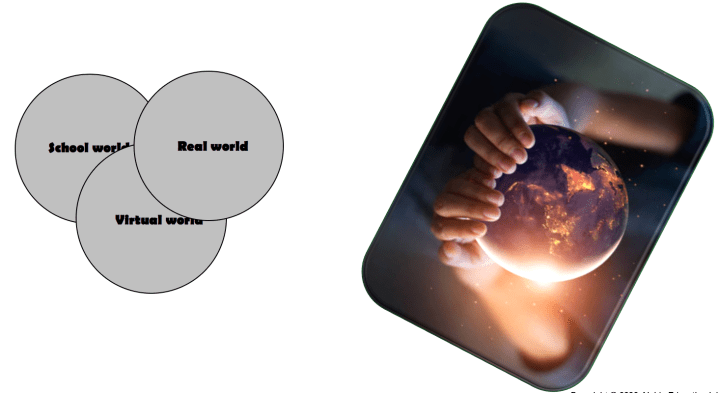 Last week I did a professional development webinar for teachers where we were talking about one of my favorite topics that I am most passionate about – making learning relevant, authentic, and engaging. As we continue to try and disrupt education as we know it and move from a teacher-centric model to a student-centered model, there are two ways to go about this:
- Focus on making learning more customized to each student
- Focus on making learning more relevant, authentic, and engaging.
At times it seems these two foci collide. We also discussed how our students live in three worlds – school world, virtual world, and real world. Right now, as we enter day 164 of the Global Pandemic, I believe these worlds have collided as well. The point is we must truly be preparing our students for the complex, rapidly changing, technology driven, increasingly connected world they will face. I said that I thought there was a song about worlds colliding that is often played at football games. A participant quickly reminded me it was When Worlds Collide by Powerman 5000. Of course I had to listen to the song and check out the lyrics. I loved that one of the lines in the song that is about being strong and not giving up was, “What is it really that motivates you?” That is what we really must find out from each of our students; or, even help them find out for themselves.
 Strategies for deeper learning that increase student engagement and produce the kinds of skills needed for today’s economy and career requirements can be improved by leveraging the practices of personalized learning allowing each student to get the kind of differentiated instruction needed to ensure that they have mastered the content. Additionally, when implementing personalized learning students benefit when we balance their computer aided learning with robust, relevant, and authentic projects. And, guess what? When taught with these strategies, in this environment, students will be more engaged.
As our students’ worlds collide we have to remember that in the world outside of school, learning happens in real time as students begin to realize they need to know something. We must remember, however, that in the real world being knowledgeable is only part of what makes a student successful. Making sense of the knowledge, communicating effectively with others about that knowledge, grappling with diverse perspectives, applying that knowledge, and validating their ideas are just as important. Our students must be able to adapt what they have learned to both predictable and unpredictable real world situations.
Don’t Be Lazy!🧰Use The Right Tools!
 I had the chance to do some work in the barn today. That brings the same joy to me that going to the beach might bring to many of you. My son and I have been doing some cleaning and reorganizing as part of a larger campaign we were calling our “Farm COVID-19 Cleansing.” Now that he is back at college, I am on my own. Today as I was working, I realized that I would get along much better if I would use a different pitchfork. I had the other style in another barn, not 50 yards away. Finally, I told myself, “Don’t be lazy; go over and get the right tool.” I did and finished up the task much quicker and effectively.
Then I began to ponder about all the things going on in education, business, industry, and all our lives due to the COVID-19 Global Pandemic (we are in Day 161, now). We must not get lazy. We need to deploy the right tools to get the right things done effectively. Go the extra yard (in my case it was 50), so to speak, to do things right. This post is not about what those specific tools are, but about, for instance, in education that our students deserve to have the right tools to fit whatever education modality he or she is in – online, blended, or in person.
161 days ago we all said, “Let’s just do the best we can.” That was appropriate 161 days ago. Not now, though. Now, we need to be doing all the right things and using the right tools no matter what industry we are in. Good enough isn’t good enough.
Where Is The “Twin”?
 Today I had the opportunity to moderate a great global webinar entitled “Creation of a Digital Twin.” The webinar was put on by GIA SMART Factory League. I am always honored to have the opportunity to work with this organization and it was incredible to be in the [virtual] room with industry representatives from over 36 different countries. And…now that we have learned we can hold these events effectively virtually and learn together apart, we can get together more often and not have the huge travel expense. Talk about holding the whole world in your hands!
 I value the opportunity to spend time learning from those in business/industry and manufacturing. It saddens me that many leaders in education talk a big game about wanting to hear from business stakeholders, but most of what happens is lip service. We need more walking the talk. Those in education must stop thinking we know more than those that hire the students we educate. It must be a partnership. There must be a true dialogue of listening to understand.
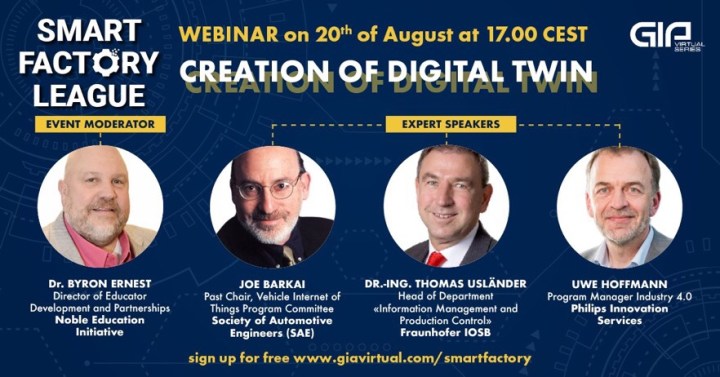 That’s why I love events like the one today where we can learn together and learn each other’s industry specific languages. Today we were learning about the “digital twin.” The creation of a digital twin enables us to simulate and assess decisions:
- Before actual assets are built and deployed
- Before maintenance
- Before a design change
- Before complex tasks
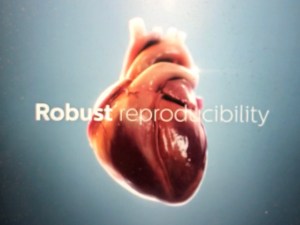 A number of industries are creating digital twins, digital replicas of products, and many other things including body parts. Today we saw a digital twin of the heart done by Philips Innovation Services. The heart digital twin performs patient specific adaptation. It was amazing. Imagine the testing of procedures and products for heart repair. Also, think of the possibilities for training and education. Endless!
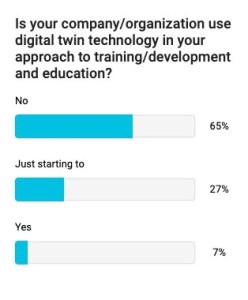 The digital twin mirrors what it is twinning in bits keeping the bit replica synchronized with the real one. I learned today that just certain parts of an asset can be selected to twin. Thus making it easier to focus in on specific functions or parts. It was pointed out that this could be of incredible use in education and training. In this sense digital twins are a new tool for education: rather than studying on the real thing you can study on its digital representation. Even though in a polling question I asked during my introductory statement today, there were only 7% of participants using digital twin technology for training/development and education, and 27% just starting too, technologies like virtual reality provide new tools for education.
Imagine if we had a digital twin of ourselves. We would still have all the flaws, but some some smart technician might find ways to help us improve. Far fetched? I think not!
Messy Creativity
 On Monday I was doing a professional development gathering for Cardinal Charter Academy in Cary, North Carolina entitled “Flat Stanley Goes Virtual: Let’s Be Engaging, Not Flat.” Of course, I used a through line: Flat Stanley’s and Flat Sarah’s. We were discussing achieving high student engagement. Participants made their very own Flat Stanley or Flat Sarah that represented their journey during the, then 156 day, journey they had spent during the COVID-19 Global Pandemic.
The participants were super creative and it is always interesting to hear the share out stories. One really caught my attention (see picture in this post) when the participant pointed out she had put a paint splatter on Flat Stanley’s right knee to represent the messiness of our lives right now during the COVID-19 Global Pandemic – the mixing of colors without a set plan or vision of a final piece of art. While it is true, there seems to be a lot of messiness and paint slinging, it got me to thinking that we should try to treat our current situation more like an artist.
In education we have always relied on our function being to provide clear standards and the facilitation and tools needed for student success. This function has been, and continues for the most part, done in a very rigid and standardized way. While reform attempts have been made there is still much work to be done to disrupt the status quo.
All of our lives have become messy during the now 158 days of the pandemic. Additionally, the pandemic has exacerbated the messiness of leading learning in education right now. To address an issue standing between a problematic status quo and student success, we must travel into an uncomfortable unknown territory with no signposts pointing toward the destination. Right now, in these times, we are on a quest not knowing our destination before arriving. We must recognize and accept the scariness and messiness of the unknown.
 We need to find ways to let loose and let the paint splatter, like on the knee of our participants Flat Stanley, into beautiful art. This makes me think of the paint splatter rooms that are popping up in many cities. Basically, you go, suit up in protective clothing, and sling paint (🎨 6+ colors) at each other and a canvas. What fun! Upon completion of your 30-45 minute “splattering” you have a beautiful piece of art. I really want to go do this! Leadership is so messy, and this splatter room concept makes such a great metaphor.
These splatter rooms have been used for therapy and team building because of the feeling of freedom achieved by just slinging the paint and the random mixing of colors. A messy process where the splatter artist doesn’t exactly know how the canvas will look in the end, but has created a beautiful product. There is so much we can’t predict, much less understand and control, especially right now. We need to keep leaping into an exploration of the possibilities with unscripted questions and activities – the splattering of paint.
We need to embrace the messiness and discover previously unimagined possibilities. Leadership is not about finding one’s courage. Rather, leadership is accepting the messiness and fear that goes with the new and unknown, and then finding the courage to surface its possibilities and beauty.
Boom! Hang On Tight! Oooooh So Close! Woohoo! Go Enjoy Your Time!
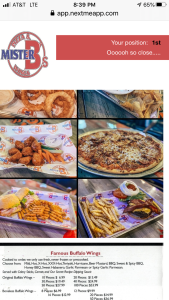
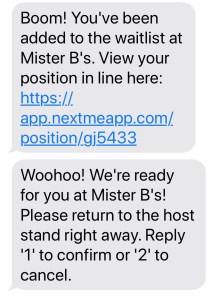
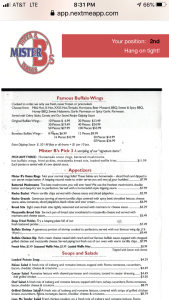 “Boom! Hang on tight! Oooooh so close! Woohoo! And… Go Enjoy your time!” were all descriptors I was receiving on my phone last night in Murray, Kentucky. We were at Mister B’s Pizza and Wings. Because of the need for physical distancing this great restaurant has an app that tells you where you are in the seating process. Once we gave them our number, a text was sent with a link to our personalized app. It gives you how many parties are ahead of you and an approximate time for seating. Genius, right? It also gave us the menu so we could be thinking about that.
I loved the descriptors along the way:
- Boom! Let me know we were in the system and to click on the app
- Hang On Tight! Meant we had one party ahead of us.
- Ooh So Close! Meant we were next.
- Woohoo! Was our text telling us they were ready for us.
- Go Enjoy Your Time! The app’s message telling us they were ready to seat us.
 Now, I know some of you are saying, “Big deal, Byron! Other restaurants do that too.” I get it. Others use QR codes to go to their menu, but I just thought the descriptors and the design of the app was cool. It may have also been the fact that we were eating at my son’s favorite go to place (data shows he can eat 15 Mister B’s famous buffalo wings in one minute – I guess there was a contest) in the home of Murray State University.
My point here really is just how far we’ve come during this, as of today, 155 day journey of the COVID-19 Global Pandemic. Business have adapted and created new ways, including our experience I described above, to enhance the customer experience; while at the same time doing their best to keep us safe. Those of us in the education world are constantly navigated the fluidity of school no longer being a place. And, individuals and families are making adjustments we never dreamed of.
I believe we need to take a moment and acknowledge and appreciate some of the great things that have been done during these 155 days, such as:
- Telephone befriending services to keep communities together
- Supermarkets, banks, and other businesses offering “elderly/senior only” times for shopping.
- We’ve become comfortable having virtual gatherings where we can come together globally without the expense and fuss of travel (I had the opportunity to spend and hour and a half with neighbors from 42 different countries, recently). We wouldn’t have even thought of that a few years ago.
- Finally, leaders are realizing working remotely can be effective. Let’s face it, big egos are the only reason for fancy buildings, offices, and “places” to work in many cases.
- Our abilities to provide professional development have improved greatly – the way we time them out, delivery, access to more people, et cetera.
- Creative money raising events
- Creative virtual concerts with some of our favorite artists. Some great artists, like Mark Tremonti, send out regular clips of personal recorded music with a message. In some ways we can feel closer to these artists than ever before.
- A chance to break routine and restructure our lives. We’ve gotten back to do some of the things we want to do, but never had the time to.
- We have learned to access culture without having to travel.
- Demand has made the internet providers make improvements; along with all technology providers.
- Educators have been allowed to be, and have risen to the challenge I might add, creative.
 I know we all want the Pandemic to be over, but I believe we need to take a moment and celebrate the accomplishments from around the world. This has given us a chance to grow and improve in so many ways as a global community. Let’s not ever fully go back to the way it was 155 days ago – let’s keep the improvement momentum going and strengthen our community. Let’s keep asking, “What can we create together?” Perhaps the biggest positive emerging from this crisis, though, is the realization that we humans are capable of global, collective action. If the stakes are high enough, we can take on these challenges together and, most importantly of all, rapidly abandon business as usual. I would love to hear about other positives you believe should be added to the list.
Big Momentum
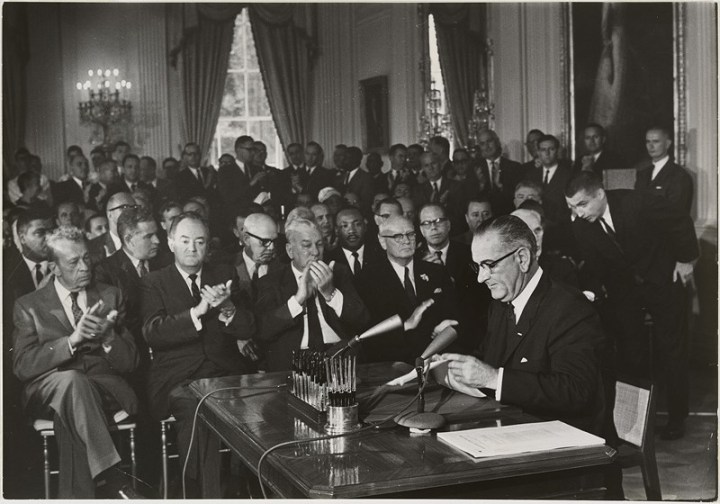
Lyndon B. Johnson – President Signs Civil Rights Bill/George Tames/1964/ National Portrait Gallery, Smithsonian Institution/Gift of Frances O. Tames/© George Tames; The New York Times
Successful sports teams in the 1960s were said to have “The Big Mo” on their side. The term refers to momentum. Since then it has come to describe lots of things, including politics, business, schools, et cetera. When we have momentum, we don’t worry about small problems, and larger problems seem to work themselves out.
 It is said, “Momentum is truly a cruel mistress. She always seeks out inertia.” Robert Caro made reference to this in The Passage of Power, in reference to the first days, weeks, and months of the Johnson Presidency. Johnson was masterful in making use of the momentum that was gained when he first took office. He was particularly effective using momentum as a lever as it related to get the civil rights and tax cut bills of 1964 passed. The momentum that occurs when something new is starting is awesome. Caro did not talk about it in the book, but I believe that momentum changed people’s perspective of President Johnson, and they forgot about mistakes and looked past his shortcomings. We need to consider that momentum probably makes us look better than we are.
When we have big momentum the purpose and goals are clear. The expedition is going smoothly and this makes it easier to enthusiastically complete initiatives. When you have no momentum, the simplest tasks seem impossible, morale becomes low, and the future appears dark. On the other hand, when you have momentum, the future looks bright, obstacles appear small, and employee engagement is high.
As leaders it is our responsibility to create momentum. Momentum begins with each of us. If we are not focused on our own or organization’s vision, working to motivate our stakeholders, and maintaining the right attitude, we are limiting our organization’s potential.
.


1 comment