Our Origins, Legends, & Heroes
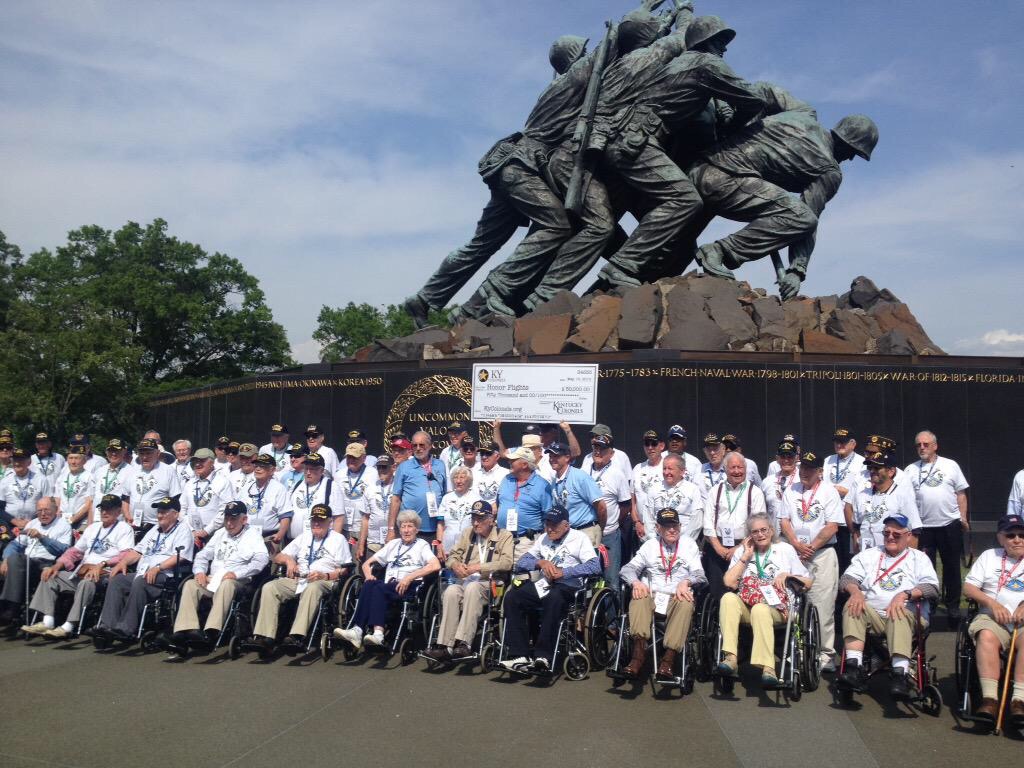
2015 Kentucky Colonel Honor Flight
“Not to know what happened before we were born is to remain perpetually a child. For what is the worth of a human life unless it is woven into the life of our ancestors by the records of history.” ~ Cicero
People living in democratic republics should know not only of its origins but also of the imperfect democratic struggle it spawned. Such appreciation might alleviate the taking of one’s way of life for granted. Americans understand the embodiment of heroic virtue in everyday life, for legends runs deep in American history.
Yesterday I had the privilege of serving our Veterans as a Guardian for our Honorable Order of Kentucky Colonels Honor Flight to Washington DC. This was a very emotional experience and I still, 24 hours later, hardly have the words to describe or reflect on the day. As a Kentucky Colonel, this was something I really wanted to do, but did not know what to expect. Well, let me tell you, it exceeded my expectations. This opportunity to serve provided the best lessons in selflessness and servant leadership one could receive anywhere. The Veterans taking part in the Honor Flight, all of whom were Kentucky Colonels, were transformers in life; they thought not of themselves but of a higher cause – America and global freedom.
“Kentucky Colonels are unwavering in devotion to faith, family, fellowman and country. Passionate about being compassionate. Proud, yet humble. Leaders who are not ashamed to follow. Gentle but strong in will and commitment. The Honorable Order of Kentucky Colonels, as a Brotherhood, reaches out to care for our children, support those in need and preserve our rich heritage.” ~ The Honorable Order of Kentucky Colonels Credo

Water Cannon Salute
Everywhere we went the Veterans were met with mobs of crowds cheering and thanking them for their service. There was even a “Water Cannon” salute at Reagan International Airport for our plane as we landed in Washington D.C. As I watched in amazement, these heroes practiced our Kentucky Colonels Credo of being, “Proud, yet humble.” These Veterans were truly touched by the outpouring of support and cries of, “Thank you for your service!” For me it was the first time of truly being in a role of 100% servant leader. Because I am not a Veteran, I did not matter to anyone yesterday, and should not have. This was incredibly satisfying and humbling. The entire day was about serving the Veterans as a group and the Veteran I was responsible for as a Guardian, Jerry McCandless (more about him later). I have always prided myself in walking the talk as a servant leader, but this provided the opportunity to be 100% servant. I have to tell you, I am a changed man.
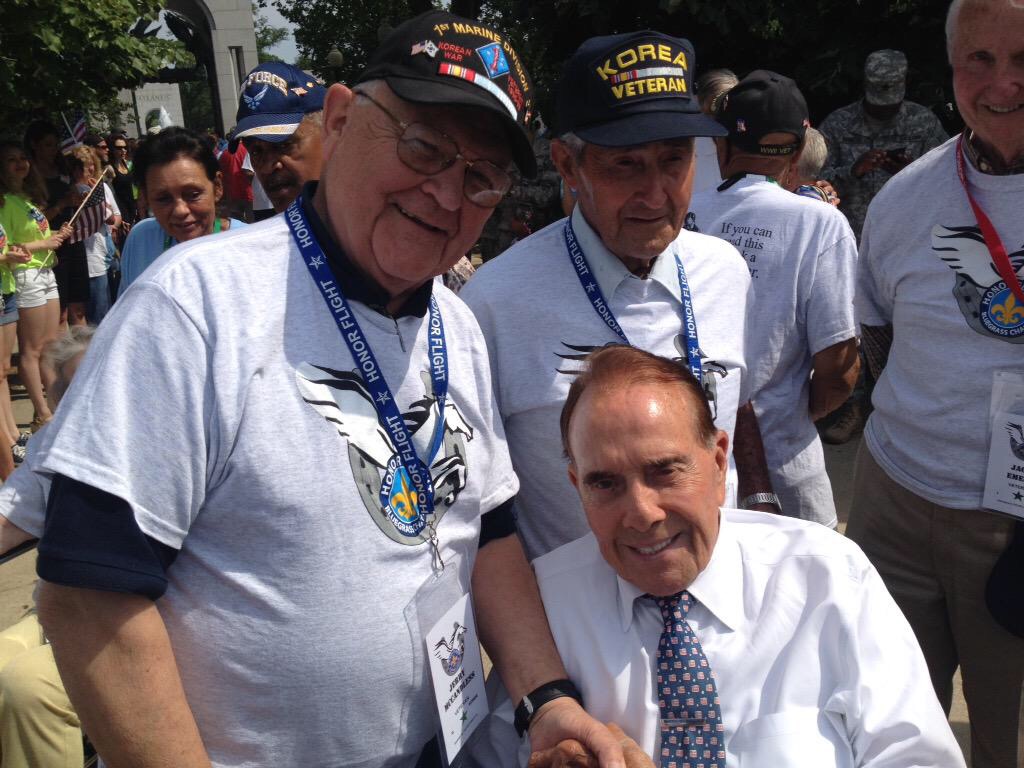
Jerry McCandless With Former US Senator Bob Dole
Amazingly, after returning to the bus someone asked me if I had my picture taken with former U.S. Senator Bob Dole. He comes out and personally greets Veterans from the Honor Flights at the World War II Memorial. Honestly, I had not even thought of getting a picture of me with him. In fact, I don’t even care to have a picture of me with him. I am, however, very proud of the picture I took of Jerry with Bob Dole. Remember, as a servant, I was to have no wants or needs on this trip – and I’m still amazed I had none, except for our Veterans to have the greatest day of their lives. As I said before, this experience really changes you and gives you the chance to fully understand what it means to be a servant leader.
These Honor Flight participants are heroes and legends. Legends serve two purposes: they provide a shared cultural experience for a people, and they symbolize the aims and ideals of that people’s common history, religion, culture, or institutional authority. As a legend, Lucius Quinctius Cincinnatus is a great example. Having stirred the passions of Republican Rome, later citizens of the Roman Empire and eighteenth century America, and men and women of contemporary times, he has been revered throughout history. His life is one of legendary accomplishment and character. Not merely legendary, Cincinnatus is also heroic. While fellow ancient warrior Alexander the Great or fellow Roman leader Julius Caesar are legendary, they do not impart the timeless moral lessons of a hero.
The hero sacrifices himself for something—that’s the morality of it. He gives his life to something larger than himself. In further contrast, the hero symbolizes our ability to control the irrational savage within us, whereas the leader may exploit the savage to gain his ends. One of the many distinctions between the celebrity and the hero…is that one lives only for self while the other acts to redeem society.” ~ Joseph Campbell
George Washington, one of our American heroes, like Cincinnatus, was a man of great accomplishment, but character, not achievement or genius, is also his most honored legacy. Character sets them apart from others. Children in schools all over Italy still recite the Cincinnatus story in the same way children of the United States learn of George Washington and the “cherry tree.” Another great American hero, Patrick Henry asked repeatedly of the role of the citizen in a Republic. He sought much more than a far removed vote in regularly scheduled elections.
Having met the living legend, a British soldier penned the following observations of Washington’s quest to live as Cincinnatus:
“Altogether he made a most noble, respectable appearance, and I really think him the first man in the world. After having had the management and care of the whole Continental army, he has now retired without receiving any pay for his trouble. he knows how to prefer solid happiness in his retirement. I admire him as superior to even the Roman heroes themselves. I am told during the war he was never seen to smile. he had only the good of his country at heart. his greatest pride now is, to be thought the first farmer in America. He is quite a Cincinnatus, and often works with his men himself—— strips off his coat and labors like a common man .”
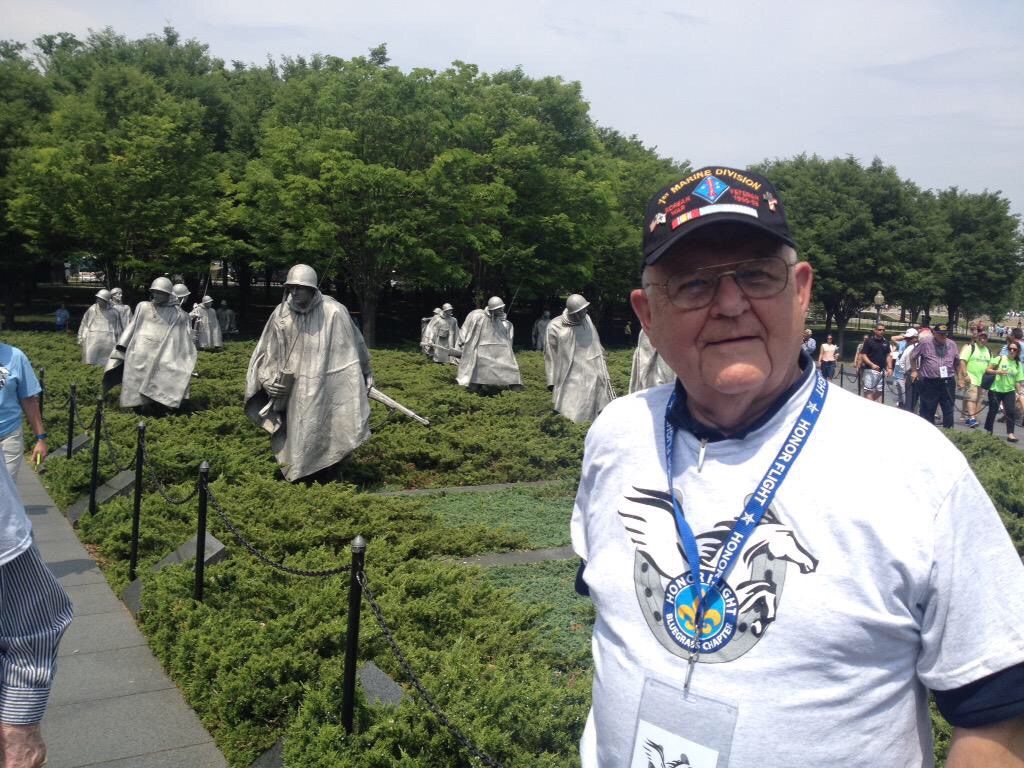
Jerry McCandless At The Korean War Memorial
This was exactly the kind of person I found in the Veterans we served for our Honor Flight. I promised I would tell you about Jerry McCandless. Jerry and I both, as Christians, believe God hand picked us to be together on this flight – God does do that you know! Jerry is a Korean War Veteran and lives on a farm. That agrarian connection got us started on the right foot. I learned so much from Jerry during our whirlwind tour of Washington D.C. I particularly loved watching him interact with young people. He brought history and a sense of patriotism alive and real for all those around him. Jerry truly is a hero who embodies the selflessness and character of George Washington and Cincinnatus. I also still get chills thinking of him telling the story of how, while on active duty in the Marine Corps, he donated $2.00 to the Marine Corps War (Iwo Jima) Memorial. He is very proud to have played a part in our country having that memorial and I believe he should be. There really are heroes who live up to the legends of countries founding heroes and we had the opportunity and honor to serve them yesterday. I would encourage you to seek out opportunities to serve our nation’s heroes!
Reference
Hilliard, M.J. (2001). Cincinnatus and the citizen-servant ideal. Xlibris Corporation.
Turmoil In Education: No One Right Way To Learn

Korean War Veteran Jerry McCandless Teaching Students From Michigan
Yesterday I had one of the most incredible experiences of my life. On Armed Services Day (May 16) I had the opportunity to serve our Veterans as a Guardian for our Honor Flight sponsored by The Honorable Order of Kentucky Colonels. Once I get sorted through all of my emotions from that experience I will write a post, but for today I am going to use the Veterans as the heroes of a post on education reform. The quote above was actually said by one of the students in the picture. The Veteran, my new friend and hero, Jerry (in the picture), did an incredible job of bringing history alive for these students from Michigan. I have to say he brought it alive for me, too! As a believer and researcher of real world context in education this really drove home the fact that students need to be able to make the connection of what they are learning to their real world context. In fact, it has really got my wheels turning as to how we might, more intentionally, on our Honor Flights connect students with our Veterans. What an untapped wealth of wisdom and knowledge for the students we serve.
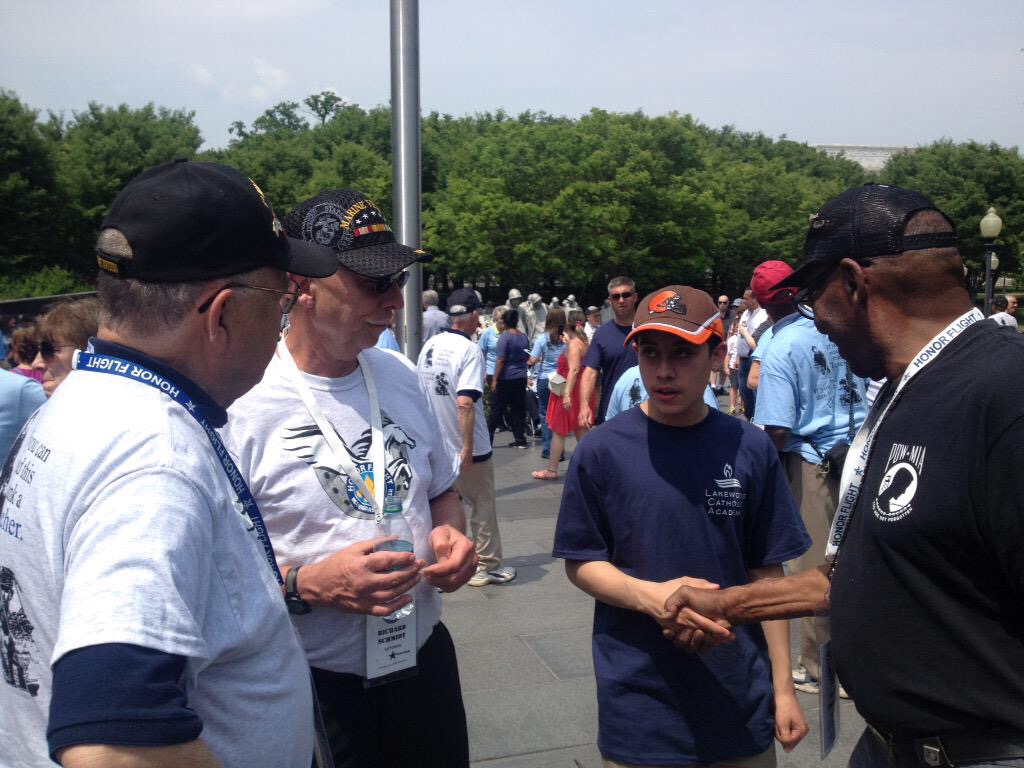
Veterans Jerry McCandless & Richard Schmidt Bringing History Alive For A Student
It was so ironic that this week’s lesson in Marciariello’s (2014) A Year With Peter Drucker was on education. Also, it is ironic that as I type this this post I am sitting in the airport waiting to board a plane for New Orleans for the American Federation for Children’s National Education Policy Summit where I am speaking on a panel on school choice and education reform. Drucker called for a systematic innovation in our schools (Maciariello, 2014). Drucker believed the heart of remediation was a “focus on strength.” He also believed we must stop “treating by patching.”
“Perhaps the time has come for an entrepreneur to start schools based on what we know about learning, rather than the old wives tales about it that have been handed down through the the ages.” ~ Peter Drucker
In September 2012 the Intelligence Unit of “The Economist“ had the United States ranked 17th out 39 countries plus Hong Kong, who was ranked third in Education Attainment, in Cognitive Skills (reading , math, and science) and Education Attainment (literacy and graduation). Bottom line: we have some work to do. “Literacy” traditionally means subject knowledge. In a knowledge society, however, people have to learn how to learn (Maciariello, 2014). The knowledge society also requires lifelong learning. For this we need a discipline of learning. We must also remember that reading is the basic skill needed for lifelong learning.
 Make sure we are aware that learning, to be most effective, should be individualized – otherwise it can be torture!
We must start with the question, “How does each of our students learn most effectively?” Then, and only then, can an individualized plan for lifelong learning be developed. The goal of teaching should be to find the student’s strengths and then focus them on achievement. Students have different patterns of learning – teachers must unlock these patterns. We need to lead our students to great achievement. We need to create a real world connection, excitement, and motivation just as our Veterans did for students yesterday in Washington D.C. This relevancy of context will go a long way in creating intrinsic motivation for the rigorous, disciplined, persistent work, and practice that learning requires. Education is a mentoring process.
Most schools and colleges are organized on the assumption that there is only one right way to learn. If we are going to be successful in truly reforming education we must differentiate the choices students have for schools. I believe in school choice, but we must actually have choices for our families, and then help them make those choices. If all schools are using exactly the same cookie cutter approach, is it really school choice? Another question to ponder in closing, “How do we create more opportunities for our students to glean from the incredible wisdom of our Veterans like Jerry McCandless and Richard Schmidt?
Reference
Maciariello, J. A. (2014). A year with Peter Drucker: 52 weeks of coaching for leadership effectiveness. New York, NY: HarperCollins Publishers.
Meaningful Measurement
 This week’s lesson from Peter Drucker started with a story from when Ronald Reagan gave a campaign appearance at Claremont College. He was telling about how different it was at the time in 1980, than when he went to college. When discussing all the entertainment and laborsaving devices and space exploration, he said: “My generation didn’t have these; we invented them. (Maciariello, 2014, p. 139).” Even today there will be fundamentally new concepts, new ways of seeing the world, new ways of relating as individuals, as organizations, and as countries that will need to be developed. This is why Peter Drucker believed that, even in 1992, we were in a “very dangerous, a very upsetting, and a very exciting period (Maciariello, 2014, p. 141).”
These upsetting, dangerous, and exciting times that Drucker refers to, and I still believe we are in, also leads to a great deal of uncertainty. Drucker talked about realizing that the things being measured for success are not meaningful anymore (Maciariello, 2014). This is where all industry and education are alike; we must have meaningful measurement of metrics that matter. This is exacerbated by the fact that we live in a “mixed mindset” society as opposed to a “growth mindset” society. We have such a fear of failure because have become so fixated on winners and losers as opposed to getting smarter. We need to use all our knowledge and insight from all sources, including the humanities, life sciences, physical sciences, economics, history, and social sciences to bring about effectiveness and results. According to Drucker (Maciariello, 2014), the knowledge society has contributed to income inequality and uncertainty (this whole idea of winners and losers).
 Education certainly is a prerequisite to competing and succeeding in our global economy today. This, in turn, creates exciting times for education. This is why I believe we must shift to a much more student-centered accountability that is framed on a growth mindset. In other words, we should weight student growth more heavily than proficiency. We should be measuring credits earned (as many students transfer from school to school already credit deficient), courses failed, attendance, and classroom engagement. We should also develop alternative accountability definitions that include mobility, date of enrollment, prior achievment, persistence and course failure. We should also include a growth measurement for high school students, which may require a pre-test in courses that have end-of-course assessements; although this is an additional assessment, a pre-test will provide actionable data that will lead to individualized instruction. I think you get the idea from this that I believe we must find out where the students are and then develop an action plan to get them there. This is very much a growth mindset approach to facilitating highly effective instruction and learning for the students we serve.
In closing, I would challenge you to take an introspective look at your organization, business, school, or governmental entity you lead and ask yourself, and your colleagues “Are we measuring the right things, do we have a growth versus fixed mindset, and how should we be measuring success?” Let me know your thoughts.
Reference
Maciariello, J. A. (2014). A year with Peter Drucker: 52 weeks of coaching for leadership effectiveness. New York, NY: HarperCollins Publishers.
New World Global Leadership
 “We know this much. The world is not going to be dominated by any one great power. For Americans that’s going to be a very difficult thing to accept. Most of us still see a world – the world of 1960 – in which America was the only great power, and the only functioning economy.” (Peter Drucker in Maciariello, 2014, p. 134) These were the words of Peter Drucker in 2004 and I think he was spot on. In fact, I believe we still don’t fully understand the new world we live in. Drucker also said, “So we Americans will have to learn that it is going to be a very different world in which different values must coexist (Maciariello, 2014, p. 134).” I really believe that sometimes we proceed as if the United States is the world, when in reality we are part of the world.
We are going to have to learn to be effective change agents of a global future. We will need to create our own future, rather than trying to predict the outcome of all these global forces (Maciariello, 2014). Whether the global demands become threats or opportunities will depend on our competence. The forces of a global society cannot be left to market forces or any one sovereign nation. Today’s lesson from Peter Drucker furthers my belief that leaders in education must make a commitment to moving global education forward. Engagement is the key to having teachers lead this movement in global education.
 Global education is not just about economics, it has to be about citizenship and global awareness. Therefore, kids need skills to navigate globally. Furthermore, kids need skills to navigate a shrinking world. The world is getting smaller and kids need the skills to navigate globally. Hanging world flags and doing multi-cultural days with different ethnic foods does NOT make students globally competent. We must begin to use the ABCs of global immersion: Academic Achievement, Bilingualism/Biliteracy, and Cultural Competance. We must create intentional/strategic curricula for global education and competancies, not just a few activities.
The skills and insights students can gain from interacting with people of different nations and cultures is critical as America engages more intensely with an increasingly global marketplace and interdependent world. As an educational leader, I must lead the charge to help the students I serve to have a high quality global education program. A great global education program is multi-faceted, fully job imbedded professional development for the teachers, and has transdisciplinary themes. Finally, I believe all students have the right to deep global competency! How will you help to develop a sense of urgency around global education?
Reference
Maciariello, J. A. (2014). A year with Peter Drucker: 52 weeks of coaching for leadership effectiveness. New York, NY: HarperCollins Publishers.


leave a comment