Leading Innovation in Education
 Being involved as a school leader of a network of schools offering fully virtual enrollment, as well as blended learning centers, I have experienced both the joys and challenges of being involved in innovation. Keep in mind online learning is very much still in the pioneer stage of development. Through this experience I have learned first hand the push back from individuals, organizations, and policymakers who will not even accept trying innovating in the space of online education and school choice. The same holds true for many other innovations in education as well. This makes it extremely hard at times to reach consensus for having education policy, accountability systems, and funding meet reality.
Some of the push back I refer to is well founded. When you think that we have been educating our children in much the same way for two centuries, it is natural for there to be some resistance to change. Interesting to me, however, is that an analysis of data from all the traditional means by which we deliver education to our children suggest we should be pushing back on some of those means as well. By their very nature, innovations are new and untested. Therefore, it is unreasonable to expect that all innovations become immediate success stories and be evidence-based. At the same time, the education field has a long history of promoting the latest fads and “flavors of the month” that turned out to be, at the least, ineffectual, and at the worst, have children falling further behind. I am certainly not suggesting we contribute to this unintended consequence either. Sometimes, though, I worry that we have not given some very effective and innovative ideas enough time to see if learning gains will be experienced.
In the world of education, innovation comes in many other forms than just the online world. There are innovations in the way education systems are organized and managed, exemplified by charter schools or turnaround academies being managed by education management organizations (EMO). There are innovations in instructional techniques or other delivery systems. We need ongoing innovation in the area of customizing learning for every student. This is very important in serving every student. There are innovations in the way teachers are recruited, prepared, and compensated. I have had the opportunity to work with Teach for America teachers and would put them up against any teacher preparation program. The training and disposition of these teachers to work with struggling urban students who are behind on both skill and grade level is outstanding.
We must continue to encourage creativity and innovation in addressing our most important challenges in education. I believe we need more opportunities for innovations to pass through a peer review process focused on the project’s design. This would provide an opportunity for vetting of the ability of the innovation to be brought to scale and be duplicated. Schools and other innovators of learning must place rigorous, experimental evaluation designs in place so that, over time, we can learn if practices are effective.
Additionally, we need to continue to think about how to accelerate innovation time and evaluation of the effectiveness of those innovations. I believe collaboration is the key here. Innovations are best designed when they are a direct result of a need in a specific school context. We need to make sure our teachers and staff have the necessary time and resources to reflect and be creative in developing customized solutions for the students he or she serve. Finally, we need to continue to develop robust networks for sharing innovations and best practices.
Big Opportunity Leadership
 On my flight home from Washington DC last night I had many things on my mind. One of which was the newly signed into law Every Student Succeeds Act, or ESSA as most people refer to it. ESSA was the reason I was in our Nation’s Capitol for the National Association of State Boards of Education (NASBE)Legislative Conference. We had the opportunity to work through what state boards’ role will be in the implementation of ESSA. I was reflecting on how much work there was to be done implementing this new and great bipartisan law that gives a great deal of power back to the states – Patrick Henry would be proud. Consensus has been reached to pass ESSA into law and now it is time for implementation. John Manning (2015) referred to this as execution in Lesson #40 of The Disciplined Leader. As I was reflecting, the pilot came on and said we had 327 miles left to Indianapolis. Because the Wright Brothers are my idols, I could not help but say a quick thank you to them for executing their plan for first flight. They took advantage of what John Kotter calls the “Big Opportunity.” Because of them, I am able to be home from Washington DC in a little over an hour. That is one big opportunity!
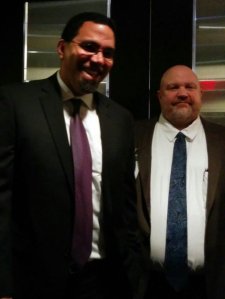
Secretary of Education John King & I
Manning (2015) discussed creating ownership in solutions. ESSA empowers many to take advantage of the big opportunities. I had the opportunity to be with our recently confirmed Secretary of Education John King, yesterday morning and we discussed the opportunities for state legislatures, state boards of education, schools, and many other stakeholders to work together for implementation of ESSA. This implementation really plays into John Kotter’s Dual Operating System approach to change. As we implement ESSA in Indiana I hope we will use the five premises from Kotter as our guide for taking advantage of the “Big Opportunity” – equity in education for all students. Secretary of Education King also left us with this very important thought, “Schools save lives!” Again, that is one big opportunity. These five guiding principles are:
- Having many change agents – by having state legislatures, state boards of education, state departments of education, and many other stakeholders involved in the collaborative implementation we should have innovation and creativity for coming up with the best practices for our students.
- Creating a “want to” not “have to” mindset – Now that the power has been placed in the state’s hands for implementation of ESSA, we must be excited and have a “get to” approach.
- Head and heart, not just head – This is easy when we are implementing law to serve our children.
- Leadership, not management – This is important for me as an Indiana State Board of Education member. I must do my part to provide the leadership to keep the strategy of ESSA implementation in tact.
- Many systems, one organization, lose the hierarchy – everyone must be a part of the “big opportunity.” Again, there must be collaboration from many different stakeholders.
 Manning (2015) taught us to “stay the course” and execute. What “big opportunities” do you have on the horizon for implementation?
The Vital Few of Leading My Team
 It is now time for my favorite activity that John Manning (2015) has readers do as part of reading the 52 lessons in The Disciplined Leader. The book is divided into three different parts and Manning (2015) instructs readers to pick their own three vital few from each part that he/she needs to work on. I really like that this is a part of the reading, as it provides a way to reflect on what has been learned in the reading and a chance to put the learning into my own real world context. In other words, the learning meets reality.
Click here to read my reflection and my vital three from Part I, The Responsibility To Lead Yourself. This post will be a reflection of Part II, The Responsibility To Lead Your Team. Part II included the following lessons:
- Choose the right words
- Put your game face on
- Be in the moment
- Focus on what is right, not who is right
- Don’t cross the line
- Treat everyone fairly
- Honor your commitments
- Don’t overuse the “I” word
- Surround yourself with great talent
- Hire who is right
- Empower employees
- Hold your team accountable
- Check up on daily goals
- Give effective performance feedback
- Spot opportunities to coach
- Demand more solutions
- Encourage disagreement
- Advocate for your team
- Recognize your employees
As you can see, Part II in The Disciplined Leader had some pretty heavy stuff. It took some studying and long reflecting to decide what my vital three would be. Since I had blogged about all 19 Part II topics, I also went back and studied all my posts. Here are my vital three:
- Empower employees
- Surround yourself with great talent
- Give effective performance feedback
Anyone who works with me or has spent very much time with me will probably not be surprised by these vital three. Empowerment and being surrounded with great talent is essential to the success of any organization. Performance feedback makes the top three because this is an initiative I just formed a task force of teachers to begin working on.
Empower Employees
This is a huge deal for me. I strive to create a “make it so” culture. Our team members are encouraged to be creative, innovative, and self starting. My desire is to have team members come to me with such great, thought out ideas that all I have to do is say, “Make it so!” What I have found is that the more I say “Make it so!” the more innovative and great ideas I get. This is such a powerful tool for employee engagement. We know that employees being engaged and and believing that what she is doing makes a difference is the number one item on the job satisfaction list.
Just last night we had the perfect example of this: A team of teachers presented our new vision, mission, and set of core values to our school board. This was a project of our Focused Leader Academy and our teachers worked through whole rewrite process as well organizing a board retreat session and other stakeholder feedback sessions. The beauty of the process is that the teachers owned it. And, one of the byproducts was the learning and professional growth that went along with the project. Therefore I would add to Manning’s (2015) on empowerment and say that with empowerment also comes professional growth. In fact, empowerment and professional growth are one of our core values:

Surround Yourself With Great Talent
This is so easily said and much tougher done. I am somewhat of a subscriber to the theory that talent is overrated. Skills must be developed. None of the great athletes, musicians, or artists were born with skills and talent at the top of their games. We all have had to be bad at something to get good and go on to be great. Therefore, surrounding ourselves with great talent also means we have the responsibility to help our team members grow and develop. I call this hyper-personalized professional development. This takes work. This takes a lot of work to imbed in cultures where this has not been a part before. It is, however, crucial for a culture of excellence.
This also relates to empowering our team members. If we want to empower our team members to make decisions and have autonomy to get the work done, then we must provide the hyper-personalized professional development necessary to help them become the great leaders they can be and have the necessary skills to do their jobs at the highest level. It would be ludicrous to empower employees to the level of a “make it so” culture without also provide the necessary knowledge to do the job. This would be the definition of chaos. Therefore, a vital part of my role as a disciplined leader is to go after top talent and then do everything possible to provide for the utmost personal professional growth.
Give Effective Performance Feedback
This vital part of being a disciplined leader is so related to my other vital three in this part of the book because at the core of performance feedback is professional growth. Our teacher performance evaluation process and tool that I inherited leave a lot to be desired. The reason for the deficiencies is how it was developed – top down. Basically, it was a “here it is” development process. There is pretty compelling research that suggests that affected by the performance feedback process should be heavily involved in the development. Leadership needs to come from those affected by it.
My goal for the task force I mention earlier is to come up with an evaluation process that is much more formative than punitive. There must be more regular check-in conversation and not just the once or twice per year evaluations. We are doing our teachers a disservice if all our principals do is check up on teachers once or twice a year. I am looking forward to seeing the work that our teachers do this.
Now that you have had the chance to learn about my vital few, what would you choose as your vital few?
Daily Huddles
 Lesson #32 in The Disciplined Leader by John Manning (2015) deals with accountability systems and checking up on goals daily. Accountability, regular check-ins are very important. Many organizations, my own school included, use dashboards to keep track of the important data that needs to be regularly monitored. Disciplined leaders are goal minded and this dashboard data needs to be linked to goals both for the organizations, teams and individuals. Besides the dashboard looks at data, Manning (2015) provides three really great ways to manage performance daily. I would like to illustrate these by providing examples of how we do these while doing our state testing for the school I lead. Keep in mind, we are a statewide school and test in 23 different locations – a monster! Here are the three practices:
- Implement flash reporting – We do this by keeping a spreadsheet that is updated by our site leads at each testing location. An important metric for us is test participation. By law, we need to hit at least 95% attendance for our Full Academic Year (FAY), those students who have/will be with us for 162 days, students. Our goal is 100% of our students to be tested. The spreadsheet shows the sites, FAY students, non-FAY students, attended vs. non-attended, and whether a make-up has been scheduled for non-tested students. This report goes out every evening to our team giving us a flash update as to how we are doing.
- Manage by walking around – I am sure you have all heard of this practice before, but I practice this during testing by picking three to four locations across the state to just show up and be an extra set of hands. This gives me a chance to visit with teachers, parents, and students and see how we are doing with our testing first hand.
- Implement “daily huddles” – This is my favorite practice during testing and the one I believe does the most good. Each night we have a daily huddle debrief call with our testing staff, site lead teachers, principals, and myself to debrief about the happenings of the day. This debrief includes a discussion on attendance, things that went well, and areas of concern/challenge/opportunity/problems. The thing I like most about these daily huddles is the fact that it allows us to implement lessons learned the very next day. Another very important component in these huddles is the time spent laughing and telling stories from the day. Most of the time these stories start with, “You can’t make this up.” This time spent telling stories laughing and having some humor really makes the stress of testing go much better and builds camaraderie among the staff. Never forget – humor is an important leadership tool!

I believe these are great tools/best practices for keeping track of important accountability data and goals. Hopefully, my examples from just one area in a very complex school are food for thought to apply to your leadership setting. Do you have other best practices you would like to share or experiences? Please share by replying to this post.
Managing Strategies for Engagement
This post is an excerpt from the book Authentic Conversations by James Showkeir and Maren Shokeir. This book is included in BKpedia, a new digital subscription service from Berrett-Koehler Publishers. Please visit bkpedia.bkconnection.com for graphics, tweets, and other resources.
Managing Strategies for Engagement
Engagement means being able to make meaningful decisions and to have the resources to act on those decisions.
The marketplace demands results now. Your customers want attention in this moment. The necessity for flexibility and speed in the face of change is paramount. The question is how to create an organization that can:
• Quickly create and apply new knowledge
• Grant exceptions and deliver unique responses
• Foster passion and accountability throughout the entire enterprise
For these significant changes to occur, three areas in the organization must be affected: (1) culture and management/governance practices, (2) architecture, which includes the ways jobs are designed and how people are grouped, and (3) the ways in which employees are rewarded. For all these changes to be planted and take root, new conversations are required.
Individuals must accept personal accountability for the success of the whole business and be responsible for their own motivation and morale. The culture must generate passion for the work and action in service of customers and good results. This requires less focus on personal ambition and a sincere commitment to the success of others.
Organizations have to create and sustain universal business literacy and adult-to-adult conversations, one person at a time. Management practices, such as budgeting, meetings, training, objective setting, performance reviews, and so on, must be recreated to encourage partnership. Dissent must be viewed as healthy. Through different conversations, knowledge and collaboration are baked into the work process, replacing compliance and control as the operating values.
Where to start? If the longest journey begins with a single step, it won’t surprise you that our advice is to begin by changing the conversations. Better conversations will reap rich, diverse information. They will encourage an examination of who plays key roles in improving business results. They will allow you to address difficult issues in a constructive way.
New conversations will champion the kind of learning and resourcefulness that lead to innovation, cost efficiency, and personal accountability—essential elements in addressing the complex problems of organizational renovation.
*****
James Showkeir and Maren Showkeir are principals of Henning-Showkeir & Associates, Inc., whose clients include 3M, Ford Motor Company, Kaiser Permanente, British Airways, Coca-Cola, Hewlett-Packard, Levi Strauss, the Greenleaf Center for Servant-Leadership, and the Nature Conservancy. Together they authored Authentic Conversations and Yoga Wisdom at Work. James passed away in August of 2015.
Reading You Like A Book
 Lesson #21 in The Disciplined Leader (2015) by John M. Manning is about how as leaders it is important for us to understand what kind of nonverbal communication cues we are sending. In reading this lesson I was reminded of the incredible book by Dr. Nick Morgan, Power Cues (2014). Power Cues reports new brain and behavioral science about how humans communicate, and the importance of authentic face-to-face interactions. Dr. Morgan goes into detail on the visual cues, subtle gestures, sounds and signals that elicit emotion. As Manning (2015) taught us, leaders who are not in tune with putting on the right game face on are not effective with their teams. Manning (2015) said, ‘Leaders tend to pay way more attention to their verbal communication than their nonverbal communication. Many leaders often aren’t aware of what their nonverbal habits are and how they regularly affect others (Kindle Locations 1216-1217).” Leaders who understand how to become more persuasive and how to communicate more effectively will create more influence in all dealings, and as we know, leadership is about influence.
“No one gets led anywhere they don’t want to go. Machiavelli was wrong; leadership is not manipulation, not in the long run. It’s alignment, the leader with the group and the group with the leader. But you first have to maximize and focus your leadership strengths in order to be ready when your moment comes.” ~ Dr. Nick Morgan
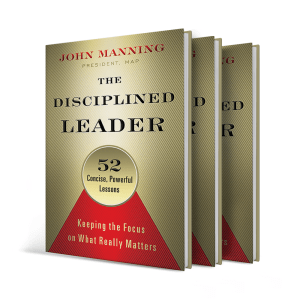

“What this means is that body language doesn’t lie and can make or break what and how well you communicate to others.” ~ John M. Manning
The first three Power Cues deal with non verbal communication (Morgan, 2014):
- The first power cue is all about self-awareness. How do you show up when you walk into a room?
- The second power cue involves taking charge of your nonverbal communications in order to project the persona you want to project— through your emotions. What emotions do you convey through your body language for important moments, conversations, meetings, and presentations?
- The third power cue helps you learn to read unconscious messages. What unconscious messages are you receiving from others?
So, as you can see it is important for us to think about the nonverbal cues we are sending, but it is also important for effective leaders to read the nonverbal signals of others. Morgan (2014) told us that body language always trumps the spoken content. He also taught us in Power Cues that most of the emotional colors and tones of conversation are set through gestures (Morgan, 2014). For those involved in education reading this, Morgan (2014) pointed out that researchers have studied how children learn and have determined that they learn nonverbally first.
The bottom line is we need to be very aware of what message we are sending in our gestures, eye contact, hands, arms, stance, and attentiveness. As Morgan (2014) pointed out, the nonverbal communications, such as gesture, happen in the brain ahead of the verbal (spoken) communication. These nonverbal signals send messages that speak to the whole person and influence our ability to build effective relationships with our teams, influence those individuals, and lead our organizations.
If you want to dig deeper I would recommend getting a copy and reading Power Cues (2014) by Dr. Nick Morgan. Combine that with reading Manning’s The Disciplined Leader (2015) and you are taking major leaps toward your professional growth and becoming an even more influential leader.
References
Manning, John (2015-06-15). The disciplined leader: Keeping the focus on what really matters. Berrett-Koehler Publishers. Kindle Edition.
Morgan, Nick (2014). Power cues: The subtle science of leading groups, persuading others, and maximizing your personal impact. Cambridge, MA: Harvard Business Review Press. Kindle Edition.
Teacher of the Year Learning Continues in 2015!
 Today was one of my favorite days of the year. As an Indiana Teacher of the Year, I was part of the selection committee for the 2015 Indiana Teacher of the Year. Today we held the interviews for the top 10 finalists. As always, I was inspired! Click here to see the listing of this year’s top 10. I am so inspired each year by how great these teachers are and come away refreshed and rejuvenated as a school leader. During the interview I take copious notes to inform our decision making at the end of the day, but also take personal notes that I use for my own professional growth. Last year I wrote a post entitled Teacher of the Year Learning and this year I thought I would do the same. For this year’s post I am going to provide you a bullet point list of all the comments, phrases, and learning that I jotted down today.
Here is the list:
- We must match teacher goals to individualized professional development
- What steps should be taken to reach the goals?
- Implementation plan
- Feedback needs to be provided regarding progress toward goals
- Purposefully select books for libraries that give a window to the world
- “One of the things that makes me, me is…”
- “I’m either going to fail forward, or being totally successful!”
- “I’m just as much a learner as they [students] are.”
- “I [teacher] lead sometimes, and they [students] lead sometimes.”
- We should be blogging our thoughts instead of just journal-ling
- Use formative assessments before even approaching summative assessments – this needs to be balanced
- Diversity is not always visible
- Teacher effectiveness starts at the local school – the school must have a process that supports growing highly effective teachers and teacher leaders
- The community drives instruction
- Share the gifts that you have
- Read the book: 7 Habits of Happy Kids
- Read the book: Mindsets in the Classroom
- “Clustering” – bringing in students who aren’t quite ready for the High Ability program, but are close and need extra attention to get them there
- We need to make students feel welcome and loved
- We need to be writing from different points of view and exposing students to writing from different points of view
- Twice Exceptional Students – high ability students who also have learning disabilities
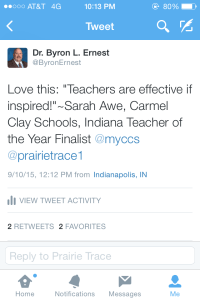
- “Teachers are effective if inspired” (my favorite quote of the day – I tweeted it)
- “Let me make a theme out of all of this”
- Blogging our journey
- If you cannot adapt to changes you will not be successful
- “Subject matter is important, but one to one contact and relationships are most important. Remember, what you are teaching today may not be the most important thing happening in a particular student’s life today”
- Ask your students: “What am I doing that is irrelevant?”
- You can’t put everyone in a box, you must individualize the instruction
- Find the students’ strengths and weaknesses
- “I evaluate myself every day”
- “Shine On”
- “Make kids first and everything else second”
- “Immediate feedback should be innate in everything we do”
- We need to love all the different experiences students bring to our classrooms
- Teacher effectiveness measures – ask the kids
- We need our students to do “authentic reading”
- We must be immersed in what matters
- We must create an environment where we have an investment in each other – this will build a true TEAM
- As a coach/mentor – the goal should be to work yourself out of a job
- We should have less required collaboration and more spontaneous/unstructured collaboration
- Poverty is the biggest issue facing education today
- Choice based classrooms –
Give students the opportunity to explore what they are interested in. Help them ask powerful questions. Give them time to explore. Students should be able to share what they have learned in a compelling way.” ~ George Couros
- We need to bookend creative lessons
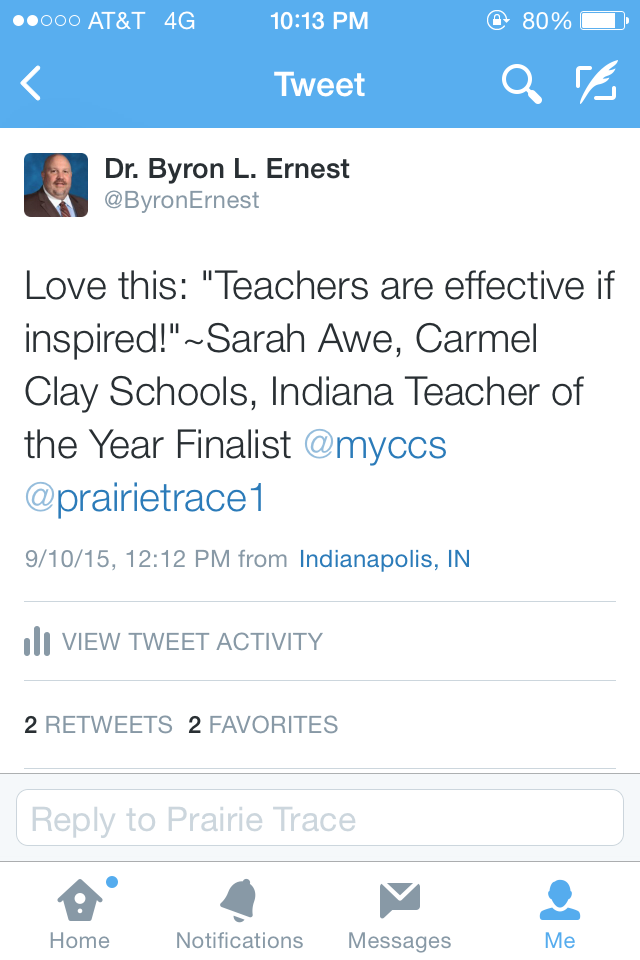
Need I say more? Again, congratulations to this year’s Indiana Teacher of the Year finalists and thanks for inspiring me today!
I think my tweet at the end of the interviews says it all:
Got Mission?
 I am a little behind in entering my weekly posts on the weekly lessons in A Year With Peter Drucker: 52 Weeks of Coaching for Leadership Effectiveness (Maciariello, 2014). This week’s entry was about developing mission statements for organizations. A good mission statement is short and focuses the attention of each member of the organization on how his or her activities fit into the overall mission of the organization. The statement tells each member what the organization is about and what it intends to do. This supports the very important concept of strategic planning as well, that every member of the organization must know his or her role in carrying out the action plan of the organization.
To that end the objective is for every person in the organization to have clear cut implications for the work they are performing. Two essential questions that Maciariello (2014) posed were: “Does your mission statement contain platitudes or is it action oriented?” and, “If adhered to will it help to fulfill your organization’s purpose?” (Maciariello, 2014, p. 270) 
I would offer up the mission statement of our recently formed Focused Leader Academy. I blogged about this in Building the Bench! Our mission for this program is: Leadership needs to appear anywhere and anytime it is needed. That is about as action oriented as you can get. Additionally, if adhered to, having empowered teacher leaders will help us to fulfill our school’s overall mission. The key is to have a mission that is widely accepted and is operational.
Reference
Maciariello, J. A. (2014). A year with Peter Drucker: 52 weeks of coaching for leadership effectiveness. New York, NY: HarperCollins Publishers.
Civilized Disdain Vs. Political Correctness

“The difference between civilized disdain and political correctness is that the former allows one to feel disdain for a person’s or group’s views or beliefs while maintaining respect for the human beings that hold them.” ~ Carlo Strenger
Happy Fourth of July to you all! By 5:00 a.m. this morning my son and I will be on Lake Michigan fishing on the DreamWeaver III; a 35 foot Viking. We are in the Scottville/Ludington, Michigan area visiting our good friend Kevin Eikenberry and his family for their annual Fourth of July party. As I reflect on this important day in our nation’s history, our forefathers did not set us up for success by practicing political correctness. They were successful by having very heated ideological debate, reaching consensus, and then implementing. Indiana House Speaker, Brian Bosma reminded me of this when I asked him what success on the State Board of Education would look like. He said, “It’s all about working together to find consensus and then carrying out implementation.”
I have been reading the great book by Carlo Strenger, The Fear of Insignificance: Searching for Meaning in the Twenty-First Century. Strenger argued the ideology of political correctness failed because it was a “profoundly inauthentic prescription: it is humanly impossible to genuinely respect beliefs no matter how irrational, immoral, or absurd (Strenger, 2011).” The resulting culture was emotionally frozen and often did not lead to fruitful discussion between worldviews in general, and between secularism and religion in particular. The ideology of political correctness stated that the only civilized way of coexistence was to respect other peoples’ beliefs, just because they are held by someone. The hope behind this ideology was that if we would just be nice and respectful to each other, we would somehow be able to coexist in the same polity.
The resulting culture of us all wanting to be “politically correct” led to us being emotionally frozen and often did not lead to fruitful discussion between worldviews in general, and between secularism and religion in particular. Strenger advocated for “civilized disdain, an alternative to political correctness that is more authentic and more attuned to what we really feel toward worldviews that we do not approve of on moral or intellectual grounds. (Strenger, 2011).” The difference between civilized disdain and political correctness is that the former allows one to feel disdain for a person’s or group’s views or beliefs while maintaining respect for the human beings that hold them. I am so glad I read Strenger’s book. Interestingly, I do not have all of the same beliefs, but I do believe we could consensus build and problem- solve together. Also, I do appreciate his look at the world and our interactions as a global society, or homo globalis, as he calls it.
 “Civilized disdain has turned out to be surprisingly productive in creating human bonds of lasting value. The mental discipline required for civilized disdain may be crucial for the type of world citizenship that will allow fruitful cooperation across ideological divides.” ~ Carlo Strenger
As I was studying this I was thinking about the signers of the Declaration of Independence and those who ultimately became the framers and founders of this great country, I love and call home. Shortly after the American revolution our founding fathers completed the Articles of Confederation. They then realized that the documents were inadequate to the task of unifying a diverse group of newly independent colonies. A debate thus ensued, between the Federalist side, led by Alexander Hamilton and James Madison, and the AntiFederalists, led by Thomas Jefferson and Patrick Henry, over exactly how much power and authority to give Congress and the other central branches of the new government. Hamilton argued that a strong central government would be essential to the nation’s survival and prosperity, while his opponents insisted that most of the nation’s power should rest within the state and local governments. By 1787, a sort of compromise was worked out that resulted in our Constitution and its first set of amendments, the Bill of Rights. I have said this before and will say it again: I am glad there was the disagreement and debate over state’s rights. I firmly believe that had there not been the federalist and antifederalist debate, there would not have been the quality final product – our Constituion and Bill of Rights.
So, on this day of celebration of the United States Declaration of Independence, let us consider civilized disdain, where we allow each other to feel disdain for a person’s or group’s views or beliefs while maintaining respect for the human beings that hold them. Then, we need to take those difference and through compromise and consensus-building form them into a “best” solution. Finally, and most importantly, we must then implement.
Happy Fourth of July and God Bless America.
Reference
Strenger, C. (2011). The fear of insignificance: Searching for meaning in the twenty-first century. New York, NY: St. Martin’s Press, LLC.
Improving STEM Education: Connecting School Work to Real Life
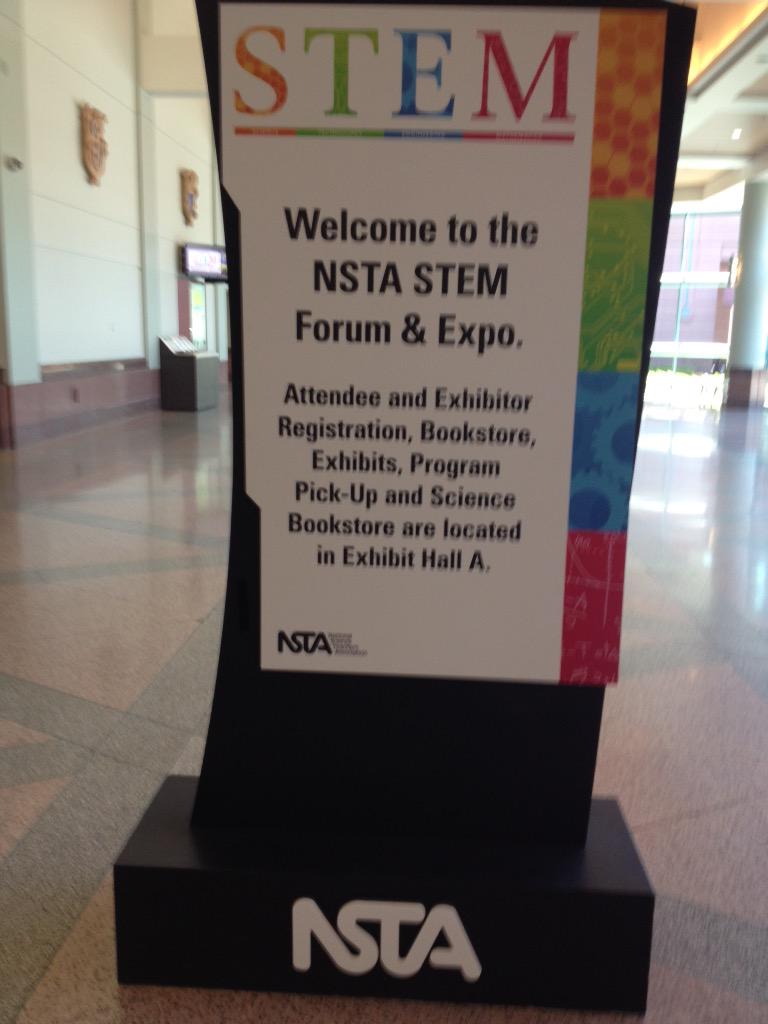 I had the tremendous honor of presenting at the International STEM Forum & Expo yesterday put on by the National Science Teachers Association (NSTA). What an incredible event. It was well-planned, and the sessions were, well, incredible. It was a great reminder to me, now that I am not in the classroom as a teacher, just how important STEM education is to our children. It was also a reminder of how tough a job it is to keep our children motivated in STEM courses and then, ultimately, through higher education if that is what the student chooses. The attendees of the National STEM Forum were reminded of this when Dr. Freeman Hrabowski, President of The University of Maryland, Baltimore County, spoke. He told us that high SAT scores correlated with students who had taken AP & Honors courses, but then ended up being the same students who dropped out or changed majors from STEM related degrees in college. Why? Because of a “fixed mindset” instead of a “growth mindset.” Dr. Hrabowski sited the work of Carol Dweck, author of Mindset: The New Psychology of Success (everyone needs to read this and all of her books). These students are so driven for success and making the top scores that when they get to college they are often disappointed by not being “#1.” Many are still top students, but can’t handle not being the top. Then, as Dr. Hrabowski pointed out, they switch to the humanities. Why? Because the humanities gets the iterative nature of the “growth mindset.” The idea that nothing needs to be perfect on the first try. In STEM courses, we tend to want to give a grade on the first, and only try. As a big believer in mastery grading, I wanted to go up and hug Dr. Hrabowski. He was talking my language!
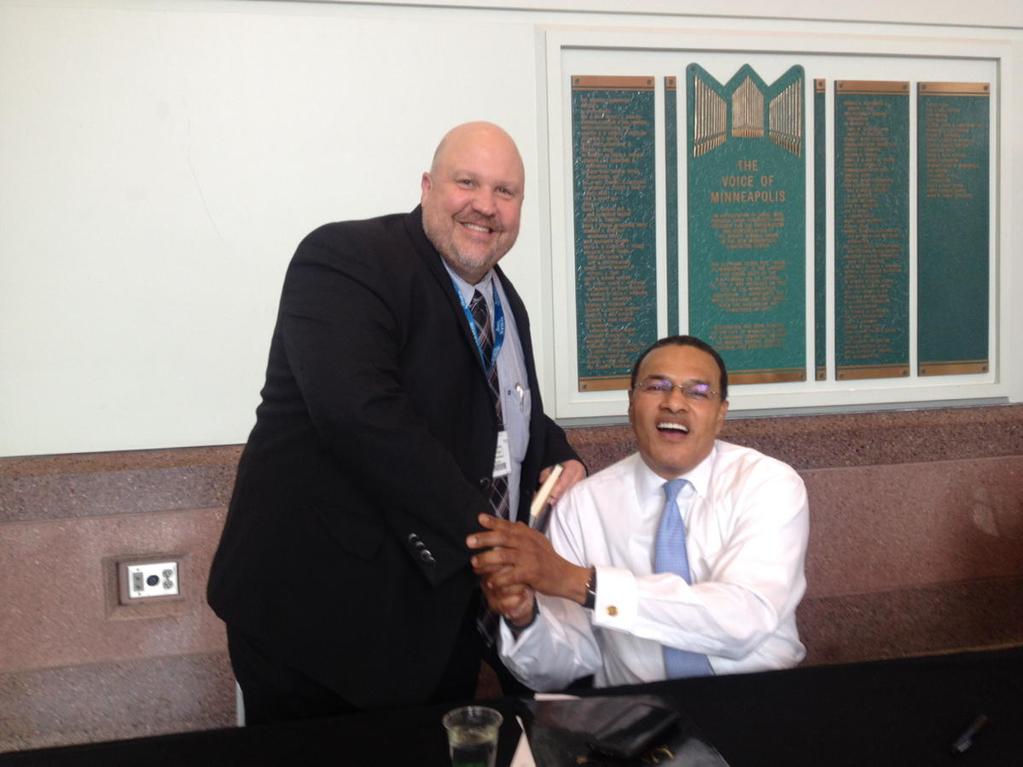
Me Hanging With My Friend, Dr. Freeman Hrabowski
It is curious to me that we have this “fixed mindset” in STEM education, because careers in STEM are not that way at all. Think about all the trial and error, experimentation, and “ah ha!” moments there are. Thus, why what Dr. Hrabowski was saying really reinforced what I had just spoke about prior to his keynote. My presentation title was: “Improving Science Education: Connecting School Work to Real Life.” The presentation was all about teaching in a real world context. I stressed that we must connect the three worlds that a student lives in: school world, real world, virtual world. The presentation was based on research I did based on student academic performance and achievement in Biology based on being taught in the real world relevancy of Agriculture. If students do not make the connection between the school work they are doing and real life, they will fall into the “fixed mindset” trap.”
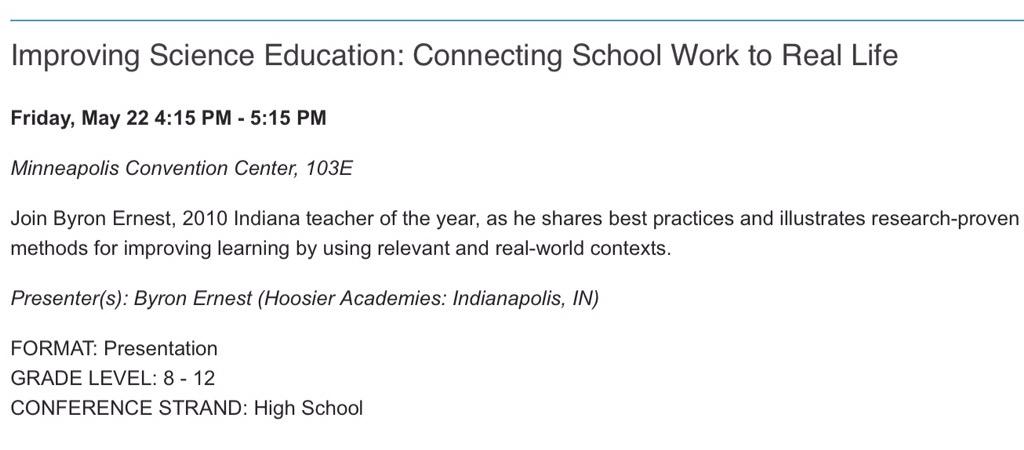
I discussed with attendees how we had partnered with AgReliant Genetics when I was teaching at Lebanon High School to provide opportunities for our students to do real world/real time research. The students were able to do this working with real researchers. This working with adults component is so very important in my opinion. To create the ideal learning environment we must have Students working in teams to experience and explore relevant, real-world problems, questions, issues, and challenges; then creating presentations and products to share what they have learned. Here is a link to my presentation:
Ernest_NSTA_RealAgSTEM_Final_2015
So, as we continue to facilitate learning for our STEM students, and all students, let’s not forget to practice a “growth mindset” and make the connection between school work and real life.


leave a comment