Do You Know What Your Guns Can Do? Or Can’t?

Heath Ernest, 4/21/12
This past weekend my son, Heath, harvested his third turkey in a row on Youth Spring Turkey Hunt weekend. Two years ago when he shot his first turkey I posted Talkin’ Turkey About Coaching (click here to read entire post). I was reminded again this year how important knowing what you can do and what you can’t are. Let’s use Heath’s gun for this analogy.
Heath hunts turkeys with a Remington 870 Youth 20 gauge shotgun. The preferred gun for hunting turkeys would be a 12 gauge in order to have more distance, but the youth guns do not come in a 12 gauge. Therefore, we know that Heath has distance limitations – what he can’t do. We also have taken the time to practice with many different combinations of ammunition and chokes (the part of the gun that controls the patter) – what he can do.
Heath knows that when a turkey is 23 yards or closer he can be successful. At 23 1/2 yards his gun does not have a pattern left to harvest a turkey. He knows all of the capabilities of his gun because of practicing and actionable feedback. He harvested his turkey on the 57th shell of the season. In other words he had taken 56 shots at targets prior to harvesting his turkey.  Because of the feedback from the targets and shots taken at different distances, Heath knows exactly how to adjust to any situation.
It is also important to note that from the time we first saw his big Tom it took 2 hours and 34 minutes to get him into acceptable range. There were a few times when he got close only to move back, well out of range. It took the guesswork out of decision making for Heath and I gave him distances from our rangefinder. He knew exactly what he and his gun could do and waited patiently for the turkey to be at the correct distance.
Let’s relate this to business and education. It is so important that we know what our guns (people) can accomplish and what they can’t, areas for improvement, and reflection on how to accomplish the mission and vision. This feedback and reflection provides insight about the skills and behaviors desired in the organization to accomplish the mission, vision, and goals and live the values. The feedback is firmly planted in behaviors needed to exceed the organization’s expectations.
Just as Heath practiced with 56 shots prior to the one used to harvest his turkey, feedback is to assist each individual to understand his or her strengths and weaknesses, and to contribute insights into aspects of his or her work needing professional development. This is also why I am such a huge proponent of IC 20-28-11.5, a new law passed in the spring of 2011 relating to the evaluation of all certified teaching staff and administrators. Without effective evaluation systems, we can’t identify and retain excellent teachers, provide useful feedback and support to help teachers improve, or intervene when teachers consistently perform poorly.
This timely, actionable feedback is crucial for any organization to know what your guns can do or can’t!
Pelican Leadership Lessons

Brown Pelican who became our fishing friend as my son and I were cleaning fish!
I just returned from our annual spring break trip to Destin, Florida. We literally live on the beach for eight days. One of my favorite things about beach life are the Brown Pelicans. Every year I am amazed by these majestic birds and the lessons we can learn from them.
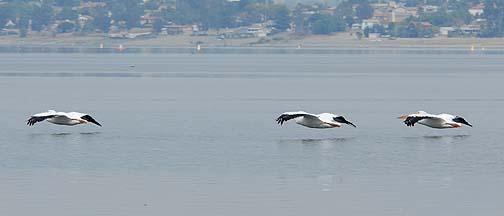 The most amazing thing they do is fly in cooperative “u” and “v” shaped groups. They do this to drive the fish to shallow water. Many times they will beat their wings on the surface of the water to drive the fish. So, like many species they collaborate to catch their food. We can learn from the Brown Pelican that without collaboration, the group/team does not succeed.
It is also amazing to watch these birds fly in a straight line. It is really cool to watch them fly right over the surface of the water. The lead bird will go up and down with the ebb and flow of the waves just above the surface. All the other birds follow in a perfect rhythmic wave. We as leaders need to also make this smooth adjustment to the ebb and flow of our daily happenings. 
Additionally, Pelicans fly in a “V” pattern. Flying this way reduces drag and saves energy (actually up to 20%). Don’t you think collaborating saves 20% of our energy as well? Even more interesting is the fact that the lead bird in the “V” has to work the hardest by breaking through the air where there is the most resistance. Sound familiar? But wait, the Pelicans have figured out this leadership challenge as well. The lead bird does not stay at the point of the “V” for very long. It drops back to let another bird lead so it can rest and have leadership renewal.
This is a very smooth transition that happens in flight. In other words, biological stress necessitates this constant transition. More importantly, every Pelican in the “V” can lead. Can you say that about everyone in your organization? Does everyone have the opportunity or feel the need to lead?
Think about it. For us, biological stress also dictates we need to rest and be renewed. Also, collaborative organizations are healthier when the hierarchies are flattened and leadership is distributed.
I am particularly excited that in Indiana, part of our new teacher evaluation system involves the teachers’ ability to provide school leadership. When effective distributions of leadership occurs all teachers are better able to lead from where they are. Leadership must occur from all levels.
Next time you need a visual reminder of leadership – Look to the Pelican

Loving the scraps we were throwing him!
The Angry Birds Effect
 I used to talk about the “Nintendo Effect.” The reason why kids of all ages love and get hooked on video games is because of the great educational best practices these games employ. These best practices are: student-centric instead of monolithic, immediate feedback, actionable feedback, the opportunity to immediately go back and re-try, and the ability to collaborate and watch others play and learn from them. You would have to agree, all of these are important to learning whether you are a p-16 learner, business executive, or pro-football player. Right?
I have now changed my phrase, however, from “Nintendo Effect” to “Angry Birds Effect.” This change is not just to keep me more in tune with the times, but the fact that Angry Birds does a better job of combining all the best practices than Nintendo ever could. For those reading that have never played Angry Birds let me give you a little tutorial. Basically, you are presented with Angry Birds and a sling shot and your job is to destroy green pigs who are sheltered by very creative structures in a variety of settings. This game, designed by the Finnish game developer Rovio Mobile, was first designed for the Apple IOS system in 2009.
Each level starts with the number, types, and order of birds predetermined. If all the pigs are defeated by the time the last bird is used, and you improve your score three times the next level is unlocked. Basically, standards mastery! Upon completing each level, players receive one, two, or three stars, depending on the score received. I want to make sure you understand here, I can play as many times as needed to get all three stars – a little different than the way most students are graded today. Players may reattempt unlocked levels as many times as they wish in order to complete them successfully or to earn additional points or starts. 
Angry Birds has many of the components that should be incorporated into great student centric curriculum and lesson planning or development of corporate training programs. The way most schools do feedback right now is by grades and “when the grades are handed out, the privilege of feeling successful is reserved only for the best students. By design, the rest experience failure” (Christensen, Horn, & Johnson, 2011). Let’s take a look at the best practices we can learn from Angry Birds:
1. Early in the game, the single Red Bird is the only one available-basic knowledge.
2. Players advance at their own pace.
3. Mastery is required to advance – You must have cleared a level three times with score improvement each time before moving on.
4. As the player advances, new levels are introduced.
5. The player can move ahead and clear levels beyond the one they are presently in, but not too far.
6. Different contexts are portrayed (deserts, gem mine, city at night, et cetera) to make it interesting and relevant to the player.
7. The player is given new tools (different types of birds) to use as he/she advances and unlocks higher levels.
8. Immediate feedback is given. The player knows the score immediately.
9. Ability to go back and retry and review any level any time.
10. The next level is always “just above” (Christensen et al., 2011) the players ability. Not too far above, but “just above.”
Let’s dig into this concept of “just above” a little deeper. Christensen et al. (2011) asserted, “There is mounting evidence that students’ learning is maximized when content is delivered “just above” their current capabilities – not too much of a stretch, and not too easy. Customization to the “just above” level for each student is much easier to achieve in software than in the current monolithic delivery of most schools.” This adds a whole new dimension to differentiated instruction and modifying learning according to the way students learn. Remember, this is true for adult learners as well.
So let’s recap what we can learn from Angry Birds. We must provide a learning environment that is student centric, not monolithic (Christensen et al., 2011); we must provide immediate and actionable feedback; we must provide the students with the ability to go back and keep trying and editing till mastery is achieved; and we must introduce material “just above” where each individual student’s capabilities are.
Next time you are planning a lesson, developing a training program, planning a practice, or whatever your profession has you teaching others; think about the best practices of Angry Birds.
Reference
Flavor of the Month or Research & Development?
 I heard discussion and saw an advertisement talking about education having our “Flavors of the Month.” In other words what’s the next initiative, program, product, or technology that will increase standardized test scores, student performance, student engagement, teacher effectiveness, learning, or whatever other metric we might be using (all of which are important). It’s interesting the advertisement using the “Flavor of the Month” analogy was for a professional development program. Interesting, huh?
Here’s my take. First of all, transformational change does not come from programs and initiatives. Those are things! It comes from having a process where action research is constantly occurring. It also is about having a collaborative culture where learning is always occurring. Garvin (2000) called this environment the learning organization. “A learning organization is an organization skilled at creating, acquiring, and transferring knowledge, and at modifying its behavior to reflect new knowledge and insights” (Garvin, 2000, p. ii). Now, think about that definition. If you think about it you’ll understand when I say it is good to use a few “Flavors of the Month” every so often to try new learning techniques for effectiveness. I would not have known I like Pistachio Ice Cream had I not been tempted to try it on a Flavor of the… trial. What’s wrong with trying new things? We need to view it as Research and Development.
The problem within our schools is we then need to collaborate in a learning organization environment to truly know what worked and did not. We need to have knowledge sharing in conjunction with knowledge generation. Now I know I will get all the negative reactions that are associated with any time of professional development or professional learning communities – no money, no time, yada yada yada. A true learning organization is a culture not a thing.
Let me give you an example. Yesterday I wanted to try using a People Search. This is an activity where students receive a chart with eight questions and they have to collaborate with eight different students to answer each question. They both initial when they believe they have the correct answer. I tweaked this activity to do it electronically and invited another teacher in who uses this activity often with success to observe and critique afterward. We spent time reflecting afterward and it was incredible and worthwhile personal growth time spent. Did you notice this did not cost money, require board approval, or any of the other things we complain about or use as excuses.
This interaction was a true modeling of a learning organization. There was no fear of failure, and even if it had failed, my teacher guest is of the same culture as me. We are not afraid of risk. The process of a learning organization starts from a cognitive phase where new ideas are exposed and are digested by the people followed by a behavioral phase (trying something new) where these ideas are put to use and finally a process improvement phase (reflection). So don’t forget we must develop a culture of Research and Development, knowledge creation and sharing, and the learning organization.
Reference
Garvin, D. (2000). Learning in action: A guide to putting the learning organization to work. Boston, MA: Harvard Business Press.
SWELL Education

SMART Worldwide Effective Learning Lab
This week’s post is going to direct you to four posts I have done for SMART Technology’s EDCompass Blog. I serve as a guest blogger and have done a series of four posts describing my journey as a SMART Exemplary Educator. This journey has also involved the development of the SWELL (SMART Worldwide Effective Learning Lab) classroom. The four titles are listed here and linked to the EdCompass Blog. Check out these posts!
Could you Convince Your School to Put a SMARTBoard in Every Room?
A SWELL Place To Be: The Story of the SWELL Classroom
A Typical Day in the SWELL Classroom
Professional Development for Digital Learning is a TALL order
Also check out this video my class made about project based learning and the use of technology. To view the video click here.
Never Be Average!

Cord and I
This week I am going to let one of my student’s words be the focus of my post. A couple of weeks ago you will remember I blogged about our basketball team (to read the post again click here). Well this week I would like to use a paper Cord Barricklow, a member of that team, wrote as a class assignment for an “I Believe…” statement. It is so exciting to have a student who combines leadership traits, faith, integrity, and values into such a balanced package. We talk a lot about leadership and life lessons in my classes and let me tell you, Cord gets it. But here I’ll let you judge for yourself. You’ll see why I say I learn from my students every day! I have taken the liberty of putting some of Cord’s most profound statements (in my opinion) in bold and italics for emphasis. Please join me in celebrating this young man’s beliefs. We can all learn from Cord. Enjoy!
Never Be Average – by Cord Barricklow
I believe in the fight to excel above others. To fully commit yourself into whatever your dream is and be the best you can be. You can achieve anything you want to with hard work and dedication. Know that you are the best at what you do. Never be average.
In order to be the best, you have to believe in yourself and know that you are capable to be that star. You must have the Muhammed Ali confidence, Ali once said, “I am the greatest, I said that even before I knew I was.” It can be seen as cockiness but it is much deeper than that. It is an attitude, a swag to what you do and what you love. When you put all of your blood sweat and tears into a single goal, you have the right to know you are the best.
You may not really like the training, it will get tough. Ali puts it into the best words. “Don’t quit. Suffer now and live the rest of your life as a champion.” That’s what has to fuel your fire. Sure, it is a struggle to maintain the level of determination to keep grinding it out, but without struggle what’s it all worth. Nothing is given to you in this world, and when you push yourself, you will get what’s necessary to be a champion.
You may need some luck in your journey, but I believe that luck is hard work, cleverly disguised. With great skill and good luck, you can achieve anything. People are born for a greater purpose than to just survive. God put us on this world to thrive at the challenges we face, not just to turn away and survive them. And when you achieve that prize, that goal you have pushed for, you give him all the glory in your victory.
I work everyday at the things I push to succeed in. Whether it is rodeo, basketball, or school. If I don’t consistently work on my game, someone else might be getting better than me. I cannot be average, I must find the push within me to get to the top, and stay there.
And when you achieve the greatness that you worked so hard to obtain, you will know that you made it, that you are not average, that you’re a champion! This I believe!
Do You Edify?
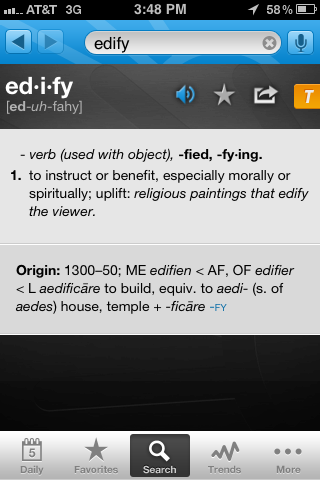 Today, as is the case most days, one of my students has provided the teaching and I am obliged to do the learning. Garrett Breedlove (@Goob_22 on Twitter) tweeted me that the word of the day was “Edification.” You may recall that Garrett was the facilitator of learning for one of my blog posts last fall. To read that post (Attitude Is Like A Cold) again click here. Now I have to admit, I didn’t even know what “Edification” meant. So off to my Dictionary App I went, and guess what the definition was? “1. The act of edifying.” I hate it when that happens! So, I looked up “Edify.” That’s when the learning began. Here’s what it said: “To instruct or benefit.” Now, that’s good stuff!
Wouldn’t it be great if we were all edifying? That would mean we would be instructing or coaching and benefiting others all the time. What a great world it would be if we were all striving to “Edify.” I was then reminded of a conversation I had just yesterday with my good friend Kevin Eikenberry. I shared my frustrations with him about a leader of a meeting I was in the week before who had just not taken her own professional development serious enough and was, quite frankly, giving wrong information. I shared that I had gone back to his book Remarkable Leadership:Unleashing Your Leadership Potential One Skill at A Time and read the part where he talks about that as leaders we must always realize that the others in the room may not be at the same knowledge level or leadership ability as us. Kevin, in his normal wisdom, shared that we have to find a way to coach and provide that information to others in a way that benefits all. 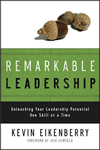
As a person who leads from the middle most of the time this makes so much sense. During our conversation it clicked that really I have to take the same approach in all my leadership roles that I take with my students. That being, to always facilitate learning from where the students are right now, and not where I want them to be. Really, I was approaching this leader wrong – Instead of instantly correcting, which is what I did (honestly, because I knew I was right & wanted to be seen as being right) I needed to “EDIFY.”
Next time I will take the lessons of Garrett and Kevin, and stop and think about how I can provide coaching, instruction, and benefit to others. In other words, provide “Edification.”
Next time you are in a situation like mine think about how you can “EDIFY.” It will make the world a better place. Thanks for the inspiration Garrett! Just goes to prove that Twitter is one of the greatest professional development tools ever.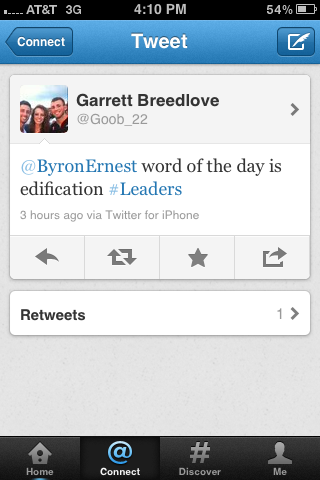
Frustration
 This past week I defended my research proposal (successfully I might add) as part of my Doctoral journey. At the end I was asked if I had any comments I would like to make about the journey. Well of course I did. For one of my comments I used the term “frustrated.” After saying that I quickly tried to correct, and said “I’m sorry, frustrated is not the correct term, I didn’t mean to sound so negative.” My doctoral committee chair quickly jumped in and said “Byron, it is o.k. to feel frustration – it’s part of the process.”
Let me tell you, as a card carrying “Positive/Possibility Thinker” it frustrated me to think I had been frustrated. So in reflecting I thought, “How can we turn frustration into a positive emotion?” Off to Dictionary.com I went. Here’s what the website had to say: Frustration – The condition that results when an action is thwarted by an external or internal force. The blocking or thwarting of an impulse, purpose, or action (who the heck uses the word thwarted anyway?). Also, it is ironic that one of John Maxwell’s Minute with Maxwell videos was on the work frustration this week as well. Click here to watch his video and hear his thoughts on “frustration”
So here’s what I learned: When I get frustrated I need to use the impulse to evaluate my purpose and create actions that will eliminate the frustration. Really, frustration is a gauge pointing us to the next action necessary to carry out our purpose. Frustration happens to you and it happens to me so let’s harness it’s effects for positive action.
I Am An American

My son, Heath, with Purdue Pete

Showing Our Spirit for the Trip to Detroit
This past week at the Little Caesar’s Pizza Bowl in Detroit, Michigan I was reminded as I am at every home Purdue Football game how proud I am to be an American as well as a Purdue alumnus (my wife, Hope, is also an alumna). We made the trip to Detroit a family trip and were not disappointed as our beloved Boilermakers won by a score of 37-32. It was an exciting game with one of the most interesting fourth quarters of a football game I have ever witnessed (I’ll leave that for another story if you did not see the game). We also had a great time pregame with Purdue Pete and all the other bowl festivities.

I Am An American
My post today, however, deals with what I consider to be one of the most moving pregame shows in the world. The Purdue University “All American Marching Band” does a show leading up to the national anthem that includes a portion called “I Am An American.” For a complete story of this show that was first done in 1966 click here. To the left is a picture of the band’s final formation in Ford Field as “I Am An American” was read. I still get goose-bumps and tears in my eyes every time it is done. Amazingly, I had a Western Michigan University fan tell me they were most looking forward to seeing the Purdue “All American Marching Band” perform. That’s pretty cool!

Traditional "Block P" by the Purdue "All American Marching Band"
I close this post and my last post of 2011 as a Proud American and Boilermaker.  Here are the words for you, see if they give you goose-bumps too:
Values, Dreams, & Priorities

In my reading, studying, and reflecting this year I have been reminded time and time again how our values drive us as leaders. Those same values drive me as an educator as well. I am glad that I chose to read the book The Leadership Challenge by Kouzes and Posner. In their book they gave us the five principles of leadership:
- Model the Way
- Inspire a Shared Vision
- Challenge the Process
- Enable Others to Act
- Encourage the Heart
I am not going to write about all of them, but suffice it to say; you need to read the book!
As an educator and leader I must envision exciting and enabling possibilities. As Kouzes and Posner said, “In some ways, leaders live their lives backward. They see pictures in their mind’s eye of what the results will look like even before they’ve started their project, much as an architect draws a picture or an engineer builds a model. Their clear image of the future pulls them forward.” As a teacher leader it is so true that I must live my life backward.

It is important that we see the end goal of what a great school and educational system looks like. Indiana’s State Superintendent of Public Instruction, Tony Bennett, has been a great modeler of this. As a teacher I must live life backwards, by seeing where the students need to be at the end of a course. So how does one live life backwards effectively? VALUES, PRIORITIES, & DREAMS!
In my opinion one of the biggest mistakes teachers and coaches make is teaching and coaching a person where they want them to be instead of where they are. One of my values in education is realizing that we must allow our students to be bad at something before they can get good at it. Let me tell you a story:
An important philosophy I have is allowing students to be bad at something before they can become good at it. The best example I can think of is Scott Martin,[1] a student who was a terrible public speaker. I use many student presentation activities in my classes, so this young man had plenty of opportunity for improvement. While having Scott as a student, a teacher made a comment to me that he did not have students make presentations because they were so poor at it. I remember saying, “Shame on you! How can students get any better if they are not allowed to try, with us helping them?” We must be willing to stand beside our students and allow them to be bad at a skill while we are teaching them to become proficient. Scott Martin went on to become a gifted speaker. In fact, he emceed the opening ceremony for our new welding shop. He did an outstanding job for the ceremony which had school board members, advisory committee members, business and community leaders, and parents in attendance.
As Kouzes and Posner said, values serve as guides to action. It is important to have our values driving us. As a teacher leader those values are equally important.
Many times when collaborating with other teachers it is easy to let that learning time turn into a gripe session about issues that are about the adults (general frustration) and not the students. It’s easy for me to bring the group back to what’s important by reminding them that what is important is the goal of a first rate learning environment for the students of Lebanon High School. In order to speak up w must know what to speak about. Our values give us that voice. Kouzes and Posner said, “Personal values clarity drives commitment.” So for us to have our priorities in order and dreaming positive dreams we must first know what we value most.
[1] Scott Martin graduated May, 2009. Author has permission to use this story.


leave a comment