Leaders See the Faces
 I had the privilege this week to accompany our Hoosier Academies families to Washington D.C. It was a great trip and I loved getting to know our families and students we serve better. As you probably know I have spent a great deal of time in our nation’s capital and every time I am there I learn something new to reflect on. This time was no exception. When visiting the exhibit dedicated to women, Women in Military Service For America Memorial, at Arlington Cementary I was struck by how personal the exhibit was. It is very well done. You actually get to know the women that have served our country personally – it was humanized. This made it so much more powerful experience. I knew these women’s stories when I was done.
  Then, later that day our group went to the United States Holocaust Memorial Museum. This museum is a very intense experience that starts with you being given a card with information about an actual victim of the Holocaust. You are to reflect on this person as you move through the museum. Believe me, it becomes very personal! The individual I was given was, Iosif Rivkin. Here is his story: He was born in 1891 in Minsk, Belorussia. Iosif was born to a Jewish family in the Belorussian capital of Minsk. He fought with the Tsarist troops in World War I and was taken prisoner by the Germans. When he returned to Minsk after the war, he began working in a state-owned factory building furniture, an occupation in which a number of his relatives also made a living.
By the early 1930’s Iosif was married and had three daughters. They lived in central Minsk. By the late 1930’s Minsk was filled with Polish refugees fleeing the German invasion. On June 27, 1941, the invading Germans reached Minsk. The Rivkens’ home was bombed the next day, and they were forced into the street. They slept by the river with numerous other refugees, until German guards threatened to shoot them all. German posters in Minsk declared that the Nazis had come to liberate the Soviet Union from Communism and Jews. In August the Germans set up a ghetto, there Iosif was put to work as a carpenter. When the ghetto was liquidated in October 1943, Iosif and his family were deported. Iosif’s daughter, Berta, escaped from the ghetto before it was liquidated. Iosif and the rest of his family were never heard from again.
As I reflected on his story, I caught myself really having feelings about what had happened to him and his family. Why was I able to do this? Because I was able to see the faces of Iosif and his family.  Isn’t that an important skill that leaders learn? It is important for us to tell the stories so that those we lead understand the faces, the values, the mission, and the vision. I really believe in the value of telling stories as a leader, but had not really thought about the exercise of seeing the faces myself. Not to me mention telling the story so those we lead see the faces. This was such a powerful lesson. I really believe that our great leaders that we celebrated while in Washington D.C., like Thomas Jefferson, Abraham Lincoln, Martin Luther King Jr., Franklin Delano Roosevelt, and John F. Kennedy all were able to see the faces of all those Americans they served. After reflection, I really believe it was their ability to see the faces of the people that gave them there wisdom.
  I am so glad I had this revolation and then was able to spend time on the trip getting to know a cross section of the Hoosier Academies families I serve. As the leader of a very large statewide school system that serves students in every county in the state of Indiana, it is very important that I am able to see the faces of those we serve. Are you taking time to see the faces and truly understanding those you lead?
Leading Together By Working Together

We are increasingly moving towards multinational, transnational organizations that are held together by two factors: control of mission and strategy, and enough people who know and trust each other. Distributed leadership and a flattened hierarchies are key to accomplishing this. In this week’s lesson on Peter Drucker, and example of how the Coca Cola Argentina division had to make a decision that was right for helping the people of Argentina, but not good for the bottom line of the company based in Atlanta Georgia (Maciariello, 2014). Coca Cola understood that performance measures for foreign subsidiaries should be adapted to local political and economic realities.
As leaders we must learn to balance having a bold vision with what to do next. We must also learn to lead together by working together. Everyone in the organization must understand the values, objectives, and expectations of the organization. This is why it is important to build a team that is competent. Empowerment without competence is chaos. Wherever you sit in the organization, there is many times a tendency to wait for others to lead. We need to create an environment where everyone in our organizations can lead from where they sit.
Trust-based relationships must replace command and control mechanisms as coordinating mechanisms. This will allow effective leaders time to perform important duties. We must create enough autonomy for our teams to meet the local realities they face. Maciariello (2014) closed this week’s lesson by posing a great question that we all, as leaders, need to answer. Does your organization have resilient trust networks, that allow individuals to transfer information to and from one another?
Reference
Maciariello, J. A. (2014). A year with Peter Drucker: 52 weeks of coaching for leadership effectiveness. New York, NY: HarperCollins Publishers.
The Leadership Bottleneck!

“The bottleneck is at the head of the bottle,” so the old saying goes. In other words, no business or organization is likely to be better than, or perform better than, its top management and leadership. As a management innovator, Peter Drucker built off of the existing knowledge of others to create and integrate missing knowledge into the organization. He called this practice “integration” (Maciariello, 2014). Top management and leadership is responsible for creating and for maintaining the spirit of the organization, which includes values, standards of conduct, and standards of quality.
So, the first task in designing and assessing an organization is the presence of an effective top management and leadership team with a strong spirit of performance. Close behind in importance is a program for developing talent to fill open management positions. Most call this the building of a bench. This athletic team analogy is appropriate. Study any successful athletic team and you will find a strong bench of players ready to perform at a moments notice. This year’s NCAA Tournament has given us many examples. Not the least of which would be Kentucky who just had their 38th season win defeating Notre Dame last night. I had the opportunity to watch this Kentucky team play in person during the tournament and it doesn’t matter who is on the floor for them – they are all great. We can certainly learn from them as we build our teams.

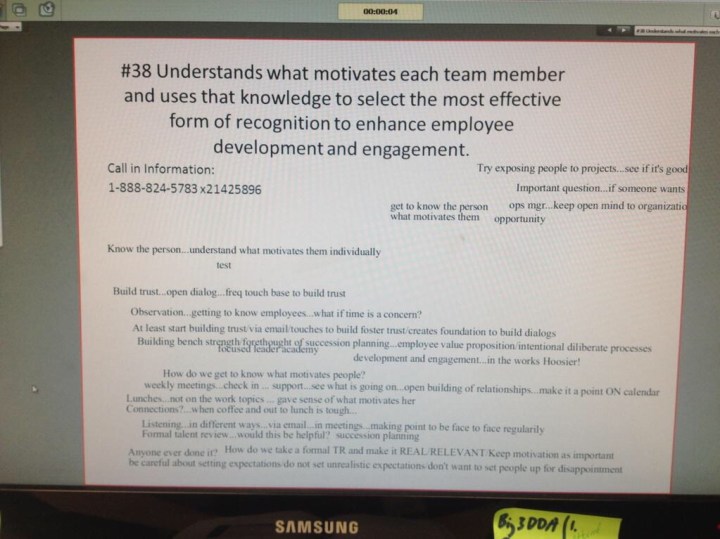
This building of a bench is very important to employee engagement. One of the things I am working very hard on for the school I now serve is a leadership academy for building our talent bench. We are going to take a group of our talented teacher leaders each year and put them through a program that will be individualized for their specific needs and interests. We are in the planning stages of this and I am sure I will blog about this in the future. In the meantime I will share a picture of a screenshot of some notes from a meeting about this, just this week.
In any major institution, such as a school corporation, the finding, developing, and proving out of leaders of tomorrow is an essential job to which the best leaders must give fully of their time and attention. Maciariello (2014) asked some great questions in this week’s reading:
- Is your organization preparing future leaders by giving significant responsibility and authority to lower level executives?
- What has been the organization’s track record of finding successors for key positions inside versus outside?
These are certainly questions I will want to use as guides as we develop our bench. How about you?
Reference
Maciariello, J. A. (2014). A year with Peter Drucker: 52 weeks of coaching for leadership effectiveness. New York, NY: HarperCollins Publishers.
The Good Samaritan Marathon

This past Thursday I had the opportunity to go with good friend, Kevin Eikenberry, to the NCAA tournament game where Purdue played Cincinnatti. The game was held in the KFC Yum Center in Louisville, Kentucky. I was excited to be going because it was my first NCAA Tournament game. Kevin had been to many of these and got tired of me saying, “We are in the house!” Sorry Kevin!

Obviously the outcome of the game was not what we wanted, but that really turned out to be a lesser story of the trip. Something astonishing happened and we were both reminded how important it is to help your fellow-man. Long-story-short, we hit something in the road and it literally punctured the tire and went through the rim on my friend’s BMW. We tried to change the tire along the interstate, but had some difficulty. That’s a whole other story that the two farm boys in the BMW are still figuring out how to tell! Anyway, we called AAA, and then (since the tire and rim were both already ruined) drove to the next exit – Exit 41 on I 65, the Uniontown/Crothersville, Indiana exit.
We then limped into the exit, pulled into the Marathon station, and began working on the car again. Remember, you have two farm boys here wanting to fix the tire. We then got a message back from AAA that it would be an hour before help arrived. This would have got us to the game late. Little did we know there were Good Samaritans at Exit 41.
An interesting thing happened at the gas station, Uniontown Marathon- RMD 64 (pictured here in the post) on the way to the tournament. Every single person that pulled into that gas station/mini mart while we were there attempted to help us. No lie – every single one. We were amazed! One lady knew BMWs and was explaining the wheel locks and another was googling BMWs for us. Then we had a car full of fellow Purdue Boilermaker fans wanting to make room in the car for us and get us to the game. I looked at Kevin and said, “I’ll see you at the game!” Really, I did say that, but I did not leave him.
Then, along came a man that knew exactly what to do. Bottom line: he made it possible for us to change the tire and get on the road. We are both so appreciative of everyone who asked to help us. We are both also still astonished that every single person who pulled into that station asked to help. How many times have you pulled in somewhere and seen someone with a broken down car or some other need and thought you were too busy to help? I am ashamed to say I have. But, from the modeling and coaching of our friends at the Uniontown/Crothersville exit, I hope to be a better neighbor!
In reflecting on and deciding how to tell this story (there is quite a bit more and gets quite funny), I thought of the ultimate story/parable teller: Jesus. I believe it would be a good reminder for us to review the story of the Good Samaritan found in the book of Luke. Luke 10: 25-37.
“Jesus told many stories, or parables, to help people learn the truth. One day a leader of the Jews asked Jesus what he must do to have eternal life. The Savior asked him what the scriptures said. The leader said that a man should love God and also love his neighbor. Jesus said that he was right. Then the leader asked, “Who is my neighbour?”
Jesus answered by telling the man a story. One day a Jewish man was walking on the road to the city of Jericho. Thieves robbed and beat him. They left the man on the road, almost dead. Soon a Jewish priest came by and saw the man. The priest walked by on the other side of the road. He did not help the man. Another Jewish man who worked in the temple came by. He saw the injured man. But he did not help the man either and walked by on the other side of the road.
Then a Samaritan man came along. The Jews and the Samaritans did not get along. But when the Samaritan saw the man, he felt sorry for him. He took care of the man’s wounds and put clothes on him. The Samaritan took the man to an inn and cared for him until the next day. When the Samaritan had to leave, he gave money to the innkeeper and told him to take care of the man.
After Jesus told this story, He asked the Jewish leader which of the three men was a neighbor to the injured man. The leader said that the Samaritan was because he had helped the man. Jesus told the Jewish leader to be like the Samaritan.”
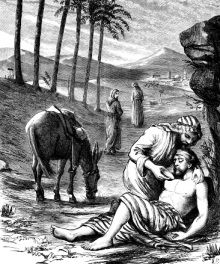
So what do we learn from this story? We must be willing to get involved. Good intentions don’t cut it! None of the people at the Uniontown Marathon – RMD 64 were just saying they wanted to help; they all truly got involved in some way. They were “walking the talk.” We may quote scripture and recite platitudes on love and God, but unless we are willing to get involved in the lives of others, we are only blowing smoke. The Samaritan treated and bandaged the wounds. He set the injured man on his donkey. He took him to an inn and cared for him throughout the night. The Samaritan could have said to himself, “I give regularly to my church. I donate to the Salvation Army every Christmas. I have done my part.” But he didn’t. As the scriptures say, he had compassion…and he acted on it.
So here are three things we need to do:
1. Don’t refuse to help when you are able.
2. Never assume someone else will do it. Take personal responsibility.
3. You may suffer for doing well, but helping someone in need is truly worth it.
Next time you have an opportunity to serve someone in need (a motorist in distress on the highway, a person under a cloud of depression, a friend in a financial bind, a single parent being overwhelmed by a rebellious child, a stressed-out coworker…) what will your reaction be? Will you be the religious law-speaking type or the proactive law-living type?
Thanks again to the folks in Uniontown and Crothersville last Thursday evening for giving us a modern day parable to live by.
Effective Leaders Make Effective Decisions
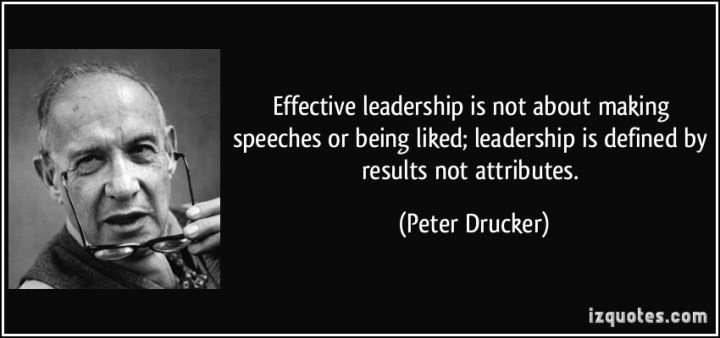
“Leadership is lifting a person’s vision to higher sights, the raising of a person’s performance to a higher standard, the building of a personality beyond its normal limitations.” ~ Peter Drucker
Drucker was confident that people could be taught to be effective executives (managers), but wasn’t as sure we could teach other to be leaders. Interesting, however, in the week 11 reading in Maciariello’s (2014) book he talked about how Drucker believed the climate in the organization needed to be right for leaders to develop and emerge. “Nothing better prepares the ground for such leadership than a spirit of management that confirms in the day-to-day practices of the organization strict principles of conduct and responsibility, high standards of performance, and respect for individuals and their work (Drucker in Maciariello, 2014, p. 79).” I wrote in the margin of the book, “So if the operations and processes are in place and being executed effectively, then leaders can grow and emerge.” I really do believe this is true. I have a saying I use in school turnaround and transformation and that is: “We need to become a REAL SCHOOL.”
The question you will ask next is, “What is a REAL SCHOOL?” My answer is quite simple: “A real school is one that has its operations and processes in place and being managed by an effective individual and team to make sure that the normal day to day activities (eg. Safety procedures, student handbook components, discipline, financial processes in the case of a school) are being carried out efficiently and effectively. I was very blessed to have just such a person in my first turnaround school. Don Burton was our Assistant Principal of Operations. Let me tell you, without him the school would have never come off the “F” list. He was the operations manager dream of a lifetime. The great part about Don was he managed the operations flawlessly and implemented our processes with the best interest of our students and staff in mind.
Mr. Burton’s awesome abilities and work ethic then allowed the teachers to teach and me to do the numerous activities as a building leader: establishing a vision, defining the mission, making sure that resources are applied to the right tasks, making effective decisions, implementing and following up on these decisions, taking criticism, keeping track of and navigating the legislative and governmental affairs, and working diligently to maintain a functioning board of directors. Imagine trying to do this in a disfuctional organization. Believe me this is not an easy task, nor did we have it perfect, but Don had us in a great place. There is a reason why schools fail, and one of the commonalities of the schools that need to be turned around is the disfuctionality and lack of the right operational practices to make it a “real school.” I’m sure you could tie common operations and practices that would make businesses and organizations “real businesses” and “real organizations.” I am positive education is not alone in this.
Again, I cannot say enough how much credit for our success goes to Don Burton. He enabled the day to day operations to go smoothly which then allowed me, and him, to grow as leaders. This truly allowed the environment to be right for leadership growth. Don certainly grew, as he now is leading a middle school in Arizona as a principal. I consider Don a dear friend and I always said we never had to schedule time, we were always catching up before or after school or on the weekends. It was just such a natural relationship. Therefore, I really think Peter Drucker’s belief that teaching someone to be a leader is very hard, if possible at all, is warranted. More importantly, however, is the lesson he has taught us that if the operations, processes, and day to day activities of the organization are highly functioning, the leader has the chance to learn and grow. In other words, the conditions must be right for growth.
I believe this point is even driven home further when we look at one of the most important attributes of leading effectively – effective decision making. Making effective decisions depends on the definition of the problem being faced and thus the appropriate conditions that have to be met for the decision to be effective. Drucker taught us that these are always the two critical issues in decision making (Maciariello, 2014). It would very hard to define or know the appropriate conditions for a decision to be effective in a disfunctional organization, operationally. I know that without the sound operational practices Don instilled in our school that I would not have been able to make the decisions I was able to, of which many turned out to be the right and effective decision.
So, as you look at growing leaders and great schools, businesses, and organizations, look first to what your definition of a “REAL” school, business, or organization is. Then make sure you’ve got the right team to manage the operations effectively.
Reference
Maciariello, J. A. (2014). A year with Peter Drucker: 52 weeks of coaching for leadership effectiveness. New York, NY: HarperCollins Publishers
The Knowledge Organization: Acting On Information
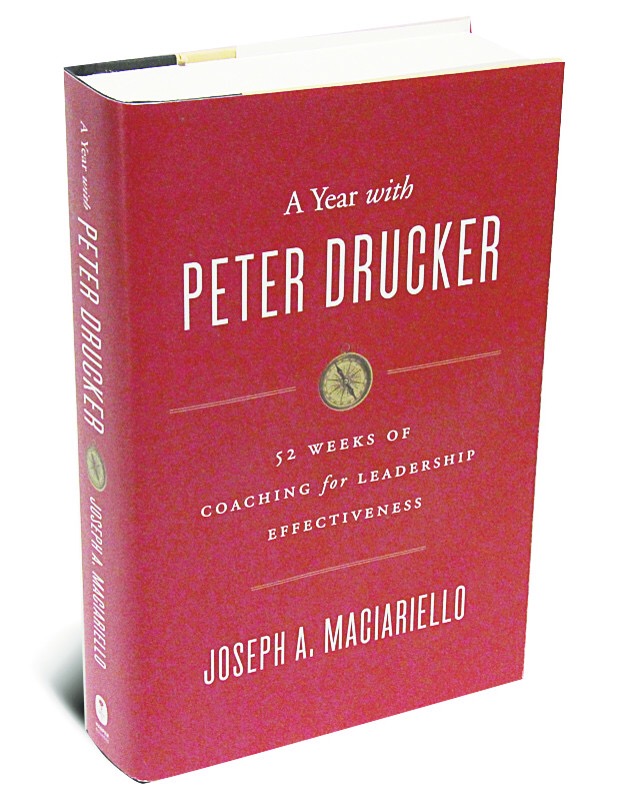
The “knowledge organization” is structured around information, not hierarchy. This week’s lesson from Maciariello (2014) really affirms the case for distributed leadership. Drucker believed that knowledge organizations were best made up of specialists who direct their own and the organizations work with the feedback of colleagues, customers, and headquarters (2014). Drucker called this an “information-based organization.” This means that the proper people in the organization must be able to transfer data into information.
This converting of data into information is a crucial step that many organizations leave out or don’t figure out how to do well. This is especially true in education. I think about all of the data we have, but it is only important if we can turnip into actionable information. Maciariello (2014) used Brad Stevens, former Butler University and present Boston Celtics, basketball coach as an example. He breaks down all of the available data and then looks for trends. For example, how many three point attempts per field goal attempt. Again, he is turning the data into information. It is then the coaches jobs to make sure the players understand the information. Then the players must act on the information. If the players do not understand the information, or don’t act on it then the data/information is worthless. This is the flow of information to information literacy to information responsibility.

I really like the idea presented this week of moving from data literacy to information literacy. This really involves the asking of two questions: What information does my organization need? And What information do I need? This really places the emphasis on creating useful information, not just showing a bunch of data. A major problem in education. So, for example, in education everyone always wants to look at growth data. I contend the more valuable information is the benchmark data of where the student is performing right now. Isn’t that what I really need (information), if I am a teacher, right now to create a plan to get that student where she needs to be academically. If we are doing that properly, the growth will take care of itself. Trust me, it works! Remember, you must convert raw data to true information.
True information is those data that are important to the solution of specific problems faced by the organization. The question is not “Are the data interesting?” but rather “Are the data important and useful for making decisions to solve problems and seize new opportunities?” This truly makes the conversion from data to information. Therefore we must focus data on the information needed for decision making.
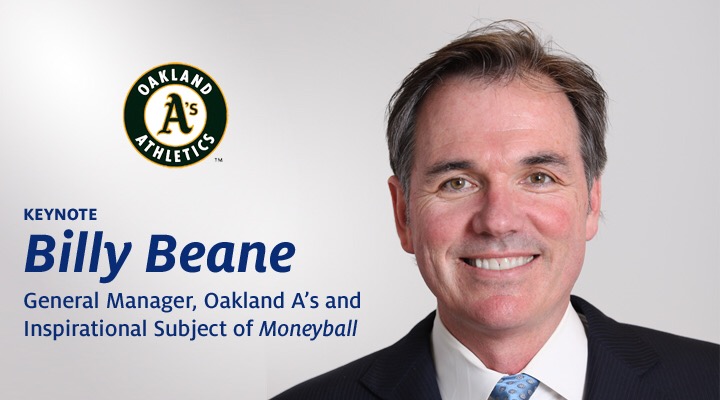
I also really like thinking about sabermetrics here, too. This was the precursor of Billy Beane’s Statcast, developed by Bill James. Billy Beane’s system took data generated by sabermetrics and turned it into useful information. His Statcast enabled him to assemble players so that their individual abilities were able to complement one another. This enabled them to “measure a player’s value in the context of the rest of the team (Macariello, 2014, p. 76).”
Eliminate data you do not need for decision making. Eliminate data that do not pertain to the information you need. Organize, analyze, and interpret the data you need so that they become true information.
Reference
Maciariello, J. A. (2014). A year with Peter Drucker: 52 weeks of coaching for leadership effectiveness. New York, NY: HarperCollins Publishers
Resist Multitasking: Cut The Pattern To Fit The Cloth
I am almost a week behind on my reflection of week nine in A Year With Peter Drucker: 52 Weeks of Coaching for Leadership Effectiveness (Maciarello, 2014). I usually read the week’s lesson and write the post on Sunday mornings. Last week, however, I had to fly out to be at Harvard University early Sunday morning so I packed my book and was going to do the work Sunday night. Well, long story short, the airline lost my bag and I just had it returned last night – a full day after returning home. That entire experience and adventure may be the topic of another post.
The basic premise of last week’s lesson was to organize our personal work and the work we delegate to others effectively. We should attempt to plan our time, making sure that our most important tasks are done first, and, as much as is possible, resist pressures to engage in multitasking (Maciariello, 2014). Both empirical evidence and common practice confirm that multitasking really isn’t possible. In other words, we should fit our most important tasks into our available time. Or, “Cut the pattern to fit the cloth.”

Andy Grove, one of the three founders of Intel, put it this way: “What am I doing that I shouldn’t be doing (Maciariello, 2014, p. 66)?” Grove also offered four other great questions to help guide us in resisting multitasking:
- Should I still be doing it?
- Am I doing it well?
- Am I adding enough value to what I am doing?
- Is it more worthwhile or less worthwhile than anything else?
Grove shared that after answering these questions he then negotiates with himself.

So how do we make this all happen? We must learn to delegate certain activities, abandon other activities, or relax the frequency of the performance of repetitive duties. To do this we must have the strongest followers. Successful leaders are not afraid of strong subordinates. We must assemble the most talented team available develop their competency and capacity, and then, get out of their way. When we develop others we simultaneously develop ourselves because we have to figure out how to raise the capacity of the people we are trying to develop. This will serve as a stretching activity for us, too.
Therefore, resist multitasking, develop your team with “A” players, and determine what are the most important tasks for you. As Peter Drucker said, “Effective leaders delegate, but they do not delegate the one thing that will set the standard. They do it (Maciariello, 2014, p. 70)!”
Reference
Maciariello, J. A. (2014). A year with Peter Drucker: 52 weeks of coaching for leadership effectiveness. New York, NY: HarperCollins Publishers.
Until Every Child Is Well

I was struck this week while at Harvard University by the story of Boston Children’s Hospital’s vision/mission: Until Every Child Is Well. Really, I guess it would be more of an anthem, as Sally Hogshead would call it. What an anthem it is, though! Think about how simple and abstract “Until Every Child Is Well” is. In my studies this week I was reminded how important it is to make sure that our vision, or anthem, is broad enough to enable us to change as the world changes. What a simple, yet powerful statement Boston Children’s Hospital has made. Who could argue with, “Until Every Child Is Well?”
If we were to write it the way Joseph Michelli taught me, using the word “Wowful,” it would be “Wowful Child Wellness.” Regardless, both statements allow for cutting edge theories of action and strategery. I was also reminded this week of the 1942 Harvard MBA graduate, John Fisher, who was the CEO of Muncie, Indiana company Ball Corporation (you probably know them for Ball Jars). He worked for the company starting in 1941 and was CEO from 1970 to 1981. After World War II the glass jar business was booming, but later Fisher purchased and developed an aerospace business. Everyone thought he was crazy, but it led to the development of the plastic water bottle. I’ll bet you would agree that was a pretty savvy move. When asked about the shift from glass at a Harvard reunion, he stated that their vision had nothing to do with just glass, it was, “we want to be the best container company.” Again, simple, broad, abstract, and agnostic. John Fisher had learned well from his Harvard MBA. He learned you must exploit your present capabilities, but you must at the same time explore. We must learn about the future quicker than anyone else.

So, since my personal wow statement is “Delivering Wowful Educational Leadership” and my anthem is “Energetic Change Agent,” I set out reflect on what these two statements should be for my school; given my learning this week. Remember the goal is to be simple, broad, abstract, and agnostic. Let’s define agnostic. The dictionary defines agnostic as: a person who holds the view that any ultimate reality is unknown and probably unknowable; broadly one who is not committed to believing in anything being for sure. Think about that for removing all barriers of thinking things will stay status quo or need to be done the same way.
Here’s what I came up with:
Delivering Wowful Learning
Until Every Child Graduates
I would welcome your feedback on these two statements. It would be great to here how you would change them. These statements allow us to change as the world changes to do what the Indiana State Constitution says in Section 8 where it states: Section 1. Knowledge and learning, general diffused throughout a community, being essential to the preservation of a free government; it should be the duty of the General Assembly to encourage, by all suitable means, moral, intellectual scientific, and agricultural improvement; and provide, by law, for a general and uniform system of Common Schools, wherein tuition shall without charge, and equally open to all. It is important to pay particular attention to the statement, “by all suitable means.” We have a constitutional obligation to make our delivery of knowledge and learning to our students distinct and effective. I love the statement, “by all suitable means.” That is simple, broad, and abstract.
Schools have growing alternatives for delivering education. Choices range from presentations and discussions in the classroom to online, blended, and hybrid courses. As facilitators of learning, teachers will increasingly turn the process of teaching and learning into a partnership, with students and teachers constantly learning from each other. Self- learning will be seen as a bonus— and encouraged. Also, think about the online world where the greatest minds are just a click away and readily available. This open access has tremendous possibilities for many of our US underserved populations as well as third world countries. Pretty exciting, don’t you think?
I encourage you to take some time and think about your school or organization vision, mission, and anthem. Does it allow you to be nimble and change as the world changes? Remember: Leaders need to be consistently inconsistent. We have to constantly explore who we are and what we do!
Targeting & Focusing Your Efforts
Think about creating tomorrow by focusing on the “right results” and “changes in trends” rather than on just the current trends affecting your organization. An important question to ask is, “What are the right results for your organization?” Maciariello (2014) posited in Week 8’s lesson that knowing your mission or purpose is essential in choosing from among all available opportunities those that have the highest probability of producing the right results.
I compare this “focusing” to that of sunlight through a magnifying glass to start paper or grass on fire. Peter Drucker said, “Concentrate on the smallest number of activities that will focus on the greatest productivity.” (Maciariello, 2014, p. 62) I have found this to be so true in turning schools around. This is one of the most important lessons I have learned from my postdoctoral professional development at Harvard University. We talk about having too many resources. I know that sounds really weird coming from an educational leader. Too many resources? Yes, if you have not asked yourself, “What am I (or our school or organization) willing to give up?” We should abandon, or not start at all, programs where even great success is unlikely to make a significant difference.

Maciariello (2014) argued that economic results require that staff efforts be concentrated upon the few activities that are capable of producing significant business results. This would be true for schools as well. Knowing who we serve and what makes us distinct allows us to concentrate our resources on a few major opportunities. This also means being prepared to eliminate past programs and best practices that are no longer productive or getting the results needed to move our organizations to the next level. “If leaders are unable to slough off yesterday, to abandon yesterday, they simply will not be able to create tomorrow.” (Maciariello, 2014, p. 63) Without targeting and focusing on the right things we will not be able to exploit our resources strategically for success.

Just like a flashlight focused on an object in the darkness, we must target ourselves on the areas where a little success will have the greatest impact. Don’t forget the key question here: What are the “right results” for our school or organization?
Reference
Maciariello, J. A. (2014). A year with Peter Drucker: 52 weeks of coaching for leadership effectiveness. New York, NY: HarperCollins Publishers.
Manipulation of Reality

“The problem is that 25 years after Photoshop launched, we’d much prefer manipulations of reality to reality itself.” This statement by Caitlin Dewey of The Washington Post in a very well written article entitled “How 25 years of Photoshop changed the way we see reality” really got me to thinking about whether this was true in all parts of our lives, not just photos and appearance. This great article was about a set of unretouched Beyoncé photos that appeared on a fan site called Beyoncé World on Wednesday morning. Within an hour the pictures were taken down, but fans were angry not that Beyoncé had been Photoshopped to breathtaking beauty, but that someone had shown her without manipulation.

So, have we really come to a time that we do prefer manipulation to reality? If so, what implications are there for leaders? The more I reflected the more I realized there are similarities between leading and manipulation. Both imply action and involve influencing people to do things. Furthermore, both ultimately benefit the person who is either doing the leading or the manipulation. Manipulation is what happens when we influence someone to do something and only we benefit from their actions. Think about it; there is really only one person that benefits from the Photoshopped pictures of Beyoncé – her. Leadership, in contrast, works to ensure that both parties benefit. For a relationship to be sustainable you need to be getting at least as much as you are giving from relationships (both personal and professional). While sounding selfish, I would argue that a relationship where one party gives without receiving much in return only breeds resentment over time. Again, this is what happens with manipulation.
As Dewey also stated in her article, “It’s worth remembering… that perfection and reality are not the same thing.” As leaders we must always make sure we are not creating distorted realities for our organizations and those we serve.


leave a comment