Distress Patterns
 “Unfortunately, you don’t just have people on your staff; you also have distress patterns. The art of managing people includes the challenge of managing their distress patterns; people are very different from their distress patterns.” This statement by Dorothy Stoneman, President, YouthBuild USA is so true. Leading a school staff or any other group involves managing irrational distress patterns in other people, stress in yourself, and attacks on you. Being mindful of these distress patterns will enable you, as a leader, to navigate your organization.
I am a major believer in the power of context. With distress patterns, context certainly matters. Everyone experiences negative and positive feelings. The tendency to respond to a certain type of situation with a specific emotion, the intensity of our emotional responses, the ways in which we express our feelings, the balance between positive and negative feelings, and the duration of a particular emotion are all characteristic of each person as an individual. People differ, then, in regard to the inner experience (feeling) and in the outward experience (behavior) of emotions. I am learning how important understanding these distress patterns is. We all have behavior patterns and attitudes rooted in painful past experiences.
Sometimes these distress patterns undermine our ability to lead or function as a team. You can tell a distress pattern when you see one because it is behavior that is repetitive, that occurs whether or not it is appropriate for the situation, whether or not it achieves positive goals, whether or not it hurts other people or oneself. It is not flexible; it almost always occurs under certain circumstances. What we have to realize as leaders is that behind every distress pattern is a past experience that causes a repetitive or unproductive behavior develop. What I learned from Dorothy Stoneman is, “it is always useful to separate people from patterns, never blaming people for patterns they happen to have, always relating to the people rather than the patterns.” Remember, these patterns come from their past personal and professional experiences.
As turnaround school leader I have experienced these distress patterns related to the culture of the organizations. Lack of trust, self serving leadership patterns, divisiveness. personal attacks or other negative behavioral patterns can be major detriments to developing a positive environment. Sometimes leaders are criticized not based on the decisions made, but on the distress patterns experienced in the past. Fair and unfair criticism, including attacks, will come to anyone who takes the visible leadership in any situation. It’s part of the territory. We need to stand up for anyone willing to take, in good faith, for good purposes, the stress of being in charge.
Informational Vs. Transformational Learning
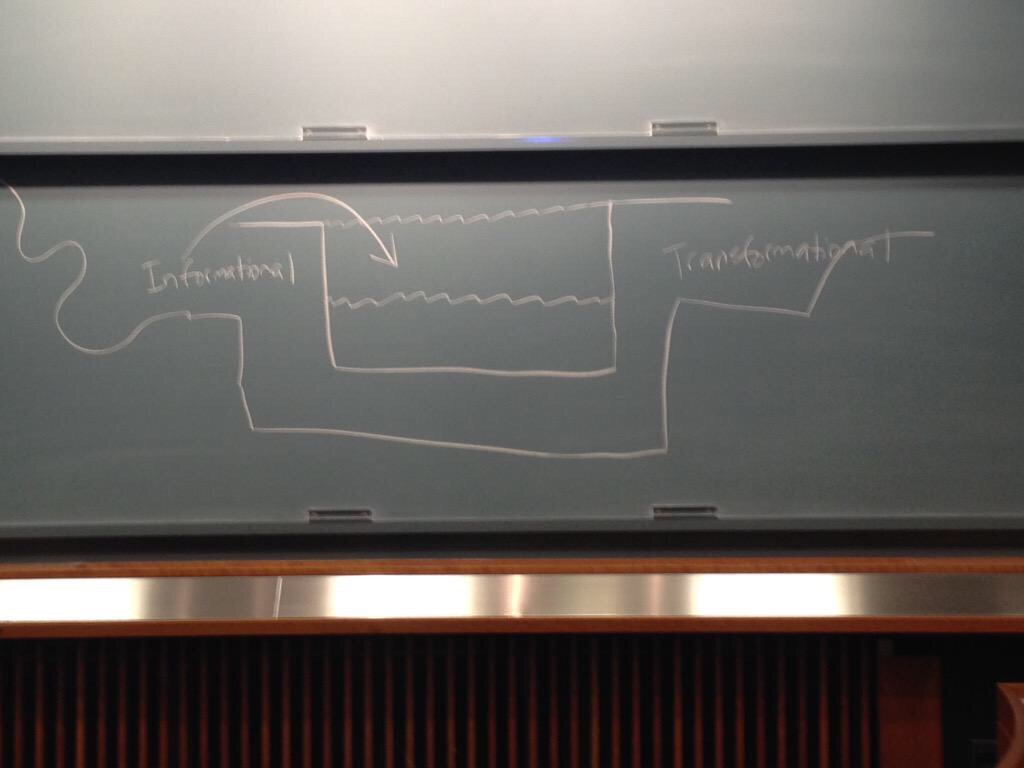 I was so impressed by the closing comments of Joseph Zolner today to conclude our learning at the Inner Strengths of Successful Leaders program at Harvard University. Joseph Zolner is Lecturer on Education and Senior Director of the Harvard Institutes for Higher Education at the Harvard Graduate School of Education. To conclude he drew a vessel on the board (see photo insert) and told us this was the vessel of the mind.
Joseph then proceeded to tell us there were two types of learning: informational and transformational. The first type is that which we use as a lower level form of learning. We are just gaining new information. In other words, informational learning will only fill our vessels so full. We need the second type of learning, transformational, in order to stretch our learning. The unique quality of human beings is our ability to think flexibly about new situations, comparing them intelligently to all past experiences, and then to do something that is uniquely appro- priate, bringing about desired objectives.
Transformational learning provides us with new ways of thinking. This can actually change the form of the vessel of the mind. In fact this new stretch, and extending of our thinking actually give us more room in the vessel of our mind for greater and more magnificent thinking. Think about the student who says to their teacher: ” I was confused before you started…Now I am confused at a higher level.” We need, as lifelong adult professional learner, to stay appropriately confused!
Don’t forget to add some transformational learning opportunities to your professional growth plan.
Values In Action: Viva VIA!
 Yesterday at Harvard University I had the opportunity to learn from and work with Jerry Murphy, former Dean of the Harvard Graduate School of Education. He is doing exciting work around the idea of ‘Dancing In The Rain.’ His idea is he wants us to flourish as a leader. The ‘Dancing In The Rain’ metaphor comes from wanting us, as leaders, to have an upbeat and realistic way of living in stressful times. I have actually played in the rain and I can tell you it is an upbeat experience. Jerry is currently writing a book on this and I cannot wait till it is published. Trust me, it will be a must read!
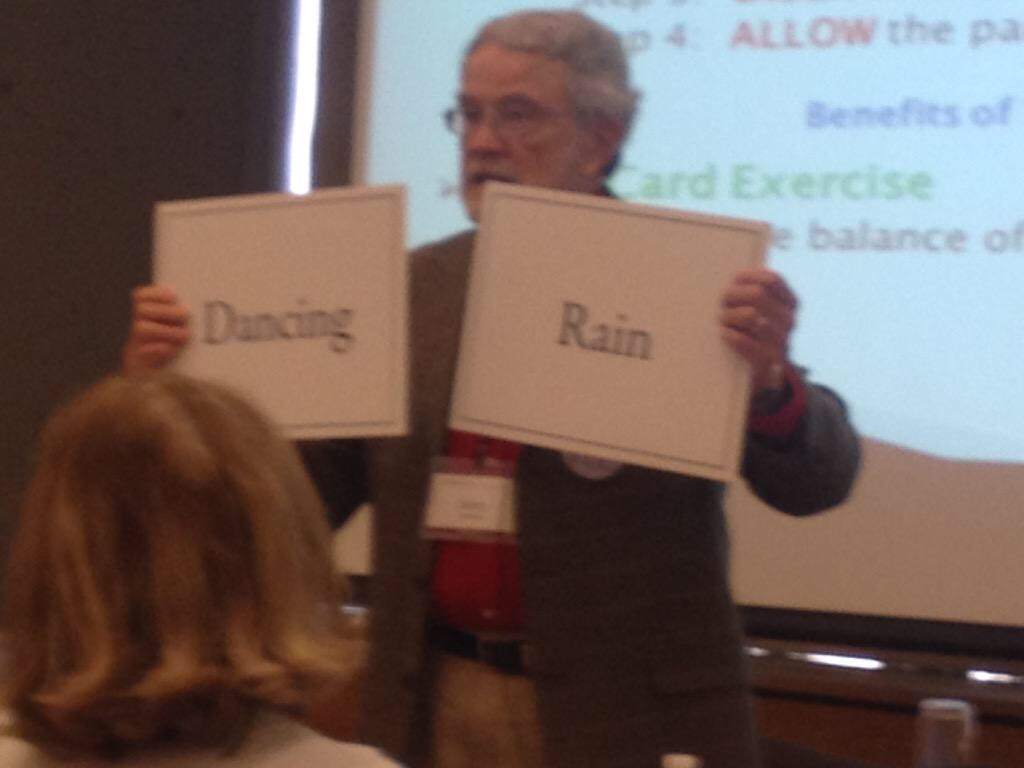 Jerry Murphy has developed a framework called ‘MY DANCE.’ Without going into much detail in this post, I would like to just share the framework.
MY DANCE FRAMEWORK:
Step 1: M – Do what MATTERS
Step 2: Y – Say YES to here and now
Step 3: D – DISENTANGLE from upsets
Step 4: A – ALLOW the pain life brings
Step 5: N – NOURISH myself
Step 6: C – Practice Self-COMPASSION
Step 7: E – EXPRESS feelings wisely
This post is really about Step 1: M – Do what MATTERS. It is the idea that what really matters are your core values. We cannot let our circumstances or discomforts that are thrown our way hijack us from what is important to us. During our time with Jerry Murphy he had us do an exercise called, ‘The Retirement Party.’ For this exercise you first imagine yourself retiring and you are attending your retirement party. Secondly, you spend a few minutes writing down four or five things that you like for people to say about your values as a trustworthy leader.
As you can imagine this exercise caused a great deal of reflection for me. I would like to share my points that I would want people to be able to say about me. Here are the four I cam up with:
1. Byron is just the kind of guy you are glad he is your friend and he has added value to your life because he has helped you grow.
2. Byron pulled me and enabled me to get to the places in my life I wanted to be. He has helped me be all I can be.
3. Byron certainly ‘Walked the Talk.’
4. Byron was able to bend in the breeze and navigate difficulties.
5. Byron was a lifelong learner.
This is not an easy exercise because sometimes you have to discover your values instead of just pulling them out of the air.
Then came the most powerful part of the exercise. He had us pick one of the statements that we wrote and think about if we were really doing and acting on that value. Then, we were to develop and action plan to truly carry out that value for everyone I serve as a leader and translate the value into action. Jerry call this Viva VIA! VIA – Values In Action. In fact he created buttons that he gave each of us. I have included a picture of the button here in this post.
My action step was for value number two: Make sure I do all I can for every staff member I serve according to their goals and professional growth plan. Sometimes it is easy to work with just a few, particularly those who are most aggressive with their own personal professional growth plans. I need to make sure and collaboratively identify those areas where the faculty I serve need to be pulled up to reach the goals they desire. This exercise really reminded me to lead my life shaped by what matters most to me. In other words what make me come alive and inspires me to lift those up which I serve.
We must remember that our values give meaning, purpose, and resolve to everything we do. As leaders, we must have a commitment to take action, even when it hurts. No matter how big the storm, the sky is big enough to handle it. Much like our storms as a leader, we must be big enough to handle them.
Bending In The Breeze: Being A Mindful Leader
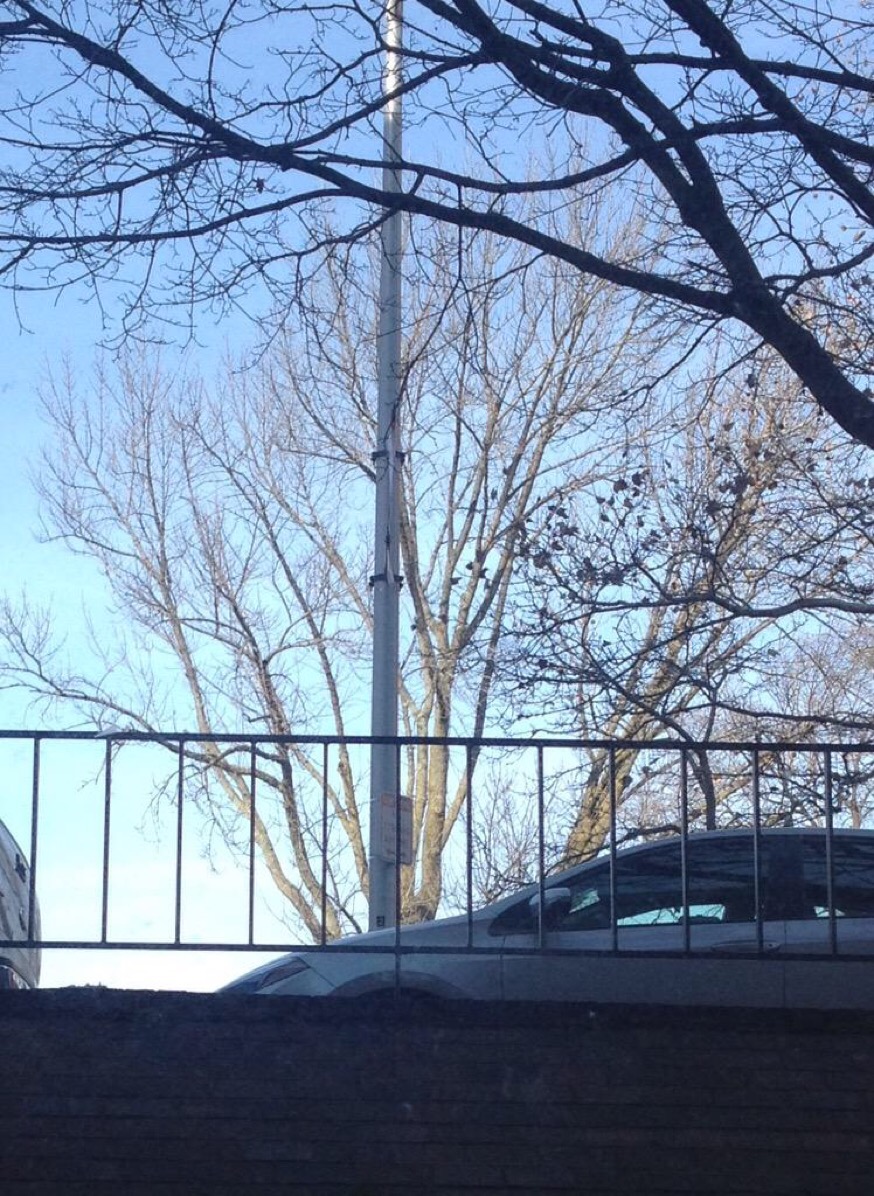 Today, while learning to be a more mindful leaders while at Harvard we did a meditation exercise looking out the window. This exercise was done in the Gutman Library at the Harvard Graduate School of Education during a session of Inner Strengths of Successful Leaders. I looked out and saw the tree that I have included a picture of in this post. It was a little windy out and the tree was gently bending in the breeze. It made me think about how as mindful leaders we must bend as the winds of difficulties blow in our everyday lives. I have seen wind break a tree that does not bend while leaving others that bend untouched.. After every windstorm there are broken branches scattered everywhere. I think, just like a tree we have a choice to either bend or break, or duck behind a windscreen.
While I agree with the observations regarding flexibility, resilence, and being adaptable. There is a fact that everyone must recognize. The tree that is highly flexible must also be rooted deeply or in a forest where the root systems intertwine and provide additional strength. A high rise building that moves up to 9 meters at the top requires a very strong foundation. A person who can bend with the circumstances must have core values and mindsets that are deeply rooted. Sometimes we need to take our mind for a walk, which was the whole purpose of the meditation at the window. We need to be aware of those things that are serving us well.
When we have difficult meetings, phone calls with difficult people, or are thrown difficult circumstances (which we will be) we need to take a mindful moment. In this mindful moment we are bending like the tree in the breeze. We need to be aware, take a moment to breathe, and show some compassion for ourselves. Also, in difficult situations we must recall what matters most to us as leaders. Another great leadership skill to remember is that when you feel the impulse to explain, LISTEN! Remember, act out of your values.
Furthermore, don’t try to get rid of difficulties, but build a bigger playing field so your values can be brought to the forefront. The leadership reality is that we will get overwhelmed. When thrown, we need to ratchet down the reaction just like the tree bends in the breeze. When thrown, our bend will be listening, looking inside to explore patterns and identify where we might be wrong, and take responsibility.
Finally, mindful leaders are poised. When we practice mindfulness we are able to bend with difficulties because of our presence and clarity to know what is happening. A great quote is, “What you resist persists.” Think about it; if the tree resists the wind and does not bend, it will break.
The Right Concepts
“It is virtually impossible to make things relevant for, or expect personal excellence from, a student you don’t know.” ~Carol Ann Tomlinson
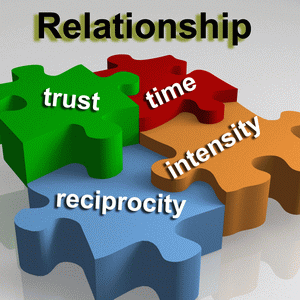 You have probably seen this quote from Carol Ann Tomlinson before, but it is so true it bears repeating frequently. I was reminded of this again this morning during my morning personal study time (yes, even on Thanksgiving day) when I was reading an article in one of my favorite periodicals, The Chronicle of Higher Education. An article entitled, “Colleges’ Prestige Doesn’t Guarantee a Top-Flight Learning Experience.” The article was about the National Survey of Student Engagement, which was released last week. This survey is known as Nessie, and was done to to identify educational quality at the institutional level. The data was collected last spring from 355,000 freshmen from 622 institutions. The research used two indicators for quality: student-faculty interaction and effective teaching practices. This research really caught my eye because of my belief in the three Rs of education: rigor, relevance, and relationships. The most important of which I believe is relationships. In fact I have blogged about this in the past. Click here to read my post entitled, “You Want Me To Do What? Teach.” Needless to say, my long and storied career in education would never have happened without the great relationship forged by Dr. Hobe Jones and myself. Obviously, this relationship has affected my feelings, attitude, and allegiance to Purdue University. I have been very blessed to have been very involved with Purdue in many ways since graduating with three different degrees.
Interestingly, this research involved asking students questions that included how often they talked with faculty members outside class about career plans, course topics, or other ideas. Wow, that is exactly what Dr. Jones did! We talked daily. Yes, you heard that right even on a campus on a university the size of Purdue with over 34,000 students. The College of Agriculture has mastered the art of making a big university small. It is really about understanding emotional intelligence. The days are gone when the preeminence of IQ as the standard of excellence in life was unquestioned; a debate raged over whether it was set in our genes or due to experience. But here, suddenly, was a new way of thinking about the ingredients of life success. Emotional intelligenc involves using emotions to promote thinking and cognitive activity. Emotions help prioritize what we pay attention and react to; we respond emotionally to things that garner our attention. Dr. Jones, through our relationship, was making sure I was paying attention to important decisions that would affect my life forever.
The other measure, which involved effective teaching practices, qualitatively analyzed the perceptions of how often their instructors clearly explained course goals and requirements, taught in an organized way, used examples to illustrate difficult points, and improve feedback. Amazingly, this list would be the same for what we would call highly effective teaching at the k-12 level. This is why the relevance part of the three Rs is so important. As we look at college and career readiness it is important we have our students ready for the teaching environment of post-secondary education. It was also no surprise that students perceived time spent improving teaching means less lecturing. Students participating in the study stated that instructors who were bettering their teaching used discussions, small group activities, student performances and presentations, and experiential-learning opportunities. It seems to me this research data allows for many partnerships between secondary and post-secondary education.
A Gallup-Purdue Index survey released earlier this year found that graduates were three times as likely to report thriving in their sense of well-being if they had connected with a professor during college. I am certainly proof of this. I believe this is true of k-12 students as well. Therefore, all of us in education have an obligation to be forming positive relationships and using effective teaching practice. After all, these are the right concepts!
Water The Bamboo
 I had the incredible privilege of meeting Greg Bell, author of Water The Bamboo this morning at the NWEA Fusion East conference. He was the keynote speaker and having read his book I was very pumped to hear him speak. I use the principles in his book and was excited to have him autograph it for me. He and I have also had great fun tweeting back and forth.
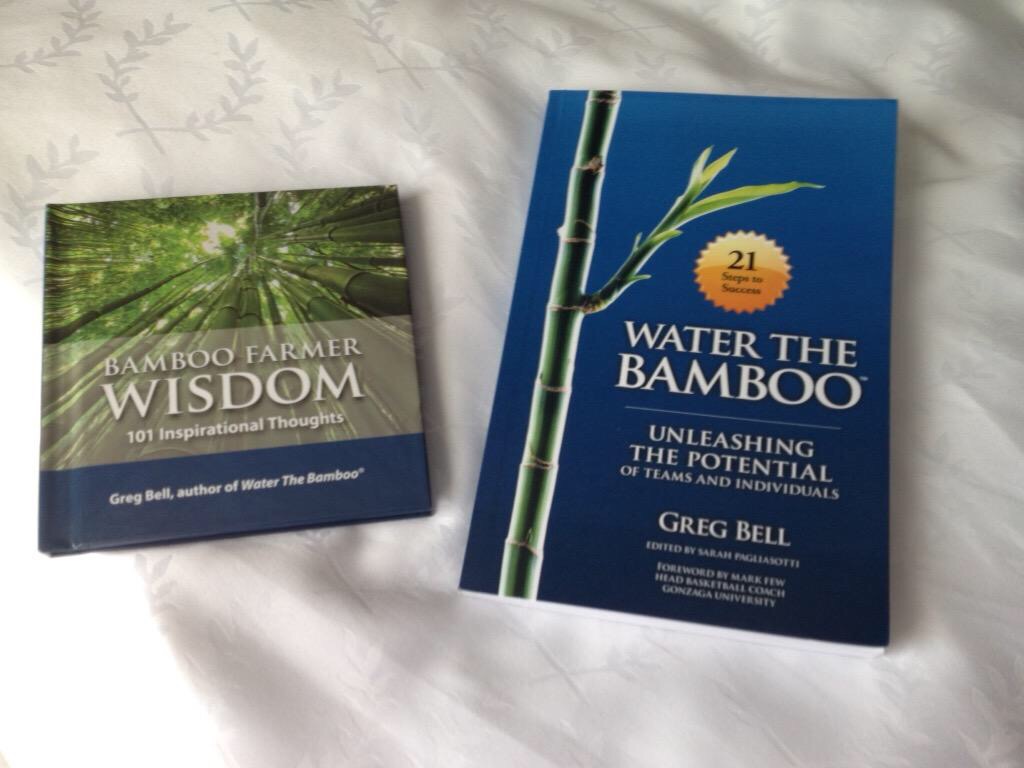
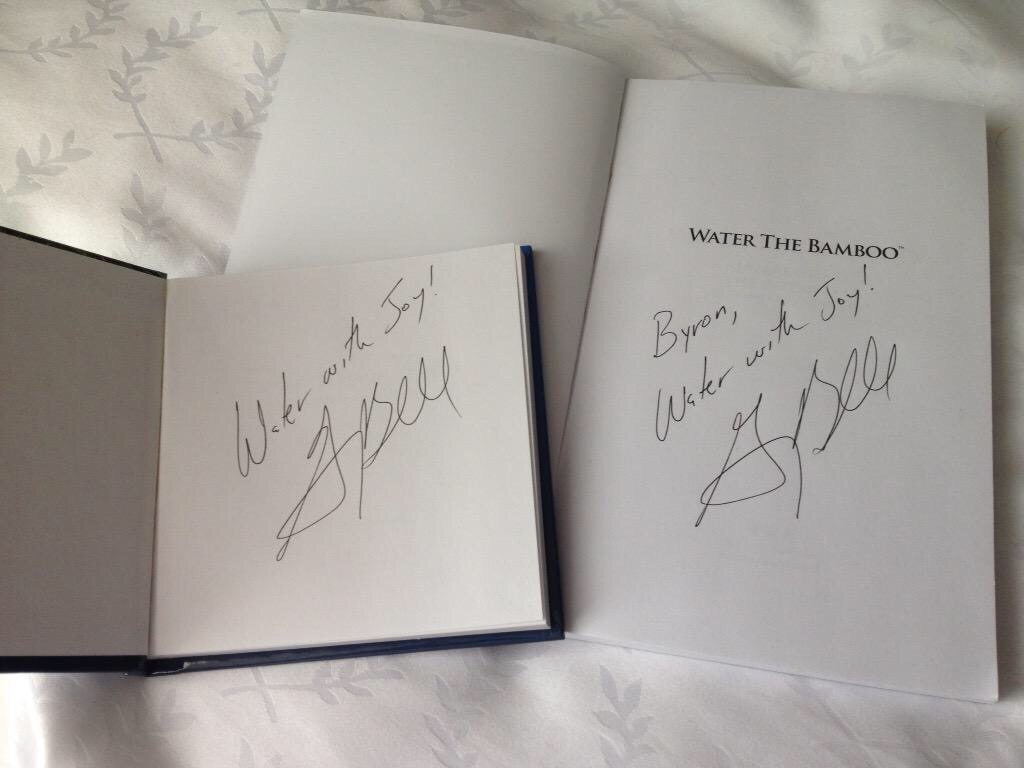 Let me tell you his keynote was just as inspiring as his book! He is awesome. During his keynote he had us all take the Water the Bamboo Oath. Needless to say, I and everyone else in attendance was inspired. I would like to share some of the thoughts with you from his speech.
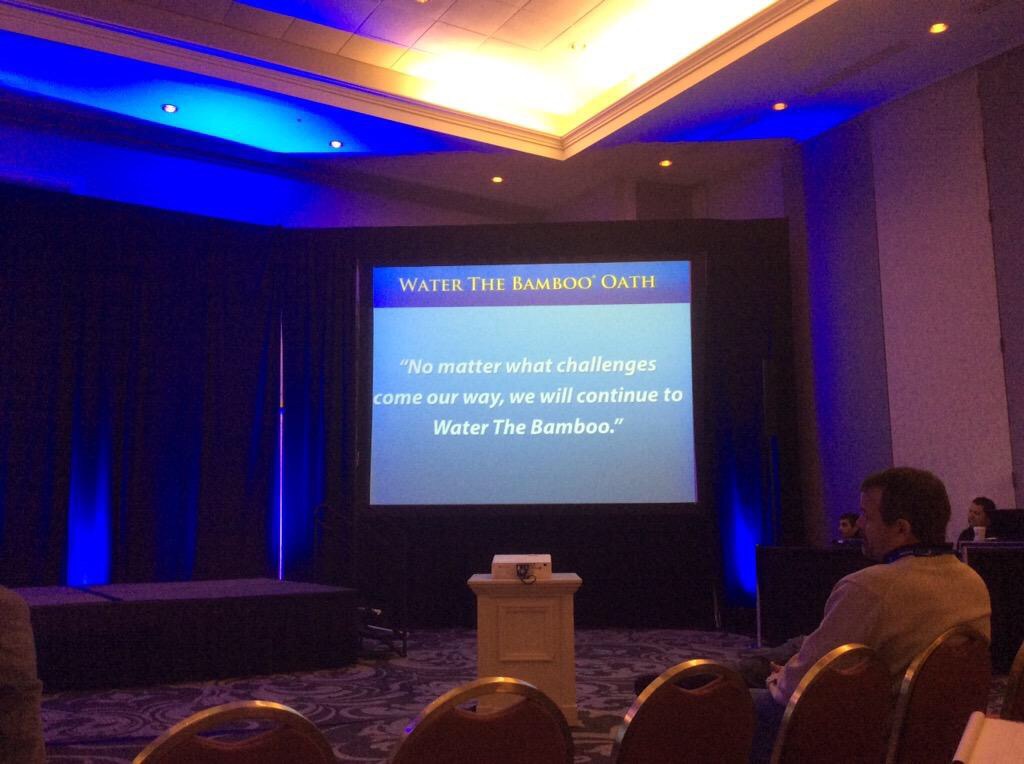 Here are the highlights:
– Sunrise or sunset…it’s all in your perspective
-Change your perspective; leave the either/or and reintroduce the “and”
-Instead of pushing, how can we stand side by side to address an issue?
-A person pushed against their will has the same opinion still
-Water the right intent
-How we talk to ourselves impacts our reality
-When you change the language you change everything
-Mindset of a Bamboo farmer: Patience, persistence, self-discipline, courage, and belief
-What are you holding on to? Bamboo sheds! Get rid of the things you no longer need. Focus on the right 20%
-Let go of your bad stories
-Don’t keep staring at the closed door. Turn around and look for the open one.
-Individuals and organizations who understand the relationship age will flourish
-Bamboo grows 90 feet in 60 days. Prior to that is shows no growth above ground for 220 days. Symbolic of many of our learners in our schools
-Start your day with this question: What’s going well?
-Don’t be a negaholic! Optimism always wins!
-We need to encourage our students to dream!
-Language matters in your organization’s culture
-Sweat the small stuff and the big stuff will take care of itself
-Catch reverse paranoia. Optimism always wins
-The word “student” in Latin means “eager to learn.” Are you cultivating this?
-Three things that will get you out of poverty: 1. education 2. education 3. education
-Are you a negaholic? Do you only see the negative? QUIT THAT! Instead, ask yourself what is going well.
 As you can tell, there was a lot of great information packed into our time with Greg Bell. Can you imagine how awesome all of our lives would be if we followed every bullet point above. Remember, we have an obligation to those we lead, particularly in our schools to be doing this. Also remember, every day with your students could be THE day!
Driven By Data
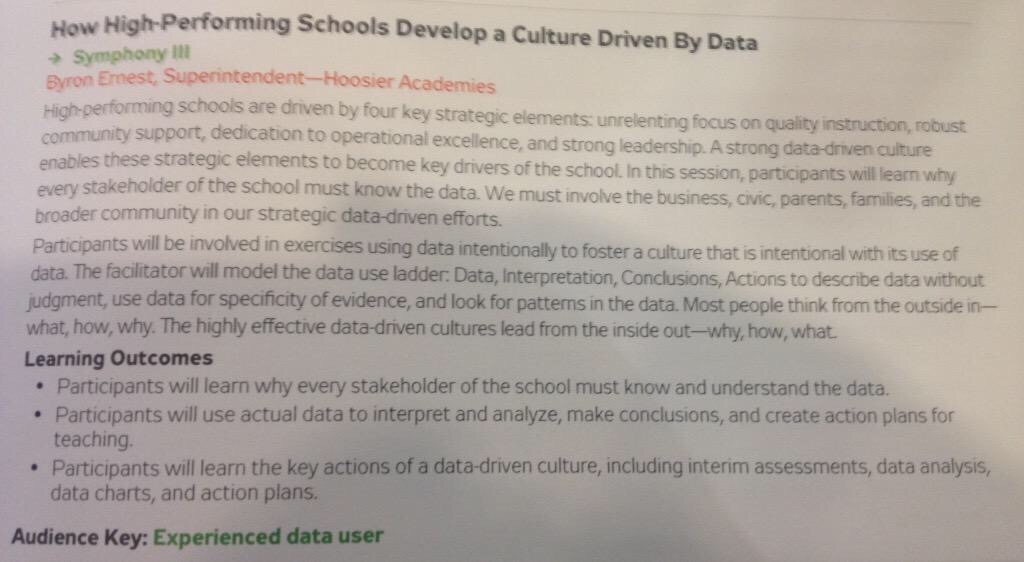
 This morning I was so honored to have the opportunity to present at the Fusion East NWEA Education Conference in Charlotte, North Carolina. The conference theme was “Tomorrow Starts Here” and my topic was How High-Performing Schools Develop a Culture Driven By Data. It was exciting to have a standing room only crowd and I hope I lived up to their expectations.
Here is the powerpoint I used for the presentation: Ernest_NWEA_FusionEast
Here are the handouts from the presentation: Ernest_NWEA_HOOSIER HYBRID 7-12 DATA MEETING PROTOCOL Ernest_NWEA_k-8_Data Meeting Protocol Ernest_NWEA_Data Meeting Rubric final
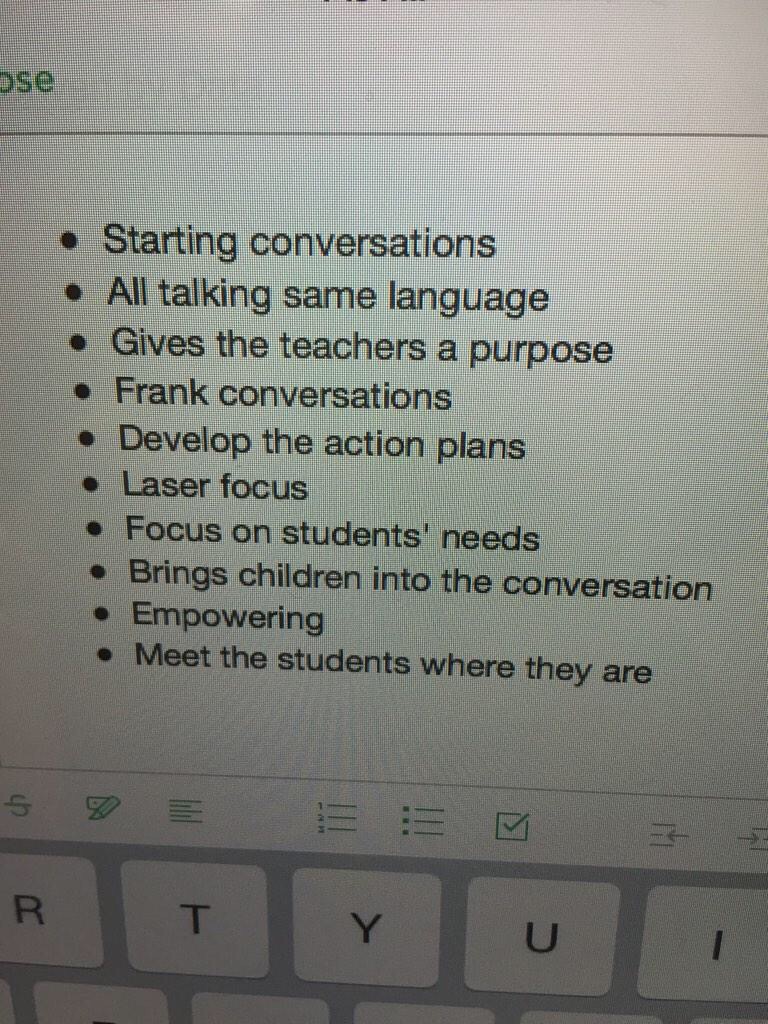
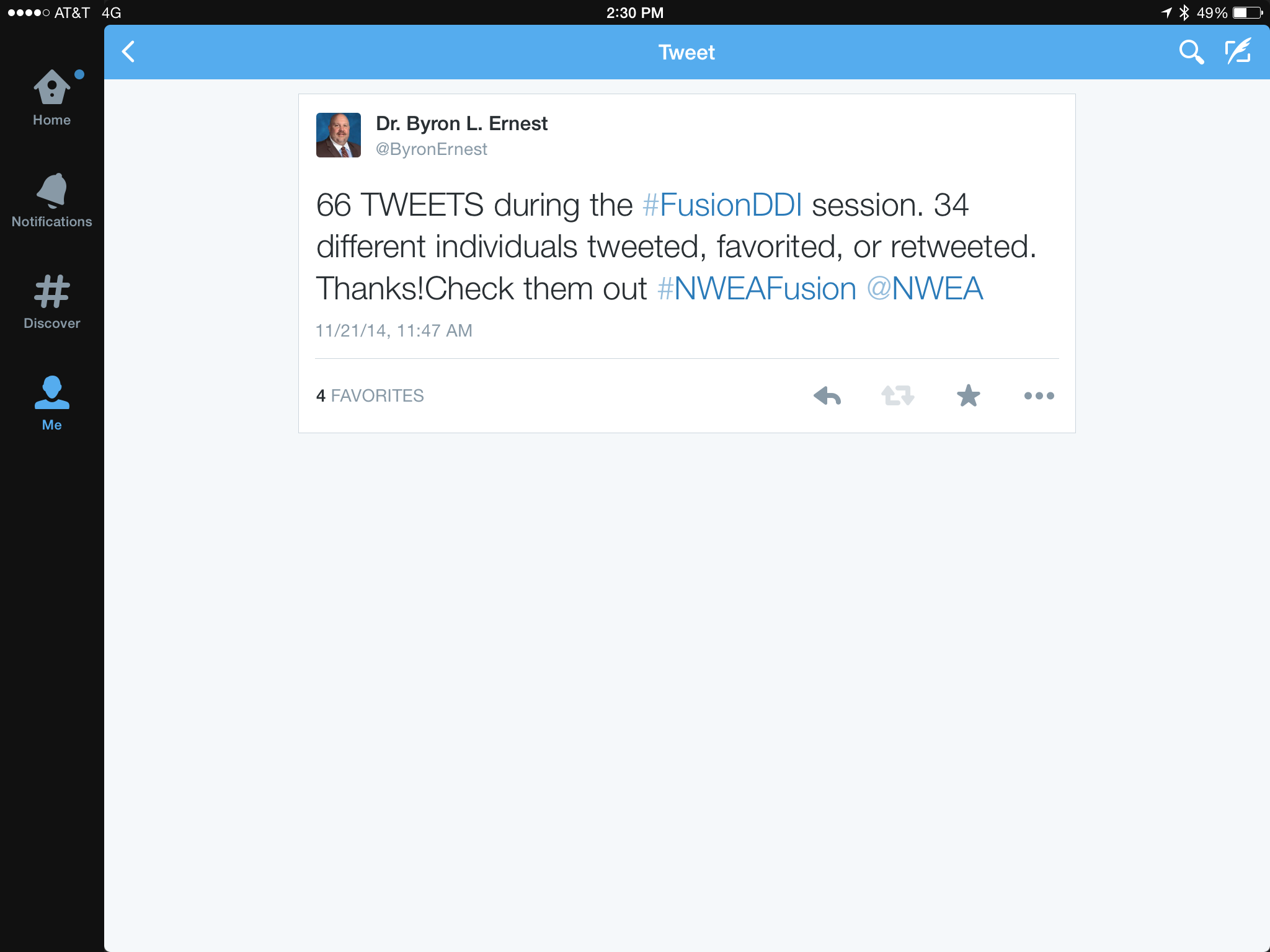
 I learned a lot from this group and have shared a list of reasons why we need to create a culture driven by data as a picture in this post. This list was the guide for a very lively discussion. We also had some outstanding tweeting going on during the program using the hashtag #FusionDDI. I am proud to say that we had 66 tweets during the program from 34 different individuals. This was outstanding and further proof of the power of twitter as a professional development tool. In fact I awarded the top five tweeters during the session with copies of the two books I referenced during the session.
 The books I referenced were Driven By Data by Paul Bambrick-Santoyo and Mindset: The New Psychology of Success by Carol Dweck. Both of these books offer so much toward developing a culture driven by data.
Finally, I want to give you some bullets of top tweets from the program:
-“If you don’t have time to do it right, when will you have time to do it over.” ~ John Wooten
-Data chats must be a regular part of your school culture.
-Data chats should be a safe place for teachers
-If your teachers change their teaching, can your students describe how it changed their learning?
-For a data driven culture to really work – there has to be coaching, observation, and feedback.
-Action plans developed after data analysis can be more effective if they are shared with your students.
-You have to describe the data without judgement
-If you don’t see it, it doesn’t exist.
-Assessments are about growth, not gotcha!
-Effective analysis – dive deep! What happened and WHY?
-Effective interim assessments should revisit material from earlier in the year, not just graded unit tests.
-Assessments must be cumulative
-We tend to assess what we taught best
-Data driven instruction gives proof that what we are doing is working, or not.
-Just because you’re teaching…it does not mean they are learning
-I wanna be a Sherpa! Let’s get good at using data! Not just me…but the culture of our schools.
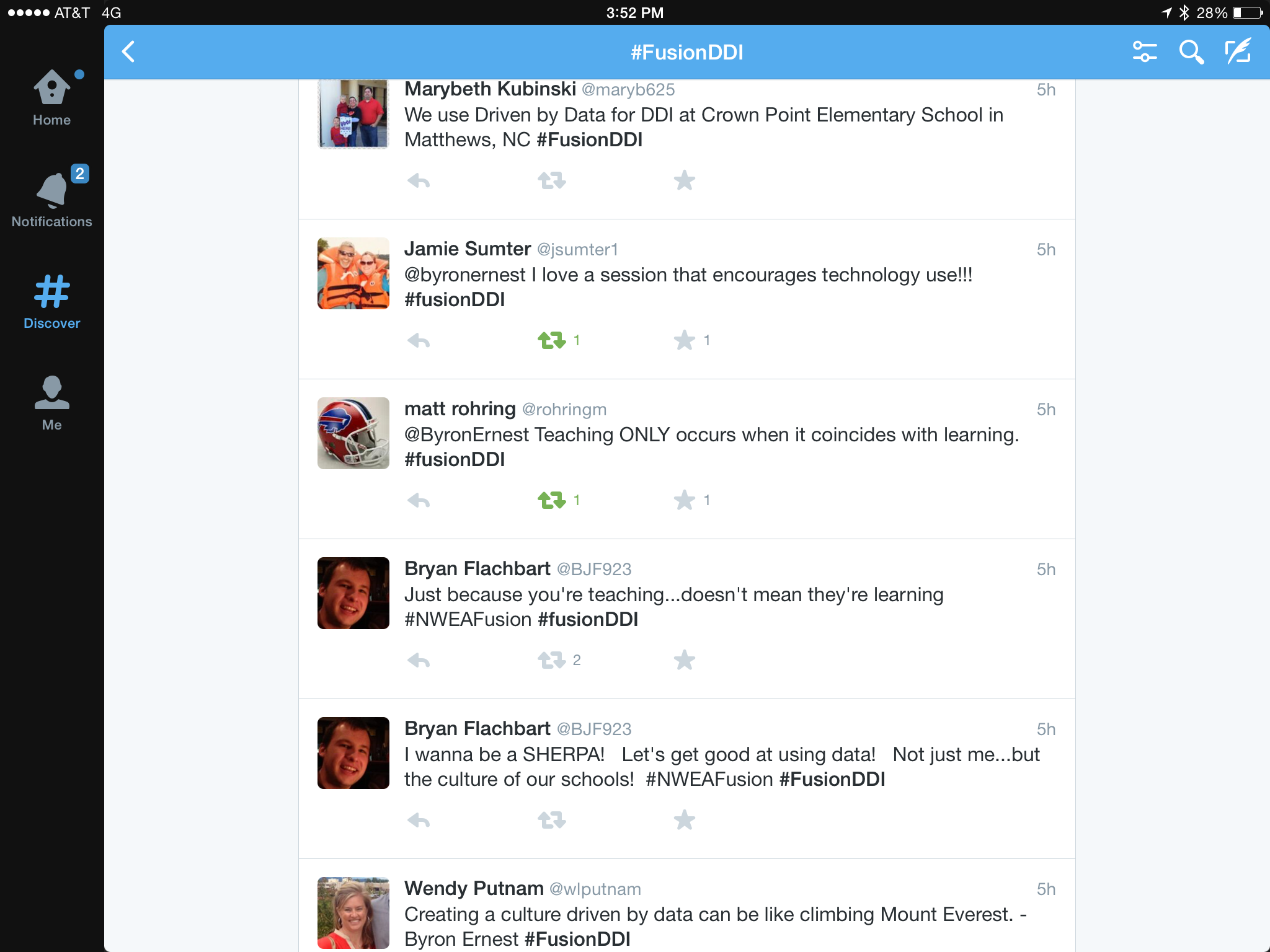 As you can see this was a pretty thoughtful group this morning. I hope I had a small part in helping them be Sherpas of their students’ learning.
“Deer In The Headlights”
 I have been to several great conferences lately and I realized something about some of the so called “experts” that present at the conferences. Now I have to be careful here because I was a speaker at all of these conference. But, I realized that in some cases the person doing the presenting has not had the experience of being the “deer in the headlights.” Usually this term is associated with being a bad thing, but I have come to realize that it really is a great thing. To really become an expert or great at leading in a certain area or circumstance you really have had to be the “deer in the headlights.”
Having successfully served as a principal for a takeover/turnaround school that broke the failing school cycle and came off the “F” list; I can say I truly was that “deer in the headlights.” I still remember that first day of the students coming in, the looks on their faces and saying, “what have I got myself into?” Then a week later after our first round of NWEA testing and seeing that only 19% of our students were on grade level, I was not only the “deer in the headlights,” but the deer smashed in the front grill of your car. Then we began to navigate and I fell in love with our students, as did the whole staff, and we turned the school around. That experience is truly at the top of my list for my career.
My experience under fire really honed me as an educational leader. I learned so many things that I could have never learned had I been in an “A” school. There were so many issues to navigate: students not on grade level, behavioral issues, staffing issues, students’ personal and family issues, operations issues, facility issues, extracurricular issues, teacher coaching, and many, many more. Don’t think for a minute that I believe myself to be an expert leader in all of those areas, but let me tell you I did have to lead the charge on all of these areas and I did learn and grow from it.
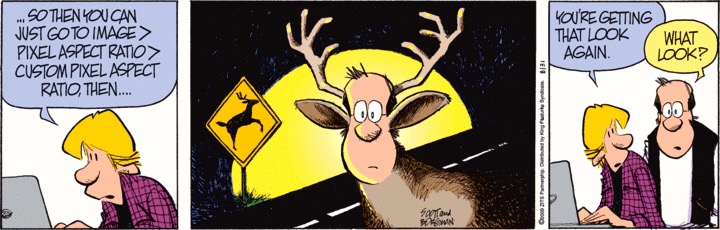 So, my point in this post to my blog is to not be afraid to be the “deer in the headlights.” Don’t be afraid to take on projects or career changes where you will be that “deer in the headlights.” I seem to have moments like that every day, but I am better and growing from it each and every day. I can think of many leaders who have become very status quo about their own professional growth and development. Really, those individuals are like old farm equipment sitting in the fence row rusting. Don’t let yourself become rusty.
I have been reading Water the Bamboo: Unleashing the Potential of Teams and Individuals by Greg Bell. I am so excited to be speaking at the same conference (NWEA Fusion East) this weekend in Charlotte, North Carolina. I can’t wait to have him autograph my book. In his book he suggests developing a personal mission statement. I did. It is: In my professional life, my vision is to always be the “deer in the headlights.” As Bell says, “To accomplish a great vision you will need laser-like focus.” Just imagine the learning I will be doing!
Eliminating Hoops & Hype in Education
 I have had an absolutely incredible first day at the 2014 National Quality Education Conference in Milwaukee, Wisconsin put on by the American Society for Quality and the ASQ Education Division. I was excited to speak on my research of connecting school work to real life, but was more excited to hear the other speakers. Additionally, as always, I learned a great deal from visiting with the other program participants. This post is a compilation of my learning from the first half of the day. You can also check out my tweets from the day by using the hashtag #ASQEd or following my tweets at @ByronErnest.

The day started with Lee Jenkins as the keynote speaker. Lee is education’s expert in continuous improvement. He started by talking about removing the hoops and hype from education. Hoops were described as waste in a school’s time, money, and enthusiasm (staff and students). Hype is a change with no way of know if we’ve improved. The secret to removing hype, according to Jenkins, is to have baseline data to know if an intervention is working or not. Much of Jenkins thoughts on this come from the book: The Toyota Way To Continuous Improvement by Jeffrey Liker.
It is very important that we take an attitude of wanting to be superior to our former selves. If you think about this from a school improvement standpoint it makes perfect sense. We have a starting point and just need to keep getting better from there. Our goal here needs to be to outperform the year before. The secret to this improvement is root cause analysis. When you dig into root causes you find things you never expected to find. When we know the root causes we are able to remove what Jenkins calls “Blamestorming.”
Think about that term “Blamestorming.” We have all done it. We can blame the legislature, political leaders, school leaders, lack of time, too many standards, standardized tests, lack of money, too much money, too many programs, et cetera. But, these are not really root causes. We must dig down deep and find the root causes. Think about this question: Was it the reading program we purchased that improved reading, or the fact that the program required that we triple the amount of time spent reading every day? Think about that. If the root cause was needing to triple the amount of time reading we could have done that without any new program cost, professional development cost, or all the other woes that come with implementing a new program. It is why programs and initiatives don’t work – teachers do! That’s me talking there; not Jenkins.
Remember, if we eliminate the hoops and hype we can optimize our systems for our students and employees and optimize the delivery of our curriculum.
Connecting School Work To Real Life: 2014 National Quality Education Conference
 The challenge to all of us in education is to find ways to make learning visible by connecting school work and real life for the students we serve. One of the ways to do that is to call on “the hand in the back of the room” and answer “why” with real world relevancy. Students understanding, mastery of basic science curriculum, and ability to use science concepts have been shown to improve when the science concepts were taught in the relevant and real world context of agriculture. Teachers many times fail to provide a context through observations, inferences, and actions appropriate for students to make the connection to the real world. These connections help the students to understand higher-level science concepts.
Through my research I investigated low student achievement in science and the social change impact of real world application through a study of agricultural science. Other current research on teaching science in a relevant context and the opportunities for cross-curricular collaboration were also investigated. I will be presenting on how to use transformative educational strategies to help students move from memorizing facts and content to constructing knowledge in meaningful and useful ways.

I am very excited to be presenting at the 2014 National Quality Education Conference this Sunday, November 16th in Milwaukee, Wisconsin. I will be presenting my research on the effects of teaching science concepts in the real world and relevant context of agriculture. While at the conference I will be tweeting using the hashtag #ASQEd. I will be encouraging those attending my session to follow me on twitter @ByronErnest and also tweet using #ASQEd.
Here is the Powerpoint presentation I will using in my presentation: NQEC2014_Ernest
Here are PDFs of the handouts I will be referencing: Ernest_NQEC2014_Handouts_1 Ernest_NQEC2014_Handouts_2
Being an educator can bring an array of challenges. How can you continue following standards, make learning fun and innovative for your students, encourage creativity in the classroom, raise state testing scores, ensure students are college and career ready, and apply student learning in unexpected ways? Discover how continuous improvement strategies, tools, and support can be implemented in order to improve processes to help address some of these challenges and increase student achievement at the 2014 National Quality Education Conference.
Key Learning Outcomes for the 2014 National Quality Education Conference:
1. Discover innovative ways that processes have been made more efficient to allow resources to be applied in unexpected ways from pre-K–12 through higher education.
2. Learn how the Baldrige Criteria can be applied to improve learning, services, and fiscal health.
3. Understand measures that have been taken to narrow achievement gaps and ensure that all students are achieving their goals, regardless of baseline data, and socioeconomic background.
4. Learn advanced practices in continuous improvement as applied to classroom and broader institutional improvements.
5. Find out what tools, practices, and professional development programs designed to assist districts in implementing Common Core standards and in measuring achievement based on these standards.
As you can see it is going to be an exciting learning experience. Don’t forget to follow my tweets from the conference at the hashtag #ASQEd.


1 comment