Let’s Talk Student Engagement: Part 1
 This morning I started a new iteration in supporting teachers and administrators during this time of remote learning due to the COVID-19 Pandemic. We are now doing 30 minute small group supports. I made two different types of support and one of them is called, “Let’s Talk Student Engagement.” The idea is to have groups of five teachers working together, coming up with solutions to increase student engagement and share expertise. I have to say I really enjoyed my first session. We had a great discussion around how to do better at engaging students.
One teacher stated that she has done away with worksheets and switched totally to projects. She is giving the students three to four choices of what project he/she wants to do. I am a huge proponent of student choice and agency when it comes to education. We also discussed the value in staying a little more general or broader in topic. In other words, don’t get to specific. Also, chunking content into smaller pieces is a best practice. Learning online can be physically, mentally, and emotionally taxing. Use of long reading passages or big projects is not advisable, unless chunked very intentionally. I philosophically believe in the Self-Determination Theory, which holds that we are most deeply engaged, and that we do our most creative work, when we feel that we are acting according to our own will on behalf of goals we find meaningful.
From a pedagogical standpoint it is very import to remember it is very important to allow for:
- in-depth discussions
- group work/projects
- both watching and creating video/audio clips
- hands-on projects
- individual time to work
“In the midst of every crisis, lies great opportunity.” ~ Albert Einstein
Albert Einstein is credited with saying, “In the midst of every crisis, lies great opportunity.” We should not forget to look at the opportunity in front of us. One of the great advantages right now, teaching virtually, is the ability to individualize and personalize like never before. There must still be the opportunity for students to have peer/group interactions and very clear expectations. We must enable our students to work autonomously, but yet develop and enjoy learning relationships with others, and feel they are competent to achieve their own objectives.
Gaps In Our Consistency
 At one of our most recent gatherings of 3D Leadership, a topic came up that the participants were calling “gaps in our consistency.” When I asked about these gaps they said they were the things that really kept them from being great teachers and the schools which they taught from being as great as they could be. One of the most important tools in effective schools is consistency. Research and practice have proved that school leaders and teachers must be consistent every day in carrying out their duties if they want to improve student performance and conduct. Here is what the teacher leaders said the gaps were:
- Being Reactionary
- Everything done short term/constant change
- Lack of training to make sure initiatives/processes could be implemented
- Relationships must be in place for there to be the trust for everything to be going well
- Besides the why, there needs to be the what and the how
- Teachers need to teach and not be auditors
Really, what any teacher wants is to be able to get to work and feel like what he/she is doing are the right things to be doing. What teachers don’t need are things constantly changing or different expectations or directions. These result in confusion. It is really about being on the same page and staying on the same page. Consistency really can be the protagonist or the villain of great accomplishment. There is a difference between being agile and continually changing focus, priorities, and behavior patterns.
One of the biggest problems that inconsistency brings on an organizational and personal level is a loss of trust. Judgement becomes not trusted, follow through on initiatives is not trusted, and trust that what is being implemented today will even be important as soon as tomorrow. The administration and staff must operate like a single coherent unit. If we are able to build this consistency in any organization we can build what researchers have called a “culture of consistency.” We need to recognize our gaps in consistency; delivering consistently can have a profound impact on our effectiveness.
Whether It’s Spinning Plates or Juggling Balls, We Can’t Afford To Drop Either For Our Kids!
 Remember, This Is a Marathon: We Want You To Still Be In The Race At The End Accept, Acknowledge, Ask, Adjunct Teaching, Advice
We need to take time to reflect on what it means to truly form a partnership between schools, teachers, and parents and consider how we can shift our practices in ways that will extend well beyond this crisis. I had the tremendous opportunity and honor to be a part of an event hosted by Kevin Eikenberry of The Kevin Eikenberry Group this past week. It was titled ‘Juggling Balls You Can’t Drop: How To Be Successful Parent, Employee, Teacher (And Spouse) Without Going Crazy. Kevin had asked me if this was an important and timely topic, and I very quickly responded with, “Absolutely!” Then it became important to pick a great teacher to be a part of the project that was doing an awesome job of supporting parents and students. Kevin left that job to me and I could not be prouder of who I picked. I had worked with Katty Pacheco, 2nd grade teacher at Renaissance Charter School at Boggy Creek in Florida, before on webinars for teachers and knew enough about the support she is providing parents right now in this time of remote learning to know she would be a great choice. And…she certainly proved me right. The parents on the Live With Kevin event really appreciated her comments and advice. It was such a great event. If you missed it, here is the link to watch the event and see materials provided from the event: Juggling Balls You Can’t Drop: How to be Successful Parent, Employee, Teacher (and Spouse) Without Going Crazy.
 I decided to do this post to share not only the link about, but to share out the thoughts I have developed prepping for the event. I’m coming up on a month of working from home and as long for many of the schools I work with being transitioned to remote learning. During these unprecedented times we all are doing the very best we can. I had the opportunity to present to the SMART Factory League global event last week too, and I will be posting my thoughts on things we need to be thinking about moving forward. One thing we need to keep in mind is what my friend and great author, Nora Bateson, said in Small Arcs of Larger Circles: Framing Through Other Patterns: “No one is qualified to talk about uncertainty. You cannot get a degree in it yet, to the best of my knowledge” (location 437/3376, Kindle Ed.). While learning virtually has incredible potential, the very piecemeal efforts are not a very good substitute for real classrooms, in most cases. The school closures across the country have real consequences for our students academically.
Schools are the cornerstones of most communities and play a role that goes far beyond academics. Our schools support the nutritional, social and emotional well-being, and other health considerations of our children. This situation has many parents overburdened trying to support their child’s education the best they can. There will be gaps in education and students behind as a result of this COVID-19 Pandemic, but we must work to learn from this experience and be ready when the call comes to re-enter our schools. All of our focus cannot just be on making sure every student has internet access, even though that is an important consideration.
Accept that you are our students’ most consistent teachers, and right now you are their only in-person teachers.
- Remember to differentiate, just like your child’s teacher would. Students who tend to be independent self-starters will thrive in a more unstructured environment. Without “wasting” time on commuting to school and having recess or dead time between class periods, they will likely become increasingly productive. Other children may require more guidance and outside motivators to continue to thrive academically.
Don’t change everything that you are doing (bring old routines to your new normal)
- Acknowledge that being a working parent from home is the most challenging
- Do not reinvent your schedule (at least to the extent you don’t have to)
- Create a daily and weekly calendar (include daily routines)
- Set boundaries and even assign roles for everyone
- This can include assigning childcare and “adjunct teaching” time for family members
- Schedule breaks in and some time for unstructured fun
- Virtual play-dates for kids and adults
- As an adult have something to look forward to at the end of the day (eg. Virtual happy hour, cooking the evening meal, family movie night, go for a drive or walk)
- Zoom (or whatever platform is being used) lunch for the kids. Suggest to your child’s teacher that students have a set lunch time and all the students sit down and eat with their cameras and mics open.
Don’t be afraid to ask
- We need to lean on our village now, more that ever (eg. Parents, kids, teachers, community members)
- Ask your teachers for resources, ask your teachers for a weekly schedule, ask your teachers for help
- Ask your teachers for a weekly “office hours” for parents to explain what will be happening that week or the next week and anything parents need to know to be successful adjunct teachers.
Your kids will give you good advice
- This is a chance to give kids a chance to be leaders of their own learning
- Ask what resources they like best
- Let your children be a part of developing the daily and weekly schedule
- Give your students agency and choice
Accept that things are not going to run 100% smoothly and we are not all going to be our 100% productive selves.
 Byron’s Book Recommendation:
The Power of Showing Up: How Parental Presence Shapes Who Our Kids Become and How Their Brains Get Wired by Daniel J. Siegel and Tina Payne Bryson
Resources:
Noble Education Initiative Learning Hub:https://www.nobleeducationinitiative.com/services/learning-hub
The Smithsonian Institution: https://www.si.edu/collections & https://www.si.edu/openaccess &
https://airandspace.si.edu/anywhere
Time For Kids: https://time.com/tfk-free/
Khan Academies Kids:https://learn.khanacademy.org/khan-academy-kids/
Educating Students To Improve The World
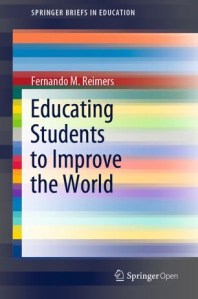 The book Educating Students to Improve the World, written by Harvard Professor Fernando M. Reimers, presents an inspiring and bold vision of how schools should be organized to cultivate a range of skills and dispositions that effectively educate students to make the world better. The book is unique in the breadth of the scholarship it integrates and in how it builds a sensible model to understand the process of educational change that honors the multidimensionality of the process. It is, at the same time, a very scholarly book, an erudite treaty of the field of global education, and a very practical book, a book that makes sense to those in the business of leading schools and school systems.
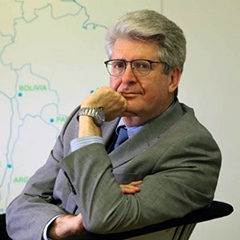
Professor Reimers
The idea that the book contains is simple, yet holds remarkable potential to transform education around the world. The big idea the book contains is that public education, as an institution of the Enlightenment, was meant to be global since its creation, but the obvious global nature of many of the challenges facing humanity requires that education becomes intentionally global. Professor Reimers argues in the book that formal education should be aligned with audacious and hopeful visions for a more inclusive world, such as those contained in the Universal Declaration of Human Rights or in the United Nations Sustainable Development Goals. Such alignment involves defining what kind of competencies would actually help students care about and have the skills to make a difference in advancing a more inclusive and sustainable world. With such clarity on the expected learning outcomes for students, the curriculum would then map backwards an instructional sequence to gradually support students in a rigorous process of development of such competencies.
But the merit of this book goes beyond articulating why education should help students develop a sense of purpose, aligned with ambitious purposes of building a better world, it then explains how structuring effective education programs requires that the process of change is advanced multidimensionally, reflecting a cultural, psychological, professional, institutional and political.
The ambitions of the book are considerable, to bridge an evident schism between the scholarship and practice of global education. The book is an intellectual tour de force tracing the history of global education to the very creation of public education systems, and integrating research reflecting a variety of disciplinary perspectives in support of a conceptual framework in service of more coherent and effective educational practice.
Enhancing the credibility of the ideas in the book is not just the fact that the book is well researched and crafted, but that it builds on a long practice of the author actually doing the very things this books recommends should be done to develop a relevant curriculum. Professor Reimers invented an approach to take bold goals, such as the United Nations Development Goals, and translate them into student learning outcomes, and then curriculum and pedagogy. It’s a simple and intuitive idea, but it had not been done before.
It is the combination of the powerful idea that education should be aligned with ambitious goals for inclusion and sustainability with a theoretical model of how to structure efforts to translate that idea into changed educational practices that makes this book unique. It is not surprising that since it was published, as an Open Access resource by Springer, a week ago, the book has already been downloaded 24,000 times.
The book can be downloaded here https://www.springer.com/gp/book/9789811538865
Easter Isn’t Canceled

Baseball was not canceled during the Pandemic of 1918-1920
Today, I chronicle thoughts, here in my blog, on a new page in the book that is the story of my life. I have been doing some personal growth studying, with the help of the Woodrow Wilson Presidential Library and Museum, on the pandemic of 1918-1920. My motivation this morning is that I am always moved by the personal stories written by people experiencing an event first hand. The most interesting and compelling speak of what was happening, the mood of the country and those around them, and what he or she was feeling at the time. I’m going to attempt a little of that this morning. I also believe if we are not using this as an opportunity for our children and students to write an account of something that will be undoubtedly written about in textbooks, or whatever our kids’ grandchildren will be using, we have missed a chance to process and save the realness of our experiences real-time.
Queen Elizabeth II shared a video message yesterday that was quite moving. Click here to watch it. The genius of her message was how different parts of the message have and will inspire different people in different ways. For me it was when she said, “But Easter isn’t canceled; indeed, we need Easter as much as ever.” No doubt things will be different today for most of us. But, Easter isn’t canceled, and different doesn’t have to mean bad.
 One of my fondest memories growing up was of our Easter morning Easter egg hunt. We’d get up and go find the eggs hidden all over our very large yard that included barn lots. Interestingly, the one thing that I remember most vividly is the blue egg, and it was always a blue egg, put on top of an electric box on the back side of the house. I need to point out that these were real boiled eggs, usually a few duck eggs mixed in because we raised ducks, and my mom and sister colored them – I wasn’t much into coloring Easter eggs (that involved being inside and standing still – some things don’t change with age). My dad was so proud of that hiding spot on the electric box (not sure why). That became a special spot, however, because the first Easter we lived in that house my dad, after I spotted and claimed the egg, had to lift me up to get the egg. The next year I could reach it and every year after that that egg was mine, and my dad would always laugh and say, “You need me to help you get that one?” I’d say, “No!” We’d make eye contact and now having a son of my own I think I know what was going through his mind.
 Easter isn’t canceled because of the COVID-19 Pandemic and my son will have an Easter basket (yes even at age 19) this morning. We will go to church via Zoom and then have the traditional Easter brunch of “One Eyed Connelly’s (that is the family name for a piece of toasted bread with a hole cut in the center and an egg cooked in that hole), sausage links, and cinnamon rolls. I’m sure there will be Easter egg hunts with the nieces and nephews to be joined virtually on some electronic platform or another. And, how cool is it we have those platforms? We are connecting more, socially, than ever before. Physical distancing (as I am calling it because I hate the term social distancing) is not keeping us from socializing.
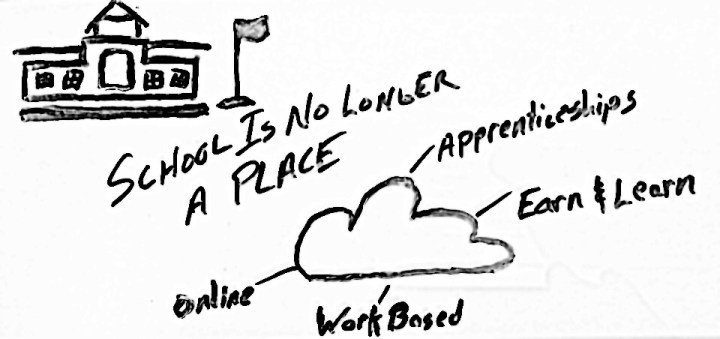 I went to my first virtual Happy Hour last week – very fun. Also, I popped into a teacher’s lunch bunch. She has all her students get their lunch and they all log into Zoom and eat together. Students get social time with their fellow students and teacher. Everyone turned their mic on and it sounded just like a traditional school lunchroom. I hope we use our pandemic experiences to get education in our country to a place where we could say, “School isn’t canceled.” I realize that is a tall order, but we need to contemplate what that would mean. We need to think about the fact school is no longer a place. We need to think about the why behind professional working parents being so frustrated with being adjunct teachers now. Continuing to educate, which I believe we need to be doing, cannot be about providing busy work and crappy worksheets. It needs to be about great content, accessible by all, and delivered in a way the student can easily access. Now becomes the time to decide what education will look like during the next pandemic, other crises, or just moving us into the next decade.
Today, however, Easter isn’t canceled. During the pandemic we are distanced, clouded by the threat of disease, but stubbornly persistent. Realizing this is usually a pastel colored and celebratory day, this might just be a season of clarity about what it means to be a person of faith.
March Flowers 🌼
 Sometimes we need to look no further than our children for inspiration in times of crisis. This was true this past weekend for me. As I read all of the different statements being put out this week by businesses and organizations, I couldn’t help but think that the simple things we are taught as children should guide every decision: the Golden Rule and what is best for others. Maybe just some good ole empathy and compassion.
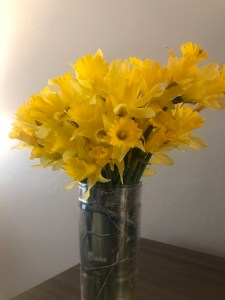
We went down to help move my son home from Murray State University this past weekend. It was tough on him to be leaving a place he has grown to love and all his friends. He was visibly upset. There was definitely mental impact at play in him having to move home because of the coronavirus. Even during this trying time, he took time to pick a clump of March flowers (daffodils) for his mother (pictured here). We’d never heard them called March Flowers. Heath told us it was a Kentucky thing. He explained, “Spring is here, new life is blooming in spite of the coronavirus.” That’s my boy, finding some beauty and positivity during a time of crisis. That was a moment I will savor forever.
As I watch groups and businesses contemplate how to get the most out of their employees at this time of global crises I can’t help but think these so called leaders have missed the point. Right now we should be thinking about how best to care for those we serve, period. And, as someone who doesn’t sit around and pontificate about a virus I know nothing about, the best thing to do is have everyone staying at home. I’m surprised how many people have become experts overnight.
In the case of k-12 education we do need to be concerned for the learning of our children. We also need to provide parents with resources to help their students along with our teachers. We need to be cognizant of the mental impact that the crisis we are living through can have. Schools need to make sure resources for parents are available so they can reinforce social-emotional skills at home and know who to contact if they are concerned about an issue impacting learning online or just in day to day life.
Staying positive is the core ingredient in the recipe of successfully coping in a time of crisis. Now is the time to be proactive in creating small moments of happiness in our days. Positive emotions help us to undo the negative effects of stress.
Play Time For Leaders


I so enjoyed my extra day that we all had today because of this being a Leap Year. I spent the day with aspiring teacher leaders at Knowledge Academies in Nashville, Tennessee facilitating a 3D Leadership gathering. Because I am always so inspired at each of these gatherings I tend to have something to blog about after most of them. Today was no exception, and because I so wanted to have a February 29th (Leap Year) entry – here it is. Today’s through line of the program titled The Focused Leader was “Your Leadership Toy Box.”
“To infinity and beyond!” —Buzz Lightyear
The first activity involved the participants picking a toy, playing with the toy, and then answering the following questions. If this toy was in your Leadership Toy Box:
- How does this toy represent great leadership traits?
- How could you use this toy to be a great leader?
We then shared these out after some quality play time. I was so blown away by the responses that I asked for volunteer guest posts to put into this blog post. Here are three of those responses:
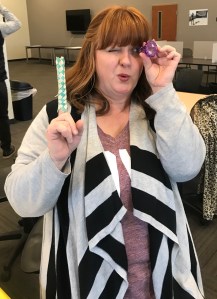
Lori Tharp
Toys and Leadership?
Today in the NEI 3D Leadership Cohort session, we were asked to select a toy and explain ways it could be a leadership tool. I selected two – a kaleidoscope and a Chinese finger trap. I was excited to answer this question since I have always been a kid at heart! After all, toys have always been a part of my life: My kids played with toys. I used to work in Children’s Ministry, then I worked as a preschool teacher. My husband sells vintage and current toys and one of my favorite movies is Toy Story! – so, this was “right up my alley!”
When I looked into the kaleidoscope at an object, I could see that the one image turned into many objects – showing a whole new perspective of the image with many facets. When I turned the kaleidoscope around and looked through it at the opposite end, I could only see one image. As I apply this to leadership I realized, as leaders, we should learn to see the things from a wider perspective – or different angles. We can all have the same goal or the same focus, but we need to be able to view ideas, opinions and suggestions from the perspectives of others, and ultimately, work together as a team…which leads me to the other toy I selected – the Chinese finger trap.
Looking at the Chinese finger trap – a simple little toy that traps the victim’s fingers in both ends of a small cylinder woven from bamboo. If you place your fingers in each end and pull outward, this only tightens the grip of the trap. Push your fingers together, it loosens up. The pieces of bamboo seem to be very fragile, and if it was only one piece, it would probably break. This little device is actually many pieces of bamboo woven together, which makes it very strong as one small unit. This reminds me of leadership. Working together as a team, makes us a stronger, tighter unit. We can accomplish more together than we can alone. Good leaders are aware of this, and they value the input of the other team members. Sometimes, though, we need to tighten up as a team, and sometimes we are so rigid we need to loosen up! Either way, leaders work as a team!
The possibilities are endless if I were to use these items in the classroom as a leadership tool. I could just imagine the kids in the class exploring these toys and finding fun and creative ways to use them. I could learn just as much from them!
“I realized, as leaders, we should learn to see the things from a wider perspective – or different angles.” ~ Lori Tharp
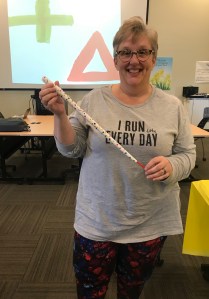
Jane Rogers
Chinese Yo Yo….. A leadership tool???
I was asked today to explain how a Chinese Yo-Yo as a leadership tool. At first, I thought “Why did I pick this toy?” Then after studying it, I thought as you throw the paper out it could be really fun to just bug people with it and see how long it would take to get them to ask me to stop. As I studied it I saw that there were different colored dots and different sizes. The larger one made me think that a leader needs to be “big” and strong and take charge. The medium dot represented that a leader needs to know when to step back and mix in and work collaboratively with everyone. The smaller dot reminded me that a leader must allow the team to be forefront and allow them to grow and shine. A good leader should know when to take charge and when to step back. As I played with the toy, throwing it out and in, it showed me that a leader needs to be flexible, adjustable, fun and maybe slightly annoying. I can see myself using it in my classroom, as a pointer to get my kids to stay engaged and would want me to call on them by slinging the toy towards them. So yes, a Chinese Yo-Yo can be leadership if you allow your self to look at it in a way you might never have thought of.
“A good leader should know when to take charge and when to step back.” ~ Jane Rogers
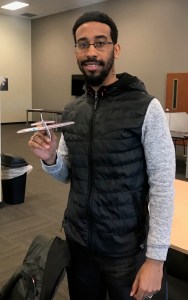
Quintarius Grigsby
Up Up & Away
Hello my name is Mr. Quintarius Grigsby. I am a Science Instructor at Knowledge Academies, basketball coach, and Christian minister. I teach Biology, Physical Science, Chemistry and I have a a background in Agricultural Sciences. At the 3D Leadership meeting the toy I chose was the World War ll Hell Cat Fighter Jet replica. Its symbolic warlike features resonated with me in such a way that I had to choose it as an identifiable leadership tool. Due to its frame and features it helps me to to remember how disciplined I am, and that I am free enough to believe that the sky is the limit. Bombs and missiles represent potential power that is destructive upon release. I believe just like the Hell Cat Fighter Jet, I have the power and influence to destroy the negatives which represent the enemy that limits us from being successful. The wings on the jet also represent freedom. This toy replica can be utilized to inspire others who desire to ascend beyond where they are now. (Leadership is a process, not a position.)
“Due to its frame and features it helps me to to remember how disciplined I am, and that I am free enough to believe that the sky is the limit.” ~ Mr. Quintarius Grigsby
We really can, as you just read, learn a lot from playing with toys. Toys can inspire new ways of thinking about leadership, teamwork and accomplishing our goals. Whether it’s motivation, wisdom or practical advice, there are some great lessons we can all take away.
Serendipity Mattered
 This week while continuing to read Great Society: A New History by one of my favorite authors, Amity Shlaes, I found the shortest sentence in the book: “Serendipity mattered” (p. 188). Serendipity has always been an intriguing word to me that I have had trouble understanding because I here it being used in different ways. But when used in the context of Shlaes book, in a two word sentence it made perfect sense. The sentence “Serendipity mattered” really drove home the point she was trying to make and really made the lightbulbs come on for me.
 In other words, there needs to be serendipity for innovation to occur. So what is serendipity? As I said earlier, I have trouble understanding it fully, but I know that when conditions are right for it, great things happen. Serendipity is said to happen by simple chance. An opportunity that comes about by a chance occurrence. Therefore, we must create the opportunities for these occurrences. This was the point that Shlaes was making in the book. The Fairchild Semiconductor company realized they needed innovation. They also realized that looseness of hierarchy drove innovation. Thus, “Serendipity mattered.” It is also why we need to beware of the current tides toward any of the Great Society’s socialistic tendencies. This will stifle the serendipity that is so needed.
 I touched on serendipity in my blog post Alternative Truths back in 2017, but only to say that we need to be intentional to create space for serendipity to occur. Therefore, I needed to study a little more. Research led me to find that our use of the word serendipity comes from The Three Princes of Serendip. The musician and poet, Amir Khusrau wrote this Persian tale in 1302. The tale is about King Jafer and his three sons. He wants them to have the best education in the kingdom. The King believed that great book learning needed to be combined with a real world context. Wow, I preach that all the time! In fact, I wrote a book, The Hand In The Back Of The Room, about it!
Anyway, the king gave each of the boys a horse and told them to go discover. The boys relished and took advantage of this experience. They learned from being on a journey of taking in real world experiences. Then in 1754, Horace Walpole coined the word serendipity in a letter. He described serendipity, by referring to the tale of the three princes, as making discoveries, by accident and sagacity, of things which they were not in quest of. He was excited about this word because there was no word to describe the discovery of something you are not looking for. It was really accidental sagacity.
Then comes the question, how do we create space for serendipity to happen. It probably won’t work to get everyone a horse, but I’m certainly up for it. Think about all the great inventions and innovations that have happened by accident. We need to remember in all this that creation precedes innovation. We need to provide ourselves and others varied routines and time for serendipitous moments to occur. It is why the story of the king sending the princes on a horseback adventure is so important. They’re heads were clear and they were just observing. Think about it; it’s why just taking a walk to clear your brain can bring creative thoughts and solutions. I do this a lot when facilitating teacher leader gatherings. I will tell them to split into groups and take a walk and discuss… They always come back refreshed and with great thoughts and ideas.
Leaders, including political leaders, need to recognize the important role serendipity plays in creativity, innovation, and even relationship building. Interestingly, in my research I found having lunch together as a strategy for encouraging serendipity. I blogged about having lunch together in Let’s Have Lunch Together, but not from the angle of serendipity.
We need to start looking for more serendipity to happen and create space for it. We might not be looking for something specific, but we need to be tuned into a channel of infinite possibilities. Think about it; this blog post was inspired by a two word sentence. It must have been serendipity!
❤️ Kids Having Ownership!
 This past week I had the honor of doing a day long professional development for teachers from all schools corporations in Elkhart County, Indiana. I am representing Noble Education Initiative carrying out this customized professional development. This was part of an ongoing Project Based Learning partnership created by Horizon Education Alliance to bring business/industry and education together to best educate students. I love doing professional development workshops, particularly when they are on topics that I am passionate about. Project Based Learning (PBL) is one of those topics. It is also energizing to be with a group of educators who are very engaged. Groups like this always remind me and validate what Gallup® finds teachers value in question 12 of the Gallup Q12 Index©: “In the last year, have you had opportunities to learn and grow?” These teachers have been given this opportunity and very much value the opportunity, and are taking advantage of the opportunity to learn and grow.
The group last week was both passionate and engaged. We started the day with what I called “Level Setting.” I had them work in pairs to talk about their PBL experience now that we were half way through the school year. I wanted them to talk about what they had learned, “wow” moments, what they still had questions about, and what they still needed help with. They were to represent this on a tear sheet and put it up on the wall. Here are a few of the tear sheets that were put up:


Did you see the comment “❤️Kids Having Ownership”? That’s what this is all about. The next few paragraphs will dig into that a little deeper.

Aubri Mosness with her students
We then had everyone individually do a gallery walk and pick one thing that stood out to them. This was an awesome discussion when the group came back together. There were questions like, “who wrote… I would like to know more,” or “I had that same experience because…,” or “I am so glad you wrote that because that same thing happened to us, and we are still trying to figure out…” You get the idea. One comment really stood out to me during this discussion; It was by Goshen High School Teacher, Aubri Mosness. She said, “I have felt the transition from me doing most of the work to the students doing most of the work. At first I was a little uncomfortable because I felt like I was doing much, but then I realized how much the students were getting out of it.” I was so excited by this. This is such a revelation in teaching. Great teaching should have the students doing most of the work. She was truly facilitating with a student managed classroom and the students have student agency and choice.
Then, at lunch Ms. Mosness’ students presented to the whole group and business/industry representatives that had joined us, on their project and I led a little Q&A. The students were incredible. During the presentation Ms. Mosness commented, “When I give my students too much, too much information, too much guidance, I am taking away opportunities for learning.” This was a drop the mic opportunity as far as I was concerned. The students all concurred. I then asked the students to give a thumbs up or thumbs down on the following question: “School work should look more like real work?” All six students gave me a thumbs up. Our students deserve to learn in an environment that is facilitated in a real world and relevant context.
 These students were giving first hand testimony affirming the research I did for my book, The Hand In The Back Of The Room: Connecting School Work To Real Life.” In the book I talk about that the hand in the back of the room was mine, and probably yours too, that was raised wanting to know why I needed to learn what I was being taught. In other words school work must be connected to real life. This is why PBL is so great. Using PBL teaching principles will make school work look and feel like real work. In other words, the question from “the hand in the back of the room is answered as to why she needs to learn what she is being taught. When teachers are allowed to make student learning the ultimate test of facilitation of learning, then instruction improves to produce better learning. The results of my research showed improved achievement/performance in science when students are taught in a relevant context. For me that context was agriculture, but there many other real world contexts to be used. This is why the partnerships with business/industry is so important for our students. The challenge to all of us in education is to find ways to make learning visible by connecting school work and real life for the students we serve.
If I Were In A Snow Globe
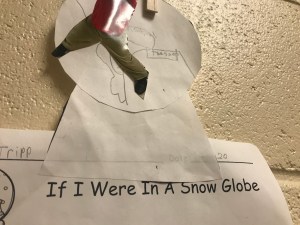 So today as I was visiting with teachers and students at our host school for 3D Leadership, Coweta Charter Academy, in Senoia, Georgia I came across a really cool writing prompt: If I Were In A Snow Globe. It was very interesting to read the student responses. Then I got to thinking, how about I write to the prompt? Here is my essay:
If I Were In A Snow Globe
Here I am in this very beautiful, pristine, and tranquil globe. Everything is perfectly in its place. Of course, my snow globe is a beautiful farm scene with a modest white farm house and three barns. There are snow covered fields and pastures with Jersey dairy cows. When you look inside the barns you see perfectly stacked round bales in a pyramid. You will also see a blue New Holland tractor backed into the barn awaiting its next task.
As much as I am loving being in this snow globe there just is no magic. No excitement. I need someone to shake my snow globe. Won’t you please shake my snow globe? Only then can there be a shift in the experience – some excitement. Snow flying landing on the roofs and on the backs of the cows making an exciting, beautiful, and ever changing experience. I just can’t imagine having to be in this snow globe with out someone shaking it up. For the magic to happen I need shook up. I wish I could get out of this snow globe and shake it. How beautiful it would be!
Lesson Of Shaking It Up
I hope you enjoyed my essay. Here’s the deal: the magic only really happens when we either get shook up, or we shake things up. The shake allows for new possibilities and new beauty. By shaking the snow globe we can create change instead of being a victim of it. So, next time you are getting shook up, take some time to recognize the magic of the shake. Or better yet, give yourself or your organization a transformative shake. How about you share your “If I Were In A Snow Globe” essay?


leave a comment