Learning To Lead Together
 As is standard operating procedure for me after some type of professional development, I have written a post reflecting on my learning. The Kappa Delta Pi Learning, Leadership, and Practice: Educating Global Citizens International Research Conference in Calgary, Alberta, Canada really caused me to reflect on my own leadership journey. Many of the presentations touched on environments, situations, and leadership that were in place, enabling me to get to where I am today. This post is a compilation of the thoughts I have had over the last couple of days and those of the presenters.
There are really five characteristics that great educational leaders that I have been associated with possess: Passion for learning, Supervisory intentionality, Reflective Conversations, Learning Culture, and High Expectations. Other Characteristics of exemplary leaders include moral purpose and interactive visibility (awareness). Great leaders then coach and mentor learning leaders who are “schooled by the system” so they are ready to move into all leadership positions. These all start at teacher leaders.
Highly effective schools with highly effective teachers promote environments where everyone can be “Learning Leaders.” Everyone in an organization fits into one of these three categories: Aspiring, Beginning, and Experienced Leaders. Because of this coherent and coordinated quality learning opportunities to support school leaders must be a part of career long professional learning. As a leader, we are a leader of learning. As such you have a responsibility to take part in career long learning.
Leadership Matters! School leadership is second only to classroom teaching as an influence on student learning. High performing school leaders regularly lead, sponsor and participate in formal and informal teacher learning. Every person in the school shares the leadership for student success. Great school leaders build a strong connection between learning and the collective leadership. High performing schools have fatter decision making structures. This fatter, more effective structure comes from shared leadership. Shared leadership works through its motivational impact and the school staff works to create structures for collaborative decision making. The school then really becomes a shared learning school.
When a school becomes a shared learning school it can more effectively address three of the most important factors of a school: Learning, Well Being, and Engagement. There are four parts of effectively building a shared learning school and classroom: Setting Direction, Developing People, Redesigning the Organization, and Managing the Instructional Program.
Built correctly, a shared learning school has an instructional ethos where there is an an acute awareness of the instructional actions and an acute awareness of teaching and learning in the school. Then everyone in the school become designers of worthwhile tasks for students.
One Man’s Trash…Leadership is Art!
 I am writing this post while in Calgary, Alberta, Canada for a conference. I am always amazed at how the littlest of events will inspire posts for my blog. Allow me to tell a story of another one of those times. With a little free time I was doing what I do best – explore and be curious. As I was exploring the streets of Calgary I came across an interesting sculpture of a horse outside Saltlik A Rare Steakhouse (I am eating there tonight). I have posted a few pictures of it in this post. It is actually a major work of art in my opinion. Basically, the artist took metal pieces of farm equipment and tools and welded them into this great representation of a horse. Really, it is amazing enough that I probably looked at it and analyzed for about an hour. Now, as a farm boy, let me tell you it is awesome!
When I first viewed it, in awe, I first thought of the old phrase, “One man’s trash is another man’s treasure,” because all of these tools and parts would really be of no value to anyone today, from an agricultural industry point of view. Yet, these worthless pieces of metal were looked at by the keen eye of an artist who saw value and placed the pieces together in perfect harmony to form this magnificent representation of a draft horse.
The longer I gazed at the beast and identified the parts of metal (my dad would have been proud) two other thoughts came to mind. Some leaders, and I consider myself one of these, are artists. We take what we have, what we can find, and what we can develop – whether time, treasures, talent in the form of people, or other resources, and mold those into something amazing. Some call this visionary, but I prefer artist. A visionary is not necessarily an artist. A visionary person can see direction and predict what needs to be done, but can’t always see how to put it all together. Take a close look at the horse and imagine all those pieces lying on the ground. A visionary might say, “let’s make something,” but the artist starts taking the pieces and welding them together while seeing the horse the whole time in her mind. The artist says, let’s make a horse,” and then proceeds to do it. I strive everyday to hone my skills as an artistic leader providing wowful educational leadership.
Another thought I had while looking at the iron equine was all the different pieces that were welded together are like all of the different individuals that make up our teams or organizations. Every piece of metal that makes up this horse had a specific role to play. If you look closely there is a tractor seat, part of a sickle, plow shear, cultivator points, leaf springs, and the list goes on and on. Again, every piece had a role. Sound familiar? This imagery hit me so hard and reminded me how important it is to make sure that every person in your business, organization, or school understands his or her specific role in carrying out the vision, mission, and action plan of the organization. This then empowers your team members to work effectively on high achievement of the key performance indicators (KPI) for your organization.
Next time you are working with your team, take a little time to imagine them all as pieces that come together to build the artwork of a successful organization! If you do that you are not just horsing around!!!
Educating Global Citizens

As I write this post I am flying over the beautiful Canadian countryside on my way to Calgary, Alberta, Canada for the Kappa Delta Pi Educating Global Citizens International Research Conference. This will be my first time to Calgary and I just know it is going to be a breathtakingly beautiful place with lots to do. I am super excited to be able to attend this conference. I was turned on to Kappa Delta Pi when I was invited to membership as 2010 Indiana Teacher of the Year. I have even had the opportunity to make professional development videos with KDP on educational leadership, effective student engagement, and highly effective facilitation of learning using technology. Kappa Delta Pi has become an important part of my personal professional development. I am even more excited that I am a conference presenter on my research entitled, “The Impact of Agricultural Science on Student Achievement and Performance in a Biology Class.”
I cannot wait to share the impact that teaching in a relevant, real world context can have on student learning. I have shared the powerpoint and supporting documents as a blog post as well entitled, “#KDPLeads.” Click #KDPLeads to read that post. My goal is to effectively facilitate a discussion and planning session that helps teachers, administrators, and other stakeholders to use relevant contexts to facilitate highly effective learning. Really, shouldn’t that be the goal of the whole conference and all our schools?
Furthermore, I picked the sessions I am going to attend (Conference Program) with one simple goal in mind: I want to learn how to be a better leader of highly effective principals and teachers in our school corporation. To do this, I want to hone my personal call to action of: delivering wowful educational leadership! It is always exciting to go to an international conference. The chance to connect, interact, and learn from leaders all around the globe is exciting. As a believer, promoter, and practitioner of global connectivity and citizenship it is a chance for me to model asset based thinking. In other words, no matter where someone comes from or their cultural orientation, he or she brings assets to the table. And, I for one, want to learn from everyone in attendance at the conference.
With the goal of connecting with everyone, I have created the hashtag #KDPLeads to organize all of my tweets and hopefully others at the conference will tweet their learning and thoughts to this hashtag as well. I am always amazed at what a great professional development tool Twitter is. Even those not in attendance at this conference can follow along and even make comments. How cool is that? So, make sure you follow me at @ByronErnest and learn with me at #KDPLeads.
The great part about belonging to an organization like Kappa Delta Pi is the smorgasbord of professional development it has to offer. These opportunities are so important for teacher leaders and school leaders because your school’s circumstances will dictate the choices made for professional development. It is also important to note the advantage KDP brings to the market because of all the platforms they make available for members to choose from. These range from live, face to face conferences like I am on my way to, to recorded videos that members can watch on their time. This truly differentiates the learning for members. I am a huge believer that professional development must be differentiated for professionals the same way it is differentiated for student learners – both in modality and content.
It always amazes me when I here educational leaders talking about not having time for professional development. I change that to the question of, “There isn’t time to not take part in personal professional development.” The educational landscape changes so quickly that we must stay current and put ourselves in the best position to create learning organizations where we can learn from others. We must be learning from each other’s mistakes, failures, and successes. The bottom line is we must be sharing the knowledge we have created. There is such a sense of urgency that we must have whether turning schools around or moving high achieving schools to the next level. The students and families we serve are so valuable that we must do everything possible to develop our skills so we can perform at the highest level. Isn’t that what we expect from the professionals that serve us – doctors, lawyers, pilots, et cetera?
If you are not doing so, I challenge you to make time to take part in some personal professional development yet this fall!
Living & Leading Like Curious George
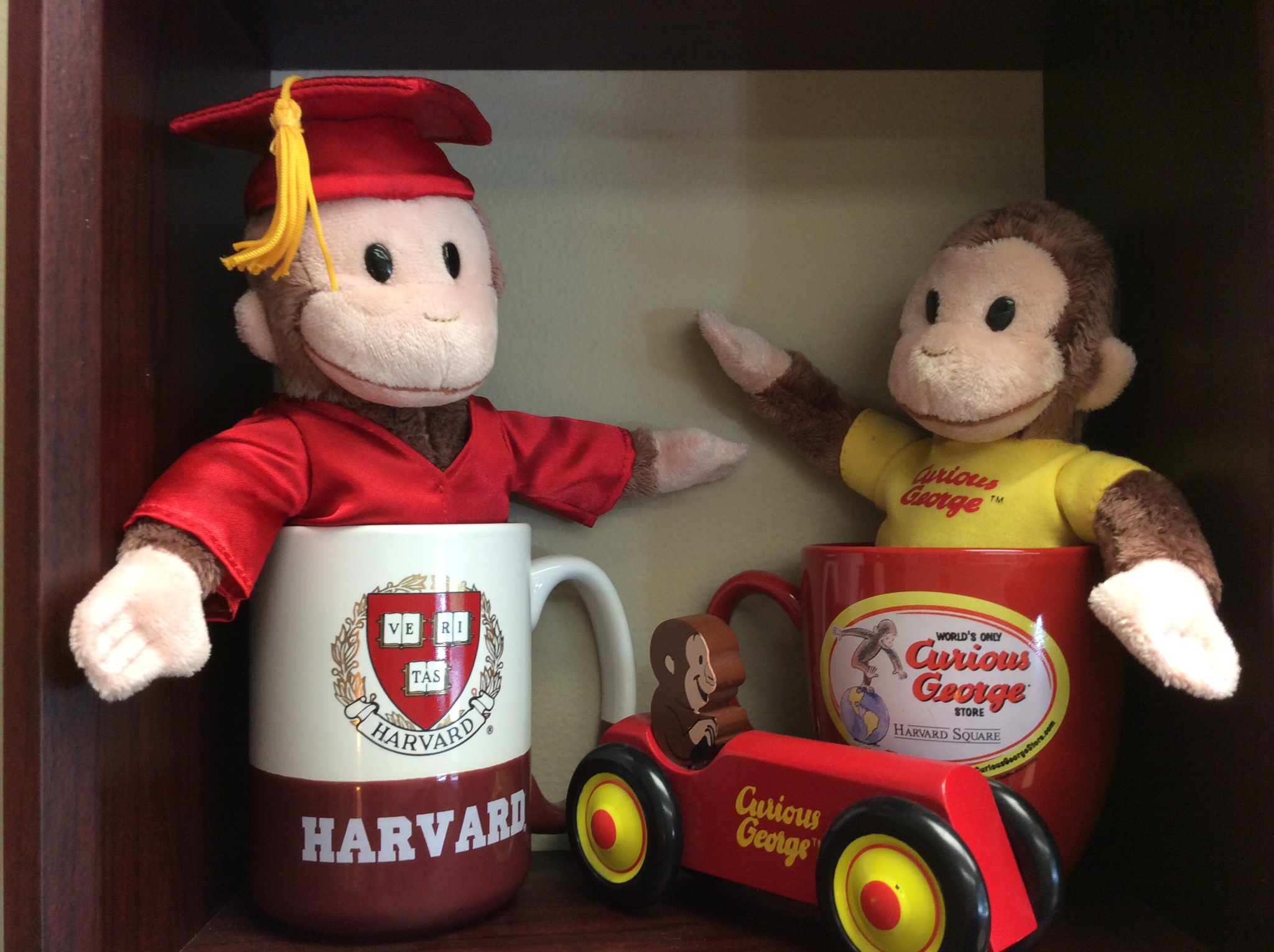
Who isn’t a fan of Curious George? No matter your age, the inquisitive little fellow who always seems to get into one scrape after another has, in all likelihood, captured your heart. I think I am such a fan because I still live every day just like like him. In fact, as you can see from the picture on this post, I have an area in my office dedicated to him. When I am at Harvard University I always have to stop into the World’s Only Curious George store to do some shopping and get my “Curious George Fix.”
Perhaps his popularity lies in the predictability of his unpredictability. You know that as soon as the man with the yellow hat leaves the house, warning George to be careful, George is going to get into trouble. And when George starts getting into trouble, he only digs himself deeper. The more you poke around, question systems, and look for new ways of doing things, the more you will frustrate some people. As a leader, though, this is what you need to be doing. All to often, however, it’s easier to leave the status quo untouched. This can really get organizations in trouble. To assume you can “arrive” and be done growing and changing is maybe the biggest mistake anyone can make. And the more you push for those out-of-the-box changes, the more you’ll frustrate those who are satisfied with keeping things the way they are.
Children naturally gravitate towards creativity and fun. But life has a tendency of breaking many of us of that. I am so blessed I have been able to resist this tendency because curiosity is a beautiful thing. It leads to new discoveries and new adventures, as long as you’re willing to pursue it. As Margret Rey (who created Curious George with her husband, H.A.) observed, “George can do what kids can’t do. He can paint a room from the inside. He can hang from a kite in the sky. He can let the animals out of their pens on the farm. He can do all these naughty things that kids would like to do.” As leaders we need to remember curiosity is a beautiful thing and needs to be embraced and encouraged. One cannot give enough credit to the Reys. H. A.’s delightful illustrations and Margret’s clear and precise turn of phrase may appear effortless, but that’s only because they labored over each book to achieve that perfect look and tone. Don’t get so tangled up in details, systems, and processes that you forget to have a little fun along the way. There’s an adventure around every corner if you’re willing to look.
If you embrace creativity in life and encourage creativity as a leader, know that things will get messy and chaotic. Rarely will you find order in the middle of creativity. As an artistic leader, I know that I’m going to have to put up with a bit of chaos in the creative process. But at the end of the day, it’s worth it. The insights, new directions, and “art” you’ll create for your school, organization, or business through the process make it worth the effort.
H. A. and Margret Rey each looked to the child within. “I know what I liked as a child,” H. A. once said, “and I don’t do any book that I, as a child, wouldn’t have liked.” By portraying George as a servant leader, they really created a great role model for all of us. If you’ve read the books or watched the cartoon’s you know George’s goal is always to help people. In helping people, however, he often gets into big messes. Doesn’t this sound familiar as a leader? Many of the characters in the books get frustrated with George. Even the one that loves him the most, the man with the yellow hat, get frustrated with him. Again, sound familiar? Which is what you’ll sometimes, unfortunately, find as a servant leader. Facilitating change, growth, and dealing with life is often messy and frustrating.
As a leader, however, the most joy I receive is in the mentoring, coaching, and creatively developing the professional growth of our team members. There are many young and talented leaders in our organization right now that have very promising careers ahead of them and I am so honored to serve them in taking that journey. Their success, advancement, and ultimately, outstanding service to others makes me as happy with them as the man in the yellow hat is with Curious George.
So, my challenge to you is to live and lead a little more like Curious George!
Teacher of the Year Learning!

This week I had the honor of serving on the Top 10 Interview Committee for the 2015 Indiana Teacher of the Year. I say honor for two reasons: 1. Because I served with nine other fellow Indiana Teachers of the Year; and, 2. I learned from the 10 candidates we interviewed. This post really has nothing to do with the Teacher of the Year process, but is about what I learned from the candidates and the reflecting I did during the interviews about my own journey in education.

I had the chance to really think about my personal mission as an educator to use rigor, relevance, and relationships to be a steward of high student performance and achievement. From a rigor standpoint we have to remember that acquiring information is not enough, the student has to be able to do something with it.
Relevance is also very important in the equation of highly effective teaching. We know that students are myopic in their vision; they need to be more global. We need to ensure an experience that is rigorous and facilitates learning of global citizenship. This also allows us to facilitate the school and students in developing “community enhancement projects.” These are the projects like cultural events that not only benefit the school, but are a huge benefit to the community.
As educators we need to be “vending machines of knowledge!” Having said that, relationship building with the students is very important. We must get to know the students as individuals, so we can challenge them the way that is best for them! This enables us to learn along-side the students. This relationship building is so important. If we go a little where the students are going , they will go a little where we are going!
Because we are not all linear in the type of students who come to us, our view of teacher effectiveness and highly effective facilitation of learning has had to evolve as well. We have advanced to a time of using data to drive our instruction. We are also using constructive, not destructive evaluation systems. It is really about coaching, observing, and providing feedback for our teachers to become all they can be. Regular and frequent walkthroughs now allow us the “touchtime” necessary to really hone in and coach teachers on one to two areas at a time for improvement.
While I realize there is so much room for improvement in our educational system, I am so excited about all the great things that are happening. I was also reminded in the presence of great teachers why I am on this education leadership journey!
Reading Big Red

I know I write a lot of posts about reading, but this post will be the most meaningful to me personally because I am describing how my love for reading began. Really, I am ashamed that I did not write this post before today because had this story not happened I probably would not be where I am today. I believe that because had I not become a reader, I would not have enjoyed the successes I have in my life. Today I was at a conference and one of the speakers mentioned the book that his teacher made him read over and over that helped him learn to read. This inspired me to reflect on my reading history.
Actually, I never had trouble reading. I just hated to read! I did not find anything that teachers were MAKING me read interesting. It was all boring stuff that I did not understand. Now, if you have followed me at all you know I am all about relevancy and how students have to understand the “why” for effective learning to take place. Students perform better when the learning is relevant to them. I’m passionate about this because I’ve got the research to back it up. We also need to change the context from the students thinking of what they HAVE to read, to what they GET to read. That’s a big mindset change.
My personal story of the journey to my love of reading also reinforces this philosophy. As I stated, I hated reading all the way through my sixth grade year. Then one day the librarian at Markleville Middle School in Markleville, Indiana changed my life. It was not rocket science for Mrs. Wilking! Think about it, most of the solutions in education aren’t. It’s about having educators who care and have formed the relationships necessary to understand the needs of their students and then acting on them.
Mrs. Wilking came to me one day and said, “You know Byron, I think the reason you don’t like reading is that you have never read anything that you enjoy.” Well, duh, I knew that! I just didn’t like reading all the things elementary students are supposed to read. Anyway, Mrs. Wilking made a suggestion that changed my life. She explained that she knew I lived on a farm, had a dog, loved animals, loved to hunt and fish, and wanted to be outdoors every moment of every day. As I think about it, nothing has really changed in my life!
Mrs. Wilking went on to explain that she had a book she wanted me to read. “Please read it,” she said. The book was Big Red by Jim Kjelgaard. The book is about a boy and his dog. From the moment Danny sees the beautiful Irish setter, he knows Red is the dog for him. Fast and smart, strong and noble, Red is the only dog Danny wants by his side. Soon, neither boy nor dog can stand to be apart. Together Danny and Red face many dangers in the harsh Wintapi wilderness that they call home. But the greatest test of their courage and friendship will come from an enemy more cunning than any they’ve known before–a bear who is the undisputed king of the wilderness, a savage killer called Old Majesty. I got goosebumps just writing this description! How could a boy like me not love this book!
Well, needless to say, I was hooked! Mrs. Wilking had made reading relevant to me. That same year I read almost all of Jim Kjelgaard’s books, including Irish Red, Outlaw Red, Stormy, and Snow Dog. I loved these books and have been a rabid reader ever since. In fact I just finished book 42 of my goal of 60 for the year. Let me tell you, the book still has to be relevant and interesting to me for me to read it. And, as you know I believe reading is a very important part of my personal professional development.
A wide variety of meaningful texts must be available to teachers and students and form the core of the curriculum. The texts must be used in ways that make them relevant to the students’ lives. Texts may be used in their entirety or partially. Additionally, there is a significant academic achievement gap between African-American, Latino and Caucasian students. One way to reduce this gap is to help struggling readers who attend public schools improve their reading skills. But, to do this, struggling African-American & Latino readers need to be exposed to books that relate to their lives, capture their interest, and shape positive life outcomes, as well as address academic progress.
All students need to be read to, need to read consistently throughout their school years, and read meaningful books and texts that relate to their lives and culture, capture their interest, and shape positive life outcomes, as well as address academic achievement. Only then will the academic achievement gap start to get smaller. If it had not been for Mrs. Wilking understanding this back in the early 1970’s I might have become one of those non-readers. Thanks Mrs. Wilking for recognizing the need for relevance in reading.
I have to close by telling you that I had the chance to thank and talk to Mrs. Wilking about her influence in my life many times before she passed away. I am thankful that I had the opportunity to do that. I think about her often and the example she modeled for me as an educator!
PS: The copy of Big Red that I read was checked out of the library. I now am inspired to find an original copy of the book. If you know where I can get one, let me know. The original book published in 1945.
Are You A Sherpa?
 This past week at our Back to School Professional Development and Family Expo I did a session using a case study of the Mount Everest -1996 disaster. I have actually posted about this before. Click here to read Mount Everest Leadership (Part 1) or here to read Mount Everest Leadership (Part 2). Out of this case study session last week two themes really emerged: We need to become the Sherpa’s of high student achievement and “Hoosier Academies Climbs Everest.”
Technically, “Sherpa” refers to an ethnic group of people from Nepal, or those hired to guide mountaineering expeditions in the Himalayas. Thus, most of us cannot hope to become sherpas (though sherpa is sometimes used as a proprietary eponym for those who haul the belongings of others or invoked to imply knowledge of high altitude mountain climbing). Yet the allure is great–sherpa guides are people, mostly men, who don’t just climb mountains; they were born to climb mountains. They are physically disposed for this act more than anyone else. It makes me consider the question: what was I born to do? What am I physically, mentally, or emotionally equipped for that 99% of the earth’s population is not?
Amazingly, for me I believe that I was born to be an educator – most recently an educational leader. I also really believe our staff came out of our kickoff expo with renewed enthusiasm that they are the ones physically, mentally, and emotionally ready to do what 99% of the population is not – educate children! I am excited for us to be leaving Base Camp today as we start our school year together and begin our summit journey up Mount Everest! The analogy of us as educational leaders to that of a Sherpa is great because they are successful by helping those around them reach their full potential. We must be Sherpa’s of high student achievement for the families and students we serve. Also, great Sherpa’s do not just look up the mountain and say, “Let’s go!” Great leaders carefully plot out each step to ensure a safe and successful trip. I believe we have a great plan and we must now execute with fidelity. Additionally, Sherpa’s routinely deal with unexpected weather, animals, obscured paths, and many other obstacles. Rather than becoming derailed, they build contingency plans and adapt in real-time.
We all know as leaders that there will be challenges and obstacles and as servant leaders must provide support wherever and whenever it is needed. I am so exited for all of those that have accepted the role of an educational Sherpa to help facilitate a great school year filled with many summits of student success!
Identifying The Thoughtful Classroom
 I am writing this post while on the flight home from Las Vegas. I flew in this morning to be a part of a Data Driven Instruction professional development. During the professional development I was asked the question of what a highly effective classroom looked liked. I was also asked if I thought it looked different for face to face instruction or virtual facilitation of learning. While there are certainly modality differences, I said great instruction is great instruction. Period.
Then I went on to discuss the adjectives I would use in describing a highly effective classroom. I used these five: engaging, comfortable, collaborative, flexible, and safe. Really, all of these have to do with the physical environment of the classroom. There are then cultural forces that go along with each of these adjectives. To be engaging the teacher will use rigorous lessons that might include global connectivity and uses a relevant context that the student cares about. A collaborative environment has a lot of student to student interaction and might include partnerships with business and industry for enabling the students to solve/research real world problems. Flexibility is also the key – in a brick and mortar setting there should be no front or back to the classroom and in a virtual setting many different modalities of technology may be used. Finally, the environment must be safe. This safety not only includes physical safety and safety from bullying, but also a safe environment where students are encouraged to think creatively, be curious, and share those thoughts.
The routines and structures that guide the life of the classroom are also important to creating an engaging and thoughtful classroom. Instead of creating thinking -skills lessons, highly effective teachers must create rich thinking opportunities. It is important to create relevant content students care about. Relevancy matters! Relevant context must be the norm, not a discrete context disconnected from anything going on in the student’s life. Course themes and generative topics make learning opportunities relevant to the students.
Guiding questions help the students keep in mind the big ideas. With the standards it is easy to get bogged down with isolated bits of knowledge. We must remain aware of the forest even as we look at individual trees. Connecting course activity to big ideas enhances the purpose and meaning of the work for the students. In other words it gives them the “why” of what they are learning. How many times have we heard students, or even ourselves for that matter, say, “Why do I need to learn this?” or “Where will I ever use this?” This relevancy makes it easier to engage students in the thinking because they are actively exploring.
Having the students pose unanswerable questions will also foster engagement. Teachers should expect students to be independent thinkers, take risks, and show initiative. Again, why it is important to have a safe environment. Making assignments iterative is also very important. There should be several drafts involved in assignments. This will emphasize process refinement.
This all really means creating a student self managed environment. This includes student to student interactions that the teacher does not control. The teacher should be a role model of engagement in the context of the class. The bottom line is we must provide students with Thinking Opportunities!
Leading Audaciously!
 As I write this post it is the eve of July 4th, 2014. I have had some incredible Fourth of July Celebrations, such as being the Grand Marshal of Lebanon, Indiana’s Fourth of July Parade in 2010. To read about that experience click here. This year, however, my family and I are spending the Fourth of July in our Nation’s Capitol. I am so excited that we will be watching the fireworks from the Washington Mall in view of all the monuments of our great leaders. Many people are writing and talking about doing audacious things these days, but what does that really mean.
In thinking about what it means to lead audaciously, I reflected on our founding fathers. Now there was some audacious leadership! These audacious leaders defied convention and stepped beyond the ‘norms.’ They provided us out of the box solutions for a group of colonies made up of people looking for something a little different. When we have the courage to live out our convictions, Walk the Talk, we lead the way for others to do the same. In other words we are serving as trail blazers. Audacious Leadership works with people to make the changes within themselves to affect and create social change for the world around them. We are all far more audacious and powerful than we think we are. What would you do that would be considered audacious if you knew you could?
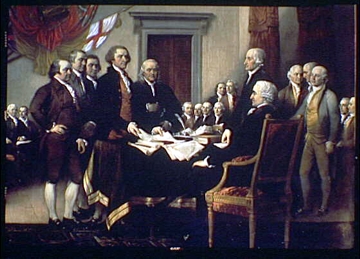
Signing of Declaration of Independence
Even though the first Fourth of July happened in Philadelphia, not Washington D.C., and did not have any fireworks or really any signing ceremony to speak of; I am still in awe of the audacity of the leaders involved on that historic day! Really, not much is known about the day except that on July 4, 1776, the Second Continental Congress was meeting in Philadelphia. It debated whether to adopt the Declaration of Independence. The delegates had come from the 13 original states. Many things, including the Stamp Act and other taxation without representation, to lead up to this point. Originally, the colonists thought boycotting British products would cause change. We all know, however, that even the Boston Tea Party was not audacious even to effect social change.

Printed Material Stamp
So, on June 7, 1776, the 2nd Continental Congress met and debated whether to break ties with Great Britain. The separation seemed likely, so the Congress assigned a committee to write an explanation of the decision. As we know, this committee then gave the job of writing to Thomas Jefferson.
Thomas Jefferson took two weeks to write the Declaration of Independence, so on July 4, 1776, Congress voted to adopt. John Hancock immediately signed in large print to signify his bold statement of committing treason. Pretty audacious, don’t you think? Then on August 4, 1776 the rest of Congress signed the Declaration of Independence.
I am truly in awe of the audacity of these leaders. They lead our nation to independence. That is about as anti-status-quo as you can get. Thomas Jefferson captured the ideals of the United states in writing. Those words inspired the original Patriots who audaciously fought against insurmountable odds. They have also inspired movements of Americans against slavery, for civil rights, for women’s rights, for education reform, and social justice in not only America, but around the globe.
On this July 4th I invite you to celebrate the audacity of our Founding Fathers and challenge you to lead audaciously to bring about social change for the people of our great nation and the peoples around the world! Happy Fourth of July!
1,000 Vs. 30,000 Foot View

30,000′ View
I already wrote one post this week that was motivated by Rich Horwath’s book Elevate: The Three Disciplines of Advanced Strategic Thinking. Click here to read Competere. I also wrote another post View From 30,000 Feet that has thoughts on strategic thinking and leading strategically as well. While finishing reading the book for the second time I was on my way home from Washington D.C. It was nighttime and if I sit next to the window I love to look out and see if I can identify the cities we are flying over.
This time I was struck by how little detail you really can see at 30,000 feet (actually, according to the pilot were cruising at 32,000 feet). I have shared a picture I took out the window at this altitude with you in this post. Then, when we were getting ready to land I took another picture at what I guessed was around 1,000 feet. I have shared that picture in this post, too.

1,000
It was amazing to me the difference in detail that could be made out. This was one of the points that Horwath was trying to make in his book. He contended that the old adage of taking a 30,000 foot view is too high. You are too high up to see anything with any precision.
He likes to use the analogy of a helicopter at 1,000 feet. here, he argued, you can see with precision and clearly recognize what you are looking at. You can see houses, trees, flow of traffic, and trucks backing into docks. So, what did I learn from my experience looking out the plane window?
The 1,000 view enables me to see the whole picture with detail. this will enable me to lead in a way that strategy is developed first, so that great tactics (key initiatives) can be put in place. Think of it this way: as I write this I am on an airplane headed back to Washington D.C. The plane I am on is the tactic. While the plane is what is getting me to my destination; it would probably not be a very successful, or safe, flight without an accurate flight plan. This flight plan and allocation of the airplane to Washington DC is the strategy.
The airline was even able to be strategic and route us around a storm. The reallocation of extra fuel to send us around the storm made our flight safer, smoother, and more enjoyable. The only negative was it took about 8 minutes longer. A pretty good trade off in my book. If this example didn’t make for a great story, I don’t know what would.
From all this I have learned that I must get myself to the optimal height to see the detail needed, but yet still get the big picture. This really becomes a question of strategic insight. An insight is the combination of two or more pieces of information or data in a unique way that leads to the creation of new value. Strategic thinking, then, is the ability to generate insights that lead to competitive advantage.
Putting strategy in action we begin to think about why initiatives need to be pursued instead of just what is being done. This kind of thinking is so important in all industries, but is crucial in education. There are thousands of tactics available that are touted as the next tool for enabling the highest student achievement. But, we have to remember that without strategy we are flying blind, literally! Without a clear strategy and theory of action, we are just completing “to do” lists!
Great strategy enables us to be agile and allocate and reallocate resources to be successful!


leave a comment