View From 30,000 Feet

As I write this post I am on a flight from Boston to Philadelphia heading home from Harvard University. It always amazes me how the view changes at 30,000 feet. The weather was terrible in Boston and there was flooding because of the storms coming in the aftermath of hurricane Andrea. But when you you get up to 30,000 feet you are above all that and the view below changes.
I was so proud to be a part of the School Turnaround Leadership Program this past week. One of the leadership lessons of the week was how we need to step into the balcony as school leaders, and watch the dance above all the chaos and noise. This analogy was driven home to me this morning as I looked out the plane window and saw the sunshine with the storms going on below.
As transformational turnaround school leaders it is important for us to get above the clouds and take stock of where we are. This clear “awareness,” as Marzano calls it gives us the opportunity to sort through the clutter and stay focused on the important work at had of putting students first.
So, next time you find yourself getting caught up in all the noise of being a leader sit back and let your mind travel to 30,000 feet where you can watch the dance in the positive cognitive glow of sunshine!
I Used To Think…But Now I Think…
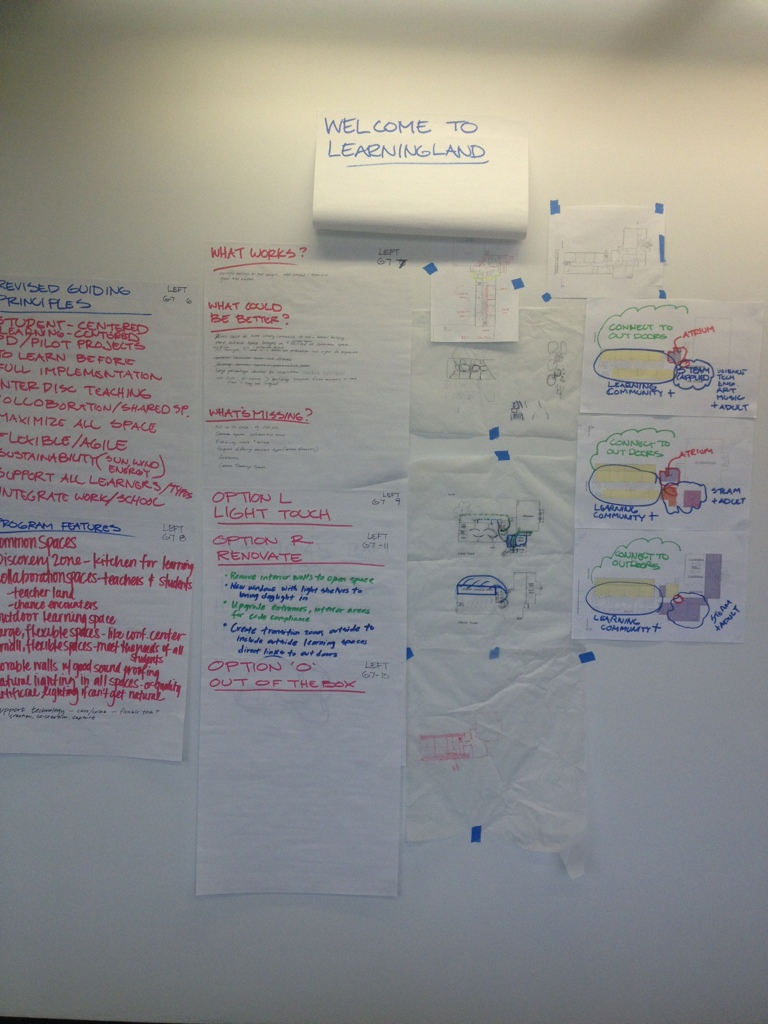
During my time at the Harvard University Graduate School of Education this week I was provoked, stretched, and made uncomfortable while exploring the principles of effective pedagogy and school design for the future. I was part of the Learning Environments for Tomorrow program. At the end of our week Daniel Wilson, of the Harvard Graduate School of Education, posed the following sentence/reflection question for us to spend 15 minutes writing about: I used to think…But now I think… I thought this was a splendid way to end a conference with some self reflection! Not to mention the fact it would make a great post to my blog. So, here is my reflective free writing:
I used to think in the same paradigm of the past that we would modernize, remodel, or build a new building that in 60 years (which is how old the average school is today) from now others would say: “This is such an old school that needs to be redesigned for the 22nd Century Learner (bet you haven’t heard anyone talking about them yet, but remember we are already 13 years into the 21st Century).”
But, I now think (actually, I know) that we need to design spaces that take into account the principles of student centered learning, learning centered, professional development and pilot projects, interdisciplinary teaching, collaboration, shared space, maximizing all space, flexibility, agility, sustainability (sun, wind, & energy), supports all learning styles and types, and integrated the community and school.
And now, I also think (actually I know) we need to use architectural and learning theory, emerging technologies, environmental sustainability, child and adult collaboration, and community engagement to create “AGILE” learning facilities that can be flexed into the 22nd Century without taking millions, or even billions of dollars to sustain or modernize in another 60 years.
The photo in this post is of the visual work process of the Design Team Project my classmates and I created. We called it LEARNING LAND! Sounds like a fun place to be, huh?
Leadership To Open The Era Of Aviation
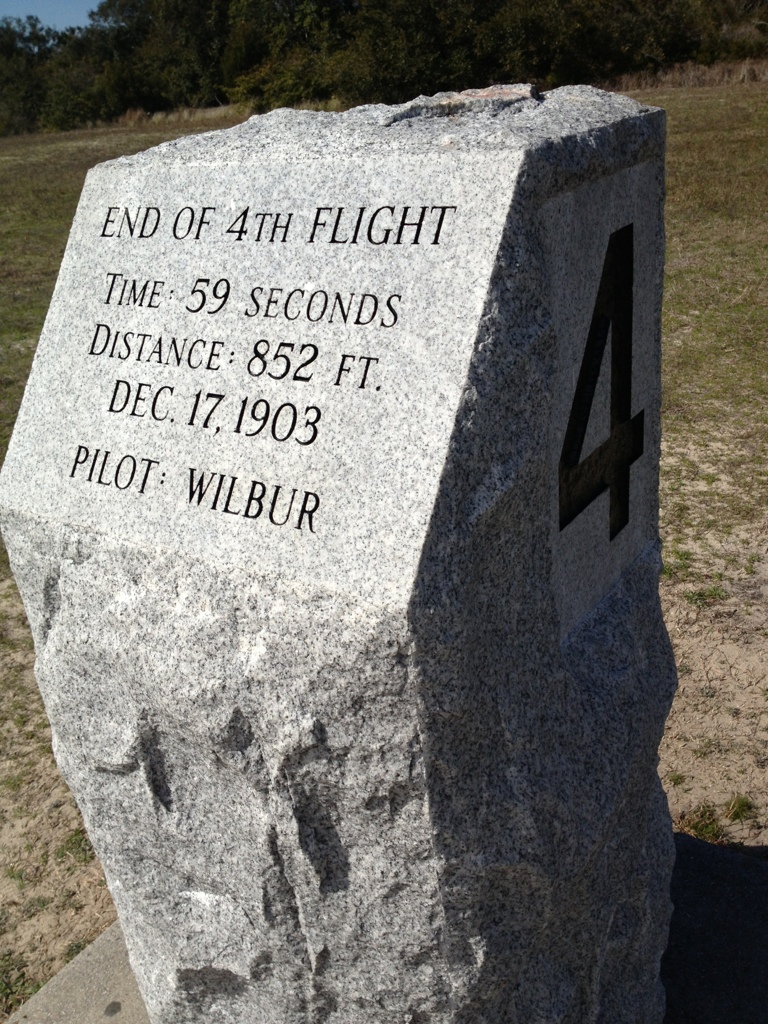
As I stood at the monument (pictured in this post) marking the fourth fiight on that blustery December 17th day I reflected on the first time I stood beside the Wright Flyer at the Smithsonian Institution. The plaque at the exhibit reads: “THE ORIGINAL WRIGHT BROTHERS AEROPLANE: The world’s first power-driven, heavier-than-air machine in which man made free, controlled and sustained flight, invented and built by Wilbur and Orville Wright flown by them at Kitty Hawk, North Carolina December 17, 1903. By original scientific research the Wright Brothers discovered the principles of human flight as inventors, builders, and flyers they further developed the aeroplane, taught man to fly, and opened the era of aviation.” Think about what this says, they “…opened the era of aviation.” What a leadership legacy!
In 1901 Wilbur and Orville had tested their latest glider design. The performance was improved and the control bugs were worked out, but the Wrights were perplexed about why their calculations were still off. Their response to this was unique and would he reason enough to regard the Wrights as the first to fly. They constructed a wind tunnel in the rear of their bicycle shop and conducted precise tests of different wing sections. The tunnel was only six feet long by sixteen inches square, with a glass window in the top panel to allow observation. A steady fan driven by a small gas engine blew air through the box at a steady twenty-seven miles per hour ), and inside, balance and spring scales measured lift and pressure on a variety of airfoils. In these experiments, the Wrights raised aviation experimentation to the level of serious engineering.
The Wrights discovered that much of the published data on wing design was incorrect or had ignored important elements of flight. After testing two hundred different wing surfaces, the brothers used their newly gained information to design Glider Number 3. As leaders we must do our own research and not take for granted the opinions of others.
The Wright Brothers put the necessary time and research into finding the best design. They did this all in the name of bringing about social change! This is what great leaders do!
Wright Brothers Determination
The Wright brothers invented the flying machine in a little more than four years, and spent less than one thousand dollars on the entire project. The brothers went about their discovery in a methodical, deliberate manor, and for the most part, they were confident that success was only a matter of time and effort.
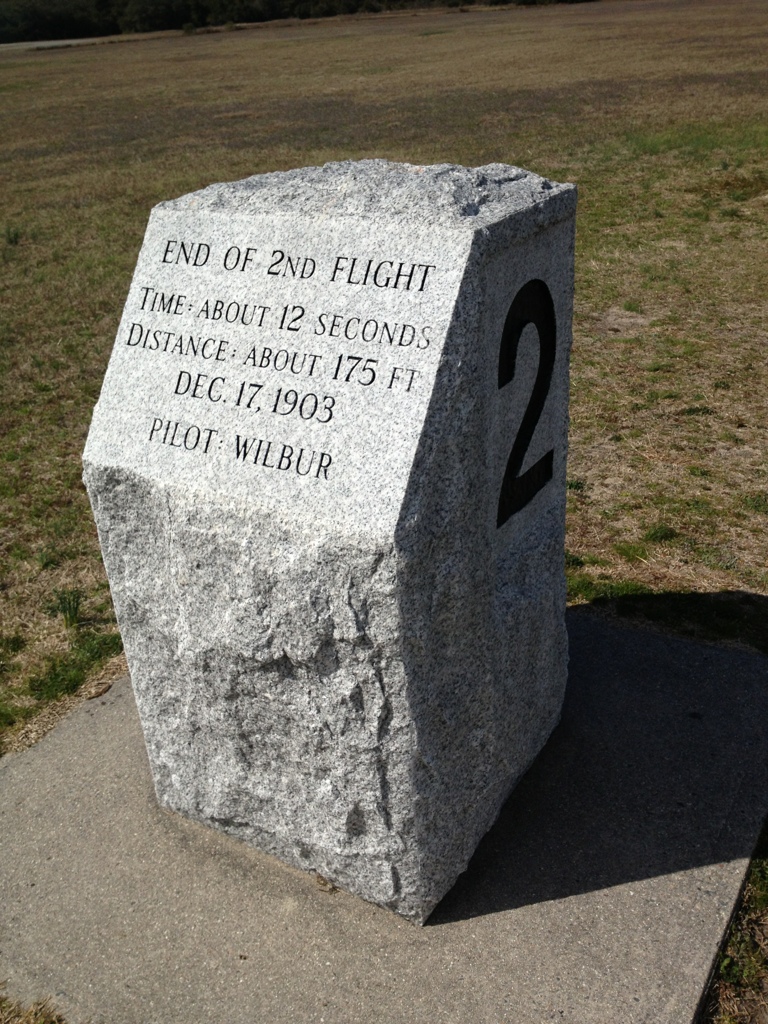
As I stood at the marker for the second flight I thought about the others, such as Samual Langley, who was far more educated and well financed for the task of being first in flight. What the Wright Brothers lacked in education and financing, however, they made up for in determination, and a single-minded devotion to the task at hand.
Many people begin a new endeavor and don’t really give it the the determination needed for success. As Malcolm Gladwell said it takes 10,000 hours of practice to become great. Imagine if the Wright brothers “tried” flying for a couple of months and then gave up saying “we are just no good at flying.” It sounds humorous but many people do this when starting a new project. At the second marker pictured in this post I thought about the thousands of glider flights testing designs and the tenacity it took to drag the plane back on December 17th, 1903 for two more flights trying to go farther still and stay in the air longer.
The next time you are in the middle of that monster project think about the journey the Wright Brothers took to give us the gift of flight!
12 Seconds of Extreme Leadership
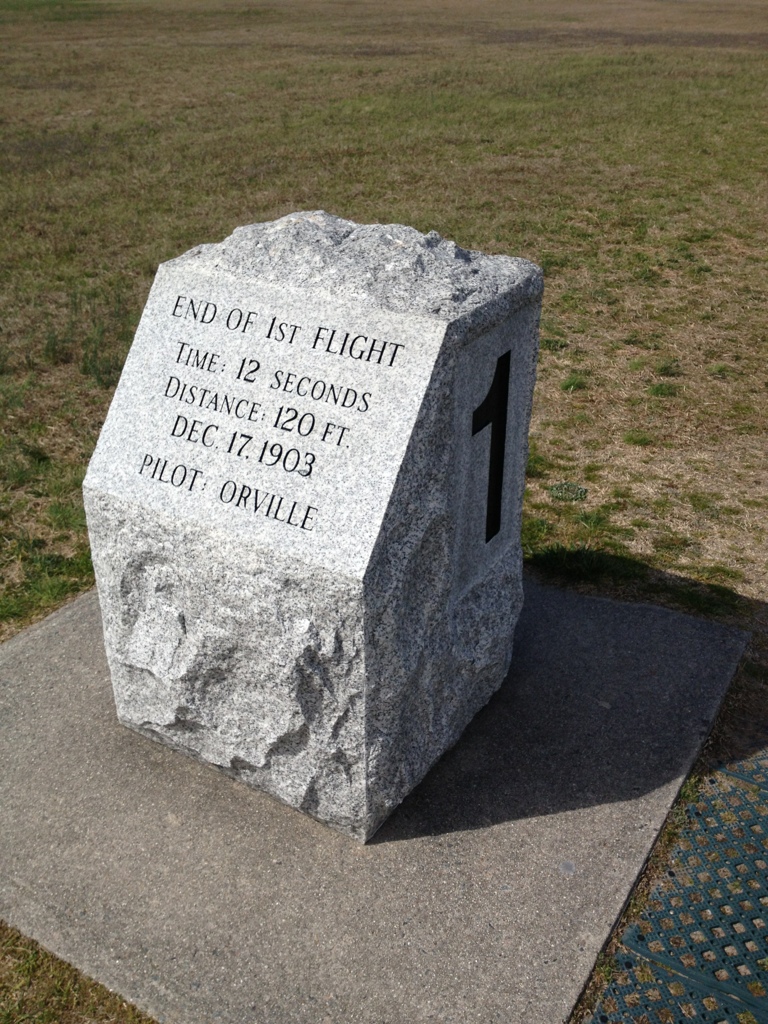
Today I walked the sandy ground where all of the Wright Brother’s extreme leadership, genius, and tenacity culminated in the first flight. To stand by the rail that the Wright Flyers slid down as a runway was breathtaking to say the least. I have been a student of their journey for many years and finally got to walk the testing grounds.
What really made me go “WOW” today was seeing and walking the length of the first flight. 12 seconds and 120 feet! I had to think, “Would I have called this success or written it off as – not enough?” Well, the Wright Brothers did both. They called it success and then said that’s not enough. In fact, they carried the plane back and made three more flights – I am going to do three more posts over the next three days using those flights. So, stay tuned!
Back to the first flight – 12 seconds and 120 feet. Why – why go again? Because of their LOVE for what they were doing. It wasn’t about them, it was about giving humans the ability to fly. It wasn’t about just going 12 seconds and 120 feet. It was about the fact it was now possible and they loved it. I can just imagine the brothers looking at each other and saying, “lets do it again, only farther.”
Wilbur Wright said, “…it is not really necessary to look too far into the future; we see enough already to be certain it will be magnificent. Only let us hurry and open the roads.” I for one am glad and inspired by the fact the the Wright brothers had the fortitude to come back to Kill Devil Hill year after year till they got it right.
In an age of instant gratification, I hope we all continue to look to these two great Americans and the many great leaders before and after them, who have achieved the unthinkable, and their achievements changed our lives.Think about it, with their game-changing feat, the Wright brothers became our exemplary innovators who helped bring about America’s rise as an economic superpower! It is their example that inspired the kind of businesses and industries that built and grew our nation, continue to solve the issues of today, and change the way we live our lives. As I stood on this hallowed ground today my prayer was and continues to be that I can carry their legacy forward by taking on new challenges with tenacity and meeting the hardships of my leadership roles with courage and confidence. If all leaders do this, our shared future is bright and our best days are still ahead.
I pray this will have have the same inspiration for you!
President’s Day Rushmorean Leadership

All of us have either seen or at least seen pictures of the famous sculpture done between October 4, 1927, and October 31, 1941 by Gutzon Borglum and 400 workers. They sculpted the colossal 60 foot (18 m) high carvings of U.S. presidents George Washington, Thomas Jefferson, Theodore Roosevelt, and Abraham Lincoln to represent the first 150 years of American history. These presidents were selected by Borglum because of their role in preserving the Republic and expanding its territory.
Although faced with different challenges and employing different styles, they all had certain values that they never compromised or lost sight of-such as integrity, trust and respect for followers. They exemplify values-based leadership.
Here’s why I believe they were great choices:
George Washington
Washington was a skillful visionary leader. This type of leader is an expert in designing and creating an organizational culture which will make possible the attainment of the leader’s vision and ideas.
As a visionary leader Washington had a vision into the far future, could develop an effective organization and attracted others to strive for the attainment of his vision so that it became a shared vision and they all worked together in an organization that sustained the vision, its beliefs and its values.
Thomas Jefferson
I believe Jefferson was chosen for his role in authoring the Declaration of Independence, which today some might call an “action statement:” In that declaration Jefferson set out the long-term aspirations of a new nation, and in asserting a natural right to happiness Jefferson meant that all individuals are entitled to make all they can of their lives.
Additionally, with his vision for public education, he understood that all individuals need to learn about democracy. As the father of public education, he set up the avenue by which all young people can become all they can be! As an educational leader I believe it is crucial to be a steward of what Jefferson started!
Theodore Roosevelt
Theodore Roosevelt is recognized as a transformational leader. He defined numerous aspects of leadership that we now take for granted in the presidency as well as in private life. His inspirational vision about the economy, industry, environmental protection, and the National Parks system is still influencing our great country to this day. He had a remarkable ability to communicate his vision, not only through his well-crafted words, but even more through his indelible example. Roosevelt’s well-publicized, courageous exploits in Cuba in the brief but deadly Spanish-American War of 1898—the fateful days he viewed as the linchpin of his life—are perhaps the most apt symbol of his leadership. Roosevelt, mounted on horseback in front of his troops, showed the way—asking others to “come” rather than saying “go” in the words of his friend Henry Cabot Lodge—putting himself at risk, making himself accountable, giving more of himself than he would ask of others. I have always said that we must walk arm in arm with others, even pulling them along at times, instead of pushing!
Abraham Lincoln
Lincoln created a true learning organization where those in his administration were free to disagree without fear of retaliation. At the same time, he knew when to stop the discussion and after listening to the various opinions, make a final decision.
When there was success, Lincoln shared the credit with all of those involved. Conversely, when there was failure, Lincoln took all the blame. Lincoln did not fear failure and created an environment where those around could take risks and make decisions without risk or worry of failure.
Finally, the most important thing we can learn from these Presidents is: you don’t have to become someone else or become like someone else to be a leader, you have to just become yourself. Go be the leader you are!
Matthew 20:26 on Being A Servant Leader
 During today’s personal devotion time I came across the Bible verse of Matthew 20:26. It reads, “Whoever wishes to become great among you shall be your servant.” Pretty good Bible leadership advice to a guy who believes in and strives to Walk the Talk on servant leadership. In fact I have written many posts on this blog on that very subject. It is mind boggling for me to think about all of the people who have been a servant to me during my life, sharing unselfishly of their time, treasures, talent, and wisdom (advice) to get me where I am today. This Bible verse reminded me of how important it is for me to be a true servant leader to those around me, and most importantly, to those I lead.
If you think about all the skills you have that have enabled you to be successful, you can probably point to someone who enabled you to hone those skills. Even though I am far from being a great father, I had a great father that modeled what great parenting was. From the kisses on the forehead to the long talks about never giving up or just being average; these are all things that are on my mind when I interact with my own son. My own experience of becoming a teacher and my commitment to students can all be traced back to a servant leader at Purdue University named Dr. Hobe Jones. You can read more by clicking here to read my post entitled “You Want Me To Do What? Teach? There is not enough internet space in the cloud to hold all the anecdotes of all those who have blessed me with their servant leadership but I must include one other.
My abilities as a teacher leader and now administrator were enabled by a man named Ralph Walker. He was my supervising teacher when I student taught, then became my principal, and ultimately became my Superintendent at the school he recruited me to start an agricultural science program. The rest is history, so to speak, but none of that history, nor the present would be possible without his having been a true servant to my leadership development needs. There are so many others that I could go on and on about here in this post like Kevin Eikenberry, who has always been there as a mentor, friend, and coach and has included me in many events of his leadership business that have helped me to grow as a leader. Or, Dr. Tony Bennett, and my Mom who taught me at a very young age that “God never shuts a door without opening a window somewhere!”
Think of all the skills needed in life to succeed. All of us are in need of leadership in our roles as spouses, teachers, administrators, business people, salesmen, CEO’s, and as friends and family members. In each of these fields, someone who is knowledgeable, whether a professional or a wise friend, is of great value to you as a servant leader. The exchange of wisdom between people is an incredible event. Good advice, the fruit of experience, is a sweet deal to those of us who hunger for wisdom.
We cannot forget, however, our obligation to become a servant to others to provide that same wisdom those we lead hunger for. Always remember the leadership lesson of Matthew: “Whoever wishes to become great among you shall be your servant.” That’s pretty good advice from the ultimate leadership manual – The Bible!
Lead Like A MacBook Pro!

I have written many posts about collaboration, flattened hierarchy, and the learning organization, but I got to thinking this week about another component of my leadership style that fits in with these concepts. The ease of use of the Mac and integrated nature of the applications. When we developed the SWELL (Smart Worldwide Effective Learning Lab) at Lebanon High School we switched to an all Mac operating platform. We were able to get the Apple folks to let us demo a set of MacBook Pros to see if they were what we needed. My idea was to combine project-based learning with modern tools like the Mac to help students develop the high-level thinking and skills they would need in today’s world.
I remember when the Apple representative was setting up the demo machines he made a couple of comments that would forever change my view on technology and leadership. He said: “With a Mac what used to take three or four steps with a pc will only take a single step with the Mac!” And he asked: “Do you want to teach how to use the computer or be project-based?” Of course I did not want to teach computers and the thought of a single step process was incredible!
Since this post is not really about technology it will suffice for me just to say that he was right and I could concentrate on teaching content, not computer applications. I wanted to measure learning chiefly by the quality of work the students create.
Because the Mac is so easy to use, even students new to computers were able to create projects that demonstrated their learning. And because using the iLife and iWork suites is so intuitive — with skills transferring easily across applications — students were able to showcase their projects in professional Keynote, Pages, and iWeb presentations that integrated text, video, and sound; in sophisticated movies edited in iMovie and Final Cut Pro; and in engaging podcasts and soundtracks created using GarageBand. The fact that steps are eliminated because of the integration of programs made it all very easy for the students to learn.
It’s just like an environment where employees are empowered to create, collaborate, and do their jobs. They are able to showcase their abilities without the barriers of hierarchy. As a leader I prefer to organize the world in a lateral fashion, seeing people on an equal plane. This enables an integration of everyone just like that of the applications of the MacBook Pro. I believe in a lateral playing field where everyone leads from where they. This enables everyone to do their jobs effectively without added steps of approval, but with the collaboration of others. Just like when I drag a picture directly from iPhoto into Pages. Both are independent programs with different roles and responsibilities, but integrate easily when needed.
The flat organization supervises employees less while promoting their increased involvement in the decision-making process; Just like the MacBook Pro needs less computer application knowledge and allows the user to be creative. It also removes excess layers of managements improves the coordination and speed of communication between employees; Just like the Mac platform involves fewer steps, fewer levels of management encourage an easier decision-making process among employees.
So, next time you sit down to the computer think about your leadership style. Do you want your computer empowered to carry out many tasks in the least amount of steps or do you want lots of hoops to jump through. Use this lens to think about how to empower those you lead to be the most effective.
The Pawn & The King

This morning during my personal growth time I was on twitter studying the #leadership tweets. I came across a tweet of the Italian Proverb: “After the game, the king and the pawn go into the same box.” Thanks @robertshemin for tweeting the proverb. I promptly retweeted and began thinking about how powerful the imagery of this was for a guy like me who firmly believes in a flattened hierarchy, leading from where you are, and the fact that it is not about me.
I must admit I know how to play chess, but I am not an avid player. Nor do I have any desire to become an avid player. In fact I really kind of find it a boring game, but that is beside the fact! I do know enough to know in a chess game, the king is the most valuable piece, pawn the least. That being said, i have played enough chess to know that if you do not have the pawns moving into the proper positions you cannot win. But once the game is over, both the king and pawns return to same box from which they were taken out.
So the first lesson I learn from this is confirmation on what I already believed to be true – successful organizations flatten the hierarchy. As Jim Collins stated in Good To Great, “When you have disciplined people you do not need hierarchy.”
Another lesson I draw from this proverb is that, in the end, all our achievements and rank should not be overvalued, since in the end, we all – go back in the same box. Even though we all hold different ranks, titles, and roles; in the end we are all the same. Therefore, I should never take advantage of my rank in terms of hierarchy at the expense of another, nor should I allow myself to be taken advantage of or undervalued by someone of higher stature. Because, as you have heard me say in many blog posts, I believe everyone has the responsibility to lead from where they are – regardless of hierarchy.
So as you start this last work week before Christmas, remember that every piece in your organization’s chess game is crucial to it’s success and at the end of the game they all go back in the same box!
Know When To Follow

I have always been a believer that we must lead from where we are. Everyone has a teachable point of view from which to contribute leadership to any opportunity. As a teacher, I always believed it was my responsibility to provide leadership for the school. For the last nine years of my teaching career I was blessed to have administrators who took my role as a teacher leader seriously. In turn, I took the role of providing street level situational awareness seriously.
Now, as a principal I realize that sometimes leading means following someone else’s lead and having others follow you down that path by supporting their efforts. It is about being in the middle of it, not directing, not dictating, and not doing it all. It is about creating leverage points, catapulting initiatives ahead and building people up in what they do and how they do it. It is about bringing people, actions, values, direction, and results all together to move forward! We must all get in the middle of the action when necessary to challenge, nudge, celebrate, and spur on teams and initiatives. It is not ceremonial lip service; it is real conversations, genuine acts.
One of my favorite things to say when making decisions in a collaborative environment is, “Tell me why I’m wrong?” And, if I am I want to know it! If we are to develop a functional learning organization it must be about facilitating open and honest discussions, putting reality on the table and actively working through it. We must all be about getting candid advice, absorbing it, and then acting on it. It is not malicious or spiteful, but it is spirited and critical to get the best information and counsel possible. I always want to know what our staff is thinking. They all come with tremendous teachable points of view.
Giving others the ability to lead from where they are is about giving people the freedom to innovate, create, and make things happen, aligned with the organization’s strategy, goals, objectives, and values. Along with the freedom to perform is the accountability to do the right things. It is not wishy-washy accountability; it is real, measurable accountability.
I strive to walk the talk by allowing our staff the ability to lead from within. I believe in having conversations with others – team members and mentors – to gain their perspectives, insights, and knowledge.
There is always room to grow and improve. The important thing is that we take the responsibility of leadership seriously. We must also remember to take this leadership role seriously no matter where we are in the organization. If you do, others will believe in you…that is the first step to creating the leadership rainbow others will follow to the pot of gold, which is a successful organization!


1 comment