Leading Like A Orchestra Conductor

A few weeks ago I got a very nice complement (in the form of a tweet) from Lauren Berry, a participant in one of my leadership development sessions that said, “Fireside chats and pumpkins galore! This crew had a blast reflecting on our time with the #NEI3DLeadership program! The biggest shoutout to @ByronErnest as our fearless leader. We have learned so much from you!” This tweet meant a great deal to me and I responded, “Words can’t express my appreciation for your tweets. Thank you! I am merely the conductor guiding the performance, not making it happen, not bringing it into being – YOU & the others in your cohort are making the beautiful music that makes these gatherings so special.” Then I got to thinking, as I always do, shouldn’t we be striving to be conductors instead of leaders?

I heard it said once of orchestra conductors that the music flows from the pages through them, they are avatars of a bigger purpose, conduits of a bigger collective goal. The idea of being conduit is also huge for me. Think about that metaphor: a conduit is something that channels or conveys something. Think about water or electricity being moved to everyone who needs it. That’s what I strive to do. Help everyone be better conductors of their orchestras (aka organizations). I hope your catching all of this play on words. But, it’s really not just words; we are on to something here.
Back to our conductor. They don’t tell the musicians how or what to play, they set the pace, cue them in, and guide. They do not bring the the beautiful music into being or make it happen. They are merely the conduit. The conductor has a premium vantage point to help bring about optimum collaboration of the entire orchestra.
Great conductors let the performers thrive in a framework that evolves as the composition progresses. The conductor is only a part of a magnificent performance. They have helped bring out the talent of every musician and cued in every resource with perfect timing. Then after taking a quick bow to the applauding audience, diverts all credit to the musicians in the orchestra (watch a conductor sometime). Are you leading like a conductor?
Unique 1 of 1 Assets
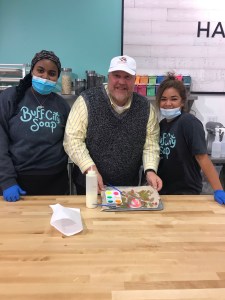
We all know people are key assets for any organization. It is the human assets, not the fixed or tangible assets that differentiate an organization from its competitors. I was reminded of this last night when I experienced Buff City Soap for the first time. For those that aren’t familiar, these two sentences from their website tell it all: “Frustrated by commercial soaps’ harsh chemicals, detergents, and animal fats, Brad and Jen set out to create a better way in 2013. So we created Buff City Soap – delightfully scented plant-based soaps, handmade daily, in front of your eyes in our Soap Makeries.” So, in we went.
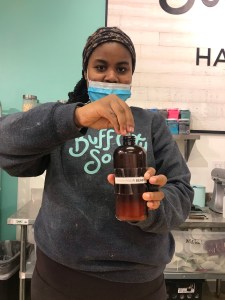
After being greeted by Francys and Alese, who were making soap when I walked in, I noticed the workbenches. Then my curiosity kicked in and I asked if I could help. They laughed and said, “Do you want to make your own bath bomb?” Are you kidding me? “Yes!” I sat down and Francys and Alese started educating me. First I had to pick a fragrance from what looked like hundreds of bottles. Frances made the suggestion of Ferocious Beast, and I rolled with it.
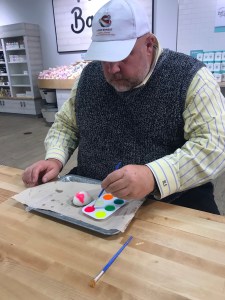
After applying the fragrance, with Alese’s guidance, I picked a palette of colors. Then Francys gave me my paint, brushes, and instructions. Then, when I was done painting, Alese helped me apply glitter. I had made my own bath bomb. Success! And, so much fun! The reason it was so much fun was because of Francys and Alese. We’re sold on Buff City Soap.

Employees champion the organizations and businesses where they work and determine the success or failure of those organizations and businesses. Every person brings a different set of skills to the table even though the job yields the same set of skills. Organizations need to recognize the value their employees and make sure they continually develop their talents and skills.
I want to praise the knowledge, expertise, abilities, skillsets, and experience of Francys and Alese. They both have incredible people skills and my hope for them is that they will always be a part of an organization that recognizes that and continues to help them grow personally and professionally. How about you? Do you recognize that your people are your most important asset? Are you helping others grow? Because, just like Buff City Soap says about their soap, every employee and teammate is unique and 1 of 1.
Being Kind

I am continuing to learn from my reading in The Lincoln Highway by Amor Towles. There has been so much talk and many articles written about kindness in the last year. Additionally, there has seemed to be a great deal of hypocrisy where organizations, companies, and leaders would be lauded one day for acts of kindness and be reported for being unsafe the next. Or, articles about kindness is more than providing for basic needs, the lowest wage possible, or most bare bones of benefits. One thing is clear: being kind is necessary and the right thing to do. It’s even a bit intriguing to me that we even need to talk about it, but here we are.

We’ve all seen the buzz word ridden definitions of kindness that people/leaders love to give. You know, the ones that have words like considering, balancing, satisfying needs, fostering group well-being, innovation, potential, and productivity. What? It’s got to be simpler than that. It is! A character, Sally, in The Lincoln Highway likes to make strawberry preserves using the recipe and technique taught to her by her mother. When asked why she goes to the hours of hard work to make the preserves when you can go to the store and buy a big jar for 19 cents (the novel takes place in the 1950s), she says because she can and precisely because it takes so much effort. She explains she does it because it does take so much labor and it is a kind thing to do.
Furthermore, Sally defined kindness as being “where necessity ends.” Let’s read that one more time: “For kindness begins where necessity ends.” Now there’s a definition we can understand. If we let that sink in it’s pretty basic – kindness kicks in after basic necessities are met. Kindness is also a part of our everyday interactions.
As it also asks in the book, “For what is kindness but the performance of an act that is both beneficial to another and unrequired?” To me that puts a whole new light on kindness. Sometimes we pat ourselves on the back for being kind when really we’ve just begun to provide for necessities. Let’s not ever forget this lesson: kindness begins where necessity ends!
Picking Your Moments

I just started reading the incredible new book The Lincoln Highway by one of my favorite authors, Amor Towles. As a believer in the importance of storytelling as a skill, reading an Amor Towles’ book is like taking a clinic. Besides becoming completely engrossed in his books, I become very reflective and end up learning a great deal about myself.

A line in the book already jumped out at me: “Sometimes the moment is picked for you.” I tell leadership development groups I work with all the time that we sometimes forget that we need to control the clock. Think about it; the best coaches control the clock from beginning to end. You might be thinking how does the moment being picked for you translate to controlling the clock. Well, it means using that moment to the fullest. This means we need to keep our attention focused on the present. One thing is for sure, whatever we are attending to in this moment will change. This change could give us the opportunity to practice accepting whatever it is that will emerge in the next moment. There is wisdom in cultivating acceptance.
I heard it said once that the reason we can fully appreciate sunsets is that we can’t control them. But, even though we can’t control when sunset happens each day (the moment is chosen for us), we can plan to be standing on the beach at the right moment to experience its glorious moment. So remember, make the most out of those moments that are chosen for you.
Leading FOR Others

I had the chance to go visit three Indiana schools this past week and see some great things happening for students in our state. I visited the International Soccer School of America, Stable Grounds, and Millersburg Elementary Middle School. I love getting out into schools and seeing programs that I have not visited before. This is an important part of my own development as a citizen leader and being part of the Indiana State Board of Education. It is impossible to understand others and build relationships without taking the time to visit and listen. At all three stops I saw communities of people who were innovating to serve our young scholars. They were meeting them where they were and preparing them for the future they choose.
When we lead as a community we foster an environment for inspiration, success, trust, and teamwork. I want to lead FOR others, to provide thought and care, develop strong relationships, support others in their own successes and consciously act with integrity. When we develop as leaders FOR others, we grow in grace, understanding, and self awareness.
Being Childlike

The other day during a Zoom meeting I said that I thought that I had matured a little over the last year. Then, one of the participants said, “Well, just don’t quit being childlike.” I thought about that and actually wrote it on my notepad. Now, as I come back to that note I guess I look at being childlike having all to do with growth, curiosity, and feeling free enough as individuals to be ourselves without unduly formed restrictions. Those things really have nothing to do with maturity and all to do the positive qualities related to children. Things like innocence, trusting, unguarded, or being vulnerable like a child. It also means taking off the many masks of propriety imposed within our society that limit our creativity and sense of exploration. I do allow myself to play, and to be silly.
I probably wouldn’t have written a blog post about this, but when reading yesterday in Mo Rocca’s awesome book, Mobituaries, yesterday he wrote that someone had described Sammy Davis Jr. as being childlike, not childish. This made me think more about the difference. Sammy certainly was fun, relaxed, spontaneous, creative, adventurous, and silly. At the same time that he was entertaining us he was doing a lot of great things in the world. Certainly not childish behavior. Childlike, yes; childish, no.
Therefore, being childlike has everything to do with growing, being curious, and being ourselves without those unduly formed restrictions that society wants to place on us. I sure hope I don’t grow out of being childlike!
What Is Your Essence?

I am reading the great book, Mobituaries: Great Lives Worth Reliving, by Mo Rocco right now and while discussing Sammy Davis Jr., he posited that when Sammy did an imitation he had a way of getting to the essence of the person. Our core essence is what makes us uniquely “me”, and is what separates each person in their individuality. This thought of essence is pretty deep. Essence is our style and what seems to show up in every one of our stories. Just as important to discovering our essence is to unraveling the mysteries of our actions, it is also important to explaining the mistakes we make. But, I was also reminded this weekend how important understanding essence is to effective relationships.
I was reminded of this during a discussion yesterday during our Carolinas 3D Leadership gathering. Two participants did some deep soul searching and were discussing how they hated to hear things from their principals or team members like, “your doing to much” or “not sure why you are doing that” or “why in the world did you add so many features to that spreadsheet.” I added that last one because I’m guilty of saying things like that. I am so glad that these two opened up, though, because I believe it opened all our eyes – I know it did mine. We were hearing their essence in their stories. Glad we were listening to understand!
I asked them what it was they wanted to hear. They said they just wanted to hear, “Great job on this” or “This is very helpful” or I really appreciate having this.” For these two, their essence is something like being three steps ahead or going above and beyond or striving for success. What we learned from this discussion was that it is not helpful for those whose essence is to build the over the top spreadsheet to say, “Um, not sure why you spent so much time on this, we don’t need all the bells and whistles.” We just need to acknowledge and recognize the person’s essence. You all know me, I asked what do you want to hear? They told me instead of “you shouldn’t have” they wanted to just hear “thank you, I appreciate all the extra work you have done.” Otherwise, we are not respecting their essence.
Since our essence is our style we don’t want to let a story overwhelm our style. That would mean to lose touch with ourselves. When work becomes more important than the living of your own life, or a relationship overshadows your individual needs, or expectations are so prescriptive that you are no longer in control of your life or how you do your job, we are not living by our essence.
It’s amazing to me how a simple word like “essence” can cause such deep thought. But, just as Sammy Davis Jr. could catch the essence of others, we too have an obligation to listen and watch for the essence of those around us understand the essence of those we work with and have relationships with. Essence is a part of each of our stories and follows us no matter which forms we may take. To truly understand the essence of another is to have power in how we work and flow with other. Finally, we also need to understand our own essence and embrace it because to do so will keep us from working against ourselves.
Work The Problem

I love the phrase, “Work the problem.” I’ve heard some of my military trained friends use this phrase. To me it means not sticking our heads in the sand and ignoring the problem or hoping it goes away. It also means we won’t guess. As Gene Kranz would say, “Work the problem. Don’t make it worse by guessing.” What he was saying was that to work the problem we need a firm understanding of the complex puzzle and what’s going on to work the problem.
Let’s also not forget in The Martian when Mark Watney, was stranded alone on Mars. My favorite quote from the movie after him having the mantra of working the problem was, “You begin. You do the math. You solve one problem, then the next one and then the next one. If you solve enough problems, you get to come home.” It’s kind of like making a puzzle; one piece at a time.
To work the problem we need to define the problem or challenge. Then we need to determine the desired outcome. For Watney, it was coming home. Information and research gathering comes next, followed by the most important part: the game plan. Then we go from working the problem to working the plan.
Attracting Successful People

If I had heard the story of H.B. Reese, I had forgotten it. He actually started a rival candy company in Hershey, Pennsylvania while still working in chocolatier Milton Hershey’s factory. Can you imagine what would happen with most leaders? There would be inevitable envious fit, and then there would be the immediate firing. Not with Milton Hershey. He supported Reese in creating that very special candy cup we all so enjoy. Not Sorry!
In fact the Hershey factory supplied the chocolate for the experiments as Reese developed the peanut butter cup. Of course Reese became successful and he and Hershey collaborated forever after till both their deaths. In fact the two companies were merged after their deaths. This is such a strong reminder that we all need to be aiding in the success of others. And, as others see this happening, it will attracted more talented people our way.
Even though they were competing, Hershey and Reese were inspiring each other. Who are you helping to be successful? Don’t be sorry!
Every Voice

I must say I am pretty impressed with the newest FBI show “FBI International.” The characters and character profiles did it for me. I was particularly drawn to the team leader, Scott Forrester played by Luke Kleintank. It was explicit in the shows script that he had picked an elite team with every person being selected for a reason and their specific strengths and skills. That got my attention – the writers want us to see him as an outstanding leader. Then, two lines in the episode I watched last night really jumped out at me and were reminders of great leader traits.
The first was early in the show after a team member had given a dissenting viewpoint to Forrester, which led to some discourse, and Forrester giving his reason for disagreeing. The dissenting team member was new and wasn’t sure how to feel about the interaction. Another member of the team pulled her aside and told her that Forrester was the type of leader that valued the team and wanted “every voice in his ear.” He wanted and needed to hear from everyone. Every voice on the team mattered. Every dissenting view mattered. Forrester was not worried about being right, he was worried about getting to right. So many poor leaders want to look smart and don’t want to hear views contrary to their own. Forrester reminded us we need every voice in our ear. BTW: it turned out the team member was right and he was wrong – so glad they wrote it that way!
In another scene, another team member brought Forrester an idea that might be a long shot to pursue. Forrester said, and I love this, “Take that wherever it goes.” Is that not just the coolest response ever? He had just given the team member full empowerment. It no longer mattered if it was a wild idea or not. The team member could fully invest. Giving team members this kind of freedom, without risking ridicule or reprisal, frees them to consider ideas and approaches that might otherwise go unexplored.
Great leaders encourage and development the ability to scrounge, forage, and rummage for ideas. We must learn to search everywhere for available ideas. Are you letting your team members follow their ideas? Or, are you letting their voices in your ear?


leave a comment