You Want Me To Do What? Teach?
 I try to read two books per week as part of my own personal professional development. One of the books I read this past week was The Seed: Finding Purpose and Happiness in Life and Work by Jon Gordon. This was an incredible book that I read in two sittings because once you start you can’t put it down. Then yesterday I had two individuals who regularly read my blog say that they really liked my book reviews. I promptly replied that I had not been doing any book reviews, and then I realized as they explained that generally my blogs revolve around something I have read. Amazingly, this made me realize just how powerful my two books a week are to my growth.
One statement that Gordon made in this book really jumped out at me and made me realize how important we all are in the roles we are meant to play. He said, “I’ve learned we are all teachers and students, and a life touches a life that touches a life.” So for this post I would like to share how it came to be that I would be a teacher. Some of you have heard me tell this story publicly many times, but it truly is a course of events that revolved around a teacher, Dr. Hobart Jones, and a student – me. Here’s the story.
My teaching career did not begin with the same story that many teachers share. I did not have an epiphany when I said to myself, “I want to be a teacher.” My journey as an educator began during my sophomore year at Purdue University when Professor Dr. Hobart Jones pulled me into his office and asked if I had ever considered teaching. When I said, “no,” he explained that he saw a talent in me for educating and wanted me to double major in Animal Science and Agricultural Education. It is amazing how someone like Dr. Jones can make a huge impact on someone’s life. His inspiration and personal interest helped me to deal with the challenges of a double major, making my 27 year educational career possible. Without Dr. Jones’ personal interest in my abilities, I probably would have missed this opportunity. It is his example of true caring that I strive to emulate every day of my teaching career.
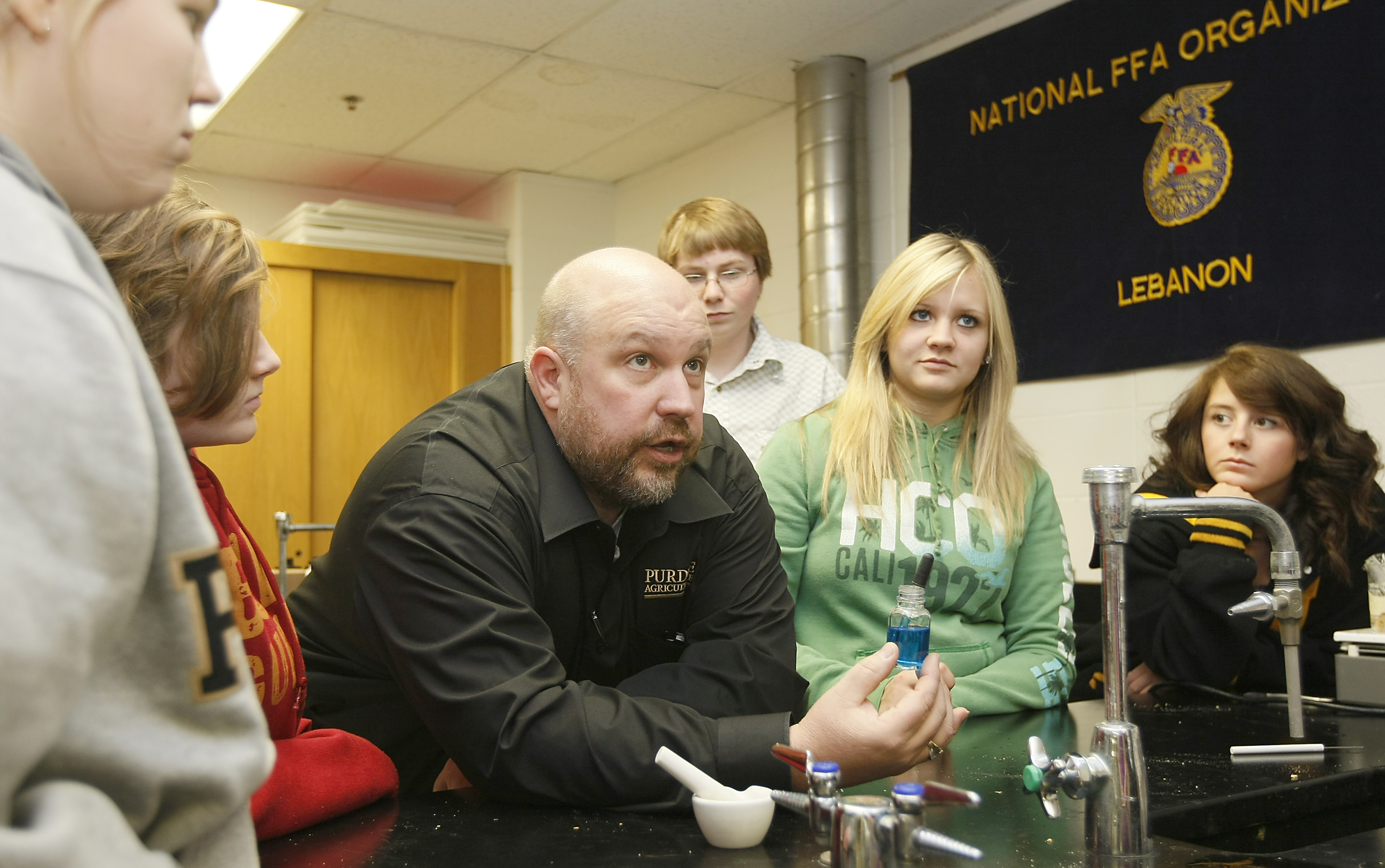
A narrative of my professional career would not be complete without mentioning my latest chapter, starting the Agriculture Department at Lebanon in 2004. As an optimistic risk taker, the opportunity to start a program where no program existed was just that – a tremendous opportunity. It has been exhilarating to start a program, establish the facilities, and lead the team in building a program that now has 584 students enrolled. It has also enabled me to teach rigorous Purdue University dual credit courses in Advanced Life Science. As the department head of three other young teachers, less than 20 years of combined experience, I have learned how to be a true servant leader. In other words, as Gordon suggested, a life touches a life (Dr. Jones to me), a life touching a life (me to the teachers I mentor), and a life touching another life (me to all the students I facilitate learning with every day).
Remember to take full advantage of all the opportunities to touch the lives you come in contact with!
As You Go, So Go Those You Lead
 I was listening to WIBC radio on my way to school, as I always do, this week. One of the guest sports commentators made a comment that caused me to do some thinking. The comment was, “As Peyton Manning goes, so go the Colts.” In other words it was going to be a tough year for the Colts until Peyton returns. This got me thinking about my own role as a teacher leader and department head at my school. What would I want to happen if suddenly I was not around tomorrow?
Now, please don’t take this as me putting down the Colts for not having someone ready to just step into that role because that is not the point at all. The statement by the commentator made me think back to something that I learned from reading the work of John Maxwell. He talked about leading in a way you can be replaced. The idea is that you have been a servant leader in such a way that others have been lifted up to a level where they could actually replace you.
I realize this would be extremely tough to do in the case of Peyton Manning but we can learn from the fact that the other quarterbacks under Peyton are certainly learning from their experience. I am sure my fellow Boilermaker, Curtis Painter, has learned a great deal from working with Peyton Manning. Still, we can reflect on our own situations and think about the people we work with. Are we developing their talents in a way that they could replace us. If we are truly servant leaders, wouldn’t the goal be that if we were gone tomorrow everything would continue seamlessly?
In fact, as Max De Pree said in Leadership Jazz, “leaders have to be vulnerable, have to offer others the opportunity to do their best. Leaders become vulnerable by sharing with others the marvelous gift of being personally accountable.” De Pree also talked about how leaders work to bring the special and creative gifts out in others.
This has really caused me to reflect and determine what I would want said about me if I could not return to school on Monday. I would hate for someone to say “As Byron Ernest goes, so goes Lebanon Community School Corporation.” I would rather have those I have worked with, coached and mentored say, “Wow, because of my time spent with Byron, I am ready the the next big steps and responsibilities that come my way.”
Hopefully, this will cause you to think about becoming vulnerable to those you serve!
Leadership Lessons of Mt. St. Helens
 Mt. St. Helens, often described by souvenir brochures as having a quiet beauty and unspoiled nature began to come alive in March of 1980.
On May 18, 1980, at 8:39 a.m., Mt. St. Helens erupted with the explosive force of 500 atomic bombs. Seventeen hundred feet were blown from the top of the mountain sending a cloud of ash and smoke for more than 60,000 feet into the atmosphere. The cloud gave those in its path a gritty taste of natures power. The Indians had most appropriately named this place “Fire Mountain.”
I have been blessed, because of meetings, to be at Mt. St. Helens twice in the last year. The second time, when I took the attached picture, I was able to take my family. While in the area, my wife bought me a beautiful ring with incredible green crystals. When I asked what the gems were she explained it was Mt. St. Helens Jewelry – Jewelry made from volcanic ash processed by heating at high temperatures and under tremendous pressure to cause the ash to turn to a crystallized state. These green (because of the copper) gems are then cut and polished to make the beautiful piece of jewelry shown below.
Then as I was reading Max De Pree’s Leadership is an Art and Leadership Jazz this week I realized De Pree‘s lessons were perfectly illustrated by this Mt. St. Helen Jewelry. Leadership is an art, that like the gems made from ash, is shaped and polished. But before the crystal is even formed the ash must undergo tremendous heat and pressure, just as a leader does. The leader must turn these challenges and problems into opportunities.
Then the leader, like the beautiful gem, must be shaped and polished. Polishing takes others help. Shaping takes us finding our voice and what we believe in. Polishing involves us studying and being involved in professional growth. Shaping involves us helping others – becoming servant leaders. Finally, polishing involves us reflecting.
So let’s not forget that we need to become artists and work hard at polishing and shaping the leadership gem that we are capable of becoming. Also, we must help to polish and shape the leadership crystals of others. Go out and use your artistic abilities to polish and shape someone today!

Connecting, Extending, & Challenging
 In education Connecting, Extending, and Challenging are so much more than just words. They are crucial to 24/7 learning and teaching students to learn to learn. I believe in 24/7 learning. We have to facilitate an environment where our students’ learning continues outside the school day – EXTENDING.
We must also challenge our students to learn and explore new concepts and take on new and exciting projects – CHALLENGING. Let me give you an example. My students just completed a project that I believe models Connecting, Extending, and Challenging – Operation Home Grown.
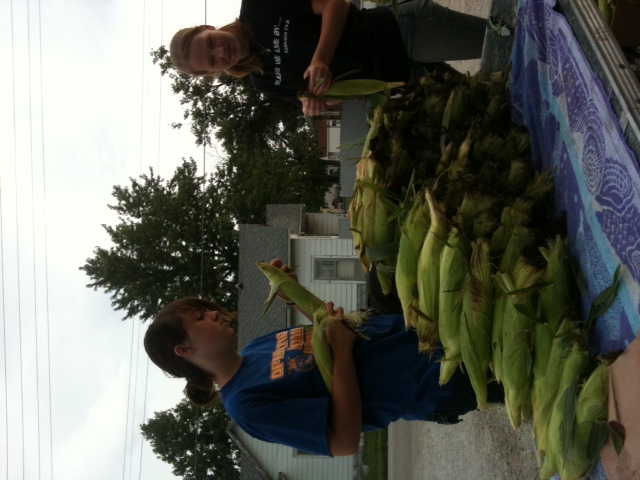
Following a series of soil chemistry and plant growth lessons n my Advanced Life Science Plant & Soils class, my students made a CONNECTION to organic and sustainable agriculture. They decided to extend their learning outside the classroom and proposed to use 2 acres of our Outdoor Agronomy Lab to grow organic sweet corn.
This CHALLENGED my students to learn how to grow organic sweet corn and come up with a plan for selling it. Not as easy as it sounds. They were challenged with a lack of rain.
Success was realized for this group of students this past weekend when they picked the first of the corn and sold out of 52 dozen ears of sweet corn in less than two hours. When we facilitate learning for ALL students of ALL ages we must remember to Connect, Extend, and Challenge them.
Reverse Mentoring

- 2010 Wyoming Teacher of the Year
I realize that the buzz word has changed from mentoring to coaching, but I have been advocating reverse mentoring for quite a while now, so I am not changing terminology. In my field of teaching, it seems that everyone is hung up on the tradition that experience equals qualifications and effectiveness. Even though this might be true in some cases, I propose that mentoring goes both ways. In other words teachers with less experience may be more effective teachers and have knowledge/skills to share with those of us with more years experience.
In fact, I’ll be the first to tell you that I would not be where I am today without the learning that has occurred from those with less years experience, but with skills, knowledge, and abilities far exceeding my own. For example, I would not have near the skills using technology to enhance student learning if it were not for a former student, Matt Ladd, who served as our technology guy at my high school. Now, amazingly, I am looked to as a leader using technology. Make no mistake, there were many others, including my students who played a role in moving me into the 21st Century. Just one example of Reverse Mentoring at its best.
The picture I chose for this post is very special because it is of a teacher with nine years experience that I, with 27 years experience, learn from every time I am with. I was blessed to get to know Christina Mills, 2010 Wyoming Teacher of the Year, two years ago during my year as Teacher of the Year. She is amazingly talented and effective in the classroom, and I value every chance I get to be around her. I was thrilled last week when I was a part of the Smithsonian Institution and Pearson Foundation’s Mission Possible: Reimagining the 21st Century Classroom in Washington D.C. and through the door walked Christina. Neither one of us knew the other was going to be there. This four day conference provided plenty of opportunity for learning; much of which came from collaborating with Christina.
So if you are reading this with many years experience in your field, do not forget that those with less years experience may just have more experience in areas you need mentoring. Or, if you are reading this and have limited years experience do not forget you have valuable knowledge to share with those of us with more years. The goal should be to learn from each other. I guess I should call it Two Way Mentoring – learning from each other.
Talkin’ Turkey About Coaching
 My son, Heath, and I had a tremendous lesson in coaching that culminated in success this past weekend. Heath loves to turkey hunt and took his first turkey Sunday morning (4/18) at 7:35 a.m. in Parke County, Indiana.
Heath, age 9, and I learned an important lesson on coaching. We have the greatest hunting coach imaginable in Shawn Brown of Royal Flush Enterprises, Inc.
Shawn gave us a list of areas that we needed to work on for Heath to be successful. Here’s what we needed to know and work on: pattern of the gun, outside range of the gun, shots from several positions (left, right, straight, sitting, kneeling, in blind, out of blind, and from several distances).
So here’s the deal. Heath’s turkey took 71 shells to take. Why, you might ask, did it take so many? Because he started practicing in January and had his final disciplined practice on Thursday (4/16)before our hunting trip. He had used 70 shells up to that point. Therefore he knew that his gun had a range, with a good pattern of 25 yards. So, when the turkey was at 27 yards, he knew not to shoot. At 23 yards, it took one shot that he had taken several times before at targets to bring in his first turkey- A 23 pound Tom with a nine inch beard. A great trophy bird for a nine year old boy!
The point of this post is that having a great coach like Shawn, and then acting on that coaching with disciplined practice will end in success.
Go HUNT out those great coaches.
Byron
Coaching vs. Mentoring
Yesterday I had the incredible opportunity to be in involved in one of the greatest experiences of my life. My good friends at the Kevin Eikenberry Group – www.kevineikenberry.com – invited me to be a part of their Coach & Be Coached: Coaching to Achieve Remarkable Performance – for others and yourself – www.remarkabletv.com – webinar. The line-up was the “whose who” of leadership of coaching.
I would like to share a thought that I had afterward:
Betty Clipman, Past International President of Sweet Adelines International and one of the presenters, made a comment that she was glad we were finally getting coaching back since mentoring had gone away, or something like that. Therefore, I looked up the word mentor – a wise and trusted counselor. Then I looked up coach – besides being a railroad car, it says: one who trains or directs athletic teams; one who gives private instruction; to train, instruct, or teach. Not a lot of difference, right? So why is mentoring now not the word of the day, but coaching is?
Here’s the reason for the comments: In education, as with a lot of other areas people cringe when they here mentoring and when mentoring programs talked about. So why have people left mentoring and moved over to coaching? I’ll tell you what I believe. Many look at mentoring and coaching as a “thing.” “Things” are not sustainable. Yesterday, the seminar drove home the fact that coaching must not be a “thing,” but a relationship, specific, appropriate, continual, and lifelong. Far from being a “thing,” it is a never-ending journey or process.


1 comment