Great Leaders Listen Without Saying Anything
In my new book, Mere Leadership, one of the leadership attributes discussed is being an aware communicator. This past week a friend of mine affirmed how important listening is. He really did not want me to directly quote him when I blogged about it but I told him I was because his comment put the exclamation point on how important listening is. He was speaking about learning leadership; the leadership he learned while he was an army officer, from the great example set by General Raymond Odierno. The bottom line was, General Odierno listened.

In my discussion of being an aware communicator in Mere Leadership, I emphasized the power of active listening as a cornerstone of effective communication. This aligns perfectly with the remark my friend made about General Odierno’s leadership: “He listened without saying one fucking thing!” I loved this comment even though it had a little foul language in it. He said it with such emphasis and conviction. He even said it so loud that everyone in the hotel lobby bar turned and looked. But he was so serious about the power of listening to understand that I must leave his statement here in my post just as he said it.
This was a testament to the transformative strength of truly attentive listening. What I call listening to understand. General Odierno’s approach exemplifies how unwavering presence and openness can foster trust, understanding, and respect within a team, illustrating that sometimes, silence and attentive ear are far more impactful than words.
Embracing Growth: Turning Past Struggles into Strength and Resilience

I am intrigued by the song, “Reward the Scars,” the new single released earlier this year by Korn in collaboration with the Diablo IV: Lord of Hatred video game folks. Now, to be clear, I am not a gamer and know nothing about the game the song is themed after. So, it may just be I can’t really speak to the song, but the lines “Fighting fast and fighting hard; Lose the past and reward the scars” really caused me to pause and think.

The whole song and especially the lines “Fighting fast and fighting hard; Lose the past and reward the scars” scream (literally) a theme of resilience and overcoming struggle. “Fighting fast and fighting hard” speaks to me about facing challenges head-on with intensity and determination. “Lose the past” encourages us to let go of past hurts, regrets, or baggage that might hinder growth.
I love the title of the song and the line “Reward the scars” because for me it signifies that the pain and difficulties endured are marks of experience and strength, which ultimately contribute to personal growth and resilience. When I reflect on difficult times or tough projects I quickly realize how these “scars” caused personal growth and become badges of credentials. The lyrics emphasize for us that confronting difficulties boldly, releasing the weight of the past, and recognizing that adversity can lead to strength and valuable lessons.
Being Clueless

Bilbo Baggins was a sort of antihero in J. R. R. Tolkien’s The Hobbit. Bilbo begins the story as a rather naive and reluctant character who grows into his role. Sound familiar? How many of us would say that is how we were? So maybe I should say Bilbo was a reluctant leader instead of an antihero. He grew into being both a leader and hero.
“Now that he has proved himself many times over, the dwarves look back on Bilbo’s cluelessness with fondness” (Corey Olsen, Exploring J. R. R. Tolkien’s The Hobbit, p. 201).

Bilbo’s occasional cluelessness in The Hobbit teaches us several valuable lessons. Bilbo reminded us that everyone has moments of uncertainty or lack of knowledge, and that’s completely okay. It emphasizes the importance of humility and being open to learning, even when we’re faced with unfamiliar situations. Bilbo’s mistakes and missteps during the quest often lead to growth and new opportunities, reminding us that errors are just part of the journey toward success.
Bilbo’s ability to adapt, remain resourceful, and eventually find courage underscores that sometimes, not knowing everything initially can be an important step toward discovering our own strengths. These moments of Bilbo’s cluelessness remind us to be patient with ourselves and others as we navigate life’s quests and adventures.
The Power of Bilbo’s Luck in The Hobbit
One of the things that really intrigues me about J. R. R. Tolkien’s The Hobbit, is how much the luck of Bilbo Baggins is referred to. Tolkien’s major theme of luck throughout The Hobbit has always intrigued me. I have always wondered and deeply pondered Tolkien’s why. I believe the major theme of “luck” points far beyond mere coincidence to an invisible divine intervention.

My favorite lines/scene in The Hobbit is when Gandalf asked Bilbo, “Surely you don’t disbelieve the prophecies, because you had a hand in bringing them about yourself? You don’t really suppose, do you,” he [Gandalf] asks, “that all your adventures and escapes were managed by mere luck, just for your sole benefit?” (P. 341). Gandalf confirmed for us that what Bilbo and the narrator had been calling “luck” the whole time was more than simply chance. I love Bilbo’s response: “Thank goodness!” said Bilbo laughing, and handed him [Gandalf] the tobacco-jar” (p. 341). Bilbo’s adventures have been “managed” by divine Providence for a purpose far greater than the enrichment of one small hobbit. This humble “Thank goodness!” reveals Bilbo as a humble servant leader.

I love how Corey Olsen pointed out in Exploring J. R. R. Tolkien’s The Hobbit out that Bilbo’s response of “Thank goodness!” “shows that he is quite satisfied to learn that he has not really been the protagonist of his story, after all. Bilbo is at peace, and our final image of him is a fitting one. Bilbo, laughing around his parlor table in Bag-End with Gandalf and Balin, hands the tobacco jar to his friend, as they all smoke their pipes together in contentment” (p. 304). This spoke to Bilbo’s humbleness and his recognition of being a part of something much larger than himself.
Olsen also pointed out that, “Bilbo’s story challenges us to think about the relationship between fate and human choice” (p. 7). As a person of faith I do believe there is divine intervention in our lives, but I also believe there is also a certain amount of luck. I know I am introducing quite the paradox with that statement but I am okay with that. I don’t claim to know what is divine intervention and what is not and I am okay with that tension. I am comfortable, just as Bilbo was, to say “Thank goodness!” that I really am not the protagonist and in control of everything like I need to be humbled occasionally into understanding I am not.
The latent points that Tolkien brings into The Hobbit are amazing. The use of “luck” is an excellent example of this. It is not obvious from the beginning, but we learn as the story goes on we learn that there is much more than luck at work in the story. Life has a way of making things look like luck, but when we look back we find that in some cases something much more divine is at work. We can’t just suppose that all the great things in our life happened just by luck. I believe there is a combination of divine intervention, the intervention of others (both good and bad), our own preparation (being prepared for what we don’t know we need to be prepared for), and probably some pure luck.
Why Go A-Roaming?

Sometimes we need a little reminder of what is important. At the end of J. R. R. Tolkien’s The Hobbit, Bilbo Baggins’ and Gandalf stop to visit the elves. We they arrive the elves are singing a song. Here is part of it:
The stars are far brighter
Than gems without measure,
The moon is far whiter
Than silver in treasure;
The fire is more shining
On hearth in the gloaming
Than gold won by mining,
So why go a-roaming?
O! Tra-la-la-lally
Come back to the Valley. O!
Where are you going,
So late in returning?
The river is flowing,
The stars are all burning!
O! Whither so laden,
So sad and so dreary?
Here elf and elf-maiden
Now welcome the weary
With Tra-la-la-lally
Come back to the Valley,
Tra-la-la-lally
Fa-la-la-lally
The elves were pointing out that the night around them that particular evening in May contained far more beauty than the hoard of riches ever could. The elves ask a simple question: since the stars, the moon, and the elves’ fire all surpass the shining brightness of riches, then “why go a-roaming?” The elves are highlighting that the forest glade by the river is not only more lasting and permanent than anything in human society, but it is also more lovely and desirable than its greatest marvels.

The elves were reminding Bilbo, just as we need this reminder sometimes, that as Corey Olsen pointed out in Exploring J. R. R. Tolkien’s The Hobbit “The things ‘that men trusted’—war, power, strength, wealth—are all ephemeral things and will always fail in the end. The small things—the leaves and grass and silly elf songs—will endure, for they are ever renewed” (p. 290). I love Olsen use of the word “ephemeral” here. I also love the application from Tolkien to our own lives. No, we cannot isolate ourselves from the global society around us and we need to take an active part, but we need to remember the things that are lasting.
The elves’ reflection suggested that true value and fulfillment come from things like natural beauty, warmth, and inner light. Those elements surpass material riches. From this, we can take away the importance of appreciating simple, genuine joys and seeking meaning beyond material wealth. I believe Tolkien was giving us a reminder encouraging us to prioritize experiences, connections, and inner growth over superficial possessions. True brightness comes from within and from the natural world around us. Embracing this perspective can lead to a more enriching and meaningful life.
Leading Transformation
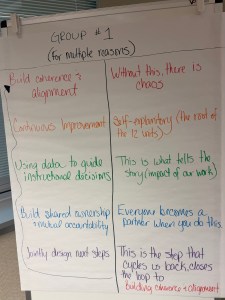
This week through the National Institute for School and System Leadership (NISL) during some great group work with an exceptional group of leaders, we explored leadership for transformation. Our task was to come up with a top five components of leading for transformation. Here’s what we came up with:
1. You’ll notice we list building coherence and alignment first on our tear sheet (see featured photo). Without coherence and alignment there is chaos. Building coherence is crucial to leading transformation because it creates a unified vision and shared understanding among all stakeholders. When there’s coherence, efforts are aligned, reducing confusion and resistance, and fostering a sense of collective purpose. This alignment ensures that everyone is moving in the same direction, which enhances trust, accelerates change processes, and increases the likelihood of sustaining the transformation over time. In essence, coherence acts as the foundation that holds complex change initiatives together, making the transformation more effective and resilient.
2. Continuous improvement is crucial to transformative leadership because it fosters an environment of ongoing learning, adaptation, and growth. In today’s rapidly changing world, leaders who embrace continuous improvement can respond more effectively to new challenges, innovate consistently, and refine their strategies to better achieve their vision. This mindset encourages resilience, keeps the organization agile, and motivates team members to pursue excellence. Ultimately, it helps sustain long-term transformation by ensuring that efforts are not static but evolve based on feedback, insights, and changing circumstances, making the leadership process dynamic and forward-looking.
3. Using data is essential for decision-making in successful transformative leadership because it provides an objective foundation for understanding complex situations. Data offers factual insights that help us make informed choices rather than relying solely on intuition or assumptions. Also, analyzing data reveals trends, patterns, and potential risks early, enabling proactive strategies.
Data allows leaders to track the effectiveness and measure the progress of initiatives and adjust actions accordingly to ensure continuous improvement. This enables the building of credibility and trust because data-backed decisions demonstrate transparency and logic, fostering trust among team members and stakeholders.
In transformative processes, data helps measure acceptance levels, resistance points, and the impact of change strategies. Integrating data into decision-making enhances clarity, reduces uncertainty, and increases the likelihood of successful transformation by aligning actions with real-world insights.
4. Building shared ownership and shared accountability is crucial in transformative leadership because it fosters a sense of collective responsibility, engagement, and commitment among all stakeholders. When everyone feels personally invested in the change process, they are more motivated to contribute their best efforts toward achieving common goals.
Shared ownership and accountability empower teams to be proactive agents of change, fostering a culture of trust, innovation, and continuous improvement necessary for successful transformation.
5. Successful transformative leaders jointly develop next steps because it fosters shared ownership and commitment among team members. When leaders involve others in planning future actions, it ensures that everyone is aligned with the vision and understands their roles in achieving goals. This collaborative approach also leverages diverse perspectives and expertise, leading to more innovative and effective solutions. Additionally, jointly developing next steps promotes buy-in, motivation, and accountability, which are essential for sustaining momentum and successfully implementing change. This participative process helps create a unified, resilient, and adaptive team dedicated to the continuous improvement I mentioned earlier.
Along with these five components, great leaders of transformation act with vision, empathy, and resilience, inspiring others with a clear sense of purpose while fostering an inclusive environment that encourages collaboration and innovation. We must communicate effectively, listen actively to diverse perspectives, and remain adaptable in the face of change. By demonstrating integrity and accountability, we build trust and motivate our teams to embrace new strategies and overcome challenges together. As transformational leaders it is our responsibility to guide our organizations through change with confidence and compassion, ensuring sustained growth and positive impact.
Being Part of a Grand Story
In my study of J. R. R. Tolkien’s The Hobbit, I have been fascinated by Bilbo Baggins’ transformation. Bilbo Baggins is a gentle, humble hobbit. He enjoyed a simple life filled with comfort, good food, and quiet days. However, beneath his unassuming exterior, he possesses a curious and courageous spirit that leads him on an unexpected adventure beyond his cozy home. Throughout The Hobbit, Bilbo evolves from a cautious, reluctant participant into a brave and resourceful hero, discovering strengths and qualities he never knew he had. I already wrote about Bilbo’s development in From Timid to Trusted: Humble Leadership and
Courage and Wisdom Blended in Measure.

Interestingly, Corey Olsen also focused on Bilbo’s evolution in his great book, Exploring J. R. R. Tolkien’s The Hobbit. He posited that, “At the beginning of the book, the narrator invites us to judge whether Bilbo ‘gained anything in the end.’ In Chapter Five [The Hobbit], we are still far from the end, but we can already begin to see what Bilbo is gaining. Bilbo has passed the turning point in his career. He has ceased to be a passive victim of his adventure, and he has embraced his new life. He has even come to take pleasure in seeing his own life as part of the great, grand stories that he listened to (with obvious pleasure, despite their Tookishness) even when he lived in Bag-End” (p.p. 108-109). Olsen went on to say, “Bilbo has come to see that, though adventures may in truth be “nasty . . . uncomfortable things” that “make you late for dinner,” as he said back in Chapter One [The Hobbit], it can also be rather grand to be a part of one of the great stories” (p. 109). Bilbo had discovered qualities in himself he never knew, reminding us to recognize and develop our own and our team’s potential.

One of my favorite lines in The Hobbit is toward the end of the book when Gandalf told Bilbo, “You are not the hobbit that you were” (The Hobbit, p. 338). While reading the book I was witnessing the changes in Bilbo, but this really drove it home. The “quest” had changed Bilbo, and for the better. Think about how many times this happens to us. When I think back to my time as a principal of a turnaround school, there were times when it was pure hell. But it was also some of the most rewarding and life-changing work I have ever done. I developed friendships I still have today and I am certainly a different and better person for having been on that quest.
Bilbo’s transformation in The Hobbit offers valuable lessons for leaders. Initially, Bilbo is cautious, comfortable, and somewhat hesitant to step beyond his familiar world. But through his journey, he developed qualities like bravery, resourcefulness, perseverance, and adaptability. Those traits, along with embracing challenges, thinking creatively under pressure, and growing through experience, are essential for effective leadership.
Bilbo also learned to lead with humility and kindness. My other favorite line in The Hobbit is, “Already they had come to respect little Bilbo. Now he had become the real leader in their adventure. He had begun to have ideas and plans of his own” (The Hobbit, p. 259). Despite his growth and developing into a leader, Bilbo remained humble and caring, qualities that foster trust and teamwork.
Bilbo’s evolution in The Hobbit can serve as an example to encourage leaders to have courage, be adaptable and flexible, and open to personal growth. Also, we need to always remember to inspire our teams to do the same.
Embracing Our Reflection: How to Heal and Grow from Life’s Broken Mirrors

I am a very reflective person and yesterday morning a post I did from June 1st in 2023 came up in the content time capsule. I love, by the way, that WordPress does those blasts from the past for me. The post was entitled Being Reflective. I still love the quote in that post from a participant in one of my workshops about a temporary tattoo she did. She said, “I placed it there (on her neck) because the only way I can see it is in a reflection and this reminds me that to be self aware I need to be reflective.” Being self aware and reflective are both very important for us to be focused leaders.
I’ve been wanting to do a post about the great Architects’ song “Broken Mirror” and that blast from the past from 2023 gave me the inspiration to get it done. The song evokes a sense of longing, introspection, and vulnerability that I have been pondering writing about for a while. The chorus of the song goes like this: “Take me to the place where the heavens are haunted; And I’ll pray to the cross you bear; Tell me, if I gavе you the world would you meet me therе?; Do you see me now?; The lights are out; I’m a broken mirror.” There is a lot to unpack there and the reason why I love great rock artists. Those artistic lines can mean many different things and provide inspiration to many different people.
For me, the reference to heaven expresses a desire to reach a place of emotional or spiritual significance. Heaven, which is a real place for me, symbolizes hope, peace, or understanding. These lines also indicate gestures of empathy or seeking connection with those who are burdened or suffering. This is so important when we, as leaders, focus on others. Asking if giving the world would be enough to meet them highlights a desire for genuine connection beyond material or superficial offerings. It is about us and the people we serve looking into the mirror.
Awe, then the lines, “Do you see me now? The lights are out, I’m a broken mirror” reflect feelings of invisibility, despair, or feeling shattered. A broken mirror can symbolize a fractured sense of self or identity, and the darkness suggests emotional struggles or loneliness. Mirrors are important tools for the focused leader because self knowledge and self reflection are critical for leading ourselves and others. If we become broken mirrors we won’t be effective leading others. To help prevent our breaking, it’s important to nurture self-compassion and resilience.
The first thing we need to do is Practice Self-Kindness by treat ourselves with the same kindness and grace we’d offer those we serve. This means acknowledging our own and others’ feelings without judgment. Relationships are also important here. We need people who listen, understand, and uplift us. And we need to do the same for others. Connection helps reinforce our sense of self.
Even if the mirror gets cracked sometimes, it doesn’t have to shatter completely. With care and support, we can repair and strengthen it.


leave a comment