Wonderment!

This past week as I was taking my son to school he had the radio on. The song Hey Brother by Aviccii was playing. As is many times the case; I got the lyrics wrong. I thought he was saying “Do you still believe in what I wonder?” In reality he was saying, “Do you still believe in love? I wonder!” Really, I’m glad I had it wrong because it got me thinking. Does my team believe in what I wonder? More importantly, do I believe in what they wonder?
Wonderment is a type of behavior, that as a leader, engenders our teams. We can accomplish this by creating environments where team members can bring their best selves and curiosity, and good things will happen as a result. By cutting off conversation through words or non-verbal cues, a less effective leader sends a message that the team member’s idea isn’t an option or even worthy of pause. Done often enough and pretty soon your team won’t even tell you you’re walking in the wrong direction.
Just as science fairs represent an invaluable learning opportunity for students to use wonderment and curiosity to conceive and develop an experiment, conduct it, prepare the findings and present them to student peers and experts in the field, leaders can use wonderment to find that next solution that does not presently exist. Instead of conducting cookbook lab experiments and submitting a lab report for a grade, science fairs foster independent thinking, creativity, problem-solving and written and oral presentation skills. The same is true for the leader; instead of doing what has always been done or what he thinks is right, spend some time in wonderment with the team!
A well-balanced leader knows that getting the best from their team means letting them talk, fail, succeed, wonder, be curious, and feel comfortable. Thus, as the leader, we have to have the strength to listen to differences and make decisions even if they are opposite to what the group thought was right. Spend some time in wonderment this week!
iREAD Because I Lead!
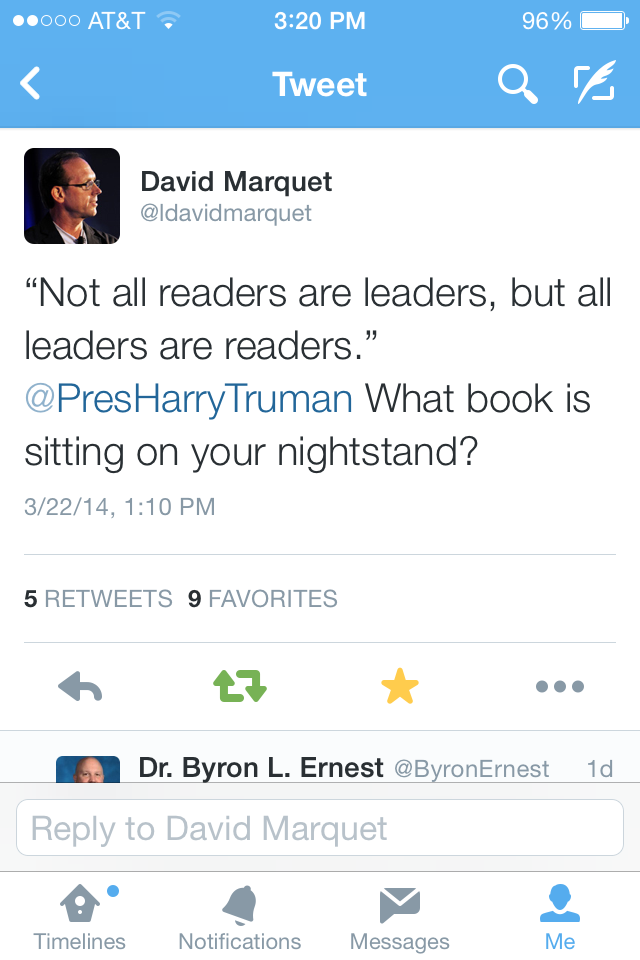
David Marquet’s Tweet
“Not all readers are leaders, but all leaders are readers.” ~ Harry S. Truman
I was reminded of this quote from our 33rd President this past week when @LDavidMarquet tweeted it. I, of course, immediately retweeted. On the same tweet, he (Marquet) also asked the question, “What book is sitting on your nightstand?” Those that follow me on twitter, @ByronErnest, know that I can’t resist answering questions. So, I answered that I just finished The Last Place on Earth: Scott and Amundsen’s Race to the South Pole by Roland Huntford and Paul Theroux. And, since I am such a fan of David Marquet, I had to throw in that he (Marquet) is like Amundsen is this contrast of two leaders. You will also notice from the picture on my response that I am now using GoodReads. It is an awesome way to keep track of books, get recommendations, and make recommendations. It even lets you scan in your books using the barcode. I learned of this app while discussing books with one of our awesome teachers, Allison Marchisani. I love the team we’ve got here because I learn from them every day.

My Response Tweet
This post is not a review of any books. I can guarantee you that I will be posting to my blog about David Marquet, however, in the future. So, watch for that, but today my post deals with the importance of reading. It is interesting that earlier in the week before being asked the question of what book was on my nightstand I was reminded of just how many books I have read this past year. In fact the exact number is 35 since July 1 of 2013. The only reason I know this is because our Media Specialist keeps track of it for our iREAD – I Just Finished Reading program. She sent out a report last week and I was amazed, as was our staff, how many books I had read!
Our school has the goal of every student and staff member reading 30 books per year outside of the normal school reading. This is a huge undertaking, but research shows that high school students should be reading 30 books outside of school per year. Therefore, our staff believes that if the students are doing it, we should be doing it. I am excited to already be five over the goal. Keep in mind I read in three modalities: book in hand, Kindle app on my iPad Air, and Audible app for listening. As a leader the benefits of reading are wide-ranging. Evidence suggests reading can improve intelligence and lead to innovation and insight. Reading — whether Wikipedia, Michael Lewis, or Aristotle — is one of the quickest ways to acquire and assimilate new information. Harvard research claimed that reading across fields is good for creativity. As a leader who reads, I can sample insights in other fields, such as sociology, the physical sciences, economics, the military, or psychology, and apply those insights to my own organization. Think about it, I can take the incredible leadership lessons of David Marquet and apply them to my own leadership journey to help us innovate and prosper.
So let me explain how we do our iREAD – I Just Finished Reading program: On the honor system, each student and staff member are responsible for reporting to our media specialist the title of each book finished. The media specialist then records the book and makes a laminated picture of the cover. This cover is then put on the walls out in the building (see picture). Our halls are filling up with cover pictures. It is great to see students and staff perusing the titles and having conversations about the books.

Book Covers
In addition, I have gone one step further with my Principal’s Picks 13-14 Program. As I finish books I actually buy a copy to be put on display in the Principal’s Picks 13-14 Display (see picture) in the media center. A card is placed in each book and staff and students can sign up to win the drawing for their very own copy of the book. There are usually four to seven books that I have read on display at a time. This has been such a fun way to promote reading. In fact it has become quite competitive when it comes drawing time for the books. There have also been some great discussions about reading that have developed out of this program.
As I close this post I would say that I really do believe that leaders are readers. Also, I want to share my list of 35 books I have finished so far since July 1 of 2013. Click on Principal’s Picks 13-14 to see my list. Since everyone will ask which is my favorite of the 35, I’ll tell you: Turn The Ship Around: A True Story of Turning of Turning Followers Into Leaders by David Marquet. Did you make the connection to where I started this post? We are full circle back to David Marquet! Because of iRead I have now made a connection to a great leader and author. Don’t forget if you lead, you must read!!!
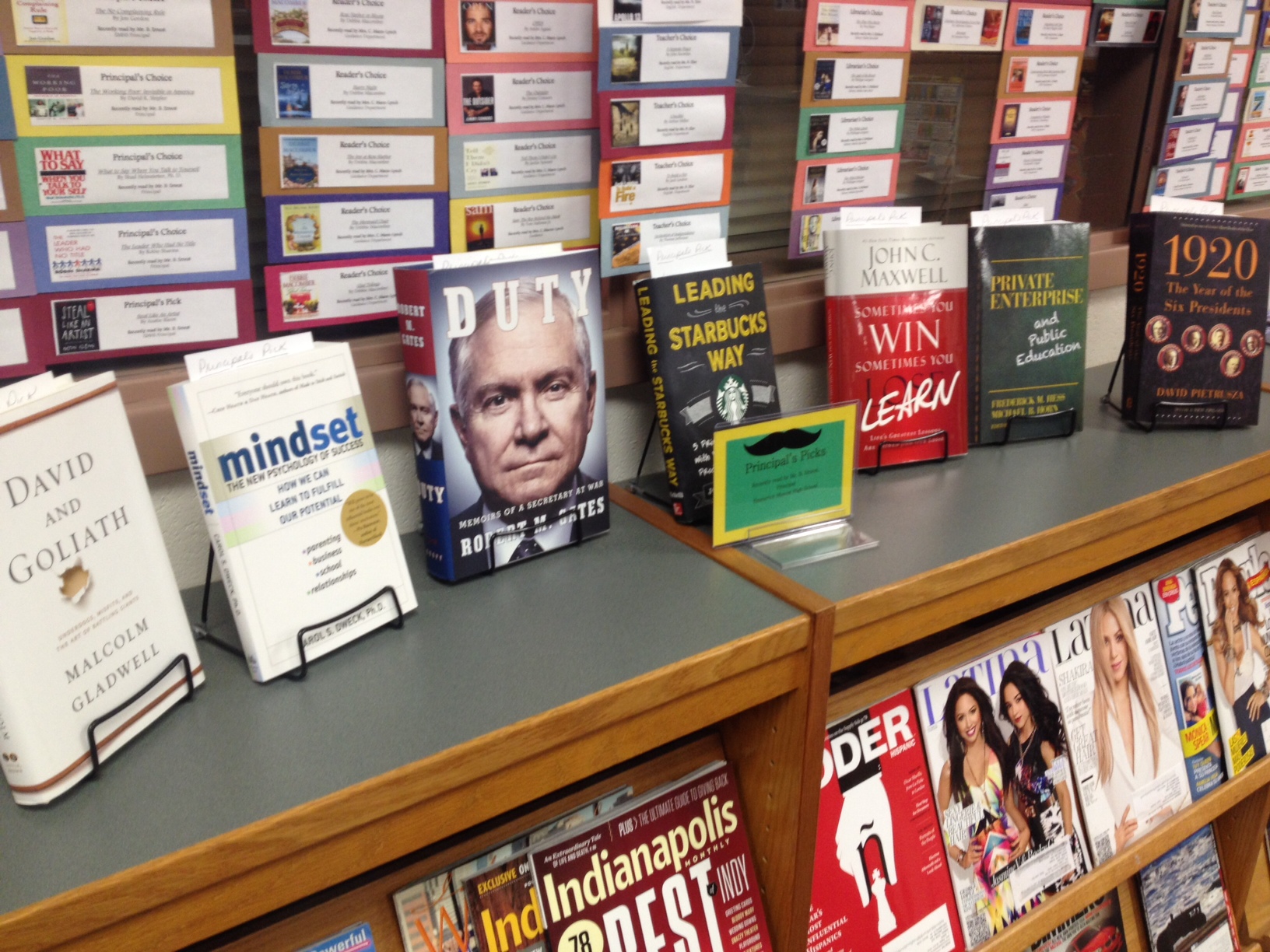
Principal’s Picks Display
Angry Birds University

Power-Up University
Back in 2012 I wrote a post about Angry Birds for the first time. To read my post The Angry Birds Effect click here. Amazingly, this game has not gone away, but gotten stronger, added different versions, and created tutorials and educational materials. For those few of you who have not had the Angry Birds educational experience, the main goal of the game is to sling-shot birds into a structure made of wood, ice, stone, or other materials in order to have the structure collapse and kill cartoon pigs. Each level offers a more challenging structure to topple and several different kinds of birds (of different sizes and capabilities) to utilize as weapons. Now there are even new versions such as Angry Birds Rio, Angry Birds Space, Star Wars Angry Birds, Angry Birds Short Fuse Aftershock, and many more.
I am still a major believer that Angry Birds is a powerful exemplar for facilitation of highly effective learning. As I play the game, I cannot not help but think: what if all teacher’s classrooms were more like this? Would students have a better learning experience? Would there be more focus on learning than teaching? I believe the reason the game is so addictive is because it plays to our meta cognitive skills. We all want instant feedback. We also want the chance to use that feedback to make adjustments and try again to ultimately attain mastery. There is no risk in trying new techniques and there is no limit to the amount of tries. This is why I am a believer in standards mastery grading using a narrative report card.
Angry Birds now has tutorials and additions such as Power-up University. This is a game segment you complete in order to learn to use special “power-up” powers given to the different characters. Power Ups can help you improve your scores in levels and help you get more stars. There are 4 Power-Ups, and you can use 2 per level. Here are the 4 Power-Ups:
- Super Seeds: Super Seeds turn any bird on the slingshot bigger and tougher.
- King Sling: King Sling upgrades your slingshot so that when flung, birds can go faster and farther than before.
- Sling Scope: Sling Scope allows you to see where your bird’s gonna go before you fling them.
- Birdquake: Birdquake rumbles the ground in a level and can make pig’s structures fall down.
As in the best video games, students need a safe place to try and fail until they succeed. There is the buzzword, “gamification” in education. Many are just taking this to mean using games for teaching, but I believe we should be on the quest to make learning more like a video game. In order to do this let’s take a look at the best practices we can learn from Angry Birds that I outlined in my original post The Angry Birds Effect:
1. Early in the game, the single Red Bird is the only one available-basic knowledge.
2. Players advance at their own pace.
3. Mastery is required to advance – You must have cleared a level three times with score improvement each time before moving on.

Instant Feedback
4. As the player advances, new levels are introduced.
5. The player can move ahead and clear levels beyond the one they are presently in, but not too far.
6. Different contexts are portrayed (deserts, gem mine, city at night, et cetera) to make it interesting and relevant to the player.
7. The player is given new tools (different types of birds) to use as he/she advances and unlocks higher levels.
8. Immediate feedback is given. The player knows the score immediately.
9. Ability to go back and retry and review any level any time.
10. The next level is always “just above” (Christensen et al., 2011) the players ability. Not too far above, but “just above.”
It is no wonder we are all addicted to this game! Now if only we could ensure that our classrooms are always safe spaces to practice new strategies, offer students a range of possibilities for how to succeed in their learning, give our students constant feedback, and support knowledge transfer within and among our courses. Angry Birds could be our exemplar for helping to close the achievement gap!
Reference
“They Were Scared!”
Last week I had the chance to go to a Lebanon High School basketball game. As you know this was the school I taught at and that my son, Heath, attends. His middle school basketball team was recognized at half time so I was excited to be there. I was also excited to watch my friend, Albert Hendrix (LHS Head Coach), coach the game. You also know from reading my blog posts that I am a huge fan of Albert and have learned so much from him. It’s hard to hang out with this guy and not learn something, so I was excited to get to visit with him after the game. Click here to view past posts that include wisdom from Albert: Own Your Own Expectations and Learning From SMART Coaches.
This particular night Lebanon played Zionsville. this was a little intimidating because former NBA and Indiana Pacer, Rick Smits’ son, Derrick, plays for Zionsville. At 7′ he was intimidating for the smaller Lebanon players. Zionsville also has other tall players making it a daunting task. Needless to say, Zionsville jumped out to an early and big lead. At half time Albert worked his coaching magic, made adjustments and Lebanon got back in the game.
After the game I visited with Albert and told him I was impressed with the half time adjustments. He said the big problem was that “they [the team] were scared!” He was speaking of his team and it was obvious they were scared in the beginning. It was such a shame because once they got past their fear, they were back in the game and playing the fast paced, aggressive basketball that Albert coaches.
The phrase, “They were scared!” has really stuck with me since that night. I told you I always learn from Albert and this day was no different. Really, when you think about it there has been a rather troubling trend across sports and really all walks of life lately. That trend is the common weak emotion – fear. It seems that people are more shook than ever when it comes to facing adversity.
I’m not just talking about physical adversity. I’m talking about all adversity. How many times have we not started a new project, applied for a different job/position, or taken on something really tough just because we were downright afraid of failure. Let’s face it, we are scared!
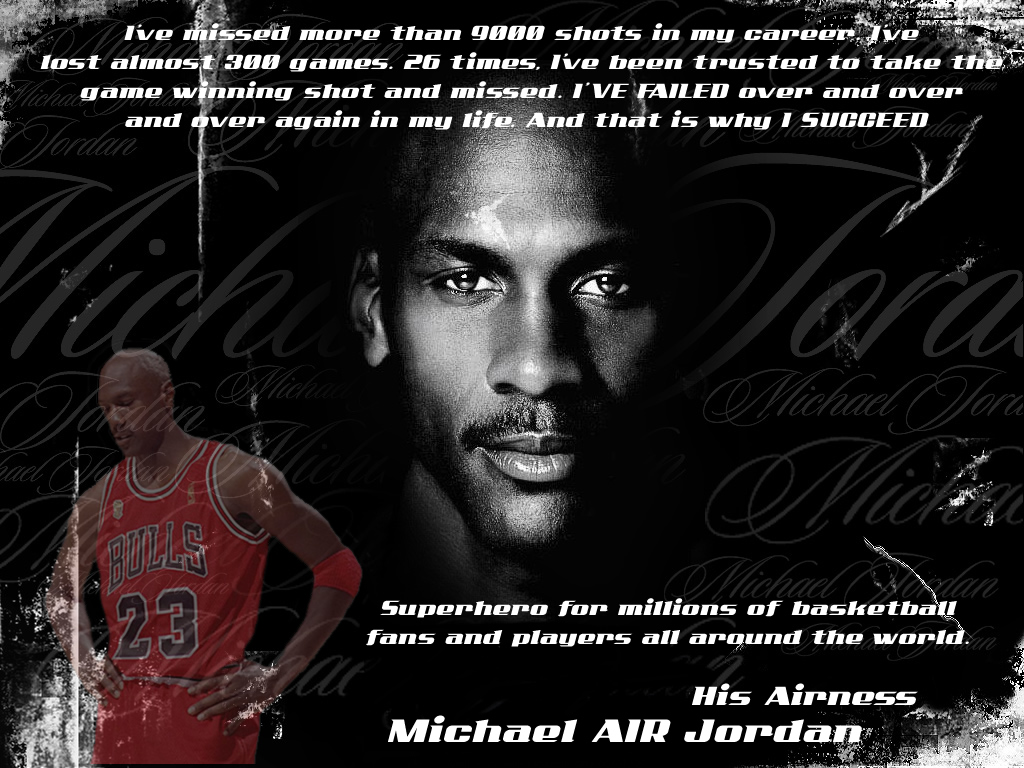
Can you imagine if Michael Jordan had given into fear? I had the chance to hear Michael Jordan speak at an event a while ago and he said, “I’ve missed more than 9,000 shots in my career. I’ve lost almost 300 games. 26 times I’ve been trusted to take the game winning shot and missed. I’ve failed over and over and over again in my life. And that is why I succeed.” Again I ask, can you imagine if Michael Jordan had given into fear?
I love two questions related to fear of failure posed by John Maxwell in his book, Sometimes You Win Sometimes You Learn: Life’s Greatest Lessons Are Gained from Our Losses, “What would you attempt to do if you knew you wouldn’t fail?” and “What do you learn when you fail?” Our fear of making a mistake or failing seems to be based on the hidden assumption that we are potentially perfect. Sometimes I think we believe that making a mistake causes us to somehow betray ourselves. I really like what Mark Twain said when asked to name the greatest of all inventors. His reply: “Accidents!”
Remember, it’s easier to go from failure to success that it is from excuses to success!
Better in 2013
 Those of you who know or follow me know I am a veracious reader. As we came to the end of 2013 I was trying to decide whether to do a top 10 reads in 2013 or what what to do to reflect on my reading. In considering my options I decided to write this final post of 2013 on what was clearly the best book I read this year. In fact it was so great I read it three times! It was not the first book I read from this author, but I was extremely moved and motivated by this book. What was the book? Better: A Surgeon’s Notes on Performance (2007) by Atul Gawande.
I am in education, but as I always say there is about 90% similarity between all industries and only 10% difference. There are amazing connections between the field of medicine and education. I have read all the books of Atul Gawande. He is widely known as an expert on reducing error, improving safety, and increasing efficiency in modern surgery. He wrote the books Complications: A Surgeons Notes on an Imperfect Science, A Checklist Manifesto: How to Get Things Right, and The Best American Science Writing 2006. All of his books are incredible, and I was particularly moved by Better.
There are always takeaways that are personal to the reader in any good insightful book, and this book was no different. One of his themes he discussed was the variation in doctors. Those doctors who are “the best” doctors with the best outcomes. Who are they? Why are they better? He calls these doctors “positive deviants.” The biggest question: How do you become one? As I read the book I also considered the variation in educators and educational leaders. Really, you could do this reflection on any profession, including your own.
A paragraph early in the book really touched me and set the stage for my intense study of the entire book. Gawande said: “Betterment is perpetual labor. The world is chaotic, disorganized, and vexing, and medicine (education) is nowhere spared that reality. To complicate matters, we in medicine (education) are also only humans ourselves. We are distractible, weak, and given to our own concerns. Yet still, to live as a doctor (teacher) is to live so that one’s life is bound up in others’ and in science and in the messy, complicated connection between the two. It is to live a life of responsibility. The question, then, is not whether one accepts the responsibility. Just by doing this work, one has. The question is, having accepted the responsibility, how one does work well.” (p. 9) You will notice I put ‘education’ in parentheses beside ‘medicine’ and ‘doctor.’ Do you see the connection between the two? You could put your profession in this paragraph too!
Now, I want to make sure you caught the responsibility part. People talk about accepting responsibility all the time and the question is asked if we accept responsibility. Think about what Gawande said here. Just by doing the work we have accepted the responsibility. Therefore we have accepted the responsibility to work to be better or best! This thought alone really brings urgency to what I do every day!
At the end of Better Gawande had five suggestions for anyone to get better:
1. Learn something about your patient. He says to ask “the unscripted question,” like where did you grow up? tell me about your family? He talks about making the human connection. Really it comes down to what I consider to be one of the most important components to education – Relationships. Without relationships and knowing your students (patients) there can be no learning.
2. Don’t complain. This is tough! It is easy to complain, but think about it… None of us like to hear others complain. Really, complaining becomes a poison to an organization. Be a solution to problems, not part of the problem!
3. Count something. We should be scientists and do action research. My doctoral degree journey really drove this home for me. By picking a problem to research that I was passionate about, I found a love for digging in and quantitatively and qualitatively analyzing. I have also learned to let the data speak for itself. It is also important to look at the data without judgement. We tend not to look deep enough into successes; it is easier to study failures.
4. Write something. Gawande said, “What you write need not achieve perfection. It need only add some small observation about your world.” I have always said that my posts to this blog serve more for my learning than for others. Even though it is really awesome to have others read what you write, writing is personal and causes us to reflect and learn.
5. Change. Gawande asserted we should, “Make yourself an early adopter. Look for the opportunity to change. I am not saying you should embrace every new trend that comes along. But be willing to recognize the inadequacies in what you do and to seek out solutions.”
Hopefully if you have not read this book yet, I have given you enough of an intellectual appetizer to convince you to read Better. If you have read it, I hope I have caused you to go back and look at your highlights and reflect on your reading. As we close out 2013 and begin 2014 I want to use Gawande’s five suggestions to help me achieve his three core requirements for success: (1) Diligence; (2) Do Right; (3) Ingenuity – Thinking Anew. My wish for everyone in 2014 is to truly be BETTER!
Dallas Cowboys Leadership Lessons

Purdue Boilermaker Kyle Orton
The first thing I want to establish up front is that this post has nothing to do with being for or against the Dallas Cowboys. There will also be no analysis of last night’s game between the Cowboys and Eagles. Now, I must admit, however, that I was watching the game with much anticipation of how Purdue Boilermaker Kyle Orton would do stepping up as the starting quarterback of the Dallas Cowboys. I believe Orton did a great job of stepping up and leading under the circumstances and I’ll leave it at that for you to agree or disagree.
This post has more to do with what I thought were some very astute comments by Trent Dilfer, ESPN Analyst and Super Bowl Champion, after the game. When asked about the future of the Dallas Cowboys, Dilfer discussed some of his own opinions about organizational leadership that I believe warrant some reflection and thought.
Dilfer talked about how sometimes the talent is overrated on the Cowboys. He said that for some reason there is a myth that when a new player puts on the “Star” of the Dallas Cowboys the “so called” abilities of that individual increase exponentially. This is important to consider in our own organizations. Do we think of ourselves or our team members as being much better than they are? It is obvious the detriments this mindset can bring to an organization. Many times an overconfidence in ability, or in a name, can bring about a miscalibration of areas for coaching and professional growth.
The next point Dilfer made was that the Cowboys are known for going after the marquee players without a real plan as to how they fit in the organization. Jerry Jones tends to go after players and personnel that are at the top of their class or are friends, but sometimes they don’t exactly fit into the big picture of the team. Dilfer called this the need for taking a 30,000 foot view of where everyone fits in the organization. Again, I want to point out that Dilfer was not being disrespectful of Jerry Jones, a very successful and great leader. Dilfer did point out an important point that, we as leaders, need to consider: Making sure we step back and look at who our team members are, their skills and skill level, and how/whether they fit the overall vision of the team.
In Good To Great: Why Some Companies Make The Leap… and Others Don’t (2001) Jim Collins discusses having the right people on the bus. It really goes beyond that to not only having the right people on the bus, but having the right people on the bus and in the right seats. I know I have made mistakes in my own role as principal in hiring that marquee teacher, that other schools are trying to recruit too, only to find he did not fit the overall culture and vision of the team. We can point to example after example where this has happened in pro sports with both players and coaches.
I appreciated Trent Dilfer’s comments after the game, done in a very respectful manner, and the reflection these comments caused me to do. I for one, and I hope you will too, am going to step back as I continue to build our team and take a 30,000 foot view of where everyone fits on the team. In other words; should they be on the bus? And, if so, what seat should they be sitting in?
Keep Your Fork: Leadership Anticipation

As we have been taking part in different family and work traditions during this holiday season I am reminded how important the feeling of anticipation is. I tweeted a few moments ago that the greatest words ever said by a mother are, “Keep your forks.” We all know what that means – DESSERT IS ON THE WAY! Then we begin to anticipate what it will be; her famous Mince Meat Pie, Cheese Cake, Carrot Cake, or some other delicacy that only moms know how to make. Think about how important the feeling of anticipation really is.
Today, Christmas Eve, is probably the greatest example of anticipation there is. Children around the world are spending the day anticipating that Santa Claus will arrive during the night and leave toys. The anticipation is even greater for those kids who sat on Santa’s lap and told him what they wanted him to bring. Those kids are now in anticipation those gifts will arrive.
My son and I did our annual Christmas shopping excursion last night. We shop for mom and then go to Buffalo Wild Wings. While we were eating and watching the Indiana Pacers win, my son, Heath, made the comment, “Dad, I look forward to this every year!” I asked why and he said, “it’s fun to do this with you and we do the same thing every year.” In fact, I would add we get the same thing every year – a new Vera Bradley backpack purse! This story even has more to do with anticipation. The sales person at Merle Norman was the same one that has helped us buy mom’s purse for the last three years. In fact we always bring her an Aunt Millie’s pretzel and she wraps all our presents from other stores too. Are we true helpless guys, or what? When we walked in she said, “I knew you would be here!” She anticipated our arrival, and we did not let her down!
So how do we use anticipation in other areas such as education and leadership? When I was teaching I loved to use anticipation guides. I now recommend these to the teachers I serve. With an anticipation guide the students are introduced to the concept of previewing and guided in completing a prepared anticipation guide for a particular topic or reading. Students are then given an opportunity to complete a portion of the anticipation guide independently. In the days that follow, students work in both teacher-guided and student-facilitated groups to extend their use of the previewing strategy with other resources and texts. Finally, students discuss as a class how using anticipation guides helped them better understand the readings, resources, and ultimately the subject at hand.
As a leader, change represents an opportunity and it must be anticipated and prepared for. Foresight and change anticipation is a hallmark of effective leadership. Technology, radical innovations, new business models, globalization, demography, consumer demands, education reform, politics, and choices all contribute to making today’s society one of accelerating change. The drivers of change are numerous and complex, and their impact varies from one sector to another. The way change affects your company depends largely on the capacity of key actors to anticipate and prepare for such an eventuality. There is big difference between anticipating and guessing. Anticipation means expecting, being aware of something in advance, to regard it as possible. The ability to anticipate is one of the key ingredients of efficient speed in leadership.
As we celebrate Christmas today and tomorrow, allow me to bring Christ into my post leave you with a couple of other thoughts on anticipation and anticipating:
Some of you are too busy dreaming about where God is taking you next to appreciate how far He has taken you recently. Stop for a moment and celebrate.
Others of you are so busy celebrating what God has done in your life that you’ve yet to realize it’s just a taste of what He still has to do in you and through you. Stop for a moment and anticipate.
Merry Christmas! May all the great things you are anticipating come to pass!
Wright Brothers Growth Mindset

First Successful Flight
Today is a very special day! It is the 110th anniversary of the first successful flight of an airplane by Orville Wright. The plane was designed by Wilbur and Orville Wright. When reflecting on the Wright Brothers today I am reminded of one of my favorite quotes: “Do not follow people who stand still.” This quote by Woodrow Wilson certainly describes the Wright Brothers, who did anything but stand still in their quest to invent a flying machine! The Wright Brothers truly had a growth mindset (Dweck, 2006). Just as Geoffrey Colvin stated in Talent is Overrated: What Really Separates World-Class Performers from Everyone Else (2008), it is not about a fixed set of skills, abilities, intelligence or talent; it is about personal growth and the mindset that we can all grow beyond where we are today. Besides all this, the fixed mindset says it is not enough to succeed, we need to be perfect and flawless. Pretty hard to live up to, I think.
On this anniversary of first flight lets look at the Wright Brothers’ growth mindset. They believed that just because it had never been done before, did not mean that it could not be done. Think about all the impossible things that have been conquered by man. These things might include, landing on the moon, landing a craft on Mars, curing many diseases, organ transplants, and yes – even first flight.
So, why settle for accepting the way things are. The Wright Brothers had the vision for what man-powered flight could do for the future of civilization. I for one am happy, on this 110th anniversary of first flight, that the Wright Brothers had the growth mindset! Do you have a fixed or growth mindset?
Top 50 Strategy In Action Indicators

Strategy in Action
As I stated in my earlier post today, Strategy In Action, I spent this week in the classroom at Harvard University learning to be a more effective leader at being strategic in the Harvard Graduate School of Education program Strategy In Action. This was a program made up of an outstanding curriculum with the learning being facilitated by the incredible Harvard faculty, Elizabeth City and Rachel Curtis. Part of my homework this afternoon is to develop commitments that I will follow through on when I get back to my school tomorrow. To enable this process I did what I have done for other programs I have attended and created a Top 50 List. In this blog post I would like to share this list and my leadership commitment. Here are the Top 50 Strategy in Action Indicators:
Top 50 Strategy In Action Indicators
Created By: Byron L. Ernest
December 2-4, 2013
Harvard University
1. Use the data as grist for our mill
2. Beware of “analysis paralysis”
3. Most people think from the outside in [what, how, why]. The highly effective lead from the inside out [why, how, what].
4. People don’t buy what you do…they buy why you do it!
5. Being strategic asks three questions: 1. Why 2. What 3. How
6. Six habits of strategic thinkers:
Anticipate
Challenge
Interpret
Decide
Align
Learn
7. Use the “Week in Review” to strategize your life
8. We need to study all strategies and find out which we are really doing, and which we are just saying we are doing
9. Some things are necessary, but not sufficient
10. The most common place strategy falls down; it’s in the leader’s head, but nowhere else!
11. Much of what we do is in the hard/high impact quadrant
Good news: We’re focused on the stuff that makes an impact
Bad news: We don’t have the capacity to do it all
12. SWOT: Strengths, Weaknesses, Opportunities, and Threats
13. An effective team is the primary mechanism for driving work
14. An effective team results in engagement in and ownership of the teams work
15. An effective team sets the tone for culture
16. Building blocks of an effective team: Shared purpose (why), right people (what), processes, structures, agendas, and accountability (how)
17. People want to do challenging and consequential work
18. The same people in Number 17 do, however, want clarity
19. Lots of little steps take you to great places
20. A meeting’s purpose is not to have people go through all they are doing to make themselves look good. It is about what is being done to add value to the work of highly effective student learning.
21. Having stakeholders pre-load the agenda with important items is a best practice
22. Think about a “value added” approach. We need to think about how we measure “value added” to each position, strategy, and theory of action
23. It’s about the work, not about the people
24. We need to make sure all our team members understand how their daily work contributes to the strategic plan
25. Root Cause Analysis: It complicates our thinking, thus keeping us from chasing shiny objects
26. It’s easier to be unclear to keep from upsetting team members, but in the end the team becomes dysfunctional and everyone is unhappy
27. When doing a Root Cause Analysis don’t forget to include the actors (who)
28. Be specific and descriptive, not judgmental when obtaining and analyzing data
29. Three kinds of data available to us: 1. See 2. Count 3. Hear
30. Must be intentional with data use
31. If you don’t see it…it does not exist
32. Is the only reason we are looking at certain data because someone else is watching it? ie. State, authorizing agents, et cetera
33. The goal of data is to have a robust look at the whole picture
34. Data use ladder: Data, Interpretation, Conclusions, Actions
35. Describe data without judgment
36. Must have specificity of evidence
37. We tend not to look deep enough into successes; it is easier to study failures
38. We must look for patterns in the data
39. There is freedom and excitement thinking expansively; this in turn enables audacious thinking
40. Audacious thinking creates a North Star to move toward
41. A vision is bold, vivid, compelling, audacious and moves beyond incrementalism
42. Book recommendation: ThinkerToys
43. What if… – think about the conversations that can be started with this
44. Use the what if… structure to think outside the normal constraints of your own context
45. When you live in a box it is difficult to open it and think expansively
46. It is also really hard to step outside of the box if someone opens it
47. SWOT – Strengths, weaknesses, opportunities, and threats
48. The value of SWOT is more in the process, shared ownership, and the communication shared in doing the exercise as opposed to the product
49. Brutally Honest Truths: Theories of Use – If…Then…
50. Make sure to mine things for the resource they are!
I will present my commitment here in form of an If…Then… Brutally Honest Truth Theory of Use. If I improve my leadership to tie together the instructional/academic and operational processes of the school then our entire staff will function as one cohesive and high functioning team. But, right now I am bouncing between the two without balance. My commitment is to provide leadership in a way that all our team members understand how their daily work contributes to the strategic plan and the most important part of all our jobs – educating children!

Leading for Success
Strategy In Action

Strategy In Action
I spent this week in the classroom at Harvard University learning to use strategy and be more strategic in supporting powerful learning and teaching in the Harvard Graduate School of Education program, Strategy In Action. This was a program made up of an outstanding curriculum with the learning being facilitated by incredible the incredible Harvard faculty Rachel Curtis and Elizabeth City. Part of my pre-work homework for this course was to read Strategy in Action: How School Systems Can Support Powerful Learning and Teaching (Curtis & City, 2012). Let me just say this is a book that everyone in education should read. A habit that I developed doing literature reviews while completing my doctorate was to take bullet notes of everything I read. This book was so outstanding that I decided to include my summary as a post to this blog. Here it is:
Top 100 Play List From
Strategy in action: How school systems can support powerful learning and teaching
Rachel E. Curtis & Elizabeth City (2012)
Prepared by: Byron L. Ernest
1. It is simply not enough to have strategies in place; we must be able to consistently execute them
2. The education of children is our number one priority. Number one above power struggles, political whims, or practitioner and parental excuses
3. High performing schools are driven by four key strategic elements: unrelenting focus on quality instruction, robust community support, dedication to operational excellence, and strong leadership
4. Every stakeholder of the school must know the data
5. No matter what our role is as educators, we cannot go at it alone. We must involve the business, civic, parental and broader community in our strategic efforts
6. Evaluate all budget recommendations based on three criteria: their direct impact on student achievement, risk to the district if not implemented, and alignment with the district’s strategic objectives.
7. If principals don’t provide the instructional leadership, the school won’t perform
8. Systems making substantial progress answer three questions: What are we doing? Why are we doing it? How are we doing it?
9. What is strategy? “The set of actions an organization chooses to pursue in order to achieve its objectives. These deliberate actions are puzzle pieces that fit together to create a clear picture of how the people, activities, and resources of an organization can work effectively to accomplish a collective purpose.” ≈ Stacey Childress
10. The great challenge and opportunity: to educate all of our children to succeed in a rapidly changing world we can scarcely imagine
11. School systems exist to support learning for all students
12. Teaching matters most
13. Being strategic, coherent, and well aligned is everyone’s business
14. Our “product” in education is learning
15. American propensity is to favor breadth over depth, meaning that American fifth graders are taught twice as many math concepts as their Japanese counterparts
16. All three parts of the instructional core matter: teachers, content, and students. The core is the interaction of the three sides of the triangle
17. Systems, not just individuals, must steward the instructional core
18. Strategy is about filtering the noise
19. Deliberate actions are puzzle pieces that fit together to create a clear picture of how the people, activities, and resources of an organization can work effectively to accomplish a collective purpose
20. When strategies are not effectively implemented teachers will experience each initiative as a discrete thing to be done, not understanding the purpose behind each and the relationship between them
21. Strategy and all its components must address the instructional core by supporting high-quality teaching of rigorous curriculum, answering the question “How will this improve the quality of student learning and teaching?’
22. Every school system we know that is rapidly improving student learning places its bets on strategic objectives and initiatives with direct connections to the instructional core
23. Teachers’ focus must be shifted from what they taught to what the students learned
24. The purpose of a team must be clear, challenging, and consequential
25. A team is responsible for developing the improvement strategy for the system, ensuring coherence and aligning resources to strategy, creating the conditions required for implementation, and tracking results is more concrete
26. Being clear about purpose guides selection of team members, who are selected on the basis of their ability to help the team fulfill its purpose
27. Clarity of purpose also help team members understand what they are being asked to do
28. Norms are a set of agreements that define how team members will behave when they meet
29. A productive and satisfying meeting begins with a well-designed agenda
30. One simple way to build trust is to be deliberate about it
31. Expressing vulnerability is one of the most powerful ways to build trust and one of the strongest indicators of the level of trust that exists in a team
32. A strong leadership team is composed of people with different expertise, experience, and perspectives
33. In the face of problems, one questions helps focus complex systems and teams: “What is best for children”
34. We can’t talk in generalities
35. Generalizations are tidy and can make conversations more comfortable, but they don’t help us to understand what is most needed in the system and to learn from the variations and exceptions
36. When tempted to oversimplify and generalize, remember to dig deeper to understand the nuances of why a project works in some settings better than it does in others
37. Use data to guide the analysis
38. Look closely at the data
39. Ask questions about the data
40. Wonder about the data
41. Many time instead of being data-driven, we are driven to distraction
42. If you want to improve outcomes, numbers alone will probably not provide all the information you need, particularly in the very human endeavor of teaching and learning
43. Three types of data: Counting, hearing, and seeing
44. Using data often leads to more questions than answers
45. Problems have causes and symptoms. We often mix these two things up.
46. “We see things as we are, not as they are” ≈ the Talmud
47. When the vision is clear, everyone in the system give the same responses to the important questions
48. In cultivating strategy for a school, it is encouraged to assess the present, imagine the future, and learn from the past
49. Personal/not personal paradox è Not about us…is about us
50. A theory of action describes the beliefs that undergird an organization’s strategy and links the strategy to the organization’s vision
51. A theory of action can be thought of as the storyline that makes a vision and strategy concrete
52. A theory of action is a hypothesis using an if-then statement to articulate what will be achieve and how, in the broadest sense, it will be achieved
53. Context matters
54. A strategy consists of a small number of strategic objectives (three to five) that frame big areas upon which the system will focus
55. The segments are: identify major strategic objectives; map strategic objectives with theory of action; and identify strategic initiatives, weighing ease and impact, synergy, and pacing and sequencing
56. Tool: Ease Versus Impact Graph
57. Strategy is not enough on its own
58. Clear and established methods of executing the strategy, problem solving, learning from the work, and refining the work as you go along are essential to helping the strategy become something that actually helps children move toward the system’s vision
59. Often, the way work gets done is defined by who is doing it rather than by principles of effective management
60. When individuals and departments work independently, their approaches to the work are variably effective and create inefficiencies in the system
61. Systems struggle in four areas: aligning resources to the strategy, implementing systems and structures to facilitate the work, supporting employees through work that demands they change their behaviors, and embracing the dynamic nature of the work
62. Strategy comes to life when its execution drives the budgeting process and the allocation of resources, be they time, staff, or money
63. The concept of cross-functional teams, the lifeblood of high-performing organizations, is unfamiliar and directly challenges the prevailing culture of autonomy and “turf.”
64. Teams need to engage in the productive conflict that generates the best ideas and work
65. Strategy execution is dynamic
66. The strategy written on the page must evolve as it grows into life, responding to the environment, changing conditions, and the learning that occurs along the way
67. Reality bumps up against the tendency of many school systems to function as if their work is static, linear, and predictable
68. The system that is able to stop “doing” long enough to respond to the environment will be better able to keep purpose at the center
69. Two-way learning is required for successful implementation of strategies
70. Logic Model: Activities, Resources, Outputs, Outcomes, Assumptions
71. A work plan is the bridge between the logic model and action
72. After-Action Reviews: The building into implementation process the mechanisms to learn from the work
73. For building stakeholder support communication in all directions is essential
74. The trick to in communicating strategy is to simultaneously communicate a sense of urgency combined with sense of agency to improve, answering the questions “why change?” and “how to change?”
75. Engaging a broad range of actors in the work is critical
76. Successful strategy execution requires a balance of support and accountability
77. Support for strategy is provided through resource allocation, technical assistance, and collaborative problem-solving
78. Accountability is ensured through regular tracking of work, timelines and benchmarks, and assessing organizational learning
79. Coordination across initiatives leads to better results
80. The work of all initiatives must be aggregated to the system level
81. Execution of strategy requires a high level of collaboration and interdependence
82. Strong execution is marked by careful planning, ongoing learning, and nimble adjustments along the way
83. Driving improvement requires us to dive in and develop ideas about what we most need to do to improve student learning and to constantly be looking beyond ourselves for better ideas
84. The success of strategy depends on your making smart bets, learning from the work, and then shaping and refining it accordingly
85. Three simple questions: How does what I’m doing support children and their learning? Is this working for children? How do I know?
86. Designing strategy requires taking the time to be thoughtful and thorough
87. For strategy to be effective, it cannot be immutable
88. Strategy must evolve in response to needs and changes in the environment
89. Measuring results is simultaneously simple and complex
90. When we ferociously commit to acting and learn from that action, both become easier because they feed on and reinforce one another
91. In execution, strategy comes to life
92. Through the process of execution strategy evolves
93. A system that uses strategy that focuses on autonomy and accountability will surely evolve as it learns from the innovations some schools initiate and the struggles other schools face
94. Two tensions of strategy design and execution: How loosely or tightly the system will manage the school and the strategies focus on all children and, at the same time, on each child
95. All children and each child
96. A system needs to balance all with each by differentiating support in response to the specific needs of struggling students, teachers, and schools
97. At the same time you are executing strategy you need to be intentionally learning from it so that you stay conscious, keep learning, and make good decisions
98. Remember to keep the focus of the system’s work on students, teachers, and the content: the instructional core
99. We must bring our best selves to the endeavor while maintaining a boundary between the work and ourselves
100. It is about the work, not the people. Ultimately, it is about the education of children.
Again, this was an outstanding book that I believe anyone who is serious about delivering wowful educational leadership, or leadership for any organization should read and study!
 Byron's Babbles
leave a comment