The Success Story Is Not Mine
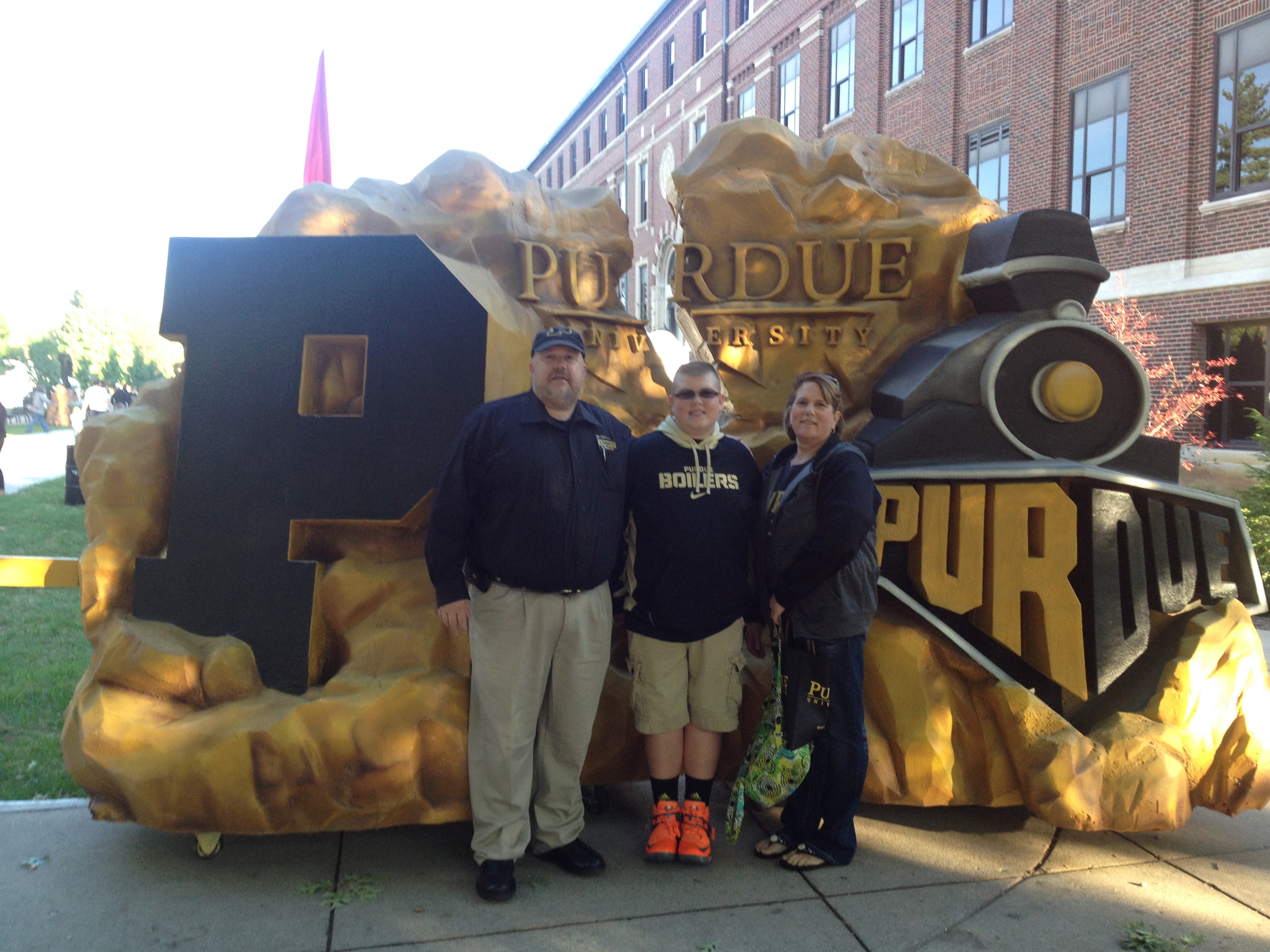
My wife, Hope and son, Heath enjoying Purdue’s 2013 Homecoming!
I had the tremendous honor to be asked back to Purdue University this past Friday to be recognized by the Purdue University Animal Science Department. As many of you know my first Bachelor of Science Degree is in Animal Science. I have blogged about how I ended up in education before and the story is told again in this blog; as the reason is because of a Professor of Animal Science, Dr. Hobe Jones.
Anyway, I received the 2013 Purdue University Animal Sciences Distinguished Alumni Mid-Career Award on Friday. It is interesting that Purdue recognizes an individual each year for demonstrating excellence the animal science industry in academia, governmental service, leadership, community service, and professional accomplishment. This is a big deal to the Animal Science Department because they had never awarded this to someone not directly employed in the Animal Science field. It is so humbling and such an honor because these people have been following and supporting my career since I got to Purdue University till now. As you know I have two B.S. degrees – one in Animal Science and the other in Agricultural Education. The degree that gets the most credit for me being in education is Animal Science. I truly believe my success story has very little to do with me, and more about how and what I was taught while at Purdue University. I would like to share my reflections that I presented at the awards ceremony which I dubbed “The Success Story Is Not Mine!”

My son, Heath, enjoying Purdue’s Homecoming from the Buchanan Club Compliments of the Purdue University Animal Science Department
Reflections On My Journey In The Purdue University Animal Science Department
Byron L. Ernest
Friday, September 27, 2013
It is such a privilege to be before you today to give reflections of my experience as a proud alumnus of the Purdue University Animal Science Department. When I consider all the outstanding individuals that have walked these halls it is very humbling to be before you. Really, today is very little about me, and a whole lot about an incredibly well designed, highly functioning department that teaches students to have a growth mindset and develop into all they can be. The success story is not mine, but that of the Purdue University Animal Science Department.
Lately there has been a great deal of discussion about the importance of measuring a college’s “return on investment.” Is the point of a college education quantifiable results or personal and intellectual growth? Should colleges be preparing students for the work force, or be preparing them for lifelong learning? Quite frankly the answer is simply “Yes.” I believe universities are responsible for facilitating personal and intellectual growth. I also believe that being prepared for lifelong learning is crucial.
Right now, data suggest that graduates will have three different professions during their lives. My life would support that data. Therefore, it is important that students are taught how to learn, how to find information, and how to work collaboratively across disciplines and cultures. Great universities, like Purdue, find a balance where students are free to form their long view of the world while at the same time acquiring the knowledge and skills to pursue a rewarding profession.
College is for finding a calling, or many callings, including the calls of friendship and love. I would like to introduce one of the loves that I found while here, my wife Hope, who is also a proud Purdue graduate. In addition we have my son, Heath, who is everyday an inspiration and my niece, Autumn Brown. Let’s talk about this calling. I came to Purdue as an Animal Science major with no intention of being in education. My teaching career did not begin with the same story that many teachers share. As a third generation teacher, I did not have an epiphany where I said to myself, “I want to be a teacher.” My journey as an educator began during my sophomore year when my Animal Science Professor and Academic Advisor Dr. Hobart Jones pulled me into his office and asked if I had ever considered teaching. When I said, “no,” Dr. Jones explained that he saw a talent in me for educating and wanted me to double major in Animal Science and Agricultural Education. His inspiration and personal interest helped me to deal with the challenges of a double major, making my 29-year career in education possible. Without Dr. Jones’ personal interest in my abilities, I probably would have missed this opportunity. It is his example of true caring that I strive to emulate every day of my career in education.
It is said, “We teach like we were taught.” I believe this. I taught like my Animal Science professors – with rigor, relevance, and always building relationships. Just a couple of examples would be Tip Cline giving us a quiz every Friday and returning it on Monday with instant feedback for growth. Also, Hobe Jones always encouraging us to stop him if we had a question or needed further understanding. I can still here him saying, “Sing out now, if you have a question!” I could go on and on, but let’s suffice it to say that Purdue Animal Sciences gave me the life lessons for the career I now hold. As I said at the beginning, the success story is not mine, but that of the Purdue University Animal Science Department. Thank you for all you have done for me and those I serve, and for this tremendous honor.
As you can can see the success story is not mine. Let’s strive every day to make someone else’s success story come true. Thank you Purdue University Animal Sciences!!!

The Oldest Band Formation in History. The Purdue Block “P.”
Mount Everest Leadership (Part 2)

Thomas Carlyle had it right: All history is a biography – as so all great companies and organizations, including schools, are indeed the direct reflection of their leaders. The leader sets the tone, the mood, the style, and the character of the whole enterprise.
Restrained Leadership
In part one of this post I spoke of the tragedy of Hall and Fisher, but to me the greatest story on leadership is from accomplished climber David Breashears, the leader of the IMAX film crew in 1996. While everyone else was headed for the summit, he sought the advice his team. The conditions did not feel right to him. His team concurred and they turned their team around and headed back to base camp. They all recalled questioning their decision when meeting the other teams on their way up while they were retreating.
Breashears argued that experience, formal authority, or expertise in one’s field do not make someone a great leader. Sometimes it is just as important to practice restraint when making decisions. I can really relate to this as a leader of a turnaround academy. There are so many resources and “the next great program,” coming at me that sometimes I have to say, “No, we are sticking to what we know works best for learning.” Additionally, we must also be able to accept others’ ideas without being threatened.
“If you assemble a great team, don’t you want to hear their ideas?” ~ David Breashears
Wow, what a statement by a great leader! While speaking at Harvard University, Breashears stated: “Some people have tremendous charisma, and they can dominate a room full of people, but all of that does not equal competence. Sure, leaders need to have a vision. But by restraint I mean the ability to accept others’ ideas without feeling threatened. Those are the people I found to be my role models – not the person who ordered me to go up the mountain, but the person who talked to the team, asking for a dialogue, not feeling threatened by the dialogue, because they still had the ability to make the final decision. Some people can tolerate no dissent. But, if you assemble a great team, don’t you want to hear their ideas” (Roberts, 2011, p. 24). Breashears is a Mount Everest size leader!
I practice this with all decisions. Pulling in all the team members that are appropriate to the decision has become standard operating procedure for me. Some have criticized, saying I can’t make a decision. Ultimately, however, I do make the decision and accept responsibility for the outcome. We have assembled a great team at our school, and guess what? I want their dialogue, dissent, and ideas!
Reference
Roberts, M.A. (2011). Leading with restraint. FTPress Delivers: Upper Saddle River, NJ.
Fireside Chats
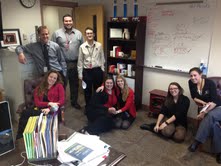
Fireside Chat In My Office
I realize that all the credit for the idea of fireside chats goes to Franklin Delano Roosevelt but I want to share with you something that started spontaneously at our school and has turned into an important part of our culture. Just as FDR used the chats to bring awareness to the American public. We use these to bring awareness about our world as a turnaround academy. These fireside chats started as a group of teachers mingling in my office after school, particularly on nights when there was an hour or two gap between school letting out and an athletic event. Most principals use this time for catching up on paperwork or the likes – not me!
We use the time for our staff to get together in my office to vent, share ideas, make me aware of issues, laugh, and even cry. Honestly, many great ideas, procedures, and programs we now have in place came from these fireside chats. Interestingly enough we called them fireside chats without a fire. Then word got out about our fireside chats and some students bought me a small electric fireplace for my office. This has become one of my most valued possessions in my office. You can see it in the picture – look close under the white board or you might miss it.
In the great book, TouchPoints: Creating Powerful Leadership Connections in the Smallest of Moments, Douglas Conant discusses the interruptions that leaders face interacting with their staff are actually moments that give the opportunity for awareness and leading in the largest of proportions. Amazingly I had a lengthy fireside chat with some teachers today and also amazingly I got an email from an assistant principal of a school in our network of schools that had started “campfires” after hearing a presentation I made on our fireside chats. I really believe the email exchange between us does the best job of describing the thoughts I would like to present in this post.
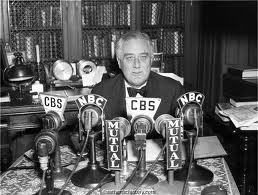
FDR Fireside Chat
So, here it is:
I wanted to share how much I appreciated “Camp Fire”. The advice/counsel that I was given will definitely help me grow in my position. I left those moments with a sense that not only am I valued as an employee but as an individual. I guess that’s what happens when we take the time to validate a student’s concerns/feelings. Thanks again and I look forward to an amazing year!
Hope you had a great first few weeks of school! Thanks again for sharing your ideas that support and value our people!
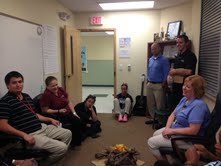
Campfire
Byron
Seriously, how cool is this! So next time you think you are wasting time talking with the people you lead, remember these could be the moments where the greatest leadership opportunities lie!
Mount Everest Leadership (Part 1)
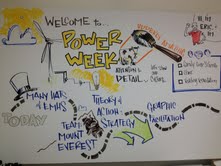
Graphic Facilitation From Power Week Session 1
This past week during our Power Week Staff Training I modeled using a case study for facilitating learning for our staff. It was on e of the first sessions and I was amazed at how we then looked back to the case study I chose, Mount Everest – 1996, the rest of the week. I understand why Harvard University uses the case study method to teach their classes and am glad I had the opportunity to learn this method from Harvard first hand. Today, I begin Part 1 of a three part post to my blog using Mount Everest – 1996 as the focal point.
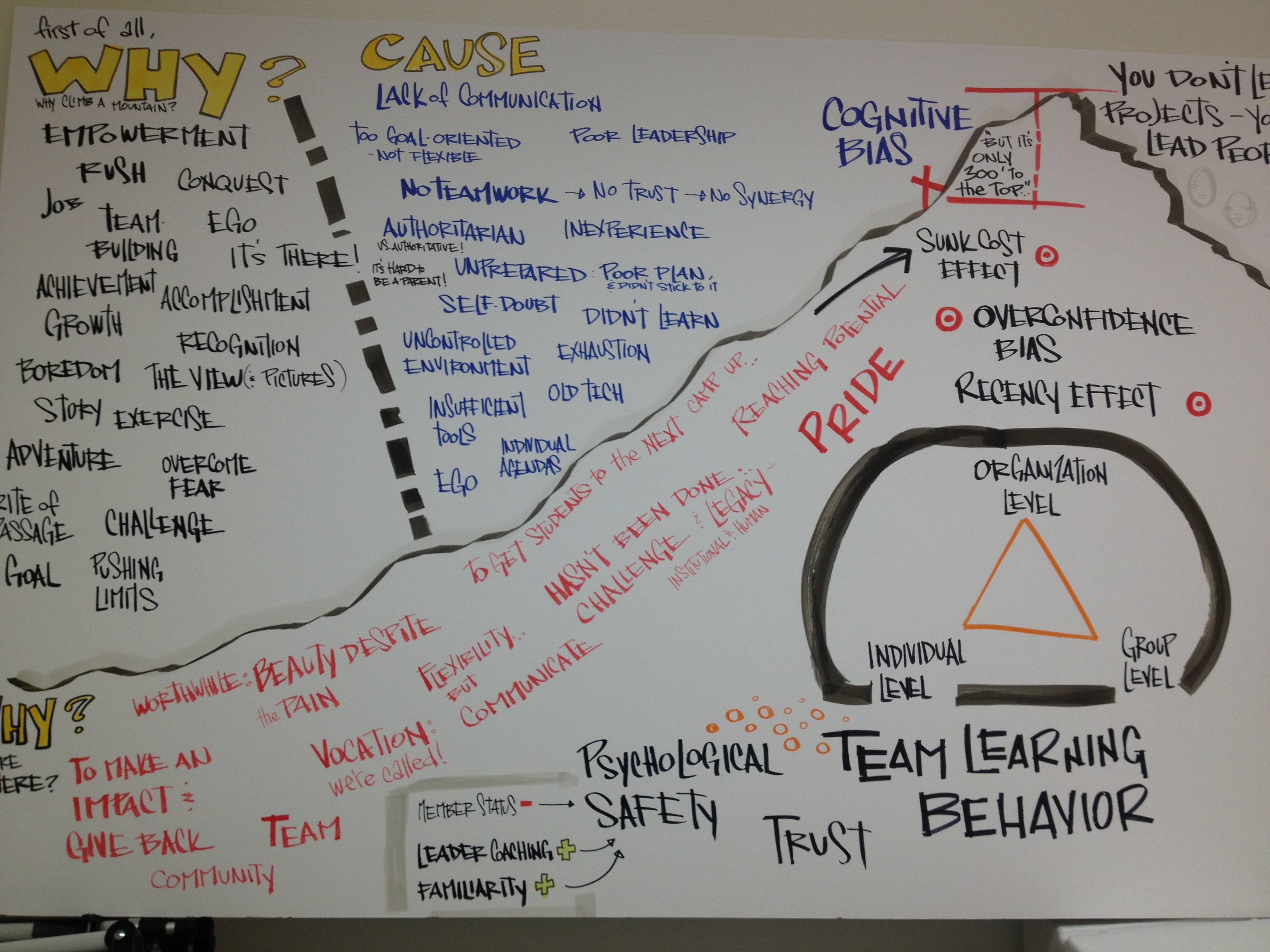
Graphic Facilitation From Mount Everest – 1996 Case Study Session
The case study of Mount Everest – 1996 also gave powerful imagery for the graphic facilitation we were also using for our week long of learning (see insert picture). If you are not familiar with the events on Mount Everest in 1996 I suggest you put Into Thin Air: A Personal Account of the Mount Everest Disaster (1997) by Jon Krakauer on your 2013 must read list.
There was both incredible achievement and great tragedy on Mount Everest in the spring of 1996. Ninety-eight men and women made it safely to the summit, but 15 did not return. Even some of the world’s most renowned high-altitude climbers, including Rob Hall and Scott Fischer reached the summit, but died during the descent because of a storm. Others barely escaped with their lives, and since then many have sought to understand what happened that day.
The first question that I asked the staff during the case study facilitation was: “Why do people climb mountains?” Here is the list that was developed:
- Push oneself to the limit
- Set goal to make it
- See things and do things that haven’t been done
- Rush
- Ego
- Recognition
- Elite Club
- Help others make it
- Competition
- The ultimate challenge
- The love of doing it
- The ultimate proving ground
As a leader, I get why some individuals want to make the climb. It is the idea of being a Trailblazer. Trailblazers go before others go. They don’t send someone where they are unwilling to go themselves. Trailblazers have been up the mountainous leadership challenges so others can come after. This is contrary to a travel agent who sends people places they have never been.
Today is the first day of school for the 2013-2014 year for our students. In my role as a Turnaround School Leader I am certainly a Trailblazer. From the list above I strive each day to be an effective Trailblazer leader from the love of doing this. My prayer is to help others involved in this important education reform work be successful and see and do things that haven’t been done before.
As we start school today I want us to help blaze the trail for our students in their world of education and learning. Our goal is for all our students to become lifelong learners. John Wooden said: “It’s what you learn after you know it all that counts.” When you are out of school, you are not out of the classroom. Life is the big classroom.
I love to learn and I want to share that love with others in the hope it will rub off. John Maxwell puts education in these three steps: 1. Learn; 2. Earn; and, 3. Return. Let’s not stop our learning with the formal education. Be an every day learner to be an every day grower!
The Achievement Gap Elephant
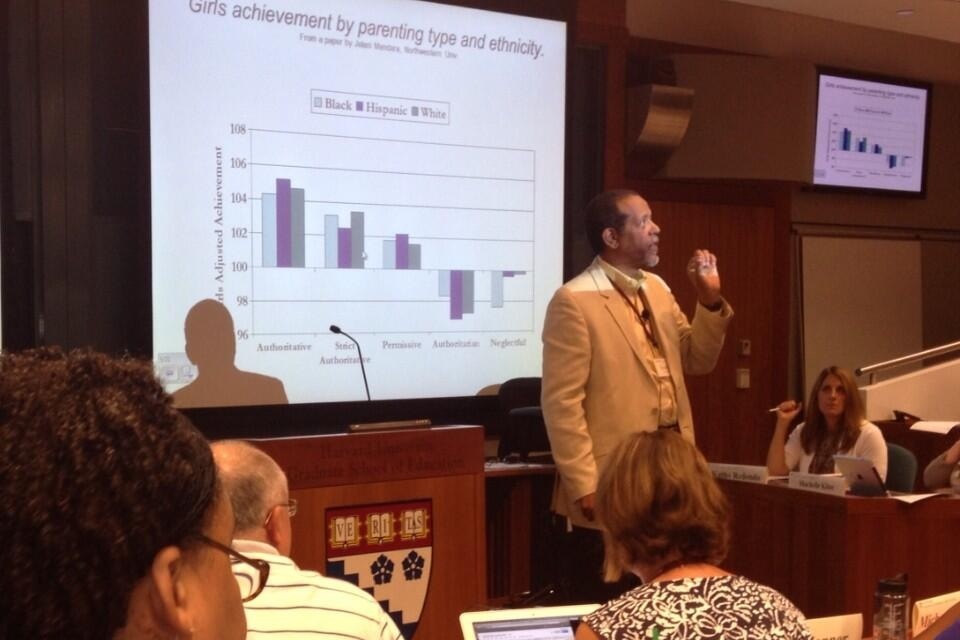
I spent this week in the classroom at Harvard University learning to be a more effective at closing the achievement gap in the Harvard Graduate School of Education program for Closing The Achievement Gap. This was a program made up of an outstanding curriculum with the learning being facilitated by incredible Harvard faculty and other expert facilitators. Part of my homework for this evening is to do a Learning Synthesis of the week. I was here at the beginning of this month for the Turnaround School Leaders program and used my blog for the Learning Synthesis. I have chosen to do this again.
We learned this week about “learned helplessness.” Dr. Ron Ferguson told the story of how an elephant is trained to stay in one place at a young age by having a painful collar and change placed on their leg. By the time they are older and big enough that the chain would not hold them it doesn’t need to even be attached to an anchor because the elephant doesn’t know he can get loose. In some ways I worry that this is the way we approach the achievement gap. Do we spend a lot of time discussing it, but then not just diving in and doing the hard work?
For this post I would like to share with you my list of 100 points that I want to use as spring boards to continuing the important work of closing the achievement gap. Here we go:
1. Shift school and district level foci to external benchmarks as points of comparison, instead of inter-group comparisons in the home community.
2. People feel overwhelmed by the complexity of the challenge.
3. School administrators try to change too many things at once.
4. We start things but do not monitor the progress.
5. There are prescriptive disagreements – people do not agree on what needs to be done.
6. Plans and strategies seem incoherent to people who are asked to participate
7. Everyone (all stakeholders) must be involved in the process.
8. Everyone must believe that students are able.
9. Everyone must have the right attitudes.
10. Students make fun of peers who try to do well.
11. Leaders must combine passion with competence.
12. We need instigators, people who work behind the scene, to plant the seeds of change and help do the hard work.
13. Dedicated teams are needed to do the hard work.
14. We need clear central themes.
15. We need a streamlined and coherent “curriculum” for the change process.
16. Have an organizational structure and capacity to teach and motivate the adults.
17. We need patient, but tough accountability in closing the achievement gap.
18. There must be institutional gathering and management of the data.
19. Data driven decision making and transparency are keys to success.
20. Community involvement is paramount for resources.
21. Theories of action for closing the achievement gap must be simple, teachable, and very specific.
22. Warm, firm control
23. Family engagement plans must be simple, teachable, and very specific.
24. Identify the evidence to guide the strategic plan.
25. Strategize/plan for specific target groups
26. The moms and dads say, “Sit your ass down!” We say, “Will you please sit down.” Students don’t understand this change in leadership style.
27. Warm, firm control
28. Parenting style is more important than anything else.
29. Most of the parenting things that work for kids, work no matter what race. The only difference is when we talk to our kids about race – “the talk.”
30. Achievement gaps occur in life experiences.
31. Life experience differences accumulate.
32. Encourage “mastery” not “performance.”
33. We must be career-long learners to be the best educators.
34. Focus on high-expertise teaching.
35. Students need ownership in the classroom.
36. When a kid asks a question, don’t berate them over it. It should be safe to say you don’t understand something.
37. Class starts the second you walk through the door.
38. Teachers need to make a connection with the student.
39. Teachers greet the students as they come through the door.
40. In great classrooms, the students know each other’s names.
41. Focus on learning, not compliance.
42. Teaching is anything a person does that affects student learning – ANYTHING!
43. The school as a workplace is the most important place for teacher training/learning/and induction.
44. The highest gain teachers go ahead and do mastery grading.
45. Learning is messy!
46. High performing teachers will let students struggle, but will scaffold the struggle.
47. Ability is malleable – Smart is something you can get!
48. High performance teachers tolerate a students’ struggle in learning.
49. Generally students know how effective their teachers are.
50. You can take what the students think to be correct about education.
51. Only putting the objectives on the board doesn’t cut it; the students won’t get it. We must put it in kid friendly language and check for understanding.
52. There is no such right as: “Students have the right to fail!” We must take that perceived right away!
53. Create an environment where no staff member can overlook something that is a non-negotiable.
54. We must create more consciousness of both positive goals and negative behaviors; we want balance in the degree to which each of these is a motivator.
55. Many students have positive self images; but they make decisions that can have long term negative consequences.
56. Difficulty can be taken as a sign that the goal is inappropriate for one’s self; the intervention helped change.
57. Incorrect assumptions about what other people think causes individuals to alter their behaviors to fit what they think other people value – “Pluralistic Ignorance.”
58. In many cases the kids already have the correct values – they just don’t know it because of pluralistic ignorance.
59. The cost of resisting what appears to be the norm can be isolation or worse.
60. When discussing issues we must create opportunities to reach consensus in the room.
61. Dominant social capital: behaviors, language, and signals that earn access and privilege in mainstream society.
62. Non-Dominant cultural capital: behaviors, language, and signals that earn access and privilege in the less dominant society.
63. Non-dominant cultural capital has value for members of non-dominant groups.
64. Tracking students increases achievement gaps!
65. Tracking helps high achievers and hurts low achievers, and exacerbates achievement gaps because people of color are disproportionately represented among low achievers.
66. The real problem is low quality instruction for classes of lower skilled students.
67. Differentiated teaching is very difficult and presents a challenge to mixed ability groupings.
68. Ultimately, the quality of instruction is what matters most.
69. There is no evidence that minority students are less likely to be assigned to high tracks if they have the same skills as white students.
70. Disproportionality of suspension and expulsions for students of color – differences in how discipline is administered. This results in depressing achievement.
71. We should use suspension and expulsion as a last result.
72. Kids decide how much you care, by how you discipline when they mess up.
73. Bias is the absence of neutrality.
74. Stereotype anxiety – “white men can’t jump.”
75. Implicit bias – unconscious behaviors that you do that you are not aware of.
76. Signaling – when someone is trying to send a signal that they are in a higher status group than they appear. As leaders, we need to find ways for them to signal.
77. Code switching and navigating – what behaviors will maximize your success in that particular setting?
78. “Sagging your pants is ok outside of school on your block, but here we are getting you ready for the adult world – the executive board room!”
79. The narratives around all the issues affecting the achievement gap are what need to be worked out.
80. Marginality: you don’t get the resources you deserve.
81. The third grade is when kids figure out the achievement hierarchy.
82. Survivors guilt – Students feel like they don’t deserve the success they have achieved.
83. If you really care about your family and community you must maximize your success so you can maximize your giving back.
84. Selling out – many times the low achievers will just say, “I don’t want to be like that anyway!”
85. Acting “white”
86. High achieving black girls tend to group.
87. High achieving black boys do not group.
88. If you take care of business from ages 12-18 you are set!
89. Training Fleas and training elephants – Learned Helplessness.
90. How do we leverage hip-hop to our students?
91. Flocabulary -www.flocabulary.com
92. Every course in school must be doing multiple high level and rigorous writing assignments.
93. The best people in the organization that can put structures in place for success are not necessarily the ones with the titles to do so – Lead from where you are!
94. If you are going to say there is bias; you must define neutrality!
95. We teach like we were taught.
96. We parent like we were parented.
97. Parenting Styles: Authoritarian, Strict Authoritative, Neglectful, and Permissive.
98. The neglectful parents do not set out to be this way. These families are overpowered by life.
99. No family chooses to be neglectful.
100. White parents get it wrong by being too permissive, but not on purpose.
Well, there are my 100 takeaways from the week. If you ever want a way to unpack what you have learned after a long week of learning you can try this exercise. I hope they have provoked some thought on education reform and closing the achievement gap for you. If so, feel free to leave a comment and we will begin a dialogue.
I really believe we need to put aside differences and join side by side in the important work of school improvement. In doing so we will begin to collaborate, build relationships, and gain the trust necessary to be successful in this hard, rewarding, and fun work! Remember, we are not tied down like the elephant thinks he is!
View From 30,000 Feet

As I write this post I am on a flight from Boston to Philadelphia heading home from Harvard University. It always amazes me how the view changes at 30,000 feet. The weather was terrible in Boston and there was flooding because of the storms coming in the aftermath of hurricane Andrea. But when you you get up to 30,000 feet you are above all that and the view below changes.
I was so proud to be a part of the School Turnaround Leadership Program this past week. One of the leadership lessons of the week was how we need to step into the balcony as school leaders, and watch the dance above all the chaos and noise. This analogy was driven home to me this morning as I looked out the plane window and saw the sunshine with the storms going on below.
As transformational turnaround school leaders it is important for us to get above the clouds and take stock of where we are. This clear “awareness,” as Marzano calls it gives us the opportunity to sort through the clutter and stay focused on the important work at had of putting students first.
So, next time you find yourself getting caught up in all the noise of being a leader sit back and let your mind travel to 30,000 feet where you can watch the dance in the positive cognitive glow of sunshine!
Diagnosis, To Strategy, To Implementation
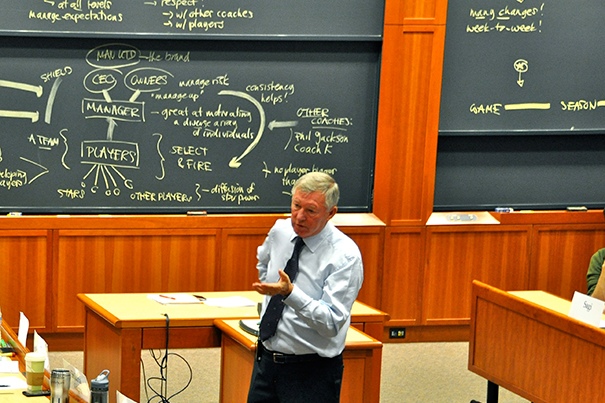
I spent this week in the classroom at Harvard University learning to be a more effective turnaround school leader in the Harvard Graduate School of Education program for School Turnaround Leaders. This was a program made up of an outstanding curriculum with the learning being facilitated by incredible Harvard faculty and other expert facilitators. Part of my homework for this evening is to do a Learning Synthesis of the week. Then I will be doing an elevator speech to my classmates.
As I reflected I was reminded of a post to this blog I made last August on the eave of the first day of school in my turnaround journey. I called it ‘Twas The Night Before. In the post I had a letter I had written to the students, parents, and community. Here it is again:
“Make It Happen”
Well here we are the Saturday before school starts at Emmerich Manual High School. As the new principal of one of the state’s turnaround academies I am so excited to finally have students here on Monday morning. I am so excited about our ADVANTAGE: Putting Students First!
For this week’s post I would like to share with you the letter I put in our first newsletter that will be given to the students on Monday. Here it is:
Hello Emmerich Manual High School students, parents, and community stakeholders,
It is with great excitement and anticipation that I write this first entry in our school newsletter! On Monday, August 6, we officially begin our partnership for the critically important task of providing highly effective learning for the students of Emmerich Manual High School. I am grateful that I have the opportunity to serve as your Principal. I want you to know I am excited to be taking this journey with you.
As a teacher my mission statement was always “to be a steward of high student achievement and performance through rigor, relevance, and relationships.” These will continue to be cornerstones that I believe are very important to highly effective teaching for our students. I would also add the fourth “R” of “Results Driven.” If we truly put our students first we will be victorious in this endeavor together and our students will win the results of high student achievement and performance and being college and career ready.
In my office I have a picture titled “Make It Happen.” The inscription reads: “Greatness is not where we stand, but in what direction we are moving. We must sail sometimes with the wind and sometimes against it – But sail we must, and not drift, nor lie at anchor,” by Oliver Wendell Holmes. This picture has a brass plate with the inscription: Emmerich Manual High School Advantage: Putting Students First, additionally, the picture is matted in such a way to have signatures put on it. I am having all staff sign this picture as a reminder that everything we do will be driven by putting our students first.
This is going to be a very exciting year. We have an incredible staff and enthusiastic and well-prepared teachers that will be facilitating engaging learning for our students. Also, I cannot wait for our athletic seasons to start, especially with the return of football.
Please know I am proud to be serving as your principal; this will be an exciting journey as we sail toward putting the students of Emmerich Manual High School first!
Positively,
Byron L. Ernest, Principal
As I read that letter I reflected on what we accomplished this past year. We certainly changed the culture and the instructional core. Are we where we need to be? – absolutely not. This week I have learned, however that we must continue to be tight on expectations.
Here are 71 quick points of reflection on my learning:
1. We must develop results oriented systems
2. When schools fail it is systemic
3. Never blame people, make it a systems problem
4. Be a thoughtful leader and step into the balcony and watch the dance going on
5. SOB – Safety, order, and basics
6. In turnaround schools, the focus is on the improvement of student and teacher learning
7. The three important parts are: teacher, content, and student – fuss with any one of those and it effects the others
8. Provide a common language
9. Connect the action to the result
10. Make the implicit explicit
11. Diagnose critical or weak links in your improvement
12. Cut out the clutter
13. Make sense of current initiatives
14. Many times turnaround schools have the problem of having too many resources
15. There is a ceiling on what people can do and learn
16. Strategy must be developed in partnership
17. Bunches of resources do not give you more capacity
18. Take the emphasis off compliance and put it on results
19. Know when things don’t feel right and know when to quit, turnaround, and the costs of keeping going
20. Prepare your teams for the appropriate “summits” and milestones
21. What makes a great leader – restraint
22. If you are going to build a great team, don’t you want their ideas?
23. You have to remember, you are not a leader of a project, but of people
24. Social and emotional learning skills are learned and developed over time
25. As the people who know the students best and are most accountable for their success or failure – teachers are the best suited to identify and assist them
26. Every child has an “emotional bank.” We must make more deposits than withdrawals.
27. Most schools are structured around the school savvy student, but most of our students are not school savvy
28. It’s an access gap, not an achievement gap
29. What is our mindset? What do we really think about our students?
30. We need to be CLEAR about what we want to build in our students – CONFIDENCE, LEADERSHIP, EFFORT, ACADEMICS, RESILIENCE -CLEAR
31. College must be a dual education process – PARENTS & STUDENTS
32. We have to learn to deal with students who come to us with luggage that we did not necessarily help pack
33. Culture is a pattern of basic assumptions
34. “Treaty of Mediocrity” – If I don’t give you much effort, then how can I expect much back in return?
35. Every organization has a power structure – either implicit or explicit
36. We’ve never tried to educate as many students at as high of a level as we are now
37. Does “belief” or “practice” need to be changed first?
38. New learning is based on prior learning…Prior learning is based on experience
39. The quality of an education system cannot exceed the quality of your teachers
40. The main influence on student achievement is the teacher
41. The most powerful place to learn teaching is when you are teaching
42. Teachers teach the way they were taught
43. The task predicts the performance
44. Students learn to do the tasks we ask of them
45. Elmore’s four questions on educational core when observing a classroom: What is the teacher saying and doing? What are the students saying and doing? What is the task the teacher has set for the students? If the student did everything the teacher asked them to do, what would the student leave the classroom knowing how to do?
46. Think about the conditions school leaders need to put in place to make teachers more effective
47. If it doesn’t hit the classroom, it doesn’t matter
48. If you don’t read fluently, you lose comprehension
49. Every teacher in the building must become a reading teacher
50. I don’t care how you read Shakespeare (print, electronic, audio, et cetera)… All I care is that you read Shakespeare!
51. To turnaround a school you must make true structural change
52. Teachers must be watching each other
53. Schools need to be teaching students how to ask the right questions
54. Kids might be “digital natives,” but they are not “digital citizens.”
55. Every school should be using Skype
56. We must harness technology for our students
57. Do not have an “anti” campaign without having a “pro” campaign
58. We are what we repeatedly do. So… Excellence is a habit
59. We need to measure what we value
60. Most people are concerned about their position, not the impact of their position
61. Teams need an effective model of communication, a collaborative conflict resolution model (there will be conflict), and a jointly agreed upon work models to be effective
62. A group of smart people does not make a team
63. Many times people we work with come to us with a limited set of perceptions and a limited set of skills
64. The elephant rule: Old history that is still causing bad feelings
65. CBD: Consult before you decide
66. GBD: Give the other person the Benefit of the Doubt
67. Always give the other person/group a way to save face
68. Most people are concerned about their position, not the impact of their position
69. We must negotiate change, not impose it
70. Communication, relationship, interests, options, legitimacy, alternatives (BATNA – Best Alternative To a Negotiated Agreement), and commitments
71. Negotiate interests, not positions
As I continue the important work of a Turnaround Principal I am reminded of something Albert Einstein said: “The formulation of the problem is often more essential than its solution, which may be merely a matter of mathematical or experimental skill.” This week has enabled me to continue to formulate the problems and frame them in a way that our school can collaboratively devise solutions!
I Used To Think…But Now I Think…
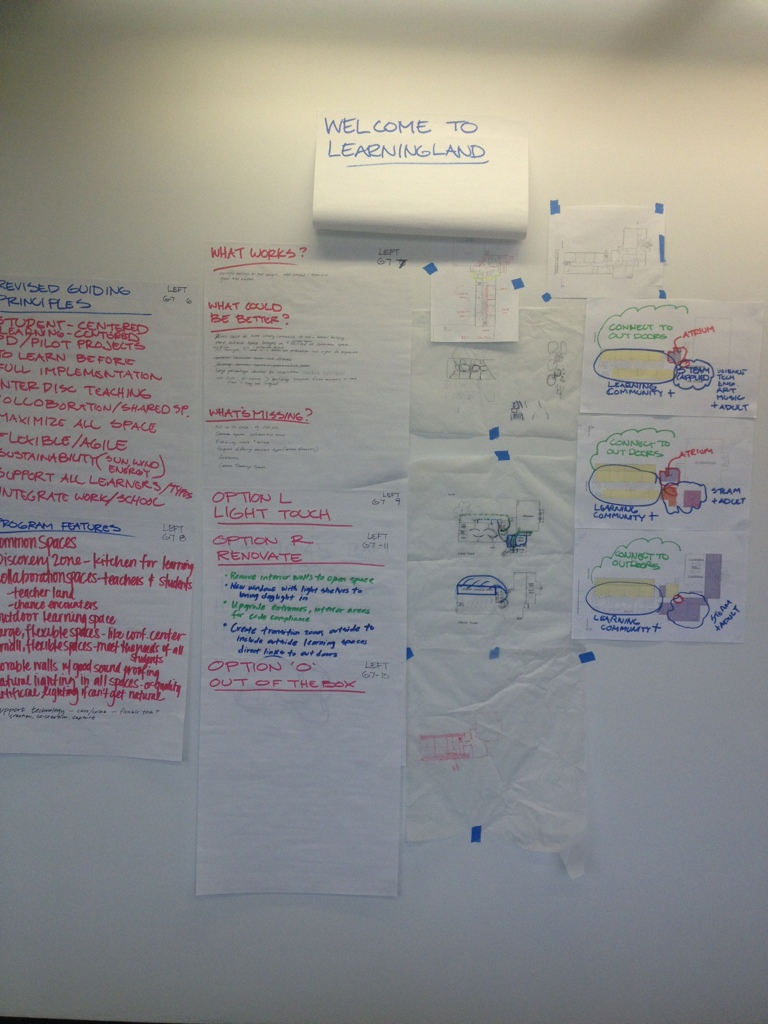
During my time at the Harvard University Graduate School of Education this week I was provoked, stretched, and made uncomfortable while exploring the principles of effective pedagogy and school design for the future. I was part of the Learning Environments for Tomorrow program. At the end of our week Daniel Wilson, of the Harvard Graduate School of Education, posed the following sentence/reflection question for us to spend 15 minutes writing about: I used to think…But now I think… I thought this was a splendid way to end a conference with some self reflection! Not to mention the fact it would make a great post to my blog. So, here is my reflective free writing:
I used to think in the same paradigm of the past that we would modernize, remodel, or build a new building that in 60 years (which is how old the average school is today) from now others would say: “This is such an old school that needs to be redesigned for the 22nd Century Learner (bet you haven’t heard anyone talking about them yet, but remember we are already 13 years into the 21st Century).”
But, I now think (actually, I know) that we need to design spaces that take into account the principles of student centered learning, learning centered, professional development and pilot projects, interdisciplinary teaching, collaboration, shared space, maximizing all space, flexibility, agility, sustainability (sun, wind, & energy), supports all learning styles and types, and integrated the community and school.
And now, I also think (actually I know) we need to use architectural and learning theory, emerging technologies, environmental sustainability, child and adult collaboration, and community engagement to create “AGILE” learning facilities that can be flexed into the 22nd Century without taking millions, or even billions of dollars to sustain or modernize in another 60 years.
The photo in this post is of the visual work process of the Design Team Project my classmates and I created. We called it LEARNING LAND! Sounds like a fun place to be, huh?
Leadership To Open The Era Of Aviation
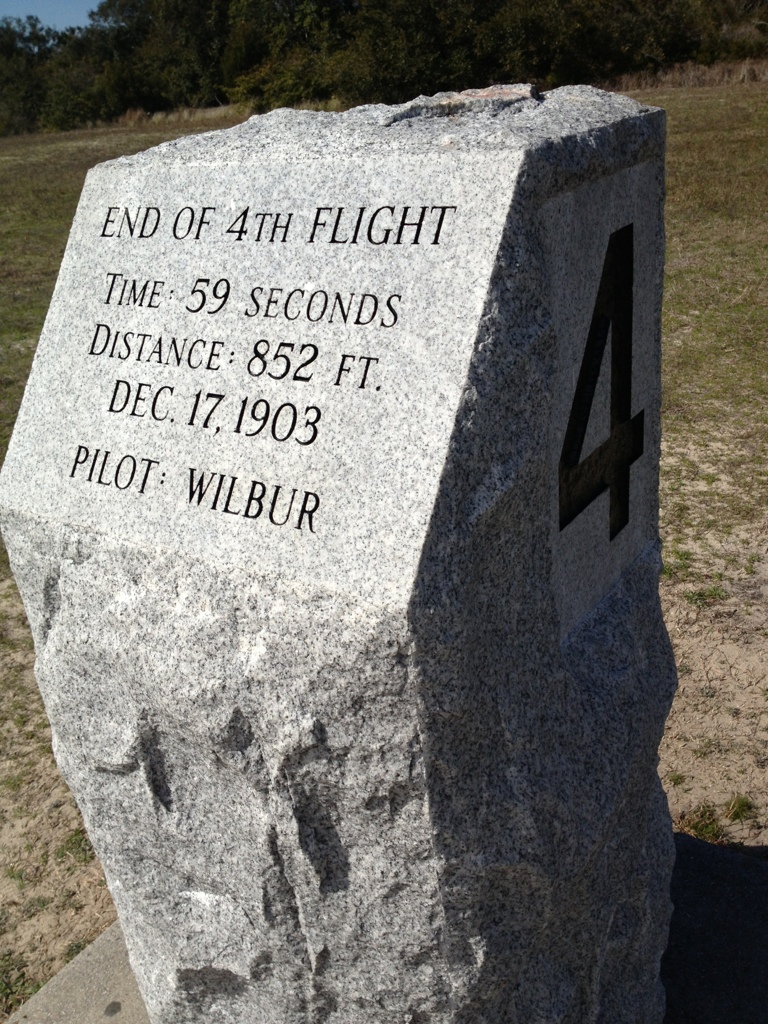
As I stood at the monument (pictured in this post) marking the fourth fiight on that blustery December 17th day I reflected on the first time I stood beside the Wright Flyer at the Smithsonian Institution. The plaque at the exhibit reads: “THE ORIGINAL WRIGHT BROTHERS AEROPLANE: The world’s first power-driven, heavier-than-air machine in which man made free, controlled and sustained flight, invented and built by Wilbur and Orville Wright flown by them at Kitty Hawk, North Carolina December 17, 1903. By original scientific research the Wright Brothers discovered the principles of human flight as inventors, builders, and flyers they further developed the aeroplane, taught man to fly, and opened the era of aviation.” Think about what this says, they “…opened the era of aviation.” What a leadership legacy!
In 1901 Wilbur and Orville had tested their latest glider design. The performance was improved and the control bugs were worked out, but the Wrights were perplexed about why their calculations were still off. Their response to this was unique and would he reason enough to regard the Wrights as the first to fly. They constructed a wind tunnel in the rear of their bicycle shop and conducted precise tests of different wing sections. The tunnel was only six feet long by sixteen inches square, with a glass window in the top panel to allow observation. A steady fan driven by a small gas engine blew air through the box at a steady twenty-seven miles per hour ), and inside, balance and spring scales measured lift and pressure on a variety of airfoils. In these experiments, the Wrights raised aviation experimentation to the level of serious engineering.
The Wrights discovered that much of the published data on wing design was incorrect or had ignored important elements of flight. After testing two hundred different wing surfaces, the brothers used their newly gained information to design Glider Number 3. As leaders we must do our own research and not take for granted the opinions of others.
The Wright Brothers put the necessary time and research into finding the best design. They did this all in the name of bringing about social change! This is what great leaders do!
Wright brothers the Extreme Leaders vs. Samuel Langley
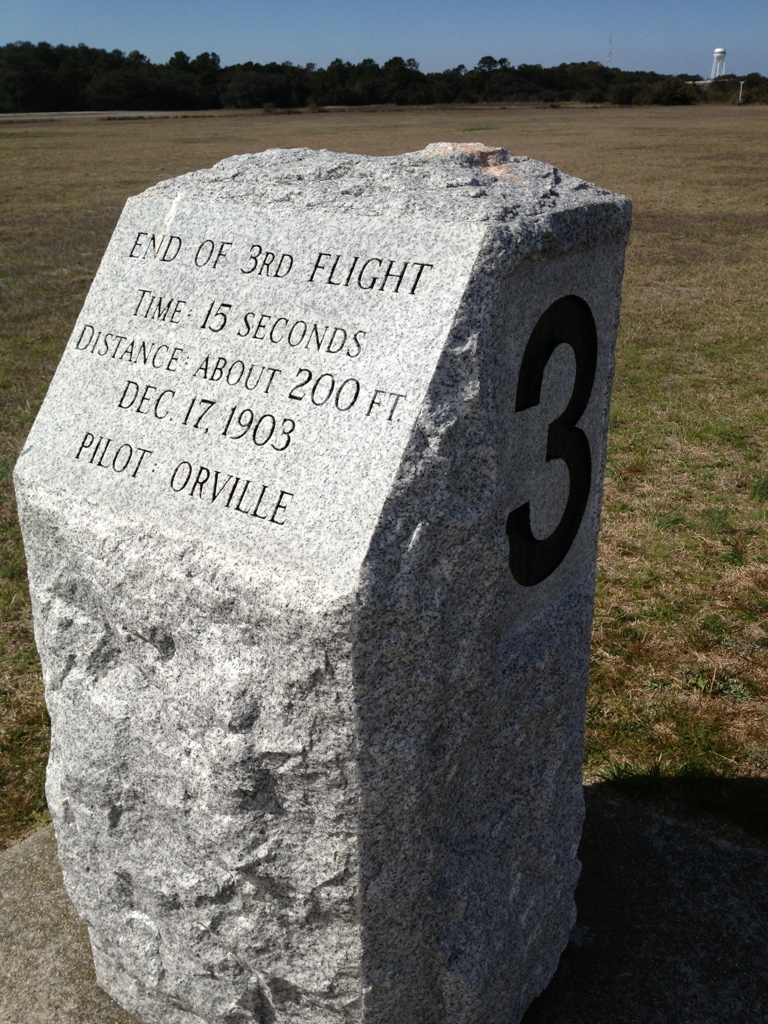
December 17, 1903
How did the Wright brothers succeed where a better equipped, better funded and better-educated team could not?
They started with why! They developed a technology that would change the world. Only the Wright brothers started with why!
Ironically, while I stood at this third flight marker a pair of fighter jets went over. I’m so glad the Wright brothers imagined a world in which we’d all take to the skies as easily as we catch the bus. And it happened.
Remember, if you’re not trying to change the world, you haven’t entered the realm of the EXTREME LEADER!
 Byron's Babbles
2 comments