“Don’t Romanticize The Job”
 Yesterday, I heard the phrase “Don’t romanticize the job” used. We all romanticize certain ideas. The context that was being used when I heard it was romanticizing police work and wanting to help people and make a difference in the world. Interestingly, those are the same things said by those going into education. Pick any job and something could probably be romanticized about it. We could find someone in real life or in movies, television shows, or books who looked cool doing it. When we romanticize, however, we are responding to how we think our lives should be, look, or feel.
As opposed to romanticizing, we need to check reality. We need think about what we really want or how we really feel. Otherwise we are probably going to be very disappointed. Most things are not near the way we romanticize them. Think about this romanticization: the person working the longest, sleeping the least, stressing the most, sending emails at all hours of the night, is working the hardest and getting the most done. Of course this is not correct, but I actually know people who set their computer to send out emails in the middle of the night so people think they are working. Dumbest thing I’ve ever heard!!!
Notoriety used to be something that happened or was achieved after having done something notable in a person’s respective field. Now it has morphed into a goal in and of itself. In other words, the romantic ambition of fame begins to inform passion – not good. This romanticizing can lead people to focus more on getting attention than learning and growing their individual skills. When deciding how to build our lives and our personal growth plans, we need to make sure we are deciding based on facts, and not some romanticized version of reality.
Serendipity Baby!
 When conditions are right for it, great things happen. Serendipity is said to happen by chance, but I believe we must create the opportunities for these occurrences to happen.
Yesterday, the perfect opportunity for serendipity occurred as we were setting up for our Impact Georgia teacher professional development. We had two big screens on either side of the stage and a screen on the stage in the middle that was not going to work, but could not be taken down. There was a group of four of us looking at the stage. I said, “Do we have any good looking banners we could drape over it?” Everyone thought and we couldn’t think of any. Then a couple of other ideas were thrown out. Both good options. But, a fourth option then came in the form of a question: “could one of the stage curtains be positioned to just cover the middle part of the stage leaving the side screens visible?” We went to work and found the answer to be “yes!” Serendipity!
The solution was awesome. The front of the room looked great. A picture is attached to this post of the stage. Why did we get to a great solution, though? First of all our group was fully engaged with each other. Secondly, we were listening to all ideas. If we want everyone to voice more of their ideas, show that you care about all all their ideas; listen carefully, patiently, and respectfully to every idea. This creates a comfortable environment that has trust, rewards open discussion, and has everyone sharing their true thoughts.
Are you creating the opportunities that allow for serendipity?
Empowerment Needs No Menus!

Angelika & I
To empower means “to give somebody power or authority” and also “to give somebody a sense of confidence or self-esteem.” I believe we can change someone’s world every single day. I have something I love to do when going to a new restaurant for the first time. I’ll tell the server to not give me a menu, and pick the meal for me. To me, this is the ultimate act of empowerment and intent-based leadership. I first did this with my dear friend and leadership idol, David Marquet, when we went out to eat one evening.
 Well, last night was the 142nd day of the Global COVID-19 Pandemic; and I was in a restaurant for the first time. We went to Riverstone Corner Bistro in Canton, Georgia, after setting up for our Impact Georgia teacher professional development happening today. So, to my table-guests surprise, told our server, Angelika, “I’m not going to look at the menu online (the way Riverstone limits contact) and I just want you to pick my entire meal for me.” At first she was a little taken back, but then we could tell she was beginning to have fun with this. She even came running back to the table and said, “I’ve got an idea and just want to know if you like lots of cheese.” I, of course, said “Yes” and away she went.
Here’s the deal: Angelika did a perfect job of showcasing the great food of Riverstone Corner Bistro and her abilities as a sever to meet the needs of her customers. She showcased a menu great and favorite if her own – Scallops Risotto. She was beaming when she brought it to the table and beamed even more when I said, “You could not have made a better pick.” It was awesome! And, as I told my table-mates, I probably would not have picked that, but because I empowered someone else, her life was brightened and I got an even better meal.
To empower someone, you have to help them feel proud of the good things they do. This is truly the essence of empowerment. It was clear that Angelika was proud of the menu items she chose for me and of the restaurant where she works. I merely opened the the door and created space for creative thinking. This requires discipline and patience on a leaders part. It also means we take a little risk, but it is worth it. We can provide hints or prompts, like my giving in and acknowledging I like cheese, but allowing those we serve to discover the answer will empower them in future situations.
“Getting It Right” Before “Being Right”
 “Pride goeth before destruction, and an haughty spirit before a fall” (Proverbs 16:18 KJV). A good daily growth exercise to read a chapter of Proverbs every day each month. There is a lot of wisdom to be gained from King Solomon. The difference between “getting it right” and “being right” with this statement, is not to suggest that we are more often than not wrong in our thinking. Despite the religious origin, people use this nowadays without religious overtones. People can say this simply as a warning not to be too arrogant.
To me “getting it right” before “being right” means having humility and an ability to consider all sides of an issue or question. Being humble does not mean that you diminish your value or take a subordinate position in terms of presenting your ideas or perceptions. It does, however, as a leader, mean than we should listen to others’ ideas before always presenting our own. And acknowledging when those ideas are better than our own. True humility is a sign of wisdom, knowledge, confidence, and strength.
“When given the choice between being right and being kind, choose kind.” ~ Dr. Wayne Dyer
“Getting it right” is a core value I practice to remind myself that making a contribution as part of a bigger team means that you have the humility to accept that others also have something worthwhile to contribute. I truly believe there is no such thing as an “expert.” But, I do talk about the “collective expertise” in the room all the time. We should all strive to be an important part of a “collective vision.” When we give up the need to always be right, we communicate and listen on a deeper level, with more understanding and acceptance, and with less judgment and resistance.
“I Get To Go Be Creative”
 Today I was in Nashville, Tennessee doing what I love to do: work with teachers. We were putting on Impact Nashville; an action packed day of professional development. While I was working to inspire teachers and help them improve their craft and the craft I love, I was inspired by the photographer who was chronicling the day. As I was welcoming the participants and handing out name badges this morning I dubbed her “girl with the camera (GWC).” She really does have a name: Lisa.
I love watching great photographers as they move about working for the best shot. Probably because I’m not very talented at taking pictures. I usually need to have someone take a selfie of me. I could tell she loved her craft from watching her. During one of my sessions I was driving home the point that we must teach in a way that has our students believing they “get to” to experience great educational activities, not “have to.”
So, of course, I included GWC Lisa in the discussion. I asked her what she said to herself as she was leaving home this morning to come to our event. She said, “I get to go be creative.” I couldn’t have scripted better – which I had not. How awesome was that response? We should all strive to create environments where we, and those we serve, “get to” and not “have to.”
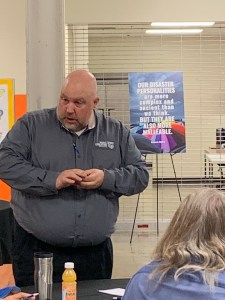 I was using the game Angry Birds as a through line for my professional development. The point was using eight principles used by Rovio in the development of Angry Birds that has caused the game to become a phenomenon that people love to spend time playing and seek to improve their skills. In fact, I always say, “Everything you need to know about teaching you can learn from Angry Birds.” Here are the eight principles:
- Make it easy to start the task.
- Show, don’t tell.
- Give useful and immediate feedback.
- Make it easy to recover from feedback.
- Complicate the task gradually.
- Accessibility/Mobility: how could we leverage the cell phone for our students?
- No single answer: players explore and try different techniques. We can experiment.
- Incentives to do better: leader boards, achievement badges, certifications, et cetera.
What are you doing to encourage a “get to” mindset in your organization. What would the world be like if we all could say “I get to go be creative” every morning?
What The H@#* Is A Team Player?
 I almost always write a blog post on the Fourth of July. Today, however, I first thought that my topic had nothing to do with the day honoring our nation’s independence, but on further thought, I believe it does. I’ll let you be the judge after you read it.
I wish I had a dollar for every time someone has said to me “he’s not a team player” or “she needs to learn teamwork.” These are very easy statements to make, but a lot harder to substantiate. Usually I even think the person making the statement understands less about teamwork than the person he or she is making the comment about. When I hear this, I always like to ask “What do you mean?” Most is the time the response I get reveals a very limited view of what it means to contribute to a team. Generally, the person making the statement wants the other person to fully concede to another way of thinking. And, if you’re paying attention, they will also use language like “reaching common ground,” as if we are looking for the best campsite.
Recently, I had a friend posit the reason individuals refer to others as non-team players is because it’s the easiest statement to put someone on the defensive. When thinking about the times I have been called out as not being a team player, it has put me on the defensive. When examining this subject in that light it really does reveal the ignorance of the other person’s understanding of team effectiveness, compromise, and consensus building.
If team effectiveness is the capacity of a group of individuals has to accomplish their own and their shared goals and objectives, then we must acknowledge the dichotomy that exists. Teams are made up of individuals and those individuals come with their own values, experience, and goals. That’s what made the melding together of the group that we call our nation’s founding fathers so powerful.
“The battle, sir, is not to the strong alone; it is to the vigilant, the active, the brave.” ~ Patrick Henry
I’ve studied many former leaders extensively and the greatest of those leaders understood the difference between teamwork and marching orders. Teamwork should allow for diversity of thought and allow exposing the best of each individual. Again, as I said earlier, teamwork relies on style and strength differences of all individuals. Right now I am reading The Years of Lyndon Johnson: Master of The Senate by Robert A. Caro. In this study of power one sees that Johnson’s use of power and definition of teamwork is that of being loyal to him (Johnson). Real teamwork does not involve loyalty to a person or “marching orders.” These “marching orders” shut down new ideas and results in only doing the bare minimum.
 Caro also laid out for his readers the fact that sometimes consensus can be reached by compromise and other times it absolutely cannot. In those times when it can’t, there must be a consensus built from scratch. In reality, many times compromise becomes a power struggle where some have to give up to accommodate others to get what they want. If this happens enough, it becomes a power struggle, not teamwork or consensus building.
Finally, the Declaration of Independence was signed by 56 people. Those 56 people did not have the same views. We must remember that not any one of these could have successfully lead us through the revolution. It took a team!
Adaptive Leadership – Great Blue Heron Style
 It’s a great morning when I can enjoy wildlife on the way to the barn. There was a Great Blue Heron out in one of our freshly mowed hay fields this morning. The background for this tall, majestic, and shaggy feathered bird this morning was a corn field (see the photo I took, featured in this post). At first I thought, “Wow that corn is really tall for the 3rd of July.” The old saying “knee high by the Fourth of July” is very outdated. As you can see from the picture, we are way past that. Think about it; if Blue Herons are 53-55 inches tall, the corn in the background is well past that. Ok, back to the point; it’s just hard for the farm kid not to talk corn.
Anyway, I have always been fascinated with these great creatures. They are amazing to watch, particularly when they are hunting rodents in a hay field. These great birds with long yellow legs can stand like statues for what seems like forever while stalking prey by site. And, when prey comes by, they don’t miss. I have blogged about these beautiful birds that have wing spans of over seven feet. Click here to read “Blue Heron Leadership.”
Now, as we begin day 115 of the the COVID-19 Pandemic, I think about how we have had to really practice adaptive leadership. Great Blue Herons can occupy a variety of habitats in freshwater and marine coastal ecosystems: lakes, ponds, rivers, flooded farmlands and meadows, irrigation ditches, and wetlands. Think about all these different habitats and the adapting that must be done. These birds are able to forage successfully on a variety of aquatic and dry land environments. They also have a very diverse and extensive menu of prey. Actually, an adaptation of the sixth cervical vertebrae allows the bird to draw it’s neck into the characteristic “S” shape and then strike with lightning speed and killing force.
Each day presents new or recurring leadership challenges. Therefore, we must learn from and draw on the wisdom of prior experiences while learning, in real time, lessons from today. In order to adaptive with the agility necessary, we must be situationally aware and asking the right questions, not just devising answers. During times like these the process of sound adaptive leadership can get lost. A preoccupation with events may lead to a short-term focus and a reactive posture. To truly adapt, we must take the long-view and adopt a broader perspective incorporating data, information, and knowledge. This will allow for the cultivation of wisdom.
Wisdom can only be gained though experience. Wisdom is about understanding and being able to adapt. Understanding is fluid. Wisdom is knowledge that is not seen as being applied rigidly to one thing. By adapting, we understand knowledge’s essence and can see how it relates to everything else, with nuances and contradictions included. Wisdom inspires adaptable versatility and provides textured lenses for dealing with reality.
Day 💯 – Getting To Know People In A Different Way
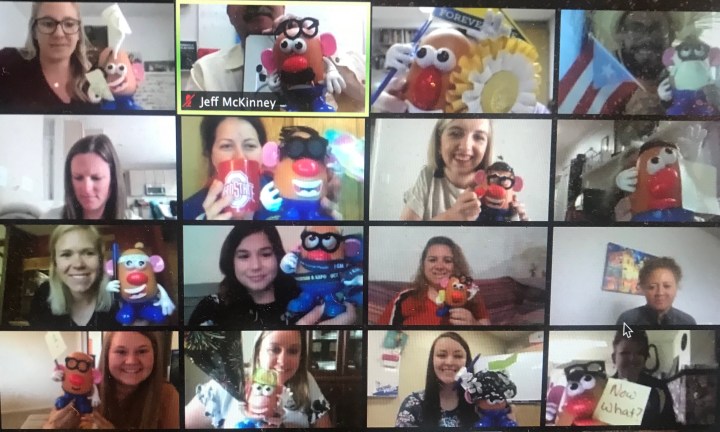 Well, here we are; day 💯 of the Covid-19 Global Pandemic. During this time of discovering a new normal, I feel more connected than ever before. I have met the children, spouses, pets, and even a grandmother of people I never would have thought possible. I’ve even introduced some of our Jersey dairy cows to others while connecting virtually. Additionally, I’ve witnessed parents attending school events virtually, while at work, that never would have been able to attend before. My point? There are things that we need to consider becoming normal. I’m not saying replace necessarily, but supplement.
Having said that, I now begin to think about what else do we need to be thinking about? How do we leverage technology? How do we stay human? How do we get the right tools in the hands of everyone? How do we decide what the right tools are?
It’s interesting to me that before the WHO (I thought that was a rock band) named this a Global Pandemic we were talking about sustainability and the environment, health care, education, and many other things. While in the education realm we have been focused on connectivity and providing meaningful virtual education, and in healthcare our actions have been around caring for Coronavirus patients and stopping the spread of the disease, we will get back to talking about the major issues in the way we were before the pandemic took over. For example, we will, no doubt, be rethinking health care and how it is delivered. In education, I continue to argue that our conversation needs to shift to the idea that school is no longer a place.
Even though I served as moderator for an awesome global event last month that was virtual with 47 countries represented, I also wonder if our assumptions about globalization have been challenged. We had been talking about distance no longer being a factor, but in some ways I’ve seen us become more isolationist and seeing us care more about the locality we operate in and what we can touch and feel. But, we’ve also seen that we can hire the best talent from anywhere and bring them onto teams. The only remaining question related to that is how to do remote working well.
I don’t think I am alone with all of this thinking and pondering. We are now entering a time of needing to decide which practices still make sense and which need to change. We need to come together as families, businesses, schools, communities, cities, states, and nations to answer the question, “What can we create together?”
FACE Is Social Currency
 Saving Face: How to Preserve Dignity and Build Trust by Maya Hu-Chan
My rating: 5 of 5 stars


This is one book that you will want to put on your “to read” shelf and then move immediately to your “currently reading” shelf. While reading this book there were many things that became immediately applicable and usable. This, to me, is the greatest of compliments. There were also times when, as I read, I would literally say, “So, that’s why I screwed that up so bad.” “Face,” as Maya Hu-Chan said is like social currency. The more you have, the easier and faster you can get things done.
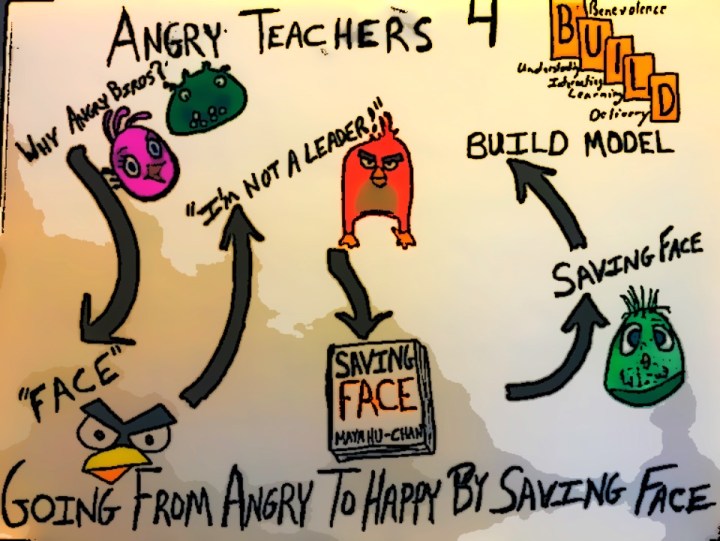 Immediately after reading my advanced copy of the book I had the opportunity have Maya be a part of a professional development webinar I put on for teachers. Maya and I used Angry Birds as the throughline for presenting the professional growth. We actually watched part of the first Angry Birds movie and picked the part of the movie where Red is asked to be a leader and he says, “I’m not a leader.”

“I’m not a leader!” ~ Red
This provided a great springboard for Maya to connect the teachings of her book. One of the things she discusses in the book is using the Platinum Rule instead of the Golden Rule (not that the Golden Rule is bad, mind you). The Platinum Rule is, “Treat others the way they want to be treated.”
Think about how just doing this would improve relationships – “face.” Needless to say, Maya’s teaching is a huge hit with educators.
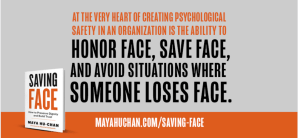 One of the most impactful parts of the book dealt with psychological safety. Hu-Chan posited that, “At the very heart of creating psychological safety in an organization is the ability to honor face, save face, and avoid situations where someone loses face.” Psychological safety is one of the number one variable for team performance. Psychological safety allows for moderate risk-taking, speaking your mind, creativity, and sticking your neck out without fear of having it cut off — just the types of behavior that lead to ideas, creation, and breakthroughs.
Finally, Maya also taught us the BUILD model in the book. BUILD stands for Benevolence, Understanding, Interacting, Learning, Delivery. By putting the BUILD model into action in our lives we will be able to live a life of significance while saving face. As you can see, you are going want to start reading this book right now.
View all my reviews
Coaching To Examine Meaning
 Coach the Person, Not the Problem: A Guide to Using Reflective Inquiry by Marcia Reynolds
My rating: 5 of 5 stars
This book truly was written as a coach’s guide to reflective inquiry. As a person who coached, mentored, and worked alongside a new school principal this year, I found myself wanting to tell stories and use reflective inquiry as I read, highlighted, and dog-eared the pages of this great book. Of course, I love the fact that Dr. Reynolds used case studies instead of acronyms for bringing clarity to her teaching. This book provides information that is immediately actionable.
Dr. Reynolds put five tools in our reflective inquiry toolbox in this book:
1. Focus: coaching the person, not the problem
2. Active replay: playing back the pivotal pieces for review.
3. Brain hacking: finding the treasures in the box
4. Goaltending: staying the course
5. New and next: coaxing insights and commitments


She also gave us three mental tips to provide psychological safety. I am so appreciative that Dr. Reynolds spent time in the book discussing how our brains work and why psychological safety is so important. I believe this might be one of the biggest issues in organizational culture today. I even tweeted the following while reading the book: “I’m always appalled when someone tells me they are nervous & fearful of talking to their leaders. This is aweful! ❤️ Love that @MarciaReynolds addresses the brain science of this in her new book #CoachThePerson. 🧠” I also tweeted: “…Additionally, @MarciaReynolds drove home the point in her great new book, #CoachThePerson, that we must create cultures that foster the psychological safety to fully express ourselves in conversations.” Here are her three mental habits:
1. Align your brain
2. Receive (don’t just listen)
3. Catch and release judgement
Toward the end of the book, Dr. Reynolds reminded us that we need to say it out loud to make it real and that our brains are meaning-making machines. In every scene of our personal and professional lives we pull from our past experiences, beliefs, values, fears, and present assumptions to make sense of the situation we are living at the moment. In this book, Dr. Reynolds taught us that, “Coaching is intended to examine the meaning people give to situations to determine what else could be going on that would change their approach going forward.” Everyone who works with people should read this great ⭐️⭐️⭐️⭐️⭐️ book!
 Byron's Babbles
leave a comment