Sharing Smiles Even If They Are A Little Harder To See

“Sharing smiles even if they are a little harder to see.” I heard this yesterday on the video that was shown prior to taking off on my flight to Atlanta. If you watch closely you can tell when someone is smiling. I was reminded this morning how important it is to still smile, even when our mask makes them a little harder to see. I walked into a school in Georgia this morning that I have not been in since last summer and a teacher I know said, “I would know that smile anywhere.” I said, “How do you know I was smiling?” She said, “You can always tell; you just have to pay attention.”
I started paying attention and you can tell. In fact the person’s whole face changes and their eyes light up. So, don’t forget: keep sharing smiles even if they are a little harder to see.
Great Collaboration or Great Competition

I am reading the great book Founding Brothers: The Revolutionary Generation by Joseph J. Ellis right now and he spoke of the “odd couple” of the revolution being Thomas Jefferson and John Adams. Both were very different in their tactics and personalities, and were unlikely friends. Before Washington’s presidency, they collaborated to solve multiple political issues. Then, as Ellis put it, the “great collaboration” turned into the “great competition” because the two intimate friends soon found themselves running for the presidency against each other. Probably no relationship in this country’s history carries as much baggage as that of John Adams of Massachusetts and Thomas Jefferson of Virginia.

This got me to thinking about the age old topic of how much competition is healthy. Pursuing individual goals alongside others can, at times, lead to counterproductive behaviors that can be harmful to both sides. This sense of competition can shift teammates (let’s consider Jefferson and Adams teammates of our democracy) focus from improving themselves or the vision of the organization to defeating a pseudo-opponent, which can lead to sabotaging behaviors. We saw these sabotaging behaviors in the case of Adams an Jefferson and I’ll bet you have seen this happen to others or yourself.
In a work setting, having read extensively about this topic, I believe in providing individualized performance statistics can help reduce competitiveness as well as its negative consequences. Competition at its best helps us to be better. At its worst, it can create unhealthy self-comparison or judgment. I am not advocating for doing away with competition. I am, however, advocating for us to not let collaborators becoming competitors stifle progress, both for the individual and the organization. Competition can actually change our world view. Never forget, everybody in an organization has something to say and undoubtedly has some value to contribute. Do we see the world as a place to grow and collaborate with others?
Where Do You Want To Rise Up Next?

The title of Chapter 23 in Mindset Mondays With DTK by David Taylor-Klaus (DTK) is “Rise Up.” This caught my attention and immediately made my mind go to my friends in Alter Bridge and their great song “Rise Today.” When the first sentence in the chapter was “In our house, we like to use rock & roll life style as a metaphor,” I knew we had serendipity.

DTK told us in this chapter that no matter what happens we must step up and put on the best show possible. This made me reflect on the fact that we have the opportunity to change the world every day. As it says in “Rise Today,” “Yeah, oh yeah; I want to rise today; And change this world; Yeah, oh yeah; Oh, won’t you rise today; And change this world?”
I blogged about this song before in “How Do We Change This World?” DTK told us in this chapter there are so many opportunities when things are far from perfect and that every obstacle is an opportunity. So let’s choose to show up and step up! “Oh won’t you rise today
And change this world?”
Somebody Did It For Me
Leaders motivate us to go places that we would never otherwise go. They are needed both to change organizations and to produce results. In any organizational climate, good leadership is perhaps the most important competitive advantage an organization can have. Amazingly, followers of leaders are just as powerfully driven to follow as leaders are to lead. Great leaders have a way of supporting others to grow and become more productive. Great leadership means putting people in the right place at the right time and then letting them thrive there.

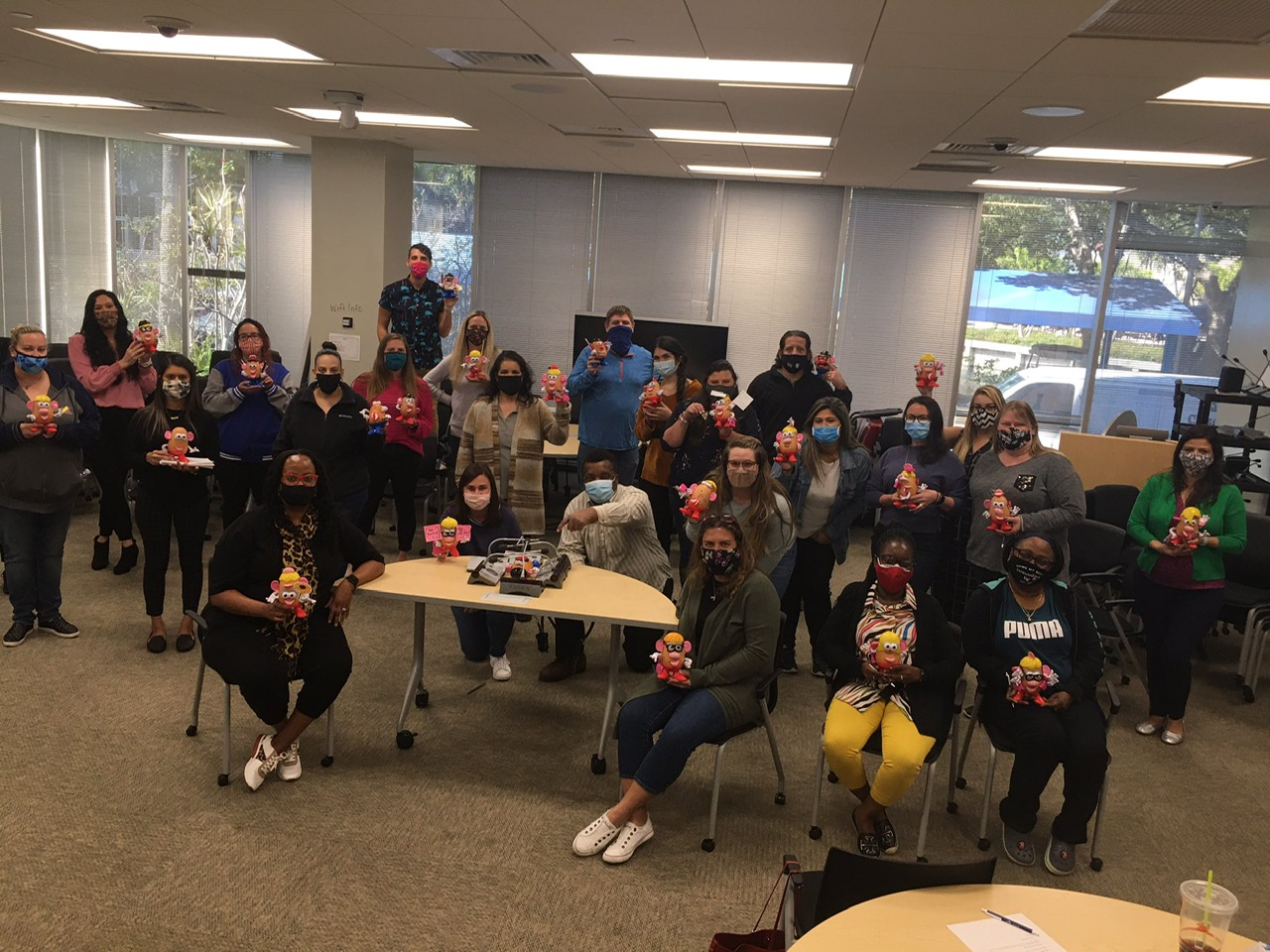
Yesterday, during our south Florida gathering of 3D Leadership participants, we did an activity that I love to do called “Who Am I As A Leader Now?” We use Mr. and Mrs. Potato Heads to do this and participants build their Potato Head to represent themselves, at that moment, as a leader. It becomes such a powerful reflective time. Then, we gathered in a big circle and shared out. All of the share-outs were so meaningful, but one phrase really caught my attention that a participant ended with, represented by a Potato Head arm placed backward, “Somebody did it for me.” This really struck me because it is so true. Everyone has a “somebody did it for me” story. And this fit so nicely with the work we were going to do later around John Maxwell’s 5 Levels of Leadership. Helping others develop into all they can be are those “People Development” and “Pinnacle” levels of great leadership.

It’s always inspiring to be in a room of educators because developing young women and men into all they can be is what we do. We get to provide that “somebody did it for me” story for many. But, let’s not forget that as leaders we have an obligation to be finding ways to provide those “somebody did it for me” stories for those in our organizational communities. It really comes down to being a servant leader. As I listened to all the stories and reasons for the Potato Head designs I was in awe of all the collective expertise in the room. This group of leaders truly wanted to be the best at serving others. Now, as I write this post I am reflecting on those in my life that have been that “somebody that did it for me” person. There have been a lot, and I would even say this group of south Florida educators “did it for me” yesterday. All of this reflection made me go back and reflect on a blog post I did back in 2013 where I reflected on those who had been a servant leader to me along the way and, in some cases, throughout my entire life. Check out my post, Matthew 20:26 on Being A Servant Leader to learn more about my journey and those who have “been there” along the way.
As we try to make some sense in this pandemic stricken world, I, and I believe all the other participants, needed to hear the stories of others – how they got where they are and how they are dealing with all things related to the global pandemic. We really developed a bonded sense of we are in this together, and while we all may be separated by only a few miles, or hundreds of miles we can all be kindred spirits and part of something bigger than ourselves to into great leaders providing “somebody did it for me” moments.
How about you? Who has provided those “somebody did it for me” moments in your life? And, who are you providing “somebody did it for me” moments for?
Into The Wild Blue Yonder
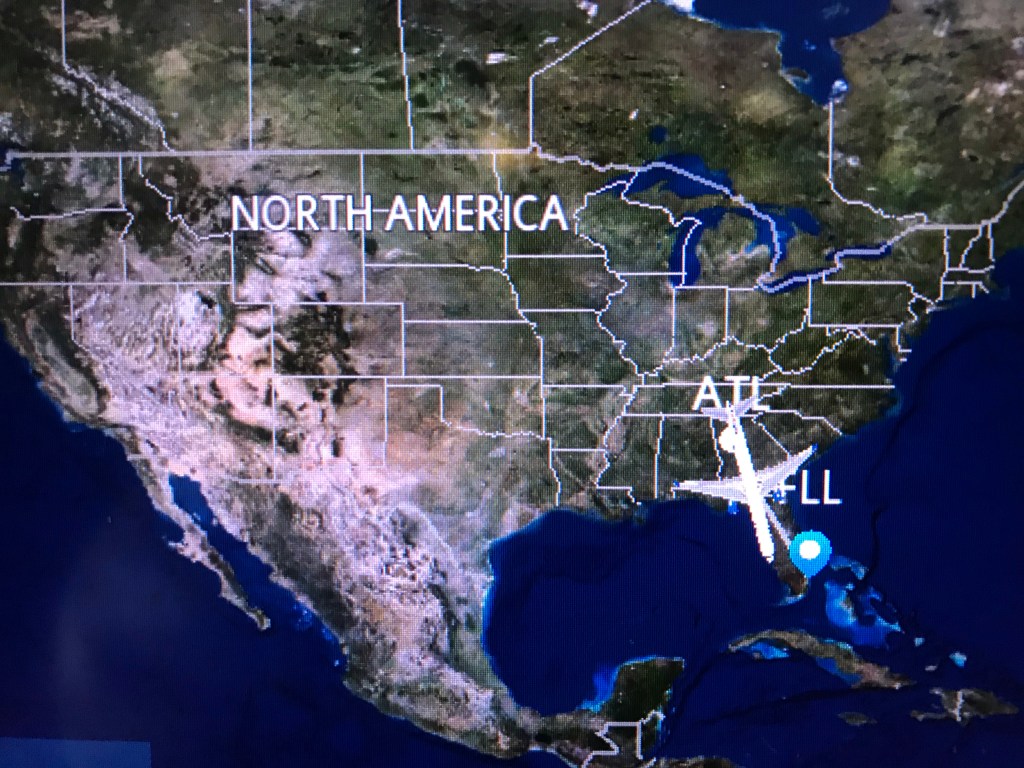
Here we are on day 323 of the global pandemic. It is also a monumental day in that I am flying for the first time in 328 days. The last time I was on an airplane was March 7, 2020. As I write this I am looking out the window from seat 16A on an Airbus A321 watching the plane be de-iced. Then, it is on to Atlanta to catch a connecting flight to Ft. Lauderdale, Florida to facilitate an in person teacher leadership gathering; March 7, 2021 was the last time I did that and it was in Kissimmee, Florida, so I flew into and out of Orlando, Florida. Seems like forever ago. I am still having conflicted thoughts about whether going live is the right thing to do. I get that it’s just hard to beat live presentations as that is where my passion really comes through, but is it safe for me, my family when I come home, or the attendees? And, I’ve gotten pretty good at facilitating gatherings virtually. Time will tell us the answer. Rest assured I am a stickler for masks, physical distancing, and lots of hand sanitizer.
It was important for me to blog about this first time back in the air because I am doing this with a certain amount of anxiety – and I’m usually not someone who has anxiety. Also, I want to chronicle as many of my global pandemic experiences as possible. Last night as I packed I had to think about things I hadn’t thought about for almost a year. Things that were second nature to a person who was flying at least once a week in the past were not routine any longer. Then there were questions:
- Did I still need 2 hours at the airport before the flight?
- Would my TSA Pre check still work?
- What would it be like at the airport?
- Would I be able to get a Starbucks?
- Would others really actually be wearing masks?
There were other things running through my mind, but you get the idea with those five examples. I am now in the air and I can tell you that so far the experience hasn’t been too bad. The worst part so far was a month ago just picking the flights. With reduced trips it’s almost impossible to get a direct flight anywhere (I used to be able to fly direct to Ft. Lauderdale from Indianapolis). It is taking me eight plus hours to get from Indianapolis to Ft. Lauderdale today. I did find that, at least right now, arriving two hours prior to the flight is not necessary. There are a lot less people at the airport. I even had my choice of parking places in the parking garage this morning. My TSA Pre worked flawlessly, and that process has even been streamlined to inserting your drivers license into a machine and the machine taking your picture – no one touches anything. Everyone was wearing masks, and yes I got my Starbucks.

With so few people traveling, what normally is a frenetic and sometimes stressful process felt downright relaxed. I got hand sanitizer when I got on the plane and just now was given a baggie containing water, cookies, and more hand sanitizer. I’m going to sit back, relax, and have a cookie. I’ll start writing again when I’m on the connecting flight from Atlanta to Ft. Lauderdale. The only thing that causes me worry right now is that you don’t get your seat assignment till you get to the gate. But, I love having no one in the seat next to me!!!
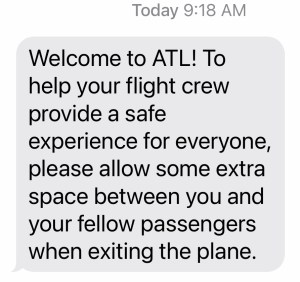
One major improvement that COVID-19 has prompted is the loading of planes from the rear forward. I’ve always wondered why we didn’t do that. Wow, what an improvement. Hey airlines! Let’s keep doing that in the post COVID-19 world. Also, I must throw in that it would be wonderful if you would always leave the seat next to us empty. Again airlines, could you implement that forever? Somehow I don’t think you’ll operationalize my request for that post COVID-19. It was worth asking, nonetheless. Check out this text I got as we landed in Atlanta:
Now I am sitting in seat 44D on a Boeing B757 on the way to Ft. Lauderdale, Florida. I must say I am a little over the smell of hand sanitizer. It wouldn’t be so bad if there wasn’t a gazillion different scents of hand sanitizers. But, I’m glad everyone is using it, so no more complaining from me. The Hartsfield-Jackson Atlanta International Airport was much more crowded than in Indianapolis, but we are now midday as opposed to early morning. I walked around the terminal for a little while, still marveling at the fact that I was inside an airport terminal again after so long.
As I look out the window I’m reflecting on all that the last year has brought to us. Today, I had the experience of flying again. It has been great to witness and experience adjustments that have been made to the airline travel business. My flying experience was remarkably less stressful than I anticipated. The airports and planes themselves were the cleanest I’ve ever seen them. Delta did a really good job of managing the risks associated with flying and, in my opinion, it appeared like the airline had things under control. I loved it when the flight attendant said, “We must do everything we can and take every precaution to care for one another.” Amazing it took a pandemic for us to begin to really think and act this way.
How about you? Have you flown since the global pandemic started? What has been your experience?
Space Shuttle Challenger: 35 Years Ago Today
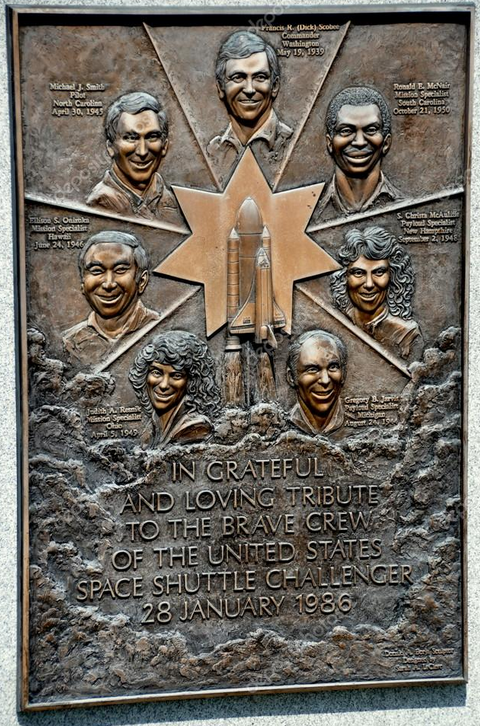
It was 35 years ago today, January 28, 1986, that the United States space shuttle, Challenger, exploded shortly after launch. As I write this it is 11:38 a.m. Easter Standard Time; the exact time that the Challenger exploded. It was certainly one of those “remember where you were” moments in my life. I was in my very first year of teaching and was teaching a class of freshmen agriculture science students. We had turned on the television in the room right before launch to watch. It was such an exciting time because Christa McAuliffe was on her way to becoming the first ordinary U.S. civilian to travel into space. And, she was a teacher, chosen through the NASA Teacher in Space Project.
So, here I was watching liftoff with my students and 73 seconds after taking off, the Challenger exploded. This is the first time I have written about that experience during my first year of teaching. There was no teacher prep class that prepared me for this, no student teaching activity that allowed me to experience something like this, or no case study lesson that would have helped me answer the students’ questions. The quietness of the explosion was very confusing. We all watched in a kind of concerned silence. A few students asked what had happened. I didn’t answer, because I didn’t know. I had chills. I am getting chills right now as I think and write about it. The television reporters announced that the Challenger had exploded and after a few minutes I turned the television off. Honestly, I do not remember what I said or anything the students said after the explosion. I can remember up to and including the explosion, but after that it is very fuzzy. We were all stunned, confused, and devastated.
At 5:00 p.m. Eastern Standard Time that evening President Ronald W. Reagan spoke to the nation and ended his remarks with some of the most moving words ever spoken: “The crew of the space shuttle Challenger honored us by the manner in which they lived their lives. We will never forget them, nor the last time we saw them, this morning, as they prepared for their journey and waved goodbye and ‘slipped the surly bonds of earth’ to ‘touch the face of God.'” He was supposed to be giving the State of the Union address that evening. The State of the Union, for the first time in modern history, was postponed.
As a teacher, another part of what President Reagan said really spoke to me and every other teacher and all the students of the United States: “And I want to say something to the schoolchildren of America who were watching the live coverage of the shuttle’s takeoff. I know it is hard to understand, but sometimes painful things like this happen. It’s all part of the process of exploration and discovery. It’s all part of taking a chance and expanding man’s horizons. The future doesn’t belong to the fainthearted; it belongs to the brave. The Challenger crew was pulling us into the future, and we’ll continue to follow them.” I love the thought of the future not belonging to the fainthearted. This was so true then and is very true today, and will always be true.
So today, as we reflect on that day 35 years ago, let us be brave, look to the future and not be afraid or fainthearted to do our part in advancing the horizons of this great world we live.
“I am what I think that you think I am”

“You will become way less concerned with what other people think of you when you realize how seldom they do.”
~ David Foster Wallace
In Chapter 22 entitled “What You Think They Think” of Mindset Mondays with DTK by David Taylor-Klaus (DTK), he told us “…people are generally not thinking of or even about you, they’re generally thinking of themselves” (p. 169). I loved this chapter because it points out something that we all do and all need to stop doing – worrying about what others think. DTK pointed out that we can’t control what others think, and what they think of us is none of our business. And, don’t forget; more than likely they’re not even thinking of you anyway. If we just remember they’re probably not even thinking of us, we can become freed of negative thinking.
“I care not what others think of what I do, but I care very much about what I think of what I do. That is character!”
~ Theodore Roosevelt
We need to worry about measuring up to ourselves, not others. It is an irrational and unproductive obsession to worry about what others think. Sociologist Charles Cooley put it this way: “I am not what I think I am and I am not what you think I am; I am what I think that you think I am.” Part of this is because we are placing undue importance on external validation, so much so that we sometimes place more emphasis on the commendation or disapproval we receive than on our actual actions. We need to do things, say things, and ask things that make sense to us. Let’s not worry about others, but care very much about what we think of what we do.
Hank Aaron: A Pillar Of Baseball

Yesterday we lost one of my childhood heroes, Henry “Hank” Aaron. I will never forget getting to watch him play, in person, as a kid. And, I can still recreate the room, in my mind, sitting with my dad on April 8, 1974 watching the baseball game that everyone anticipated to be “the one.” The one where Hank Aaron hit number 715 and broke Babe Ruth’s record. He did not disappoint that night. That was probably the most famous home run ever.
The part of the story that still has an impact on me was all the hate that surrounded Aaron as he approached the 715 milestone. All of the racial hatred that surrounded that moment, the hate mail, the death threats, and fear of his teammates at that time were just unbelievable. At age 11, I was having trouble processing these stories and, in reality, most of those stories didn’t come out till later, but here was this great man that would not be defined by fear or hate. We have come so far and made great strides in terms of equity, but there is still so much to be done. As we reflect on and honor the life of Hank Aaron we need to pledge our continued resolve on the promising path toward equity.
After his retirement, Aaron joined the Braves’ front office working in a variety of jobs, including player development and community relations. He would always remain a blunt and unflinching advocate for civil rights in this country.
“Each time Henry Aaron rounded the bases, he wasn’t just chasing a record, he was helping us chase a better version of ourselves — melting away the ice of bigotry to show that we can be better as a nation. He was an American hero. God bless, Henry “Hank” Aaron.”
President Joe Biden on Twitter
I’ll end this tribute to Hank Aaron with his 755th and final home run that came on July 20, 1976, when he was a member of the Milwaukee Brewers, off Angels right-hander Dick Drago. His home-run mark stood until Barry Bonds hit his 756th on Aug. 7, 2007. The ever gracious Hank Aaron recorded this message to Bonds that was played on the jumbotron that evening, “I move over now and offer my best wishes to Barry and his family on this historical achievement. My hope today, as it was on that April evening in 1974, is that the achievement of this record will inspire others to chase their own dream.” That was him, always encouraging others to work hard toward their dreams regardless of any circumstance. How about you, are you chasing your dream? Let us not remember this great man for what he did on the baseball field, but for the way he lived his life and the example he set for us. Thanks, Hammerin’ Hank!
Leading Like Yahtzee
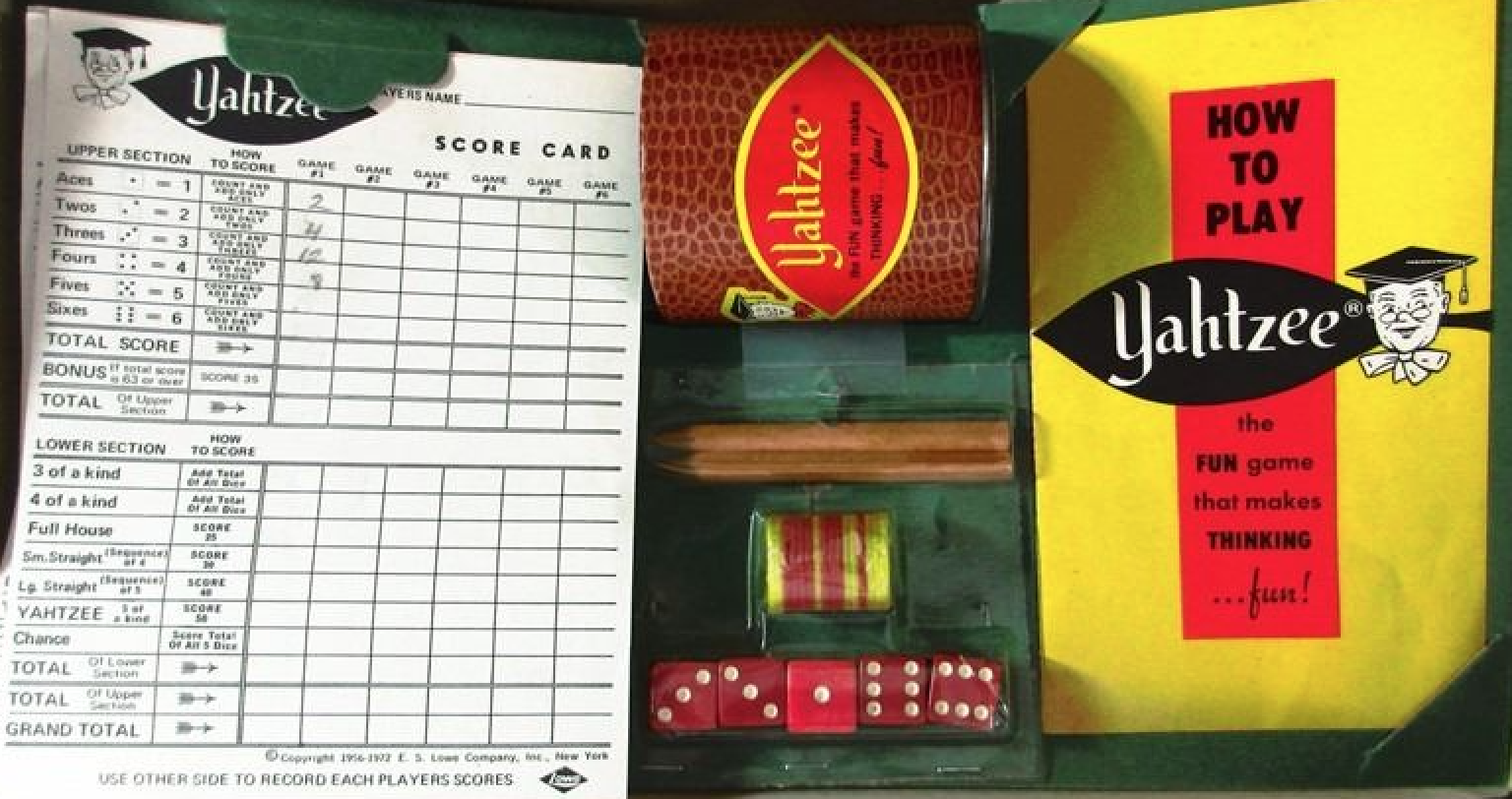
Last week in our first gathering of our newest cohort of Florida 3D Leadership Program participants, we were discussing leadership being like chess or checkers. The participants even played chess and checkers while having the discussion. We had some great discussion related to this considering things like you must know your opponent, players have limited movements, checkers is at a smaller level, checkers and chess have different missions, playing chess is more like be a principal, playing checkers is more like being a teacher leader, and strategic movement/placement. Then, one group discussed that they thought leadership was more like playing Yahtzee. The game of Yahtzee then came up again in another discussion. I finally had to come clean with the group and admit I had never played Yahtzee or even knew how the game was played. Of course after the gathering was over I had to look up the game of Yahtzee and found that the group was right, there are leadership characteristics contained in the game of Yahtzee.
Actually, on the surface Yahtzee appears to be a simple game. Each player gets thirteen turns to complete their score card. The top section of the score card consists of numbers 1 thru 6. You need to roll three ones, three twos, three threes, etc. to get your “minimums.” You could also roll four fives (or four of anything), which comes in handy if you were only able to roll two threes on a previous turn. The idea on the top section is to score at least 63 total points, so you can get the 35-point bonus. If you get a “Yahtzee!” you score 50 points. That’s when you get all five dice to be the same during your turn. Some players focus solely on getting Yahtzee at the expense of everything else. Some people really work hard count on getting the Yahtzee. From my studying, however, a balanced scorecard is more beneficial to winning the game. Balance is important in leadership as well. In education for example there must be balanced effectiveness in governance, financial health, student performance and achievement, or teacher effectiveness. Concentrating on any one of these and forgetting the rest would be disastrous to the school.
Yahtzee seems like a game of chance. It’s much more. It’s a game of decisions and imperfect trade-offs. Wow, doesn’t that sound a little like leadership. So, there is actually some genius in comparing leadership to the game of Yahtzee. We must at some point fully form our approach to decision making. Success, failure, decisions, and sacrifices are in play with every turn while playing Yahtzee. Excellent practice for leading in real time. The game of Yahtzee is completely random. But, as leaders we know that sometimes completely random things happen. Therefore, something completely random and driven by chance can be, as we can learn from playing Yahtzee, be managed within a solid set of priorities and strategies. Do you have other ways you would compare playing Yahtzee to leading effectively?
Irrational Exuberance
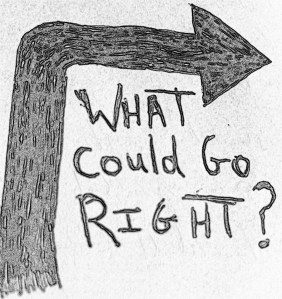
As an artistic leader versus being a technocrat, I have always been that one focusing on how great things were going to be; how great that lesson I just planned would go, how that next webinar would go, how many gazillion people would want to be part of a new leadership program, or how much everyone would love that latest workshop activity I just planned. Sometimes, because of this focus, I am viewed as not being detail oriented enough, or not being realistic enough. Some of that might be true, but as David Taylor-Klaus (DTK) pointed out Chapter 21 of Mindset Mondays with DTK entitled “What Could Go Right?”, nothing can ruin an organization quicker than not planning for success.
I’ve actually seen and experienced this with new schools that weren’t prepared for the large number of students who enrolled. It is tricky to not be prepared for great things. Without thinking through what could go right, we won’t be ready to handle great things when they happen.
“Stop being afraid of what could go wrong, and focus on what could go right.”
~ Unknown
DTK pointed out that companies buckled under the pressure of not being able to handle what Alan Greenspan called, “irrational exuberance,” during the dot-com era. Bottom-line: we must focus on what could go right. I like the quote above because while we need to have operational awareness of challenges and obstacles, we must not fear them. What are the next things that will go right for you?


leave a comment