Leading Like Valentine’s Day

Because Valentine’s Day is on Sunday this year, I hope you are spending a Happy Valentine’s Day with those you care most for. And, I hope that tomorrow you will continue to lead like Valentine’s Day with those you work with. The American clergyman, and personal effectiveness writer and speaker, Norman Vincent Peale, considered a burning conviction and contagious enthusiasm to be the most critical factors in successful living and leadership. You, no doubt, probably have someone on this Valentine’s Day you have that kind of passion for. How about in your professional life? Do you have a cause, a passion, or a why that makes you contagious with enthusiasm? Do you have a burning conviction for those you serve?
“Your enthusiasm will be infectious, stimulating and attractive to others. They will love you for it. They will go for you and with you.”
~ Norman Vincent Peale
Valentine’s Day makes us think of love. What comes with the thought of love? Passion and desire. Great leaders have passion. Passion for the work they do. They love leading a team to success. Great leaders also have great desire. They desire to lead a successful organization. So be contagious with your enthusiasm and burn with conviction.
Lastly, don’t do like some do in the romantic realm of Valentine’s Day and only show your love one day a year with flowers or a box of chocolate. That’s not what love is. Love is treating people well every single day of the year. Find ways to treat your people well, with respect, and show them your appreciation. Treating people well will inspire them to new heights. Happy Valentine’s Day!
Accessing Our Own Ignorance

Many times our own knowledge, or love for our own knowledge gets in the way of our ability to grow and learn. We must always remember that we may need to know what others know in order to solve our own problems. I am reading an advance copy of the second revised and expanded edition of Humble Inquiry: The Gentle Art Of Asking Instead Of Telling by Edgar H. Schein and Peter A. Schein. The book reminded me that when we want to influence others we need to “access our own ignorance.” It helps to come to the conversation with a genuine desire to learn; a belief that the other person has information we need in order to be successful. This gives us the potential for new knowledge to emerge that just might enhance our decisions.
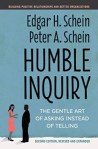
If we can open ourselves to learning from others, we can collaborate to help each other. When we access our ignorance we come to conversations both confident about what we know, and humble about what we don’t know. To me, accessing our own ignorance is like becoming a sponge and soaking up all the knowledge and wisdom from those around us. In order to learn through collaboration we must acknowledge that we all need each other to accomplish our goals.
Natural Curiosity

Curiosity. Everyone is born with it; it’s innate and natural to every child. But somewhere along the way, many lose their sense of how to use curiosity to expand their minds. I would even argue that there are things we do in education that cause our young people to lose or give up on their curiosity. When we reach school age, answers become more important than curious thought. Today, I had a person in a meeting describe me as being open to my natural curiosity. I’ve got to admit, I took it as a compliment to be described as curious. I am a very curious person and try to be curious every day.
Curiosity helps us to discover new ideas and open up new avenues and possibilities. Additionally, curiosity brings excitement into our lives. So, how do we stay open to our natural curiosity? We need to make time for curiosity. Part of that time needs to be for play. This gives us the opportunity to explore. Curious people can always find something interesting to explore. Being curious can help us be less judgmental. Curious people as focused on exploring options rather than just trying to be right and have someone else be wrong.
We also need to ask lots of questions. We need to channel our innate child-like curiosity and do more asking of what, why, who, when, where, and how to get at the big-time secrets of the world. Those that are curious are not afraid of questions and being wrong. Finally, the curious never stop learning.
Declaring
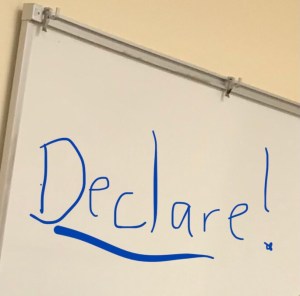
This week in Chapter 24 of Mindset Mondays With DTK, David Taylor-Klaus taught us that the only way to avoid criticism was to do, say, and be nothing. Since that won’t work for me and I hope it won’t work for those of you reading this post, let’s explore this a little. We learned from DTK in this chapter that Winston Churchill had a deep confidence in his own vision. We must have a strong point of view in order to avoid being nothing.
Again, the only way to avoid any criticism is to do, say, or be nothing. I recognize that I can be polarizing at times, but the one thing that everyone knows is where I stand on issues. Agree or disagree, you don’t have to wonder where I stand. Machiavelli told us to “declare.” I do not prescribe much of Machiavelli’s teaching, but I do believe in “declaring.” In other words, a strong and informed point of view, belief, or set of core values. Keep in mind, however, declaring a strong point of view does not mean that those beliefs can’t evolve and change. We need to be constantly evolving, learning, and growing.
DTK said, “…if we choose to share a perspective that will offend no one, it will also touch no one” (p. 183). Criticism can be painful, but if we take an attitude of learning from it we can turn it into a gift. What do you need to declare and turn into a strong point of view?
Lift Every Voice

Happy Super Bowl Sunday. As I settled in for Super Bowl LV. I loved this statement by Bruce Arians, Head Coach of the Tampa Bay Buccaneers, when being interviewed by Bill Cowher for the Super Bowl Today Show: “If you are going to make me better, I am going to listen to you.” Having just gotten home this morning from facilitating a bunch of leadership development this past week and weekend, I was reflecting on how much time we had spent discussing that people will follow you because they want to (relationship) and people will follow you because you get results (production). Coach Arians was making this comment in response to continued praise for giving minority coaches opportunities. Additionally, the Buccaneers are the first NFL team to have two female coaches on staff in a Super Bowl. He reflected on his own experience being overlooked that made him want to help others get recognized. The Tampa Bay Buccaneers are the only team in the NFL with all Black coordinators.

In a great story by ESPN Staff Writer, Jenna Laine (she has awesome journalistic talent, by the way), Coach Arians said “A player is gonna ask the coach, ‘How are you gonna make me better?'” “He doesn’t really care if the answer comes from a male or female, Black, white, brown, yellow, who — just ‘help me be better,’ Arians said. “The best teachers I had were all different races, all different ethnic groups, male and female. If you can teach, you can coach.” It impressed me that Arians deflected a little of the praise saying, “That was not by design. Those are the best coaches I know.” Here’s the deal, great leaders recognize potential and then act on that by providing opportunities. It’s the most important thing we do as leaders.
Another thing Coach Arians said to Laine that really stuck with me was “To hear voices in a staff meeting that aren’t the same, don’t look alike, but they all have input — you get better output.” This is so true! It’s why in education we need to continue to work extremely hard in diversifying our teaching staffs. As we continue to work for excellence and equity, we must continue to tap the shoulders of ALL with potential – that’s what great leaders do.
Informed Procrastination

Yet another phrase used by Joseph J. Ellis in Founding Brothers: The Revolutionary Generation has caused me to ponder and think about the merits of what he called “enlightened procrastination.” He used this phrase to describe how our second President, John Adams, kept our infant country from going to war with France by not revealing a series of insults from the French government until time and diplomacy could resolve the issues. It worked for President Adams in this scenario and I am pondering about the merits of this as a leadership tool. I am going to guess that many of you are already saying, “You’re crazy!” Hear me out and feel free to comment.
If you have ever responded too quickly to an email, phone call, face to face, or now, Zoom interaction when you were upset and then regretted it this could be a place to use procrastination as a leadership tool. Take time to ponder and think. This will give you a chance to respond as opposed to reacting. I have people I work with regularly kid me about always waiting till the end of a meeting or conversation to ask a question or make a comment – just when they think it is about to end. This is because I’m a slow processor. I actually continue to work at honing this as a positive skill. It allows me to hear all sides and again, process.
Another thing is, we don’t have to solve every issue. Providing time for others to weigh in or solve themselves can be both healthy and many times bring about a better solution. I’m now thinking it should be called “informed procrastination.” Informed procrastination can help us, as leaders, make better decisions. Taking the time to ponder on answers to problems you are striving to find a solution for can help us better understand different perspectives and angles. To be clear, I am not suggesting we all become procrastinators. I am suggesting, however, that when we are informed, we can use it as a leadership tool.
Leading The Michelli Way
I am a huge believer in intersectional learning. This is the learning that can be accomplished from the commonalities and complexities of different industries, businesses, and organizations. I have always been a fan of Dr. Joseph Michelli’s work and books. He has knocked it out of the park with his latest book, Stronger Through Adversity: World-Class Leaders Share Pandemic-Tested Lessons On Thriving During The Toughest Challenges. This book is the encyclopedia of intersectional learning. I am only about 25% through the book, but have learned and reflected on so many things. I have read all of his books, and I have to attribute many of the ideas I have implemented over the years started from the learning I have done from his books.

My goal with this post is to pay it forward and invite all of you to learn from Dr. Michelli. If you are one who likes to learn from others and then apply that learning to your own context, then his work is for you. He has studied and chronicled, in-depth, the many companies he has worked with, improved, consulted, and learned from. Let me just give you one example from the book. Let’s begin with this quote:
“a responsibility alongside other hospitality brands to ensure all travelers who decide to book an all-inclusive getaway will feel confident that they’ll have a safe, comfortable, and memorable experience. Each and every resort or hotel brand needs to stay true to its unique value proposition in the market, yet abide by a common denominator of strict hygiene and safety protocols. Health and safety have always been top priorities among travelers, and now they are key determining factors in a consumer’s decisions to travel.”
Carolyne Doyon, President and CEO of North America and the Caribbean at Club Med
I don’t care what industry you are involved in, the learning here applies. Take the words “hotel or resort,” “traveler,” “travel,” or “hospitality” and change them to those that apply to your organization and the statement applies. When I think of both my policy making and leadership roles in education this statement really applies.
I talk about the value proposition that Doyon speaks of in my leadership training all the time. As a believer in school choice, I believe every school must have a unique value proposition. In other words, why should families choose your school to attend? No doubt, the pandemic has even created new, what I call, competitive advantages.
We have had to contemplate bringing students back and opening schools, keeping students and teachers safe, how to do virtual education or some combination of virtual and in person education effectively, and how to still hold ourselves accountable for the learning and outcomes ALL students we serve deserve.
Dr. Michelli’s book is so timely because we are still working on all this. I was just in a briefing today on the Biden administration’s priorities in education and these items are being contemplated. We need to use the learning from all sectors to help us learn and navigate our course. Stronger Through Adversity gives us the actions of many great leaders. I wish we could have a summit of all the leaders to create action plans for all of us. Maybe he’ll let me pick a couple of leaders and invite me to do one of his podcasts with him. I can dream, can’t I?
As I said at the beginning, this post is intended to serve as my paying it forward for you to check out this great book and the learning that can be gained from Dr. Michelli’s work. Check it out!
Sharing Smiles Even If They Are A Little Harder To See

“Sharing smiles even if they are a little harder to see.” I heard this yesterday on the video that was shown prior to taking off on my flight to Atlanta. If you watch closely you can tell when someone is smiling. I was reminded this morning how important it is to still smile, even when our mask makes them a little harder to see. I walked into a school in Georgia this morning that I have not been in since last summer and a teacher I know said, “I would know that smile anywhere.” I said, “How do you know I was smiling?” She said, “You can always tell; you just have to pay attention.”
I started paying attention and you can tell. In fact the person’s whole face changes and their eyes light up. So, don’t forget: keep sharing smiles even if they are a little harder to see.
Great Collaboration or Great Competition

I am reading the great book Founding Brothers: The Revolutionary Generation by Joseph J. Ellis right now and he spoke of the “odd couple” of the revolution being Thomas Jefferson and John Adams. Both were very different in their tactics and personalities, and were unlikely friends. Before Washington’s presidency, they collaborated to solve multiple political issues. Then, as Ellis put it, the “great collaboration” turned into the “great competition” because the two intimate friends soon found themselves running for the presidency against each other. Probably no relationship in this country’s history carries as much baggage as that of John Adams of Massachusetts and Thomas Jefferson of Virginia.

This got me to thinking about the age old topic of how much competition is healthy. Pursuing individual goals alongside others can, at times, lead to counterproductive behaviors that can be harmful to both sides. This sense of competition can shift teammates (let’s consider Jefferson and Adams teammates of our democracy) focus from improving themselves or the vision of the organization to defeating a pseudo-opponent, which can lead to sabotaging behaviors. We saw these sabotaging behaviors in the case of Adams an Jefferson and I’ll bet you have seen this happen to others or yourself.
In a work setting, having read extensively about this topic, I believe in providing individualized performance statistics can help reduce competitiveness as well as its negative consequences. Competition at its best helps us to be better. At its worst, it can create unhealthy self-comparison or judgment. I am not advocating for doing away with competition. I am, however, advocating for us to not let collaborators becoming competitors stifle progress, both for the individual and the organization. Competition can actually change our world view. Never forget, everybody in an organization has something to say and undoubtedly has some value to contribute. Do we see the world as a place to grow and collaborate with others?
Where Do You Want To Rise Up Next?

The title of Chapter 23 in Mindset Mondays With DTK by David Taylor-Klaus (DTK) is “Rise Up.” This caught my attention and immediately made my mind go to my friends in Alter Bridge and their great song “Rise Today.” When the first sentence in the chapter was “In our house, we like to use rock & roll life style as a metaphor,” I knew we had serendipity.

DTK told us in this chapter that no matter what happens we must step up and put on the best show possible. This made me reflect on the fact that we have the opportunity to change the world every day. As it says in “Rise Today,” “Yeah, oh yeah; I want to rise today; And change this world; Yeah, oh yeah; Oh, won’t you rise today; And change this world?”
I blogged about this song before in “How Do We Change This World?” DTK told us in this chapter there are so many opportunities when things are far from perfect and that every obstacle is an opportunity. So let’s choose to show up and step up! “Oh won’t you rise today
And change this world?”


leave a comment