Do You Think I Know How To Be Happy?

You all know I love to watch a great episode of Frasier. There is so much to learn from the vane Dr. Frasier Crane, played by Kelsey Grammer. I walked in the house late last evening and was flipping through TV shows and had to stop when I saw an episode was on. Frasier had just been told by an ex-girlfriend that he did not know how to be happy. Well, you know Frasier, he became obsessed with that, and the idea of not being able to be happy became the throughline of the show. He even called his ex-wife, and psychiatrist, to ask, “Do you think I know how to be happy?” She told him he was the only one that could answer that.
What Frasier found was that in everything he did he formulated what the “perfect” version would be and then, as we know, nothing is ever perfect. At one point he was on a trip and the plane was delayed, his hotel room wasn’t right, and the restaurant where he finally sat down to eat was out of everything he wanted. Needless to say, Frasier went ballistic. We’ve all been there, right? Fill in the blank: we’ve planned the perfect weekend and then…__________________. Sometimes we have nothing to do with what happened, other times we do. In this case, none were Frazier’s fault. But, we sure know how to become miserable and make those around us miserable too.
In Frazier’s case I don’t think he was being a hedonist. It had more to do with perfection versus pleasure. How we choose to interact with our external world has a great impact upon how we feel inside. Research tells us that focusing on what’s important and not obsessing over minor annoyances can keep us in a happy place. It turns out those cliches “Don’t sweat the small stuff” and “You can only control what you can control” were right.
But, I also want to go back to the perfection thing. “Perfect” can be such a ferocious enemy of happiness and getting things done. Roy T. Bennett argued that “Perfectionism is the enemy of happiness. Embrace being perfectly imperfect. Learn from your mistakes and forgive yourself, you’ll be happier. We make mistakes because we are imperfect. Learn from your mistakes, forgive yourself, and keep moving forward.” Think about it, perfect is like a unicorn; super cool, but have you actually ever seen one? “Perfect” and the unicorn are both pretty elusive. So, in the meantime, I’ll enjoy the beauty of the horse, till the real unicorn comes along. Get the point?
This made me think about the teaching of Jack Canfield. I remembered him talking about how we humans let perfection get in the way of happiness. Again, this could be the perfect vacation, the perfect presentation, the perfect event, the perfect first impression, and the list goes on and on. Canfield taught us that many times we let our perfects, or “ideals” come from others. Think about it; how many things look just like the brochure portrays? Someone else’s ideals shouldn’t affect your own happiness. Instead, Canfield told us that in order to achieve happiness, you should create focused goals for yourself. Furthermore, never forget that our social circles, coworkers, or relatives should not decide what is right for us or what makes us happy, only you can decide.
20 Seconds Of Bravery

“What if it is about creating your vision, developing your plan, and taking one bold step after another, just twenty seconds of bravery at a time?” (p. 313) I had to begin my post on Chapter 45, “Boldness & Bravery” in Mindset Mondays with DTKby David Taylor-Klaus (DTK), with this quote from DTK. Having just launched my new business last week, Leadery Global, I needed this little pep talk to get my week started. I am “…step[ping] boldly into what’s present, and danc[ing] with whatever’s on the field” (p. 312). Choosing to be bold is what DTK was talking about in this chapter. He also reminded us, however, to be responsive, not reactive – no knee-jerk reactions.

Now, back to my favorite part of the chapter – 20 seconds of bravery. DTK is referring to a movie his wife, Elaine, saw claiming that it only takes 20 seconds of true bravery to overcome obstacles. If you think about those things we put off instead of doing what Brian Tracy called “Eating The Frog,” it makes sense. The more we avoid something, the more it controls our life. Just as first responders run toward the danger, we need to face our fears instead of being controlled by them. All it takes is 20 seconds!
What can you choose to be bold for 20 seconds of bravery about today? It may just change the entire trajectory of your life!
Testing Everything & Conceiving Different Outcomes

While this post will probably pose a controversial idea to those “Scientific Method” purists, my post is meant more to be thought provoking. As a person who taught the Scientific Method to agriculture science students for years, I understand why hypotheses have been a part of the method since the 17th century. But, some, okay a lot, of things have changed and advanced since the 17th century. In the great book Alien Thinking: The Unconventional Path To Breakthrough Ideas, authors Cyril Bouquet, Jean-Louis Barsoux, and Michael Wade argued that the use of hypotheses are, in many cases, no longer necessary given the immediate and real-time abilities for data analysis we now have in a digital world. Think about all the things we used to have to wait long periods of time to get data back on, that are now immediate.

This made so much sense when we think about confirmation bias, the tendency to process information by looking for, or interpreting, information that is consistent with one’s existing beliefs. If we make no assumptions and just let the data go where it goes, would that not be better – and more accurate? Granted, I have not completely thought through all this. The way we would traditionally set up the hypothesis test is to formulate two hypothesis statements, one that describes the researchers prediction and one that describes all the other possible outcomes with respect to the hypothesized relationship. With the aid of artificial intelligence, augmented reality, digital twinning, and many other digital capabilities could we find relationships, or lack there of, that we would have never thought of in a world using the alternative and null hypothesis? The point to remember here about stating hypotheses is that a prediction (guess) is formulated (directional or not), and then a second hypothesis is formulated that is mutually exclusive of the first and incorporates all possible alternative outcomes for that case. When the study analysis is completed, the idea is that we will choose between the two hypotheses.

Bouquet, et al. posited that “The Alien experimenter doesn’t need to formulate a hypothesis – just come up with an experiment and then measure the results.” This will better allow us, they went on to say, “…conceive different outcomes, as well as the ability to measure and learn from them.” So maybe, just maybe, it is time to rethink the long tradition called the hypothetical-deductive model, and begin a new tradition of Alien Thinking.
Ability In Abundance

Abundance is really an ecological term. It speaks to the representation of a particular species in an ecosystem. In basic terms, the number of individuals found in a sample. This is then figured by a ratio called relative species abundance. As a person who tries not to use superlatives when working with people, I love the thought of abundance. Think about it, I can tell an individual or several individuals they have an abundance of ability in a group without making someone feel the lesser. If I say something like, “Julie, your just the best” everyone else in the room is suddenly not the best. But, I watch this happen in meetings all the time.
I just founded my own company, Leadery Global. The name came from the word Leadery which was created during a leadership workshop (click here to read about that) I was doing. We noted that those who showed, and acted, with an abundance of courage were said to show “bravery.” So, we decided that those who show abundance in the practicing of leadership should be referred to as acting with “leadery.” Note, it still has gets the dreaded red dashed line under it, but that’s what’s cool and creative in my world – making up a word!
I came across the phrase, “ability in abundance” this week and love it. When I think about those who show leadery, I ponder what that abundance is. Granted that abundance won’t be the same for everyone, but I do believe there are some common traits. These traits include:
- standing up for what is right,
- taking the first step forward,
- making sacrifices,
- always acting with integrity,
- preserving,
- developing and helping others grow,
- fulfillment of duties, and
- giving others hope.
I’m sure you could add other traits to to the list one needs in abundance to practice leadery, but that is a pretty good start. I believe there is potential abundance in every person. It is our responsibility to help develop those abilities. In our own organizational ecosystems let’s begin to increase the “relative ability abundance.”
Your True Nature

Many of you will remember the great show Frasier, starring Kelsey Grammer as psychiatrist Dr. Frasier Crane. There was always so much going on in each episode and many times the plot revolved around the extreme vanity of Frasier and his brother Dr. Niles Crane, played by David Hyde Pierce. One of my favorite parts of the show was the animated title screen at the beginning. It would show the title, Frasier, with a sketch of the Seattle skyline. There would always be some animation as simple as the blinking red light on top of the Space Needle, to a helicopter, to a lightning bolt, or the Seattle Monorail (my favorite). I’ve got to admit, sometimes I turn to the beginning of the show just to see that title screen come on. Click here to see a compilation of all the animated title screens.
Anyway, last night I was watching and Frasier said to Niles, “You can never deny your true nature.” This is so correct. We can’t fake it. It will hinder us from becoming all we can be and ruin our relationships with others. So, why do we all, at some time or another, stand in the way of our own happiness by denying who we are and inhibit our own freedoms? What we can learn from Frasier is that fear, vanity, ambition, stubbornness, and money all play a part. We ultimately deny our true selves because of things that are inconsequential in the long run. Think about this, too: when you deny your true nature, you are not only denying yourself, but you are also denying others the opportunity to know the true “you.” How sad is that?

As a result we present the world with a diluted version of ourselves, kind of like the markers you grab to write on the white board that are dried and out of ink and only make faint and muted tones instead of the rich vibrancy of a brand new marker. Or, perhaps the version we offer to others is altogether a farce. We end up showing the world what we think they will accept because that is easier than the thought of rejection we might face if they see our true nature.
Each one of us was born with the propensity for things that we cannot escape. We can’t be someone we are not. So, we need to be the best me “me” we can be. Don’t deny who you are out of a stubborn notion of who you wish to be, or perhaps who you think you should be. Each of us has special gifts, so let’s let our best selves begin to unfold and take flight.
Authentic & Genuine

During some leadership development & workshop presenting training I’ve been doing the last couple of days I’ve been discussing the need to be authentic and genuine. A participant asked if being authentic and being genuine are the same thing. Sometimes they get used interchangeably, but I like to use them with”and” because I believe they are two separate and important qualities.
“Authentic” refers to how we are being ourself. It is a reference to self-expression. In other words, how we express ourself reflects how we really are inside, what we are thinking, feeling, perceiving and believing. Being authentic means we externalize the same things as our inner world of thoughts.
Being “genuine” means we are exactly what we appear to be. This is about not faking it or being imitation. When our emotions are real and not pretended, we are genuine. This is about how we relate to others and interacting in a caring way. Being genuine is also about caring for others.
When being authentic and genuine we will show our vulnerabilities and imperfections. It’s about being present in the moment. We will also share our true thoughts, beliefs, and opinions with the world.
You Wanted The Best, You Got The Best!

In Chapter 44, “Trust Yourself to Create” of Mindset Mondays with DTKby David Taylor-Klaus (DTK), DTK told us, “Personally, I’d rather be judged by the world for what I do than judged by myself for what I don’t do” (p. 307). Many times we let the thought of failure or being judged keep us from getting started. We live in a world where we judge ourselves, judge others, and get judged by others. As I was watching A & E’s great Biography: KISStory Volume I last night it was said that KISS was not a critic’s band, but a band of the people. What that meant was that KISS didn’t care how the critics judged them. They cared that the fans believed they were getting the best show in the world!

Some measure life through money and accolades. Others measure it through beauty and popularity. Others measure it through family and relationships. Others measure it through service and good deeds. Chances are you measure it through some combination of all of these things, but one in particular matters most to you. This is where our values and our own identity come into play. As Gene Simmons said, “Figure out for yourself what makes you special and then create it.” “We [KiSS] were authentically us.” No one else can tell you what that is. Paul Stanley weighed in on this when he said, “No matter who you aspire to be, and how hard to try to be them, you will never be better than they are at it, so you must be the best at being who you are.” In other words we must know who we are, what we stand for, and what our competitive advantage is.
The more we are able to measure ourselves by our own internal metrics the better off we will be. The more external (the critics) our metrics for our own value and self-worth, the more we screw everything up for ourselves. An important part of our own personal growth is to recognize our own fixation, to recognize how we measure ourselves and consciously choose our internal metrics for ourselves. We must also recognize that everyone else in the world have their own metrics for judging that might, or might not, match our own. Paul Stanley shared, “We were the ones that weren’t supposed to succeed. We followed our own instincts.” Had KISS listened to the critics we might not be celebrating nearly 50 years of the greatest rock and roll band ever. Be best according to the metrics you determine.
What’s The Next Step?

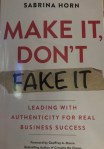
“You don’t need to have all the answers but you do need to have a next step.” Sabrina Horn told us that in her great book Make It, Don’t Fake It: Leading With Authenticity For Real Business Success. I discuss this with teachers a lot. Some in the teacher development arena will tell new teachers they need to have all the answers. This advice includes faking it and not letting students know the teacher doesn’t know the answer. This is very bad advice. Just as this is not true in Sabrina’s world as a CEO, it is not true for teachers. Some of the best labs and lessons I had as a teacher were when something didn’t go as planned. I would say, “I have no idea why this didn’t work, but let’s all dig into this and figure it out together.” The students and I learned so much from this humble act. It was so much fun and I was modeling an important leadership skill for my students. All leaders would do well to learn this.
This humility does not show weakness or confidence. It shows we recognize something pretty obvious – no one knows everything. The great leaders know what they don’t know and understand there are things they don’t know they don’t know. But, learning from and with others, asking questions, and asking for help are hallmarks of an effective and humble leader. This growth mindset modeled curiosity, collaboration, and a plan for discovery with my students. This same mindset also worked for me as a principal and superintendent. Many times the next step might be pausing to learn the answers together as a team.
The Goal Setting Paradox

I have always had an interesting relationship with goal setting. I’ve always had goals, but I’ve also always believed in living life and believing there were people and opportunities that show up at the right moments for me to choose how to use the effects of – kind of like a chemical reaction. Everly, a character in Patti Callahan Henry’s great historical novel, Surviving Savannah said it best, “Anyone who is engaged in life at all is brave.” Now don’t take this to say I am against goal setting. It’s just that I believe we must recognize the paradoxical effects that goal setting can have.

This reflection on goal setting was prompted by Chapter 43, “Raise The Bar” in Mindset Mondays with DTKby David Taylor-Klaus (DTK). He taught us that we are motivated by reasonable stretches. We need to go beyond the common endpoint to what he called the “visionary goal.” He told us “…there’s something extraordinary that happens when your marshaling your energy in the direction of a stretch goal.” I totally get that and have been blessed to experience that. But, this is also where the paradox begins.

In the great book by my good friend, David Marquet, Leadership Is Language, David reminded us that strict goals plus steep hierarchies can create an environment fertile for unethical behavior. He also reminded us that, “Strategies to achieve goals are often at odds with learning.” Now, I know this was in no way where DTK was going in Chapter 43, but the paradox is worth noting. I believe it needs to become the litmus test for goals. Individuals and organizations need to keep a close eye on whether goals are creating the desired effect of stretching us toward our greater purpose. I have witnessed ambition taking over purpose and there are well documented cases of this. In fact I’ve blogged a great deal about it. If you want to check out a couple, read Passion At Ambition’s Command and When Purpose & Passion Turn Into Ambition. To counteract this, DTK taught us to remember that failure along the way, if used for learning and course correcting, is a key contributor to the ultimate success of a goal.

So, thinking back to what Everly said in Surviving Savannah, if to be engaged in life is to be brave, let’s be brave and set the bar high, make sure we don’t let the goal get in the way of learning, and never let goals turn into purposeless ambition. Remember the litmus test for goal setting.
Don’t Be Colonel Klink

I just finished re-reading the classic great book, How To Win Friends & Influence People by Dale Carnegie. There is so much great stuff in that book. One part made me pause and think, however. Carnegie talked about how to get people in an affirmative state of mind by asking questions that nudge them in the right direction, he argued this as a way to help others arrive at your conclusions or ideas on their own. This feels very coercive to me. But, I am also all too aware of coercive leaders who if it is not their idea, your idea won’t be considered. So sad, but still happens way too much.

I’ve been thinking about this for the last week or so. Then last night I flipped on Hogan’s Heroes to wind down from the day. You know, the fictional comedy based in a Nazi prisoner of war camp, Stalag 13, that ran from 1965-1971 (my childhood). Colonel Hogan was the ranking P.O.W. officer and the throughline of the show was that a group of prisoners, under Hogan’s leadership, were running special operations for the Allied Forces out of the camp. I love watching the show because there are both good and bad leadership examples to think about in a very funny setting. The Commandant, Colonel Klink, is a bumbling, self absorbed, ambitious, and very vane leader who is so inept that he boasts having a no escape record, but has a major underground (literally) Allied operation being run from the camp by prisoners.
Now, back to the topic of nudging ideas in our direction. In almost every episode Hogan will get Klink to do what he wants by putting Kink’s vanity to work. He’ll begin asking Kink things like, “If you would do_____, then you’ll look very innovative.” or “Wow if you”ll order_______, Hitler would probably give you an award or promote you.” Then Klink will turn around and say, “Hogan, I have an idea…” and repeat back the very idea Hogan planted. The best is when Hogan then says to Klink, “I just don’t know how you do it, sir. You come up with the greatest ideas. You have the mind of a great leader.” When in reality Klink couldn’t think himself out of a paper bag.
“Did House interrupt him and say, “That’s not your idea. That’s mine”? Oh, no. Not House. He was too adroit for that. He didn’t care about credit. He wanted results. So he let Wilson continue to feel that the idea was his. House even did more than that. He gave Wilson public credit for these ideas.”
“Let’s remember that everyone we come in contact with is just as human as Woodrow Wilson. So let’s use Colonel House’s technique.”
Dale Carnegie in How To Win Friends & Influence People
In the book, Carnegie used President Woodrow Wilson and Colonel Edward House as examples. House used the strategy, when Woodrow Wilson was president, of rather than giving Wilson explicit advice, the colonel would very casually mention a proposal of his in conversation or ask questions about it. Then, over time, the idea that Colonel House had planted would take root in Wilson’s mind – so much so that Wilson often thought the plan was entirely his own. Of course, House never corrected him. The most important part of this lesson is that House did not care about credit, he just wanted results.
So, if you have that boss (I won’t call them a leader because they don’t deserve it) that everything has to be their idea, give some nudges. But, if you’re that boss – QUIT being Colonel Klink!


leave a comment