Silence Is Golden
 I love it when one of my favorite Presidents is quoted in books that I am reading. Robert Caro included a quote from former United States Speaker Of The House Sam Rayburn credited to former President Calvin Coolidge is his book The Path To Power. I‘ve already blogged about Sam Rayburn in “Sam, Be A Man.”
 Rayburn was credited with saying that one of the wisest statements outside of those written in the Bible was when Calvin Coolidge said, “You don’t have to explain something you never said.” This speaks to the wisdom of our 30th President. Coolidge matters and was a role model of great leadership. Sometimes the smartest thing is to say nothing at all.
“You don’t have to explain something you never said.” ~ Calvin Coolidge
This can keep us from ending up negotiating and debating against ourself. Additionally, being silent at the right times can keep there from being misunderstandings. Just because there is silence does not mean we need to talk, especially if we are not completely knowledgeable on the subject being discussed. I’ll bet if you are like me you have had times where you have wished you hadn’t said something – because you ended up having to explain it and then couldn’t.
It is also important to listen to what has already been said. Often, in meetings I say, “Everything has been said, just not by everyone yet.” I’ll bet you’ve been in meetings where everyone keeps saying the same thing or making the same point over and over, too. Robert Caro teaches us that reading biographies of leaders offers us great learning. I am certainly learning a lot from reading his work.
“Sam, Be A Man”
 I have been in the Rayburn House Office Building many times in Washington D.C. I had not, however, really ever given much thought to the great man the building was named after, former Speaker Of The House Sam Rayburn. Robert Caro did a whole chapter plus on Sam Rayburn in the great book I’m reading right now, The Path To Power. I am now researching biographies on Rayburn and I am going to study his life, service, and leadership.
 The part that Caro vividly portrayed is the integrity with which Sam Rayburn lived and led. He wrote the story that Rayburn told of what his dad told him when he left home for college. His dad held his hand and told him four words, “Sam, be a man.” That’s pretty powerful when you think about it. What does it mean to be a man? For Sam Rayburn it was about living and leading with honor and integrity. Rayburn would say, “There are no degrees of honorableness. You either are or you aren’t.” A very powerful two sentences to live by.
“There are no degrees of honorableness. You either are or you aren’t.” ~ Former U.S. Speaker Of The House Sam Rayburn (Texas)
This reminds me of what my good friend, former U.S. Congressman Steve Buyer, used to tell me and my students each year when we visited him in room 2230 of the Rayburn House Office Building: “Your character is your legacy.” That was always so moving. My students would talk about that and try to define it for the rest of our time at the National FFA Washington Leadership Conference, and the trip home. I was so proud, as an Indiana FFA Advisor to take students to this conference every year for so many years and have my students get to meet with such a great leader. It was so impactful for me to read about the man who lived with such honor that the building was named after that housed the office of a man that was such a great leadership role model for myself and my students.
“Your character is your legacy.” ~ Former U.S. Congressman Steve Buyer (Indiana)
Our legacy grows with each new experience. Our leadership is not shaped nor our legacy defined at the end of our career or life, but rather by the moments shared, the decisions made, the actions taken, and even the mistakes made along the journey. It’s about a continual reinvention of ourself with new learning, experience, relationships, and wisdom. We need to be thinking about our personal growth and continual improvement.
Deep Innovation
 As a self proclaimed energetic change agent, I had a great chance to check my values and views toward innovation while reading the awesome book, Innovation For The Fatigued: How To Build A Culture Of Deep Creativity by Alf Rehn. Rehn argued that we have become “shallow innovators” and need to start practicing “deep innovation.” One problem is we start using the same old rhetoric that makes us think we are “maverick innovators,” being “transformative,” or practicing “disruptive thinking.” We think these buzzwordy titles mean we are innovating, but really we are merely tinkering around the edges and making superficial changes. See why I gave this book ⭐️⭐️⭐️⭐️⭐️?
“Innovation has become a tired buzzword.” ~ Alf Rehn
 According to Rehn, we need to focus on big solutions. In order to have deep innovation we need to start from scratch, or go in an entirely different direction. Real innovation, Rehn posited, looks beyond what we do and know now. One of my big takeaways was that we need to stop directing so much time and talent on incremental change. Many times we take the easy way out and make ourselves feel better, saying we are taking baby steps.
“Innovation history teaches us that human beings are terrible at identifying innovative ideas.” ~ Alf Rehn (p. 54)
Another part of the book that really jumped out at me was the section entitled “The Curse of Expertise” (p. 54). I have always worried about getting caught up listening to so called “experts.” In fact, I have blogged about my dislike of experts many times in Thanks For Not Being An Expert, Decision Making vs Problem Solving – and Why the Difference Matters, and Dig In & Stop Guessing. Rehn explained that many great ideas have been killed before they had a chance to prove themselves by these so called “experts.” Rehn said, “As curious as it sounds, the better we are at something and the more expertise we’ve amassed, the worse we often get” (p. 55). It is not that experts are bad, but we just should not rely on their word as the final word. Experts often forget that their expertise represents a very small part of the world’s total wealth of knowledge. We have a tendency to overestimate what experts know and want to use their opinions carte blanche. I see this happen a lot in policy decisions.
Finally, Rehn advised us to cultivate a culture of innovation. We need a certain amount of trust and an environment where we are able to voice our ideas or opinions without fear of censure or dismissal. This is what Amy Edmondson coined as “Psychological Safety.” If we lack an innovative culture we will only practice “shallow innovation” instead of “deep innovation.” This will then eat away at our organization’s purpose, according to Rehn. The loss of purpose will ruin an organization and affect employees at every pay grade of an organization.
So, let’s create a culture of innovation so we can practice “deep innovation” and change the world!
❤️ Kids Having Ownership!
 This past week I had the honor of doing a day long professional development for teachers from all schools corporations in Elkhart County, Indiana. I am representing Noble Education Initiative carrying out this customized professional development. This was part of an ongoing Project Based Learning partnership created by Horizon Education Alliance to bring business/industry and education together to best educate students. I love doing professional development workshops, particularly when they are on topics that I am passionate about. Project Based Learning (PBL) is one of those topics. It is also energizing to be with a group of educators who are very engaged. Groups like this always remind me and validate what Gallup® finds teachers value in question 12 of the Gallup Q12 Index©: “In the last year, have you had opportunities to learn and grow?” These teachers have been given this opportunity and very much value the opportunity, and are taking advantage of the opportunity to learn and grow.
The group last week was both passionate and engaged. We started the day with what I called “Level Setting.” I had them work in pairs to talk about their PBL experience now that we were half way through the school year. I wanted them to talk about what they had learned, “wow” moments, what they still had questions about, and what they still needed help with. They were to represent this on a tear sheet and put it up on the wall. Here are a few of the tear sheets that were put up:


Did you see the comment “❤️Kids Having Ownership”? That’s what this is all about. The next few paragraphs will dig into that a little deeper.

Aubri Mosness with her students
We then had everyone individually do a gallery walk and pick one thing that stood out to them. This was an awesome discussion when the group came back together. There were questions like, “who wrote… I would like to know more,” or “I had that same experience because…,” or “I am so glad you wrote that because that same thing happened to us, and we are still trying to figure out…” You get the idea. One comment really stood out to me during this discussion; It was by Goshen High School Teacher, Aubri Mosness. She said, “I have felt the transition from me doing most of the work to the students doing most of the work. At first I was a little uncomfortable because I felt like I was doing much, but then I realized how much the students were getting out of it.” I was so excited by this. This is such a revelation in teaching. Great teaching should have the students doing most of the work. She was truly facilitating with a student managed classroom and the students have student agency and choice.
Then, at lunch Ms. Mosness’ students presented to the whole group and business/industry representatives that had joined us, on their project and I led a little Q&A. The students were incredible. During the presentation Ms. Mosness commented, “When I give my students too much, too much information, too much guidance, I am taking away opportunities for learning.” This was a drop the mic opportunity as far as I was concerned. The students all concurred. I then asked the students to give a thumbs up or thumbs down on the following question: “School work should look more like real work?” All six students gave me a thumbs up. Our students deserve to learn in an environment that is facilitated in a real world and relevant context.
 These students were giving first hand testimony affirming the research I did for my book, The Hand In The Back Of The Room: Connecting School Work To Real Life.” In the book I talk about that the hand in the back of the room was mine, and probably yours too, that was raised wanting to know why I needed to learn what I was being taught. In other words school work must be connected to real life. This is why PBL is so great. Using PBL teaching principles will make school work look and feel like real work. In other words, the question from “the hand in the back of the room is answered as to why she needs to learn what she is being taught. When teachers are allowed to make student learning the ultimate test of facilitation of learning, then instruction improves to produce better learning. The results of my research showed improved achievement/performance in science when students are taught in a relevant context. For me that context was agriculture, but there many other real world contexts to be used. This is why the partnerships with business/industry is so important for our students. The challenge to all of us in education is to find ways to make learning visible by connecting school work and real life for the students we serve.
Obstacles ARE The Path
 I heard a great quote from the late Jane Lotter that really got me thinking this morning: “And may you always remember that obstacles in the path are not obstacles, they ARE the path.” I have blogged about obstacles and barriers before and most recently in Obstacles Vs. Barriers and Overcoming Obstacles. I really liked and was inspired by the Lotter quote because I had not ever really thought of the obstacles as being the path, or even a part of the path. When we begin to look at these obstacles as just part of the path it gives us an entirely new perspective. Leaders who live with a fearless approach and embrace the adventures in daily pursuits, are able to shape-shift and mold ourselves into the leaders we truly desire to be. I actually blogged about shapeshifting in Teacher Leader Shape-Shifter, last summer.
As I was thinking about this, I remembered watching Star Trek Deep Space Nine and there being shapeshifting species, called Changlings, who could adapt their shape to whatever was necessary to the situation. Odo, a shapeshifter, was so cool; he could change from solid to liquid, male to female, or living being to inanimate object. How cool is that? Better yet, how useful could that be? Particularly when thinking about obstacles. So, can we shape-shift to let obstacles just be part of the path? Probably not, but there are things we can do to be a shapeshifting leader.
We can:
- Create an environment where everyone is empowered at the right time.
- We can have empathy, show our emotions, and have compassion. This will let our teams know we are vulnerable and care.
- Develop an atmosphere where everything is a joint effort. Everyone has value in this environment and the project will be looked at from every vantage point.
- Be observant. When we can see and plan for obstacles in advance, they can be viewed more as parts of the path.
- Become more taciturn. Odo, in Star Trek, was considered taciturn. In this sense I believe the character was not snobby, but a very reflective and active listener.
We must develop our capacity to embrace ambiguity and achieve results in unfamiliar environments. As I always say, “I am uncomfortable with being uncomfortable.” As we become a more and more global society, we must continue to develop our personal abilities to understand and appreciate the different values of our global counterparts. When we become adaptive leaders, we are able to select behaviors that are best suited help those we serve on the path of success. We must be able to adapt to the nature and demands of a particular situation.
Are you ready for the path ahead?
If I Were In A Snow Globe
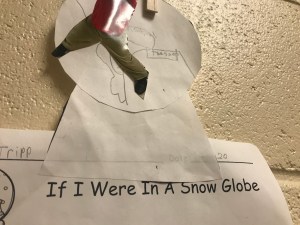 So today as I was visiting with teachers and students at our host school for 3D Leadership, Coweta Charter Academy, in Senoia, Georgia I came across a really cool writing prompt: If I Were In A Snow Globe. It was very interesting to read the student responses. Then I got to thinking, how about I write to the prompt? Here is my essay:
If I Were In A Snow Globe
Here I am in this very beautiful, pristine, and tranquil globe. Everything is perfectly in its place. Of course, my snow globe is a beautiful farm scene with a modest white farm house and three barns. There are snow covered fields and pastures with Jersey dairy cows. When you look inside the barns you see perfectly stacked round bales in a pyramid. You will also see a blue New Holland tractor backed into the barn awaiting its next task.
As much as I am loving being in this snow globe there just is no magic. No excitement. I need someone to shake my snow globe. Won’t you please shake my snow globe? Only then can there be a shift in the experience – some excitement. Snow flying landing on the roofs and on the backs of the cows making an exciting, beautiful, and ever changing experience. I just can’t imagine having to be in this snow globe with out someone shaking it up. For the magic to happen I need shook up. I wish I could get out of this snow globe and shake it. How beautiful it would be!
Lesson Of Shaking It Up
I hope you enjoyed my essay. Here’s the deal: the magic only really happens when we either get shook up, or we shake things up. The shake allows for new possibilities and new beauty. By shaking the snow globe we can create change instead of being a victim of it. So, next time you are getting shook up, take some time to recognize the magic of the shake. Or better yet, give yourself or your organization a transformative shake. How about you share your “If I Were In A Snow Globe” essay?
Naked Leadership
 This past Thursday night, we had an incredible 3D Leadership gathering in Mooresville, North Carolina. This was the first gathering of the third cohort of our North and South Carolina leadership development program. This first time together involves an activity called, “Who Am I As A Leader Today?” The participants are all given their very own Mr. or Mrs. Potato Heads and must creatively put them together to represent who they are that day as a leader. We then circle up and everyone shares. This is always so meaningful and is such a great way to begin building a community. You can find out a lot about someone and yourself when you’ve channeled the inner Mr/Mrs Potato Head.
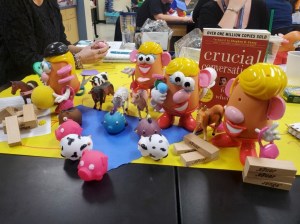 I am always inspired by the wild representations that participants come up with and the deep and meaningful descriptions they give. Always lots for me to blog about after these. One of the member’s presentations really jumped out at me, however, when she said she considered leaving her Mrs. Potato Head blank without putting anything on it. She shared she wanted it to represent the nakedness she felt as a new leader and her desire to learn and become clothed with knowledge. She even brought in some Bible teaching, reminding us that Jesus had come into the world a naked and humble leader of all – and, we all come into the world naked and without anything. She had gone ahead and decorated he Mrs. Potato Head because, as she told us, she needed to recognize that she does have leadership skills today, but wants to continue learning.
The entire group, including me, was blown away by this insightful reflection. Of course, I was so moved that I said I thought there was a book to be written – Naked Leadership. Everyone laughed (thank goodness), but the more I have reflected on it the more I like the title, and the metaphor it represents. For one thing, it’s a catchy title. I’ll bet some of you are reading this post just because the word naked is in the title and you needed to know who was naked. When I began to reflect and study the idea of Naked Leadership, however, I found so many important leadership lessons.
They Realized They Were Naked
In Genesis 2, the Bible says of Adam and Eve, “The eyes of both of them were opened…and they realized they were naked.” As leaders we must have our eyes opened and realize we do not know everything. We need an attitude of personal professional growth and a desire to actively listen to others.
The Emperor Has No Clothes
I love the children’s fairytale The Emperor’s New Clothes. This might have application as a leadership fable for learning more today than at any point in history. You know the story… the emperor was very vain and loved new clothes, so some swindlers took advantage of this. They told the emperor they could fashion the most beautiful cloth ever made that could only be seen by someone who was stupid. So, emperor gave them gold, expensive silk and other items to make the cloth. Of course, these were swindlers who did not make anything but steal the items. Let’s skip to the end of the story…the emperor goes out with his new clothes which were allegedly invisible, and, of course, is naked. No one has the courage to tell the emperor he is naked until he comes to a little boy who says, “But he doesn’t have anything on!” It took the innocence of a child to make the emperor realize he had no clothes.
Wouldn’t we be more effective leaders if we were able to recognize our own nakedness without even needing to be told, as our 3D Leadership participant suggested? This would, I believe, open us up to being advised by others to our nakedness as well. The other part of the story that most never go on to talk about is that once the emperor realizes he really is naked, he continues on, naked, because of his desire to not admit being wrong and his extreme vanity.
I don’t know if the Naked Leadership book will ever get written. I hope it does, but in the meantime we all need to recognize our metaphorical nakedness and be open to finding ways for clothing ourselves with the skills of great leadership. How about you; Do you have any ideas for chapters in the Naked Leadership book?
Living Is Having A Past Full Of Mistakes
 The other day as I was having dinner with a good friend I was talking about some mistakes I had made. He said, “Byron, part of living is having a past full of mistakes.” Wow, how true this is! And, how impactful it was to hear from this. As a person who never worries about failure and tries to learn from every mistake, it was huge to talk this out.
The thing to remember and tell ourselves, however, is that the mistake was not on purpose. We didn’t misunderstand circumstances or miscalculate a situation on purpose. Would we forgive someone else? Sure! So we need to remember to forgive ourselves too, and fail forward. This all doesn’t qualify if the mistake or failure was while taking a risk. That is the nature of risk taking and is necessary.
Then, we just need to do everything we can to fix the mistake. That may mean talking to someone, coming up with a better solution, or letting someone else help out. I always say to others, “There’s nothing you can screw up bad enough that the sun won’t come out tomorrow. And, if it doesn’t, it won’t matter anyway.” Remember, we are human and not infallible.
Finally, we need to take the position that we will be smarter next time. We need to learn from mistakes. Just as others have had amnesia about our past mistakes, we need to have amnesia about others. This is truly having compassion.
Let’s Have Lunch Together!
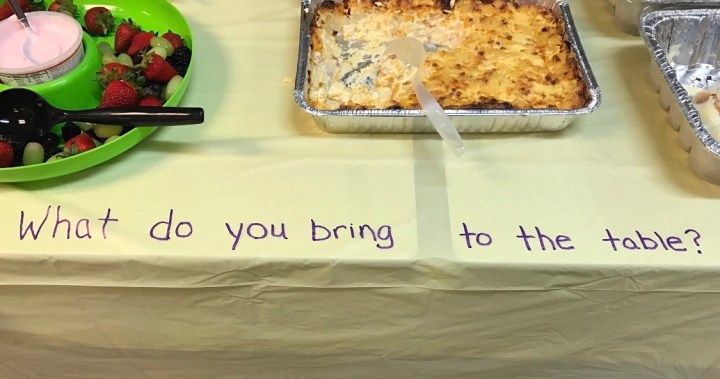 Last night we started our third cohort of 3D Leadership in Indiana. Hard to believe we have started our third year. Just seems like yesterday that I began putting the curriculum together for this program. Last night as we were discussing relationship building as a function of leadership, one of our participants, Sarah Medve, shared a story that really touched me and the rest of the group.
Sarah said she realized that she needed to do a better job of building relationships. Sarah also realized that she was missing out on building work friendships and collaboration because instead of taking time to eat lunch with coworkers she was making copies, grading papers, or any of the many other tasks of the day. This great teacher leader explained she has begun making sure all her tasks are done at other times so she can stop and eat lunch with others. Then Sarah told us she had fun eating lunch with others and did not want to miss it. Wow! This is a big deal!
We all do it, though. Work through lunch or sit alone and check emails. Sharing meals together, however, builds relationships. Eating together provides time to get to know each other and encourage cooperation through informal communication. Eating lunch together also increases productivity because it widens our perspectives. Eating together is a powerful act.
Researchers at Cornell University argued that eating lunch together has a much more positive effect on organizational community than the artificial activities that many organizations use like rope courses and things we call team building activities. These things are sometimes offsite and require a lot of energy. The Cornell study showed that employees (in the case of this study – firefighters) make fun of and do not see any value in them (Kniffin, et al., 2015).
This insightful story from our teacher leader reminded us all of the benefits of commensality. Coworkers that eat lunch together feel more like family and build friendships. So, we need to learn from our teacher leader, Sarah Medve, and make time to eat together with fellow teachers and staff. Why? Because, as Sarah so insightfully told us, it is fun and she feels closer to her coworkers. The rest of us leaders need to think more about providing opportunities for employees to eat together and do away with the manufactured and trite team-building exercises.
 You might be interested to know that after our gathering we all went to Jockamo’s and had dinner together. It was so much fun and we learned a lot about each other. It was nice to put into practice what we were learning in 3D Leadership. I know I left feeling much closer to the group.
REFERENCE
, J. (2015). Eating Together at the Firehouse: How Workplace Commensality Relates to the Performance of Firefighters, Human Performance, 28:4, 281-306,DOI: 10.1080/08959285.2015.1021049
366 Page Best Selling Autobiography
 In the past few days there has been plenty said and written about New Year’s Resolutions. Why do people bother? I even saw (notice I didn’t say “read”) a blog with 15 steps to keeping your resolutions. Really! Why do we put ourselves through that process for failure.
If I was going to have a New Year’s Resolution, however, it would be to appreciate my friends every day and catch more fish. Pretty doable, I believe. And, unlike where we do things like get an accountability partner (which, by the way, just adds stress to someone else’s life) this resolution is fun for your friends. Who wouldn’t want to go to lunch and catch up, or go fishing?
In my morning motivational message, that I tweet and post on LinkedIn (notice it’s not an email I force people to deal with – it’s a choice for someone to go look at it) each day, I said, “Today is the first blank page of a 366 page autobiography. Make it a best seller.” I really believe if we approach every day as a page to a best seller we could write a pretty good book.
 Best selling and Pulitzer Prize author Robert Caro says, “I have to produce every day.” Caro has written massive volumes about Robert Moses, New York City shaper, and President Lyndon B. Johnson. He will tell you these books are not about the men, but about power – getting it, using it, becoming abscessed with it, and abusing it. I have read The Power Broker and it is awesome. I am planning to start the series on Lyndon Johnson this year.
 Many have asked Caro over the years about his work habits, and there have even been interviews. Therefore, even though he was not done with the last volume of his books on Lyndon B. Johnson, he took time to write Working. In this book, which is a great read by the way, he outlines how he goes about doing the work of writing these in-depth books on power. What stuck out to me was when he wrote that he writes 1,000 words per day. Then at the beginning of the next day he reviews and revises the writing of the previous day and writes another 1,000.
See where I’m going here? What a great metaphor on this New Years Day! We need to approach this New Leap Year as a blank pad to write 1,000 words per day for a 366 page best selling autobiography. Each day we can reflect on the previous day, but then get to work on the next 1,000 metaphorical words that are our life. So maybe, just maybe it’s this simple: produce every day.
 Byron's Babbles
2 comments