Leading By Accident
 Not too long ago I was sent a screen shot of a post on FaceBook (I don’t do FaceBook, so someone had to send it to me) – check out the picture with this post for the message. When I read the post I realized that while I live and lead according to what works for me, the core values of the organization I work for, and my personal core values, my efforts to become my best self have the capacity to positively affect people I didn’t even know were paying close attention. People I never would have thought were finding inspiration in anything I do, however, were telling me the opposite, and were indicating that my decisions about my own life, the way I led, and taking chances on them had inspired them to take chances in their own lives. I started to think about all the people who motivate and inspire me just by being themselves, and I surmised that they (we) are all leading by accident. We do our thing for our own reasons. But by being true to that thing, we may very well help people find their own thing, perhaps by creating a path that didn’t exist or illuminating one so others can see it. Hum… could it be this what empowerment really looks like?
 Even if we don’t get to hear about how our lives affect others, they do. We are all leaders by accident in our own ways. Just as Dr. Alexander Fleming stumbled onto Penicillan in the 1920’s we stumble our way into others’ lives. Leadership lesson #14 from John Parker Stewart in 52 Leadership Lessons: Timeless Stories For The Modern Leader, told the story of how Dr. Fleming discovered the bacteria killing mold, Penicillan, by accident. It ultimately took two other scientists to help make commercial production of Penicillan a reality. Had it not been for Dr. Fleming’s belief in what the accidental discover could do for humanity, who knows what would have happened, or where we would be today.
Even though in the formal sense we may not be leading that all the time – in our jobs, in our roles as parents, siblings, friends, et cetera; we really are being a leader (by accident) every moment of every day. The post from Reuben drove home for me the absolute truth of that statement. We may not be motivated by the desire to demonstrate leadership qualities when we become the arbiters of our own, most authentic lives, but we kind of can’t help it, it seems. So, go out there and lead by accident and intentionality.
Social Complexity
 For each of the last two days I blogged about Dynamic Complexity and Generative Complexity respectively. My inspiration for these posts has been the book by Adam Kahane titled Solving Tough Problems: An Open Way of Talking, Listening, and Creating New Realities. I feel compelled to write about the third complexity he offered in the book: Social Complexity. As Kahane (2004) taught us: “[S]ocial complexity requires us to talk not just with people who see things the same way we do, but especially with those who see things differently, even those we don’t like. We must stretch way beyond our comfort zone” (p. 75). Wow, how true this is. Think about this for a minute; how many times when trying to solve complex issues do we really listen to those who think differently, see the world differently, or just flat-out don’t like us?
“Roughly, by a complex system I mean one made up of a large number of parts that interact in a nonsimple way. In such systems, the whole is more than the sum of the parts, not in an ultimate, metaphysical sense, but in the important pragmatic sense that, given the properties of the parts and the laws of their interaction, it is not a trivial matter to infer the properties of the whole. In the face of complexity, an in-principle reductionist may be at the same time a pragmatic holist.” ~ Herbert Simon in his 1962 article, “The Architecture of Complexity.”
I look at social complexity as being complicated by the very nature that we cannot provide a simple model of the system that adds up and makes sense of, or can predict the independent behaviors of the parts; rather, the parts are influenced in their behaviors by the behaviors of other people, groups, organization, governments, or even populations. This is in contrast with the simple system of an internal combustion engine. It might seem very complex, but really it is simple because every part, both moving and not, has a function and order in which to do that function.
In a spark ignition engine, the fuel is mixed with air and then inducted into the cylinder during the intake process. After the piston compresses the fuel-air mixture, the spark ignites it, causing combustion. The expansion of the combustion gases pushes the piston during the power stroke. In a diesel engine, only air is inducted into the engine and then compressed. Diesel engines then spray the fuel into the hot compressed air at a suitable, measured rate, causing it to ignite. This all very hierarchical in that everything happens in a specific order that never changes.
Let’s now contrast this with the social complexity and causal processes (sub-systems) that make up our education system. And consider some aggregate properties we may be interested in such as state law and policy, federal law and policy, political dynamics, local community social differences, socio-economic factors, race, mobility, or the social and emotional needs of our students to just name a few. Some of the processes that influence these properties are designed (Every Student Succeeds Act, school boards {both state and local}, school management systems), but many are not. Instead, they are the result of separate and non-teleological processes leading to the present. And there is often a high degree of causal interaction among these separate processes. As a result, it might be more reasonable to expect that social systems are likely to embody greater complexity and less decomposability than systems like an internal combustion engine.
“To create new realities, we have to listen reflectively. It is not enough to be able to hear clearly the chorus of other voices; we must also hear the contribution of our own voice. It is not enough to be able to see others in the picture of what is going on; we must also see what others are doing. It is not enough to be observers of the problem situation; we must recognize ourselves as actors who influence the outcome.” ~ Adam Kahane
This reminds me of a legislative panel I am on right now to look at and make recommendations to our state legislature on our high stakes summative state testing (required by the Every Student Succeeds Act – ESSA). This committee is made up of 23 different individuals and appointed by different entities. My appointment comes as being the representative of the Indiana State Board of Education. Needless to say, we have lots of social complexity. Needless to say it has been awkward and tenuous navigating on this panel. Here are some things I have learned from Kahane (2004) to help us as leaders:
- To solve a complex problem, we have to immerse ourselves in and open up to its full complexity.
- Our core tasks need to be to “widen the circle” and “deepen the bench.”
- Tough problems can only be solved if people talk openly, and in many situations this takes real courage.
- Listen openly.
I close with Kahane’s (2004) definition of listening: [T]he process of taking in something new and being unsettled and changed by it” (p. 69). I ask you: Are you a leader who listens?
References
Kahane, A. (2004). Solving tough problems: An open way of talking, listening, and creating new realities. San Francisco: Berrett-Koehler.
Generative Complexity
 Yesterday I blogged about Dynamic Complexity after reading in the book by Adam Kahane and is titled Solving Tough Problems: An Open Way of Talking, Listening, and Creating New Realities. Another type of complexity worth organizing our thoughts about is Generative Complexity. Kahane (2004) said, “Generative complexity requires that we talk not only about options that worked in the past, but also about ones that are emerging now” (p. 75). To me this is all about not getting caught up in thinking about how things have always been done, but about how no one has ever thought about doing them.
“We cannot develop creative solutions to complex human problems
unless we can see, hear, open up to, and include the humanity
of all the stakeholders and of ourselves. Creativity requires all
of our selves: our thoughts, feelings, personalities, histories,
desires, and spirits. It is not sufficient to listen rationally to inert
facts and ideas; we also have to listen to people in a way that
encourages them to realize their own potential and the potential
in their situation. This kind of listening is not sympathy, participating
in someone else’s feeling from alongside them. It is empathy,
participating from within them. This is the kind of listening
that enables us not only to consider alternative existing ideas but
to generate new ones.” ~ Adam Kahane
We need to remember that there are many interdependent parts of a complex system. Additionally, a complex systems world view highlights that interactions between parts of the system and the behavior of the system as a whole are critical. As leaders, we must learn to do a better job of seeking out, fostering, and sustaining generative relationships that yield new learning relevant for innovation.
When discussing leadership we tend to focus on leaders’ individual characteristics rather than on the dynamics of interactions between leaders, group members, and the context in complex organizational systems over time; and we certainly do not do enough toward our own professional growth as leaders, or those on our teams, to create conditions that allow their organizations to evolve (2006). We must also find ways to improve our own and organizations’ ability to learn continuously and implement learning in action as projects proceed.
References
Kahane, A. (2004). Solving tough problems: An open way of talking, listening, and creating new realities. San Francisco: Berrett-Koehler.
Surie, G. & Hazy, J.K. (2006). “Generative leadership: Nurturing innovation in complex systems.” E:CO Issue Vol. 8 No. 4 2006 pp. 13-26.
2016-2017 Welcome Back
 As Head of Schools for the Hoosier Academies Network of Schools, I want to extend a warm welcome to our returning students and family members and those of you who are new to the Hoosier Academies Network of Schools. Thank you for partnering with us in the education of your children. Many of us here are also parents and we understand the huge responsibility we have for ensuring that all children find success at every level of their academic experiences.
I am so excited to welcome you back to school today. I have told others that this is the most excited I have ever been to start a school year. In fact Mr. Hurst, our science/biology teacher, was so excited that he could not sleep last night – think about this; he has been doing this for 41 years and he still gets nervous. I’m excited because of our new vision, mission, and core values we developed last year and the implementation around these that will guide us this year.
Our vision is “Success for Every Student in Indiana.” We define success using the definition of Dr. Felice Kaufman – “Knowing what one wants in the world and know how to get it.” We understand that success looks different for every student.
Our new mission is “Hoosier Academies Network of Schools Engages Students in a Customized and Accessible Education by Collaborating with Parents and Families for Student Success.”
We have five core values:
Students First for Success
- We are implementing the National Family Academic Support Team with fidelity this year in order to give students and families the support needed to be successful in our schools.
- We started the Insight School of Indiana in order to support students who are behind or need extra support to be successful.
Educating, Supporting, and Empowering Teachers, Staff, and Families for Success
- This year we are implementing the National model for Instructional Coaching. Our teachers will be getting regular coaching in order to help them reach their full effectiveness in facilitating learning for your children.
Safe Environment for Success
- We will continue our anti-bullying campaign.
- We will have drug awareness programs.
- We will be using our Raptor (instant background check) system here at our Franklin Road 7-12 Learning Center and at our Caito Road k-6 Learning Center to ensure that everyone that comes into the building has had a background check. We have alarmed our doors so we know no-one is coming in or going out that should not be. Students are assigned to a teacher for every minute of the day and instruction will be happening from the minute the students come on campus until they leave. We have implemented our School Master attendance program so that attendance is being taken with fidelity. I have set the goal of no less than 95% attendance for all of our schools, but particularly hybrid days. I believe you will find that the ship has been tightened at our hybrid centers. We must take full advantage of the face to face time that your children have with our teachers.
Strong Community Relationships for Success
- We have had many Back to School Expos across the state and a few more to go. Check the website for other community events where you can connect with staff for support you may need.
- Hoosier Helpings is a food pantry that can help families in need access food, toiletries, clothing, pet supplies, and some household items. Click here for information for support if needed.
Accountability for Success
- With our new Academic Plan we have put in place improvements to make sure that your son or daughter is receiving the support necessary for academic performance and achievement.
- We are clearly communicating expectations
- We are supporting a culture of continual improvement
You will be hearing more details about many of the initiatives I have touched on here during your specific school convocation break outs, but please know I am excited for us to be back together for an exciting year of learning.
Significance, Influence, & Leadership
 It has been said that leadership is influence. This is so true, and I was reminded of this today. I had the honor of being part of a book launch and signing at one of our local Barnes and Noble stores today for author, . He wrote the book The Second Decade: Raising Kids to be Happy, Self-Sufficient Adults through Work (2016). I learned of the book through Indiana Speaker of the House, Brian Bosma. He sent me a copy of the book and asked that I read it and think about how this book could be used to influence others in helping to develop and educate our children. I was excited to get the book and, of course, immediately read it. Come on, the Speaker of the House sends you a book and asks you to read it, well, you read it! And…of course, I started tweeting about it. Next thing you know I’m tweeting back and forth with Speaker Bosma and, lo and behold I’m suddenly tweeting with Dr. Helveston. Then, I’m being invited to attend a book signing via twitter. I continue to be amazed by the power of twitter. Well, of course I am going to the book signing – one of my most valued collections is of my author signed books. So, now that I have set the stage let’s get to some content in this post.
It was such an honor to have Speaker Bosma introduce me to Dr. Helveston before the event started. Little did I know I was being introduced by a man, Speaker Bosma, who has had a great deal of influence on me (to read about that, click here) to another man, Dr. Helveston, who would influence me immensely in just the few minutes of visiting and listening to him speak at the event. One of the most powerful things he said to me was, “This research and book is a project I have started really late in my life and career.” With this statement he had me hooked as someone who absolutely knows how to be significant in life. As a believer that there is no such thing as retirement – only significance in the second half, I was certain I had met an icon of being significant, not just successful. This has been a topic of interest of mine for some time now. In fact I have blogged about it in “Significance: Impacting Outside Yourself.”
 As we talked, it was evident that Dr. Helveston wants to continue to have an influence on the world and particularly on our youth. He wants to find influential ways to have the ideas and framework brought forth in his book to really make a difference. Make no mistake, Dr. Helveston is a successful doctor, but I was truly in the presence of an influential and significant person and leader. There were individuals in attendance who were mentioned in the book and I could quickly see the influence this great man had on their lives. This very humble man clearly has had an influence on everyone he has come in contact with and is significant. Leaders, like Dr. Helveston, that strive to be significant seek to create the greatest impact and influence. These are the types of leaders that we value the most; inspired by their courage and resiliency, we seek to emulate them. Here I was in the presence of two such leaders – Dr. Helveston and Speaker Bosma. These are the leaders that can get the most out of very little, are grateful for the opportunity to lead, and always treat others like family. It was very evident from all the stories that every patient of Dr. Helveston became family. Speaker Bosma told the story of how they had met when he became the doctor of his son. Now, years later, there is still a very close relationship between Dr. Helveston and the Bosma family.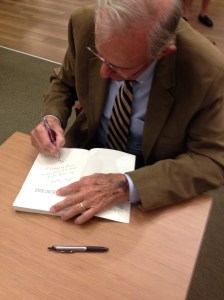
Great leaders are the most memorable, influential, and significant. They go about their day leveraging their distinction by leading in ways that come most naturally to them. This is so true, because I might not even had read the book had there not been a leader in my life that turned me on to reading. Had there not been a Mrs. Wilking in my life I might not have become the leader I have because I would not have had the learning from reading I have been afforded. You can learn of the birth of my love of reading by checking out “Reading Big Red.” Click here to read the post. Significant leaders are those who enjoy sharing their wisdom and secrets of success. Dr. Helveston has certainly done this in his book. Leadership is a process of influencing others. Dr. Helveston is without a doubt influencing others with the framework for developing our children suggested in this book.
The Second Decade: Raising Kids to be Happy, Self-Sufficient Adults through Work (2016) is an incredible book that really makes you think and want to take action. I wrote the following in both my Goodreads and Amazon five start review of the book:
“Everyone who is a parent, teacher, or in a position to influence children either directly or by policy should read this book! In this book, Dr. Helveston recognizes the need for what I will call internships – meaningful work. The five actions developed in this book of:
1. Plan ahead for a quality education pursued with an eye on the future;
2. Learn life lessons and useful skills from the work you perform and the people you meet;
3. Seek advice and inspiration from mentors throughout your life;
4. Recognized that nothing is accomplished without time and effort; and
5. Pursue honest and productive work
are well developed, researched, and referenced so the reading can use the book as a guide. This book can serve as a framework for anyone who believes as I do, that helping parents teach their children to gain academic skills through a quality education and acquire practical skills learned by working is an invaluable component to a lifetime of success. Again, this is the must read book of all who want success for all children.”
 Dr. Helveston posited in the book that there is an important activity that seems to be getting lost amid meaningless structure—holding down a job outside the home, for money. He argued that more than any other activity, work adds meaning to the knowledge learned in books and gives depth to the values instilled at home. I really agree with this and the research would concur. In fact, this is why I believe internships are so important in young people’s lives. This workplace development orientation requires inculcating good character traits within the young person, which will help them to carry out their professional responsibilities throughout the rest of their lives.
The idea of the “inclusive middle class” is one that really jumped out at me in the book. This really drove home why it is important for us to make sure we are carrying out and teaching our children the five actions listed above. Dr. Helveston said:
“But the future offers a two-way street. A position attained is never guaranteed. A person can attain more or accomplish less. Success can be in the form of financial security or with the attainment of other worthwhile goals. In either case, it takes effort to keep and possibly improve one’s place in society.” ~ Dr. Eugene Helveston (2016, p. 25)
Those who understand this will certainly have a leg up in society. We have an obligation to the children of the world to be providing them with the experiences to learn these facts. One way to formalize this would be to ramp up our internship programs both at the post-secondary level and in our high school programs. What better way to give our students the real life experiences necessary to help them be successful, happy, and functional citizens. Dr. Helveston’s book provides a guide and framework for educators, parents, and policymakers to help our children understand what opportunities are available to them and facilitate the journey to become their best selves.
Career Readiness for All?
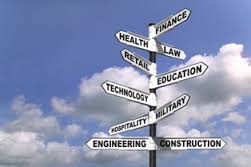 I had the privilege of meeting and hearing from Dr. Nancy Hoffman of Jobs for the Future yesterday at our fourth Panel to Study Alternatives to the ISTEP+ Program Test. Our objective of having Dr. Hoffman was to discuss how we assess career readiness under the Every Student Succeeds Act (ESSA). I really saw a great deal of the value in the information she was presenting to us and wanted to share. Here are some facts she started with:
- The unemployment rate among Hoosiers age 16 to 19 year old is about 15%.
- Missing out on jobs during the late tees can have negative effects throughout a person’s working life.
- A young person who doesn’t get work experience between 16 and 19 is missing a major developmental experience.
- The economy suffers because of the above bullet points.
I was also struck by the idea of disconnected youth: those who are not in school or working – “have lower wages and marriage rates, higher incarceration and unemployment rates, worse health, less job satisfaction, and eve less happiness as adults than people who did not experience youth disconnection. Just as early successes breed optimism, early setbacks plant the seeds of hopelessness.”
“It’s not just about young people: The economy needs prepared young people.” ~ Dr. Nancy Hoffman
- Far too many young people complete a postsecondary degree/credential.
- STEM fields hold promise; employers struggle to find skilled employees.
- High school is not working for far too many young people
- Careers increasingly require postsecondary education and work readiness skills and experience.
- Education workforce, and economic development are inextricably connected.
“In my utopia, all high school students would have a structured work experience – just as 70% of young people do in Switzerland.” ~ Dr. Nancy Hoffman
Indiana is ahead of most states in having a law requiring career readiness activities starting in elementary school. Indiana has a career readiness definition which includes all students. Additionally, Indiana has career exploration courses. We provide Career and Technical Education (CTE) dual enrollment and we have strong CTE results.
Here are some questions that states need to be asking and addressing:
- What is the state’s definition of career readiness?
- Does the state want to focus on all students or exclusively CTE students?
- Are college and career preparation the same or different?
- How should various options be valued and weighed?
The Leadership Tower: A Classic Jenga Model
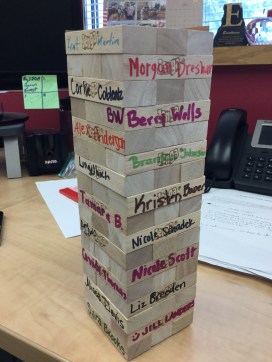 I recently got a very cool gift from a group of Hoosier Academies Network of School’s teachers. The teachers took Jenga® pieces, signed them, and then glued the tower together. This was such an appropriate and appreciated gift because of how much we use the Jenga® theme, and the fact that they built something to give to me. For those that know me well, know that I am a believer in creating models and building when do professional growth activities. In other words, I strive not to use technology and presentations. I was deeply moved by the gesture and have picked a special place in my office for this.
You all know what Jenga® is, right? That’s the game where you start with 54 wooden pieces stacked in 18 alternating rows creating a stable tower. Every move from that point on destabilizes the tower as pieces are removed from inside the structure to place them on top growing it taller and taller until it eventually topples. Many times when we play we just pull pieces till someone (the loser) makes the tower fall. As I looked at the tower I had been given, I thought about the powerful metaphor Jenga® is as a leadership model. I have blogged about it before in Jenga Masters Leadership. Click here to read the post. This time as I was viewing the tower I thought of a new aspect. I viewed the tower as a model of change and strategy decisions.

As a leader, are you building towards a cohesive vision for the future of your organization? Or, are you just pulling blocks out and placing on top of the tower, hoping the structure does not topple over?
My New Leadership Talent: Spinning Plates!
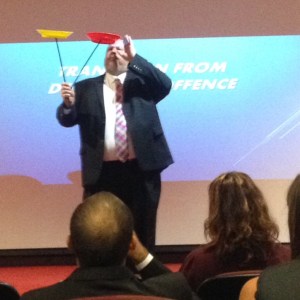 Coming to grips with the multiple parts to any organization is invaluable for leaders trying to keep their people and priorities in balance at a time when cultural and leadership change sometimes seems an existential imperative. Just as a circus performer deftly spins plates or bowls to keep them moving and upright, so must leaders constantly intervene to encourage the sorts of behavior that align an organization with its top priorities. Masters in this circus manipulation art can barely keep 100 plates spinning at a time. How many plates can any harried player-manager handle? Typically, less than a dozen.
Today, for the first time in my life I did a plate spinning act for our entire school staff. I had been using the metaphor for a few months now because of all of the things we have going on. In fact, I would many times just make a motion like I was spinning a plate. Therefore, I decided in my opening session that I would spin plates. For being my first time it went very well – I think. I even used the act introduce our newest administrators by passing them a poll with a spinning plate as an act of passing the torch, so to speak. The plates really represent all the facets, initiatives, paradoxes, parts of an organization a leader must be focused on. Spend to much time on one plate and the others fall. Left too long without attention, they run out of energy, start spinning out of control, and may come crashing to the floor. Personal development, coaching, performance management, addressing team dynamics, and reinforcing objectives are all forms of plate spinning. The leader must find the exact right balance.
Embracing the paradoxes can be uncomfortable. Yet the act of trying to reconcile these tensions helps leaders keep their eyes on all their spinning plates and identify when interventions are needed to keep the organization lined up with its top priorities. I believe approaching leadership much like plate spinning makes it possible to avoid the frustration of many leaders I’ve witnessed, who pick the extremes by either trying to stifle complex behavior by building powerful and rigid top-down structures, or by looser, more laissez-faire styles of management that expose the messy realities of human endeavor. Far more centered and high performing, in my experience, are those leaders who welcome the inconvenient contradictions of organizational life.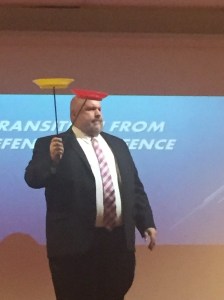
This is why I am such a believer in engagement and empowerment of everyone on the team. With an intent-based leadership philosophy where everyone is a leader, all individuals have a role in keeping the plates spinning. Empowerment is fundamentally an individualized equation, or what I call hyper-personalized. What might make one employee engaged might turn off the next person – we, as leaders, must be able to read these turn-ons and turn-offs. There are many variables that can impact any one person’s engagement, and the mix is individually unique. You can’t just become a better plate spinner. You have to find ways to keep the plates spinning on their own.
Indiana Assessment Vision
 Yesterday, we had our third legislative panel meeting studying alternatives to the ISTEP Program Test. This is part of our working toward the assessment plan under the Every Student Succeeds Act (ESSA) for Indiana. One of the things we worked on yesterday was the vision statement of the group. Using suggestions from panel members, the panel legislative staff came up with the following draft statement:
“Indiana looks to design an assessment system that is student-centered and provides meaningful and timely information to educators and parents on both a student’s on-grade proficiency level and growth toward Indiana’s College and Career Ready standards. The assessment needs to be viable, reliable, research-based, and meet the requirements of both state and federal law, while meeting the needs of all students across Indiana.”
Now, being the vision guru I am, I immediately realized it did not meet the 35 words or less rule of thumb. I did, however, quickly underline what I thought were the most important parts of the vision statement that our panel needed to do to meet the needs of our students, families, and schools (I have underlined above). Here are the points:
- student-centered
- meaningful
- timely
- information to educators and parents
- on-grade proficiency level and growth
I suggested we eliminate the last sentence, “The assessment needs to be viable, reliable, research-based, and meet the requirements of both state and federal law, while meeting the needs of all students across Indiana.” because I do not believe it is at all visionary to be valid, reliable, researched based and meeting the letter of the law. We have that obligation to Indiana and the federal government through ESSA. We don’t need a vision for that.
So, my proposed vision statement would be:
“Indiana looks to design an assessment system that is student-centered* and provides meaningful and timely information to educators and parents on both a student’s on-grade proficiency level and growth toward Indiana’s College and Career Ready standards.”
You will notice the * with student-centered. I believe we should have a definition for student-centered following the vision statement. For me, that definition could be:
*A Student-centered assessment system, which includes student performance, academic growth, and multiple measures, sets challenging items and tasks that are intended to encourage deep learning and create a sense of high expectations and mutual accountability.
Then, I believe it is even more important to develop a set of belief statements associated to this process. I took pieces from what individuals submitted as vision statements to make a list of possible belief statements. I really believe that many of what panel members submitted were belief statements, not vision statements. This was a good things because we should have belief statements guiding our work.
Here is the list I came up with:
- New assessment must be implemented with fidelity
- Timely results
- Empowers students, parents, educators, and administrators
- Includes college and career readiness metric
- Meets the needs of all students
- Cost effective
- Accurately assesses students’ learning and growth over time
- Takes less time away from instruction and learning
- Equity for all students in how they take the assessment (technology/modality)
So, put all together, here’s what my draft would look like:
“Indiana looks to design an assessment system that is student-centered* and provides meaningful and timely information to educators and parents on both a student’s on-grade proficiency level and growth toward Indiana’s College and Career Ready standards.”
*A Student-centered assessment system, which includes student performance, academic growth, and multiple measures, sets challenging items and tasks that are intended to encourage deep learning and create a sense of high expectations and mutual accountability.
Indiana’s new assessment system must:
- be implemented with fidelity.
- provide timely results.
- empower students, parents, educators, and administrators.
- include college and career readiness metric.
- meets the needs of all students.
- be cost effective.
- accurately assesses students’ learning and growth over time.
- take less time away from instruction and learning.
- provide equity for all students in how they take the assessment (technology/modality).
Because ESSA requires us to have a summative assessment in grades 3-8 and a high school component our conversation must shift from all the chatter about whether wanting to test or not or whether it is right to test. Really, that is irrelevant. What is important is that we make sure all of our stakeholders understand “why” assessment is happening and exactly how the data will be used. I believe we are on the right track to developing a vision and belief statements that can drive this work. I would love to hear feedback on additional belief statements or edits to make the belief statement suggestions better.
Teacher Evaluation & Leading Learning
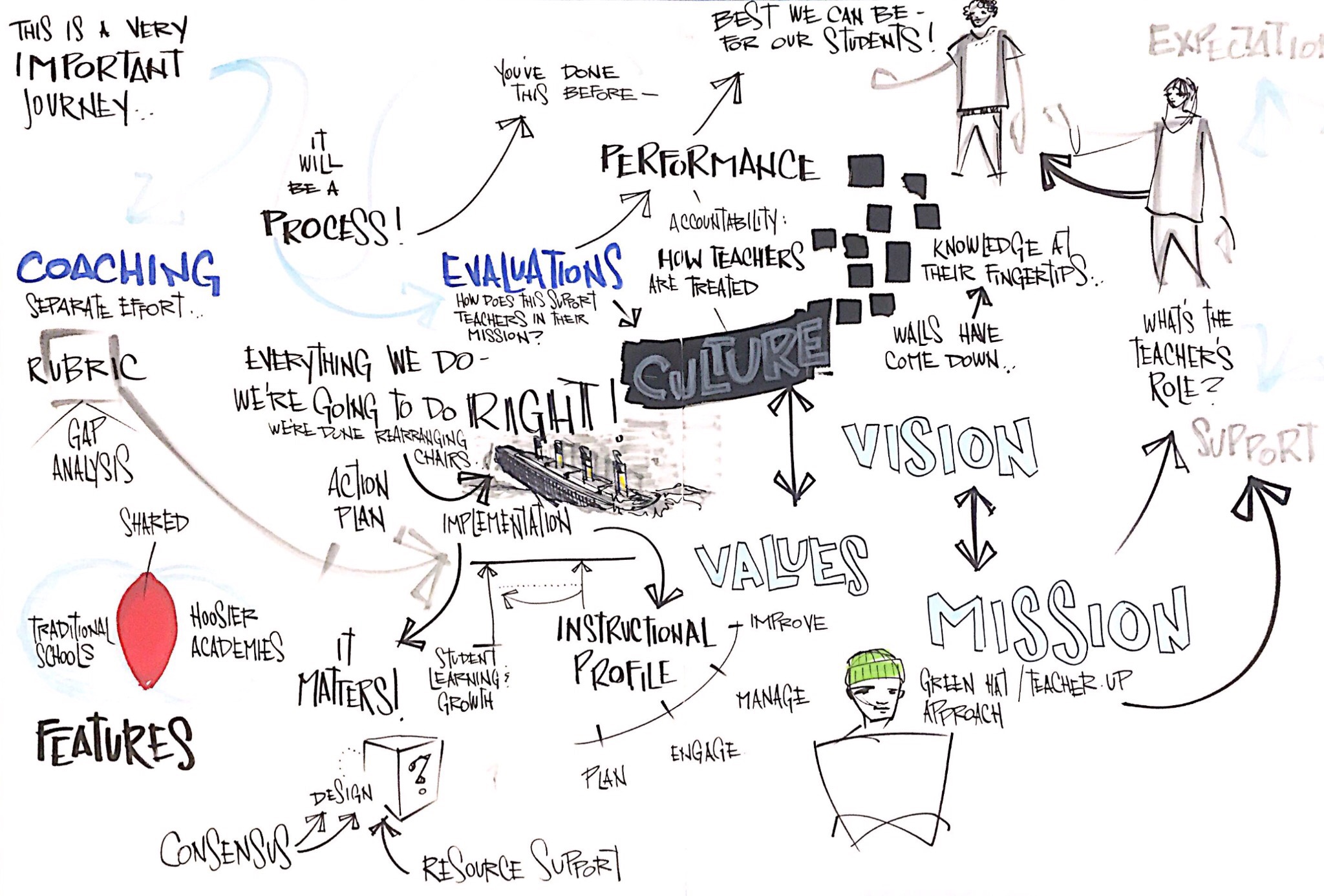 Evaluation of teacher performance plays a crucial role in educational personnel reform, student performance, and teacher leader development, so it has been an important yet difficult issue to tackle in educational reform. Before the reform efforts of 5-10 years ago, teacher performance evaluation was very teacher task oriented, neglecting contextual performance and student learning. I would call this managing teachers as opposed to leading learning. Previous evaluations of teachers failed to make strict distinction among the three dominant types of evaluation: capability, achievement, and effectiveness. I also believe these evaluations did not take into account the context of the school. These evaluations were a single action being done to teachers as opposed to a process or system created and carried out to support teachers in his or her role of carrying out the vision and mission of their school.
This post is not about how to create a teacher evaluation system, but about why it is so important that we have a great performance evaluation system to SUPPORT our teachers. I believe this is one of those areas where our teachers deserve to be made “first” so we can put our “students first.” Marzano tells us that great evaluation systems develop expertise with specificity. This is so important in enabling our teachers to carry out their role in providing highly effective student learning and growth as part of the learning profile of the school. Additionally, Danielson argues the full value of a high quality evaluation framework is not realized until it is used as the foundation for professional conversations among practitioners as they seek to enhance their skill in the complex task of teaching.
So, let’s talk about those conversations. We are completely overhauling our evaluation process/system for the Hoosier Academies Network of Schools. Leave it to say, there were many gaps in the process (or lack there of) and rubric I inherited. Those that know me very well know that my first step was to form, yes, you guessed it, a “task force.” Let’s touch on that for a moment – I believe task forces are a great way to build leaders. Our teacher evaluation task force is made up 3:1 of teacher leaders. What better way to get leaders ready than actually “doing” the work of leading? This is teacher engagement at its best! We just started our journey this past week with two days of intense conversations, gap analysis, and action planning around the complex task of teaching in our very different and complex context. This was very important to our beginning to develop what Danielson calls, “Developing a common understanding is critical to accuracy, teaching advancement, and the Framework’s impact on students’ core learning.” In my opening statement to our task force I explained this is a very important journey – we must support our teachers so they can be the best they can be for our students.
We are very fortunate to have partners in this journey. To ensure we get this right, we have become a part of the Indiana Teacher Appraisal and Support System (INTASS) project. The INTASS project offers states, districts, and schools support in designing, implementing, and monitoring their teacher evaluation systems. More importantly, by being part of the project we receive training for our teacher evaluators and support for teachers to engage in evaluation and professional growth opportunities. Here’s what I love about this – note it’s all about the teacher. Another great benefit is we get get to take this journey with two great educational leaders who I greatly respect, Dr. Sandi Cole and Dr. Hardy Murphy. I believe one of the most important points, among many great points, Dr. Cole got our teachers to understand last week was making the mindset shift that teacher evaluation is not something done “to” teachers, but done with teachers to provide professional growth and support for all of our teachers. Dr. Murphy drove home the fact that our performance evaluation system must enable our teachers to effectively carry out the vision and mission of the school.
The INTASS process rests on four basic elements of a quality evaluation plan:
- Clear, frequent, and transparent communication among a wide base of stakeholders
- Professional practice measures that are mutually agreed upon by stakeholders
- Multiple measures of student learning outcomes
- Fully aligned post-evaluation processes, including job-embedded professional growth and support for all educators.
My friend and author of Under New Management, Dr. David Burkus would argue that we need to change from the old systems of evaluation where there is one big formal annual evaluation to a more frequent, less formal process. Our friends at INTASS would agree and so do our teachers. Our teachers on the task force told us loud and clear that they wanted feedback often that was meaningful and actionable. Including teachers’ growth and development in more check-ins would allow administration and staff more time to talk about opportunities – novel idea! Teachers could also examine their current role and their desired career path and then receive advice on the knowledge, skills, and abilities they need to improve in their current role and to move closer to the future they envision for themselves and how that personal vision aligns with the school’s vision and mission. This is a contrast to the rearview-mirror perspective provided by most annual reviews, including our own that I would give an “F,” but we are fixing. These more frequent discussions about the teacher’s growth and development allows all to brainstorm on staff goals and how they align with the school’s strategy. These more frequent observations and conversations help teachers own their career and development plan and feel more empowered to grow. This growth will, in turn, enable effective leading of learning for our students.


leave a comment