From Best Practice To Next Practice
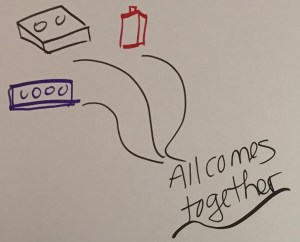 Today was the final day of the 2nd Annual Global Smart Manufacturing Summit in Berlin, Germany. I really valued the time to get to know business and industry leaders from around the world. I was reminded of what my good friend Kevin Eikenberry and I used to talk about a lot – when we look at the differences between different industries (eg. manufacturing vs. education), we see about 90-95% of our issues being the same and about 5-10% different. What I mean here is that many of the challenges and roads to improvement are the same. Think about it, we all have responsibility in finance, HR, facilities, and customers. If we break that down further, we all have one of the same groups within the customer category – employees. Now, I get it; our employees are our competitive advantage, but employees are still a customer to be taken care of at the highest level.
Organizational Commitment
The first session this morning was about initiatives and organizational commitment. As a believer in learning organizations, I was really enamored by the discussion of organizational commitment. This thinking really fits with a lot of the Gallup® research I have been studying around employee engagement. When we discuss organizational commitment, we are talking about the bond employees experience with their organization. Broadly speaking, we know employees who are committed to their organization generally feel a connection with their organization, feel that they fit in, and believe they understand the goals of their organization.
 Next Practice
One of the session titles this morning was “From Best Practice To Next Practice.” I really appreciated this session because we talk a lot in education about “best practices,” but really it is about making the right choice and implementing the next practice. Good or bad, I tend to be the one looking for the next practices. Really, that is what this entire discussion was about for the global leaders here: what are the next practices.
Convergence
Then, it comes down to convergence. How do we take several sources of independent data and bring them together to develop strong conclusions? In education we call this using “multiple data points.” I don’t think we do the best job of bringing all the data points together. For example, this week I was reading and article about teacher pay and how it was decreasing. I question if we have been properly converging HR, financial planning, and student data in a way that would inform what we have been paying our teachers in Indiana. I’ll let you grapple with my comment here, but you get the point.
Problems
One of the comments that I loved most today was, “We shouldn’t be talking about the problems of today, but the problems of tomorrow.” This is so true! This means in education we need to be looking several years out as to what business and industry needs. We also need to think about what our execution model will be for making sure our students have the skills necessary to meet the needs of the workforce. A few phrases/questions coming from the global manufacturing leaders that jumped out at me were:
- What data is coming from where?
- How do you use your data?
- Appropriate levels of (you fill in the blank here)
- Move from reactive to predictive and preventative
Outcomes
All of this discussion has made me an hinkeven bigger believer in us (both Indiana and the United States) needing to move to a strictly outcomes based school accountability system. We could then, truly in partnership with business/industry and higher education, determine what transferable skills students need and have coming out of high school. Then we can match those transferable skills to outcomes that the students needs to accomplish. Here are some examples and outcomes:
- industry certifications
- 4 year degrees
- Associate degrees
- Trade school
- Joining the military
- Meaningful employment
At a time when our state has 75,000 jobs per year going unfilled because there are not skilled workers to take those jobs, we need to be thinking about the outcomes for our students. Thus the skills gap of only 42% having any kind of post-secondary preparedness versus the 75% needed.
If we are going to have our students ready for the workforce we will need to:
- Teach students in a real world and relevant context
- Enable, encourage, and stimulate students to be curious
- Teach students how to fail and that it is o.k. to fail
- Engage students in career exploration activities at a young age
- Determine the transferable skills needed to have students ready for today’s jobs
- Teach students to be disruptors
- Provide pre-apprenticeship, apprenticeship, and work based learning internships
Business and Industry engagement in education programs not only prepares students with the skills they need for careers, but it also contributes to the development of clearly developed career pathways that lead students to careers after graduation.
What Does Industry 4.0 Mean?
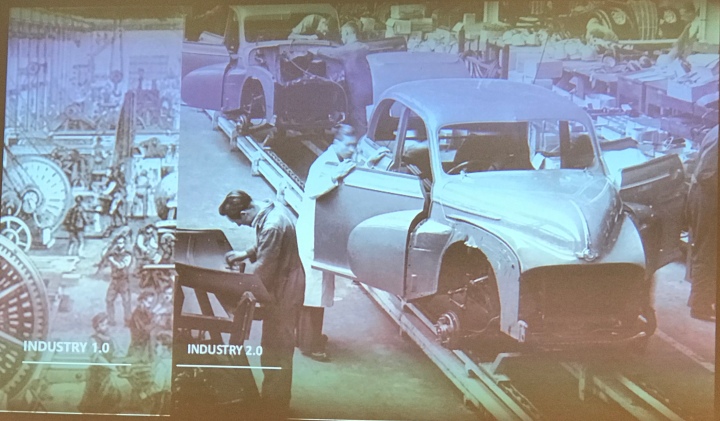 Today, I had the honor of being in attendance at the 2nd Annual Global Smart Manufacturing Summit in Berlin, Germany. One of the topics we grappled with was of what does Industry 4.0 mean? Ron Zahavi, Chief Strategist for IoT Standards and Consortia, Microsoft Corporation did a great job of walking us through some history.
Industry 1.0
This is the first industrial revolution:
- Technology such as wheels and engines replaced artisans
- Child labor laws had to be introduced to prevent abuse
Industry 2.0
- Assembly lines allowed workers to be turned into consumers
Industry 3.0
- Lean Processes improved the quality of products
- Advent of computer use
- Robots reduced mistakes and improved productivity and safety, but began replacing people
Industry 4.0
- Big data and analytics
- Autonomous robots
- Simulation
- Horizontal and vertical system integration
- The industrial Internet of Things (IoT)
- Cybersecurity
- Additive Manufacturing/Advanced Manufacturing
- Augmented Reality
Interestingly, in all these cases technology and mechanization are involved, but in the revolutions of Industry 1.0, 2.0, and 3.0, I wonder if we forgot how important people are. We must remember as we navigate Industry 4.0 that people are more important that the devices and technology.
In my world of educating young scholars and creating education policy, we have a responsibility to make sure as we move to Industry 4.0 to put people at the forefront. We do not want to make the same human mistakes with 4.0 that we made with the first three revolutions.
I really believe more than ever that we must make sure that we create space for industry to do as much of the training of our students as possible. Industry is in a good position to do this. What we have to do, though, is identify the transferable skills students need and institutionalize those skills in the framework of the internship learning being done in partnership with industry. This is crucial because of the mobility of our students.
We must be educating our students on the new things being done with Industry 4.0, but must also be educating them on the benefits. In other words, answering the question: How does this make life easier? Not just always pointing to financial improvement and the bottom line. We must begin to develop a workforce made up of the right quantity and right quality of workers. The skills we are preparing students with must match the needs of the workplace.
Industry 4.0 will require new skill sets, and manufacturers will need to attract the right talent. This may involve partnering with k-12 schools to train students. Existing training programs may need to be expanded to include new technologies that are introduced to the marketplace. Manufacturers also need to recruit for Industry 4.0, which may differ from how they have done it in the past. Both business and industry and education will need to stop all focus being on qualifications determined by degrees and certificates, companies should recruit for capabilities to succeed. These capabilities will include specialized skills.
For us to compete during Industry 4.0, it will require us to conduct constant iteration and be flexible. It’s not about buying software or purchasing a curriculum and then watching it all play out. To compete in Industry 4.0, the education sector and manufacturers must be flexible and agile in the face of change, and, most importantly, partner together.
Learning to Do, Doing to Learn!
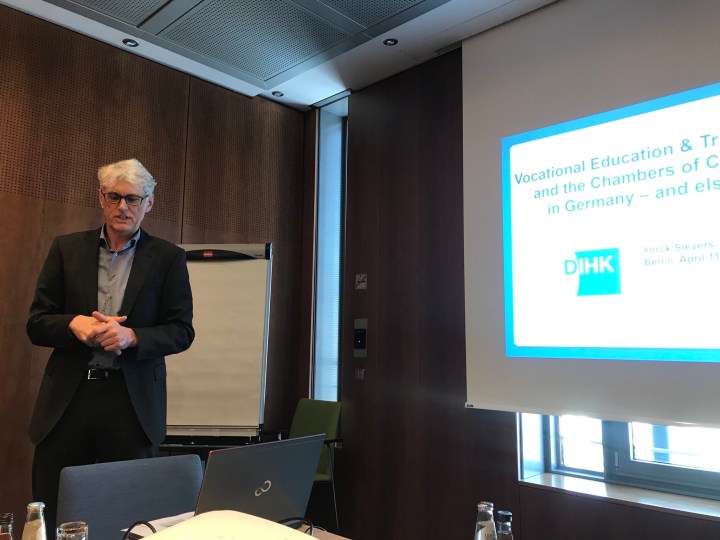 Today, while in Berlin, Germany, I was reminded that what I always say, “Once an Agriculture Science teacher and Career and Technical Education (CTE) Director, always a CTE guy. As I visited with Yorck Sievers of The Association of German Chambers of Commerce and Industry, I was reminded just how engrained the FFA motto of, “Learning to Do, Doing to Learn, Earning to Live, Living to Serve” is to making a positive difference in the lives of students by developing their potential for premier leadership, personal growth and career success through agricultural education. This is also engrained in my core values of how to educate young scholars. The Association of German Chambers of Commerce and Industry (Deutscher Industrie- und Handelskammertag, DIHK) is the central organisation for 79 Chambers of Commerce and Industry, CCI (Industrie- und Handelskammern, IHKs) in Germany. All German companies registered in Germany, with the exception of handicraft businesses, the free professions and farms, are required by law to join a chamber.
The FFA motto gives members 12 short words to live by as they experience the opportunities in the organization. Learning to Do, Doing to Learn, Earning to Live, Living to Serve. Learning by doing is also a cornerstone of the German education system. Whether someone wants to become a carpenter or a hotel concierge, she has probably gone though what is known as the dual education system. This system combines time spent in the classroom with work at a company. During our education research trip with Horizon Education Alliance, we learned about how Germany’s vocational education system pairs hands-on learning with classroom learning to give young people a leg up in the workforce. Most students graduate not only with a degree, but also with job experience and a deep knowledge of their trade. This vocational training offers a high degree of job security. The professional certifications issued to students at the end of their programs are well respected within their fields, and more than half of apprentices stay on as full-time employees at the businesses where they trained. They even get paid during their studies.
Check out a few slides from our meeting with Sievers:
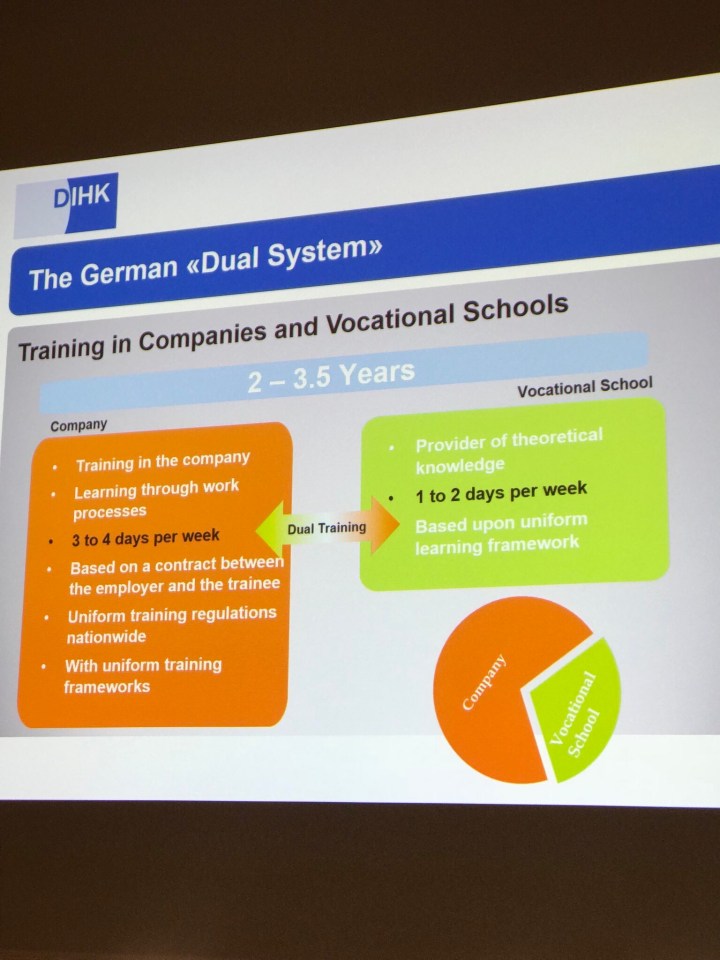
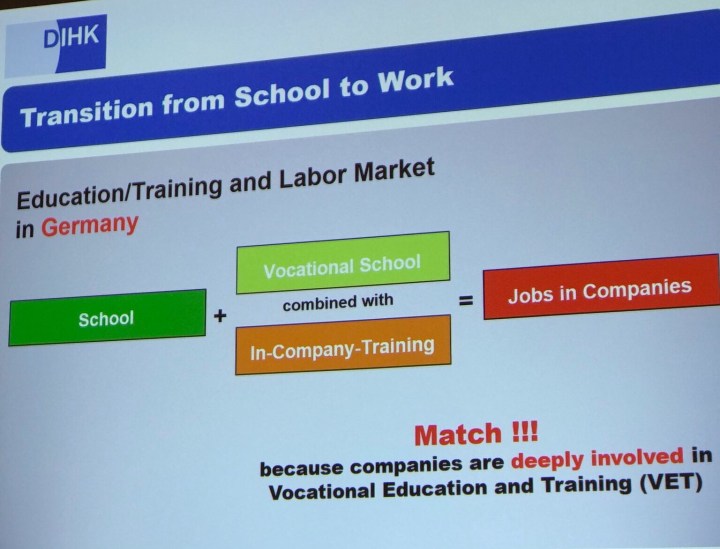
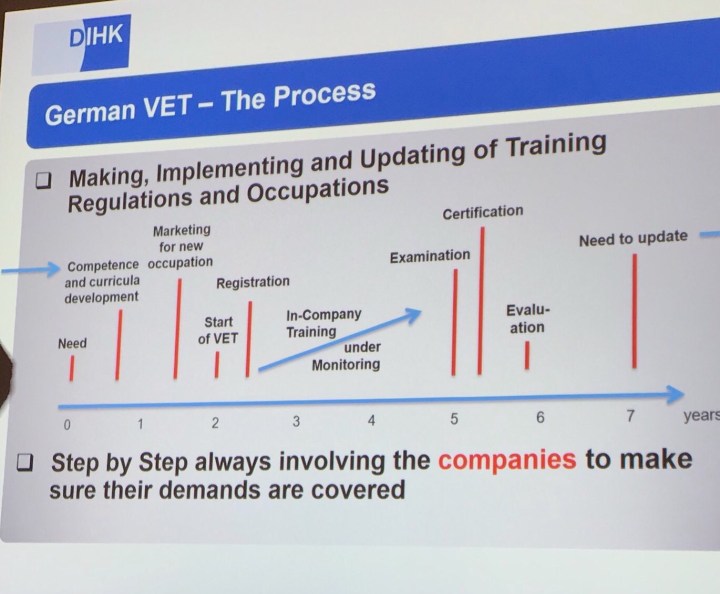
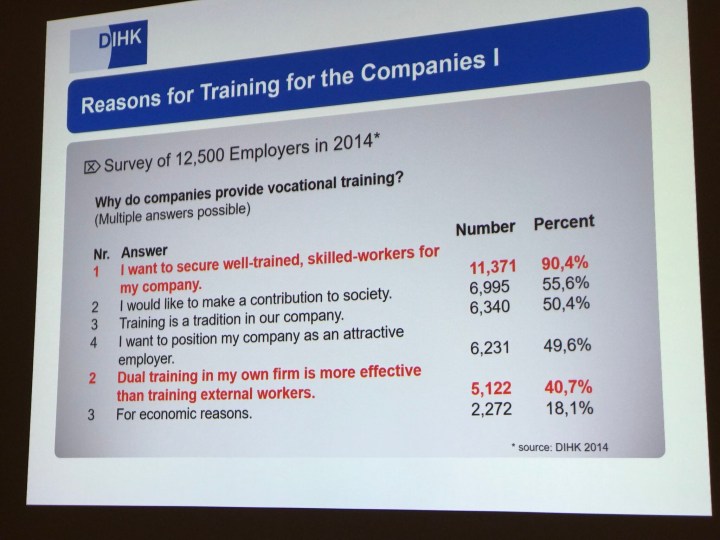 During this time with Sievers we also learned that schools follow the companies and not the other way around. This training model is all about the future of the company, but the companies are not left alone. The companies need support. This is competency based education. The Chambers in Germany provide:
- Organization
- Registration
- Examination
- Certifications on a national level
In this German model there are courses that cover more than 350 different occupations that are approved by the businesses and federal bodies overseeing the program. In Germany, they are truly walking the talk by facilitating students for “Learning to Do, Doing to Learn, Earning to Live, Living to Serve.”
Focus On The Wider World
 Last week I did a 3D Leadership Program™ session on focusing as a leader. It was about focusing on three things:
- Self
- Others
- Wider World
Clearly if we want to be effective leaders we must focus on ourselves. This focus does not mean being self-centered, but self-caring. We must take care of ourselves physically, emotionally, and spiritually. Additionally, we must take ownership of our own professional growth. If we are taking care of ourselves then we can begin to focus on others using our empathy, caring, and relationships.
Another important focus area and focus of this post is to focus on the wider world. To do this I believe it is important for us to not only take a worldview look at our own part of the world, but also look literally at the rest of the world. I will be doing this for the next 12 days in Germany and Switzerland. I am on the plane flying to Berlin, Germany as I write this post. I am very honored to have been asked to go on this trip that was organized by Horizon Education Alliance. There are representatives from schools and business/industry in Elkhart County, Indiana as well as State Representatives, Governor’s Office officials, colleges and universities, and me as a member of the Indiana State Board of Education taking part in this experience and serving as ambassadors of our state and country. Again, what an honor!
I am hoping to add a post to my blog each day as our journey progresses. So, stay tuned to Byron’s Babbles each day to see where we have been and what we have learned. It is going to be fast and action packed learning. Tomorrow we will be attending the 2nd Annual Global SMART Summit in Berlin, Germany. This will be a chance to learn more about Manufacturing 4.0 and I am excited to learn how we can better prepare Indiana’s students to work in this environment upon completion of high school. I am super pumped about all the businesses and industries that will be represented. See the photo here to see who the players are who will be in Berlin:
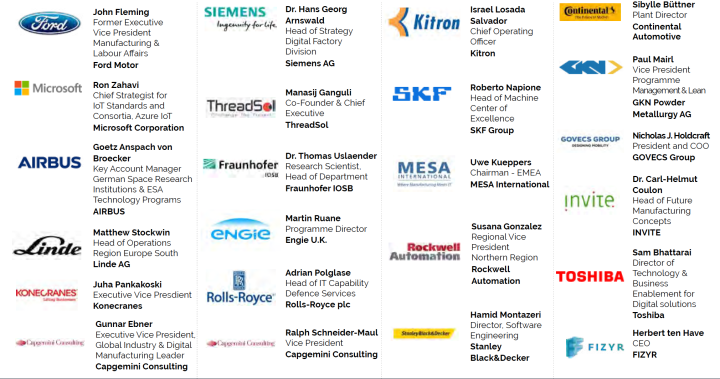
Surely you recognize a few on the list. This will be the who’s who of business and industry. SMART, or 4.0 Advanced Manufacturing applies information and manufacturing intelligence to integrate the voice, demands and intelligence of the ‘customer’ throughout the entire manufacturing supply chain. It marries information, technology and human ingenuity to bring about a rapid revolution in the development and application of manufacturing intelligence to every aspect of business. It changes how products are invented, manufactured, shipped and sold. We will be gaining insights on what it takes to thrive in this new paradigm shift in manufacturing through the use of advanced technology. Our Indiana delegation will be part of the 200+ delegates from the top leading companies from around the world sharing their management strategies on the opportunities and challenges that lie ahead in the Digital Economy.
Back to the point of this post – focusing on the wider world. This is so important because we must practice exploratory strategic thinking and creative thinking. Leaders with a strong outward focus are able to exercise these two skills. These leaders tend to be visionaries who sense the far-flung consequences of local decisions and imagine how the choices they make today will play out in the future.Take Bill Gates: On 60 Minutes, Melinda Gates remarked that Bill was the type of person who would read an entire book on fertilizer. “Why fertilizer?” Charlie Rose wanted to know. The connection was obvious to Bill Gates, who is constantly looking for technological advances that can save lives on a massive scale: “A few billion people would have to die if we hadn’t come up with fertilizer.”
Any business school course on strategy will give you the two main elements: exploiting your current advantage and exploring for new ones. It’s not surprising to find that exploitation requires concentration on the job at hand, whereas exploration demands open awareness to recognize new possibilities. But exploitation is connected to the brain’s reward circuitry—in other words, it feels good to coast along in a familiar routine. So when you switch to exploration to roam widely and pursue fresh paths, you have to make a deliberate cognitive effort to disengage from that routine and maintain open awareness. We must always be looking to spot new opportunities.
Thinking creatively involves three forms of focus:
- Vigilance—remaining alert for relevant information while immersing yourself in all kinds of input
- Selective attention—focusing on one thing while filtering out everything else
- Open awareness, which we’ve discussed earlier
The classic model of creative thinking shows how you use each of these:
• First you use vigilance to gather a wide variety of pertinent information.
• Then you alternate between intense concentration on the problem at hand (selective attention) and letting your mind wander freely, as you might in the shower or going out for a run (open awareness).
Being a focused leader doesn’t merely mean concentrating on the biggest priorities of the year or being in tune with corporate culture. It means commanding the full range of your own attention. With diligence, you can cultivate focus on yourself, on others, and on the wider world. As a result, you’ll be able to direct your attention—and others’ attention—where you need it.
For the next few days I am going to focus on a wider world view. I want to know how the best of the best are leading our industries. I want to learn how the best of the best in Germany and Switzerland are educating young scholars to be ready for post-secondary success. Let me be clear; I do not want the United States to become Germany or Switzerland. What I want is for us to learn the best of what others are doing find ways for us to get better at educating our students. In saying that it does not mean that I do not think we are doing a good job. It means that if better is possible than good is not enough. We need to be pursuing fresh paths by spotting new opportunities with open awareness. I hope you will tune into my blog over the next several days and check out the wider world global learning taking place with a group of us from Indiana, USA.
Leadership Algorithms
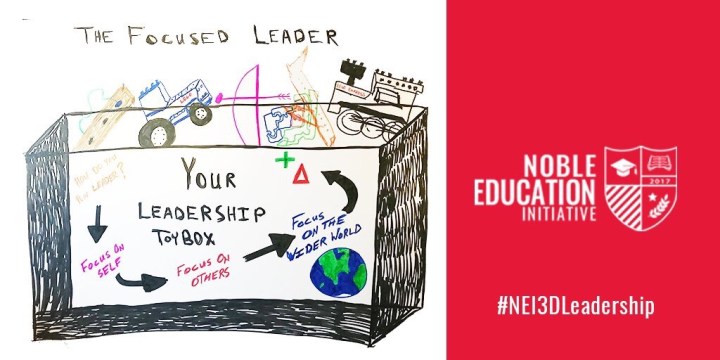 This past Tuesday I facilitated a gathering of our South Carolina 3D Leadership Program cohort. The through line was “Your Leadership Toy Box.” The idea was to use toys to discover ways to be focused leaders. At the beginning of the gathering I had each participant grab a toy and answer the question of how the toy they chose represented leadership. Participants were given 10 minutes to prepare a response in any format they chose. Needless to say, the responses were awesome, inspiring, and most importantly – FUN!
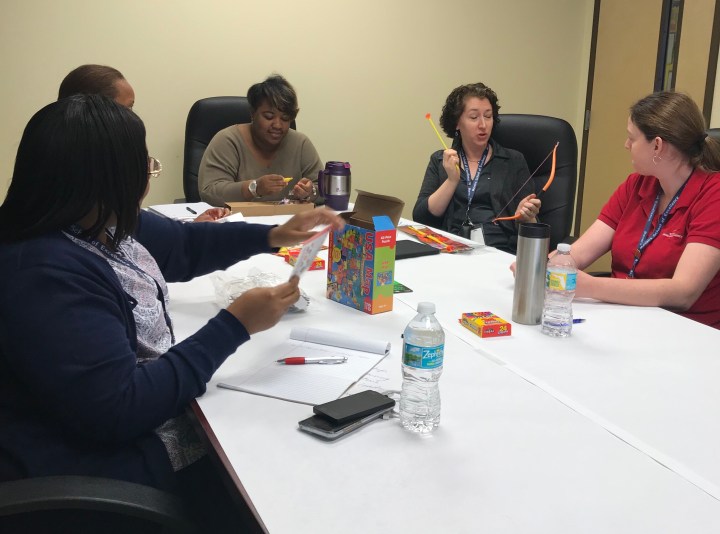 One of the toys chosen was a Rubik’s Cube. As was the plan, this toy caused a lot of reflection, and even more for me after the participant reported out. Click below to watch the video of her presentation: Leadership Algorithms. It’s awesome!
Her reflection really got me to thinking about leadership and education. I thought about how this game reveals lessons that we all face as educators and leaders. Every year, we encounter and solve challenges that must be addressed on several levels, just as the Rubik’s Cube must be solved side by side and layer by layer. Every day teachers make decisions before, during, and after classroom lessons to successfully engage students and lead the learning process, maneuvering through numerous machinations to address diverse learning styles and skills. This is what teacher leaders do. School leaders must search for ways to enable continual school improvement, which requires school leaders to study, plan, implement, analyze, react, and adjust throughout the decision-making and implementation processes. These are the same skills and actions necessary to conquer the Rubik’s Cube.
So what did we learn from the Rubik’s Cube algorithms? Leadership requires us to step back from time to time and re-assess the situation in order to move forward. Successful leaders are continually convening the team to assess and re-assess processes in order to improve. We also learned that making one twist of the cube leads to multiple changes on the cube. When we make changes as leaders, we have to understand there is a ripple effect that affects the team and the organization. Leadership is so much like the Rubik’s Cube because to be a successful leader, we must think several moves ahead of the one we are actually working on. In talking to those who have solved the Rubik’s Cube, they tell me you have to think ahead and there are algorithms. What is your leadership algorithm?
What Do You Think?
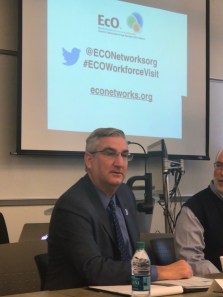
Governor Eric Holcomb
I had the opportunity to meet with an impressive group of community leaders this past Friday. As we continue to work through the guidance and implementation of our new Indiana Graduation Pathways, of which I chaired the panel that created this policy, we are working very hard to learn from the groups in the state that have been doing this work already and successfully. The Community Education Coalition and Economic Opportunities through Education (EcO) Network in southeast Indiana is one such group that brings educators, manufacturing leaders, workforce, and community-based organizations together to coordinate and align educational program offerings for students to successfully connect with well-paying manufacturing occupations.
Last year, the Indiana State Board of Education was charged with establishing graduation pathways per HEA 1003. The goal was to create an educated and talented workforce able not just to meet the needs of business and higher education, but also have students able to succeed in all post-secondary endeavors. To account for the rapidly changing, global economy, every K-12 student needs to be given the tools to succeed in some form of quality post-secondary education and training, including an industry recognized certificate program, an associate’s degree program, or a bachelor’s degree program. Every student should graduate from high school with 1) a broad awareness of and engagement with individual career interests and associated career options, 2) a strong foundation of academic and technical skills, and 3) demonstrable employability skills that lead directly to meaningful opportunities for post-secondary education, training, and gainful employment. During the process of our panel convenings we did a lot of asking, “What do you think?” Now, thanks to the Community Education Coalition we are able to continue to ask “what do you think?” as we work through making sure schools are able to put the pathways in place for students. We are so grateful that they put the event together last week that included Governor Eric Holcomb, State Legislators and Policy Makers, business and industry leaders, higher education leaders, K-12 school leaders, and most importantly students. There was a lot of question asking and learning going on.
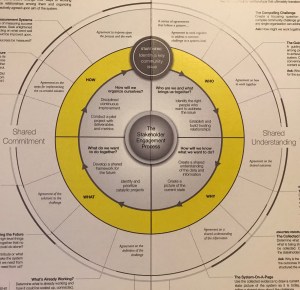 The partners and facilitators of the Community Education Coalition and EcO initiatives have learned to make inquiry a habit of mind, thereby initiating a long-term commitment to continual improvement and growth. This coalition has developed an outstanding process that uses the questions of “who?, why?, what?, and how?” in order to identify key community issues. You can bet the four words of, “What do you think? are asked in this process. Essential to the success of this process was collaboration with colleagues across different disciplines for clarifying their questions and for understanding and analyzing the data they collected. For example, data like: high school graduation rate, education attainment growth, STEM enrollment growth rate, GDP per capita, employment growth, and average annual wages are used as outcomes to measure success.
 This data is then able to be used by stakeholders to answer the questions of “who?, why?, what?, and how?” and the question of: What do you think? We are reminded of how important these four words are in Gem #7 entitled “Four Magic Words: ‘What do you think’” in 52 Leadership Gems: Practical and Quick Insights For Leading Others by John Parker Stewart. In this lesson Stewart reminds us that leaders often fall into the trap of assuming they have the right answer. I am also reminded of the teaching of one of my heroes in community work, Peter Block, who believes that effective leaders are not problem solvers, but conveners of communities of people to solve issues.
“Using these four inclusive words [What do you think?] is evidence of an effective and healthy leader who actively listens to the input of the members of the team.” ~ John Parker Stewart
All research is messy and recursive; and it has been my experience that collaborative inquiry is more so because no one knows the end. You are not starting with answers, but with questions. Throughout the process, partners reflect on what is being observed and found out. The stakeholders may change direction, ask new questions, challenge the inconsistencies they discover, seek new perspectives, and fill gaps in their information. During our gathering on Friday we were reminded over and over that the process of connecting the stakeholders is more important than looking at programs. It would be very hard to replicate programs in all parts of the state, but it would not be hard to replicate the process of deciding what programs are needed and developing programs specific to each area. It is all about bringing collaboration to scale.
To do this we must remember to ask the pertinent questions, listen, and ask “what do you think?”
Got Experience?
 Here’s a question for you: Are skills directly proportional to years of experience?
While I agree that experience will give you more expertise in subject matter, people skills, and well-roundedness—I believe that all these are not necessarily causal of years of experience. Nor do I believe years of experience always correlate with exceptional performance. So what’s my idea of proper experience? It’s having had enough time in the field to see the results caused by your own decisions and workflow. Actually, that can be done in a short amount of time. Conversely, I have known individuals with a great many years experience who really hadn’t grown or improved much. In my field of education, I have known new teachers with little experience in terms of years that were much more effective facilitators of learning than some teachers with many years experience.
This was the topic of Gem #6 entitled “27 Years Of Genuine Growth Or 1 Year Repeated 27 Time” in 52 Leadership Gems: Practical and Quick Insights For Leading Others by John Parker Stewart. In this lesson Stewart taught us that strong leaders seek new opportunities to continually develop and hone their skills. Weak leaders just keep doing the same things and embrace the status quo.
“Make each additional year in your work one of genuine learning and growth.” ~ John Parker Stewart
I view experience as the sum of a few factors: time working, experiences survived, the nature of the role and responsibilities, and potential lessons learned. Really, there is no magic number of years to this. It is about learning from your experience and the idea of continuing to practice and improve. It is not about the difference between experience and not enough experience, but about has it been the right experience. Then it really boils down to what have we been learning from the things we have been doing.
So, do you have x number of years experience, or x number of years doing the same thing over and over?
Failure To Communicate
 We spent a lot of time today discussing communication in our Noble Education Initiative 3D Leadership Program kickoff for our South Carolina and North Carolina schools today.
  Then when I was reading Gem #4 entitled, “The Biggest Hurdle To Effective Communication Is The Assumption That It Has Taken Place” in, 52 Leadership Gems: Practical and Quick Insights For Leading Others by John Parker Stewart. The main point of this gem was to not assume that everyone in the loop has received and understood the message. I really believe it even goes further than this. We also must make sure we understand the Vantage Point of the person we are communicating to.
“Leaders must accept as a constant that when two or more minds attempt to communicate, they are coming from at least two different perspectives.” ~ John Parker Stewart
One of the models I like to teach about to leaders is the Vantage Point Model developed by MG Taylor. Basically, the model looks like a topographical map that takes you from task to philosophy or philosophy to task depending on how you look at it. The lesson here is, though, that it depends on your role as to which Vantage Point you are working from. If we can find a way to communicate and look at all change from all seven Vantage Points we are in a better place to have communicated effectively to all. Here are the Vantage Points:
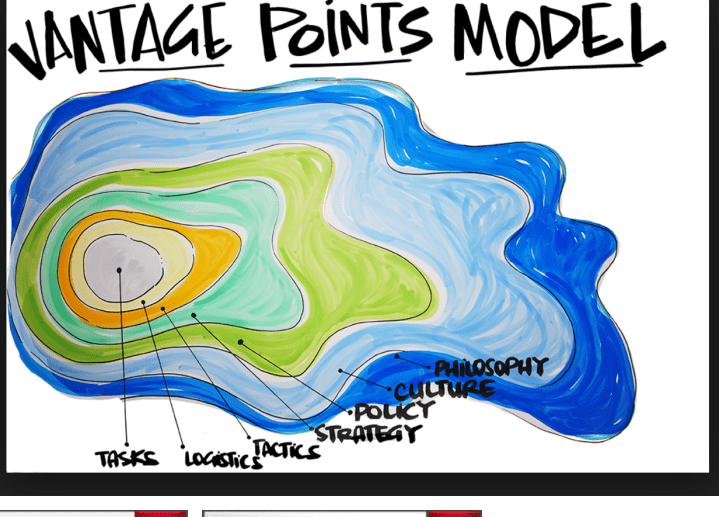
In reality we can never understand the philosophy of an organization or school, in my case, until you are immersed in the tasks that comprise its daily functions. Moreover, our daily tasks can blind people to culture and philosophy, or cause them to accept it too casually. I have found that if organizations can find commonality by using the Vantage Points as a guide it can be become a powerful pathway to effective communication. This model also serves as a guide to answering the “why?”.
Think about all the Vantage Points of those you serve in your next communications.
‘
Reluctant Leader
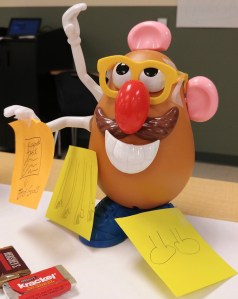 Today when doing one of our newly developed Noble Education Initiative 3D Leadership Program trainings, I had a teacher say, “You know, I would call myself a reluctant leader.” This was in response to me saying that “Everyone is a leader.” And…I really believe it. Interestingly as I dug deeper into the teacher’s comment we realized it was not what you might think. It had nothing to do with being passionless or not wanting to step up to fully embrace his leadership role. Taking on a leadership role does not always come naturally. Lack of confidence, self-doubt, apprehension and fear of failure all hold many gifted people back. Or just simply having a leader who does not embrace developing others as leaders or empowering others in an intent-based leadership environment.
Many times individuals, maybe including this wonderful teacher, might have no pressing desire to be the one that directs and guides others (and would prefer to stay in the background) yet responsibility regularly falls in his lap. If so, he may be what is often called a reluctant leader. The reluctance does not reflect the individual’s desire or ability to be a leader. More than likely, this might be the very type of leader that would fit best into a situation because the reluctant leader is not seeking the opportunity for status or recognition.This type of leader simply wants to serve. I think this describes many teachers.
I really believe we often find this reluctance in teachers. I was that teacher for a long time, too. I just wanted to be a great teacher, period. Then I began to realize I could have a leadership influence in the school and had a principal at the time that embraced that. Out of this added responsibility came my passion as a teacher leader. We must leverage our teachers as leaders if we want to have our schools operating at maximum potential performance for our students. Teacher leaders assume a wide range of roles to support school and student success. Whether these roles are assigned formally or shared informally, they build the entire school’s capacity to improve. Because teachers can lead in a variety of ways, many teachers can serve as leaders among their peers. Teacher leaders are the most important untapped resource in many of our schools today.
Teachers have front-line knowledge of classroom issues and the culture of schools, and they understand the support needed to do their jobs well. Teachers’ contributions are critical to making education reform efforts succeed. When teachers participate in improving education, the changes are more likely to work. Without teacher leaders’ contributions, teachers often pretend to comply with the new expectations, but conduct business as usual once the classroom door is closed.
I loved the fact that at the end of our retreat today the same teacher that had called himself a reluctant leader was now saying, “I must embrace the role and opportunities that I have.” In fact, click here for this teacher’s reflection using his Mr. Potato Head model at the end of the day. It’s pretty powerful. If we can train and help all teachers to be all the teacher leader they can be, think of the great schools we will have. It is our role, as leaders, in whatever the organization, to help our team members be ready to embrace their roles and responsibilities and give them the opportunities for professional and personal growth.
Creating Places of Innocence
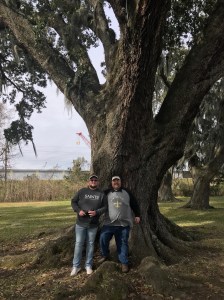
My Son, Heath, And I On a Dad and Lad Adventure
Yesterday in a meeting of North & South Carolina principals, the comment was made that we need to create places where innocence is fostered for our children. This really got me thinking about how we do this both with our own children and the students we serve in our schools. The notion of innocence refers to children’s simplicity, their lack of knowledge, and their purity not yet spoiled by mundane affairs. Such innocence is taken as the promise of a renewal of the world by the children. One of the most delightful things about children is their sense of innocence and wonder, yet helping them maintain that sense of wonder can be challenging in our sophisticated, hurried society.
This rapid and early gain of knowledge by our children is quite the paradox. We all know that knowledge is powerful, but when children learn the wrong things too early it can really be detrimental. Vast amounts of knowledge and information is readily available to our children, and we, as parents, want our children to have this knowledge because we believe it will help them grow and compete. However, this same knowledge can ruin their innocence.
Here are a few things I believe can help us in the creation of places of innocence:
Have fun. Build time into your schedule to allow for silliness, downtime, and play.
Leverage nature and the scenery around us. Children are instinctively attuned to the wonders of nature. We do not have to prompt students to enjoy playing in the mud, seeing the beauty of flowers, watching kittens play. I love the idea I heard one time of planting a family tree and then having family time at each season change to note changes in the tree. My family has a Pin Oak tree that my son brought home from school when he was in the 4th grade that we use for this. In fact, I blogged about this tree in Lesson Of A Pin Oak.
Reading together. This is so important and can even be done with high-school age students. For example, I have chosen to read the same books my son has to read for school. For example, I just read Tough As They Come by Travis Mills because my son was reading it for a class. Wow, what great conversations this spurred for he and I. All I can say is, “try it.”
Use technology wisely and discreetly. Children should not be burdened with information that is too adult in nature. They have neither the cognitive nor social-emotional skills to process this information.
Family events. Or, family events where the children bring a friend. We do a lot of family activities and my son and I do Dad and Lad events/trips. The beauty of these is that we control our own content.
This is way too complex an issue to solve with a blog post, but I believe we all need to be reflecting on creating places of innocence. Most importantly we need to be mindful of what our children are being exposed to and give them more age appropriate choices. If you have thoughts on this important and complicated issue, please comment/respond to this post.
 Byron's Babbles
2 comments