Creating Autonomy Is More Than Stepping In A Puddle

Simple Truth #12, “Create Autonomy Through Boundaries”, in Simple Truths of Leadership: 52 Ways To Be A Servant Leader and Build Trust, Making Common Sense Common Practice by Ken Blanchardand Randy Conley reminded me of what my friend and mentor David Marquet always says, “[empowerment and agency without developing the technical skills will create chaos.” Blanchard reminded us of this in this chapter when he said, “Ensure people are aware of all procedures, rules, and laws” (p. 37). The development, goals, expectations, and accountability give us the boundaries.
“A river without banks is a large puddle.”
John Carlos and Alan Randolph in Empowerment Takes More Than A Minute
Just yesterday, as I was in a gathering as a part of some Aspen Institute work in education I am doing right now, we were contemplating how to make sure our educators have the professional growth and development to do all the work that science tells us is necessary to enhance the quality and depth of student learning when the students have opportunities to interact with others and make meaningful connections to subject material. This is really a combination of the teachers and students having the autonomy to do this important work. Therefore, it is important for organizations to take a systems approach to promoting development and addressing both student and adult skills and beliefs; organizational culture, climate, and norms; and routines and structures that guide basic interactions and instruction. I don’t believe this looks much different no matter what the organization is in the business of doing. If we want more than a “puddle” of autonomy we must create the meaningful opportunities for developing the right ethos for autonomy, agency, and empowerment.
Don’t Be A Courage Crusher

Courageous Cultures: How to Build Teams of Micro-Innovators, Problem Solvers, and Customer Advocates by Karin Hurt
My rating: 5 of 5 stars
A courageous culture becomes a community where individuals are engaged and finding, developing, and using their full potential. I love that “courage crushers” were called out by Hurt and Dye very early. Sadly, I have worked in organizations with these types. These are toxic environments, as you pointed out. Also, I loved the thought of creating a courage oasis.

I have always been big on the point of there needing to be clarity. This became very evident during the pandemic. As Hurt and Dye pointed out, there cannot be curiosity without clarity. It was also discussed that with clarity of goals, processes, and roles and responsibilities comes a safe place.
Finally, I loved all the tips and real examples sprinkled throughout the book. For example, I loved the example of the “magic button” for employees to use to provide feedback and give ideas. If we truly want organizations and communities where everyone is engaged, we must provide safe place where those we serve can be courageous. Everyone needs to read this book, but if you are a “courage crusher” PLEASE read this book!
View all my reviews
Asking Better Questions
Questioning is such a powerful tool. Asking questions is a skill that should be developed and honed. In fact, there are careers such as doctors, lawyers, and police officers, where an important part of the training is in the art of developing questions and asking them. I was reminded of just how important the leadership skill of questioning is when watching a Major Crimes rerun and Lieutenant Louie Provenza (G. W. Bailey) said, “Well, we may not have all the answers, but I think we have better questions.” Before focusing in on answers, we must figure out the crux of the matter: the essential problem or question to be addressed.
When you think about it, most of our day, no matter what we do, is spent asking others for information. Asking questions unlocks learning and is very important in building relationships. What is the key to getting better questions? We need to listen more (no surprise there) and, well…ask more questions. Genius! Research tells us there are several reasons why more questions aren’t asked. Sometimes it’s ego and wanting to look like the smartest person in the room, sometimes it’s being scared of the question being viewed as dumb, or just not speaking up. Sometimes, I just believe we forget the power of a good question.
I am that person that when the conversation or discussion is about done, that will have a couple of questions. Remember Columbo doing that? “Oh, just one more thing…” I really like to listen to what others are saying and slowly process. I even write questions down and sometimes even put numbers by them, representing the order to ask them so I don’t forget the questions. The technique probably is not as important as remembering we should end more sentences with a question mark than with a period. What do you think?
Who Are You?

You all know I love the television show Blue Bloods. This past week in Season 12 Episode 16 Officer Angela Reddick (Ilfenesh Hadera) has been shot. Frank Reagan (Tom Selleck) tells her, “You know who you are. Be that!” There have been comments about that statement and some fellow enthusiasts even think more is yet to come related to the comment. Commissioner Reagan actually made that same comment to her twice in this episode. I think it was Socrates that said, “To know thyself is the beginning of wisdom.” So, we need to know who we are. For me this has a great deal to do with knowing my core values, feelings, interests, and passions. These provide guidelines I can apply to solve life’s varied issues.
When our outside actions are in accordance with our inside feelings and values, we will experience less inner conflict. We know more about ourselves than anyone else. When we know who we are, we know what we need to do instead of looking for permission from others. When we understand ourself we will begin making a bigger impact on the world. I guess that is the “Be that” part of the quote.
Shakespeare taught us, “to thine own self be true.” If only I could have dinner with Socrates and Shakespeare to discuss this! I believe that to “Be that!” means maximizing our potential. There is no wondering, wishing, or hoping when we know who we are. In fact, we can celebrate being empowered to be who we are. Do you know yourself? If you do, are you willing to “be that” person?
Our #1 Customers

This week, Simple Truth #11, “Profit is the applause you get for creating a motivating environment for your people so they will take good care of your customers”, in Simple Truths of Leadership: 52 Ways To Be A Servant Leader and Build Trust, Making Common Sense Common Practice by Ken Blanchardand Randy Conley reminded us that our number one people in our organizations are our people that make it all happen.
“If you train, empower, and care about your people as your number one most important customer, they will go out of their way to take care of your organization’s number two most important customer – the folks who buy your products and services.”
Simple Truths of Leadership, p. 35
So, don’t forget…make your team members and employees number one so they can make those your organization serves number one!
Discretion
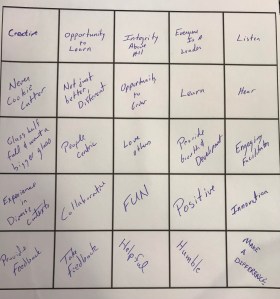
I did a Bingo card strengths/talents/values activity during a leadership development gathering this week with the great leaders I get to work with at Hamilton Heights School Corporation focused on building highly effective teams. The focus was on both being a great team member as well as being a great team leader. Filling out the Bingo card starts as an individual activity, but also has some time allowed for discussing getting to exactly the right words and helping each other find the right words. I always do this activity right along with the groups and my Bingo card is the featured photo of this post. This group was really into getting the right words to describe their strengths, talents, skills and values. This group’s discussion inspired me to think deeper about those traits as well.

It always seems that in the days after doing this activity I come across an intriguing word that I would maybe like to add. Today, while reading the incredible book The Body Scout by Lincoln Michel I read the line, “Do you know what the most important trait we look for in a great baseball scout? Discretion!” I have paraphrased a little here, but discretion is an interesting trait. Check out the definition:

I love the dual definition that discretion has. Discretion is something we should have as a great leader and team member. And, it is something we should give as a great leader. It is so important for us to use discretion when working with others. Great leaders are required to extensively exercise discretion to address the issues they face. Discretion must be used in the current context. Discretion is a behavior that involves using our core values. The sniff test I use is asking the question, “Is this my story to tell?” Guess what? Most of the time it is not. That helps me use discretion.
Additionally, as a leader whose mantra is “make it so” we must be ready to give discretion to those we serve. That also means we must have those we serve developed with the technical skills to effectively use that discretion. This really made me think about those times when I’ve been told, “Byron, use your discretion.” I don’t know about you, but that makes me feel really good! Think about how that makes others feel when you say it. As a teacher, it also gave my students incredible agency, gave them tremendous empowerment, and engaged them.
So, I encourage you to use discretion! It really is an important trait. But remember, great leaders do not use their discretionary freedom for personal rather than organizational benefit. With discretion comes the ‘do the right thing’ distinction and we must be aware of the importance of choice and vision. At the same time once a choice is made it’s critical that ‘things are done well’. In other words, the choice made is executed well, and others on the team are given discretion, thus engaging everyone in the delivery.
Using Different Strokes For The Same Folks

With this week’s simple truth, I realized just why Ken Blanchard and Randy Conley wanted to name their latest book, DUH! Why Isn’t Commonsense Leadership Common Practice? instead of Simple Truths of Leadership: 52 Ways To Be A Servant Leader and Build Trust, Making Common Sense Common Practice. Simple Truth #10 entitled “Effective servant leaders don’t just use different strokes for different folks, they also use different strokes for the same folks” reminds us that the people we serve will be at different development levels for the different goals, projects, and initiatives they are working on. Therefore, our people will need different strokes (leadership styles) for the different things they are doing.
“Managers who are servant leaders take a situational approach in leading people. They know they sometimes need to use not only different strokes (leadership styles) for different folks but also different strokes for the same folks in different areas of their job.”
Ken Blanchard (2022). Simple Truths of Leadership, p. 31.
So many leaders believe project improvement is all about emphasizing efficiency measures instead of the behavioural or interpersonal factors. While achievements of performance measures such as time, budget, and functionality are important, leading people to deliver results is needed instead of managing work. This also means that leadership style and the ability to practice situational leadership and use the right style in the moment for each individual. Let’s also not forget that this also reaffirms how important relationships are to leadership. We must really know those we serve to know the different strokes.
Thinking About Love

What is love? Now there is a question. When I looked it up there are at least eight different kinds of love depending on what source you are studying. Lately, however, I have been obsessed with this idea of leaders, organizations, businesses, and now even governments, loving their people. We all want a community in which to “belong”. A community in which everyone can bring their best self to and leverage their talents each and every day. If we want people to be engaged, whether at work or civically, we must create communities of belonging. So how do we do that? By loving each other!

My thoughts on this were prompted by a line Rob Hart put in his great new book that I just finished, The Paradox Hotel. I’ve got pages of quotes from the book for further pondering, but here is the prompt for this post: “There are different kinds of love, nevertheless they are all still love.” Very true!
Maturana and Verden-Zöller (2008) asserted that, “We humans are loving animals that become ill when deprived of love” (p. 7). They went on to assert, “…that these many different expressions do not denote different forms, kinds, or levels of love as an emotion, but that they in fact connote only different relational dimensions of our living as loving animals” (Appendix 10). So, nevertheless, all the different kinds of love are still love. It seems we have let success, measured in monetary terms, expectations, or desires for what others do take over for our love. Because love is not blind acceptance we must be sincere in creating mutual respect. Love is about a coexistence where we do not put our own desires expectations or aims ahead of others and begin to manipulate. When we think about love in this way it really is about a feeling of belonging and making sure others have the opportunity to belong.
Clearly, love is a complex thing, but all the different kinds of love are still love. What goes around comes around. So let’s all show a little more love.
Reference The Origin of Humanness in the Biology of Love, Humberto Maturana Romesin and Gerda Verden-Zöller Edited by Pille Bunnell, Imprint Academic 2008.
Different Strokes For Different Folks

I love the phrase “different strokes for different folks.” I’m such a believer and advocate for individualization, personalization, and differentiation for everyone. We work at this in education for all scholars, but we need to be diligent about doing this for those adults we serve as well. Here we are in the ninth week of the year and in Simple Truth #9, “Effective Servant Leaders Realize They Have To Use Different Strokes For Different Folks”, in Simple Truths of Leadership: 52 Ways To Be A Servant Leader and Build Trust, Making Common Sense Common Practice by Ken Blanchard and Randy Conley we are told that the best leaders use different strokes (leadership styles) for different folks. To be flexible and differentiate for those we serve we must, “Determine whether they are generally an Enthusiastic Beginner; a Disillusioned Learner; a Capable, but Cautious, Contributor; or a Self-Reliant Achiever” (p. 29). I’m going to make you read this great book to get all the details.
Furthermore, I believe this flexibility is part of loving those we serve. When we really take the time to understand and build relationships with others, whether our students or those we work with, we can help to individualize and differentiate for what styles and support will enable them to thrive.
Try Calling In

I was so happy to see “New” pop up on the television in the description for The Equalizer last night. I love the show. Delilah (Laya DeLeon Hayes), Robin McCall’s (Queen Latifah) daughter, had called out one of her school friends over a question of family heritage. In a discussion with Delilah, Viola “Vi” Marsette (Lorraine Toussaint) told Delilah that instead of calling her friend out, she should try calling her in. We really have become a call-out culture and taken conversations that should be opportunities to inquire and learn and turned them into mud slinging or even worse. Some are even referring to this as the “calling out culture.” It has become so easy to call-out others on social media, television media, YouTube, or other message boards. It is even curious to me how brazen people have gotten at calling others out in public.
To me, “calling in” would be would be the more loving way to have a difficult conversation. And, when we can, how about doing it in private and with respect? Calling in could take us from blame to contribution. As a participant in a leadership development gathering I facilitated this weekend pointed out, we need to listen to hear. Calling in helps us to do just that – hear. In most cases, calling someone out has become trivial, oriented toward turf protection, and despicable. This verbal “trashing” reminds me of what I believe the Ancient Greeks called an “ad hominem” attack. With this attack, the opponent attacks us personally, changes the subject, and uses “virtue signaling”. I blogged about virtue signaling in Leading Without “Virtue Signaling”. So, let’s call others in and make sure we are listening to hear and understand.
 Byron's Babbles
leave a comment