Servant Leadership: Being Liberated From Self-Concern
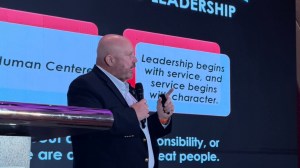
Back in 2018 I wrote, Servant Leadership; Not Just Cliché. Still, with so many leadership buzzwords and corporate jargon, I worry that servant leadership has become undeniably a cliché. Everyone touts being human-centered, but are they really living up to what it means. I’m still reading through my notes and highlights from reading The Gospel According to Tolkien: Visions of the Kingdom in Middle-Earth by Ralph C. Wood. Wood argued that, “To be a servant is to be liberated from self-concern. It is to be so fully devoted to the common good that one hardly thinks of one’s own wants and needs at all.” That’s a really good definition!

Wood also pointed out that we have the ultimate example of servant leadership from God. Wood posited that “God did not assume the life of a ruler or king, a prophet or philosopher, but rather the role of a servant.” He goes on to point out that many of the characters in J. R. R. Tolkien’s The Hobbit and The Lord of the Rings lived by contentedly serving to unmake the Ring. Frodo and Sam, as well as Merry and Pippin, all served not for glory, but to make Middle-earth a better place.
“Christ Jesus, … though he was in the form of God, did not count equality with God a thing to be grasped, but emptied himself, taking the form of a servant, being born in the likeness of men. And being found in human form he humbled himself and became obedient unto death, even death on a cross” (Phil. 2:5-8).
Frodo, Sam, Merry, and Pippin display humility by taking on the tremendous burden of destroying the Ring, often putting the mission above their own safety and comfort. Servant leaders prioritize the needs of others and are willing to make personal sacrifices for the greater good. A pretty good reminder on this Memorial Day Weekend as we honor those here in the United States who paid the ultimate sacrifice for our freedom.


leave a comment