Taking Subjective To Objective
I talk about language mattering a bunch. Also, I talk about using buzz words, and words that don’t really mean anything. Then, this morning I read a great piece by Alex Dripchak that was a good reminder of words not to use. His article, “Starting A Career In Sales? Avoid These Words!” was in the context of sales, but the principles really apply to everything. Even as a person who is critical of word choice, I wanted to go back and read everything I’d written in the last week and make sure I wasn’t using the “bad, worse, and worst” words suggested. Alex calls these “trigger” words.
Furthermore, they are words that are overused and assumptive, according to Alex. I love this way of describing what I always call buzz words. Most recently I blogged about this in the context of core values in Core Values Are The Heart & Soul. In that post I added hoopla and corporate gibberish to the words we shouldn’t use. In taking another look at my post, I wonder if “authentic” is another word that has been used to the point of having no meaning (I’ll ponder that later).
Alex told us to make the subjective, objective. He noted that “best,” “unique,” “innovative,” and “cutting edge” were rendered hollow a long time ago. Using the teaching of Lee Salz, Alex said, “…if you can’t prove it, don’t use it.” I know I said I would ponder it later, but “authentic” has been rendered hollow too. If I understand Alex correctly what would be better, would be to say, “I am different because…” Thus taking subjective to objective.
Eliminating Disdain & Maintaining Respect

In the leadership development work I do we always all agree that relationships are the key to everything. And, they really are. Healthy and respectful working relationships are a must if you want an effective and enjoyable workplace, organization, community, or even world. One cornerstone to healthy relationship building is intellectual humility. When practicing intellectual humility, we open our minds to learning. With intellectual humility we become wiser. It is really about realizing that we can learn from opposing views and have more constructive discussions, even when we disagree. Practicing intellectual humility allows us to be less judgmental of others.

This has actually been a topic of my blog posts many times before. I began thinking about virtue signaling, which I first blogged about in Leading Without “Virtue Signaling.” Then, this morning, when reading in Amor Towles’ incredible book The Lincoln Highway, I came across this statement about Emmett Watson, an 18-year-old Nebraskan farm kid just released from a Kansas juvenile detention center after serving 15 months for involuntary manslaughter: “Emmett was raised to hold no man in disdain. To hold another man in disdain, his father said, would presume you knew so much about his lot, so much about his intentions, about his actions, both public and private, that you could rank his character against your own without fear of misjudgment.” That’s a pretty powerful statement, don’t you think? By not judging, virtue signaling, or holding others in disdain we enable a community that values learning and where learning happens when what is not known or understood is acknowledged.
We must model this humility by admitting when we do not know or understand something. Modeling also involves recognizing the value in opinions that are different from our own. In the face of conflicting evidence, we need to be open to changing our opinions. The disdain and contempt described by Emmett’s father destroys teams, communities, and relationships. It prevents trust and respect and makes it hard for any real human warmth. It is tangibly damaging, causes stress and can harm people emotionally, mentally and ultimately physically.
Finally, I am reminded of what Carlo Strenger said: “The difference between civilized disdain and political correctness is that the former allows one to feel disdain for a person’s or group’s views or beliefs while maintaining respect for the human beings that hold them.” There will be gaps in knowledge, ideological divides, differences of opinion, and cultural differences, but we must strive for fruitful cooperation and shared learning to be effective world citizens.
One Of A Kind Of Days

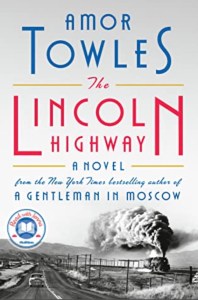
I seem to be on a role blogging about Amor Towles’ great new book The Lincoln Highway. Towles is an incredible storyteller, as I pointed out in The Long & Short Of Great Stories. There are so many points in his books that cause me to think and reflect. I really like the character, Woolly, in the book. Woolly told us that we need to turn “every-day-days” into “one-of-a-kind of days.” I love this! Think about it: too many times we get into a rut liking the every-day-days, but it’s so great to have days with no equal and that are completely unique.
What if we could do something we had never done before every day. Now those would be one-of-a-kind of days. Our goal could be to use everything that happens as an opportunity for a one-of-a-kind experience. As I write this my plane has been delayed for two hours. I am going to go explore. Who knows what I will find? Maybe inspiration for some great activity; maybe some new technology; maybe a new acquaintance I would have never known; who knows! Here’s what I do know: while others are griping, moaning, and stressing, I’ll be exploring.
The power to make each day something special is ours. But, we must be responsible for our own experience. Grandiose things don’t have to happen for a day to be special. We need to appreciate the little things. Pay attention and notice things that would pass you by in an “every-day-day.” The little inconveniences of the day can turn into incredible experiences. We need to pay attention to the sounds, smells, and sights that probably get ignored on the “every-day-days.” If we don’t look for extraordinary in the ordinary, we won’t find it. Believe it’s there, believe we will find it, and we will.
I guess it all comes down to making the most out of each day. I don’t want to be content with “every-day-days.” I want to make a difference for others and help others each and every day. To do this I will need to make every day a “one-of-a-kind of days.”
The Long & Short Of Great Stories
We’re all in situations where we have to be able to tell stories. I believe story telling is an important skill for leaders. It’s one reason I have fell in love with reading fiction novels. We can learn from great authors like Amor Towles. I am reading The Lincoln Highway by Amor Towles right now and loving it. A quote I wrote in my notes the other day while reading was: “The funny thing about stories is they can be told as long stories or short stories or anything in between.” I thought about this today as I was doing a leadership development gathering in Georgia. A lot of how I facilitate gives the participants an opportunity to reflect and tell stories. Some are short and we long for more, others are long, and many are in between. Not everyone is a natural-born storyteller. That doesn’t mean, however, that we don’t run into a ton of different situations where we need to do just that.
I love listening to peoples’ stories. The more animated they get, the more interested I become. Our stories should be anchored in personal experiences and show vulnerability. I also love imagery. Imagery is one of the things I love about Towles’ writing. He is a master at this and I am striving to learn from his work. Right now I am reading about Duchess’ and Woolly’s trip from Nebraska to New York in the Studebaker they “borrowed” from Emmett without his permission. On the trip they are staying in Howard Johnson motels. Remember them? Orange roofs and blue spires. When Towles described the buildings, rooms, the restaurant, and even the food and placemats I was transformed back to my childhood and could see myself there with my parents. I was transformed back to those days gone by. Amazing! Towles knows how to give just the right amount of detail without overwhelming with unnecessary details. Something we all need to hone in our own storytelling. Reading the work of great writers helps us do this.
Good storytelling isn’t about buzz words and fancy language. It’s about conveying our message clearly and simply. We need to connect with our audience as humans. I always try to tell stories as if I was telling the story to my friends sitting around a fire on my back porch. Or, better yet, consider how you would tell the story standing around a water cooler. I guess shorter probably is better, but always remember, every story can be told long, short, or in between – the message is the key.
Separating The Idle From The Industrious

I’m now getting to another prompt for a post that I had on my “to blog about list.” This prompt is from another quote in The Lincoln Highway by Amor Towles: “Time is what God uses to separate the idle from the industrious.” I learned from David Marquet that great leaders understand how to control the clock. This quote got me to thinking about this control of the clock. When I looked up being industrious, this is what I found: industrious: applying oneself with energy to study or work; actively and purposefully getting things done; opposite of being idle and accomplishing nothing. The best example of why we need to be industrious is thinking back to being a kid (okay, I still kind of am a kid). The worst days ever were the ones when there was nothing to do. Time seemed to stand still – I wasn’t controlling the clock. When we are idle and purposeless, we are at our unhappiest.

The way to happiness is finding purpose in how we use our time. We are at our best when our time includes industriousness that leads to tangible production. Also, think about that great feeling at the end of a very productive day of working really hard. It’s such a great “tired.” There are a lot of days like this on the farm. This feeling also happens when you are taking the shot where others will not, and doing things that other people may consider difficult. Time passes whether we are controlling the clock or not. The best athletic coaches are the ones who know how to control the clock the best.
My takeaway from the interaction in Towles’ novel was that we need to find purpose to truly be industrious. When we take a moment to really look around to see what is out there, we can find an unlimited number of things that can and should be done for ourselves, for others, and the betterment of the world. Participating in resolving these things can help us not only feel useful and helpful, but actually be useful and helpful.
Our Many Faces
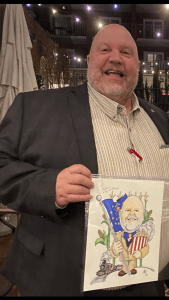
This week I was reminded how important our ability to read faces is. And, how important the faces we make are. First, on Monday, I was given a caricature and was described as Jupiter, the bringer of jollity, from The Planets. I blogged about this in Leading With Jollity. I have always taken pride in being able to read faces. It is such an important skill when teaching and facilitating learning. I love to read and interpret the feelings and expressions of those around me. It turns out we are all born with this intuition. Within a few hours after we are born, we recognize the face of our mother.

I am reading the fascinating book, Read The Face: Face Reading For Success In Your Career, Relationships, and Health by Eric Standop right now. Face reading, according to Standop, is our first language. As a master face reader, Standop is able to read personality, character, emotions, and even the state of a person’s health. This can all be done from simply glancing at their face. While certainly not trained in this, I still believe it is important for us to be able to pick up on the clues of face reading and continually work at paying attention and honing this skill. When I am facilitating learning for a group I always try to watch for the facial cues of the participants. I can tell when someone has something to say, a question, agreement, or is in disagreement. These cues help me to let the discussion deepen organically and play out.
My many years of teaching agriculture science gave me the opportunity to hone these skills. In the past few years, working with adults, I have had the chance to hone them further. And, one of the perks of virtual meetings is that we can really study the faces of others. Clearly, if you read Leading With Jollity, you’ll find that Christine Benson had the caricature done of me, and described me as Jupiter, bringer of jollity, from only getting to know me through Zoom meetings. Actually, that was a pretty accurate description. To me this proves that we can get to know people well in a virtual setting. In many cases I have been able to get to know people even better. Sometimes discussions go even deeper online. I am not saying that I do not want to be in person, because that is still my preference, but if we use our innate ability to face read to the fullest we can form even deeper relationships. What are you learning from others’ faces? What is your face telling others?
My Memories Matter

As I wrote the rough draft of this post I was on a plane taxiing to the runway at Reagan National Airport in Washington D.C. As I looked out window I saw the dome of our Capitol and the Washington Monument (see my pictures). This caused several moments of reflection. I thought about all 12 U.S. Presidents that have been in office since I was born. I thought about the Vietnam War that happened during my lifetime. I thought about President Nixon and his resignation. I thought about the first President I voted for, Ronald Reagan. I thought about the first Gulf War. I thought about 9/11. I thought about wars in Afghanistan and Iraq. I thought about all the time my son Heath and I spent in Washington D.C. when he was growing up when I brought him with me to the Washington Leadership Conference of the National FFA Organization every year. I thought about getting to pay my respects to Ronald Reagan as he was lying in state in the Capitol rotunda. I thought about being with President Obama in the Oval Office. I thought about spending time with, then Vice President, Joe Biden and Dr. Jill Biden at Number One Observatory Circle. I thought about being awarded the Smithsonian Diffusion Award in the Smithsonian Castle. I thought about the fall of the Berlin Wall, the end of the Cold War, and getting to stand at the Brandenburg Gate where President Reagan told Gorbachev to tear down the wall. I thought about being in Vice President Pence’s White House Office. A lot of memories were running through my mind. I realized I’ve experienced a lot in my almost six decades.

That’s a lot of history. That’s a lot of memories. But what does it all mean? Does living through all that matter? Yes, all those memories matter! Our memories make us who we are. They create our worldview in ways we hardly realize. It is why we must be always creating the situations to create memories for our children. We also need to be creating memories for our students. All that we have ever learned, from how to get along and play with others, how to read, and even how to resolve conflicts, makes us who we are. That is why who taught us and our experience of the things we have learned are all embedded in the memories themselves.
Our memories are essential because they allow us to grow and learn to be a better person. Our memories help us understand why we are who we are. When we understand why we are who we are, we become empowered to create ourselves intentionally. Oscar Wilde said, “Memory is the diary that we all carry about with us.” I am so glad that my peek out the airplane window caused me to open my mind’s diary and begin reflecting on who I am.
Leading With Jollity

My dear friend, Christine Benson, who is chair-elect for the National Association of State Boards of Education (NASBE) has introduced me to a new piece of culture: The Planets. This work took three years to compose (1914-1917) by Gustav Holst. Basically, the composer attributed characteristics to the seven planets of Mars, Venus, Mercury, Jupiter, Saturn, Uranus, and Neptune. Christine told me that I reminded her of Jupiter, the bringer of jollity. She told me that as the round-faced cheery uncle of all the planets, and king of the gods, Jupiter is impressive and majestic. I guess I lead with jollity. I love the fact that Holst was a student of astrology and horoscopes in the context of the planets inspiring music.

One description of the musical representation of Jupiter was that it took us on a whirlwind of emotions which was full of climatic passion, zeal and triumphant feelings. I was beginning to understand where Christine was coming from thinking this described me. With Jupiter, the air is full of life, joy, heroic and majesty. Jupiter brings jollity and is an up-lifter because it signifies happiness and abundance, expansion and brings a disposition of mirth, joyousness, hopefulness and trustworthiness, expectant and confident, and a desiring for devotion through service. Jupiter also transforms the mercurial, logical mind, bringing wisdom and understanding which promote nobility of thought and aspiration.
To immortalize my jollity, Christine had a caricature done representing me. I especially love that she had the artist do it using images she screenshot during Zoom meetings and things I have talked and mused about during meetings. This just goes to show that we really can get to know each other well in a virtual setting. That has been a silver lining of the pandemic that I do not want us to ever lose sight of. I love the substantive conversations in the virtual world that come from making a real connections with those who we are on line with. The power is always in the dialogue. It is about being human no matter whether we are in person or online; the power in interactions is to take time to truly and more deeply understand what each other is experiencing. Over the past couple of years we have created new patterns and rituals together. These new patterns and rituals bring a sense of structure, unity, and collaboration. Understanding what matters most to us and discovering who we might become, and then help as a result, is the real work of our lives. Let’s approach all this with jollity.
The Proof Of The Pudding Is In The Eating

As a person who lives by metaphor and idiom, I love that English is a language rich with imagery, meaning, and metaphor, and when we want to express ourselves we can draw upon a catalog complete with beautifully turned phrases, drawing from the language’s Latin, French, and Germanic roots. I was reminded of this last night when presented the most beautiful piece of cheesecake I had ever seen (see featured photo). When I said this, the person giving it to me said, “Well, the proof is in the pudding.” Then he immediately said, “What does that mean, anyway, the proof is in the pudding?” Umm…let’s see. I believe this might be an idiom.
So I guess this phrase originated in 1605 as a proverb that went, “The proof of the pudding is in the eating.” That actually makes much more sense, don’t you think? At least now I don’t think I have to dig in pudding looking for a proof – I was having awful flashbacks from geometry class in high school.
I believe understanding this phrase is pretty simple: It doesn’t matter how fancy the decoration and presentation, the true test of a pudding is in how it tastes. In other words, success of something can only be judged by putting it to its intended use or experiencing in its final form. It’s all about results.
Leading Like A Orchestra Conductor

A few weeks ago I got a very nice complement (in the form of a tweet) from Lauren Berry, a participant in one of my leadership development sessions that said, “Fireside chats and pumpkins galore! This crew had a blast reflecting on our time with the #NEI3DLeadership program! The biggest shoutout to @ByronErnest as our fearless leader. We have learned so much from you!” This tweet meant a great deal to me and I responded, “Words can’t express my appreciation for your tweets. Thank you! I am merely the conductor guiding the performance, not making it happen, not bringing it into being – YOU & the others in your cohort are making the beautiful music that makes these gatherings so special.” Then I got to thinking, as I always do, shouldn’t we be striving to be conductors instead of leaders?

I heard it said once of orchestra conductors that the music flows from the pages through them, they are avatars of a bigger purpose, conduits of a bigger collective goal. The idea of being conduit is also huge for me. Think about that metaphor: a conduit is something that channels or conveys something. Think about water or electricity being moved to everyone who needs it. That’s what I strive to do. Help everyone be better conductors of their orchestras (aka organizations). I hope your catching all of this play on words. But, it’s really not just words; we are on to something here.
Back to our conductor. They don’t tell the musicians how or what to play, they set the pace, cue them in, and guide. They do not bring the the beautiful music into being or make it happen. They are merely the conduit. The conductor has a premium vantage point to help bring about optimum collaboration of the entire orchestra.
Great conductors let the performers thrive in a framework that evolves as the composition progresses. The conductor is only a part of a magnificent performance. They have helped bring out the talent of every musician and cued in every resource with perfect timing. Then after taking a quick bow to the applauding audience, diverts all credit to the musicians in the orchestra (watch a conductor sometime). Are you leading like a conductor?
 Byron's Babbles
leave a comment