Discretion
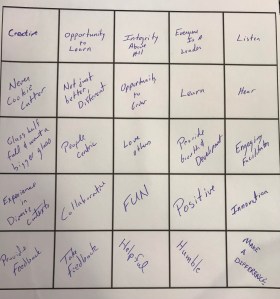
I did a Bingo card strengths/talents/values activity during a leadership development gathering this week with the great leaders I get to work with at Hamilton Heights School Corporation focused on building highly effective teams. The focus was on both being a great team member as well as being a great team leader. Filling out the Bingo card starts as an individual activity, but also has some time allowed for discussing getting to exactly the right words and helping each other find the right words. I always do this activity right along with the groups and my Bingo card is the featured photo of this post. This group was really into getting the right words to describe their strengths, talents, skills and values. This group’s discussion inspired me to think deeper about those traits as well.

It always seems that in the days after doing this activity I come across an intriguing word that I would maybe like to add. Today, while reading the incredible book The Body Scout by Lincoln Michel I read the line, “Do you know what the most important trait we look for in a great baseball scout? Discretion!” I have paraphrased a little here, but discretion is an interesting trait. Check out the definition:

I love the dual definition that discretion has. Discretion is something we should have as a great leader and team member. And, it is something we should give as a great leader. It is so important for us to use discretion when working with others. Great leaders are required to extensively exercise discretion to address the issues they face. Discretion must be used in the current context. Discretion is a behavior that involves using our core values. The sniff test I use is asking the question, “Is this my story to tell?” Guess what? Most of the time it is not. That helps me use discretion.
Additionally, as a leader whose mantra is “make it so” we must be ready to give discretion to those we serve. That also means we must have those we serve developed with the technical skills to effectively use that discretion. This really made me think about those times when I’ve been told, “Byron, use your discretion.” I don’t know about you, but that makes me feel really good! Think about how that makes others feel when you say it. As a teacher, it also gave my students incredible agency, gave them tremendous empowerment, and engaged them.
So, I encourage you to use discretion! It really is an important trait. But remember, great leaders do not use their discretionary freedom for personal rather than organizational benefit. With discretion comes the ‘do the right thing’ distinction and we must be aware of the importance of choice and vision. At the same time once a choice is made it’s critical that ‘things are done well’. In other words, the choice made is executed well, and others on the team are given discretion, thus engaging everyone in the delivery.
Using Different Strokes For The Same Folks

With this week’s simple truth, I realized just why Ken Blanchard and Randy Conley wanted to name their latest book, DUH! Why Isn’t Commonsense Leadership Common Practice? instead of Simple Truths of Leadership: 52 Ways To Be A Servant Leader and Build Trust, Making Common Sense Common Practice. Simple Truth #10 entitled “Effective servant leaders don’t just use different strokes for different folks, they also use different strokes for the same folks” reminds us that the people we serve will be at different development levels for the different goals, projects, and initiatives they are working on. Therefore, our people will need different strokes (leadership styles) for the different things they are doing.
“Managers who are servant leaders take a situational approach in leading people. They know they sometimes need to use not only different strokes (leadership styles) for different folks but also different strokes for the same folks in different areas of their job.”
Ken Blanchard (2022). Simple Truths of Leadership, p. 31.
So many leaders believe project improvement is all about emphasizing efficiency measures instead of the behavioural or interpersonal factors. While achievements of performance measures such as time, budget, and functionality are important, leading people to deliver results is needed instead of managing work. This also means that leadership style and the ability to practice situational leadership and use the right style in the moment for each individual. Let’s also not forget that this also reaffirms how important relationships are to leadership. We must really know those we serve to know the different strokes.
Thinking About Love

What is love? Now there is a question. When I looked it up there are at least eight different kinds of love depending on what source you are studying. Lately, however, I have been obsessed with this idea of leaders, organizations, businesses, and now even governments, loving their people. We all want a community in which to “belong”. A community in which everyone can bring their best self to and leverage their talents each and every day. If we want people to be engaged, whether at work or civically, we must create communities of belonging. So how do we do that? By loving each other!

My thoughts on this were prompted by a line Rob Hart put in his great new book that I just finished, The Paradox Hotel. I’ve got pages of quotes from the book for further pondering, but here is the prompt for this post: “There are different kinds of love, nevertheless they are all still love.” Very true!
Maturana and Verden-Zöller (2008) asserted that, “We humans are loving animals that become ill when deprived of love” (p. 7). They went on to assert, “…that these many different expressions do not denote different forms, kinds, or levels of love as an emotion, but that they in fact connote only different relational dimensions of our living as loving animals” (Appendix 10). So, nevertheless, all the different kinds of love are still love. It seems we have let success, measured in monetary terms, expectations, or desires for what others do take over for our love. Because love is not blind acceptance we must be sincere in creating mutual respect. Love is about a coexistence where we do not put our own desires expectations or aims ahead of others and begin to manipulate. When we think about love in this way it really is about a feeling of belonging and making sure others have the opportunity to belong.
Clearly, love is a complex thing, but all the different kinds of love are still love. What goes around comes around. So let’s all show a little more love.
Reference The Origin of Humanness in the Biology of Love, Humberto Maturana Romesin and Gerda Verden-Zöller Edited by Pille Bunnell, Imprint Academic 2008.
Different Strokes For Different Folks

I love the phrase “different strokes for different folks.” I’m such a believer and advocate for individualization, personalization, and differentiation for everyone. We work at this in education for all scholars, but we need to be diligent about doing this for those adults we serve as well. Here we are in the ninth week of the year and in Simple Truth #9, “Effective Servant Leaders Realize They Have To Use Different Strokes For Different Folks”, in Simple Truths of Leadership: 52 Ways To Be A Servant Leader and Build Trust, Making Common Sense Common Practice by Ken Blanchard and Randy Conley we are told that the best leaders use different strokes (leadership styles) for different folks. To be flexible and differentiate for those we serve we must, “Determine whether they are generally an Enthusiastic Beginner; a Disillusioned Learner; a Capable, but Cautious, Contributor; or a Self-Reliant Achiever” (p. 29). I’m going to make you read this great book to get all the details.
Furthermore, I believe this flexibility is part of loving those we serve. When we really take the time to understand and build relationships with others, whether our students or those we work with, we can help to individualize and differentiate for what styles and support will enable them to thrive.
Try Calling In

I was so happy to see “New” pop up on the television in the description for The Equalizer last night. I love the show. Delilah (Laya DeLeon Hayes), Robin McCall’s (Queen Latifah) daughter, had called out one of her school friends over a question of family heritage. In a discussion with Delilah, Viola “Vi” Marsette (Lorraine Toussaint) told Delilah that instead of calling her friend out, she should try calling her in. We really have become a call-out culture and taken conversations that should be opportunities to inquire and learn and turned them into mud slinging or even worse. Some are even referring to this as the “calling out culture.” It has become so easy to call-out others on social media, television media, YouTube, or other message boards. It is even curious to me how brazen people have gotten at calling others out in public.
To me, “calling in” would be would be the more loving way to have a difficult conversation. And, when we can, how about doing it in private and with respect? Calling in could take us from blame to contribution. As a participant in a leadership development gathering I facilitated this weekend pointed out, we need to listen to hear. Calling in helps us to do just that – hear. In most cases, calling someone out has become trivial, oriented toward turf protection, and despicable. This verbal “trashing” reminds me of what I believe the Ancient Greeks called an “ad hominem” attack. With this attack, the opponent attacks us personally, changes the subject, and uses “virtue signaling”. I blogged about virtue signaling in Leading Without “Virtue Signaling”. So, let’s call others in and make sure we are listening to hear and understand.
Getting Untwisted

This past week in a leadership development gathering I was reminded of a game that I had not heard mentioned or thought about for years – Twister. If your not familiar with this game that came out when I was three years old, basically you give a spinner a whirl and then have to put your hands and feet on different colored circles on a mat. Oh, and did I mention, there are multiple players on the same mat. The person who can keep from falling wins. It’s quite a contortionist game. Anyway, during a discussion of whether leading was like chess or checkers, one participant said, “Actually, a lot of days it’s like Twister.” Let the discussion begin!!!
You know I couldn’t leave that alone. I asked the participant to dig a little deeper. She explained how chaotic the game was, just like our lives at times (okay, all the time). Also, the game is a physical illustration of how we encounter twists and turns in life. Every day as leaders we are asked to make moves that are uncomfortable and many times it is hard to keep our balance (there’s a play on words). Because we were talking about focusing on self this really was a great metaphor. Think about all the thoughts that represent the spins: doubts, fears, struggles, insecurities, home vs work, and on and on. Then throw in the moves others are asking you to make. It can be overwhelming.
Much of this Twister deal we bring upon ourselves; or at least let be brought upon us. So, how do we get untwisted? This is where the focusing on self comes in. I’m a big believer in positive self talk. We need to show ourselves the grace and compassion we show others. Sharpening our skills for well-being is something focused leaders do. Also, we must not let others spin the dial. I am reminded of something I wrote in Don’t Join The Circus: “How many leaders have we seen lately that bend over backwards and in odd ways trying to be everything to everyone?” We can’t be effective if we are all twisted up. So let’s work on focusing on taking care of ourselves and making moves that make a difference for others, not just get us all twisted up.
The Best Minutes You Can Invest

I’m very passionate about the fact that we need to love employees, people, students, well…everyone. To do that means really making an investment. I’m not talking about a huge financial investment, but an investment of minutes for each of those we serve. “Sometimes the simplest acts – like paying attention, commenting on what people are doing, or having a friendly chat – can be the most meaningful” (p. 25). This statement in Simple Truth #8, “The Best Minute Servant Leaders Spend Is The One They Invest In People”, in Simple Truths of Leadership: 52 Ways To Be A Servant Leader and Build Trust, Making Common Sense Common Practice by Ken Blanchard and Randy Conley really drove home the point of how best to love those we serve – spend our minutes making people feel special.
“Investing in people is about spending time focusing on them, not yourself.”
Ken Blanchard, Simple Truths of Leadership, p. 25
Beware! Don’t try and fake this, however. Those you serve will always see your fakeness (I know fakeness is not a word, but I like it here). If you ask how someone’s weekend was or what they need, be prepared to listen and provide support if needed. Let’s spend our minutes wisely. Let’s spend time focusing on others.
Exactly What We Aim For
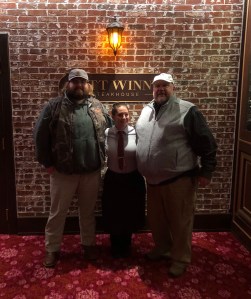
As I write this post I am in a hotel room in Louisville, Kentucky sitting in the comfy chair while my son sits at the desk finishing an animal science class assignment. I’m in Heaven! I get to spend time with my boy. He drove over from Murray State University and I came from home to meet here for the weekend at the National Farm Machinery Show. He’s now a junior, but it’s still rough on me having him six hours from home. Before he left for college we did everything together. Now, when we get a weekend like this it is very special. I’m telling you all this to make the point that everything we do this weekend becomes part of the memory.
So, the experience matters! While in Louisville we are customers. And, as my friend Joseph Michelli would remind me, it is all about the customer experience. I try to find and read everything he writes because his insights help me grow personally and professionally. In a blog post entitled “It’s Not What You Value | Team Member and Customer Value” he wrote:
“…I believe that even greater customer value comes from moving from services to experiences (rather than from products to services).”
I love this idea of moving to experiences. I’ve always tried to make my gatherings (what most call workshops and professional development sessions) like a KISS concert – an experience. Tonight, my son and I had an experience! We went to Churchill Downs and ate at Matt Winn’s Steakhouse. To learn who Colonel Matt Winn was, click here.

Our experience started as soon as we parked at Churchill Downs. Actually, let’s back up. The experience started shortly after I made our reservation when I got an email explaining what gate to go in, where to park, and that someone would meet us to take us to the restaurant. Everything was exactly as outlined. We were picked up in a golf cart and driven through hallowed Churchill Downs to the red carpet. We walked through jockey statues painted in the silks of major race winners. Of course we stopped and took a selfie with the representative of the Kentucky Derby winner. Then it was up to the sixth floor. We were treated to tableside service and incredible food, all while overlooking the historic Churchill Downs Racetrack.
Then before the dessert cart we were asked if we would like to go out on the veranda and enjoy the view. So, we did! We actually stayed out there for an hour and visited with other exhibitors and attendees of the National Farm Machinery Show. After three hours and forty-six minutes we were finishing up our experience, umm, dinner. My son then made a profound comment to our server, “This is so much more than what I anticipated!” And our incredible server replied with the comment that affirms all of Joseph Michelli’s teaching, “That’s exactly what we aim for.” Giving people more than they anticipate. That’s a huge part of the customer experience.
Here’s the deal, the food (product) was incredible. In fact, after the deviled egg appetizer my son said he would never eat another because no deviled egg could ever compare again. The physical atmosphere was awesome. Those to me were the easy things. It was the people that made the experience. We knew our server so well by the end of our experience that we wanted our picture taken with her. She and all the other incredible people made the experience more than what we anticipated. Matt Winn’s will become an annual tradition for us. It’s an experience my son and I will not forget and a memory we will always cherish. This was a perfect reminder of just how important the experience we give others is.
Side By Side Leadership

I’m glad I hadn’t written this post reflecting on Simple Truth #7, “When People Are Off Track, Don’t Reprimand Them – Redirect Them”, in Simple Truths of Leadership: 52 Ways To Be A Servant Leader and Build Trust, Making Common Sense Common Practice by Ken Blanchard and Randy Conley before a leadership development gathering I facilitated last night because a conversation added value to the book content. We discussed how important it is to show grace, have empathy, and practice compassion. One leader asked, “What happens when the person you are showing grace to just isn’t getting the job done?” A great discussion ensued. Many even shared their stories of being on both sides of that question. Long story short, where we landed was that there has to be grace with accountability. If we really love those we serve this is the right thing to do. So, for example, if a person has had some change that causes him to be a little late to work, then there can be the accountability of, “what’s our goal of when we can get back to being on time?” Or, even better, could there be some adjustment made for that person to work later in the day that would help out someone needing to leave earlier? This is what loving those we serve is all about. We say it can’t be one size fits all for students, why does it have to be one size fits all for adults? I don’t think it does.
This all caused me to reflect even more on what Blanchard called “side-by-side leadership.” He stressed that we are almost always in learning mode and “Punishing a learner is never appropriate…” (p. 23). Ever had that boss that liked to reprimand? You know, the one you only heard from when we made a mistake – in today’s world usually in the form of a text or email. Not real helpful, right? Blanchard said, and I believe this goes right along with our grace with accountability discussion last night that, “When people are clear on the goal and still learning but their performance isn’t up to standard, redirection is far more effective than a reprimand. The aim is to BUILD (emphasis added by me) people up so they will continue to move toward improved performance” (p. 23). So, let’s all get side-by-side with those we serve and build, build, build!
Reverse Mentorships Revisited

I’m not sure where I would be without the incredible mentoring I have had over the years from students, yes you heard me right, and those younger and less experienced than me. I was reminded of this during a discussion where a teacher with 20 years experience was thanking a second year teacher for all she had learned from him. This mentoring extended far beyond the typical reverse mentoring of sharing knowledge about technology. The mentoring that was discussed in this conversation was about mentor on various topics of teaching strategies and cultural relevance.
Cara Dune: Take care of this little one.
Greef Karga: Or maybe, it’ll take care of you.
From The Mandalorian – Season 1 Episode 8: ‘Chapter 8: ‘Redemption’ (1×08) | Produced by Lucasfilm
The cool part about this organic mentoring relationship was that is was not a one way street. There were opportunities to exchange ideas, and even inspire one another. The beauty is that we know there are skills gaps on both sides, and that each person can address their weaknesses with the help of the other’s strengths. What’s interesting about these reverse mentorships beyond the incredible exchange of skills, knowledge, and understanding, there are great relationships and friendships created. Check out my very first blog about this in Reverse Mentoring. Bridging generational and hierarchical gaps to improve communication are important things that can happen. So, if you want to foster a more inclusive culture that values the contributions of all employees, and increase engagement and collaboration multiple generations, encourage more reverse mentorships.
 Byron's Babbles
leave a comment