Play Time For Leaders


I so enjoyed my extra day that we all had today because of this being a Leap Year. I spent the day with aspiring teacher leaders at Knowledge Academies in Nashville, Tennessee facilitating a 3D Leadership gathering. Because I am always so inspired at each of these gatherings I tend to have something to blog about after most of them. Today was no exception, and because I so wanted to have a February 29th (Leap Year) entry – here it is. Today’s through line of the program titled The Focused Leader was “Your Leadership Toy Box.”
“To infinity and beyond!” —Buzz Lightyear
The first activity involved the participants picking a toy, playing with the toy, and then answering the following questions. If this toy was in your Leadership Toy Box:
- How does this toy represent great leadership traits?
- How could you use this toy to be a great leader?
We then shared these out after some quality play time. I was so blown away by the responses that I asked for volunteer guest posts to put into this blog post. Here are three of those responses:
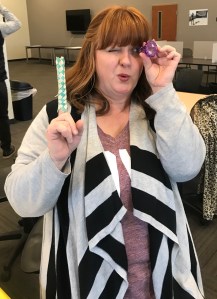
Lori Tharp
Toys and Leadership?
Today in the NEI 3D Leadership Cohort session, we were asked to select a toy and explain ways it could be a leadership tool. I selected two – a kaleidoscope and a Chinese finger trap. I was excited to answer this question since I have always been a kid at heart! After all, toys have always been a part of my life: My kids played with toys. I used to work in Children’s Ministry, then I worked as a preschool teacher. My husband sells vintage and current toys and one of my favorite movies is Toy Story! – so, this was “right up my alley!”
When I looked into the kaleidoscope at an object, I could see that the one image turned into many objects – showing a whole new perspective of the image with many facets. When I turned the kaleidoscope around and looked through it at the opposite end, I could only see one image. As I apply this to leadership I realized, as leaders, we should learn to see the things from a wider perspective – or different angles. We can all have the same goal or the same focus, but we need to be able to view ideas, opinions and suggestions from the perspectives of others, and ultimately, work together as a team…which leads me to the other toy I selected – the Chinese finger trap.
Looking at the Chinese finger trap – a simple little toy that traps the victim’s fingers in both ends of a small cylinder woven from bamboo. If you place your fingers in each end and pull outward, this only tightens the grip of the trap. Push your fingers together, it loosens up. The pieces of bamboo seem to be very fragile, and if it was only one piece, it would probably break. This little device is actually many pieces of bamboo woven together, which makes it very strong as one small unit. This reminds me of leadership. Working together as a team, makes us a stronger, tighter unit. We can accomplish more together than we can alone. Good leaders are aware of this, and they value the input of the other team members. Sometimes, though, we need to tighten up as a team, and sometimes we are so rigid we need to loosen up! Either way, leaders work as a team!
The possibilities are endless if I were to use these items in the classroom as a leadership tool. I could just imagine the kids in the class exploring these toys and finding fun and creative ways to use them. I could learn just as much from them!
“I realized, as leaders, we should learn to see the things from a wider perspective – or different angles.” ~ Lori Tharp
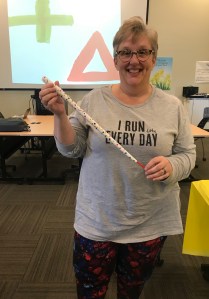
Jane Rogers
Chinese Yo Yo….. A leadership tool???
I was asked today to explain how a Chinese Yo-Yo as a leadership tool. At first, I thought “Why did I pick this toy?” Then after studying it, I thought as you throw the paper out it could be really fun to just bug people with it and see how long it would take to get them to ask me to stop. As I studied it I saw that there were different colored dots and different sizes. The larger one made me think that a leader needs to be “big” and strong and take charge. The medium dot represented that a leader needs to know when to step back and mix in and work collaboratively with everyone. The smaller dot reminded me that a leader must allow the team to be forefront and allow them to grow and shine. A good leader should know when to take charge and when to step back. As I played with the toy, throwing it out and in, it showed me that a leader needs to be flexible, adjustable, fun and maybe slightly annoying. I can see myself using it in my classroom, as a pointer to get my kids to stay engaged and would want me to call on them by slinging the toy towards them. So yes, a Chinese Yo-Yo can be leadership if you allow your self to look at it in a way you might never have thought of.
“A good leader should know when to take charge and when to step back.” ~ Jane Rogers

Quintarius Grigsby
Up Up & Away
Hello my name is Mr. Quintarius Grigsby. I am a Science Instructor at Knowledge Academies, basketball coach, and Christian minister. I teach Biology, Physical Science, Chemistry and I have a a background in Agricultural Sciences. At the 3D Leadership meeting the toy I chose was the World War ll Hell Cat Fighter Jet replica. Its symbolic warlike features resonated with me in such a way that I had to choose it as an identifiable leadership tool. Due to its frame and features it helps me to to remember how disciplined I am, and that I am free enough to believe that the sky is the limit. Bombs and missiles represent potential power that is destructive upon release. I believe just like the Hell Cat Fighter Jet, I have the power and influence to destroy the negatives which represent the enemy that limits us from being successful. The wings on the jet also represent freedom. This toy replica can be utilized to inspire others who desire to ascend beyond where they are now. (Leadership is a process, not a position.)
“Due to its frame and features it helps me to to remember how disciplined I am, and that I am free enough to believe that the sky is the limit.” ~ Mr. Quintarius Grigsby
We really can, as you just read, learn a lot from playing with toys. Toys can inspire new ways of thinking about leadership, teamwork and accomplishing our goals. Whether it’s motivation, wisdom or practical advice, there are some great lessons we can all take away.
Hearing Every Leader
 Yesterday I blogged Arguing The Value Of Our Experiences Is Futile as the result of inspiration from rereading Kim Scott’s Radical Candor: Be A Kickass Boss Without Losing Your Humility. Today’s post is a result of more notes taken while reading. The phrase “listen, challenge, commit” really stuck with me for further reflection.
 We need to listen to understand. We need to challenge with respect. We need to then commit ourselves to the decision and the team. If you think about, if we could always get these three things right we would have happy and engaged employees and teammates. Not to mention be successful at carrying out our missions.
“Most people do not listen with the intent to understand; they listen with the intent to reply.” ~ Stephen R. Covey
We need to listen without agreeing, disagreeing, or interrupting. Just listen intently to understand. When a culture of being able to challenge is developed, the team will always grow. This will create trust and cohesion. We need to explain objections clearly and succinctly. The challenge is about us getting it right; not about someone being right.
If everyone has fully been heard for understanding and differences sorted out, then a commitment can be reached. Everyone has been heard and understood. The important thing here is for everyone to have their voice heard and be valued.
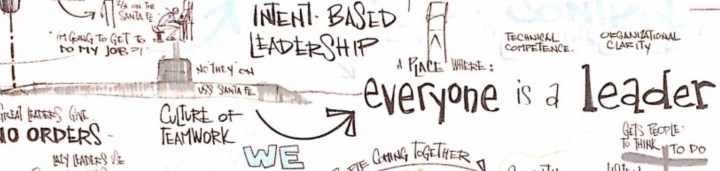
 I hear leaders talk about lack of ownership or buy-in. I’m always amazed when I hear “we now need to go get buy-in.” If you are saying that, you have already lost. Team members will be committed when their voices are heard and their ideas used. I’m also amazed at how leaders think they know better than the people closest to the day to day execution. This is what my good friend David Marquet calls “leader-leader” or “intent-based” leadership as opposed to “leader-follower” in his great book Turn The Ship Around: A True Story Of Turning Followers Into Leaders. Marquet argues that decisions need to be made where the data is created. He believes, as do I, everyone is a leader. This is why teacher led schools are so important and why I am so committed to developing teacher leaders.
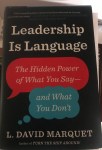 If this enthuses you, you need to get his latest great book, Leadership Is Language: The Hidden Power Of What You Say And What You Don’t. Bottom line: decisions must be made where they will be executed.
I have blogged about Marquet’s work before in Everyone Is A Leader and Imagine A Place Where Everyone Is A Leader. I so respect David as a friend and great leader who has, like Kim Scott, actually practiced what what what he teaches. I consider the three books referred to in this post as must reads for everyone – since everyone is a leader. In Scott’s book she challenges using the word leadership because we say things like “leadership teams” which gives the appearance that others somehow aren’t leaders or haven’t “arrived” yet as leaders. But, if we go with everyone is a leader, we probably take care of this.
We must involve all team members in decisions, listen to each other, challenge, and then commit. If we believe everyone is a leader, then we need to let every leader be heard. This makes everyone mutually accountable. No more worrying about buy in.
Arguing The Value Of Our Experiences Is Futile!
 I just finished reading one of my favorite books for the third time. If you’ve ever had one of those books that you learn something new from or discover something you missed the first times you read it, you understand where I’m coming from. The great book I’m referring to is Radical Candor: Be A Kickass Boss Without Losing Your Humility by Kim Scott. I’m not sure a person shouldn’t read this book once a month, but more importantly one should put in place the lessons learned from this great book.
Something I believe separates her writing from other books in the leadership genre is how Scott shares her mistakes and missteps right along with the successes. In other words, she practiced what she preached in the writing of this book. Scott truly takes her commitment to herself as seriously as any other professional responsibility. Ironically, as I was writing this post I got a text from a school leader I am mentoring asking me to share my top five leadership books. This book will, no doubt, be on the list I suggest to her.
 I have always been impressed with the ontological approach to leadership and with ontology. Much of what Scott taught us was how to form the work community necessary for each of us to “be” when answering the question of “what can we create together?”
 In the book, Scott refers to “ontological humility.” The source she referenced is Fred Kofman’s book Conscious Business: How To Build Values Through Values. Ontological humility is the idea that none of us has sole claim on reality or truth. We must recognize that others have equally valid perspectives that deserve our consideration and respect. You don’t have to read very many tweets, be a part of an organizational team, or be involved in very many meetings to know ontological humility is not practiced very well in many settings. Make no mistake, it is tough to live this as a value. But, it is an important leadership trait to hone.
In fact, I try to bring ontological approaches into all leadership development gatherings I do. Additionally, it is an important part of the coaching and mentoring I do. I blogged about it in Leading With Natural Self Expression. This intuitive and natural expression that forms our leadership comes from our recognizing our experiences and the experiences of others. In education it is these experiences that enable teachers to bring real world relevance into lessons for students. Bottom line is we must understand the experiences that form our colleagues’ reality. Scott posited in the book we need to understand the past experiences of our colleagues all the way back to kindergarten.
One of my favorite quotes that I wish I knew who to credit it to is:
“To argue with someone else’s experience of reality is futile…To add their experience to yours is possibly useful.”
Read that one more time and let it sink in. Pretty deep, right? This is why the teaching of Scott in Radical Candor is so important. We must better understand ourselves, our thoughts, and our actions. Then, and only then, by understanding those on our team can we understand how to coach, mentor, provide praise, criticism, or other guidance effectively. Notice, Scott promoted guidance versus feedback. Just the term “feedback” alone, she taught us, makes us bristle. We need to care personally and challenge directly. These are the ingredients necessary for Radical Candor™️ to flourish. How well are you practicing ontological humility?
Serendipity Mattered
 This week while continuing to read Great Society: A New History by one of my favorite authors, Amity Shlaes, I found the shortest sentence in the book: “Serendipity mattered” (p. 188). Serendipity has always been an intriguing word to me that I have had trouble understanding because I here it being used in different ways. But when used in the context of Shlaes book, in a two word sentence it made perfect sense. The sentence “Serendipity mattered” really drove home the point she was trying to make and really made the lightbulbs come on for me.
 In other words, there needs to be serendipity for innovation to occur. So what is serendipity? As I said earlier, I have trouble understanding it fully, but I know that when conditions are right for it, great things happen. Serendipity is said to happen by simple chance. An opportunity that comes about by a chance occurrence. Therefore, we must create the opportunities for these occurrences. This was the point that Shlaes was making in the book. The Fairchild Semiconductor company realized they needed innovation. They also realized that looseness of hierarchy drove innovation. Thus, “Serendipity mattered.” It is also why we need to beware of the current tides toward any of the Great Society’s socialistic tendencies. This will stifle the serendipity that is so needed.
 I touched on serendipity in my blog post Alternative Truths back in 2017, but only to say that we need to be intentional to create space for serendipity to occur. Therefore, I needed to study a little more. Research led me to find that our use of the word serendipity comes from The Three Princes of Serendip. The musician and poet, Amir Khusrau wrote this Persian tale in 1302. The tale is about King Jafer and his three sons. He wants them to have the best education in the kingdom. The King believed that great book learning needed to be combined with a real world context. Wow, I preach that all the time! In fact, I wrote a book, The Hand In The Back Of The Room, about it!
Anyway, the king gave each of the boys a horse and told them to go discover. The boys relished and took advantage of this experience. They learned from being on a journey of taking in real world experiences. Then in 1754, Horace Walpole coined the word serendipity in a letter. He described serendipity, by referring to the tale of the three princes, as making discoveries, by accident and sagacity, of things which they were not in quest of. He was excited about this word because there was no word to describe the discovery of something you are not looking for. It was really accidental sagacity.
Then comes the question, how do we create space for serendipity to happen. It probably won’t work to get everyone a horse, but I’m certainly up for it. Think about all the great inventions and innovations that have happened by accident. We need to remember in all this that creation precedes innovation. We need to provide ourselves and others varied routines and time for serendipitous moments to occur. It is why the story of the king sending the princes on a horseback adventure is so important. They’re heads were clear and they were just observing. Think about it; it’s why just taking a walk to clear your brain can bring creative thoughts and solutions. I do this a lot when facilitating teacher leader gatherings. I will tell them to split into groups and take a walk and discuss… They always come back refreshed and with great thoughts and ideas.
Leaders, including political leaders, need to recognize the important role serendipity plays in creativity, innovation, and even relationship building. Interestingly, in my research I found having lunch together as a strategy for encouraging serendipity. I blogged about having lunch together in Let’s Have Lunch Together, but not from the angle of serendipity.
We need to start looking for more serendipity to happen and create space for it. We might not be looking for something specific, but we need to be tuned into a channel of infinite possibilities. Think about it; this blog post was inspired by a two word sentence. It must have been serendipity!
Seeing What Others Don’t See
 The best leaders see things that other leaders don’t see. At least I believe this to be true about the leaders I most respect. Recently, I heard it said of George Washington that he was an idealist and saw things as they should be. If we think of idealists as seeing the full potential in others and organizations, I certainly agree. Idealists are visionaries. Think about it, Washington’s vision for our country was visionary because there was not any other country out there to copy off off.
The part that really impresses me about Washington, however, is that he was also a pragmatic leader. He was a practical thinker. When he took over the Virginia Regiment and then the Militia he had to focus on the processes necessary to achieve the vision. Both times he was given groups of undisciplined/unruly men that he had to create the processes of rule, order, and training.
While Washington was that rare leader that possessed idealism and pragmatism, I believe it was his ability to truly inspire and mobilize people that separated him from others. Also, he was able to keep his ambitions in check – most let ambitions for power, position, money, or status wins out over purpose and core values. Washington might be our true shining star role model for this.
As I was studying for this post, I came across a quote credited to French novelist, Marcel Proust: “The real act of discovery consists not in finding new lands, but in seeing with new eyes.” This quote could certainly apply to great visionary leaders and Washington. In doing more research, however, I found this was a paraphrase and not what was actually written in Proust’s novel.
The quote is paraphrased out of Proust’s seven volume novel, Remembrance Of Things Past (1923). The actual phrase is in Chapter 2 of Volume 5, The Prisoner, and is actually referring to art instead of travel. You might disagree, but I believe the actual passage to be more meaningful than the paraphrased version. Here is the actual transcript:
“The only true voyage of discovery, the only fountain of Eternal Youth, would be not to visit strange lands but to possess other eyes, to behold the universe through the eyes of another, of a hundred others, to behold the hundred universes that each of them beholds, that each of them is.”
Proust was an incredibly talented and artful writer. His writing in this novel gives us another way to think about the leadership of Washington. He was seeing our country through another set of eyes, not just using the same paradigms that were known by all at the time. As an artful leader, Washington was able to envision what great things our new universe, a democracy, would behold for each of us.
Today, if we truly want to embrace one-of-a-kind ideas in a world of copycat thinking, we need to see the things that others don’t see.
Reflecting On Our Presidents

“The Republican Club,” by artist Andy Thomas, was personally chosen by President Donald Trump to be displayed in the White House.

Andy Thomas Democratic Club presidents painting Image of “The Democratic Club” painting by Andy Thomas
It has been an incredible 2020 President’s Day. I had to drive to Nashville, Tennessee this morning so I had lots of time to reflect on our Presidents. My son and I were together this past weekend and reflected on the Presidents in the paintings displayed in this post. We pondered what they were discussing and thought about how great it would be to have conversations with these Presidents. As I got closer to Nashville, I reflected on the leadership of Andrew Jackson. I had the chance to go to The Hermitage last year and to the site of The Battle of New Orleans the year before that. There are certainly things that I would not have agreed with Andrew Jackson on, but there is no question he was a great leader. I blogged about his leadership in “Old Hickory” Leadership.
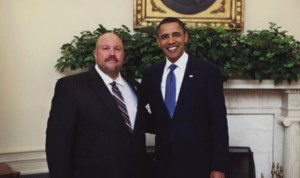 I had a great day tweeting questions every hour or so related to our Presidents. There was some great interaction. Here’s the questions I asked throughout the day:
- Who was our U.S. President the day you were born?
- Who were the U.S. Presidential candidates the first time you were able to vote?
- If you could have dinner and a conversation with any past or present/living or deceased United States President, who would choose?
- If you care to share, who was the first U.S. President you ever voted for?
- Who has spent time in the Oval Office with a U.S. President? Is so, which one?
- If you could add another U.S. President to Mount Rushmore, who would you add?
- Are you reading about any U.S. Presidents right now? If so, which one(s)?
- Have you finished any great President autobiographies or biographies lately?
- What is your favorite Presidential Library you have been to?
- What do you consider the best book by or about a First Lady of our great nation?
 Wow, until I typed them out here, I had not realized I had asked 10 questions today. I can’t resist telling you that our 10th President was John Tyler. He became President in 1841 when William Henry Harrison died. He was the first Vice President to succeed to the Presidency after the death of his predecessor. How about that for some President’s Day learning? It was sure fun reflecting on the past and how our Presidents have affected our lives and this great country we call home.
Declaring Beliefs & Attitudes

John F. Kennedy was President on the day I was born
Trying to make sense out of political trends or political culture is very tricky at best. We see trends over time, but they are not always absolute. I’m not sure there is any longer a “typical American.” There are many indicators that become tendencies, but there are probably more exceptions. The bottom line is that there are many factors that influence Americans when they cast their secret ballot. I’ve been reflecting on this on this 2020 President’s Day.
Family certainly plays a role. Think about the Kennedy’s who were staunch Democrats. Think about the Bush’s who are die hard Republicans. When I look at my own son’s political views, he certainly has not fallen far from the proverbial tree. But, you can look at other families where the children go to the complete other side of political views. One only needs to study President Ronald Reagan’s children. We do know, however, from research that parental beliefs do have great influence on children’s political beliefs.
One thing is for sure, Americans have a great deal of political power. More than most realize. As Joe Biden always says, “All politics are personal.” Therefore, since it is personal and a conversation, then every American has a voice. First of all, and most importantly, everyone needs to vote. Voting is the most fundamental form of civic engagement in a democracy. Voting is an expression of your beliefs and also has consequences based on choices.
Machiavelli taught us to “declare.” I have always practiced this – there is never a mistake where I stand on something. Others just tell others what they want to here. Beliefs are those closely held ideas that support our values and expectations about life and politics. Our attitudes are affected by our personal beliefs and represent the preferences we form based on our life experiences and values.
In a democracy we have an obligation to “declare” these beliefs and attitudes. At the same time, however, it is important to respect those with differing opinions. I did not say agree with, I said respect. I have blogged about this in Civilized Disdain Vs. Political Correctness, What Can We Create Together, and Typical Discourse. Our beliefs and attitudes over time become a set of norms and core values that solidify our political and societal views. This in turn forms how we believe should happen in our society or what the government should do in a particular situation. Remember, your views are important and valued.
Passion At Ambition’s Command
 We teach that having passion is a key to success, particularly when linked with purpose. History, however, teaches us that passion can become destructive. Research in psychology describes this destructive passion as “obsessive passion.” The good passion is “harmonious passion.” My recent reading has given examples of two individuals where obsessive passion drove the individuals to become power hungry.
“His passions were at ambition’s command.” ~ James A. Caro in The Path To Power
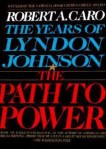 In The Path To Power, Robert A. Caro said that Lyndon B. Johnson‘s passions were at ambition’s command. Johnson was obsessed with power and couldn’t get enough of it. The ambition for power and becoming president took over and clouded any purposeful passion for helping the people of our country. Everything he did and anyone he helped was dependent on what he could get out of it, or what power could be derived. When obsessive passion takes over with ambition calling the shots, the person’s self-worth becomes validated by whatever the ambition is. In the case of Lyndon Johnson that ambition was power.
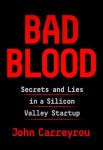 Another person I recently studied who let obsessive passion take over was Elizabeth Holmes, Founder and CEO of Theranos. I read about her in Bad Blood: Secrets And Lies In A Silicon Valley Startup by John Carreyrou. She had purpose and passion for a world changing blood testing and analysis machine that only needed a drop or two of blood to run a myriad of tests. Her company wasn’t able to meet performance standards or efficacy. She is still involved in legal actions against her including criminal charges. Her ambition was for success as defined by celebrity, power, and greed instead of purpose for significance. To read more about this check out When Purpose and Passion Turn Into Ambition.
Does Life Imitate Art, Or Art Imitate Life?
 I have been spending some time contemplating Oscar Wilde‘s thoughts on art. I love all kinds of art and consider myself an artist in terms of being creative and imaginative. I am definitely more of an artist than technocrat. I always say there is no bad art. You can refute that if you like, but Wilde and I would have been in agreement that artists should not be interested in seeking approval or creating art for demand. The instant artists, or we artistic leaders, begin to seek others approval we lose our creative juices. Think about what it is like when you are working on something and have to keep getting approval. The idiot needing the approval command and control gratification is stifling your creativity and ability to innovate. I recently wrote about this is in Empowerment Triggers The Approach System.
“…the new work of art is beautiful by being what Art has never been.” ~ Oscar Wilde
If you think about it art really means new. To truly be artistic in whatever we do whether it is leading, teaching, building, et cetera, we must be creative and innovating; we need to practice some individualism. Wilde argued “Art is the most intense mode of individualism that the world has known.” I believe if we approach everything we do as art, we would probably reach our highest potential.
“Life imitates art far more than art imitates life.” ~ Oscar Wilde

James Ensor (Belgian, 1860 – 1949) Christ’s Entry into Brussels in 1889, 1888, Oil on canvas 252.7 × 430.5 cm (99 1/2 × 169 1/2 in.), 87.PA.96 The J. Paul Getty Museum, Los Angeles
If you think about it, leadership and art both bring social encounters to life life. One of my favorite artworks that I believe intersects with leadership is James Ensor‘s painting Christ’s Entry Into Brussels in 1889. The painting, which began expressionism, has Jesus in the middle of a chaotic crowd of very real and very unreal characters. I was first introduced to this painting back in 2012 and then blogged about the inspiration in Rushmorean Servant Leadership. For me it was about Jesus leading from the middle, or amongst us. I do try to lead in that way while being creative. Which still begs the question of whether Wilde was right, does life imitate art or art imitate life?
How Do You Play Leader?
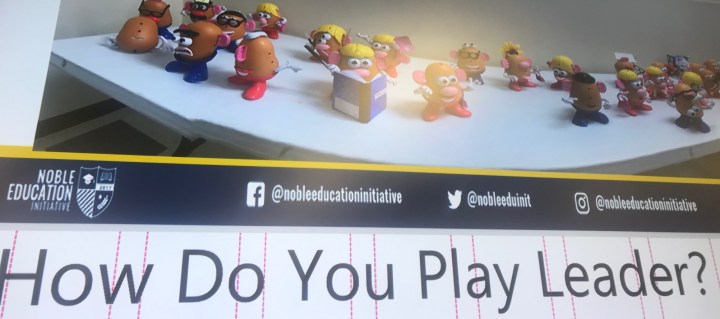


This past weekend at our Indiana 3D Leadership Gathering, we did a toy activity that involved Lite Brites®. Participants made a picture that represented how the Lite Brite® could be used for great leadership. The activity was called “How Do You Play Leader?” The groups did a great job with their pictures. While they were sharing out I wrote down a few notes. Check out what I wrote down here: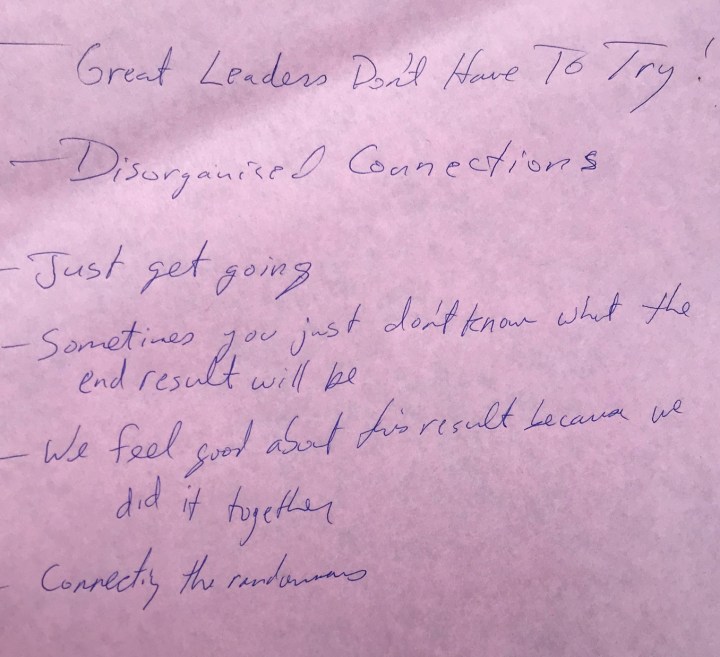
I was particularly struck by the statement that “Great leaders really don’t have to try!” I asked the person to dig a little deeper into that comment. She said that a leader who is authentic and is himself or herself instead of trying to be someone else or copy someone else is much more effective. Great leaders find a system that works for her or him, rather than trying to force oneself into a prescribed notion of a what a leader has to be. If we know ourselves well enough, we can take steps to go about leading effectively. Situations change what we need to do, but should never change who we are. We need to make sure we’re treating all team members as we would want to be treated. We need to be genuinely interested in learning something new every day from our team, and they will follow you. It’s all about relationship building. I blogged about this in Let’s Have Lunch Together!
There was also a deep discussion about how teams are most times brought together by a certain amount of randomness and disorganized connections. Great leadership connects the randomness. Leaders should be the key connectors of team members. Support them them to understand their value in the organization. Leaders need to respect all team members. Respect comes in different forms: respecting time, respecting opinions, respecting diversity, respecting the culture, and more. When we trust and respect our team members and connect with them, they will respond with dedication and enthusiasm. Because of this, our connected team members will see clarity, levels of engagement across the organization, a positive culture and community, and most of all, improvement in communication. Remember, trust builds through connections with people and forms the bedrock of a team. Teams are built on human cooperation. Without relationships, we’ve got no team.


leave a comment