Leading Like Yoda
 Last night we created personal Mount Rushmores in our 3D Leadership gathering. I was surprised to have a new leader added to the list – Yoda. Of all the years I’ve been doing this, this is the first time a participant has put Yoda on their personal Mount Rushmore. Moreover, last night there were two people out of the group of 48 that picked Yoda to be on their personal Mount Rushmore.
So of course I had to dig into Yoda as a leader. In the Star Wars universe, Yoda might be the single most important hero. Yoda is wise and insightful and brings many leadership lessons to the forefront to help us all become better at serving those we lead. Of course, several Yoda quotes were thrown out in the course of the gathering, like:
- “Do or do not. There is no try.”
- “[Luke]: I can’t believe it. [Yoda]: That is why you fail.”
- “You must unlearn what you’ve learned.”
- “Much to learn you still have.”
- “Fear leads to anger. Anger leads to hate. Hate leads to suffering.”
One of the things I took away from some really great discussions was that we need to remember that thinking about the future is really important for finding direction, but don’t do it at the expense of what we are currently doing. We need to focus on the task at hand. Spend time in the moment. Be present. It will make us more efficient, and we’ll notice more.
Yoda often taught his pupils through action. We decided last night that leaders are built by learning from their imperfections. Yoda gives us an example of what one participant said she would like to be: “Fair, compassionate, and motivational.” Challenges will push and motivate us. In this time of uncertainty we must focus on continuing to learn so we can help the world triumph. As the group taught me last night, the only thing to do is the next right thing.
March Flowers 🌼
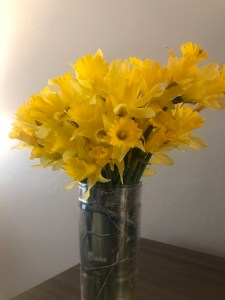 Sometimes we need to look no further than our children for inspiration in times of crisis. This was true this past weekend for me. As I read all of the different statements being put out this week by businesses and organizations, I couldn’t help but think that the simple things we are taught as children should guide every decision: the Golden Rule and what is best for others. Maybe just some good ole empathy and compassion.
We went down to help move my son home from Murray State University this past weekend. It was tough on him to be leaving a place he has grown to love and all his friends. He was visibly upset. There was definitely mental impact at play in him having to move home because of the coronavirus. Even during this trying time, he took time to pick a clump of March flowers (daffodils) for his mother (pictured here). We’d never heard them called March Flowers. Heath told us it was a Kentucky thing. He explained, “Spring is here, new life is blooming in spite of the coronavirus.” That’s my boy, finding some beauty and positivity during a time of crisis. That was a moment I will savor forever.
As I watch groups and businesses contemplate how to get the most out of their employees at this time of global crises I can’t help but think these so called leaders have missed the point. Right now we should be thinking about how best to care for those we serve, period. And, as someone who doesn’t sit around and pontificate about a virus I know nothing about, the best thing to do is have everyone staying at home. I’m surprised how many people have become experts overnight.
In the case of k-12 education we do need to be concerned for the learning of our children. We also need to provide parents with resources to help their students along with our teachers. We need to be cognizant of the mental impact that the crisis we are living through can have. Schools need to make sure resources for parents are available so they can reinforce social-emotional skills at home and know who to contact if they are concerned about an issue impacting learning online or just in day to day life.
Staying positive is the core ingredient in the recipe of successfully coping in a time of crisis. Now is the time to be proactive in creating small moments of happiness in our days. Positive emotions help us to undo the negative effects of stress.
Change Is A Coming!
 There is one thing for sure as I sit and write this post on this Sunday morning; change is a coming. My son is coming home from college till at least April 6th, and learning remotely and online (since I miss him being at home every day, I am excited for him to be home). The students at the schools I serve will be learning remotely. The teachers and school leaders I serve will be learning and creating best practices for remote and online student learning. Also, we must develop best practices for caring for the non-academic needs of our students (eg. food, social emotional, et cetera). I need to consider what limiting social contact means for mean personally. Additionally, I am positive that there will be things on the policy side of my life, as an Indiana State Board of Education member, that will have to be decided. So, as I said, times are changing. The coronavirus (COVID-19) pandemic is bringing change to all the world and all our lives.
As I contemplate all the constant and fluid change going on around me, I continue to remind myself that change is a never-ending process. Change is not a journey or a one-time event. Additionally, as a person who doesn’t like the term expert, or am not even sure there is such a thing, we need to remember that, right now, there are no experts – we’ve never been through this before. So, we have a bunch of people doing the best we can. The changes we are experiencing due to the coronavirus (COVID-19) pandemic need to be continuous and participatory. We must communicate and collaborate. This can’t become about who can tweet what they are doing the fastest to feed their own ambition. Or, who can blast someone else for what they haven’t done.
The problem with thinking of change as a journey is that travel is sequential. We move from one leg of the journey to the next. Change, in contrast, isn’t a series of steps; it is not a map you can follow. There is no Maps App for change, particularly not for coronavirus. As a lover of metaphors, let’s imagine pouring cream (I prefer coconut flavored) into a mug of coffee. Almost immediately as the liquids merge, there is a color change from black to brown to a light tan depending on how much cream we add. Change needs to look more like that. Instead of someone trying to come up with a well-executed plan on their own, it becomes what I call triageformational. Yes, triageformational is a term I coined. I first blogged about it in Triageformational Leadership: New Hybrid Definition of Triage and Transformational Leadership. I believe it applies more now, with our coronavirus situation, than ever before. Here is what I said in that blog post:
“Those that I believe that would make great triageformational leaders place a high value on fostering an environment or community of collaboration. This community is balanced, diverse, and equitable. These leaders build community and culture by truly living out their own core values and the organization’s core values. Just like doing triage in an emergency situation, these leaders are prioritizing what gets done next by matching core values to the situation. This in turn brings about transformation and service oriented leadership.”
We must change the way we change. We cannot have all change initiatives coming from on high. CEOs and other bureaucratic leaders who decree the values they created alone have already failed. Those values must be collaboratively developed. So, how should we change? Well, change must be continuous and participatory, and we must look for those who know more than ourselves.
Win Every Day!
 Win Every Day: Proven Practices for Extraordinary Results by Mark Miller
My rating: 5 of 5 stars
Back in 2012ish my son was obsessed with the term “Win the day!” because growing up he was a rabid Oregon Ducks football fan. At that same time I had just become principal of a state turnaround academy. My son even made me a plaque, declaring “Win The Day!” out of a 2X4 he found in the barn for my office. This is still one of my most valued possessions. You can check out my 2012 blog here: https://byronernest.blog/2012/11/04/w… .

My “Win The Day!” Plaque Made By My Son, Heath
Winning the day can mean many things, but to me it means giving all I have every day and making the most out of the things I can control. That’s why I love the title of Mark Miller’s book that was just released this past week, Win Every Day. The book is based on Miller’s findings that high performing organizations do these four things: 1. Bet on leadership; 2. Act as one; 3. Win the heart; and 4) Excel at execution. I love the fact that Miller uses some sports analogies in the book to make the points. He makes the point that if you execute well you do not need a lot of plays.
As a leader, we owe it to all those we serve to “Win Every Day!” Miller taught us in this great book that our choices are the only things we can control. He told us to “Choose wisely” (p.127). The bottom line according to Miller is that we can be encouraged and even challenged, but if we want to be great, we will have to decide. This book is so appropriate for everyone to read right now as we are dealing with the global outbreak of Coronavirus Disease 2019 (COVID-19). This challenge is top of mind for individuals and organizations across the world. Because of the ever changing and fluid nature of the situation, it would be wise for us all to contemplate how we excel at execution. This is a book that every person in the world should take time to read and reflect on right now. We must WIN EVERY DAY!
Mingling At High Tables

Indiana State Fair
This will be a little different type of post for me, but fits with my belief that the physical environment is just as important to a gathering of any type to the formation of a community as the facilitation or the invites. I love high tables. I love to go to events that have tables. I love to host gatherings that have high tables. There are many advantages to to using high top tables that are many times referred to as bar tables, cocktail tables, pub tables, or bistro tables.
If you want to encourage people to mingle, meet and start conversations with others, then high top tables might be the best choice. The big advantage I see is the ability to have an infinite sized group standing around them. With low tables the group size is very fixed. Think about it; if you are at a gathering with low tables and a table only had four chairs and all four are occupied you go to another table. It is awkward, unless you are asked, to pull up a chair. Even more awkward to stand next to the table and talk with everyone else sitting.
 Besides allowing more people to huddle around them, the high tables create a more intimate space for attendees to gather close for engaging conversations that encourage involvement of all. I love the encouragement of people to converse with each other and huddle closer together.
 I am so obsessed with high tables that for our son’s graduation party, which was held in one of our barns, I made sure we had an area for high tables. We had the barn set up for seating for 100 people, but then had an area for high tables. Amazingly, those tables had a large group around them for the duration of the five hour gathering. It was an interesting dynamic, some around those high tables stayed almost the whole time and others came and went. I couldn’t help but watch those who gravitated to the regular table and chairs would sit, eat, and visit for a while and then gravitate to the high tables. I also noticed my son moving throughout the high tables and enjoying all the conversations. At the time the party ended we still had a large group of guests huddled around those high tables.
Then, we could one of the high table and chairs set to our county fair and Indiana State Fair where we were showing dairy cows. We are know for always having peanuts and snacks out for anyone to share. We were amazed at the amount of friends and new acquaintances the high table brought into our show camp. We had such a great time visiting and became believers in the power of mingling at high tables.
With The Crowd, Not Of It
 I am reading Robert Caro’s second volume in The Years Of Lyndon Johnson – Means Of Ascent. He is such a great author and I love the things in this book that make me ponder, reflect, and give me pause. Right now at about a third of the way through this volume I am learning about a most fascinating man, Coke Stevenson. Or, Mr. Texas as he was known, was Texas’ 35th Governor.

Cincinnatus Statue in Cincinnati
He is my kind of leader. He practiced the learning of one of my heroes, Cincinnatus, of not wanting to lead for power, but to serve. Cincinnatus always returned to the farm. At the conclusion of all his service he just wanted to go back to his ranch, where he milked his own cows and branded his own calves. See why I love this guy?
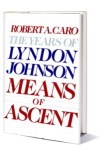 Stevenson was beyond reproach in the Austin, Texas bar seen of lobbyists that was known for the three Bs: “beefsteak, bourbon, and blondes” (p. 158). The way Caro described him in this setting really caused me to think: “But although, in Austin, Stevenson was with the crowd at the Driskill Bar, he was not of it; there was a reserve, a dignity, about this tall, broad-shouldered, silent man with that watchful stare that set him apart from the crowd” (p. 159). This was a man that lived his values, instead of talking about them like so many leaders do.
I loved that statement, he was with the crowd, not of it. This was a man modeling, not just going along to get along. He was able to get along on his own terms. That’s a pretty big deal in my book. Following the crowd will cause us to be mediocre at best and live contrary to our core values. It really causes us to live a life of self-betrayal, and resigns is to an average life. It has been said that those who follow the crowd get lost in it.
Influencer, Inspiring, & Impactful
 At yesterday’s Indiana 3D Leadership gathering I was inspired to do some deeper studying, which is usually the case, because of discussion that took place. I usually say the discussion inspired me, but for this post I’m contemplating what to call it. More on why I say that, later in the post. Last night we did an activity that I call Rushmorean Leadership which was then followed up by an activity called extending the influence. The activity calls for teacher leaders to bring pictures to identify four great leaders to put on their own personal Mount Rushmore. Then they bring six additional pictures to extend the influence.
As with everything this Indiana group does, I was blown away. What struck me last night, however, was that one participant talked about the persons on their board as influencers. Then the next referred to the leaders as inspiring and yet another referred to the her chosen leaders as impactful. For some reason I just had to ask the question of the group: What’s the difference, if any, in these descriptors? A great discussion ensued, which then led to me studying deeper this morning.
We all know that leadership is not about a title or a designation. We also know, and I’m glad we discussed this in depth last night that ambition is not a favorable characteristic of great leaders. For ambition will take over purpose. Influencers, we decided, spread passion for work, causes, innovation, or change. Those that inspire evoke a sense of energy. Finally, impact involves getting results. Impact is ultimately the measuring stick of the influence or inspiration.
Influencers cause us to think about things differently. They help us to shape our purpose, passion, and core values. Interestingly several participants had parents on their boards and referred to how they had influenced their lives.
In contrast, those that inspire help us gain motivation. This inspiration may be in the form of receptivity, positivity, or motivation. There is research that links inspiration to motivation. This inspiration causes us to actively engage in environments that lead toward self growth and fulfillment of needs.
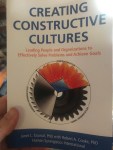 The more I studied and reflected on all this I formed the opinion that most, if not all, of the leaders chosen by the group were influencers who were creating an impact. These individuals were all helping to create constructive cultures, whether in organizations, nations, or globally. In their five star book, Creating Constructive Cultures: Leading People and Organizations to Effectively Solve Problems and Achieve Goals, Janet Szumal and Robert Cooke of Human Synergistics International ask the question: “As a leader, how can you both directly and indirectly influence your organization to ensure that members can independently and interactively solve problems and achieve the organization’s goals more readily and effectively?” I love the question because it has both directly and indirectly. Of the ten leaders each participant brought pictures of, some influenced directly, eg. parents. Others influenced indirectly, eg. Michelle Obama.
One thing is for sure; in all cases the individuals chosen embodied the necessary styles to create constructive cultures. All strove to create the cultural norms necessary for creating constructive cultural styles. See the constructive styles below:
So, I’ve come to the conclusion that influencing, being inspiring, and being impactful are not mutually exclusive. They go hand in hand when being a model of personal growth for us and creating constructive cultures.
The Nuanced Context Of The Great Society
 The Great Society: A New History by Amity Shlaes
My rating: 5 of 5 stars
This is a well written and researched book. The book, for me, was written in such a way that lets the reader determine her/his own views on the subject. I spent a great deal of time pondering and reflecting on the content of the book. Having been a child during the Great Society era, I agree with the fact that the federal government, during this era, redefined its role in the arts, on media (television and radio), and public schools. As, Shlaes taught us, “Washington left no area untouched” (p. 6). In turn, the federal government became intrusive in the 1960s. The lesson learned was that the hypocrisy of how the middle class and the poor were treated began to limit our ability to innovate. One of the biggest lessons we should take from this book and the 1960s and 1970s is our need to find ways to truly evaluate programs, which we still do not have. Any time there are programs initiated by government we need to be able to answer whether the programs were worth and cost and if they achieved what was promised. This made me think of another of Shlaes great books, Coolidge, where we learned of Coolidge’s disdain for using legislation to experiment. In my blog post Remember Freedom Is Yours Until You Give It Up: https://byronernest.blog/2020/01/25/r… I spoke of how Harry Truman always spoke of the nuances of leadership, and the Great Society must be studied, which Shlaes did, in the nuanced context of the relationship of the Vietnam War, poverty, and civil rights.
Reflective Culture Gut Checks: A ⭐️⭐️⭐️⭐️⭐️ Review
 Creating Constructive Cultures: Leading People and Organizations to Effectively Solve Problems and Achieve Goals by Janet L. Szumal PhD
My rating: 5 of 5 stars ⭐️⭐️⭐️⭐️⭐️
This is the most extensive use of data and research I have encountered dealing with organizational culture. The most striking part of this, however, is the practical way in which the information is delivered – in easy to understand chunks that allow for what, I have been calling in tweets, chances for reflective gut checks.


As leaders, we need this opportunity for reflection and these driving questions. Reading this book gives leaders an opportunity to take a deep look and examine the community being created as a result of that leadership. As this book taught us, “Leaders Affect Culture…and Culture Affects Leaders!” This book should be on that shelf that contains your most valued books between your favorite book ends.
A Twist Of The Kaleidoscope
 A couple of weeks ago I spoke to a group of college interns using kaleidoscopes as the through line. I gave all the participants a small kaleidoscope and had them get into groups, look through their toys, and relate the view to their journeys as interns and becoming leaders. As the graphic I drew during the presentation shows, I titled our time together Kaleidoscopic Adventure. I encourage you to take a moment and check out the points made by the groups reflected on the graphic.
 The interns quickly got the point that looking through a kaleidoscope is all about perspective. Perspective is the strongest power of the mind. Give the scope a twist one way and you see a set of images, and turn it the other way and you see another set of images. The different views represent our lives. We just need to find the angle we want to look through.
 Our lives are complex, random, and structured; all at the same time. Much like looking through a kaleidoscope, we look from the simple to the complex. Sometimes we need to remember to look back through the kaleidoscope the opposite way, taking the complex back to a simple focus. This reflection brings us back to a simple neutral.

View through the kaleidoscope given to the interns
One thing is for sure, we need to enjoy the beauty of the journey. Just like the kaleidoscope, we all have different views and experiences. We also need to remember that the world we live in is ever changing and quickly changing just like the view as we twist the kaleidoscope. A kaleidoscope is such a great metaphor because it symbolizes ever-changing and endless possibilities. The kaleidoscope also reminds us of our endless possibilities powered only by the limits of our own creativity and innovative prowess.


1 comment