The Servant Leadership: Self-Esteem Connection
 The Servant Leadership: Self-Esteem Connection
By Ken Blanchard
Originally Appeared on the Ken Blanchard Companies Blog
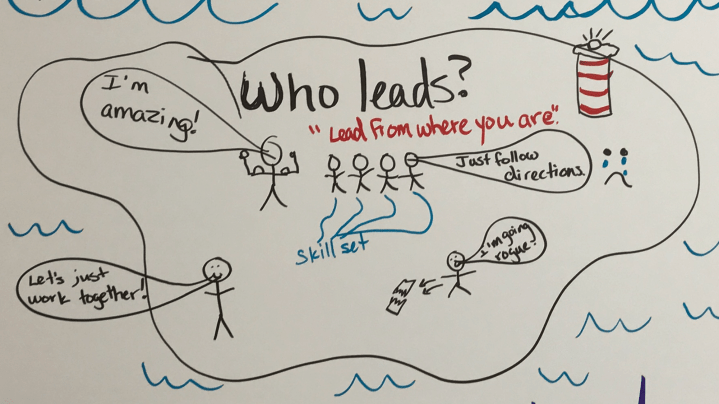
Servant leadership is best described as an others-focused form of leadership. It’s not an easy model to follow for leaders who believe in commanding and controlling their people—but it is easy for leaders with high self-esteem. Such people have no problem giving credit to others. They have no problem listening to other people for ideas. They have no problem building other people up. They don’t see praising others as a threat to themselves in any way. People with high self-esteem buy into the ancient Chinese philosophy of Lao Tzu:
“A leader is best when people barely know he exists; when his work is done, his aim fulfilled, they will say, ‘We did it ourselves.’”
Leaders who place themselves in the center of the universe and think everything must rotate around them are really covering up not-okay feelings about themselves. This is an ego problem that manifests as either fear or false pride. When you don’t feel good about yourself, you have two choices. You can either hide and hope nobody notices you, or you can overcompensate and go out and try to control your environment. I think people who feel the need to control their environment are just scared little kids inside.
I learned from the late Norman Vincent Peale that the best leaders combine a healthy self-acceptance with humility. Norman liked to say, “Leaders with humility don’t think less of themselves—they just think about themselves less.” To me, this approach sounds like a great way to begin for an aspiring servant leader.
Coaching and Self-Esteem
To me, servant leadership is a good way to describe the role that managers are expected to play today to help their people win. Judging and evaluating people erodes their self-esteem, but servant leadership builds self-esteem and encourages individual growth while attaining the organization’s objectives.
Servant leadership is something people need. Leaders need to support and help individuals in the organization to win. The days of the manager being judge, jury, and critic are over. Today, a manager needs to be a cheerleader, facilitator, and listener. Managers who are servant leaders are the ones most likely to achieve both lasting relationships and great results.
**************************************************************************************
 More about Ken Blanchard
Ken Blanchard is a best-selling business author with over 21 million books sold. His newest book, Servant Leadership in Action, is being released on March 6. Ken is also hosting a free Servant Leadership in Action Livecast on February 28 featuring more than 20 authors, CEOs, and thought leaders speaking on the topic. Learn more here!
Four Causes of Unproductive Meetings and What to Do About Them
 Four Causes of Unproductive Meetings and What to Do About Them
By Dick Axelrod
Originally published on dickaxe.cayenne.io
- Unclear Purpose
Meeting participants are unclear about the purpose of the meeting or what they want to accomplish. Before holding a meeting, ask yourself what you want to be different for yourself, the participants, and the organization as a result of holding this meeting. Make sure you share this purpose with the participants. If you are a meeting participant and don’t know or understand the purpose of the meeting ask, “What is the purpose of this meeting?” at the beginning of the meeting. Then ask yourself, “What can I contribute to make this meeting productive?”
- Unclear Roles
It is amazing to find out how many attend meetings where they don’t know why they are there or what is expected of them. We see many leaders who invite people to the meeting because they might provide a different perspective. However, these participants do not know that is what is expected of them. They attend the meeting not knowing why they are there and consequently feel the meeting is a waste of time.
- Decision-Makers Not Present
When the meeting participants are not empowered to make decisions, everyone feels their time is wasted. While participants may have fruitful discussions, they must then take their work product to the decision-makers who were not part of the discussion and who may not understand the reasons why recommendations are being made. This additional layer of bureaucracy wastes everyone’s time. Empowering meeting participants to make decisions or having decision-makers present will eliminate this added bureaucracy.
- Unclear Decision-Making Process
We have watched many groups flounder because the decision-making process is unclear. They don’t know whether they are being asked to learn about a decision that has already been made, provide the leader with feedback, or be part of the decision-making process. Clarifying the decision-making process prior to starting the discussion saves time and energy.
***************************************************************************************
 More about Dick Axelrod
Dick and is wife Emily Axelrod are pioneers in creating employee involvement programs to effect large-scale organization change, and co-founded the Axelrod Group in 1981. Dick is also a lecturer in University of Chicago’s Masters in Threat and Response Management Program, and a faculty member in American University’s Masters in Organization Development program. Dick and Emily created the Conference Model®, an internationally recognized high-involvement change methodology.
Together, Emily and Dick are frequent keynote speakers and co-authors. Their latest book is Let’s Stop Meeting Like This: Tools to Save Time and Get More Done it outlines a flexible and adaptable system used to run truly productive meetings in all kinds of organizations―meetings where people create concrete plans, accomplish tasks, build connections, and move projects forward.
Plus + / Delta Δ
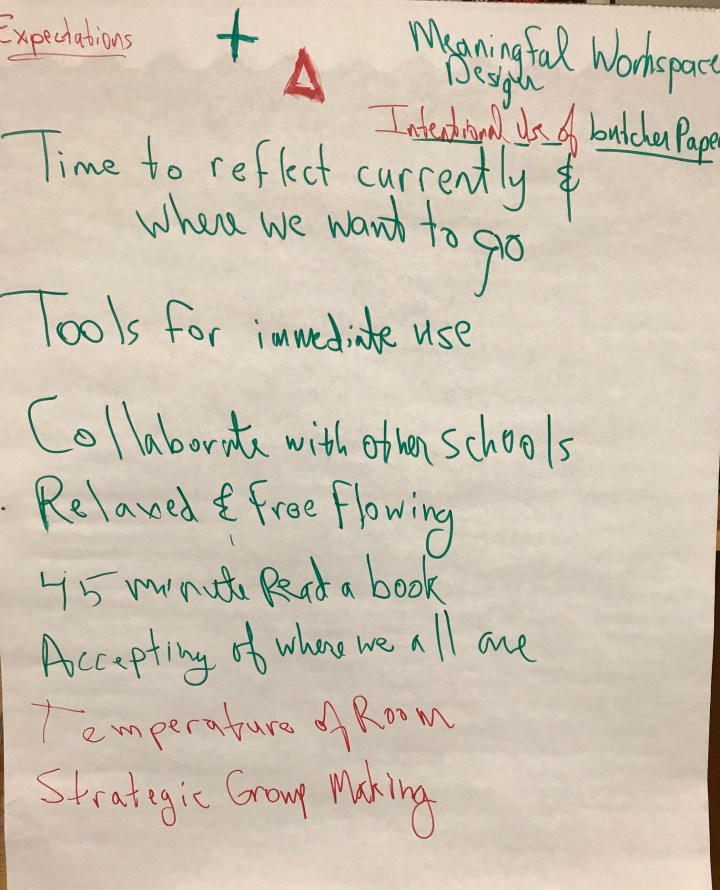 One of the tools I learned from my work in the Advanced Educational Leadership Program at the Harvard Graduate School of Education was how to do a Plus + / Delta Δ session at the end of a convening. I appreciated learning this from Dr. Liz City from Harvard University. She does this at the end of any convening or class I have been involved with. I have found this to be one of the greatest way to really find out what has gone well and what has not.
Here is how it works: At the end of the day or session we put up a board and put a + and a Δ on it. Then open it up to the group to give the positives from the day and the areas of improvement needed. I have found it to be a much more valuable experience if I do not start with positives or negatives and then switch to the other. The way I run the session both +s and Δs can be given together and not in any order. This way of doing it allows for pluses to be thought of when thinking about a delta and visa versa. As the discussion ensues all comments recorded in writing up on a foam board (see blog post picture).
I really believe this model does a couple of important things for the convened community. One big thing this process does is help to bring trust. Nothing can be off the table to bring up. More importantly, once a delta is on the table it is up to the leader/facilitator to make adjustments for the next convener. Or, if it is a plus, how do I, as facilitator continue to make sure this is a plus in the future. The second thing I believe happens using this way of collecting feedback is the depth of the information received and the amount of information. Let’s face it, getting surveys back is tough.
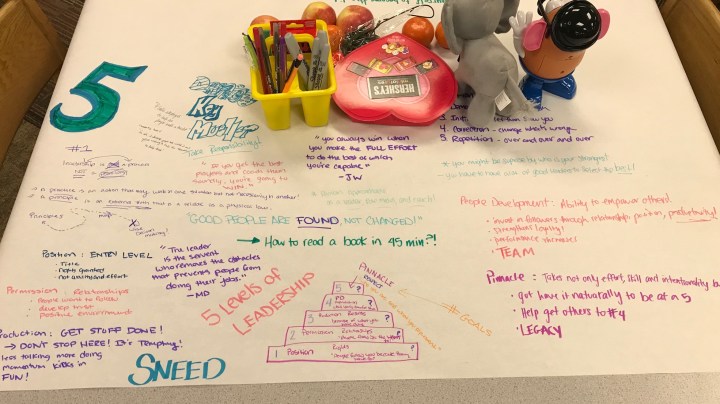
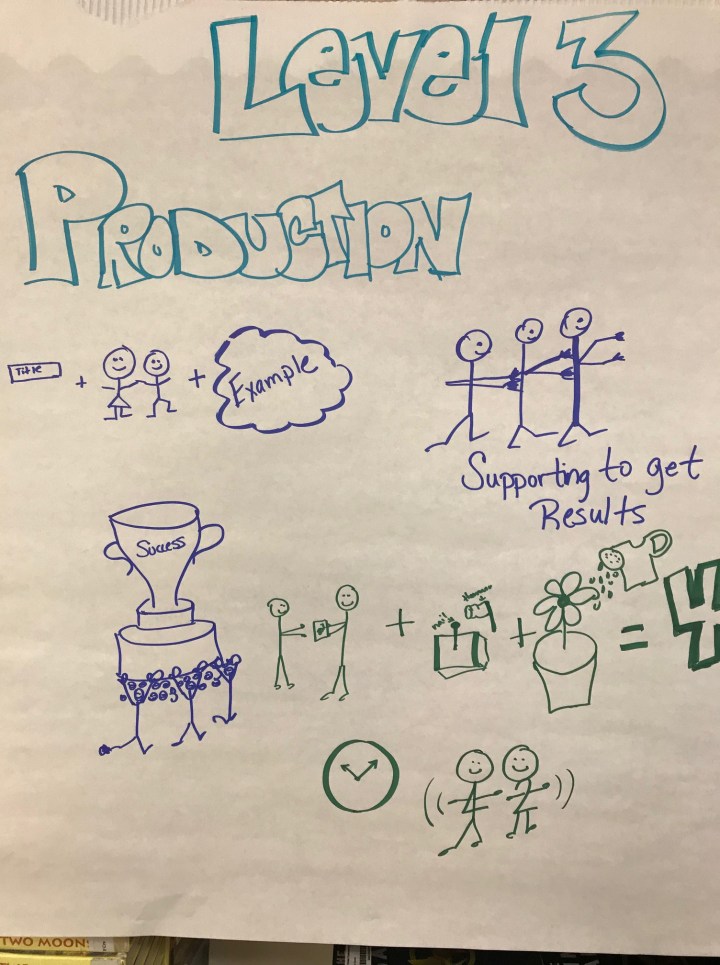 Furthermore, let me give you an example of the great information that a +/Δ session can give at the conclusion of a convening this past weekend. I always have butcher paper and crayons on the tables for participants to take notes, draw, doodle or whatever helps them learn. This convening was no different. The group of teacher leaders and school leaders I was working with were very much into graphic recording, both on the tables and when reporting out from small group work (see inset photos).
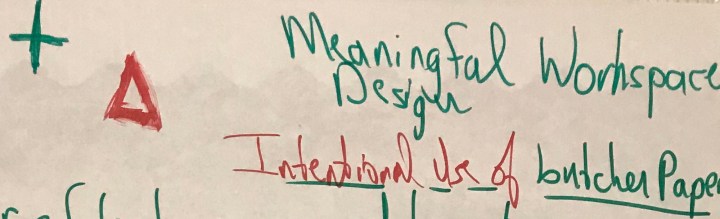 During the Plus / Delta session a participant said, “I have one that is both a plus and delta.” I said, “Great, lets talk about it.” She went on to say, “I really like the butcher paper and I took lots notes and made graphic. I really consider it a big plus.” She went on to say, “However, I wish we could use our doodles, notes, and graphics in a more intentional way.” I asked, “What do you mean by that and how could we do that?” The participant said, “Maybe we could do a gallery walk at different times during the day and reflect on the work of our fellow participants.” How cool was that! Participants taking ownership of making a convening designed for them better. It doesn’t get any better than that! I would argue that we would have never got to that level of discussion in a survey. Needless to say, we will build in intentional activities to learn from the butcher paper captured work of our participants. Exciting stuff!
I would encourage you to find your Pluses + and Deltas Δ.
How to Make Your Next Meeting as Engaging as a Video Game
 How to Make Your Next Meeting as Engaging as a Video Game
By Dick Axelrod
Originally published on dickaxe.cayenne.io
Have you ever tried to pry a child from a video game? Not easy, is it? That is because game designers embed core engagement principles into every game.
Quarrel®, a combination of Risk® and Scrabble®, is a good example. In Quarrel® you play against a variety of characters of varying levels of skill. Examples are: Caprice, who is not very smart; Damien, who is of average intelligence; and the super bright Helena, to name a few. Depending on the level of the game, you can play against one to four opponents who possess varying skills. Each round pits you against another opponent who must spell words containing up to eight letters. You gain territory if you win a match, and lose territory if you lose a match. There are numerous messages that let you know how well you are doing throughout the match. There are other more sophisticated features to the game, but the basics give us insight into why the game is so engaging:
- It is challenging. Participants must take a random set of letters and make words of a specific length within a specific time limit. Participants must also strategize about how to take over the most territory as well as how to play against opponents of varying skill.
- It invites people to participate. The audio and visual aspects of the game make the game easy to play and encourage participation.
- It provides feedback. The game provides immediate feedback about how well you are doing compared to others, and rates your word IQ.
- It builds interest through variety and drama. The game is intriguing because you are not always playing against the same players. There is a sense of drama because you are never sure of the outcome.
- It supports learning. One of the unique features of the game is that it provides dictionary definitions of words that you and your opponents play. If you want to practice by playing the same game again with different moves, you can do that as well.
- It brings closure to the work. Games have a specific beginning and end. You know when you start, you know when it is over, and you know how well you did.
What if your next meeting was one where:
- There was challenge to be met
- Participants felt invited to participate?
- Feedback occurred so that participants knew how close they were to meeting the challenge
- Interest was built through variety and drama: new people, new ways of working, new settings
- Learning occurred: participants left smarter than when they entered
- Closure occurred through clear decisions, assignments
***************************************************************************************
More about Dick Axelrod
Dick and is wife Emily Axelrod are pioneers in creating employee involvement programs to effect large-scale organization change, and co-founded the Axelrod Group in 1981. Dick is also a lecturer in University of Chicago’s Masters in Threat and Response Management Program, and a faculty member in American University’s Masters in Organization Development program. Dick and Emily created the Conference Model®, an internationally recognized high-involvement change methodology.
Together, Emily and Dick are frequent keynote speakers and co-authors. Their latest book is Let’s Stop Meeting Like This: Tools to Save Time and Get More Done it outlines a flexible and adaptable system used to run truly productive meetings in all kinds of organizations―meetings where people create concrete plans, accomplish tasks, build connections, and move projects forward.
The Gift of Listening Without Fixing
 The Gift of Listening Without Fixing
An excerpt from The Courage Way
By Shelly L. Francis
A senior management leader we’ll call Bob had tension with another person on staff, which made him feel as though his value to the organization was being questioned. He went to the CEO, Mike, for advice—and to vent a bit, too. He paced around the corner office, unsettled. Rather than give Bob instructions about what to do next, Mike consciously opted to ask open, honest questions. That meant asking questions Mike couldn’t possibly know the answer to but that would help Bob listen to his own inner wisdom.
In their conversation that day, Mike posed these questions in response to Bob’s unfolding story: What does that mean to you: feeling your value is being questioned? How does that feel to you? Do you recall a time when you had a similar feeling? How did that turn out? What are some things that occur to you as a next step?
The questions helped Bob connect the current situation with some other times in his current life and in his past. He was able to look at the workplace episode differently, and he gained a new perspective on how to approach his colleague for further conversation.
Mike’s internal stance as a leader was the foundation of this curiosity-driven yet nonjudgmental conversation that led to Bob’s insights. What Bob couldn’t see was that Mike was also embodying a few other touchstones to create safe and trust- worthy space: allowing silence, turning to wonder, and no fixing, saving, advising, or correcting. This approach empowers others to make wise decisions based on their own genuine inner knowing, rather than just accepting a superior’s advice (or seeming to but without a sense of ownership). Mike said, “I’m fascinated every time in these interchanges how much more satisfying the result seems to be when I don’t jump in with the first advice that comes to mind. My conversation with Bob had so much more texture to it. My impression was that Bob appreciated the fact that I didn’t dive in and tell him what to do and that I was interested enough in the situation to help him talk through it.”
Mike knew that his approach was atypical. “Allowing silence is challenging, especially in the workplace. People are taught to fill the silence. If you engage in conversation with open, honest questions and you give people time to ponder, that means you have to be patient with the silence.”
Mike sees how this form of conversation supports a workplace culture of compassion and empathy. “It’s harder to stop and think of asking an open, honest question. But it is a form of caring for someone, and it comes across that way—as caring.” It also communicates a charged expectation that Bob will address the situation responsibly and will be accountable for maintaining professional relationships with colleagues. This is paradox in action, to hold the tension between caring and accountability.
Mike told me that learning to ask open, honest questions is both a challenge and benefit of Courage Way practice because it’s made him a much better listener. “I’ve realized there is no greater gift you can give someone than deeply listening to them.” Open, honest questions are a form of humility in leadership, too. It’s easier but can be a form of arrogance to ask questions that try to manipulate people into the answer you want them to find.
An open question leads us to what Einstein referred to as a “holy curiosity.” ~ Dawna Markova
*************************************************************************************
 About Shelly L. Francis
Shelly L. Francis has been the marketing and communications director at the Center for Courage & Renewal since mid-2012. Before coming to the Center, Shelly directed trade marketing and publicity for multi-media publisher Sounds True, Inc. Her career has spanned international program management, web design, corporate communications, trade journals, and software manuals.
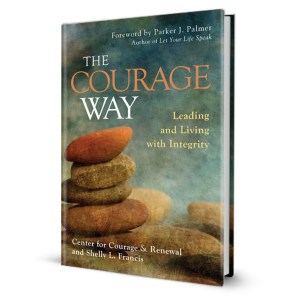
The common thread throughout her career has been bringing to light best-kept secrets — technology, services, resources, ideas — while bringing people together to facilitate collective impact and good work. Her latest book The Courage Way: Leading and Living with Integrity identifies key ingredients needed to cultivate courage in personal and professional aspects of life.
The Courage Way
 The Courage Way: Leading and Living with Integrity by Shelly L Francis
My rating: 5 of 5 stars
My Review: Being a leader takes tremendous courage and involves taking risks every day. That courage, if we are honest, is very hard to muster up at times. We all have core values we believe in and when the proverbial bullets begin to fly and hit our Kevlar, we find out just what we are made of. More importantly, those around us and that we serve find out what we are made of, too! In The Courage Way, we learn about five very important ingredients to being a courageous leader: understanding our true self, trust, being a part of trusting community, learning to embrace the paradox of leading and learning, and learning to reflect as a part of learning to lead more effectively and courageously. This book is a must read for anyone wanting to lead courageously at any level of community, even on the world stage.
~Dr. Byron Ernest
Five Key Ingredients of the Courage Way

Five Key Ingredients of the Courage Way
An excerpt from The Courage Way
By Shelly L. Francis
Leadership is a daily, ongoing practice, a journey toward becoming your best self and inviting others to do the same. And at the heart of this daily practice is courage.
Through more than 120 interviews, I found a pattern of five key ingredients in how leaders have learned to cultivate courage. Three powerful main concepts are true self, trust, and community; the two key practices are paradox and reflection. Here’s a brief overview.
True Self
Our basic premise is that inside of each person is the essential self who continues to grow and yet somehow, deep down, remains constant. Every person has access to this inner source of truth, named in various wisdom traditions as identity and integrity, inner teacher, heart, inner compass, spirit, or soul. Your true self is a source of guidance and strength that helps you find your way through life’s complexities and challenges. When you begin to listen to and trust the truest part of yourself, your choices and relationships flow from that trust, begetting more trust.
Trust
Courage takes trust—in ourselves and in each other. Trustworthy relationships create the conditions for people to flourish and for positive change to arise. Relational trust is based on our perceptions of personal regard, professional respect, competence, and integrity in other people. Coming to understand the attitudes, assumptions, and biases that lead to such perceptions of trust entails honest inner work. Our collection of principles and practices is a time-tested approach for facilitating inner work and cultivating relational trust.
Community
Becoming more self-aware and trustworthy requires both individual introspection and a supportive community. We offer a specialized meaning of community as “solitudes alone together” as well as a “community of inquiry.” Our practices offer models for how to reflect and interact with each other so that new clarity and courage can emerge.
Being receptive to the very idea of needing other people in community takes courage and yet, in turn, creates resilience. Leaders must know how to invite people into and hold them accountable for cocreating trustworthy space so that they can support each other in service of their work together. Achieving effective collaboration requires genuine trustworthy community.
Paradox
We can learn to practice paradox by recognizing that the polarities that come with being human (life and death, love and loss) are “both-ands” rather than “either-ors.” We can learn to let those tensions hold us in ways that stretch our hearts and minds open to new insights and possibilities. With paradox we honor both the voice of the individual and our collective intelligence. We trust both our intellects and the knowledge that comes through our bodies, intuitions, and emotions. Paradox values both speaking and listening. An appreciation of paradox enriches our lives, helping us hold greater complexity. Integrating our inner lives with our work in the world comes from daily practice in holding paradox.
Reflection
Refection cultivates more ways of knowing and learning that complement your mind and emotions, but draw from a deeper place: your intuition, imagination, and innermost being. Reflection is a practice that can be enriched by the mirroring of trust- worthy companions.
When we reflect together, such as by exploring how universal stories of human experience intersect with the personal stories of our lives, it can create relational trust. Guided conversations focused on a poem, a teaching story, a piece of music, or a work of art—drawn from diverse cultures and wisdom traditions—invite us to reflect on the big questions of our lives, allowing each person to explore them in his or her own way. Reflection helps us find the inner ground on which we stand firm, and it helps us find common ground with others.
If we are willing to embrace the challenge of becoming whole, we cannot embrace it all alone—at least, not for long: we need trustworthy relationships to sustain us, tenacious communities of support, if we are to sustain the journey toward an undivided life. Taking an inner journey toward rejoining soul and role requires a rare but real form of community that I call a “circle of trust.” ~ Parker J. Palmer
*************************************************************************************
 About Shelly L. Francis
Shelly L. Francis has been the marketing and communications director at the Center for Courage & Renewal since mid-2012. Before coming to the Center, Shelly directed trade marketing and publicity for multi-media publisher Sounds True, Inc. Her career has spanned international program management, web design, corporate communications, trade journals, and software manuals.
The common thread throughout her career has been bringing to light best-kept secrets — technology, services, resources, ideas — while bringing people together to facilitate collective impact and good work. Her latest book The Courage Way: Leading and Living with Integrity identifies key ingredients needed to cultivate courage in personal and professional aspects of life.
Leadership Lessons From Super Bowl LII
 How about this? Last night the underdog Philadelphia Eagles upset the defending champion New England Patriots, 41-33, to win their first Super Bowl ever. As is our family tradition, we went to our good friend’s home to watch and enjoy the Super Bowl. For this game I really did not have any dog in the fight, but found three things very interesting to reflect on during the game. First, it is such a credit to the Patriots to have been in the position of going for a record 6th Super Bowl title. Think about it, we say all the time it is tougher to stay at the top than to get there. So, kudos to the New England Patriots for that – staying at the top of the game. Secondly, the Philadelphia Eagles had to work from being the underdog. In fact they were the underdog in all post-season games. Not an easy thing to do. Finally, my third area for reflection, and maybe the most important story, is the bench-building work of the Philadelphia Eagles. In other words, to lose a franchise quarterback and have one ready to take over like, Nick Foles, is amazing.
Nick Foles is quite the story when you think about the fact that he was considering walking away from professional football as recently as this past off-season. Then he won the Super Bowl Most Valuable Player award after leading the Eagles past the New England Patriots, 41-33, in Super Bowl LII. There is no doubt that Carson Wentz was in control of the quarterback room prior to his injury, but it is also clear that the backup quarterbacks Nick Foles and Nate Sudfeld were paying attention and learning. Credit Carson Wentz with leading by example in the quarterback room so that when it became Foles’ responsibility to hold the clicker, run the video, dissect the plays and report his insights, Foles was ready.
Additionally, I saw it reported somewhere that John DeFilippo, the Eagles’ quarterback coach, asked Foles to study the offensive plays he liked and choose 25 he thought worked best for him. DeFilippo wanted Foles’ input on plays and the concepts, too. Think about this leadership move by DeFilippo to create an effective package of run-pass option plays that suited Foles’ strengths. Since getting the starting nod in the game at Los Angeles, the Eagles offense has continually morphed into one for Foles rather than for Wentz. I would argue you cannot do this having some intentionality about bench building as an organization. In fact, we see other NFL teams that have done this well; the Dallas Cowboys come to mind. We have also teams not do this well, our Indianapolis Colts this past season when losing Andrew Luck. I am amazed how some teams are able to lose a paramount player and just keep going without missing a beat and others really struggle.
Could it be that it starts in the team room with how the bench is being modeled to, how the bench is being interacted with, and ultimately how the game plan was tweaked, adjusted, and iterated to meet the strengths of the backup? I would argue that it does. Certainly some lessons to be learned here from some reflection on the Super Bowl. What have you been reflecting on since Super Bowl LII?
“No, That’s Not The Problem” ~ Peter Drucker
 Gem #5 entitled, “A Problem Well Defined Is A Problem Half Solved” (quote from Peter Drucker), in 52 Leadership Gems: Practical and Quick Insights For Leading Others by John Parker Stewart was about Peter Drucker’s insistence that problems be defined by root causes, not symptoms. This really got me to thinking about how much we really do this. The point here is we spend a great deal of time dealing with symptoms of the problem as opposed to the actual problem. It is why I am such a believer in looking at outcomes. Sometimes our biggest problem is, we don’t know what the problems are.
 Dr. Drucker also recommended against picking “Elephant Problems.” Elephant problems are ones that are just to big to address. In other words they would just cover too much to really get down to root cause problems. Therefore, elephant problems need to be broken down into smaller parts. I also like the discussion of not just using convenient data. Sometimes we just look at the data that either reinforces our own theories or hypothesis.
To really solve problems we need to first define the problem well and then get to the root cause. Only then can we begin to develop solutions that will be effective. What I have learned is that nearly everyone is usually clear on the task, but not clear on outcomes. Dr. Drucker was tough on those he worked with to continue to search for the real problem. He would continually say, “No, that’s not the problem.”
Failure To Communicate
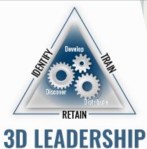
 We spent a lot of time today discussing communication in our Noble Education Initiative 3D Leadership Program kickoff for our South Carolina and North Carolina schools today.
  Then when I was reading Gem #4 entitled, “The Biggest Hurdle To Effective Communication Is The Assumption That It Has Taken Place” in, 52 Leadership Gems: Practical and Quick Insights For Leading Others by John Parker Stewart. The main point of this gem was to not assume that everyone in the loop has received and understood the message. I really believe it even goes further than this. We also must make sure we understand the Vantage Point of the person we are communicating to.
“Leaders must accept as a constant that when two or more minds attempt to communicate, they are coming from at least two different perspectives.” ~ John Parker Stewart
One of the models I like to teach about to leaders is the Vantage Point Model developed by MG Taylor. Basically, the model looks like a topographical map that takes you from task to philosophy or philosophy to task depending on how you look at it. The lesson here is, though, that it depends on your role as to which Vantage Point you are working from. If we can find a way to communicate and look at all change from all seven Vantage Points we are in a better place to have communicated effectively to all. Here are the Vantage Points:
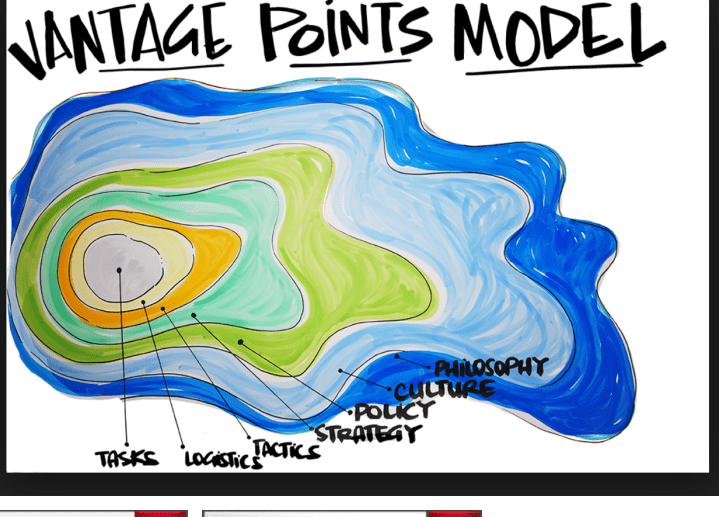
In reality we can never understand the philosophy of an organization or school, in my case, until you are immersed in the tasks that comprise its daily functions. Moreover, our daily tasks can blind people to culture and philosophy, or cause them to accept it too casually. I have found that if organizations can find commonality by using the Vantage Points as a guide it can be become a powerful pathway to effective communication. This model also serves as a guide to answering the “why?”.
Think about all the Vantage Points of those you serve in your next communications.
‘
 Byron's Babbles
leave a comment