Creating Autonomy Is More Than Stepping In A Puddle

Simple Truth #12, “Create Autonomy Through Boundaries”, in Simple Truths of Leadership: 52 Ways To Be A Servant Leader and Build Trust, Making Common Sense Common Practice by Ken Blanchardand Randy Conley reminded me of what my friend and mentor David Marquet always says, “[empowerment and agency without developing the technical skills will create chaos.” Blanchard reminded us of this in this chapter when he said, “Ensure people are aware of all procedures, rules, and laws” (p. 37). The development, goals, expectations, and accountability give us the boundaries.
“A river without banks is a large puddle.”
John Carlos and Alan Randolph in Empowerment Takes More Than A Minute
Just yesterday, as I was in a gathering as a part of some Aspen Institute work in education I am doing right now, we were contemplating how to make sure our educators have the professional growth and development to do all the work that science tells us is necessary to enhance the quality and depth of student learning when the students have opportunities to interact with others and make meaningful connections to subject material. This is really a combination of the teachers and students having the autonomy to do this important work. Therefore, it is important for organizations to take a systems approach to promoting development and addressing both student and adult skills and beliefs; organizational culture, climate, and norms; and routines and structures that guide basic interactions and instruction. I don’t believe this looks much different no matter what the organization is in the business of doing. If we want more than a “puddle” of autonomy we must create the meaningful opportunities for developing the right ethos for autonomy, agency, and empowerment.
Our #1 Customers
This week, Simple Truth #11, “Profit is the applause you get for creating a motivating environment for your people so they will take good care of your customers”, in Simple Truths of Leadership: 52 Ways To Be A Servant Leader and Build Trust, Making Common Sense Common Practice by Ken Blanchardand Randy Conley reminded us that our number one people in our organizations are our people that make it all happen.
“If you train, empower, and care about your people as your number one most important customer, they will go out of their way to take care of your organization’s number two most important customer – the folks who buy your products and services.”
Simple Truths of Leadership, p. 35
So, don’t forget…make your team members and employees number one so they can make those your organization serves number one!
Using Different Strokes For The Same Folks

With this week’s simple truth, I realized just why Ken Blanchard and Randy Conley wanted to name their latest book, DUH! Why Isn’t Commonsense Leadership Common Practice? instead of Simple Truths of Leadership: 52 Ways To Be A Servant Leader and Build Trust, Making Common Sense Common Practice. Simple Truth #10 entitled “Effective servant leaders don’t just use different strokes for different folks, they also use different strokes for the same folks” reminds us that the people we serve will be at different development levels for the different goals, projects, and initiatives they are working on. Therefore, our people will need different strokes (leadership styles) for the different things they are doing.
“Managers who are servant leaders take a situational approach in leading people. They know they sometimes need to use not only different strokes (leadership styles) for different folks but also different strokes for the same folks in different areas of their job.”
Ken Blanchard (2022). Simple Truths of Leadership, p. 31.
So many leaders believe project improvement is all about emphasizing efficiency measures instead of the behavioural or interpersonal factors. While achievements of performance measures such as time, budget, and functionality are important, leading people to deliver results is needed instead of managing work. This also means that leadership style and the ability to practice situational leadership and use the right style in the moment for each individual. Let’s also not forget that this also reaffirms how important relationships are to leadership. We must really know those we serve to know the different strokes.
Different Strokes For Different Folks

I love the phrase “different strokes for different folks.” I’m such a believer and advocate for individualization, personalization, and differentiation for everyone. We work at this in education for all scholars, but we need to be diligent about doing this for those adults we serve as well. Here we are in the ninth week of the year and in Simple Truth #9, “Effective Servant Leaders Realize They Have To Use Different Strokes For Different Folks”, in Simple Truths of Leadership: 52 Ways To Be A Servant Leader and Build Trust, Making Common Sense Common Practice by Ken Blanchard and Randy Conley we are told that the best leaders use different strokes (leadership styles) for different folks. To be flexible and differentiate for those we serve we must, “Determine whether they are generally an Enthusiastic Beginner; a Disillusioned Learner; a Capable, but Cautious, Contributor; or a Self-Reliant Achiever” (p. 29). I’m going to make you read this great book to get all the details.
Furthermore, I believe this flexibility is part of loving those we serve. When we really take the time to understand and build relationships with others, whether our students or those we work with, we can help to individualize and differentiate for what styles and support will enable them to thrive.
The Best Minutes You Can Invest

I’m very passionate about the fact that we need to love employees, people, students, well…everyone. To do that means really making an investment. I’m not talking about a huge financial investment, but an investment of minutes for each of those we serve. “Sometimes the simplest acts – like paying attention, commenting on what people are doing, or having a friendly chat – can be the most meaningful” (p. 25). This statement in Simple Truth #8, “The Best Minute Servant Leaders Spend Is The One They Invest In People”, in Simple Truths of Leadership: 52 Ways To Be A Servant Leader and Build Trust, Making Common Sense Common Practice by Ken Blanchard and Randy Conley really drove home the point of how best to love those we serve – spend our minutes making people feel special.
“Investing in people is about spending time focusing on them, not yourself.”
Ken Blanchard, Simple Truths of Leadership, p. 25
Beware! Don’t try and fake this, however. Those you serve will always see your fakeness (I know fakeness is not a word, but I like it here). If you ask how someone’s weekend was or what they need, be prepared to listen and provide support if needed. Let’s spend our minutes wisely. Let’s spend time focusing on others.
Side By Side Leadership

I’m glad I hadn’t written this post reflecting on Simple Truth #7, “When People Are Off Track, Don’t Reprimand Them – Redirect Them”, in Simple Truths of Leadership: 52 Ways To Be A Servant Leader and Build Trust, Making Common Sense Common Practice by Ken Blanchard and Randy Conley before a leadership development gathering I facilitated last night because a conversation added value to the book content. We discussed how important it is to show grace, have empathy, and practice compassion. One leader asked, “What happens when the person you are showing grace to just isn’t getting the job done?” A great discussion ensued. Many even shared their stories of being on both sides of that question. Long story short, where we landed was that there has to be grace with accountability. If we really love those we serve this is the right thing to do. So, for example, if a person has had some change that causes him to be a little late to work, then there can be the accountability of, “what’s our goal of when we can get back to being on time?” Or, even better, could there be some adjustment made for that person to work later in the day that would help out someone needing to leave earlier? This is what loving those we serve is all about. We say it can’t be one size fits all for students, why does it have to be one size fits all for adults? I don’t think it does.
This all caused me to reflect even more on what Blanchard called “side-by-side leadership.” He stressed that we are almost always in learning mode and “Punishing a learner is never appropriate…” (p. 23). Ever had that boss that liked to reprimand? You know, the one you only heard from when we made a mistake – in today’s world usually in the form of a text or email. Not real helpful, right? Blanchard said, and I believe this goes right along with our grace with accountability discussion last night that, “When people are clear on the goal and still learning but their performance isn’t up to standard, redirection is far more effective than a reprimand. The aim is to BUILD (emphasis added by me) people up so they will continue to move toward improved performance” (p. 23). So, let’s all get side-by-side with those we serve and build, build, build!
Approximately Right To Exactly Right

It’s funny; we all have that word when we are learning to talk that our parents told the story about. Mine was calling candles at Christmas time “nandles.” By my birthday I had perfected my speaking and called them candles on my birthday cake. For my son it was “corn on the bob” instead of “corn on the cob.” The point of the story is that we both eventually got it right. As an educator, I’ve always understood the power of praising progress and growth to proficiency. Somehow, though, many leaders forget this with adults.
This week in Simple Truth #6, “Praise Progress!”, in Simple Truths of Leadership: 52 Ways To Be A Servant Leader and Build Trust, Making Common Sense Common Practice we are told by Ken Blanchard and Randy Conley that “Good performance is a moving target, not a final destination” (p. 21). Their point is that if we are serving correctly as a leader we will be coaching, developing, and cheerleading along the way – not just waiting to see if there is success or failure. As we’re told by Ken and Randy, “Exactly right behavior is made up of a series of approximately right behaviors” (p. 21). Nandles became candles and corn on the bob became corn on the cob. What was your word you had approximately right?
Seagull Management

This week’s Simple Truth #5, The Key To Developing People Is To Catch Them Doing Something Right, in Simple Truths of Leadership: 52 Ways To Be A Servant Leader and Build Trust, Making Common Sense Common Practice by Ken Blanchard and Randy Conley really resonated with me. Last week I had made the comment that right now everyone seems to be looking over their shoulder waiting for someone to catch them doing something wrong, saying something wrong, or making some kind of mistake. My experience with those kind of cultures of fear of making mistakes is that we are going to, you guessed it, make mistakes. So, how do we change this? It is actually pretty easy, shift to “…catching people doing things right and praising them” (Blanchard & Conley, 2022, p. 19). They tell us it really is common sense.
“Seagull management, where managers set goals with people and then disappear until something else goes wrong. Then they fly in, make a lot of noise, dump on everybody, and fly out.”
Blanchard & Conley, 2022. Simple Truths of Leadership. p. 19.
But really, how do you change that? I loved the term Blanchard used to describe how we are missing the mark. He called it “seagull management.” I am sure after many of you read the quote above defining seagull management you were saying, “Yes! I have totally experienced this.” It may be that person that only texts, calls, or emails when something is wrong or it is perceived we’ve made a mistake. I’ll also relate this to society in general right now to the people who only post mistakes or quote people on social media who have misspoke (not really intending to say what they said). Again, my experience has been that when we are in environments like that we tend to make more mistakes.
We are all going to make mistakes. Remember, the only people who don’t are the ones not doing anything (sometimes the seagulls). So, let’s use the common sense practices from Blanchard and Conley and catch people doing great things, praise them and “Make it clear you have confidence in them and support their future success” (p. 19). Key word there is “support.”
Don’t Get Caught In The Activity Trap
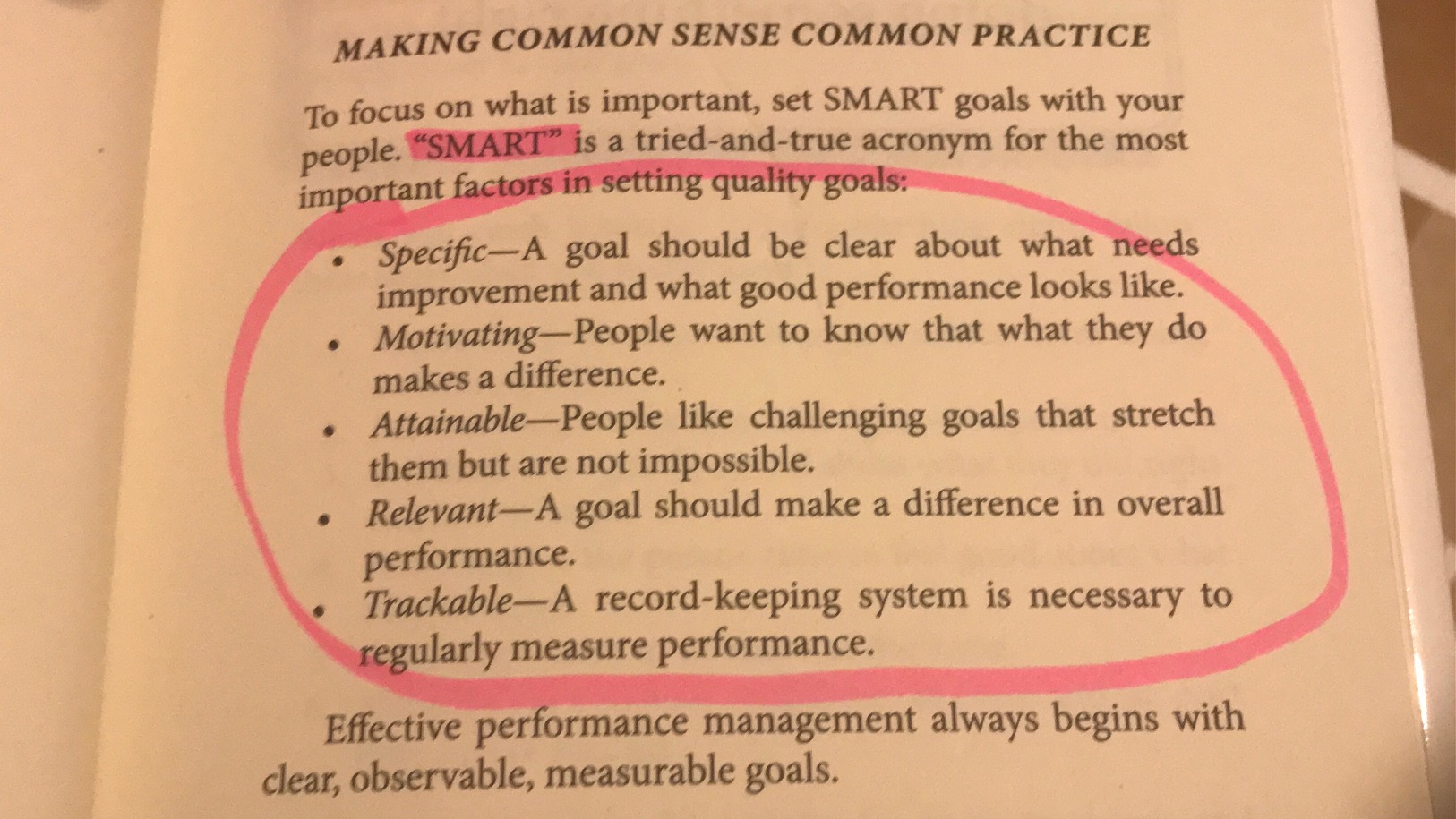
Goals are very important. I don’t think anyone will argue that. Even just starting meetings by reminding everyone the goal to be accomplished is important to keeping us from going down rabbit holes. Having said that, I have always been fascinated to watch how leaders use goals – or not. In Simple Truth #4, All Good Performance Starts With Clear Goals, in Simple Truths of Leadership: 52 Ways To Be A Servant Leader and Build Trust, Making Common Sense Common Practice we are told by Ken Blanchard and Randy Conley that great leaders help those they serve to “…establish observable and measurable goals around their key areas of responsibility” (p. 17). I have witnessed leaders who are all about setting the SMART (see picture) goals, but then do not give the support needed for those they serve to accomplish the goals.
The authors called this out with what they called the “activity trap.” Blanchard and Conley said, “As a result, people tend to get caught in an activity trap where they are busy doing tasks – but not necessarily the right tasks” (p. 17). For some leaders it almost seems like they believe it is an honor to have their people, and even themselves, overloaded with the trivial issues, irritations, requests, and routine activities that eat up our time and resources. If we really want to shape the future, see around the corners, and look into the future we must use our goals and then set the strategy to achieve them. Getting caught up in the activity trap keeps leaders and their organizations from fulfilling their strategic mission.
Remember, activities completed do not necessarily equal desired outputs or worthwhile outcomes. This activity trap also kills innovation. Doing a bunch of activities prescribed by someone else does not mean that we have achieved the desired output or outcome, or set up other dependent activities for success. I believe this is a real problem in the area of education, where I spend a lot of time. Many times teachers are given many prescribed activities that are not really driving student achievement. The moral of this story is that we need to set the right SMART goals for outcomes and then support those we serve to achieve them with them using their own data to make decisions and adjustments.
Can You Get Your Deck Chair Unfolded?

Simple Truth #2 this week in Simple Truths of Leadership: 52 Ways To Be A Servant Leader and Build Trust, Making Common Sense Common Practice by Ken Blanchard and Randy Conley was “Every great organization has a compelling vision.” We spend quite a bit of time on this in the leadership development work I do. So many times this just becomes a task to get done, then laminated and pinned on the wall. Then when someone is coming to visit everyone better have it memorized. Worthless, right? Right! I love the three elements: 1. Purpose; 2. Picture of the future; and 3. Values.
It is then so important to involve all stakeholders in the development and living out of the vision. Basically, we are answering the question: “Where are we going and what is going to get it there?” Thinking of the vision in the three parts suggested in Simple Truths of Leadership gives context and life to the vision. This reminded me of someone once referring me to an interaction between Charlie Brown and Lucy in a Peanuts comic:
“Life, Charlie Brown, is like a deck chair. Like a what? Asks Charlie Brown. Lucy then explains. Have you ever been on a cruise ship? Passengers open up these canvas deck chairs so they can sit in the sun. Some people place their chairs facing the rear of the ship so they can see where they’ve been. Other people face their chairs forward – they want to see where they’re going. On the cruise ship of life, which way is your deck chair facing?”
Charlie Brown replies: “I’ve never been able to get one unfolded.”
Peanuts, Charles M. Schultz
We need to help everyone get their deck chairs unfolded and facing forward to the future.
 Byron's Babbles
leave a comment