To Say Or Not To Say

In Season 10, Episode 233 of M*A*S*H, Hawkeye (Alan Alda) gave Colonel Potter (Harry Morgan) an incredible compliment saying, “He not only knew what to say, he knew what not to say.” This compliment referred to Colonel Potter’s great communication skills. It meant that Potter had the skill and wisdom to choose his words carefully, knowing when to speak and when to keep silent. A person with this skill understands the impact of their words on others, and has the ability to communicate effectively without causing offense or misunderstanding. The character of Colonel Potter in this great show had incredible emotional intelligence as a leader. This emotional intelligence helped him to be articulate and tactful. His leadership was a valuable asset in the chaotic situations of war and leading an army hospital, where communication is important.
Have you ever noticed that it is much more difficult to know what not to say? In fact, sometimes those we serve just need for us to listen and not say anything. To say or not to say, really is the question.
Move With It

I love the phrase “Life moves in one direction; you should move with it.” Life is constantly moving forward and changing, and it is important to adapt and evolve with these changes instead of resisting or trying to go against them. We can use the past to inform our journey moving forward, but we can’t go backward. We cannot control everything that happens in our lives, but as the saying goes we can control how we respond and react to those events. We can apply this to the various aspects of our lives, including personal growth, career development, and relationships.
Furthermore, by embracing change and moving forward with life, we can better navigate the ups and downs, ultimately living a more fulfilling and satisfying life. We need to stay open-minded, resilient, and adaptable to whatever life throws our way.
The Best Plans

You all know I love the television series, Lethal Weapon. There are always lots of little lessons and things to reflect on. During Season 1, Episode 17, Riggs told Murtaugh that, “the best plans never feel like they are the best plans.” Murtaugh pushed back on that, but the more I thought about it the more I believe that is sometimes the truth. Actually, more than sometimes; a lot of the time. Often, the best plans require effort, sacrifice, and hard work. They may involve making difficult decisions, taking risks, and stepping outside of one’s comfort zone. These actions can be uncomfortable, and even scary at times.
The bottom line is that whether a plan feels like the best plan or not may depend on our perception and attitude towards it. We must always make sure our plans are well thought-out and executed properly, so they have potential to result in success. It is important to remember that the journey to success is rarely easy, but the rewards can be worth the effort.
Looking At It Instead Of For It

I loved the phrase, “I went aggressive because I would rather be looking at it than for it” that Detective Martin Riggs (Clayne Crawford) made in an episode of the television series Lethal Weapon. He made the comment defending purchasing way more Chinese food selections for he and a colleague than they needed. I could relate because I tend to do things like that because I don’t want to run out or not have enough selections. In fact, I know I over-ordered on some supplies just this morning I need for a retreat I am facilitating in a couple of weeks. This gives me more control over the situation. I would rather be looking at a little extra in the end than needing to find more supplies at the last minute. An aggressive approach usually keeps us from having to scramble in the end.
Upon reflection I realize I usually take a more aggressive approach or action in order to address a problem or situation proactively, rather than waiting for it to become a bigger problem and having to deal with it later. It’s about putting in the effort on the front end, rather than having to expend more time and energy later on to fix it. We always need to be thinking of how to take a more proactive approach to problem-solving, instead of waiting until things become more pressing.
Conversation As A Series Of Interruptions

Recently, I heard conversation described as a series of interruptions. As I reflected on the comment, I realized it is true. That is why it is so important to actively listen and be adaptable and flexible in our communication styles. We also need to be open to unexpected changes in the conversation. Very rarely are conversations smooth and uninterrupted exchanges of ideas between two people or groups of people. Have you ever been in a conversation that has had frequent interruptions, whether intentional or unintentional, that disrupted the flow of conversation and cause communication breakdowns? I have people I talk to on the phone that this really happens a lot with. The other person is either trying to multitask with something that is noisy, begins talking to others, or their Bluetooth gets out of range of their phone. The interruptions can also take other forms, like side comments, digressive remarks, questions, or even silence.
We need to strive to not be the ones causing the interruptions mentioned above. But that certainly does not keep us from being in conversations like that. Even with the occasional interruption, or veering of topic (I’m known for that), conversations can still be productive and meaningful if participants are listening attentively and actively navigate the conversation effectively; staying focused on their goals for the conversation.
Enemies We Have Made

Grover Cleveland’s enemies ended up making him more successful and influential. Troy Senik did a great job of bringing this out in his great book, A Man of Iron. The Turbulent Life and Improbable Presidency of Grover Cleveland. In 1884 when Cleveland, our 22nd and 24th President, received the Democratic nomination for President one of the descriptions used by a convention speaker was, “But they love him most for the enemies that he has made.” This really got me thinking about the effect that our enemies have on us. We certainly don’t want to let our enemies define us, but we can let them make us stronger. As in Cleveland’s case, having enemies can also bring us admirers and supporters who appreciate our courage and conviction.

We’ve all probably had situations where taking a stance on something led to the creation of enemies. I know I can think of a few. Actually, quite a few. I’ve heard some say that if we are not making enemies we are not doing anything. We certainly cannot please everyone, nor should we try; because we won’t please anyone, including ourselves. When we stand up for what we believe in and take a stance on something, there will always be those who disagree with us or see us as a threat. Our enemies, however, can serve as proof of our integrity. We can then use the opportunity to showcase our character and values. Being a leader is not about being right or being liked. It is about getting it right and progress.
Rising Above The Noise

Yesterday I blogged from the inspiration of the great Limp Bizkit song My Way in The Leadership Fight. Today’s post was inspired by Through Fire and their great song, Lose it. This song from start to finish has a lot of lessons for us to think about, both individually, and as a global society. The first verse gave us a bunch to think about. Here it is: “I try to be the voice that rises up above the noise; In the madness, in the static; I try to hold it all together as it falls apart; We dismantle what we can’t handle; and We’re polarized from every side.” The phrases in this verse suggest a willingness to give up on something if it becomes too difficult or complicated to deal with, implying a lack of perseverance or commitment. We all need to be the voice that rises up above the noise. Relationships matter here. By building strong relationships with your audience members, you can create a loyal following that will help amplify your message and spread it to others.
The phrase “We dismantle what we can’t handle” could suggest a willingness to give up on something if it becomes too difficult or complicated to deal with, implying a lack of perseverance or commitment. With so much complexity, really we should say multiple complexities, out there today, situations and issues begin to feel overwhelming. Maybe instead of viewing dismantling from a negative viewpoint, we need to consider taking on the challenge that seems too difficult to overcome or manage and breaking it down into smaller, more manageable pieces. With those manageable pieces, we need leaders who can define the priorities. Along with this prioritization, we must decide what not to do along with what to do. Great leaders make sure their radar extends out across all the ecosystems in which they operate. If we all work together, we can hold it together.
The Leadership Fight

While doing some work in the barn on this super beautiful day today, I had the Sirius XM blaring. When the great Limp Bizkit song My Way came on, the phrase, “You think you’re special, you do; I can see it in your eyes; I can see it when you laugh at me; Look down on me and walk around on me; and Just one more fight about your leadership.” I thought about how so many others have had these kinds of thoughts about another person’s ability to lead or manage a particular situation or group. Sometimes disagreements over decision-making, communication, or other leadership qualities lead to this kind of blow up.
Do you have those that could be using the phrase, “Just one more fight about your leadership” about you? Are there changes that could be made to make the situation better? Or, is there ongoing discord or dissatisfaction with a leader you are working with and their methods? What would it take to make things right? Take a moment and reflect on the greatest leaders and leadership styles you have experienced. What made those experiences great? Could anything be applied to the current situation to eliminate the leadership fight?
Being More Present In The Present

I was listening to Indiana native and Princeton University’s head basketball coach, Mitch Henderson, after their 75-85 loss to Creighton University. He reflected and showed appreciation to his players for allow themselves to be coached. This really jumped out at me. To continually grow, evolve, and improve we must allow ourselves to be coached. But, let’s not forget that coaching is a collaborative process that requires open communication, mutual respect, and a shared commitment to growth and development. Henderson clearly earned his players trust, thus allowing them to be open to being coached. As leaders, it is our responsibility to build rapport, establish clear boundaries and expectations, and create a sense of partnership and collaboration with those we serve.
Relationships and teams are built in real-time. To become a team we must engage fully in the process and work together towards achieving their goals. It is also crucial that everyone involved, especially the leader/coach, be present. I loved what Princeton freshman forward Vernon Collins said, “He’s thankful for the past; but he’s more present in the present…” Did you catch why Collins said? “…he’s more present in the present.” Sometimes we let past history and success cloud our present situation. We need to be more present in the present.
Surprise Me
I am a huge believer in the cultivating of a collaborative and supportive work environment. The best leaders are the ones who give their teams autonomy and create a sense of ownership among their staff, instilling a greater sense of responsibility and empowering individuals to take ownership of their roles within the organization. Interestingly, this act of delegation is extremely hard for some leaders. It is tough for some to let go. When decision-making authority is given to those closest to where the data is created, it can lead to improved communication, as team members have the opportunity to have greater input and more direct interaction with each other when problem-solving. In “Empowerment Needs No Menus!” I said, “To empower someone, you have to help them feel proud of the good things they do. This is truly the essence of empowerment.” One of the best examples of this are great servers at restaurants. I first experienced this when going out to eat with my dear friend and leadership idol, David Marquet. He said, “Byron are you up for letting our server pick everything from our drinks to dessert?” I was all in and it was a wonderful experience. I now use this as a leadership exercise and it is interesting to see how everyone handles it.

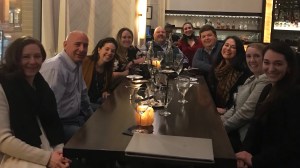
This week I was in Washington D.C. for the National Association of State Boards of Education’s (NASBE) Legislative Conference and one of the highlights is always getting a group together for dinner. No surprise, I was left with the planning of where we would be going. I picked TruLuck’s Ocean’s Finest Seafood & Crab. Here’s the deal: on their website they tell you to “Escape the ordinary!” The great experience there allowed us to do just that. On their Twitter site they tell us, “Captivating ambiance and genuine Southern Hospitality – We believe small touches inspire lasting memories. Delight in dining again.” I’ve got to tell you, the small touches that our server Lulu brought to our group from Maine, Arkansas, New Jersey, Georgia, Indiana, Texas, Kansas, and present and past NASBE staff did inspire memories that will last us the rest of our lives. Needless to say, Lulu was fantastic.

Now, back to empowerment. It was clear that Lulu knew what she was doing. She knows the menu and every item on the menu; she knows how read every individual in a group; and she understands the right questions to ask to best meet the needs of her customers and create those small touches that inspire. This was so evident that one in our group, Renée Rybak Lang, NASBE’s Communication Director, empowered Lulu by saying, “Surprise me” when it was her turn to order- leaving her entire meal in Lulu’s hands. I loved it! Lulu was excited by this declaration of empowerment, asked Renée a couple of questions, like “How hungry are you?” and away she excitedly went. Remember, empowered team members feel that they are contributing to the growth and success of the organization. Lulu is a critical part of TruLuck’s success. And since I know you are wondering; yes, Renée loved her steak and lobster. Renée allowed Lulu to utilize her own creativity, knowledge of her menu, and the relationship she had built with the customer to choose a better meal for her than she might of chosen for herself. I’m sure Renée made Lulu feel proud of the great things she does. Additionally, TruLuck’s was able to deliver on their promise of escaping the ordinary, because of Lulu. What are you doing to foster a culture of empowerment and create a sense of ownership among team members?
 Byron's Babbles
leave a comment