Anything & Everything
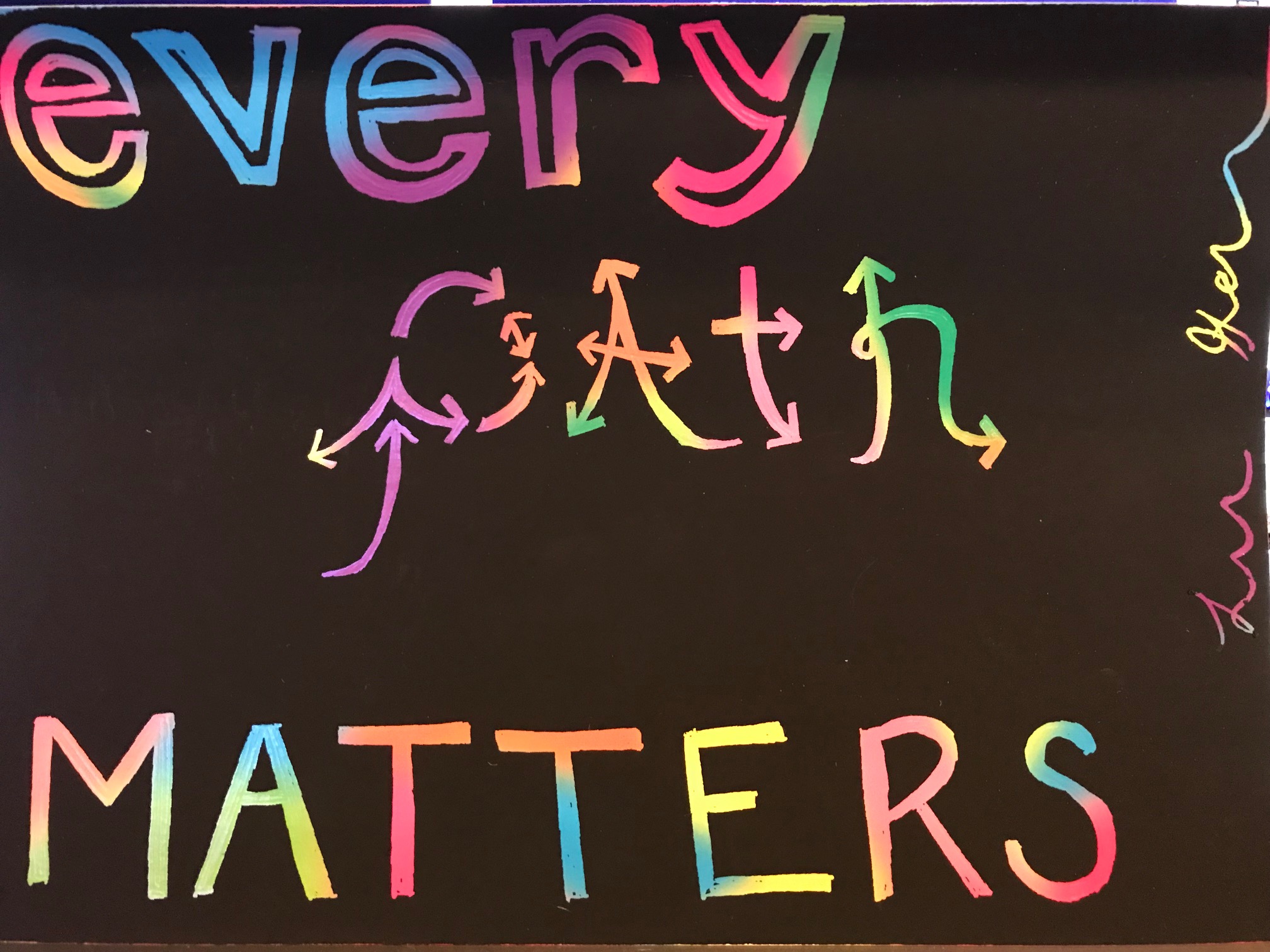
David Allen once said, “You can do anything, but you cannot do everything.” I was reminded of this quote while reading The Bookshop At Water’s End by Patti Callahan Henry. The line in the book that inspired this post was, “There was no ‘either’ ‘or.’ There was ‘anything’ and ‘everything’.” This was in the context of the way two young girls were spending their summer vacation (you really need to read the book!). I loved this because it was not about choosing, it was about doing it all. I totally get where David Allen comes from in saying we cannot do it all, but for young people, especially, shouldn’t it be about experiencing it all. We actually spent time diving in on this in recent leadership development workshops I have been doing on core values by contemplating that a core value of “Every path matters” is much more livable than just saying “students first” as many do. As I teach, for core values to mean anything they must be livable. We must help students understand what possibilities are out there. And, give them a chance to realize those possibilities.
This line, “There was no ‘either’ ‘or.’ There was ‘anything’ and ‘everything'” in this novel reminded me we must be exposing our students to as many paths as possible. Nor, should we be excluding paths, but making sure our students understand where each path can or cannot take them. It must ultimately be their decision. We need to help them determine their interests and talents. We must also help and encourage our students to fall in love with learning. We need to be the people their lives that challenge them and hold them accountable. We need to be the ones who will offer questions and share their experiences. Let’s try to create the environments where our young people like Bonny and Lainey, who in the novel read, swam, and made wishes about their dream lives, don’t have to worry about doing “either” “or,” but can to “anything” and “everything.” Every path matters!
Seventh Graders Know!
I spent this past week coaching teachers during their first days of school. It was so great to be in classrooms all day and then spend time leading reflection discussions after school. It has always been interesting to me how I can walk into a class and immediately know whether the teacher has the entire class engaged and the overall culture of the classroom. I think it is because I always focus on what the students are doing. I walked into a seventh grade class this past Wednesday and saw a teacher and group of students knocking it out of the park. It was one of those moments where I wanted to be back in seventh grade and a part of her class.
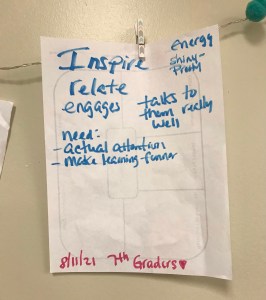
At an appropriate transition I asked the teacher and class if I could interrupt with a question. They all said yes and I asked if they all thought their teacher was doing a great job. It was a loud and resounding “YES!” I then asked a followup, “Why?” I also asked the teacher to write down what the seventh graders told us. By the way, a student pointed out I had asked two questions and not just the one I had gotten permission for – gotta live seventh graders! The list is the featured pictured of this post. What they said was:
- Our teacher inspired us.
- She can relate to us.
- She makes it exciting and engages us.
- She had a lot of energy (literally, this teacher was running from student to student).
- She helps them make everything shiny and pretty.
- She talks to us really well.
- She gives us actual attention.
- She makes learning funner (I know funner is not a word, but it should be and I told the student I would allow it).
This teacher was clearly “withit” and was building relationships with her students. Our students deserve those eight items that these seventh graders outlined. It really doesn’t matter what age group a person is facilitating, all these items apply. Our seventh graders know!
Leading Like A Hinge

I spent this week coaching teachers as the school year got started for many of the schools I work with. One of the teachers I coach told his students that he loved it when I was in the school because I was like the hinges on a door. “Without hinges the door is useless. You can have fancy doorknobs and windows, but the hinges make the door functional. Hinges attach a door to its frame, and are the pivot point for opening and closing the door.” I do hope I am helping teachers connect with their students and am serving as a hinge for the door to open for them to become highly effective facilitators of learning for their students.
Upon further reflection I was reminded of something retired Admiral James Stavridis, author of Sailing True North: Ten Admirals and the Voyage of Character, said: “Leadership is how we influence others. It is like a big door that swings. But that big door of leadership swings on the small hinge of character.” I hope that I bring a great degree of character to my leadership and that I inspire others to do the same.
I want to provide those I coach with the tools, guidance, support, and feedback they need to thrive in their teaching career. I want to be the hinge that opens the door to their success.
Imaginative Play Zones

Albert Einstein famously said, “To stimulate creativity, one must develop the childlike inclination for play.” And even Pablo Picasso said, “Every child is an artist. The problem is how to remain an artist once we grow up.” If children are more creative than adults, it’s not because they have a superior imagination. They just don’t suffer from self-doubt and fear to the extent that adults do. In this respect, at least, we could all afford to be more like children. We don’t question kids being more creative than adults; we all intuitively just know it’s true and we view it as a natural state for children.

So why do kids have the aptitude for creativity? Play! And, remember they have not yet developed, or been taught the self doubt and fear part to the extent we adults have, either. In studying the work of Dr. Stephanie Carlson, an expert on childhood brain development at the University of Minnesota, she taught us that kids spend as much as 2/3 of their time in non-reality— in imaginative play. This is why when I am providing development for adults I always try to spend some time channeling their inner child. Adults want to, and effectively, learn like kids. We want the play, time for imagination, and a safe place for trying new things.
As I worked with teachers this past week we discussed creating psychologically safe places for our students to learn and try new things (the things we are teaching are new). But, we must also not forget our adults – we need a psychologically safe place as well. How about we create imaginative play zones?
I Was Needed!

I love that a lot of what I do is helping teachers get better at their craft. Teaching is such a beautiful cross of science and art. Leonardo da Vinci would be having great fun if he were around helping us improve our teaching for learning today. He believed science and art were very tightly connected. This week I have had the honor and pleasure of facilitating professional development for teachers at Nashville Collegiate Prep and Knowledge Academies in Nashville, Tennessee. I have truly been inspired by this group of professionals. Every day I am excited to get the day of learning with them started.
“Change the audience, change the meaning.”
Leonardo da Vinci
On Wednesday I did a session entitled “Engagement Strategies: Teachers As Facilitators, Knowledge Navigators, and Co-Learners. At the beginning of this session I do an activity that begins with the prompt question, “What do you want students to say at the
end of the week about your facilitation?” The groups got five minutes to write everything that came to mind on Post-it® notes. This is part of a larger activity and participants get to share out after each part. I love walking around and looking as they are writing. There were literally hundreds of sticky notes being made, and I was inspired by all of them. But, one caught my eye and required my attention (the featured photo of this post).
On one of the Post-it® notes of Jamie Martineau, Kindergarten teacher at Nashville Collegiate Prep she had written four bullet points:
- I was part of something
- I was important or needed
- I am a part of this class
- We did it
I was blown away by the thought of every student feeling this way. After getting to know Jamie this week, I have no doubt that her students will feel that way. Going through school is where many of students begin learning to be part of something bigger than themselves. It’s during this time in our classes that we can help make our students feel valued as individuals. The developing personalities of our students need a strong and secure environment in order to flourish in academia. Let’s face it; our students learn more and behave better when they receive high levels of understanding, caring and genuineness.
We cannot underestimate the importance of cultivating a classroom culture in which students feel valued, respected, heard, and an important part of something. One way we can build this solid foundation for learning is to listen to our students. Fostering conversations about real world and relevant issues, topics, and problems ensures that our classrooms become places of academic inquiry and collaboration founded on a sense of fairness and mutual respect.
If a student considers their teacher to be caring and accepting, they’re more likely to adopt the academic and social values of their teacher. This, in turn, influences how students feel about their school work and how much (or how little) they value it. Here are some tips on how to make sure our students belong and are part of something:
- prioritising high-quality teacher-student relationships
- creating a supportive and caring learning environment
- showing interest in students
- trying to understand students’ point of view
- respectful and fair treatment
- fostering positive peer relationships and mutual respect among classmates to establish a sense of community
- positive classroom management
- Giving students a voice
We all want to belong. ALL of our students deserve to be an important and needed part of our school communities. We can do it!
Be An Explorer, Not An Expert

I am so glad I read the book, Alien Thinking: The Unconventional Path To Breakthrough Ideas. This book helped me further hone the alien that has always been in me for wild and creative thinking and innovation. In the book, authors Cyril Bouquet, Jean-Louis Barsoux, and Michael Wade presented an incredible framework using ALIEN as an acronym. I highlighted the framework in What Will You Regret When You Are 80 Years Old? Another comment the authors made in the book that caused me to do further thinking was that we need to “Approach things not as an expert, but as an explorer.” I’ve always been a critic of so called experts and this was a warning of the problem of acting like an expert.
The problem of overconfidence and closed-mindedness in areas we believe we have expertise is all the more troubling because we so generally tend to credit ourselves and many times others with having more expertise than we really do. In Alien Thinking we were taught that discoverers know what they are looking for and then go out and find it, but explorers take chances by creating new things, and looking for what they don’t even know is there. The expert status can serve as blinders keeping us from exploring for the next way of doing what we are doing well now better or differently.

Those that know me well know that I love intersectional learning and learning from outside my own industry. Bouquet et al. argued there is great value in this as well. They posited that “Leaders thus need to think like explorers, become more adventurous and steal the essence of ideas from outside their industries…” Taking an expert frame of reference keeps us from looking for what is next. We need to be looking at industries outside our own and “stealing” ideas. I believe this is an issue particularly in education. There is not enough exploration happening in other industries to learn how to best educate. We can rely on our “outsider status” and being “adjacent outsiders” to learn and discover from others.
Authentic & Genuine

During some leadership development & workshop presenting training I’ve been doing the last couple of days I’ve been discussing the need to be authentic and genuine. A participant asked if being authentic and being genuine are the same thing. Sometimes they get used interchangeably, but I like to use them with”and” because I believe they are two separate and important qualities.
“Authentic” refers to how we are being ourself. It is a reference to self-expression. In other words, how we express ourself reflects how we really are inside, what we are thinking, feeling, perceiving and believing. Being authentic means we externalize the same things as our inner world of thoughts.
Being “genuine” means we are exactly what we appear to be. This is about not faking it or being imitation. When our emotions are real and not pretended, we are genuine. This is about how we relate to others and interacting in a caring way. Being genuine is also about caring for others.
When being authentic and genuine we will show our vulnerabilities and imperfections. It’s about being present in the moment. We will also share our true thoughts, beliefs, and opinions with the world.
What’s The Next Step?

“You don’t need to have all the answers but you do need to have a next step.” Sabrina Horn told us that in her great book Make It, Don’t Fake It: Leading With Authenticity For Real Business Success. I discuss this with teachers a lot. Some in the teacher development arena will tell new teachers they need to have all the answers. This advice includes faking it and not letting students know the teacher doesn’t know the answer. This is very bad advice. Just as this is not true in Sabrina’s world as a CEO, it is not true for teachers. Some of the best labs and lessons I had as a teacher were when something didn’t go as planned. I would say, “I have no idea why this didn’t work, but let’s all dig into this and figure it out together.” The students and I learned so much from this humble act. It was so much fun and I was modeling an important leadership skill for my students. All leaders would do well to learn this.
This humility does not show weakness or confidence. It shows we recognize something pretty obvious – no one knows everything. The great leaders know what they don’t know and understand there are things they don’t know they don’t know. But, learning from and with others, asking questions, and asking for help are hallmarks of an effective and humble leader. This growth mindset modeled curiosity, collaboration, and a plan for discovery with my students. This same mindset also worked for me as a principal and superintendent. Many times the next step might be pausing to learn the answers together as a team.
Developing Leadership
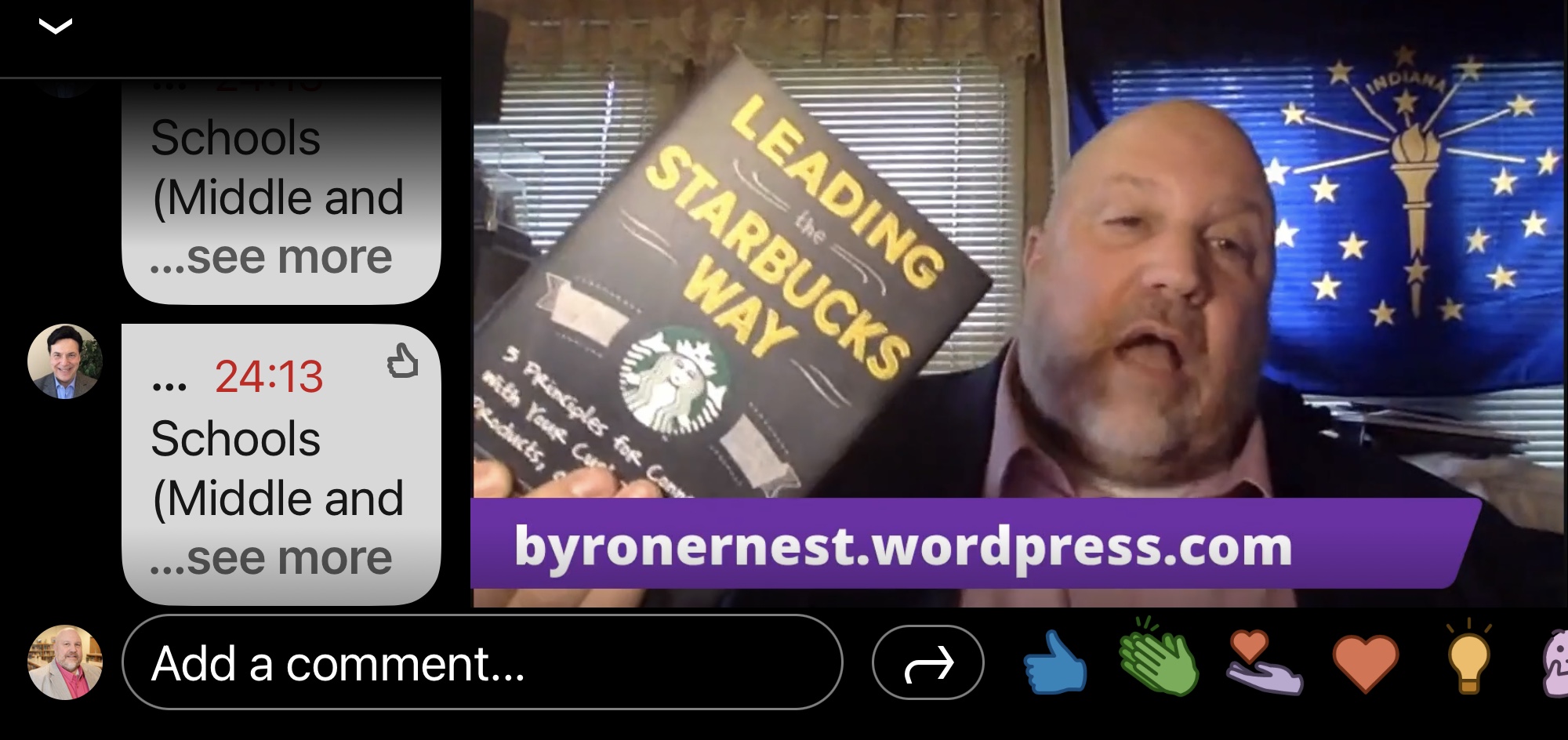
Yesterday, on Day 443 of the Global Pandemic, I had the opportunity of a lifetime to do a live-stream discussion with Joseph Michelli, Ph.D. of The Michelli Experience. You can watch the video here in this post. I have literally read every one of Joseph’s books. His work has had a huge impact on me as a leader and an educator. I think back to how much The Zappos Experience, Leading The Starbucks Experience, The Starbucks Experience, and When Fish Fly impacted how I led while principal of a state takeover academy. The experience that we provided for our students, families, and teachers was directly impacted by that learning. This is actually what I call intersectional learning. The learning that takes place between different contexts, industries, cultures, or experiences. Neither Zappos, Starbucks, nor the Pikes Place Fish Market are in the business of K-12 education, but there is much to be learned from how they do business and the customer experience they provide. After the books I had be be in Seattle, Washington and I made sure I spent a day of the trip experiencing the original Starbucks and the Pikes Place Fish Market. My son, Heath, even had the experience of catching one of the flying fish (on the second try – and I have the video to prove it).

It was great to reflect on this today during my conversation with Joseph. He is truly living out his Legacy Statement: “I want to be remembered as someone who captured what was right in the world and shared it for the betterment of others.” All that he has so eloquently shared in well researched and documented ways over the years has made me a better person and enabled me to serve others in a much more effective and authentic way. Joseph has suggested that we should all create legacy statements. Here is mine: “Hopefully I’ll be remembered as a thoughtful leader who showed love for those I served by providing growth and development.” If you want to know more about this, read Where Were You Era.
In the couple of days leading up to this live-stream discussion I pulled blogs that I had done about Joseph and his work (there were many) and took some notes of things I wanted to have brought out in the discussion. Amazingly, many of these were things he asked about or wanted to discuss as well. That was pretty cool and felt very organic and authentic given that we had not talked or prepped anything together prior to the event. I loved what he pulled from my book, The Hand In The Back Of The Room: Connecting School Work To Real Life, “Education exists in the larger context of society. When society changes – so too must education if it is to remain viable.” This was from Part I: Why A Relevant and Real World Context Matters. In one of Joseph’s “Resilience ReCaps” in his latest book Stronger Through Adversity, he says, “Leadership action, in and out of a crisis, can be viewed as operating on three levels – generalized, customized, or personalized.” I believe you could switch out “education” for “leadership” and this statement remains very true. To be effective for our students we must be spending a great deal of time in customized and personalized. That’s where the learning becomes exciting and engaging for both the student and the teacher.
Joseph also taught us in Stronger Through Adversity that, “Love is a passionate approach to work and heartfelt care for the growth and development of those you serve” (p. 265). He said this after quoting Joe Duran, CEO and Founder of Personal Financial Management at Goldman Sachs, who said, “I hope people will say love was the driving force for everything we did. Ideally, they would feel we loved our people and our clients. They would sense that we loved waking up each morning to serve them” (p. 265) Love is something very powerful that we should be exercising with those we serve. Love makes it personal, and when something becomes personal it becomes important.
Integrity Is A Catalyst

If culture and community are a shared group phenomenon, then our behaviors are the catalyst for the formation of a healthy and highly functioning community. Topping the list of these behaviors has to be integrity. I like looking at integrity as a behavior, not just as a word. I’ve been frustrated lately with leaders who “talk the walk” instead of “walking the talk.” Don’t tell me about your integrity, show me. I guess I’m not alone in believing this is an issue because Mike Horne wrote a great book on the subject that I just finished, Intregrity By Design: Working and Living Authentically.

In the book, Mike told us, “The effect of our behavior in groups and teams is cumulative—it all adds up in our working effectiveness” (p. 37). Thus, the shared group phenomenon I spoke of earlier. People are looking for men and women of integrity who would be able to influence their lives positively. With integrity, we are able to interact with all echelons of society and our own communities we are a part of, including our organizations and teams. This becomes a catalyst because people would undoubtedly prefer to deliberate or associate with trustworthy individuals.
Mike so aptly reminded us that, “In the course of organizational life, leaders emerge in teams and groups. Organizations and groups offer daily opportunities for lead- ers to stand up for integrity-full behavior” (p. 37). It is important to remember that a leader’s behavior reflects on not only their own reputation, but also on the reputation of the organization. It is difficult to have faith in a leader who says one thing but does another: a leader’s words and actions should match.
“The supreme quality for leadership is unquestionably integrity. Without it, no real success is possible, whether it is on a section gang, a football field, in an army, or in an office.”
~ Dwight D. Eisenhower
It has been a while and a lot has changed since President Eisenhower led during war and then in the White House. But this gap in time has not diminished the importance of integrity as a leadership trait. Eisenhower was great at modeling integrity. “Leaders look for teachable moments and moments of truth to develop individual and group integrity” (Horne, p. 38). How about you? Are you making a strong impression?
 Byron's Babbles
leave a comment