Thankful For The Multitude Of Ways To Connect & Learn

I usually write a reflective post each year on Thanksgiving Day and this year will be no different. As I reviewed some past years’ works to post on Twitter and LinkedIn I became really reflective as I read through “I Count You Twice!”. I wrote that post in 2016, but I am amazed at how much of those thoughts apply even more today. I talked about making sure we were making lots of opportunities for learning available in and out of the classrooms for our young scholars. The last couple of years have proven just how important this is.
As I ponder all I’m thankful for, I think about all the ways we can access learning. For example I just started a writing class (The Source Code of Storytelling) with Rob Hart. His latest book, The Warehouse, sold in more than 20 countries and was optioned for film by Ron Howard. How cool is it that I can learn from this very talented and accomplished writer to better tell stories or maybe tell better stories. Is there a difference? In fact, overnight, I received my first feedback from Rob on my reactions and questions related to his first lecture.
Additionally, I love that the lectures are written. Of course, I highlighted and inserted notes all over the PDF of the lecture I made. In my reflection I even said, “First of all, as an education guy I loved that I was reading a written lecture about, well, writing. How cool is that?” The point here is that I’m learning from, interacting with, and receiving actionable feedback from a great writer! And, as Rob pointed out in his lecture, “Every genre—every book—can offer you something you didn’t know.” As a believer in intersectional learning, I believe these next four weeks are going to be a wild ride of learning. There are already things I have picked up that will enable me to improve my practices that have nothing to do with writing or storytelling.
So, today on Thanksgiving, I give thanks that we have the multitude of ways to connect with and learn from people with the experience/expertise of a Rob Hart. Would I love to personally be sitting down with him and having coffee, yes. But, we know that isn’t always going to be possible (Maybe someday, Rob – and I’ll buy- see I was paying attention!). This way, anyone, from anywhere on planet earth can have access to his treasures.
I am also thankful we continue to make sure these kind of opportunities are available to ALL our young scholars in our schools. I know Rob does great work in the arts, literacy, and education. I want to continue to dream about a world where every child could/would learn from Rob Hart or the likes of a Rob Hart. The more diverse the experiences and people we can have students interacting with the better.
Let’s be thankful, but also let’s continue to push forward making the world an even better place so that in 2022 on this day we are thankful for even more!
Don’t Always Saticfice

Nobel Prize winning economist Herbert Simon coined a term that for me is somewhat paradoxical. The term is “saticficing.” He described it as a blend of satisfying and sufficient.He used the word to describe our tendency to leave things at “good enough.” Now, on first blush this can be a good thing – and is. For example those tasks on your to do list this morning that if you spend the time to go beyond “good enough” there will be no value added. Or, another example would be to drive around looking for the best brand of gas for my car. At some point I need to settle on “good enough,” otherwise I am wasting time.
Our brains actually do this optimizing for us so we don’t overload. This is because we have cognitive limits. In our earlier example of tackling our to do list this morning, I like putting a majority of our energy toward a project believed to be more important or needing the making good better.
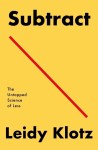
Saticficing might keep us from wasting time, but let’s also not forget that not taking a little extra time might keep us from considering “subtraction.” In his great book Subtract: The Untapped Science Of Less, Leidy Klotz taught us that sometimes we need to resist the tendency to satisfice and do more by subtracting. This book is a must read, by the way. An example he gave would include the Strider bike invented by Ryan McFarland, which goes beyond good enough. This is an awesome example of taking the extra effort to subtract. While pedals and training wheels work well for kids, it seems that subtracting the pedals and training wheels works even better for kids to balance. Who’d a thought it?
The other example Klotz gave in the book was Edward Tufte. He works in information design and coined the term “chartjunk.” I so love people who invent words! Kind of like me inventing the word “Leadery” that is in my company name, Leadery Global. Anyway, chartjunk is all that extra crap that ends up on graphics representing data. This really resonated with me because I have worked with the people who will use every software option available when doing a graphic or spreadsheet. Really, all we need is the data, not a show that you know how to use all that crap. Sorry, touchy issue with me. But, I love Tufte because he shows us how removing chartjunk (or what I call crap) can add clarity.
So, the moral of this post is that sometimes saticficing keeps us efficient, but other times we need to take the extra time/effort to edit and subtract. Think about that the next time you’re ready to hit send on the world’s longest email or busiest graphic in history.
Always In A State Of Becoming

This week I had the opportunity to go to Disney’s EPCOT. I’ve always been inspired by the creative and imaginative of Walt Disney. I was here for ExcelinEd’s 2021 National Summit On Education. As you can imagine, because of the inspiration of the location, there were lots of quotes and references from Walt Disney. One from EPCOT, which stands for Experimental Prototype Community of Tomorrow, was that Walt Disney wanted to build a community of tomorrow that “would never be completed.” His vision was to have a place for demonstrating and introduce new ideas and systems. What was really jumping out at me was this idea of “always in a state of becoming.” Just like Disney’s vision of EPCOT never being completed, we personally are always in a state of becoming as well as everything around us. This includes education. As the world, society, and what we know from science about how children develop and we learn, our work is never completed. Thus with every day comes the opportunity for becoming – becoming even more incredible than yesterday!
I love this idea of “becoming.” It is so much more liberating than “improving” or “changing.” Those two things signal there being a deficiency. “Becoming” signals growth, adaptation, and evolution. Think about it: every moment we are becoming something– something else. Our intellect is constantly evolving and changing because of the different impressions, and different visual/audio/spatial stimuli that we have each and every day.
While philosopher Parmenides spoke of “being” and Heraclitus’ philosophy was about “becoming,” we are not sure if Parmenides was responding to Heraclitus, or Heraclitus to Parmenides. This rivalry had a profound influence on Plato. As Heraclitus said, “No man ever steps in the same river twice, for it’s not the same river and he’s not the same man.” There is always a state of flux.
We’re never the same person. Every moment our molecules, atoms, and cells change in our body. Who we were yesterday isn’t the same person are today. Therefore we need to embrace that we and everything around us is always “becoming.”
Taking Subjective To Objective
I talk about language mattering a bunch. Also, I talk about using buzz words, and words that don’t really mean anything. Then, this morning I read a great piece by Alex Dripchak that was a good reminder of words not to use. His article, “Starting A Career In Sales? Avoid These Words!” was in the context of sales, but the principles really apply to everything. Even as a person who is critical of word choice, I wanted to go back and read everything I’d written in the last week and make sure I wasn’t using the “bad, worse, and worst” words suggested. Alex calls these “trigger” words.
Furthermore, they are words that are overused and assumptive, according to Alex. I love this way of describing what I always call buzz words. Most recently I blogged about this in the context of core values in Core Values Are The Heart & Soul. In that post I added hoopla and corporate gibberish to the words we shouldn’t use. In taking another look at my post, I wonder if “authentic” is another word that has been used to the point of having no meaning (I’ll ponder that later).
Alex told us to make the subjective, objective. He noted that “best,” “unique,” “innovative,” and “cutting edge” were rendered hollow a long time ago. Using the teaching of Lee Salz, Alex said, “…if you can’t prove it, don’t use it.” I know I said I would ponder it later, but “authentic” has been rendered hollow too. If I understand Alex correctly what would be better, would be to say, “I am different because…” Thus taking subjective to objective.
Eliminating Disdain & Maintaining Respect

In the leadership development work I do we always all agree that relationships are the key to everything. And, they really are. Healthy and respectful working relationships are a must if you want an effective and enjoyable workplace, organization, community, or even world. One cornerstone to healthy relationship building is intellectual humility. When practicing intellectual humility, we open our minds to learning. With intellectual humility we become wiser. It is really about realizing that we can learn from opposing views and have more constructive discussions, even when we disagree. Practicing intellectual humility allows us to be less judgmental of others.

This has actually been a topic of my blog posts many times before. I began thinking about virtue signaling, which I first blogged about in Leading Without “Virtue Signaling.” Then, this morning, when reading in Amor Towles’ incredible book The Lincoln Highway, I came across this statement about Emmett Watson, an 18-year-old Nebraskan farm kid just released from a Kansas juvenile detention center after serving 15 months for involuntary manslaughter: “Emmett was raised to hold no man in disdain. To hold another man in disdain, his father said, would presume you knew so much about his lot, so much about his intentions, about his actions, both public and private, that you could rank his character against your own without fear of misjudgment.” That’s a pretty powerful statement, don’t you think? By not judging, virtue signaling, or holding others in disdain we enable a community that values learning and where learning happens when what is not known or understood is acknowledged.
We must model this humility by admitting when we do not know or understand something. Modeling also involves recognizing the value in opinions that are different from our own. In the face of conflicting evidence, we need to be open to changing our opinions. The disdain and contempt described by Emmett’s father destroys teams, communities, and relationships. It prevents trust and respect and makes it hard for any real human warmth. It is tangibly damaging, causes stress and can harm people emotionally, mentally and ultimately physically.
Finally, I am reminded of what Carlo Strenger said: “The difference between civilized disdain and political correctness is that the former allows one to feel disdain for a person’s or group’s views or beliefs while maintaining respect for the human beings that hold them.” There will be gaps in knowledge, ideological divides, differences of opinion, and cultural differences, but we must strive for fruitful cooperation and shared learning to be effective world citizens.
One Of A Kind Of Days

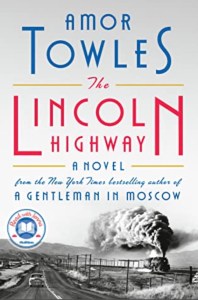
I seem to be on a role blogging about Amor Towles’ great new book The Lincoln Highway. Towles is an incredible storyteller, as I pointed out in The Long & Short Of Great Stories. There are so many points in his books that cause me to think and reflect. I really like the character, Woolly, in the book. Woolly told us that we need to turn “every-day-days” into “one-of-a-kind of days.” I love this! Think about it: too many times we get into a rut liking the every-day-days, but it’s so great to have days with no equal and that are completely unique.
What if we could do something we had never done before every day. Now those would be one-of-a-kind of days. Our goal could be to use everything that happens as an opportunity for a one-of-a-kind experience. As I write this my plane has been delayed for two hours. I am going to go explore. Who knows what I will find? Maybe inspiration for some great activity; maybe some new technology; maybe a new acquaintance I would have never known; who knows! Here’s what I do know: while others are griping, moaning, and stressing, I’ll be exploring.
The power to make each day something special is ours. But, we must be responsible for our own experience. Grandiose things don’t have to happen for a day to be special. We need to appreciate the little things. Pay attention and notice things that would pass you by in an “every-day-day.” The little inconveniences of the day can turn into incredible experiences. We need to pay attention to the sounds, smells, and sights that probably get ignored on the “every-day-days.” If we don’t look for extraordinary in the ordinary, we won’t find it. Believe it’s there, believe we will find it, and we will.
I guess it all comes down to making the most out of each day. I don’t want to be content with “every-day-days.” I want to make a difference for others and help others each and every day. To do this I will need to make every day a “one-of-a-kind of days.”
The Long & Short Of Great Stories
We’re all in situations where we have to be able to tell stories. I believe story telling is an important skill for leaders. It’s one reason I have fell in love with reading fiction novels. We can learn from great authors like Amor Towles. I am reading The Lincoln Highway by Amor Towles right now and loving it. A quote I wrote in my notes the other day while reading was: “The funny thing about stories is they can be told as long stories or short stories or anything in between.” I thought about this today as I was doing a leadership development gathering in Georgia. A lot of how I facilitate gives the participants an opportunity to reflect and tell stories. Some are short and we long for more, others are long, and many are in between. Not everyone is a natural-born storyteller. That doesn’t mean, however, that we don’t run into a ton of different situations where we need to do just that.
I love listening to peoples’ stories. The more animated they get, the more interested I become. Our stories should be anchored in personal experiences and show vulnerability. I also love imagery. Imagery is one of the things I love about Towles’ writing. He is a master at this and I am striving to learn from his work. Right now I am reading about Duchess’ and Woolly’s trip from Nebraska to New York in the Studebaker they “borrowed” from Emmett without his permission. On the trip they are staying in Howard Johnson motels. Remember them? Orange roofs and blue spires. When Towles described the buildings, rooms, the restaurant, and even the food and placemats I was transformed back to my childhood and could see myself there with my parents. I was transformed back to those days gone by. Amazing! Towles knows how to give just the right amount of detail without overwhelming with unnecessary details. Something we all need to hone in our own storytelling. Reading the work of great writers helps us do this.
Good storytelling isn’t about buzz words and fancy language. It’s about conveying our message clearly and simply. We need to connect with our audience as humans. I always try to tell stories as if I was telling the story to my friends sitting around a fire on my back porch. Or, better yet, consider how you would tell the story standing around a water cooler. I guess shorter probably is better, but always remember, every story can be told long, short, or in between – the message is the key.
Separating The Idle From The Industrious

I’m now getting to another prompt for a post that I had on my “to blog about list.” This prompt is from another quote in The Lincoln Highway by Amor Towles: “Time is what God uses to separate the idle from the industrious.” I learned from David Marquet that great leaders understand how to control the clock. This quote got me to thinking about this control of the clock. When I looked up being industrious, this is what I found: industrious: applying oneself with energy to study or work; actively and purposefully getting things done; opposite of being idle and accomplishing nothing. The best example of why we need to be industrious is thinking back to being a kid (okay, I still kind of am a kid). The worst days ever were the ones when there was nothing to do. Time seemed to stand still – I wasn’t controlling the clock. When we are idle and purposeless, we are at our unhappiest.

The way to happiness is finding purpose in how we use our time. We are at our best when our time includes industriousness that leads to tangible production. Also, think about that great feeling at the end of a very productive day of working really hard. It’s such a great “tired.” There are a lot of days like this on the farm. This feeling also happens when you are taking the shot where others will not, and doing things that other people may consider difficult. Time passes whether we are controlling the clock or not. The best athletic coaches are the ones who know how to control the clock the best.
My takeaway from the interaction in Towles’ novel was that we need to find purpose to truly be industrious. When we take a moment to really look around to see what is out there, we can find an unlimited number of things that can and should be done for ourselves, for others, and the betterment of the world. Participating in resolving these things can help us not only feel useful and helpful, but actually be useful and helpful.
Our Many Faces
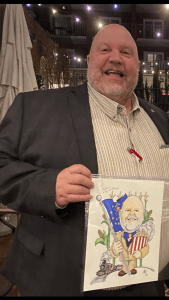
This week I was reminded how important our ability to read faces is. And, how important the faces we make are. First, on Monday, I was given a caricature and was described as Jupiter, the bringer of jollity, from The Planets. I blogged about this in Leading With Jollity. I have always taken pride in being able to read faces. It is such an important skill when teaching and facilitating learning. I love to read and interpret the feelings and expressions of those around me. It turns out we are all born with this intuition. Within a few hours after we are born, we recognize the face of our mother.

I am reading the fascinating book, Read The Face: Face Reading For Success In Your Career, Relationships, and Health by Eric Standop right now. Face reading, according to Standop, is our first language. As a master face reader, Standop is able to read personality, character, emotions, and even the state of a person’s health. This can all be done from simply glancing at their face. While certainly not trained in this, I still believe it is important for us to be able to pick up on the clues of face reading and continually work at paying attention and honing this skill. When I am facilitating learning for a group I always try to watch for the facial cues of the participants. I can tell when someone has something to say, a question, agreement, or is in disagreement. These cues help me to let the discussion deepen organically and play out.
My many years of teaching agriculture science gave me the opportunity to hone these skills. In the past few years, working with adults, I have had the chance to hone them further. And, one of the perks of virtual meetings is that we can really study the faces of others. Clearly, if you read Leading With Jollity, you’ll find that Christine Benson had the caricature done of me, and described me as Jupiter, bringer of jollity, from only getting to know me through Zoom meetings. Actually, that was a pretty accurate description. To me this proves that we can get to know people well in a virtual setting. In many cases I have been able to get to know people even better. Sometimes discussions go even deeper online. I am not saying that I do not want to be in person, because that is still my preference, but if we use our innate ability to face read to the fullest we can form even deeper relationships. What are you learning from others’ faces? What is your face telling others?
My Memories Matter

As I wrote the rough draft of this post I was on a plane taxiing to the runway at Reagan National Airport in Washington D.C. As I looked out window I saw the dome of our Capitol and the Washington Monument (see my pictures). This caused several moments of reflection. I thought about all 12 U.S. Presidents that have been in office since I was born. I thought about the Vietnam War that happened during my lifetime. I thought about President Nixon and his resignation. I thought about the first President I voted for, Ronald Reagan. I thought about the first Gulf War. I thought about 9/11. I thought about wars in Afghanistan and Iraq. I thought about all the time my son Heath and I spent in Washington D.C. when he was growing up when I brought him with me to the Washington Leadership Conference of the National FFA Organization every year. I thought about getting to pay my respects to Ronald Reagan as he was lying in state in the Capitol rotunda. I thought about being with President Obama in the Oval Office. I thought about spending time with, then Vice President, Joe Biden and Dr. Jill Biden at Number One Observatory Circle. I thought about being awarded the Smithsonian Diffusion Award in the Smithsonian Castle. I thought about the fall of the Berlin Wall, the end of the Cold War, and getting to stand at the Brandenburg Gate where President Reagan told Gorbachev to tear down the wall. I thought about being in Vice President Pence’s White House Office. A lot of memories were running through my mind. I realized I’ve experienced a lot in my almost six decades.

That’s a lot of history. That’s a lot of memories. But what does it all mean? Does living through all that matter? Yes, all those memories matter! Our memories make us who we are. They create our worldview in ways we hardly realize. It is why we must be always creating the situations to create memories for our children. We also need to be creating memories for our students. All that we have ever learned, from how to get along and play with others, how to read, and even how to resolve conflicts, makes us who we are. That is why who taught us and our experience of the things we have learned are all embedded in the memories themselves.
Our memories are essential because they allow us to grow and learn to be a better person. Our memories help us understand why we are who we are. When we understand why we are who we are, we become empowered to create ourselves intentionally. Oscar Wilde said, “Memory is the diary that we all carry about with us.” I am so glad that my peek out the airplane window caused me to open my mind’s diary and begin reflecting on who I am.
 Byron's Babbles
leave a comment