Leading By Accident
 Not too long ago I was sent a screen shot of a post on FaceBook (I don’t do FaceBook, so someone had to send it to me) – check out the picture with this post for the message. When I read the post I realized that while I live and lead according to what works for me, the core values of the organization I work for, and my personal core values, my efforts to become my best self have the capacity to positively affect people I didn’t even know were paying close attention. People I never would have thought were finding inspiration in anything I do, however, were telling me the opposite, and were indicating that my decisions about my own life, the way I led, and taking chances on them had inspired them to take chances in their own lives. I started to think about all the people who motivate and inspire me just by being themselves, and I surmised that they (we) are all leading by accident. We do our thing for our own reasons. But by being true to that thing, we may very well help people find their own thing, perhaps by creating a path that didn’t exist or illuminating one so others can see it. Hum… could it be this what empowerment really looks like?
 Even if we don’t get to hear about how our lives affect others, they do. We are all leaders by accident in our own ways. Just as Dr. Alexander Fleming stumbled onto Penicillan in the 1920’s we stumble our way into others’ lives. Leadership lesson #14 from John Parker Stewart in 52 Leadership Lessons: Timeless Stories For The Modern Leader, told the story of how Dr. Fleming discovered the bacteria killing mold, Penicillan, by accident. It ultimately took two other scientists to help make commercial production of Penicillan a reality. Had it not been for Dr. Fleming’s belief in what the accidental discover could do for humanity, who knows what would have happened, or where we would be today.
Even though in the formal sense we may not be leading that all the time – in our jobs, in our roles as parents, siblings, friends, et cetera; we really are being a leader (by accident) every moment of every day. The post from Reuben drove home for me the absolute truth of that statement. We may not be motivated by the desire to demonstrate leadership qualities when we become the arbiters of our own, most authentic lives, but we kind of can’t help it, it seems. So, go out there and lead by accident and intentionality.
Social Complexity
 For each of the last two days I blogged about Dynamic Complexity and Generative Complexity respectively. My inspiration for these posts has been the book by Adam Kahane titled Solving Tough Problems: An Open Way of Talking, Listening, and Creating New Realities. I feel compelled to write about the third complexity he offered in the book: Social Complexity. As Kahane (2004) taught us: “[S]ocial complexity requires us to talk not just with people who see things the same way we do, but especially with those who see things differently, even those we don’t like. We must stretch way beyond our comfort zone” (p. 75). Wow, how true this is. Think about this for a minute; how many times when trying to solve complex issues do we really listen to those who think differently, see the world differently, or just flat-out don’t like us?
“Roughly, by a complex system I mean one made up of a large number of parts that interact in a nonsimple way. In such systems, the whole is more than the sum of the parts, not in an ultimate, metaphysical sense, but in the important pragmatic sense that, given the properties of the parts and the laws of their interaction, it is not a trivial matter to infer the properties of the whole. In the face of complexity, an in-principle reductionist may be at the same time a pragmatic holist.” ~ Herbert Simon in his 1962 article, “The Architecture of Complexity.”
I look at social complexity as being complicated by the very nature that we cannot provide a simple model of the system that adds up and makes sense of, or can predict the independent behaviors of the parts; rather, the parts are influenced in their behaviors by the behaviors of other people, groups, organization, governments, or even populations. This is in contrast with the simple system of an internal combustion engine. It might seem very complex, but really it is simple because every part, both moving and not, has a function and order in which to do that function.
In a spark ignition engine, the fuel is mixed with air and then inducted into the cylinder during the intake process. After the piston compresses the fuel-air mixture, the spark ignites it, causing combustion. The expansion of the combustion gases pushes the piston during the power stroke. In a diesel engine, only air is inducted into the engine and then compressed. Diesel engines then spray the fuel into the hot compressed air at a suitable, measured rate, causing it to ignite. This all very hierarchical in that everything happens in a specific order that never changes.
Let’s now contrast this with the social complexity and causal processes (sub-systems) that make up our education system. And consider some aggregate properties we may be interested in such as state law and policy, federal law and policy, political dynamics, local community social differences, socio-economic factors, race, mobility, or the social and emotional needs of our students to just name a few. Some of the processes that influence these properties are designed (Every Student Succeeds Act, school boards {both state and local}, school management systems), but many are not. Instead, they are the result of separate and non-teleological processes leading to the present. And there is often a high degree of causal interaction among these separate processes. As a result, it might be more reasonable to expect that social systems are likely to embody greater complexity and less decomposability than systems like an internal combustion engine.
“To create new realities, we have to listen reflectively. It is not enough to be able to hear clearly the chorus of other voices; we must also hear the contribution of our own voice. It is not enough to be able to see others in the picture of what is going on; we must also see what others are doing. It is not enough to be observers of the problem situation; we must recognize ourselves as actors who influence the outcome.” ~ Adam Kahane
This reminds me of a legislative panel I am on right now to look at and make recommendations to our state legislature on our high stakes summative state testing (required by the Every Student Succeeds Act – ESSA). This committee is made up of 23 different individuals and appointed by different entities. My appointment comes as being the representative of the Indiana State Board of Education. Needless to say, we have lots of social complexity. Needless to say it has been awkward and tenuous navigating on this panel. Here are some things I have learned from Kahane (2004) to help us as leaders:
- To solve a complex problem, we have to immerse ourselves in and open up to its full complexity.
- Our core tasks need to be to “widen the circle” and “deepen the bench.”
- Tough problems can only be solved if people talk openly, and in many situations this takes real courage.
- Listen openly.
I close with Kahane’s (2004) definition of listening: [T]he process of taking in something new and being unsettled and changed by it” (p. 69). I ask you: Are you a leader who listens?
References
Kahane, A. (2004). Solving tough problems: An open way of talking, listening, and creating new realities. San Francisco: Berrett-Koehler.
Loving A Challenge
 This week’s leadership lesson (#13) from John Parker Stewart in 52 Leadership Lessons: Timeless Stories For The Modern Leader, played off the story of the invention of the potato chip. The story goes that it was about dinner time during Moon’s second summer season on the Lake. Moon’s Lake House, owned by Cary Moon, was one of the finest restaurants in the Saratoga Springs, New York area, a historically affluent and resort community. A customer came in and ordered Moon’s Fried Potatoes, the well-known house specialty. The cook, George Crum (born George Speck) whipped up a batch and served it to the customer, who complained that the potatoes were cut much too thick. So, he sent the item back to be remade. Crum did his best to make them thinner, yet when the discerning patron got his second order, again he complained that the thickness of the potatoes weren’t to his liking. So, once again, the customer told Crum to try again.
Crum, none too pleased that someone would insult his cooking, cut the potatoes paper-thin, dumped them in a vat of oil, let them cook so long that they became hard and crispy, and then salted them heavily, thinking that these “fried potatoes” would now be inedible. When served the item, the customer took a bite…and then another…and then another, before proclaiming that the fried slices of potatoes were delicious. It became known as the “Saratoga Chip.” The potato chip was born – so the story goes.
 When reading this I was thinking of a leadership workshop that I did this past week with my great leadership jazz partner Mike Fleisch. I took the participants to lunch at The Old Bag of Nails in Westerville, Ohio. This was a great place and we had a great waitress. She needed to be because I pulled my trick of letting our waitress pick all our food for us. I did not tell any of the group of eight I was going to do this. When our waitress brought the menus I promptly told her we did not need them. I used my friend, David Marquet’s line of “We are control freaks and for our therapy we are going to let you choose our meals.” I think this freaked her out at first, but then she began to view it as a challenge and really got into it.
We did have two participants, however, that were having difficulty. I let everyone give a couple of guard rails, but our picky eaters were have trouble getting their minds wrapped around the idea of not being able to select their own meals. In the end they joined us in letting our waitress make all our selections for us. Bottom line: we had the time of our lives and awesome meals. We had awesome appetizers and I had an awesome Cold Water Cod Reuben on Marble Rye. Then, she brought Bread Pudding and the best Carrott Cake I’ve ever had. Everyone, even those who were challenged and uncomfortable at first, agreed we had a much better meal and a lot of fun because we had empowered our waitress to use her expertise to make our dining experience great.
“Opportunities often come in unpleasant disguises that must be removed with effort and ingenuity.” ~ John Parker Stewart
Our group had the opportunity to try new things and our waitress, who said she had never done this before, was given a challenge and absolutely loved sharing her favorites on the menu with us. We then debriefed and had a lively discussion, which Mike captured very well on the graphic at the beginning of this post. Take a look – you’ll be amazed at what all can be learned during lunch. As Stewart pointed out we need to see challenges and setbacks as opportunities for innovation and creativity.
Generative Complexity
 Yesterday I blogged about Dynamic Complexity after reading in the book by Adam Kahane and is titled Solving Tough Problems: An Open Way of Talking, Listening, and Creating New Realities. Another type of complexity worth organizing our thoughts about is Generative Complexity. Kahane (2004) said, “Generative complexity requires that we talk not only about options that worked in the past, but also about ones that are emerging now” (p. 75). To me this is all about not getting caught up in thinking about how things have always been done, but about how no one has ever thought about doing them.
“We cannot develop creative solutions to complex human problems
unless we can see, hear, open up to, and include the humanity
of all the stakeholders and of ourselves. Creativity requires all
of our selves: our thoughts, feelings, personalities, histories,
desires, and spirits. It is not sufficient to listen rationally to inert
facts and ideas; we also have to listen to people in a way that
encourages them to realize their own potential and the potential
in their situation. This kind of listening is not sympathy, participating
in someone else’s feeling from alongside them. It is empathy,
participating from within them. This is the kind of listening
that enables us not only to consider alternative existing ideas but
to generate new ones.” ~ Adam Kahane
We need to remember that there are many interdependent parts of a complex system. Additionally, a complex systems world view highlights that interactions between parts of the system and the behavior of the system as a whole are critical. As leaders, we must learn to do a better job of seeking out, fostering, and sustaining generative relationships that yield new learning relevant for innovation.
When discussing leadership we tend to focus on leaders’ individual characteristics rather than on the dynamics of interactions between leaders, group members, and the context in complex organizational systems over time; and we certainly do not do enough toward our own professional growth as leaders, or those on our teams, to create conditions that allow their organizations to evolve (2006). We must also find ways to improve our own and organizations’ ability to learn continuously and implement learning in action as projects proceed.
References
Kahane, A. (2004). Solving tough problems: An open way of talking, listening, and creating new realities. San Francisco: Berrett-Koehler.
Surie, G. & Hazy, J.K. (2006). “Generative leadership: Nurturing innovation in complex systems.” E:CO Issue Vol. 8 No. 4 2006 pp. 13-26.
Lemonade It
 Last week, during one of our sessions of our Focused Leader Academy I was struck by the idea of not feeling the need to win all of our battles. And… that is o.k! But… we do need to have all the battles! It is an important part of not being a lazy leader. It is also a very healthy part of collaboration and being a learning organization. These thoughts came from hearing one of our team members say, “I took that battle on and lost.” And, I thought to myself, “This person is not a lazy leader.” He was willing to have the conversation. Sometimes these battles, conversations, or losses become the spark or spring boards for changes down the road to happen.
In our session we quickly dubbed this, “Lemonade It.” We have learned that our dispositions to create lemonade from lemons are identifiable and can be developed intentionally and deliberately. Naisbitt (2006) said, “Times of change are times of opportunity. When relationships of people and things are shifting, new juxtapositions create new needs and desires offer possibilities” (p. 92). We must remember that lemonade is not something that is produced naturally. In fact, there is an enormous amount of work that it takes to make lemonade.
So, let’s see here; the recipe for lemonade is: add the lemons and squeeze the right amount of lemon juice into a pitcher; then add water and the right amount of sugar to achieve the best tasting results. How about this, then, as a recipe for dealing with opportunities for providing leadership for success and making lemonade from lemons:
- Focus your future goals in your current organization for the betterment of all.
- Develop skills in self-direction, team collaboration, and project management.
- Increase motivation to accelerate your career goals with perspective.
- Recognize the importance of good communication and thoughtful, ambitious leadership.
- Focus your leadership on the alignment to the vision, mission, and core values of the organization
So I conclude by asking you this: When life hands you a lemon, do you make lemonade or pucker your lips?
Reference
Naisbitt, J. (2006). Mind set. Harper Collins. Canada.
Cosmetic Leadership
 This week’s leadership lesson (#12) from John Parker Stewart in 52 Leadership Lessons: Timeless Stories For The Modern Leader used Aesop’s Fable “The Stag at the Pool” to teach us an important leadership lesson. For the sake of making this post more worthwhile here is the fable:
A stag saw his shadow reflected in the water, and greatly admired the size of his horns, but felt angry with himself for having such weak feet.
While he was thus contemplating himself, a Lion appeared at the pool.
The Stag betook himself to flight, and kept himself with ease at a safe distance from the Lion, until he entered a wood and became entangled with his horns.
The Lion quickly came up with him and caught him.
When too late he thus reproached himself:
“Woe is me! How have I deceived myself! These feet which would have saved me I despised, and I gloried in these antlers which have proved my destruction.”
This is a pretty powerful story when you think about it. So, what is the moral of this Aesop’s Fable? “What is most truly valuable is often underrated.” Stewart taught us not to get caught up in the “cosmetics” of life. He suggested we get to caught up in the visibly superior qualities. I believe we do this personally and in our roles as leaders. I call this “selling the sizzle instead of the steak.” We need to make sure we are doing the right things according to our strategies, vision, mission, and core values and not getting sidetracked with attractive “antlers” that will get us all tangle up in things that, on the surface, look cosmetically attractive.
“What is worth most is often valued least.” ~ John Parker Stewart
 When reflecting on this I think of the awesome new song just released by the great band Alter Bridge on their new album The Last Her0. coming out on October 7th. The song is Show Me A Leader. Click here to watch the video of the song. Trust me, I will be doing some separate blogging about the song and band in the near future, but for now I believe “The Stag at the Pool” story relates to the song. Here are the lyrics:
“Show Me A Leader”
Well they’re selling another messiah
Here tonight
But we’re all way too numb and divided
To buy itSinging
No no no
We are all too divided this time
No no noShow me a leader that won’t compromise
Show me a leader so hope never dies
We need a hero this time
No no noDisillusioned and tired of waiting
For the one
Whose intentions are pure unpersuaded
We can trustSinging
No no no
‘Cause a promise is never enough
No no noShow me a leader that won’t compromise
Show me a leader so hope never dies
We need a hero this timeI know, I know
I know if we’re to survive
We need to know this is not the end
How will we ever get by
It’s getting harder to fight out here on our ownShow me a leader that won’t compromise
Show me a leader so hope never dies
Show me a leader that knows what is right
Show me a leader so hope can survive
We need a hero this timeNo no no
We need a hero this time
Or we will never survive
No no no
We need a hero this time
Or we will never survive~ Alter Bridge
Whole System Leadership
 On a cool, clear December night in 1972, an Eastern Airlines L-1011 jumbo jet slammed into the Everglades 18 miles northwest of Miami. This crash is the focus of Lesson #10 in 52 Leadership Lessons: Timeless Stories For The Modern Leader by John Parker Stewart. A small $12 light bulb had gone out and preoccupied the crew of Flight 401. That triggered a series of Murphy`s Law-like consequences that ultimately killed 101 of the 176 people aboard. Now, almost 44 years later, the crash is still remembered for all its ironies, sadness and triumphs. After doing a little research I believe this crash still remains the worst aviation disaster in Florida history. The amazing part is still the fact that because the impact was cushioned by soft muck and Saw Grass, 75 people lived — some of them barely receiving a scratch.
Flight 401 originated at New York’s John F. Kennedy Airport (JFK), with a destination of Miami (MIA). The flight was uneventful until the approach into Miami. While preparing for landing and lowering the landing gear, the flight crew was unable to determine that the nose landing gear was fully extended and locked in the extended position. The green indicator light which would normally illuminate upon locking of the nose landing gear did not come on. After that, what happened is the subject of this blog post. While messing around trying to get the light to work, the autopilot that was supposed to be keeping the plane at 2,000 feet was turned off. Because everyone was preoccupied with one facet of the plane only, the green indicator light, n0-one was paying attention to anything else. It was not until the plane was at 900 feet and descending quickly that anyone even thought to ask if the altitude was correct. It was too late, however.
This crash has been the subject of books and movies. The primary cause of this accident was not the aircraft, but the crew — the human factor. Yes, the light bulb was not working, but that was the only thing. Even though the crew members were dealing with the landing gear indicator light, they still should have noticed their surroundings and been monitoring the aircraft’s altitude. Research (Robson, 2008) tells us that as long as our stress levels are not to high we can notice things going on around us not related to the task at hand – in this case, working on the light bulb and noticing the altitude. Conversely, however, it is possible for cognitive tunneling to develop (Chou, Madhavan, & Funk, 1996). Cognitive tunneling (Chou, Madhavan, & Funk, 1996) happens when one thing we are doing is given all our attention while not watching anything else. Do you see the leadership connection here?
Cognitive tunneling (Chou, Madhavan, & Funk, 1996) can cause us all to focus on one task while missing the warning signs from other parts of the organization. As leaders this is dangerous, maybe not in the sense of Flight 401, but certainly in the success or failure of the organization. After this crash, the airline came up with what it calls Crew Resource Management (CRM). Basically, with CRM the captain is expected to continue to monitor all system while delegating specific indicators or fixing of challenges/problems to others. What does this mean? Someone is always flying the plane, or leading the organization.
The best historic example of CRM in action is US Airways Flight 1549 where Captain Chesley “Sully” Sullenberger successfully landed the disabled airplane he was leader of in the Hudson River. During that emergency landing Captain Sully flew the plane and gave First Officer Jeff Skiles the job of focusing on the reference handbook that included instructions for emergency situations. Two things that really jumped out to me while studying these events was the need for checks and balances in our organization. As leaders we need processes in place to make sure we have eyes on all facets of the organization enabling us to fly the plane without focusing on a single warning light.
“Always focus on the things that matter most.” ~ John Parker Stewart
Additionally, those we lead must have the professional development, education, and growth opportunities to handle the delegation of responsibilities. We can connect this back to a principle of intent-based leadership by which if our employees do not have the skills to handle what they are in charge of, chaos ensues. We need accountability measures that ensure our employees are able to handle the tasks and leadership they are responsible for.
References
CHOU, C., MADHAVAN, D., & FUNK, K. (1996). Studies of cockpit task management errors. International Journal of Aviation Psychology, 6(4), 307-320.
ROBSON, D. (2008). Human being pilot. Cheltenham, Australia: Aviation theory limited.
4 Things You Probably Hate about Millennials and Why You’re Probably Wrong
 Listen, the challenge of parenting, educating, training, mentoring, and guiding young people has been around for thousands of years. Consider this quote attributed to Socrates, almost 2,500 years ago:
“Our youth now love luxury. They have bad manners, contempt for authority; they show disrespect; they contradict their parents, chatter before company; gobble up their food and tyrannize their teachers.” ~ Socrates
“But my millennials are so much more annoying than we ever were.” Got it.
Remember, millennials look nothing like the previous generations, and that’s why they annoy you. It’s a lack of understanding of and between different generations. The point is millennials are probably everything and nothing we say about them.
- Entitled, lazy, and won’t do what they’re told? In a poll of 5,000 workers by Jennifer Deal of the Center for Creative Leadership and Alec Levenson of the University of Southern California, 41% of millennials agreed that “employees should do what their manager tells them, even when they can’t see the reason for it,” compared with 30% of baby boomers and 30 percent of Gen Xers.
- Aren’t competitive? The Economist cites research by CEB, a consulting firm that polls 90,000 American employees each quarter, that 59% of millennials say competition is what gets them up in the morning much more than the percentage of baby boomers or Gen Xers that say that about competition.
- Only communicate digitally? That study by Jennifer Deal and Alec Levenson showed that more than 90% of millennials surveyed want face-to-face feedback and career discussions.
- Jump ship and are not committed for the long term, or really any term? According to the US Bureau of Labor Statistics, the average worker stays at a job 4.4 years, and yes, according to the Future Workplace “Multiple Generations @ Work” survey of 1,189 employees and 150 managers, 91% of millennials expect to stay less than three. But beware of averages: Millennials may find it normal to job-hop faster than any previous generation, but when they find the right opportunity they actually are more loyal than the previous generation. The CEB study showed millennials put future career opportunity among their top five reasons for choosing a job, again ahead of other generations.
Simply put, when it comes to millennials, most of us have no idea what to believe or do. So we believe and assume the worst. Until we see this, the most powerful myths or assumptions that we have about millennials will continue to negatively impact our attitudes about, perceptions of, and relationships with them.
Get past the myths and realize that individual differences are more important than generational ones In the end, most millennials just want what we all should want: challenge, flexibility, purpose, engagement, collaboration, work-life balance, transparency, and authenticity.
They want bosses who care, set clear expectations, and are willing to coach—and who understand what they expect and need in the workplace. Are these things so unappealing or are they just not your story?
Don’t let generational differences be the problem. Lean in and consider millennials an opportunity to learn, connect, and kick more butt in your business using millennial power.
*****
Need help understanding, engaging, and retaining your millennial workforce? Dan Negroni, Author, Speaker, Attorney, Kick butt business consultant, coach, and proud Dad of a few Millennials delivers actionable solutions. Different from all other millennial experts, Dan’s empowering business approach at launchbox, creates quick value and seamless connections with millennials and management each on their own terms. Using unique content and delivery methods that audiences respond to immediately he leverages results from the inside out. Allow millennials to be your secret weapon and maximize your commitment to them to innovate, create a culture of engagement and grow your businesses today. To start click here to grab your copy of Chasing Relevance: 6 Steps to Understand, Engage and Maximize Next Generation Leaders in the Workplace or call them at 858.314.9687 for a free Coaching Assessment.”
2016-2017 Welcome Back
 As Head of Schools for the Hoosier Academies Network of Schools, I want to extend a warm welcome to our returning students and family members and those of you who are new to the Hoosier Academies Network of Schools. Thank you for partnering with us in the education of your children. Many of us here are also parents and we understand the huge responsibility we have for ensuring that all children find success at every level of their academic experiences.
I am so excited to welcome you back to school today. I have told others that this is the most excited I have ever been to start a school year. In fact Mr. Hurst, our science/biology teacher, was so excited that he could not sleep last night – think about this; he has been doing this for 41 years and he still gets nervous. I’m excited because of our new vision, mission, and core values we developed last year and the implementation around these that will guide us this year.
Our vision is “Success for Every Student in Indiana.” We define success using the definition of Dr. Felice Kaufman – “Knowing what one wants in the world and know how to get it.” We understand that success looks different for every student.
Our new mission is “Hoosier Academies Network of Schools Engages Students in a Customized and Accessible Education by Collaborating with Parents and Families for Student Success.”
We have five core values:
Students First for Success
- We are implementing the National Family Academic Support Team with fidelity this year in order to give students and families the support needed to be successful in our schools.
- We started the Insight School of Indiana in order to support students who are behind or need extra support to be successful.
Educating, Supporting, and Empowering Teachers, Staff, and Families for Success
- This year we are implementing the National model for Instructional Coaching. Our teachers will be getting regular coaching in order to help them reach their full effectiveness in facilitating learning for your children.
Safe Environment for Success
- We will continue our anti-bullying campaign.
- We will have drug awareness programs.
- We will be using our Raptor (instant background check) system here at our Franklin Road 7-12 Learning Center and at our Caito Road k-6 Learning Center to ensure that everyone that comes into the building has had a background check. We have alarmed our doors so we know no-one is coming in or going out that should not be. Students are assigned to a teacher for every minute of the day and instruction will be happening from the minute the students come on campus until they leave. We have implemented our School Master attendance program so that attendance is being taken with fidelity. I have set the goal of no less than 95% attendance for all of our schools, but particularly hybrid days. I believe you will find that the ship has been tightened at our hybrid centers. We must take full advantage of the face to face time that your children have with our teachers.
Strong Community Relationships for Success
- We have had many Back to School Expos across the state and a few more to go. Check the website for other community events where you can connect with staff for support you may need.
- Hoosier Helpings is a food pantry that can help families in need access food, toiletries, clothing, pet supplies, and some household items. Click here for information for support if needed.
Accountability for Success
- With our new Academic Plan we have put in place improvements to make sure that your son or daughter is receiving the support necessary for academic performance and achievement.
- We are clearly communicating expectations
- We are supporting a culture of continual improvement
You will be hearing more details about many of the initiatives I have touched on here during your specific school convocation break outs, but please know I am excited for us to be back together for an exciting year of learning.
Significance, Influence, & Leadership
 It has been said that leadership is influence. This is so true, and I was reminded of this today. I had the honor of being part of a book launch and signing at one of our local Barnes and Noble stores today for author, . He wrote the book The Second Decade: Raising Kids to be Happy, Self-Sufficient Adults through Work (2016). I learned of the book through Indiana Speaker of the House, Brian Bosma. He sent me a copy of the book and asked that I read it and think about how this book could be used to influence others in helping to develop and educate our children. I was excited to get the book and, of course, immediately read it. Come on, the Speaker of the House sends you a book and asks you to read it, well, you read it! And…of course, I started tweeting about it. Next thing you know I’m tweeting back and forth with Speaker Bosma and, lo and behold I’m suddenly tweeting with Dr. Helveston. Then, I’m being invited to attend a book signing via twitter. I continue to be amazed by the power of twitter. Well, of course I am going to the book signing – one of my most valued collections is of my author signed books. So, now that I have set the stage let’s get to some content in this post.
It was such an honor to have Speaker Bosma introduce me to Dr. Helveston before the event started. Little did I know I was being introduced by a man, Speaker Bosma, who has had a great deal of influence on me (to read about that, click here) to another man, Dr. Helveston, who would influence me immensely in just the few minutes of visiting and listening to him speak at the event. One of the most powerful things he said to me was, “This research and book is a project I have started really late in my life and career.” With this statement he had me hooked as someone who absolutely knows how to be significant in life. As a believer that there is no such thing as retirement – only significance in the second half, I was certain I had met an icon of being significant, not just successful. This has been a topic of interest of mine for some time now. In fact I have blogged about it in “Significance: Impacting Outside Yourself.”
 As we talked, it was evident that Dr. Helveston wants to continue to have an influence on the world and particularly on our youth. He wants to find influential ways to have the ideas and framework brought forth in his book to really make a difference. Make no mistake, Dr. Helveston is a successful doctor, but I was truly in the presence of an influential and significant person and leader. There were individuals in attendance who were mentioned in the book and I could quickly see the influence this great man had on their lives. This very humble man clearly has had an influence on everyone he has come in contact with and is significant. Leaders, like Dr. Helveston, that strive to be significant seek to create the greatest impact and influence. These are the types of leaders that we value the most; inspired by their courage and resiliency, we seek to emulate them. Here I was in the presence of two such leaders – Dr. Helveston and Speaker Bosma. These are the leaders that can get the most out of very little, are grateful for the opportunity to lead, and always treat others like family. It was very evident from all the stories that every patient of Dr. Helveston became family. Speaker Bosma told the story of how they had met when he became the doctor of his son. Now, years later, there is still a very close relationship between Dr. Helveston and the Bosma family.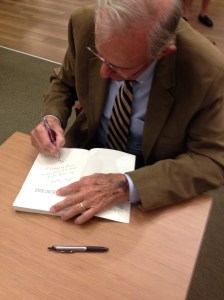
Great leaders are the most memorable, influential, and significant. They go about their day leveraging their distinction by leading in ways that come most naturally to them. This is so true, because I might not even had read the book had there not been a leader in my life that turned me on to reading. Had there not been a Mrs. Wilking in my life I might not have become the leader I have because I would not have had the learning from reading I have been afforded. You can learn of the birth of my love of reading by checking out “Reading Big Red.” Click here to read the post. Significant leaders are those who enjoy sharing their wisdom and secrets of success. Dr. Helveston has certainly done this in his book. Leadership is a process of influencing others. Dr. Helveston is without a doubt influencing others with the framework for developing our children suggested in this book.
The Second Decade: Raising Kids to be Happy, Self-Sufficient Adults through Work (2016) is an incredible book that really makes you think and want to take action. I wrote the following in both my Goodreads and Amazon five start review of the book:
“Everyone who is a parent, teacher, or in a position to influence children either directly or by policy should read this book! In this book, Dr. Helveston recognizes the need for what I will call internships – meaningful work. The five actions developed in this book of:
1. Plan ahead for a quality education pursued with an eye on the future;
2. Learn life lessons and useful skills from the work you perform and the people you meet;
3. Seek advice and inspiration from mentors throughout your life;
4. Recognized that nothing is accomplished without time and effort; and
5. Pursue honest and productive work
are well developed, researched, and referenced so the reading can use the book as a guide. This book can serve as a framework for anyone who believes as I do, that helping parents teach their children to gain academic skills through a quality education and acquire practical skills learned by working is an invaluable component to a lifetime of success. Again, this is the must read book of all who want success for all children.”
 Dr. Helveston posited in the book that there is an important activity that seems to be getting lost amid meaningless structure—holding down a job outside the home, for money. He argued that more than any other activity, work adds meaning to the knowledge learned in books and gives depth to the values instilled at home. I really agree with this and the research would concur. In fact, this is why I believe internships are so important in young people’s lives. This workplace development orientation requires inculcating good character traits within the young person, which will help them to carry out their professional responsibilities throughout the rest of their lives.
The idea of the “inclusive middle class” is one that really jumped out at me in the book. This really drove home why it is important for us to make sure we are carrying out and teaching our children the five actions listed above. Dr. Helveston said:
“But the future offers a two-way street. A position attained is never guaranteed. A person can attain more or accomplish less. Success can be in the form of financial security or with the attainment of other worthwhile goals. In either case, it takes effort to keep and possibly improve one’s place in society.” ~ Dr. Eugene Helveston (2016, p. 25)
Those who understand this will certainly have a leg up in society. We have an obligation to the children of the world to be providing them with the experiences to learn these facts. One way to formalize this would be to ramp up our internship programs both at the post-secondary level and in our high school programs. What better way to give our students the real life experiences necessary to help them be successful, happy, and functional citizens. Dr. Helveston’s book provides a guide and framework for educators, parents, and policymakers to help our children understand what opportunities are available to them and facilitate the journey to become their best selves.
 Byron's Babbles
leave a comment